Basic Learning Styles and PrinciplesMust be fully prepared to reach a diverse group of students with a variety of:Backgrounds
Experiences
Cultures
Personalities
Learning StylesThe Role of the EducatorA educator is a facilitator.
A facilitator is a catalystfor learning.
Catalyst:  an agent that provokes or speeds significant change or action.
As an educator, we want to create circumstances within which learning takes place at a faster  rate.Learning Styles DefinedKEY:  When a student has difficulty learning, it is most likely because they are processing the information outside of their natural learning style.A learning style is a student’s favored, or preferred method of thinking, understanding, and processing information.
75% of all educators today present material in a sequential, analytical manner, whereas as little as 10% of student learn effectively that way.
Must integrate better strategies!ActivityDirectionsRead the following article.http://www.the-signal.com/news/article/15801/Explain how the “GLAD” program helps struggling students overcome their learning challenges.
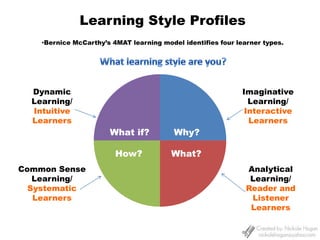
Learning Style ProfilesBernice McCarthy’s 4MAT learning model identifies four learner types.What learning style are you?Dynamic Learning/Intuitive LearnersImaginative Learning/ Interactive LearnersHow?Common Sense Learning/ Systematic LearnersAnalyticalLearning/ Reader and Listener Learners
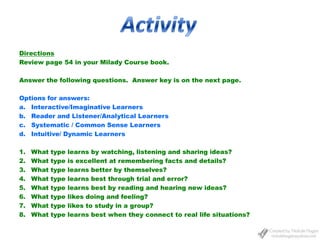
ActivityDirectionsReview page 54 in your Milady Course book.Answer the following questions.  Answer key is on the next page.Options for answers:Interactive/Imaginative LearnersReader and Listener/Analytical LearnersSystematic / Common Sense LearnersIntuitive/ Dynamic LearnersWhat type learns by watching, listening and sharing ideas?What type is excellent at remembering facts and details?What type learns better by themselves?What type learns best through trial and error?What type learns best by reading and hearing new ideas?What type likes doing and feeling?What type likes to study in a group?What type learns best when they connect to real life situations?
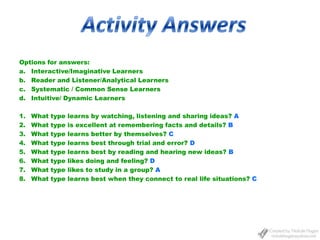
Activity AnswersOptions for answers:Interactive/Imaginative LearnersReader and Listener/Analytical LearnersSystematic / Common Sense LearnersIntuitive/ Dynamic LearnersWhat type learns by watching, listening and sharing ideas? AWhat type is excellent at remembering facts and details? BWhat type learns better by themselves? CWhat type learns best through trial and error? DWhat type learns best by reading and hearing new ideas? BWhat type likes doing and feeling? DWhat type likes to study in a group? AWhat type learns best when they connect to real life situations? C
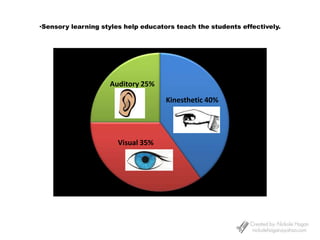
Sensory learning styles help educators teach the students effectively.Auditory 25%Kinesthetic 40%Visual 35%
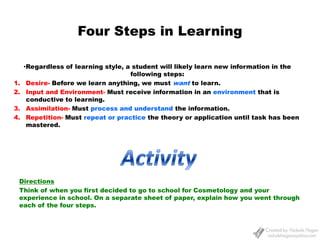
Four Steps in LearningRegardless of learning style, a student will likely learn new information in the following steps:Desire- Before we learn anything, we must want to learn.Input and Environment- Must receive information in an environment that is conductive to learning.Assimilation- Must process and understand the information.Repetition- Must repeat or practice the theory or application until task has been mastered.ActivityDirectionsThink of when you first decided to go to school for Cosmetology and your experience in school. On a separate sheet of paper, explain how you went through each of the four steps.

Chapter 3

  • 1.
    Basic Learning Stylesand PrinciplesMust be fully prepared to reach a diverse group of students with a variety of:Backgrounds
  • 2.
  • 3.
  • 4.
  • 5.
    Learning StylesThe Roleof the EducatorA educator is a facilitator.
  • 6.
    A facilitator isa catalystfor learning.
  • 7.
    Catalyst: anagent that provokes or speeds significant change or action.
  • 8.
    As an educator,we want to create circumstances within which learning takes place at a faster rate.Learning Styles DefinedKEY: When a student has difficulty learning, it is most likely because they are processing the information outside of their natural learning style.A learning style is a student’s favored, or preferred method of thinking, understanding, and processing information.
  • 9.
    75% of alleducators today present material in a sequential, analytical manner, whereas as little as 10% of student learn effectively that way.
  • 10.
    Must integrate betterstrategies!ActivityDirectionsRead the following article.http://www.the-signal.com/news/article/15801/Explain how the “GLAD” program helps struggling students overcome their learning challenges.
  • 11.
    Learning Style ProfilesBerniceMcCarthy’s 4MAT learning model identifies four learner types.What learning style are you?Dynamic Learning/Intuitive LearnersImaginative Learning/ Interactive LearnersHow?Common Sense Learning/ Systematic LearnersAnalyticalLearning/ Reader and Listener Learners
  • 12.
    ActivityDirectionsReview page 54in your Milady Course book.Answer the following questions. Answer key is on the next page.Options for answers:Interactive/Imaginative LearnersReader and Listener/Analytical LearnersSystematic / Common Sense LearnersIntuitive/ Dynamic LearnersWhat type learns by watching, listening and sharing ideas?What type is excellent at remembering facts and details?What type learns better by themselves?What type learns best through trial and error?What type learns best by reading and hearing new ideas?What type likes doing and feeling?What type likes to study in a group?What type learns best when they connect to real life situations?
  • 13.
    Activity AnswersOptions foranswers:Interactive/Imaginative LearnersReader and Listener/Analytical LearnersSystematic / Common Sense LearnersIntuitive/ Dynamic LearnersWhat type learns by watching, listening and sharing ideas? AWhat type is excellent at remembering facts and details? BWhat type learns better by themselves? CWhat type learns best through trial and error? DWhat type learns best by reading and hearing new ideas? BWhat type likes doing and feeling? DWhat type likes to study in a group? AWhat type learns best when they connect to real life situations? C
  • 14.
    Sensory learning styleshelp educators teach the students effectively.Auditory 25%Kinesthetic 40%Visual 35%
  • 15.
    Four Steps inLearningRegardless of learning style, a student will likely learn new information in the following steps:Desire- Before we learn anything, we must want to learn.Input and Environment- Must receive information in an environment that is conductive to learning.Assimilation- Must process and understand the information.Repetition- Must repeat or practice the theory or application until task has been mastered.ActivityDirectionsThink of when you first decided to go to school for Cosmetology and your experience in school. On a separate sheet of paper, explain how you went through each of the four steps.