The Teaching PlanThe educator’s ability to lead and inspire students to a desire for learning is critical.
The educator of the 21st century is known as a facilitator, not a teacher.
Key:  Create a positive learning environment that will provide a pathway to career success.
The more time an educator spends in preparation, the more time available for student learning.Teacher Organization and PreparationClassroom organization includes knowing your subject matter and the most recent developments in the fields you teach.
Must identify materials and equipment necessary for learning.
Setting the appropriate tone for the first day of class is critical to creating a dynamic learning environment.General OrganizationPlan a system that works for you.
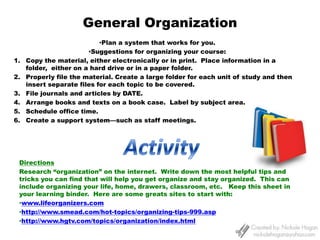
Suggestions for organizing your course:Copy the material, either electronically or in print.  Place information in a folder,  either on a hard drive or in a paper folder.Properly file the material. Create a large folder for each unit of study and then insert separate files for each topic to be covered.File journals and articles by DATE.Arrange books and texts on a book case.  Label by subject area.Schedule office time.Create a support system—such as staff meetings.ActivityDirectionsResearch “organization” on the internet.  Write down the most helpful tips and tricks you can find that will help you get organize and stay organized.  This can include organizing your life, home, drawers, classroom, etc.   Keep this sheet in your learning binder.  Here are some greats sites to start with:www.lifeorganizers.com
http://www.smead.com/hot-topics/organizing-tips-999.asp
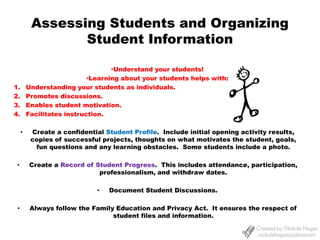
http://www.hgtv.com/topics/organization/index.htmlAssessing Students and Organizing Student InformationUnderstand your students!
Learning about your students helps with:Understanding your students as individuals.Promotes discussions.Enables student motivation.Facilitates instruction.Create a confidential Student Profile. Include initial opening activity results, copies of successful projects, thoughts on what motivates the student, goals, fun questions and any learning obstacles.  Some students include a photo.
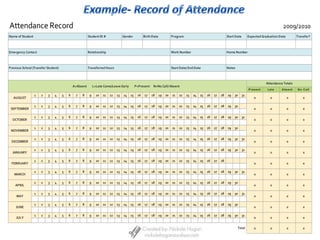
Create a Record of Student Progress.  This includes attendance, participation, professionalism, and withdraw dates.
Document Student Discussions.
Always follow the Family Education and Privacy Act.  It ensures the respect of student files and information.Example- Record of Attendance
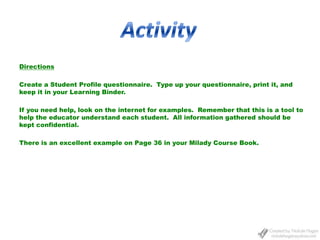
ActivityDirectionsCreate a Student Profile questionnaire.  Type up your questionnaire, print it, and keep it in your Learning Binder.  If you need help, look on the internet for examples.  Remember that this is a tool to help the educator understand each student.  All information gathered should be kept confidential.  There is an excellent example on Page 36 in your Milady Course Book.
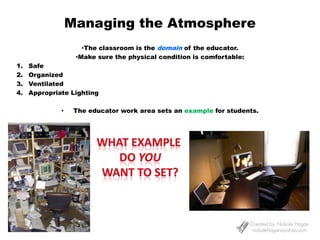
Managing the AtmosphereThe classroom is thedomainof the educator.

Chapter 2

  • 1.
    The Teaching PlanTheeducator’s ability to lead and inspire students to a desire for learning is critical.
  • 2.
    The educator ofthe 21st century is known as a facilitator, not a teacher.
  • 3.
    Key: Createa positive learning environment that will provide a pathway to career success.
  • 4.
    The more timean educator spends in preparation, the more time available for student learning.Teacher Organization and PreparationClassroom organization includes knowing your subject matter and the most recent developments in the fields you teach.
  • 5.
    Must identify materialsand equipment necessary for learning.
  • 6.
    Setting the appropriatetone for the first day of class is critical to creating a dynamic learning environment.General OrganizationPlan a system that works for you.
  • 7.
    Suggestions for organizingyour course:Copy the material, either electronically or in print. Place information in a folder, either on a hard drive or in a paper folder.Properly file the material. Create a large folder for each unit of study and then insert separate files for each topic to be covered.File journals and articles by DATE.Arrange books and texts on a book case. Label by subject area.Schedule office time.Create a support system—such as staff meetings.ActivityDirectionsResearch “organization” on the internet. Write down the most helpful tips and tricks you can find that will help you get organize and stay organized. This can include organizing your life, home, drawers, classroom, etc. Keep this sheet in your learning binder. Here are some greats sites to start with:www.lifeorganizers.com
  • 8.
  • 9.
    http://www.hgtv.com/topics/organization/index.htmlAssessing Students andOrganizing Student InformationUnderstand your students!
  • 10.
    Learning about yourstudents helps with:Understanding your students as individuals.Promotes discussions.Enables student motivation.Facilitates instruction.Create a confidential Student Profile. Include initial opening activity results, copies of successful projects, thoughts on what motivates the student, goals, fun questions and any learning obstacles. Some students include a photo.
  • 11.
    Create a Recordof Student Progress. This includes attendance, participation, professionalism, and withdraw dates.
  • 12.
  • 13.
    Always follow theFamily Education and Privacy Act. It ensures the respect of student files and information.Example- Record of Attendance
  • 14.
    ActivityDirectionsCreate a StudentProfile questionnaire. Type up your questionnaire, print it, and keep it in your Learning Binder. If you need help, look on the internet for examples. Remember that this is a tool to help the educator understand each student. All information gathered should be kept confidential. There is an excellent example on Page 36 in your Milady Course Book.
  • 15.
    Managing the AtmosphereTheclassroom is thedomainof the educator.
  • 16.
    Make sure thephysical condition is comfortable:SafeOrganizedVentilatedAppropriate LightingThe educator work area sets an example for students.What example Do youWant to set?
  • 17.
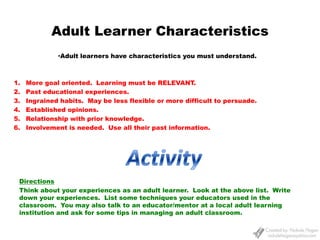
    Adult Learner CharacteristicsAdultlearners have characteristics you must understand.More goal oriented. Learning must be RELEVANT.Past educational experiences. Ingrained habits. May be less flexible or more difficult to persuade.Established opinions. Relationship with prior knowledge. Involvement is needed. Use all their past information.ActivityDirectionsThink about your experiences as an adult learner. Look at the above list. Write down your experiences. List some techniques your educators used in the classroom. You may also talk to an educator/mentor at a local adult learning institution and ask for some tips in managing an adult classroom.
  • 18.
    Student DemographicsStudent demographicswill have a significant impact on how you present information and interact with the class.
  • 19.
  • 20.
    Age- By facilitatinglearning that involves different age groups, you will better prepare graduates for workforce.
  • 21.
    Gender- Male studentstend to keep speaking when interrupted until their point is made. Female students are less likely to reenter class discussion.
  • 22.
    Ethnicity- May influencehow the student perceives and learn information.
  • 23.
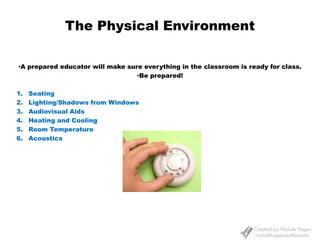
    Unique InterestsThe PhysicalEnvironmentA prepared educator will make sure everything in the classroom is ready for class.
  • 24.
    Be prepared!SeatingLighting/Shadows fromWindowsAudiovisual AidsHeating and CoolingRoom TemperatureAcoustics
  • 25.
    The Motivating ClassroomTheroom should be organized.Allow varied instructional activities to occur simultaneously.Suit the needs of the educator and learners.Store all supplies and equipment.Ensure there are no distractions.Ensure a clear view of learners at all times.Ensure frequently used material are readily accessible.Create excitement for internal motivation. Use updated bulletin boards. They enhance learning and increase retention.Use color to reinforce learning.Pale Yellow/Almond- Best for not irritating.Pale Pink/ Light Rose- Soothing, used in jails.Green- Security, inspires creativity.Blue- Relaxing and tranquil, color of academics, good for general classrooms.Orange- Agitate learners.Bright Yellow- excites brain and body.Natural Colors- Retained at a higher rate vs. Black and White.
  • 26.
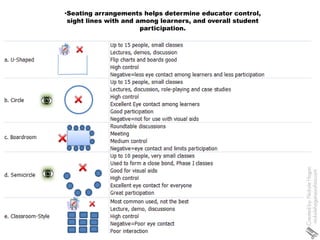
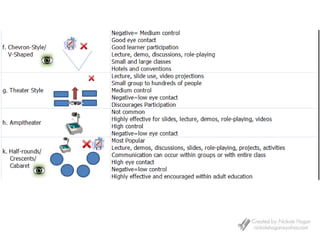
    Seating arrangements helpsdetermine educator control, sight lines with and among learners, and overall student participation.
  • 27.
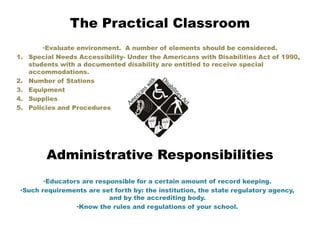
    The Practical ClassroomEvaluateenvironment. A number of elements should be considered.Special Needs Accessibility- Under the Americans with Disabilities Act of 1990, students with a documented disability are entitled to receive special accommodations. Number of StationsEquipmentSuppliesPolicies and ProceduresAdministrative ResponsibilitiesEducators are responsible for a certain amount of record keeping.
  • 28.
    Such requirements areset forth by: the institution, the state regulatory agency, and by the accrediting body.
  • 29.
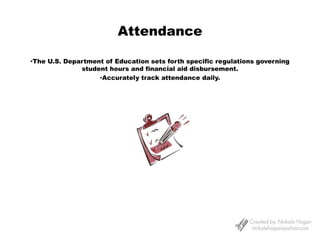
    Know the rulesand regulations of your school.Attendance The U.S. Department of Education sets forth specific regulations governing student hours and financial aid disbursement.
  • 30.