What are Learning Styles?
Information enters your brain three main ways:
sight, hearing and touch, which one you use the
most is called your Learning Style
 Visual Learners learn by sight
 Auditory Learners learn by hearing
 Tactile Learners (kinesthetic) learn by touch
Visual Learners
 Prefer to see information such as pictures,
diagrams, cartoons, demonstrations
 Picture words and concepts they hear as
images
 Easily distracted in lecture with no visual aids
 Overwhelmed with intense visuals
accompanied by lecture
 Benefit from using charts, maps, notes, and
flash cards when studying
Auditory Learners
 Prefer to hear information spoken
 Can absorb a lecture with little effort
 May not need careful notes to learn.
 Often avoid eye contact in order to concentrate
 May read aloud to themselves
 Like background music when they study
Tactile or Kinesthetic Learners
 Prefer touch as their primary mode for taking in
information
 In traditional lecture situations, they should write out
important facts
 Create study sheets connected to vivid examples
 Role-playing can help them learn and
remember important ideas
 May benefit by using manipulatives
Okay, I
get it
now.
Your Intelligence Profile
created by Howard Gardner
 A theory of “multiple intelligences,” suggesting
abilities seem to cluster in eight different areas:
 Verbal-Linguistic Skills
 Logical-Mathematical Skills
 Bodily-Kinesthetic Skills
 Visual-Spatial Skills
 Interpersonal Abilities
 Intrapersonal Abilities
 Musical Abilities
 Naturalistic Abilities
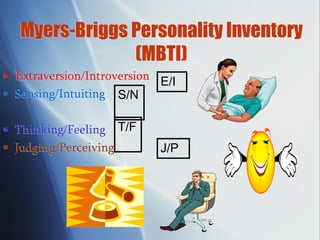
Myers-Briggs Personality Inventory
(MBTI)
 Extraversion/Introversion
 Sensing/Intuiting
 Thinking/Feeling
 Judging/Perceiving
E/I
S/N
T/F
J/P
Extraversion/Introversion
(Social Orientation)
 Extroverts
 Like talking with others and taking action.
 Prefer active learning and group projects.
 Introverts
 Prefer to have others do the talking.
 Prefer lectures and structured tasks.
Sensing/Intuiting
(Information Processing)
 Sensors
 Are most at home with facts and examples.
 Are drawn to realistic and practical applications.
 Prefer memorizable facts, and concrete questions.
 Intuiters
 Prefer concepts and theories which can give
greater play to imagination and inspiration.
 Prefer interpretation and imagination.
Thinking/Feeling
(Decision Making)
 Thinkers
 Like to take an objective approach and
emphasize logic and analysis in their
decisions.
 Prefer objective feedback, and thrive
when there is pressure to succeed.
 Feelers
 Prefer emotion to logic.
 Give greater weight to the impact of
relationships in their decisions.
 Prefer positive feedback and individual
recognition.
Judging/Perceiving
(Achieving Goals)
 Judgers
 Prefer clearly defined strategies to
achieve goals.
 May jump to closure too quickly.
 Prefer orderliness, structure, and
deadlines.
 Perceivers
 Like to consider all sides to a problem
and may be at some risk for not
completing their work.
 Prefer spontaneity and flexibility.
My mind is
made up!
Don’t confuse
me with facts.
Let’s think this through
Surface Learning
 Studying the minimum of what needs to
be learned
 Relying primarily on rote memorization,
often exercised at the last minute
[Cramming]
 Motivation comes from grades
 In a hurry to get it over with.
 Risky – no real learning occurs
 Much less likely to lead to college success
Deep Learning
 Goal is to truly understand course material
 Involves actively constructing learning
experiences
 Leads to better memory retention
 Deep learners enjoy the process of learning
for its own sake
 Deep learners use more thinking skills
Fascinating!
I need to
know more…
Discovering Your
Own Learning Style
 Take a Learning Styles test.
 Think about your favorite classes in high school or college so
far. What do they have in common? Did you like…
 mastering facts?
 discussion? or working on your own?
 lecture? or pairing or grouping?
 hands-on activities?
 Do some self-analysis (called metacognition).
 How do you think you learn?
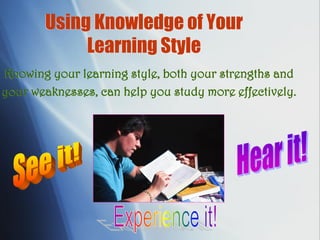
Using Knowledge of Your
Learning Style
Knowing your learning style, both your strengths and
your weaknesses, can help you study more effectively.
Build Strengths across the
Learning Styles
 Make the best use of your learning style.
 Work harder in skills that don’t come easily to
you.
 Be flexible and adaptable, try new things and new
ways.
 Keep growing! Don’t be easily satisfied!
Different Teaching Styles
Are they compatible with your learning
style?
Lecture – teacher talks all period
Group discussion – teacher talks but encourages
discussion
Small groups – teacher aids (facilitates) group
interaction
Visual focus – teacher uses lots of visual aids
Verbal focus – words, words & more words
Logical sequence – teacher presents material in a
step-by-step, reasonable format
Random sequence – teacher jumps all over the place
Build Positive Relationships
with Your Instructors
 Much of college is about interactions with your
professors.
 The success of those interactions will have a major
impact on your overall college success.
 Don’t let your learning style or personality preferences
control your behavior.
 Take responsibility for relating to your instructors in a
way that will be most beneficial to you.
 They will be more responsive if you appear to be
confident and in control.
Solving Problems with Instructors
 Instructors are human (it’s true, honest.) You can talk
to them.
 If you are struggling in a course, talk to classmates and
approach instructor.
 Be courteous and forthright. We all make mistakes:
instructors & students both.
 Keep copies of your work.
 Direct complaints to instructor first.
 If unsuccessful, appeal in writing to instructor’s
supervisor or the school’s “Ombudsperson”
We can
work
this
out…
Making the Most of the Student-
Instructor Relationship
 Make it a point to attend class
regularly, and on time.
 If you have a question, ask it.
 Save your “cuts” for emergencies.
 Sit near the front.
 See your instructor outside class
when you need help.
 Share one or more “one minute
papers” and your ideas with your
instructor.
Remember!
No matter what your Learning Style is it’s
very important to-
 Be involved in class – participate!
 Link classroom experience to the outside world
 Relate class concepts to your own life.
 Ask questions and offer criticism.
 Stimulate further relevant discussion.
 Don’t get distracted – stay “on-task”
 Keep an open mind: there are many ideas beyond
your own.

Learning Styles.pdf

  • 1.
    What are LearningStyles? Information enters your brain three main ways: sight, hearing and touch, which one you use the most is called your Learning Style  Visual Learners learn by sight  Auditory Learners learn by hearing  Tactile Learners (kinesthetic) learn by touch
  • 3.
    Visual Learners  Preferto see information such as pictures, diagrams, cartoons, demonstrations  Picture words and concepts they hear as images  Easily distracted in lecture with no visual aids  Overwhelmed with intense visuals accompanied by lecture  Benefit from using charts, maps, notes, and flash cards when studying
  • 4.
    Auditory Learners  Preferto hear information spoken  Can absorb a lecture with little effort  May not need careful notes to learn.  Often avoid eye contact in order to concentrate  May read aloud to themselves  Like background music when they study
  • 5.
    Tactile or KinestheticLearners  Prefer touch as their primary mode for taking in information  In traditional lecture situations, they should write out important facts  Create study sheets connected to vivid examples  Role-playing can help them learn and remember important ideas  May benefit by using manipulatives Okay, I get it now.
  • 6.
    Your Intelligence Profile createdby Howard Gardner  A theory of “multiple intelligences,” suggesting abilities seem to cluster in eight different areas:  Verbal-Linguistic Skills  Logical-Mathematical Skills  Bodily-Kinesthetic Skills  Visual-Spatial Skills  Interpersonal Abilities  Intrapersonal Abilities  Musical Abilities  Naturalistic Abilities
  • 7.
    Myers-Briggs Personality Inventory (MBTI) Extraversion/Introversion  Sensing/Intuiting  Thinking/Feeling  Judging/Perceiving E/I S/N T/F J/P
  • 8.
    Extraversion/Introversion (Social Orientation)  Extroverts Like talking with others and taking action.  Prefer active learning and group projects.  Introverts  Prefer to have others do the talking.  Prefer lectures and structured tasks.
  • 9.
    Sensing/Intuiting (Information Processing)  Sensors Are most at home with facts and examples.  Are drawn to realistic and practical applications.  Prefer memorizable facts, and concrete questions.  Intuiters  Prefer concepts and theories which can give greater play to imagination and inspiration.  Prefer interpretation and imagination.
  • 10.
    Thinking/Feeling (Decision Making)  Thinkers Like to take an objective approach and emphasize logic and analysis in their decisions.  Prefer objective feedback, and thrive when there is pressure to succeed.  Feelers  Prefer emotion to logic.  Give greater weight to the impact of relationships in their decisions.  Prefer positive feedback and individual recognition.
  • 11.
    Judging/Perceiving (Achieving Goals)  Judgers Prefer clearly defined strategies to achieve goals.  May jump to closure too quickly.  Prefer orderliness, structure, and deadlines.  Perceivers  Like to consider all sides to a problem and may be at some risk for not completing their work.  Prefer spontaneity and flexibility. My mind is made up! Don’t confuse me with facts. Let’s think this through
  • 12.
    Surface Learning  Studyingthe minimum of what needs to be learned  Relying primarily on rote memorization, often exercised at the last minute [Cramming]  Motivation comes from grades  In a hurry to get it over with.  Risky – no real learning occurs  Much less likely to lead to college success
  • 13.
    Deep Learning  Goalis to truly understand course material  Involves actively constructing learning experiences  Leads to better memory retention  Deep learners enjoy the process of learning for its own sake  Deep learners use more thinking skills Fascinating! I need to know more…
  • 14.
    Discovering Your Own LearningStyle  Take a Learning Styles test.  Think about your favorite classes in high school or college so far. What do they have in common? Did you like…  mastering facts?  discussion? or working on your own?  lecture? or pairing or grouping?  hands-on activities?  Do some self-analysis (called metacognition).  How do you think you learn?
  • 15.
    Using Knowledge ofYour Learning Style Knowing your learning style, both your strengths and your weaknesses, can help you study more effectively.
  • 16.
    Build Strengths acrossthe Learning Styles  Make the best use of your learning style.  Work harder in skills that don’t come easily to you.  Be flexible and adaptable, try new things and new ways.  Keep growing! Don’t be easily satisfied!
  • 17.
    Different Teaching Styles Arethey compatible with your learning style? Lecture – teacher talks all period Group discussion – teacher talks but encourages discussion Small groups – teacher aids (facilitates) group interaction Visual focus – teacher uses lots of visual aids Verbal focus – words, words & more words Logical sequence – teacher presents material in a step-by-step, reasonable format Random sequence – teacher jumps all over the place
  • 18.
    Build Positive Relationships withYour Instructors  Much of college is about interactions with your professors.  The success of those interactions will have a major impact on your overall college success.  Don’t let your learning style or personality preferences control your behavior.  Take responsibility for relating to your instructors in a way that will be most beneficial to you.  They will be more responsive if you appear to be confident and in control.
  • 19.
    Solving Problems withInstructors  Instructors are human (it’s true, honest.) You can talk to them.  If you are struggling in a course, talk to classmates and approach instructor.  Be courteous and forthright. We all make mistakes: instructors & students both.  Keep copies of your work.  Direct complaints to instructor first.  If unsuccessful, appeal in writing to instructor’s supervisor or the school’s “Ombudsperson” We can work this out…
  • 20.
    Making the Mostof the Student- Instructor Relationship  Make it a point to attend class regularly, and on time.  If you have a question, ask it.  Save your “cuts” for emergencies.  Sit near the front.  See your instructor outside class when you need help.  Share one or more “one minute papers” and your ideas with your instructor.
  • 21.
    Remember! No matter whatyour Learning Style is it’s very important to-  Be involved in class – participate!  Link classroom experience to the outside world  Relate class concepts to your own life.  Ask questions and offer criticism.  Stimulate further relevant discussion.  Don’t get distracted – stay “on-task”  Keep an open mind: there are many ideas beyond your own.