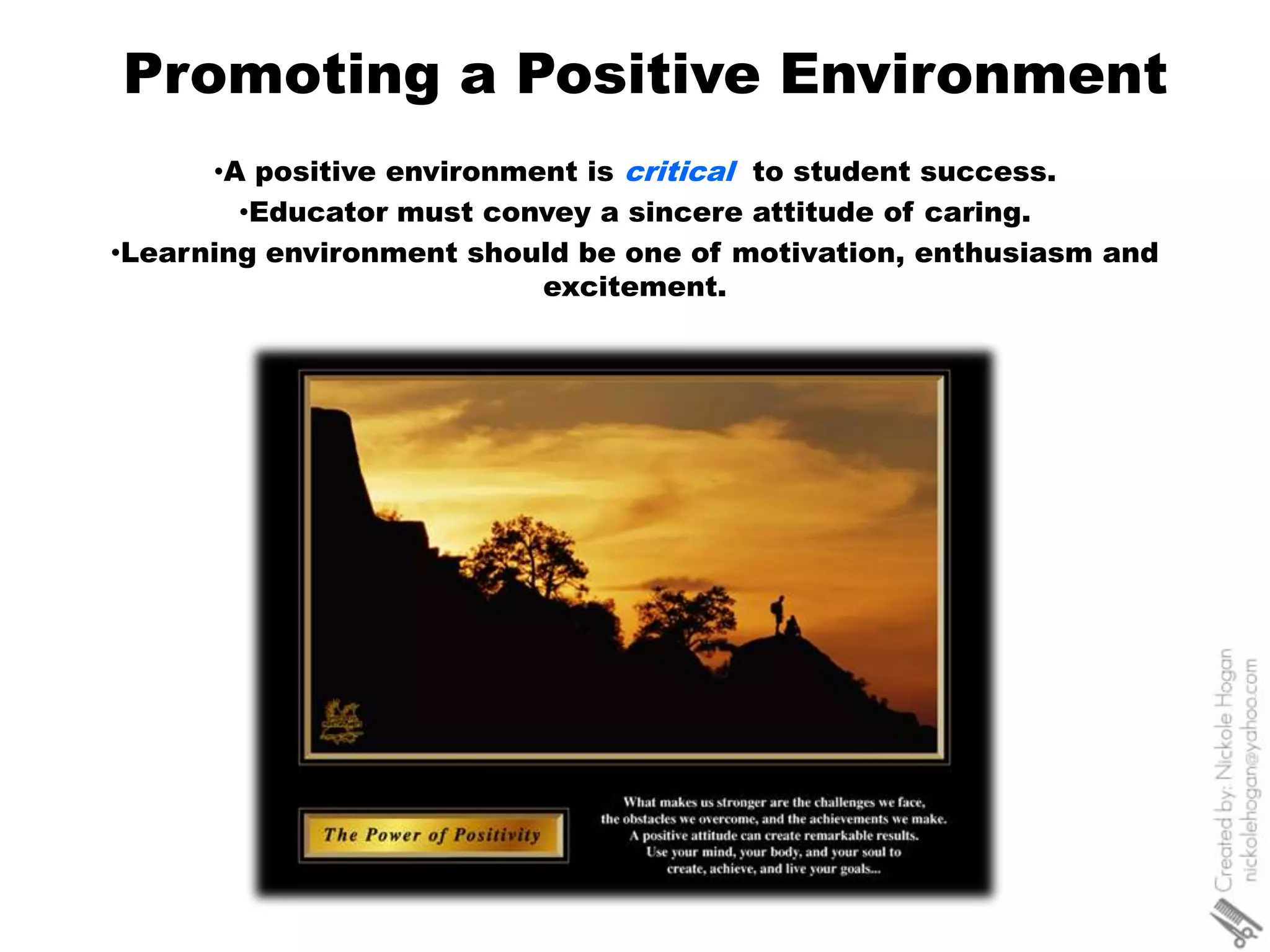
Promoting a Positive EnvironmentA positive environment is criticalto student success.
Educator must convey a sincere attitude of caring.
Learning environment should be one of motivation, enthusiasm and excitement.Professionalism in the ClassroomKey:  The educator’s image, attitude, and actions are often mirrored by learner’s behavior.
It is vital that the educator project the best possible professional image at all times.
By establishing credibility and authority, the educator will be more effective in maintaining order, respect and control in the classroom.Principles of Managing Learner BehaviorEducators will respect adult learners and establish the guidelines that will be followed in the classroom.
By setting well-defined goals, guidelines, and expectations early on, future conflicts may be avoided.
Educator may use the transfer technique which involves the learners in the process of establishing the guidelines for professionalism in the classroom.  They will be more likely to commit.
Guidelines should be set forth in a document outlining what is expected of them, both in behavior and performance.
Educators should focus on positive means for enforcement.
Hostility, ridicule, sarcasm and negativity are counterproductive to the objectives of the institution.The following techniques are consistent with maintenance of good disciplineLow-Profile Intervention- This method uses the least amount of force necessary to deter or control a misbehavior.  Minimal force is associated with minimal time and effort.  Some low-profile techniques can be employed to avoid disruption.Ignore It:  Often learner’s misbehavior is for no other purpose than attracting attention.
Name Dropping: This may work when a student is talking to another student.
Close Proximity:  Physically move toward the learner who is in violation.
Eye Contact: It must convey to the learner that failure to remedy the misbehavior will result in negative consequences.
Verbal Desists:  Use of a verbal cue may stop behavior.  Do not use hostility or sarcasm.Uniformity and Consistency- Consistency is defined as behaving the same way on repeated occasions when the circumstances are the same or similar.  Uniformity deals with consistency among different learners.  Educator must fairly and uniformly apply and implement policies and procedures.3. 	High-Profile Intervention- This requires force and may require more time and effort.  It may be necessary for chronic misconduct.  Keep in mind the seriousness, the timing, the behavioral history, the attitude of learner and personality.
Managing Chronic MisconductThe primary purpose of employing the control procedures previously discussed is to achieve immediate cessation of misbehavior by learners.
The secondary purpose is to permanently eliminate misconduct.

Chapter 4

  • 1.
    Promoting a PositiveEnvironmentA positive environment is criticalto student success.
  • 2.
    Educator must conveya sincere attitude of caring.
  • 3.
    Learning environment shouldbe one of motivation, enthusiasm and excitement.Professionalism in the ClassroomKey: The educator’s image, attitude, and actions are often mirrored by learner’s behavior.
  • 4.
    It is vitalthat the educator project the best possible professional image at all times.
  • 5.
    By establishing credibilityand authority, the educator will be more effective in maintaining order, respect and control in the classroom.Principles of Managing Learner BehaviorEducators will respect adult learners and establish the guidelines that will be followed in the classroom.
  • 6.
    By setting well-definedgoals, guidelines, and expectations early on, future conflicts may be avoided.
  • 7.
    Educator may usethe transfer technique which involves the learners in the process of establishing the guidelines for professionalism in the classroom. They will be more likely to commit.
  • 8.
    Guidelines should beset forth in a document outlining what is expected of them, both in behavior and performance.
  • 9.
    Educators should focuson positive means for enforcement.
  • 10.
    Hostility, ridicule, sarcasmand negativity are counterproductive to the objectives of the institution.The following techniques are consistent with maintenance of good disciplineLow-Profile Intervention- This method uses the least amount of force necessary to deter or control a misbehavior. Minimal force is associated with minimal time and effort. Some low-profile techniques can be employed to avoid disruption.Ignore It: Often learner’s misbehavior is for no other purpose than attracting attention.
  • 11.
    Name Dropping: Thismay work when a student is talking to another student.
  • 12.
    Close Proximity: Physically move toward the learner who is in violation.
  • 13.
    Eye Contact: Itmust convey to the learner that failure to remedy the misbehavior will result in negative consequences.
  • 14.
    Verbal Desists: Use of a verbal cue may stop behavior. Do not use hostility or sarcasm.Uniformity and Consistency- Consistency is defined as behaving the same way on repeated occasions when the circumstances are the same or similar. Uniformity deals with consistency among different learners. Educator must fairly and uniformly apply and implement policies and procedures.3. High-Profile Intervention- This requires force and may require more time and effort. It may be necessary for chronic misconduct. Keep in mind the seriousness, the timing, the behavioral history, the attitude of learner and personality.
  • 15.
    Managing Chronic MisconductTheprimary purpose of employing the control procedures previously discussed is to achieve immediate cessation of misbehavior by learners.
  • 16.
    The secondary purposeis to permanently eliminate misconduct.
  • 17.
    Some students mayrequire high-profile intervention.Reprimands- This can be applied publically or privately. They should be brief and to the point. Clarification and caring must precede confrontation if a resolution is expected.Change the Consequences- It the determined consequences are not effect, it may be necessary to exact a higher cost for those students.Agreements or Contracts- A written contract will add meaning to the agreement made between the educator and learner. A signed agreement carries a greater commitment by learner.Conferences- A private conference between the educator and the learner gives both parties the opportunity to discuss the problems and potential solutions. The environment should be non-threatening. Focus on the violations, not the character of the learner. Ask sufficient questions to find out the view of the learner.
  • 18.
    ActivityDirectionsCreate an Educator-LearnerAgreement. Refer to page 79 in your course book for an example. Type the agreement, print it and place it in your learning binder. Place it in a page protector.
  • 19.
    Academic AdvisementMany stateregulatory agencies and accrediting bodies require that the students have access to academic advisement.
  • 20.
    In addition, studentswhose academic or attendance progress is unsatisfactory must be counseled and provided with needed assistance.
  • 21.
    Educators may becalled upon to provide information and advice to learners on subjects such as employment, licensing, regulations, and state laws.
  • 22.
    Educators must beprepared to provide references to those agencies that are qualified to counsel students.
  • 23.
    Educators should scheduleregular sessions with every student to discuss their academic progress.
  • 24.
    Keep in mindthat all human have a need for approval, recognition and appreciation.Managing Difficult Learner BehaviorThere are several barriers that can prevent learning.Learning Barrier- Anyone or anything that prevents the student from achieving their learning objectives.Situational Barrier- Temporary difficult behavior.Chronic Behavior- Behaves in a difficult manner consistently and effects others in a bad way.The educator’s role is to get the learner back on track without ridicule or embarrassment.
  • 25.
    Effective communication iscritical in dealing with barriers.Constant Attention Seeking and InterruptionsSeveral strategies may be used to deal with negative behavior.Pairs for projects- requires learner to work with another and acknowledge partners contribution.Involve the group- call on all learners in the classroom.Play for prizes- using incentives encourages all learners to participate.Help is on the way- solicit the help of these learners with special projects.Bottom of the barrel- assign the least interesting projects to that learner. It will convey that you do not reward undesirable behavior.
  • 26.
    Chronic TardinessTardiness disruptsthe flow of information for all learners.
  • 27.
    There are severalsolutions for tardiness.Thank you!- Give positive reinforcement and make sure students are tuned into MMFI-AM “Make me feel important about myself.”Timely Beginnings- Start class on time. Starting late rewards the poor performers.What Did I Miss?- Start with a dynamic activity that they will not be able to participate in if they are late.Break the Break Schedule- Consider a 5-10 minute break every 45-50 minutes. This helps retain interest and focus. Time Will Tell- Have all students synchronize their watches or wireless device to the classroom clock. Everybody will agree that the time is the same for everyone.No Interruptions, Please- Depending on policy, latecomers may not even be allowed into class.
  • 28.
    Too Shy toParticipateYou will recognize these students by their lack of energy and passive attitude.
  • 29.
    The challenge isthat they are entering a field which requires outgoing, expressive behaviors.
  • 30.
    There are strategiesthat may help the student.Keep Groups Small- They will be more likely to participate.Volunteer- Make sure that the first volunteers you select are asked to do something completely painless and fun.Match with a Mentor- Make an effort to match a shy learner with one who is outgoing.
  • 31.
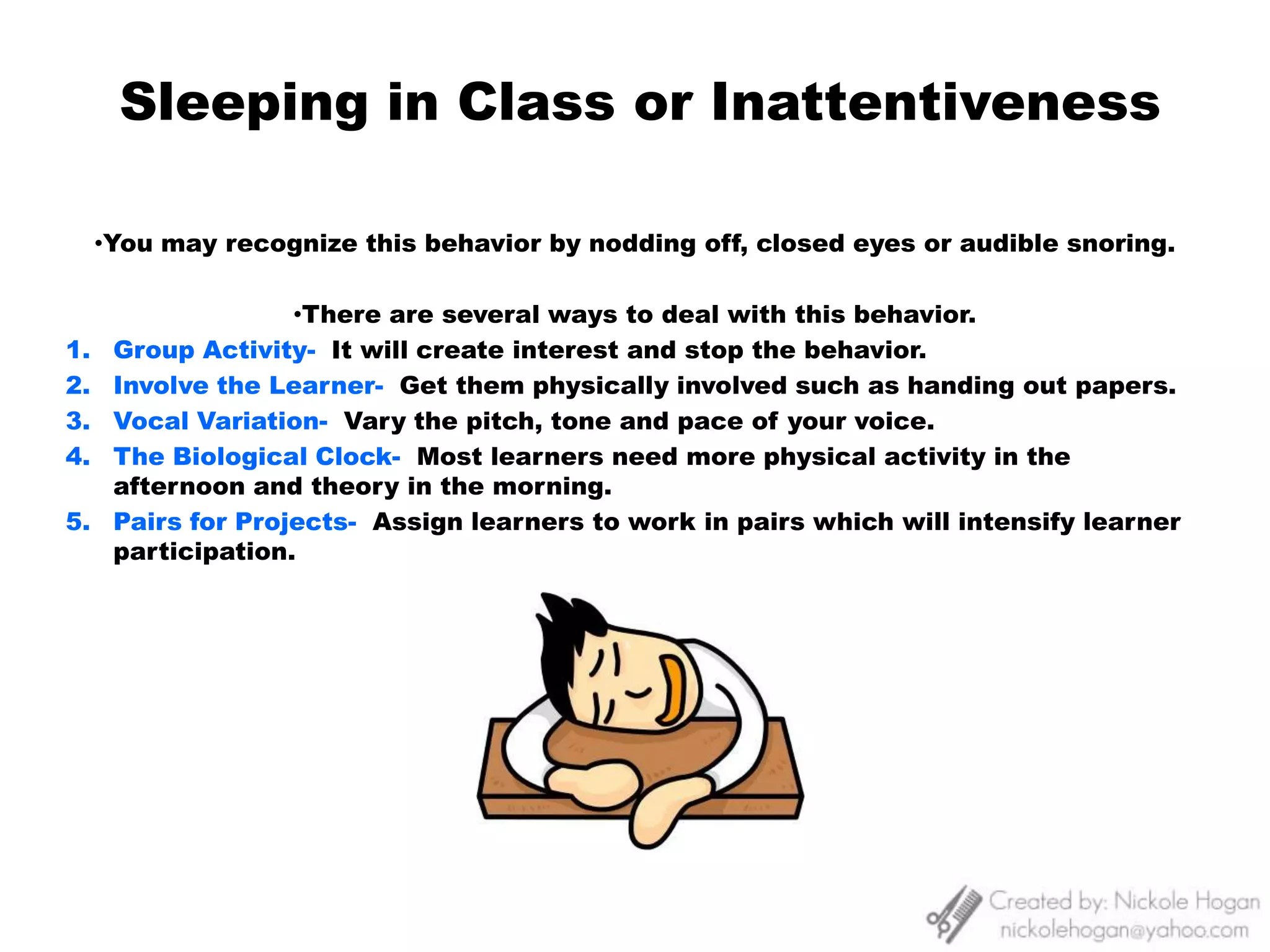
    Sleeping in Classor InattentivenessYou may recognize this behavior by nodding off, closed eyes or audible snoring.
  • 32.
    There are severalways to deal with this behavior.Group Activity- It will create interest and stop the behavior.Involve the Learner- Get them physically involved such as handing out papers.Vocal Variation- Vary the pitch, tone and pace of your voice.The Biological Clock- Most learners need more physical activity in the afternoon and theory in the morning. Pairs for Projects- Assign learners to work in pairs which will intensify learner participation.
  • 33.
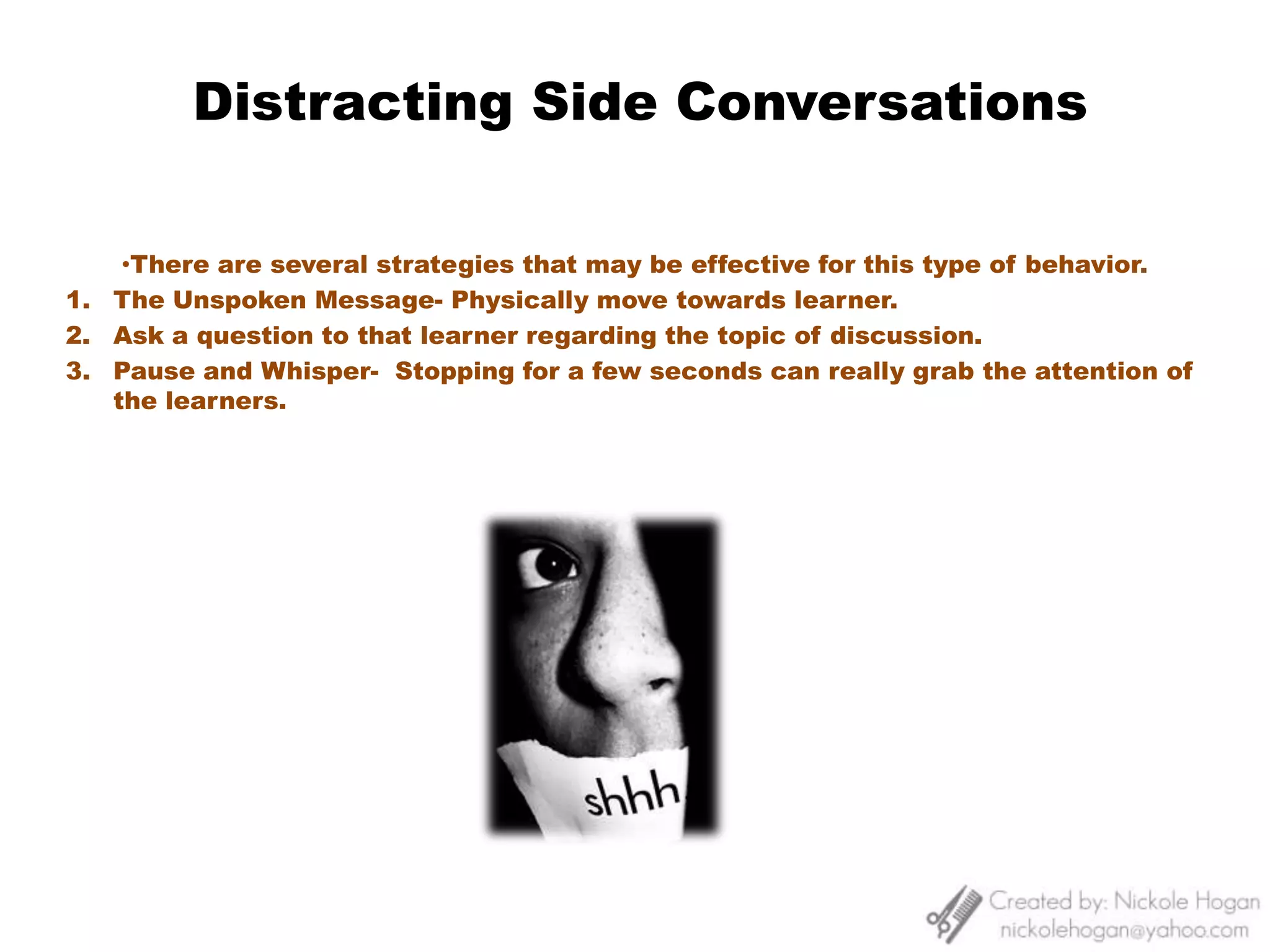
    Distracting Side ConversationsThereare several strategies that may be effective for this type of behavior.The Unspoken Message- Physically move towards learner.Ask a question to that learner regarding the topic of discussion.Pause and Whisper- Stopping for a few seconds can really grab the attention of the learners.
  • 34.
    Doubt and PessimismYouwill be able to recognize these learners by their body language and constant argument.
  • 35.
    You may becaught off guard with their challenges.
  • 36.
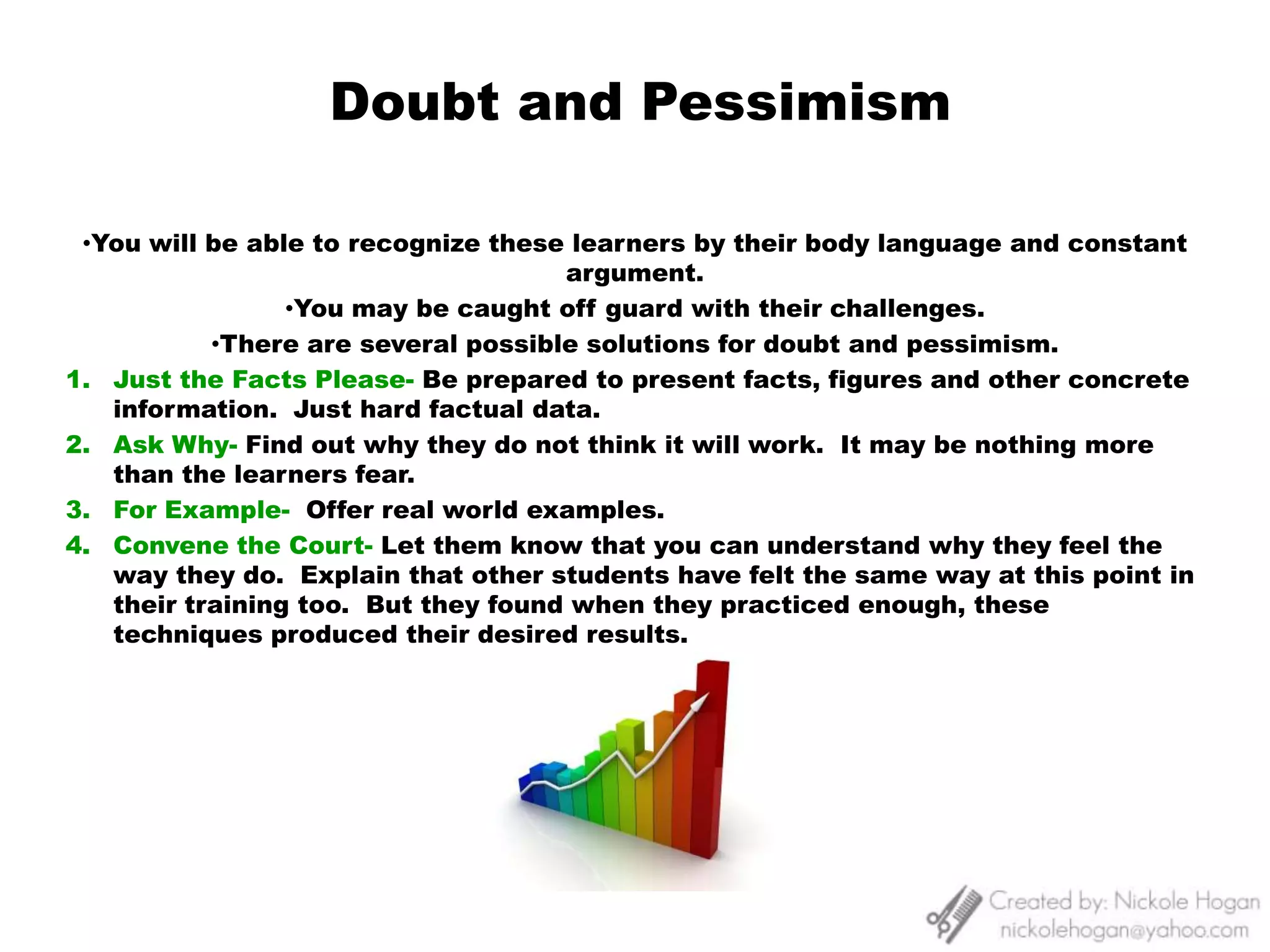
    There are severalpossible solutions for doubt and pessimism.Just the Facts Please- Be prepared to present facts, figures and other concrete information. Just hard factual data.Ask Why- Find out why they do not think it will work. It may be nothing more than the learners fear.For Example- Offer real world examples.Convene the Court- Let them know that you can understand why they feel the way they do. Explain that other students have felt the same way at this point in their training too. But they found when they practiced enough, these techniques produced their desired results.
  • 37.
    Having All theAnswersThese learners have a comment for every single issue. Their participation can interrupt others learning.
  • 38.
    Some strategies proveeffective.What Do You Really Know? Incorporate pretesting to identify students who may know more vs. one’s that just think they do.Help is on the Way- Solicit their help for special projects.Question? Meet with this student on break and ask if they would be willing to take questions on the subject from the entire group. If they are confident, they will be more than willing. If not, they will deny the opportunity and minimize their “know it all” attitude.
  • 39.
    ActivityDirectionsCreate a listof student situations that may be difficult for you to address. Explain why they are difficult for you. List potential intervention that might be appropriate for each situation. Refer back to the chapter for help.