What is the role of an educator?Coach
Motivator
Mentor
Friend
Disciplinarian
Peace-Maker
Negotiator
Arbitrator
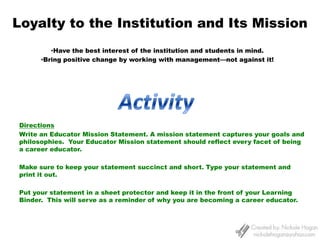
EntertainerQualities of a Career EducatorLoyalty to the Institution and It’s Mission
Welcome Advice from Colleagues
Constant Pursuit of Knowledge
Effective Time Management and Organized Work Methods
Authority, Order, and Self-Confidence
Professional Ethics, Character, and Human Relations
Dependability and Flexibility
Cooperation and Teamwork
Interest in Other People
Initiative and Ability to Work Independently

Chapter 1

  • 1.
    What is therole of an educator?Coach
  • 2.
  • 3.
  • 4.
  • 5.
  • 6.
  • 7.
  • 8.
  • 9.
    EntertainerQualities of aCareer EducatorLoyalty to the Institution and It’s Mission
  • 10.
  • 11.
  • 12.
    Effective Time Managementand Organized Work Methods
  • 13.
    Authority, Order, andSelf-Confidence
  • 14.
  • 15.
  • 16.
  • 17.
  • 18.
    Initiative and Abilityto Work Independently
  • 19.
  • 20.
  • 21.
  • 22.
  • 23.
  • 24.
  • 25.
    Effective Communications andGenerational Skills
  • 26.
    Winning Personality andPositive AttitudeManagers and director’s lookFor these qualities in the educators They hire!
  • 27.
    Loyalty to theInstitution and Its MissionHave the best interest of the institution and students in mind.
  • 28.
    Bring positive changeby working with management—not against it!ActivityDirectionsWrite an Educator Mission Statement. A mission statement captures your goals and philosophies. Your Educator Mission statement should reflect every facet of being a career educator. Make sure to keep your statement succinct and short. Type your statement and print it out. Put your statement in a sheet protector and keep it in the front of your Learning Binder. This will serve as a reminder of why you are becoming a career educator.
  • 29.
    Welcome Advice fromColleaguesBe receptive to competent counsel and be guided.
  • 30.
    You will benefitfrom other educators success.
  • 31.
    You will gainextensive knowledge!ActivityDirectionsStart making a list of questions that you can ask your future colleagues. Throughout your study of the educator program, you can add to this list. If you would you like to take it one step further, find a mentor at a local cosmetology school. Welcome their advice and knowledge. Start asking your questions now!
  • 32.
    Constant Pursuit ofKnowledgeMust be EXPERT in your field.
  • 33.
    Learning is thebasis for all thinking!
  • 34.
    Educator should obtainat least 40 contact hours per year.ActivityDirectionsStart your pursuit of knowledge now! There are multiple trade publications available to you. There are some publications that are completely free! Here are some professional favorites. (Not all listed are free.) Sign up for your favorite magazines and sites.www.americansalonmag.com Click on “Subscribe /Renew to Magazine” Follow the instructions. For most individuals, they offer a FREE monthly magazine.www.americanspamag.com Click on “Subscribe/Renew” then “to Magazine.” Follow the instructions. This is also a FREE monthly magazine to most professionals.www.behindthechair.com Sign up for this massive website of tips, tricks and techniques for professionals. Also don’t forget to click on the “Freebies” tab.www.pravana.com Sign up as a professional and you will be able to get certified for FREE with the Pravana color line.
  • 35.
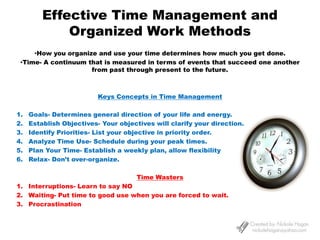
    Effective Time Managementand Organized Work MethodsHow you organize and use your time determines how much you get done.
  • 36.
    Time- A continuumthat is measured in terms of events that succeed one another from past through present to the future.Keys Concepts in Time ManagementGoals- Determines general direction of your life and energy.Establish Objectives- Your objectives will clarify your direction.Identify Priorities- List your objective in priority order.Analyze Time Use- Schedule during your peak times.Plan Your Time- Establish a weekly plan, allow flexibilityRelax- Don’t over-organize. Time WastersInterruptions- Learn to say NOWaiting- Put time to good use when you are forced to wait.Procrastination
  • 37.
    Authority, Order, andSelf-ConfidenceAuthority- an individual cited or appealed to as an expert, the power to influence or command thought, opinion or behavior.
  • 38.
    For an educatorto achieve recognition as an authority he must have self-esteem and self-confidence.
  • 39.
    Self-Esteem- the deep-downfeeling you have in your own soul about your own value or self-worth.
  • 40.
    Self-Confidence- Confidence inoneself and in one’s own power’s and abilities.Key Point: If authority is used fairly and consistently, it will gain the respect and loyalty of the learners.Once authority is established, there will be effortless order in class.
  • 41.
    Must be asubject matter expert in every subject you teach.ActivityDirectionsIt is imperative to have unshakeable confidence as an educator. Think about a person you know who has high self-confidence and self-esteem. On a separate piece of paper, write down the traits and behavior of this person. Write down what they specifically do that projects a healthy self-confidence and self-esteem.
  • 42.
    Professional Ethics, Character,and Human RelationsEducators who are of high moral excellence are in high demand.
  • 43.
    Educators must modeland teach those standards.ActivityDirectionsIt is essential that a master educator knows what they stand for! Create a list of your morals and values. Type up this list, put it in a sheet protector and keep it in the front of your Learning Binder.
  • 44.
    Dependability and FlexibilityThisis all it takes to be in the top 20% of your profession: show up, be on time, be ready to work. That makes you dependable!
  • 45.
    Must be readyto adapt to new, different or changing requirements.
  • 46.
    Must be flexibleand move into a learner-centered educational environment.ActivityDirectionsThink about the last job you worked at or think of a position of responsibility you held. Answer these questions.How many days did you miss when you were in that position?How many times were you late in that position?How many days did you “slack” and not really get much work done?How many times did you say “it is not my job” ?How many times did you call in sick and you were not sick?Now review your answers. This should indicate if you were in the top 20%. Now you can take the information and set goals on how you can be in the top 20% as a career educator.
  • 47.
    Cooperation and TeamworkPutother people’s interests higher than your own.
  • 48.
    Successful cooperation isa two-way street.ActivityDirectionsRead the following quote and write your thoughts about how cooperation and teamwork has changed the world.“Never doubt that a small group of thoughtful, committed people can change the world. Indeed, it is the only thing that ever has.” –Eleanor Roosevelt
  • 49.
    Interest in OtherPeopleWhen you begin to actively cultivate an interest in other people, the eternal law of Cause and Effect will begin to work.
  • 50.
    If you exhibitgenuine interest in your colleagues, they will be happy to help you when you need it.
  • 51.
    Goodwill practices withencourage teamwork and cooperation.ActivityDirectionsSearch online and research about the Law of Cause and Effect. It will help you gain a better understanding of how it effects the world and ultimately your teaching. One of my favorite books/video about the Law of Cause and Effect is “The Secret”. Go to http://www.thesecret.tv/ to learn more.
  • 52.
    Initiative and Abilityto Work IndependentlyLearn to work independently and with little close supervision.
  • 53.
    Be a self-starterLearnto take Independent Action:Study your position description.Read and study the school’s operating procedures.Read and study rules established by oversight agencies.Be willing to take risks.Follow the steps for building self-confidence.
  • 54.
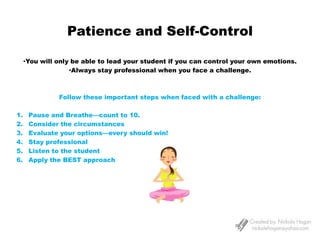
    Patience and Self-ControlYouwill only be able to lead your student if you can control your own emotions.
  • 55.
    Always stay professionalwhen you face a challenge.Follow these important steps when faced with a challenge:Pause and Breathe—count to 10.Consider the circumstances Evaluate your options—every should win!Stay professionalListen to the studentApply the BEST approach
  • 56.
  • 57.
    “Look” the part”Courtesy,Compassion, and ConsistencyBy being courteous you can command the same from your students.
  • 58.
  • 59.
    Your compassion willhelp ensure that rules and standards are applied equally and fairly.ActivityDIRECTIONSWrite down a time when you have shown compassion when no one else in that situation seemed to care. This same compassion will help you understand your students and gain their respect.
  • 60.
    Desire and MotivationDesireis the great equalizer.
  • 61.
    Key: strongpersonal desire and self-motivation are a must!
  • 62.
    Desire is thefoundation for all self-motivation.
  • 63.
  • 64.
    Motivation is likea motor to a car.
  • 65.
    You will becomemore motivated if you surround yourself with high achievers.ActivityDIRECTIONSThere are a lot of things you can do to help stay positively self-motivated such as: doing think you enjoy, improve physical fitness, and identify major life goals or desires. Make a list of what motivates you. Remember that each individual is different.
  • 66.
    Enthusiasm and EnergyEnthous-from Greek work inspired.
  • 67.
    Motivational experts concurthat enthusiasm can be developed.Imagination and PleasureEducators who are in great demand in the workforce are resourceful; they have creative ability and active minds.
  • 68.
    A creative imaginationwill help facilitate the presentation of various course topics.
  • 69.
    Stress and anxietyobstruct the learning processEffective Communications and Generational SkillsEducators must be able to master the art of communication, not only with coworkers but also with their students.
  • 70.
    These students willvary greatly in age, background, culture, beliefs, and attitudes. ActivityDIRECTIONSResearch on the internet and find ways you can learn to communicate better with different types of individuals. Write down any notes you feel are important. Practice these communication skills starting today!
  • 71.
    Winning Personality andPositive AttitudeEducators must develop a personality that fosters learning and genuine human relationships.
  • 72.
    There are stepsyou can take to develop a pleasant, enjoyable and amiable personality.Maintain an open mind.Must have a passion for the industry.Make the best of what you have.Do not hold grudges.Do not live in fear.Focus on the future, not the past.Do not be critical.Do not insist on having the last word.Key: It is never necessary to apologize for things you haven’t said or done!
  • 73.
    Successful people chooseto work towards achieving goals.