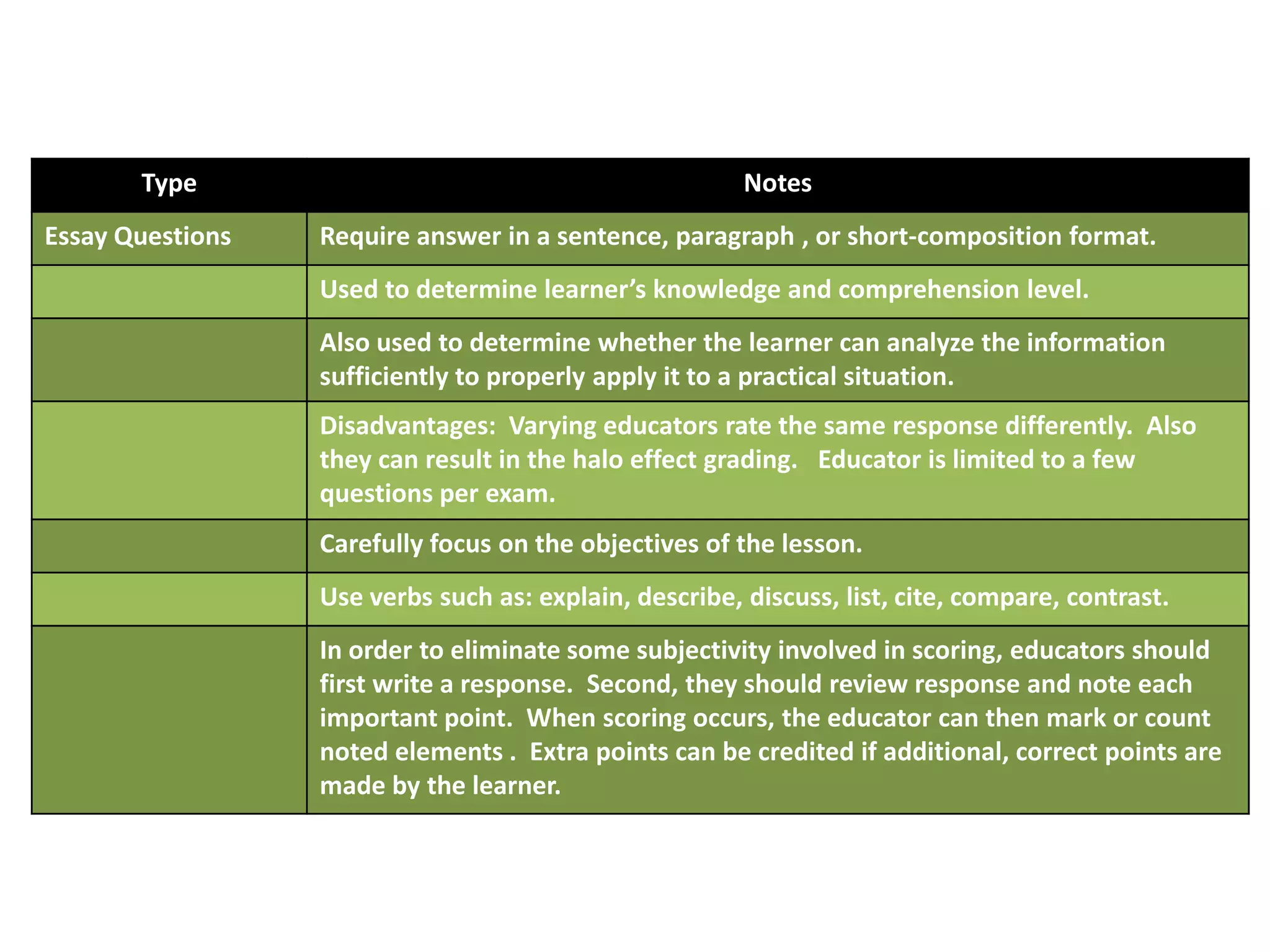
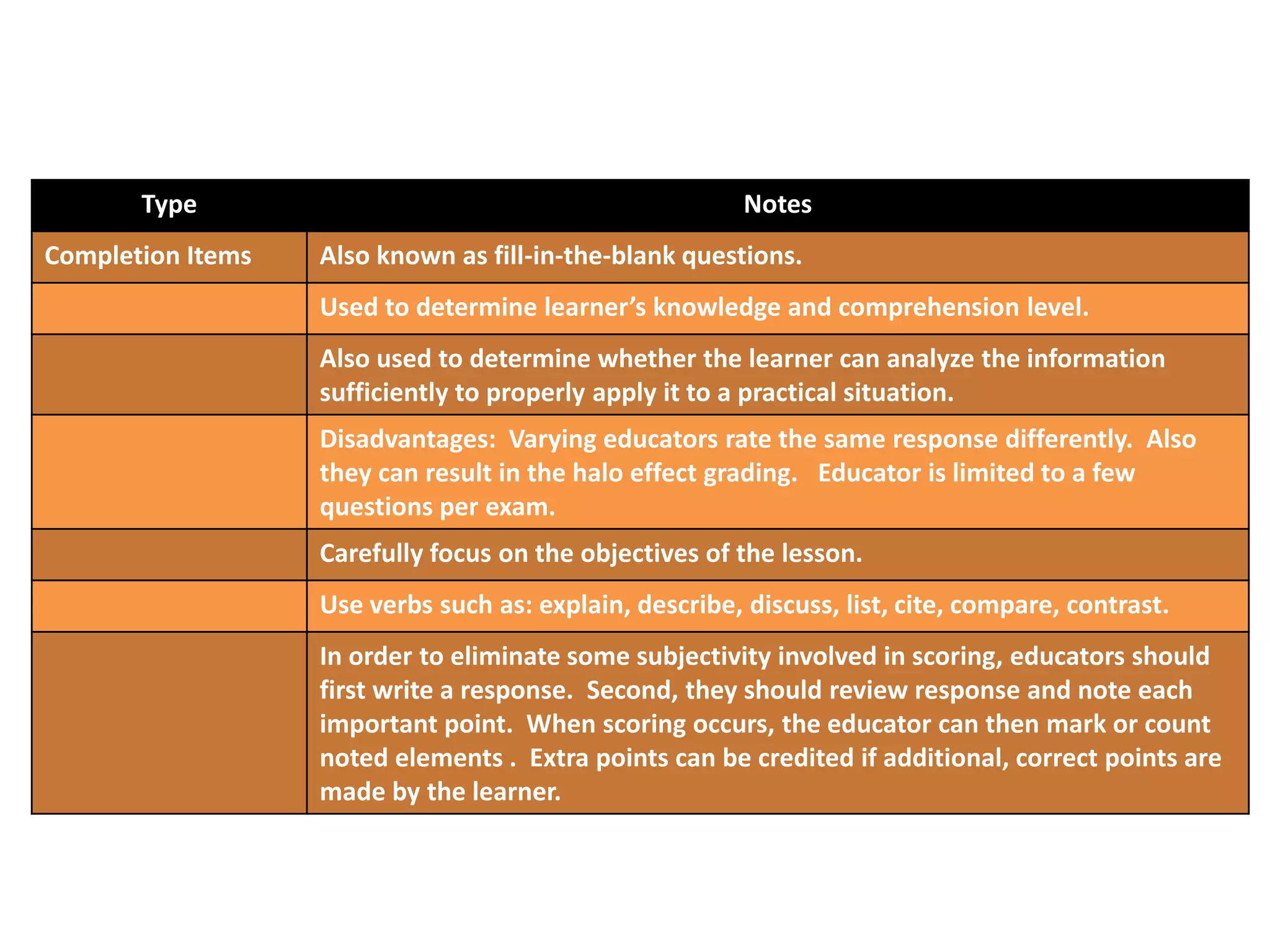
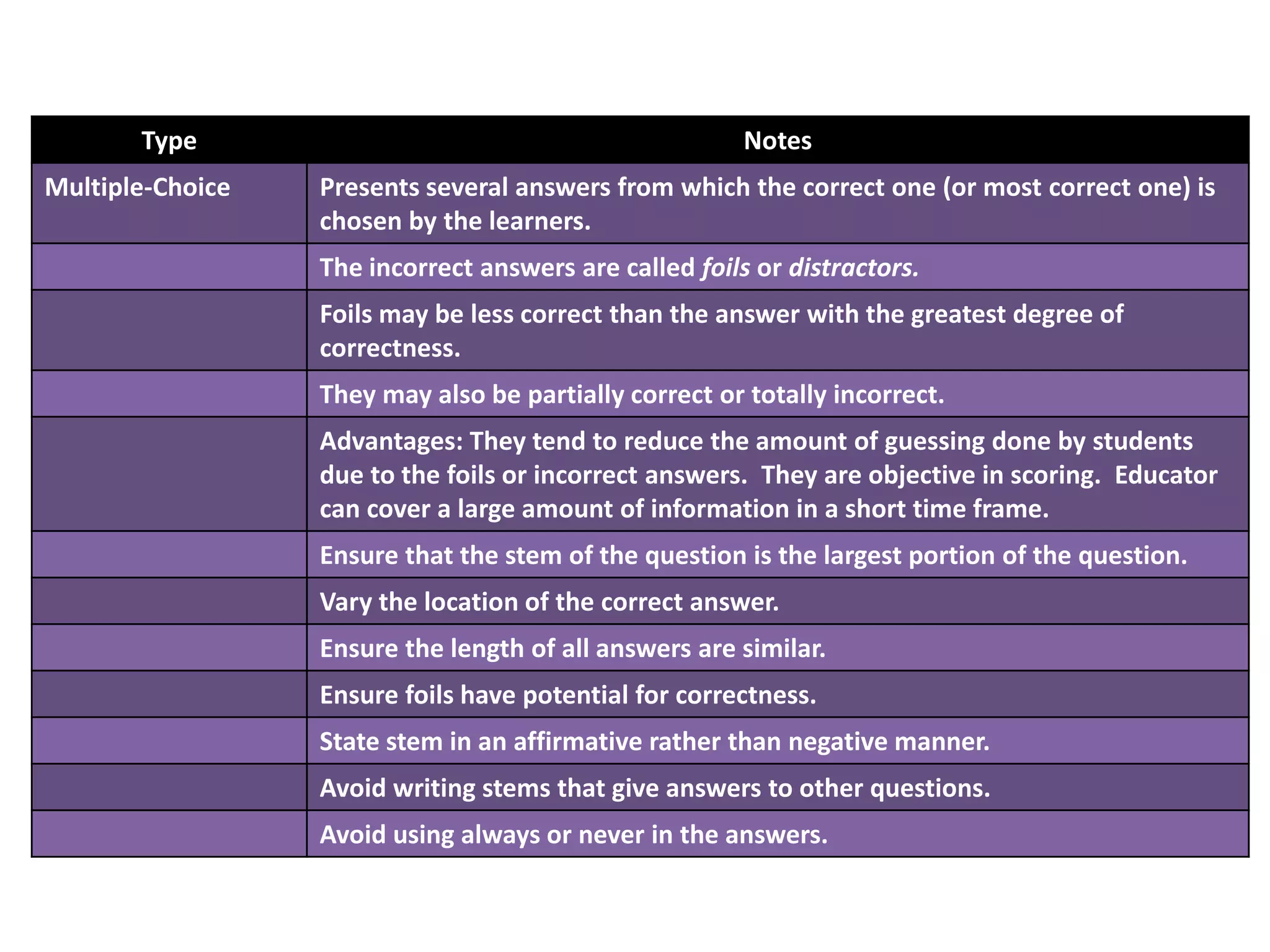


What’s in a Grade?It is essential that an educator become proficient in measuring the knowledge acquired by the learners.
Grade: to assign a letter or number that shows how well one has done.
The purpose of grading:To evaluate learner achievement.To build confidence.Identify educational progress.Measure the knowledge, skills, and attitude of learners.By establishing predetermined criteria to measure performance, all students will receive equitable evaluation.
Accrediting bodies set standards that require institutions to follow established grading procedures in a fair and equitable manner.
Master educators will use grading to challenge learners and assess their progress.What to GradeKEY:  Grading must correlate with educational objectives that determine what the student is expected to know, feel, or be able to explain or do.
Only when objectives are established and evaluated can the educator determine whether or not an outcome in behavior has occurred.
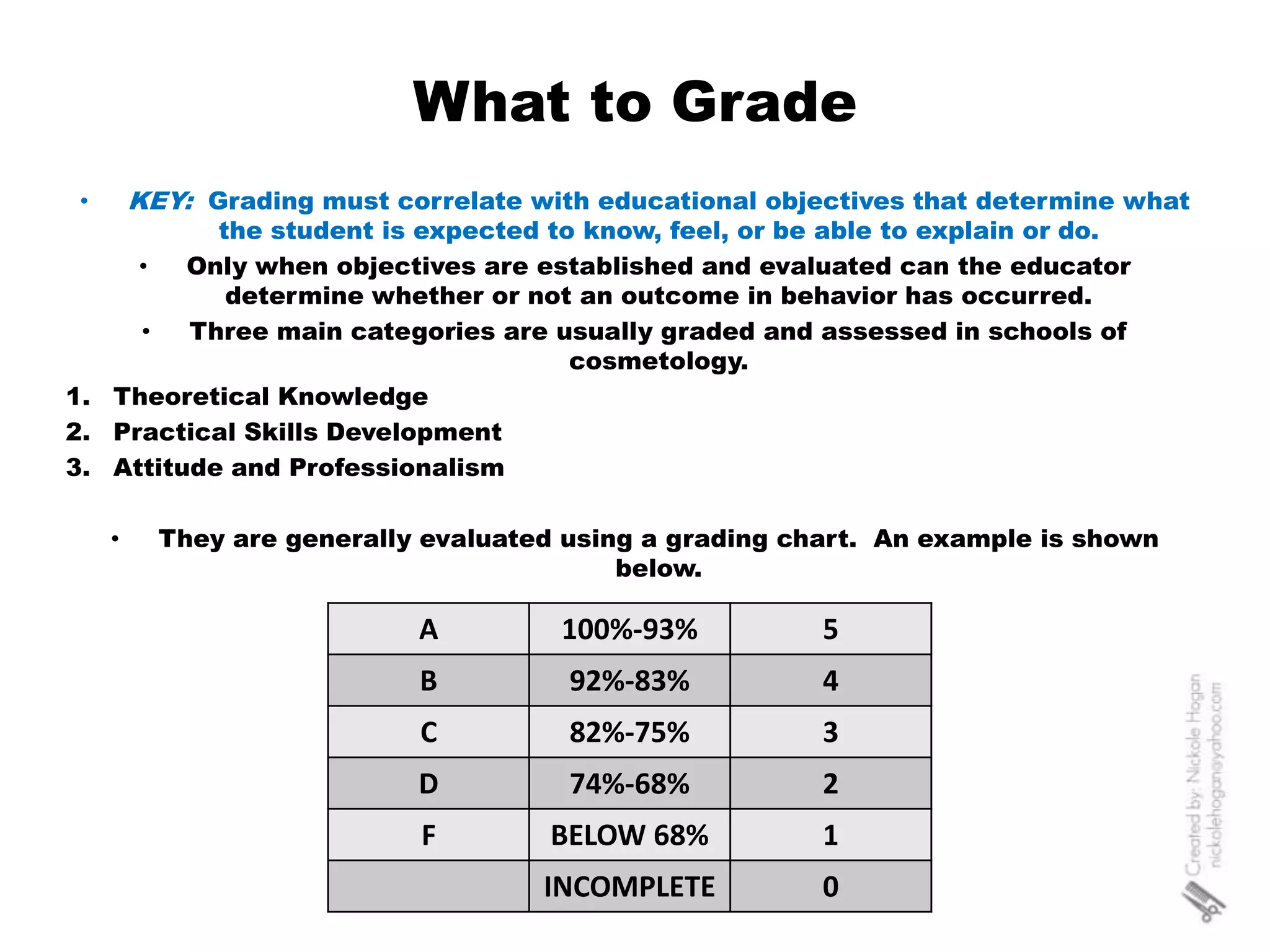
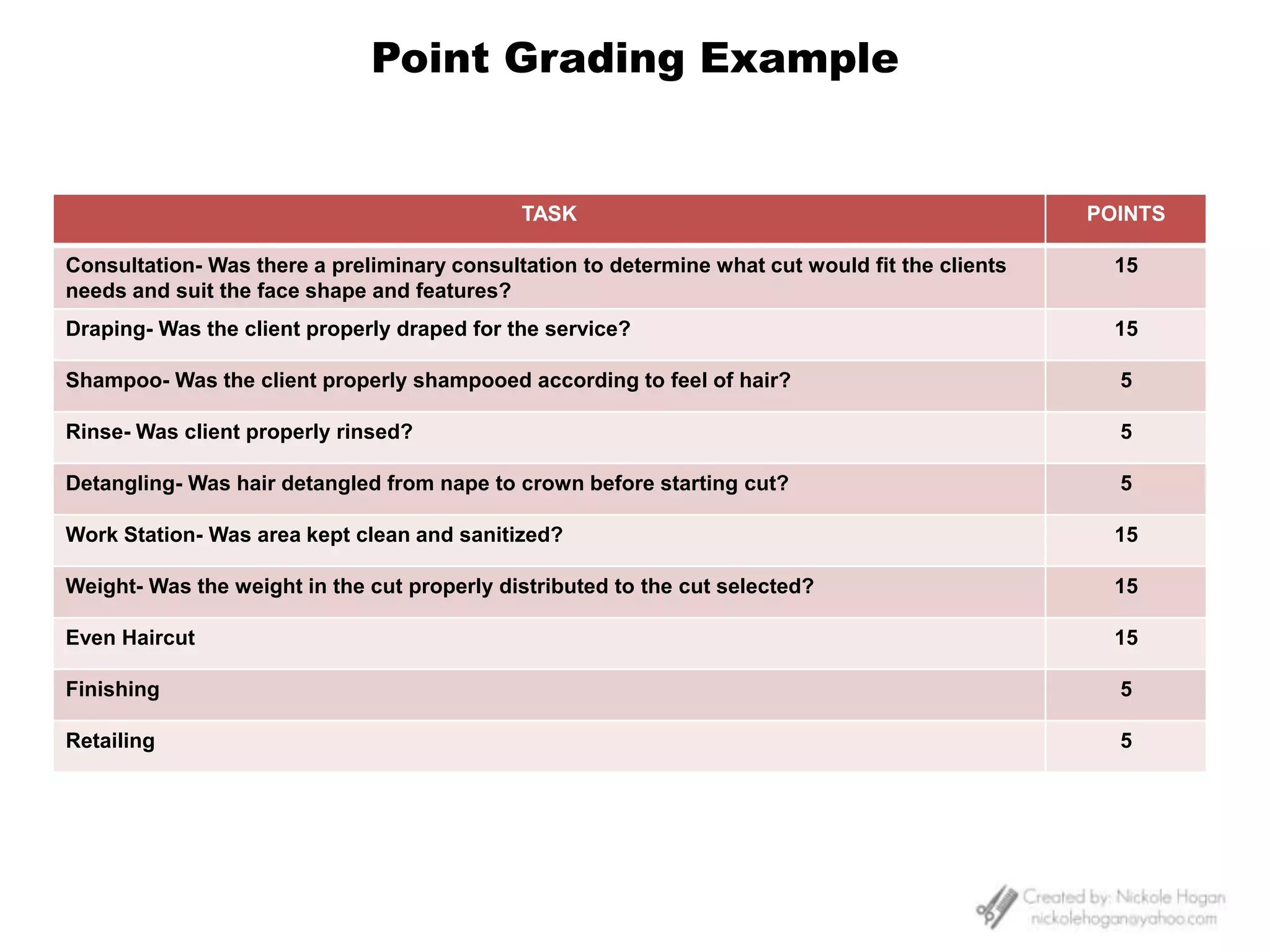
Three main categories are usually graded and assessed in schools of cosmetology.Theoretical KnowledgePractical Skills DevelopmentAttitude and ProfessionalismThey are generally evaluated using a grading chart.  An example is shown below.Sample Grading ProcedureStudents are assigned theory study and a minimum number of practical experiences in each category of study.
Specific theory and practical assignments are designated as requirements for graduation from the course.
Theory is evaluated after each unit of study.
KEY: Practical assignments are evaluated as completed and counted toward course completion only when rated as SATISFACTORY or better.
Practical skills are evaluated according to text procedures, performance standards set by the state licensing agency, and requirements set forth in established skills performance criteria.
Students must maintain a minimum theory grade of 75% and pass a final written practical exam prior to graduation.When to GradeIt is important for the learner to understand the criteria in which they are being graded and how they are progressing throughout their course of study.
Outcome Evaluation:  determines what the student knows after having been taught certain material or skills.
This is often done through pretesting and post testing.
Summative Evaluation:  the process of assigning grades after testing has occurred.
For example, a test may be given after a chapter or unit of study.
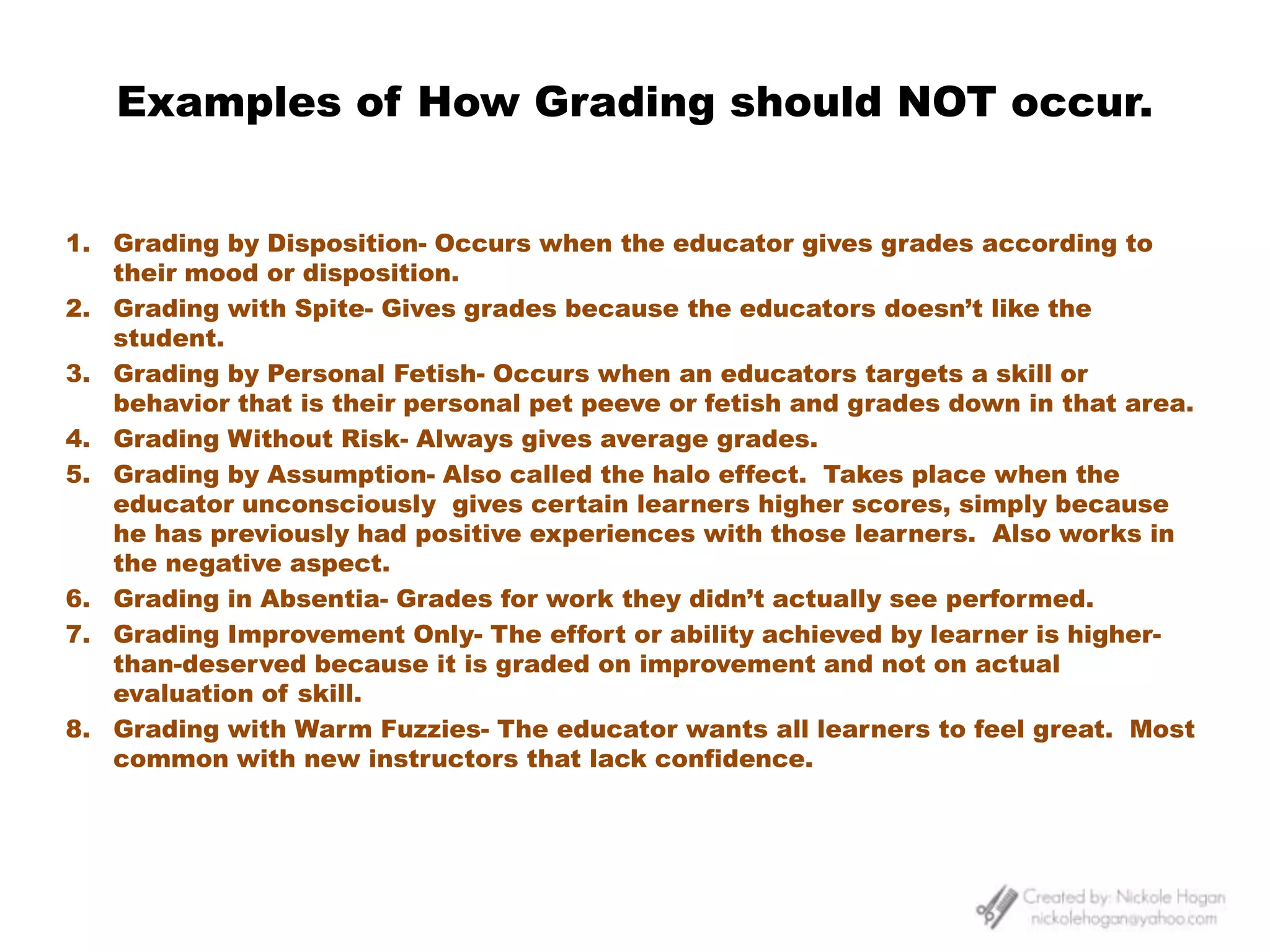
Master educators will learn to incorporate both methods.Examples of How Grading should NOT occur.Grading by Disposition- Occurs when the educator gives grades according to their mood or disposition.Grading with Spite- Gives grades because the educators doesn’t like the student.Grading by Personal Fetish- Occurs when an educators targets a skill or behavior that is their personal pet peeve or fetish and grades down in that area.  Grading Without Risk- Always gives average grades.Grading by Assumption- Also called the halo effect.  Takes place when the educator unconsciously  gives certain learners higher scores, simply because he has previously had positive experiences with those learners.  Also works in the negative aspect.Grading in Absentia- Grades for work they didn’t actually see performed.  Grading Improvement Only- The effort or ability achieved by learner is higher-than-deserved because it is graded on improvement and not on actual evaluation of skill.Grading with Warm Fuzzies- The educator wants all learners to feel great.  Most common with new instructors that lack confidence.
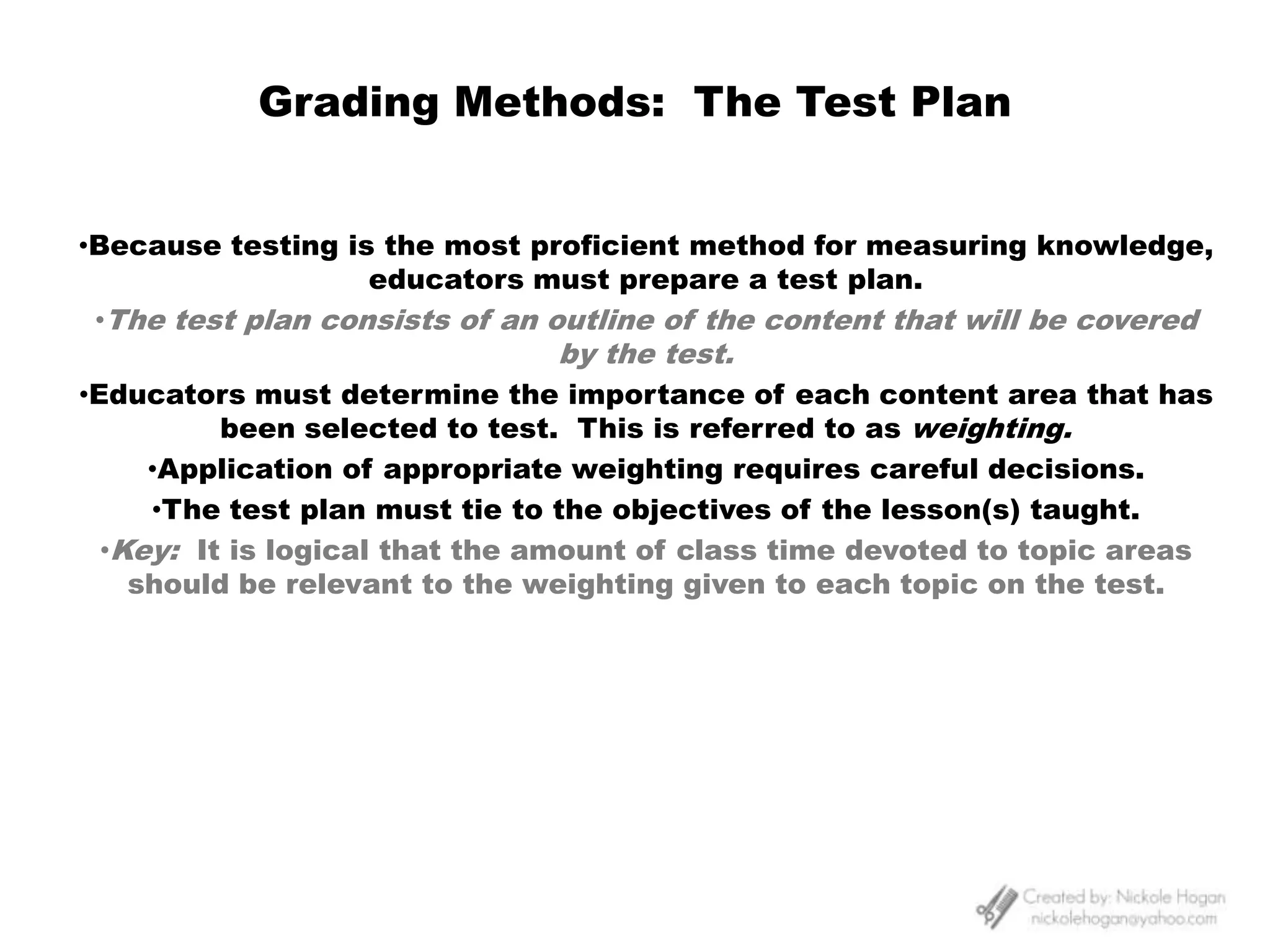
Grading Methods:  The Test PlanBecause testing is the most proficient method for measuring knowledge, educators must prepare a test plan.
The test plan consists of an outline of the content that will be covered by the test.
Educators must determine the importance of each content area that has been selected to test.  This is referred to as weighting.
Application of appropriate weighting requires careful decisions.
The test plan must tie to the objectives of the lesson(s) taught.
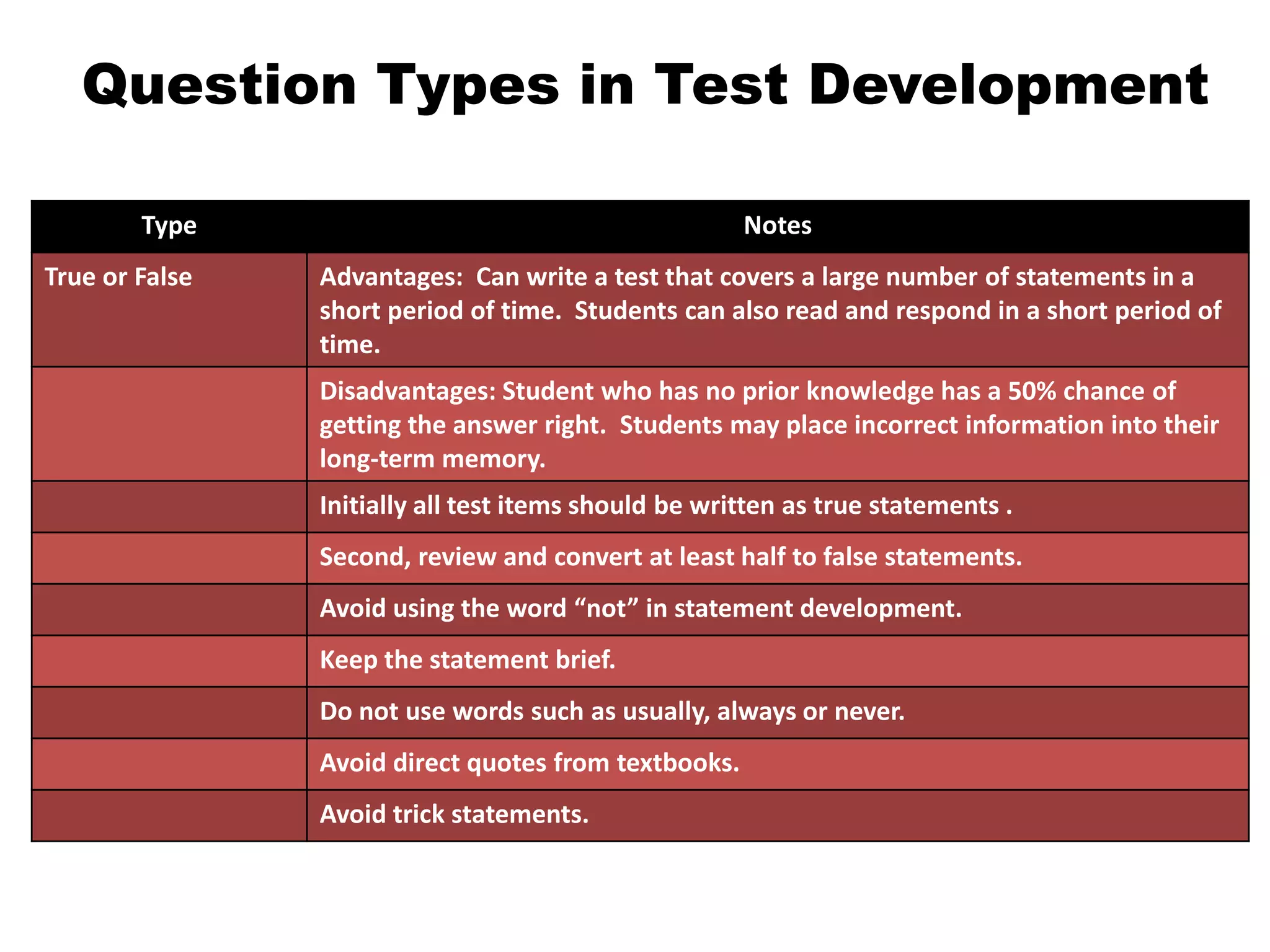
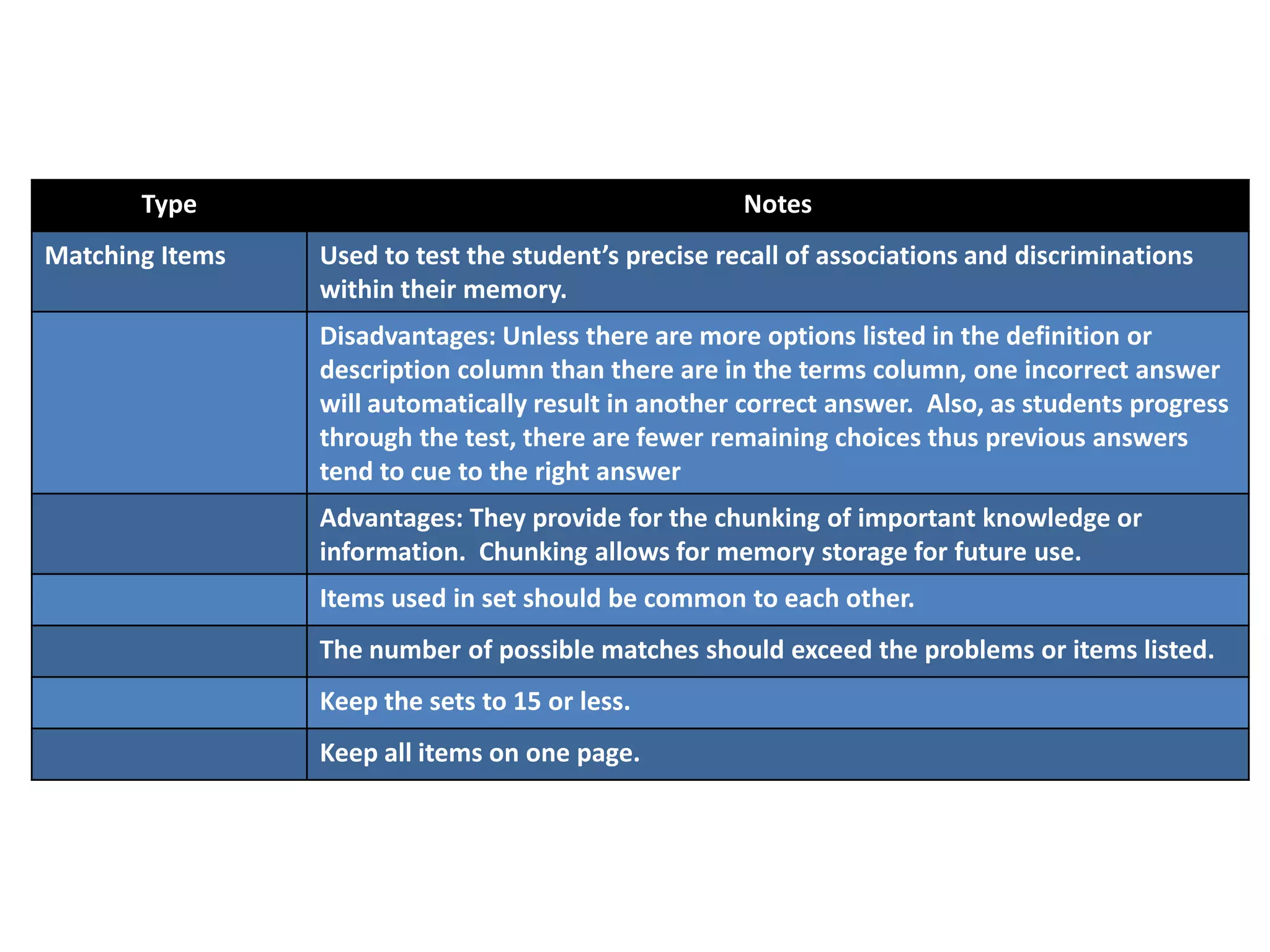
Key:  It is logical that the amount of class time devoted to topic areas should be relevant to the weighting given to each topic on the test.Question Types in Test Development

Chapter 9

  • 1.
    What’s in aGrade?It is essential that an educator become proficient in measuring the knowledge acquired by the learners.
  • 2.
    Grade: to assigna letter or number that shows how well one has done.
  • 3.
    The purpose ofgrading:To evaluate learner achievement.To build confidence.Identify educational progress.Measure the knowledge, skills, and attitude of learners.By establishing predetermined criteria to measure performance, all students will receive equitable evaluation.
  • 4.
    Accrediting bodies setstandards that require institutions to follow established grading procedures in a fair and equitable manner.
  • 5.
    Master educators willuse grading to challenge learners and assess their progress.What to GradeKEY: Grading must correlate with educational objectives that determine what the student is expected to know, feel, or be able to explain or do.
  • 6.
    Only when objectivesare established and evaluated can the educator determine whether or not an outcome in behavior has occurred.
  • 7.
    Three main categoriesare usually graded and assessed in schools of cosmetology.Theoretical KnowledgePractical Skills DevelopmentAttitude and ProfessionalismThey are generally evaluated using a grading chart. An example is shown below.Sample Grading ProcedureStudents are assigned theory study and a minimum number of practical experiences in each category of study.
  • 8.
    Specific theory andpractical assignments are designated as requirements for graduation from the course.
  • 9.
    Theory is evaluatedafter each unit of study.
  • 10.
    KEY: Practical assignmentsare evaluated as completed and counted toward course completion only when rated as SATISFACTORY or better.
  • 11.
    Practical skills areevaluated according to text procedures, performance standards set by the state licensing agency, and requirements set forth in established skills performance criteria.
  • 12.
    Students must maintaina minimum theory grade of 75% and pass a final written practical exam prior to graduation.When to GradeIt is important for the learner to understand the criteria in which they are being graded and how they are progressing throughout their course of study.
  • 13.
    Outcome Evaluation: determines what the student knows after having been taught certain material or skills.
  • 14.
    This is oftendone through pretesting and post testing.
  • 15.
    Summative Evaluation: the process of assigning grades after testing has occurred.
  • 16.
    For example, atest may be given after a chapter or unit of study.
  • 17.
    Master educators willlearn to incorporate both methods.Examples of How Grading should NOT occur.Grading by Disposition- Occurs when the educator gives grades according to their mood or disposition.Grading with Spite- Gives grades because the educators doesn’t like the student.Grading by Personal Fetish- Occurs when an educators targets a skill or behavior that is their personal pet peeve or fetish and grades down in that area. Grading Without Risk- Always gives average grades.Grading by Assumption- Also called the halo effect. Takes place when the educator unconsciously gives certain learners higher scores, simply because he has previously had positive experiences with those learners. Also works in the negative aspect.Grading in Absentia- Grades for work they didn’t actually see performed. Grading Improvement Only- The effort or ability achieved by learner is higher-than-deserved because it is graded on improvement and not on actual evaluation of skill.Grading with Warm Fuzzies- The educator wants all learners to feel great. Most common with new instructors that lack confidence.
  • 18.
    Grading Methods: The Test PlanBecause testing is the most proficient method for measuring knowledge, educators must prepare a test plan.
  • 19.
    The test planconsists of an outline of the content that will be covered by the test.
  • 20.
    Educators must determinethe importance of each content area that has been selected to test. This is referred to as weighting.
  • 21.
    Application of appropriateweighting requires careful decisions.
  • 22.
    The test planmust tie to the objectives of the lesson(s) taught.
  • 23.
    Key: Itis logical that the amount of class time devoted to topic areas should be relevant to the weighting given to each topic on the test.Question Types in Test Development
  • 28.
    ActivityDirectionsUsing the MultipleChoice method of testing, create a 15 question test for any chapter of your choice. Keep in mind the tips on how to create an effective test.Type, print and keep in your learning binder.
  • 29.
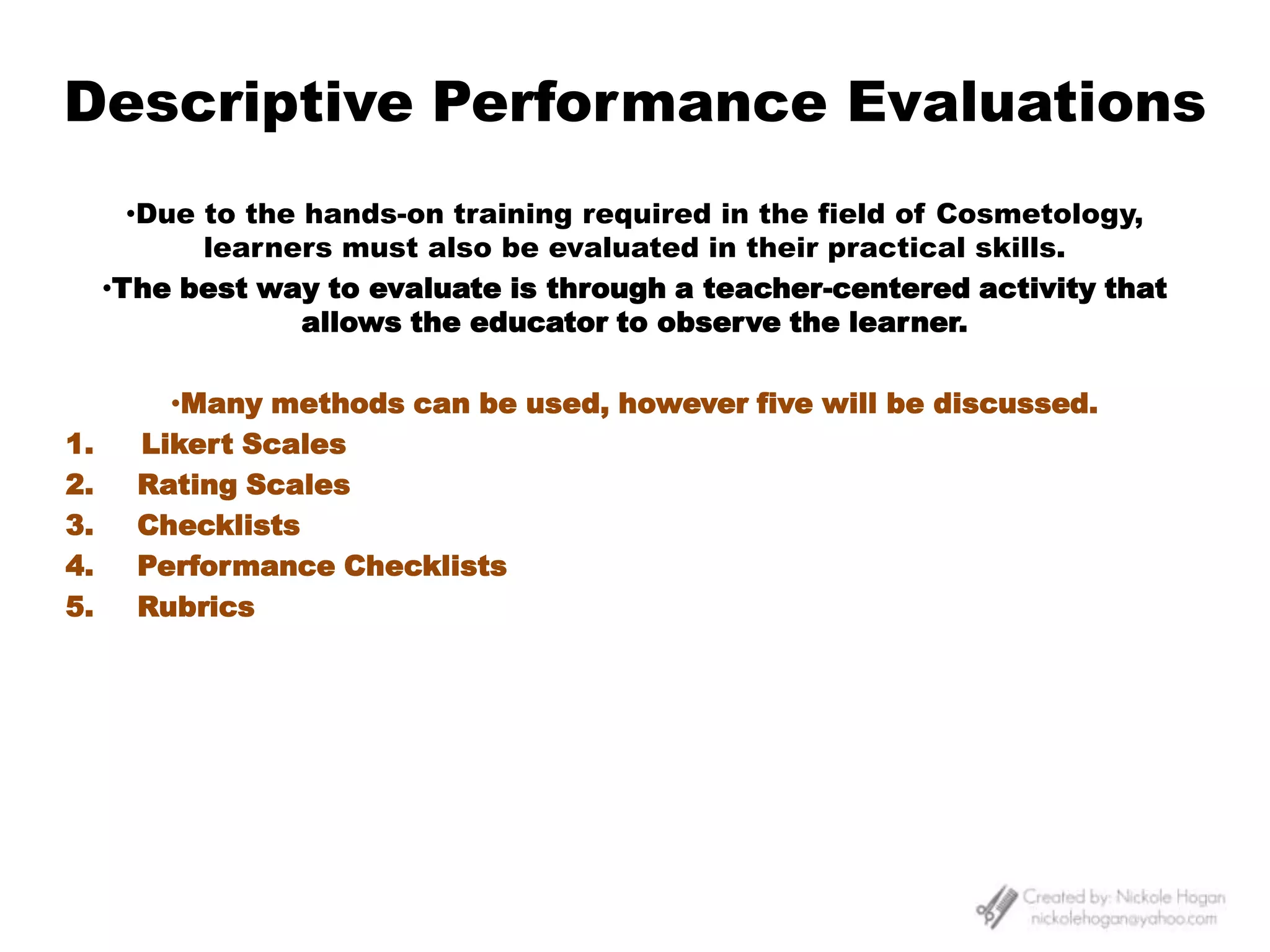
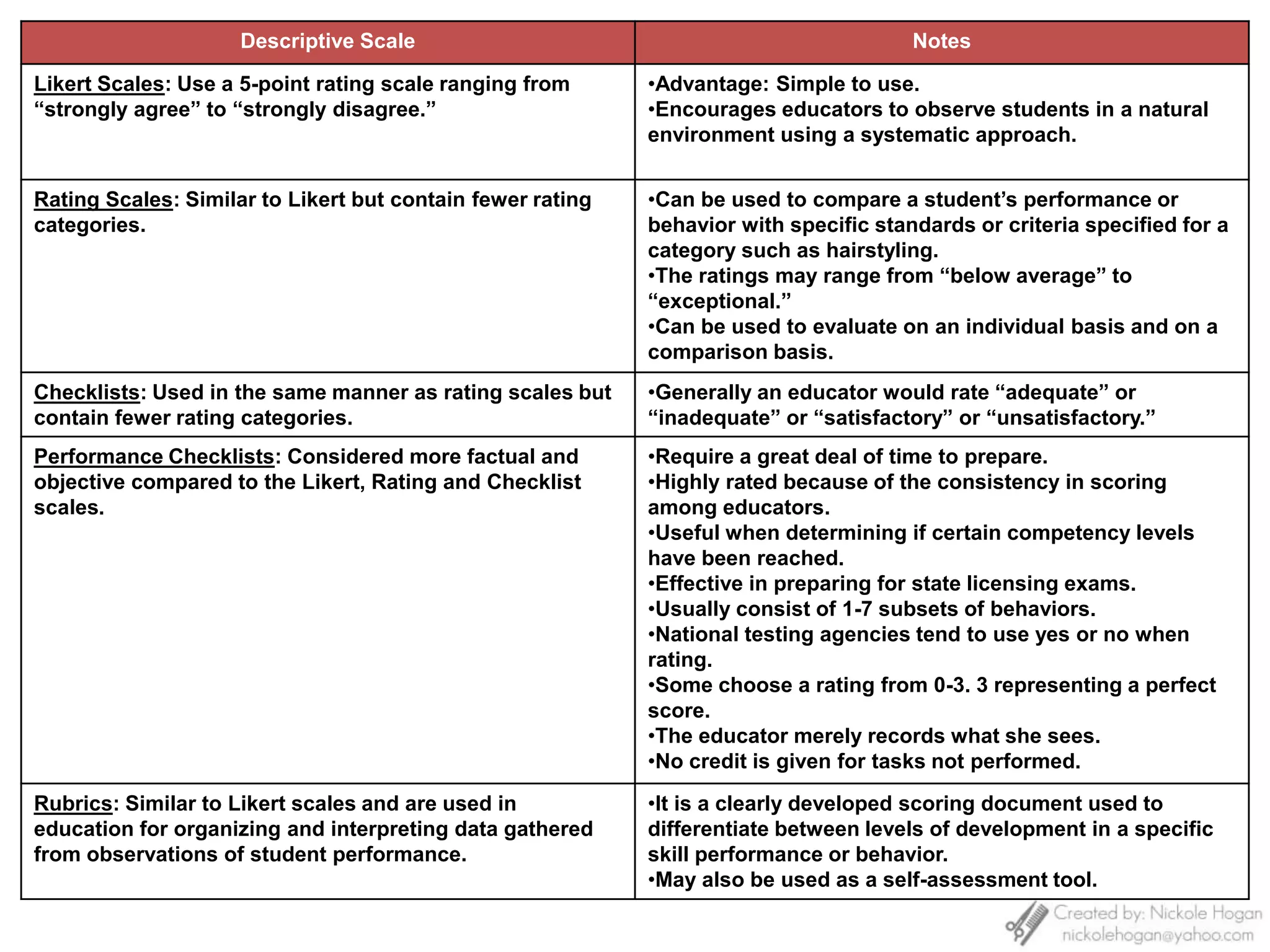
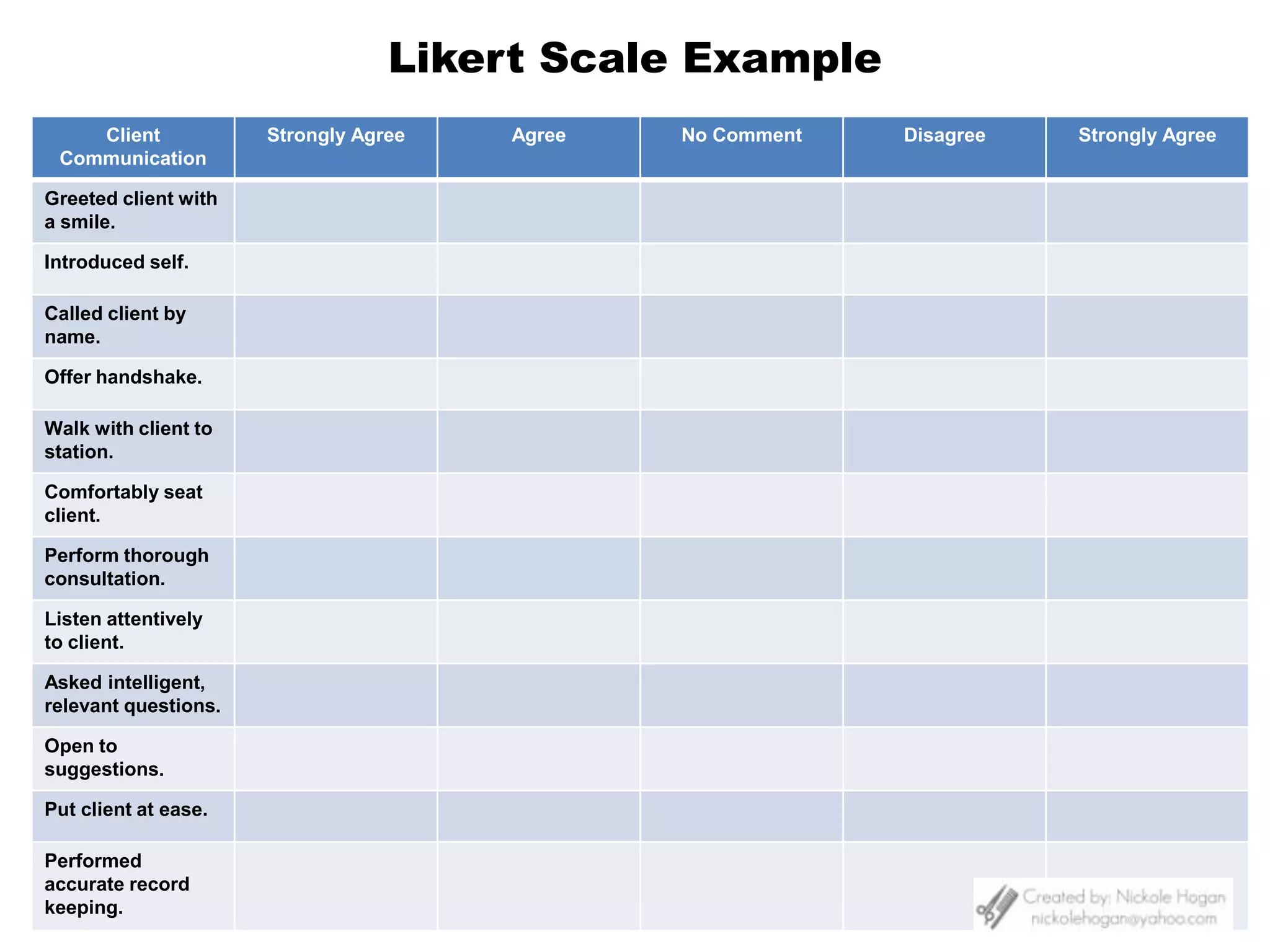
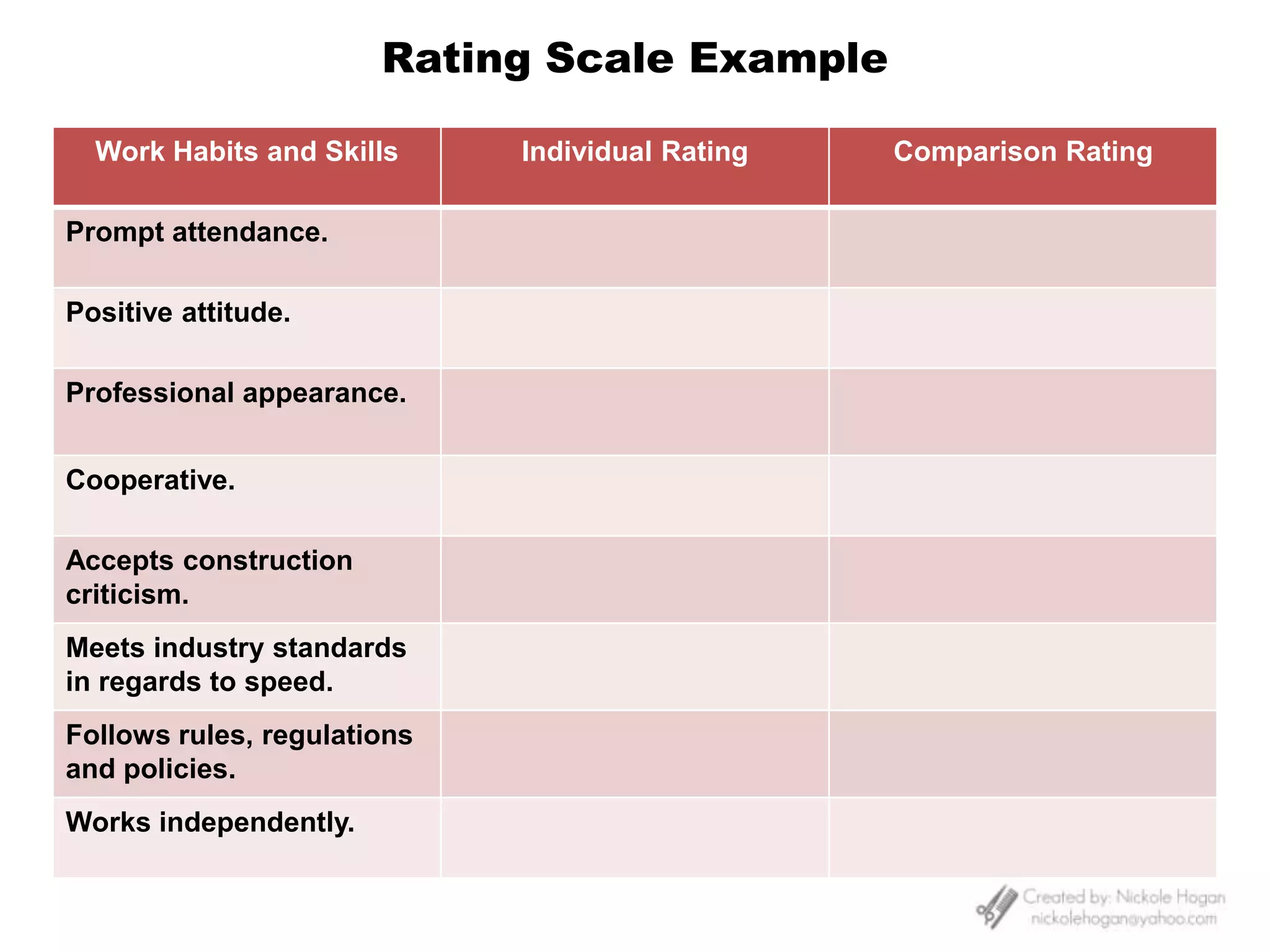
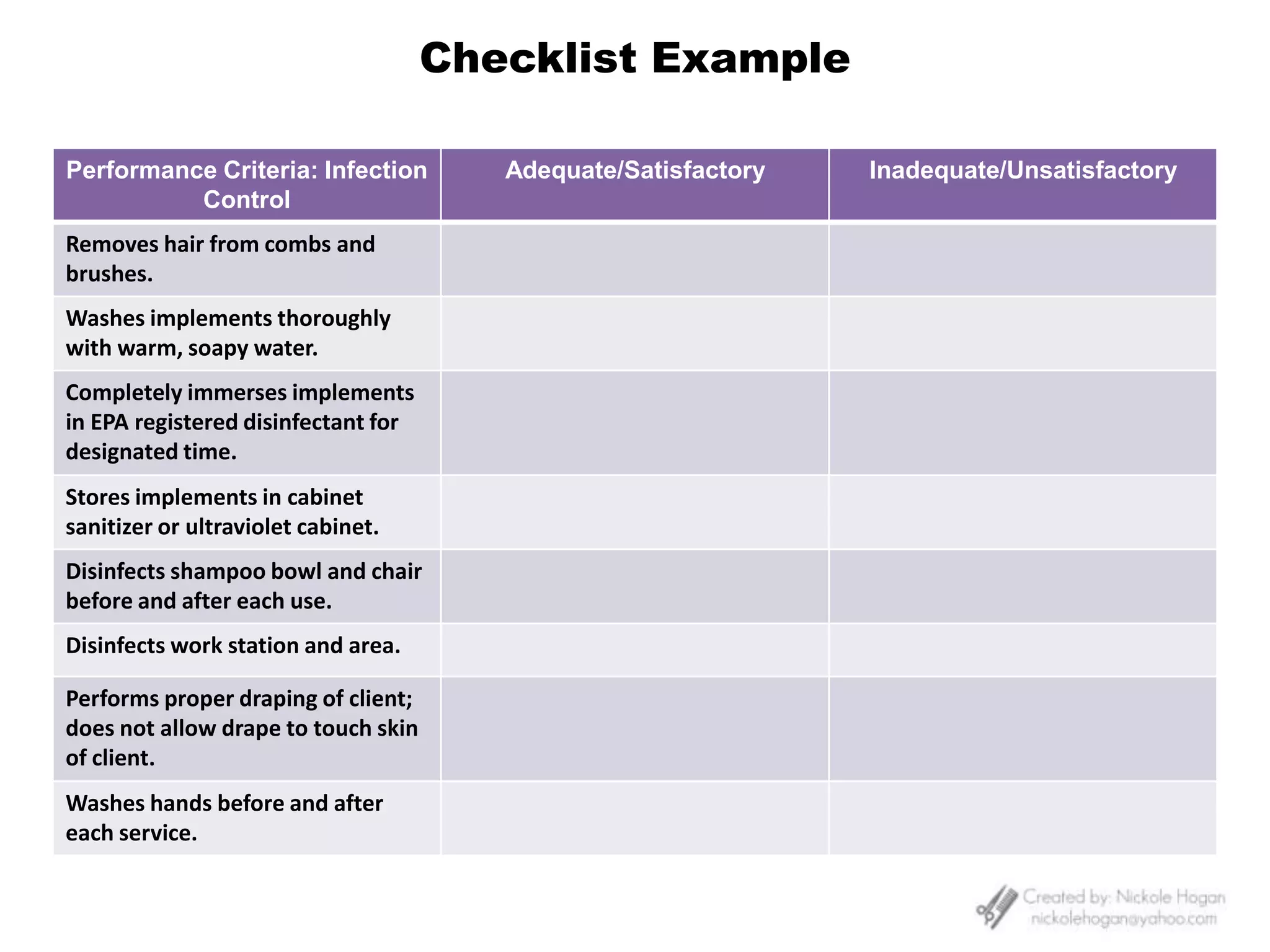
    Descriptive Performance EvaluationsDueto the hands-on training required in the field of Cosmetology, learners must also be evaluated in their practical skills.
  • 30.
    The best wayto evaluate is through a teacher-centered activity that allows the educator to observe the learner.
  • 31.
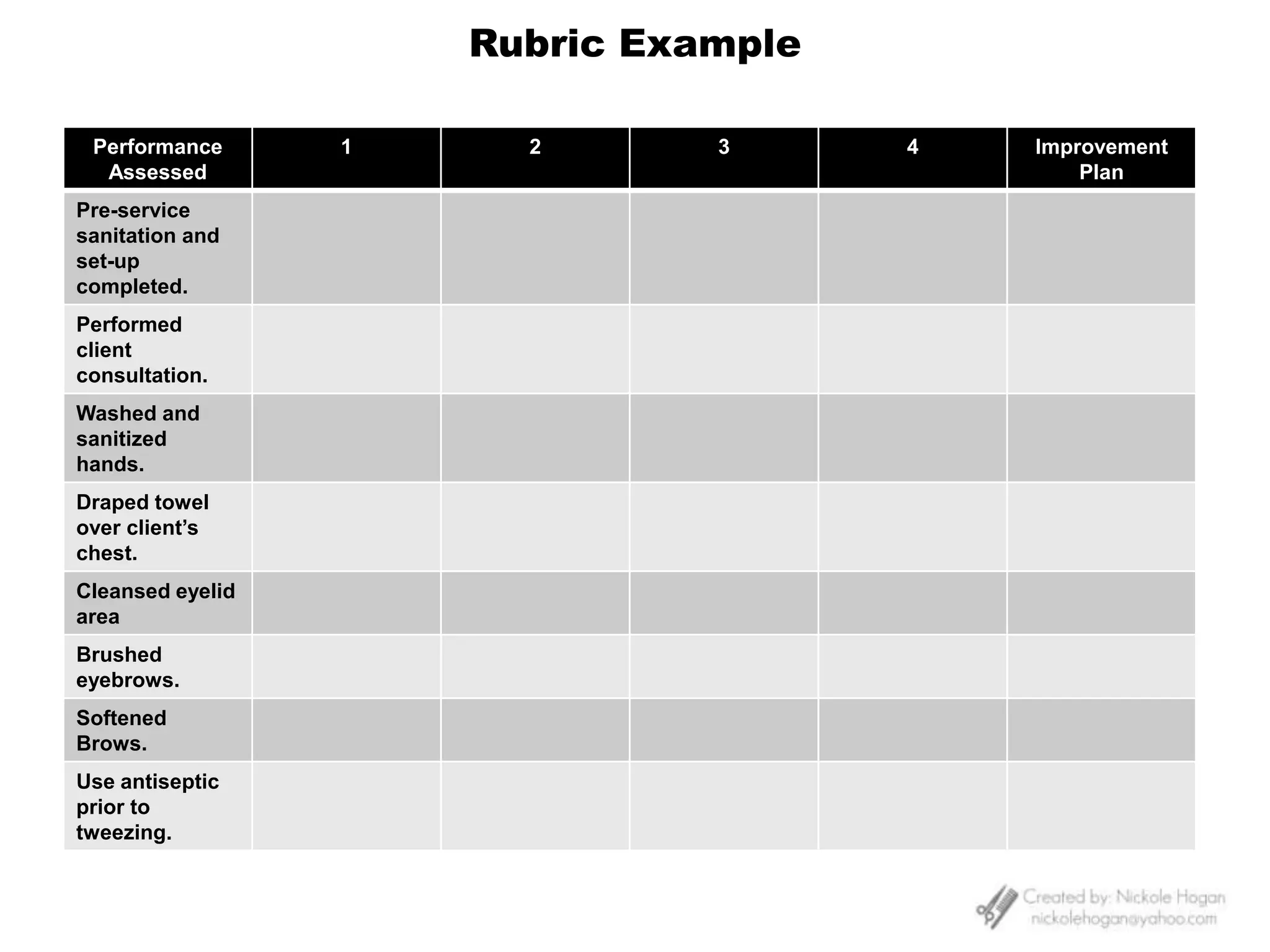
    Many methods canbe used, however five will be discussed. Likert ScalesRating ScalesChecklistsPerformance ChecklistsRubrics
  • 33.
  • 34.
  • 35.
  • 36.
    Performance Checklist Example–Please see example on page 205 in your Milady course book.
  • 37.
  • 38.
  • 39.
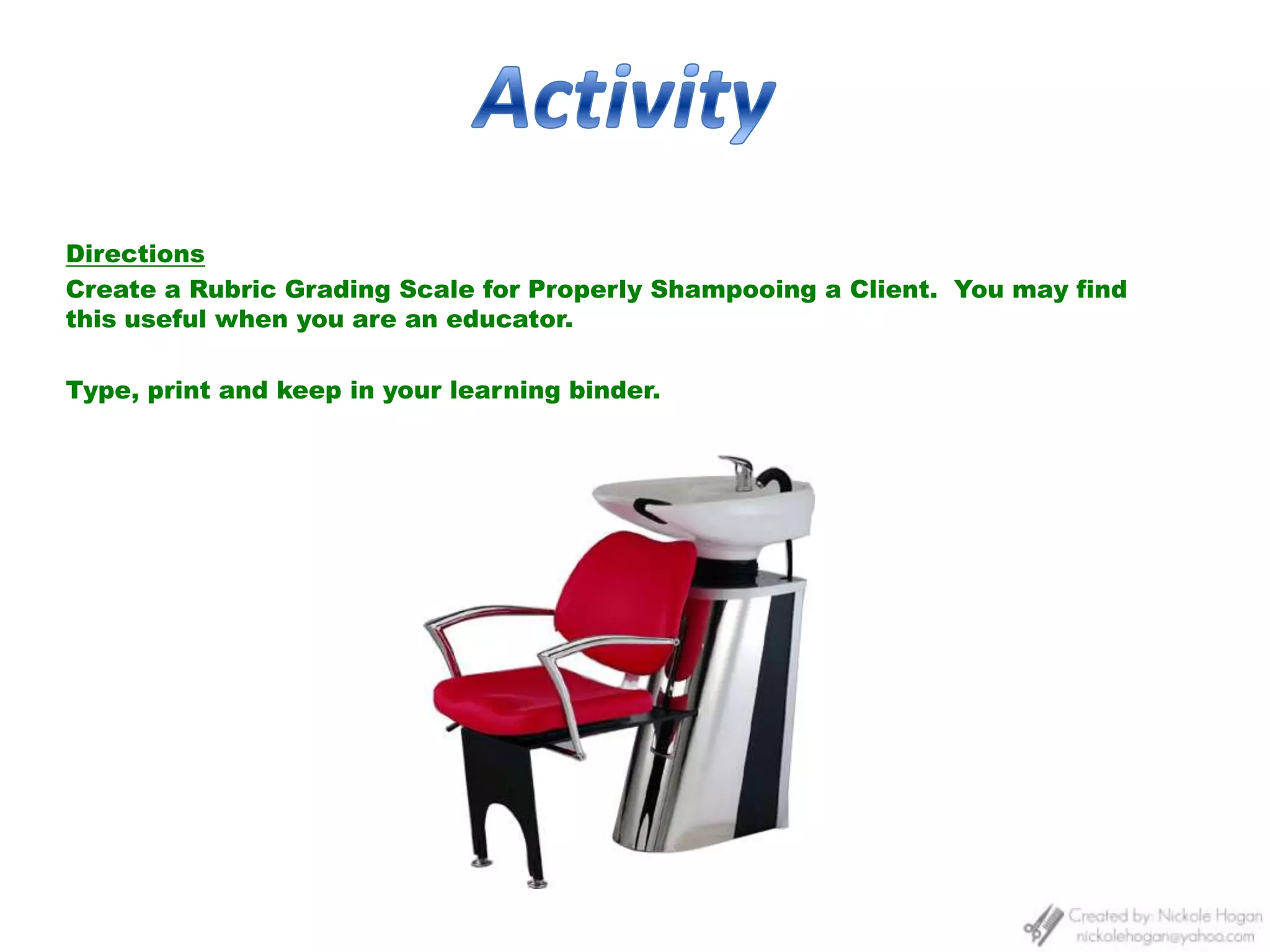
    ActivityDirectionsCreate a RubricGrading Scale for Properly Shampooing a Client. You may find this useful when you are an educator.Type, print and keep in your learning binder.
  • 40.
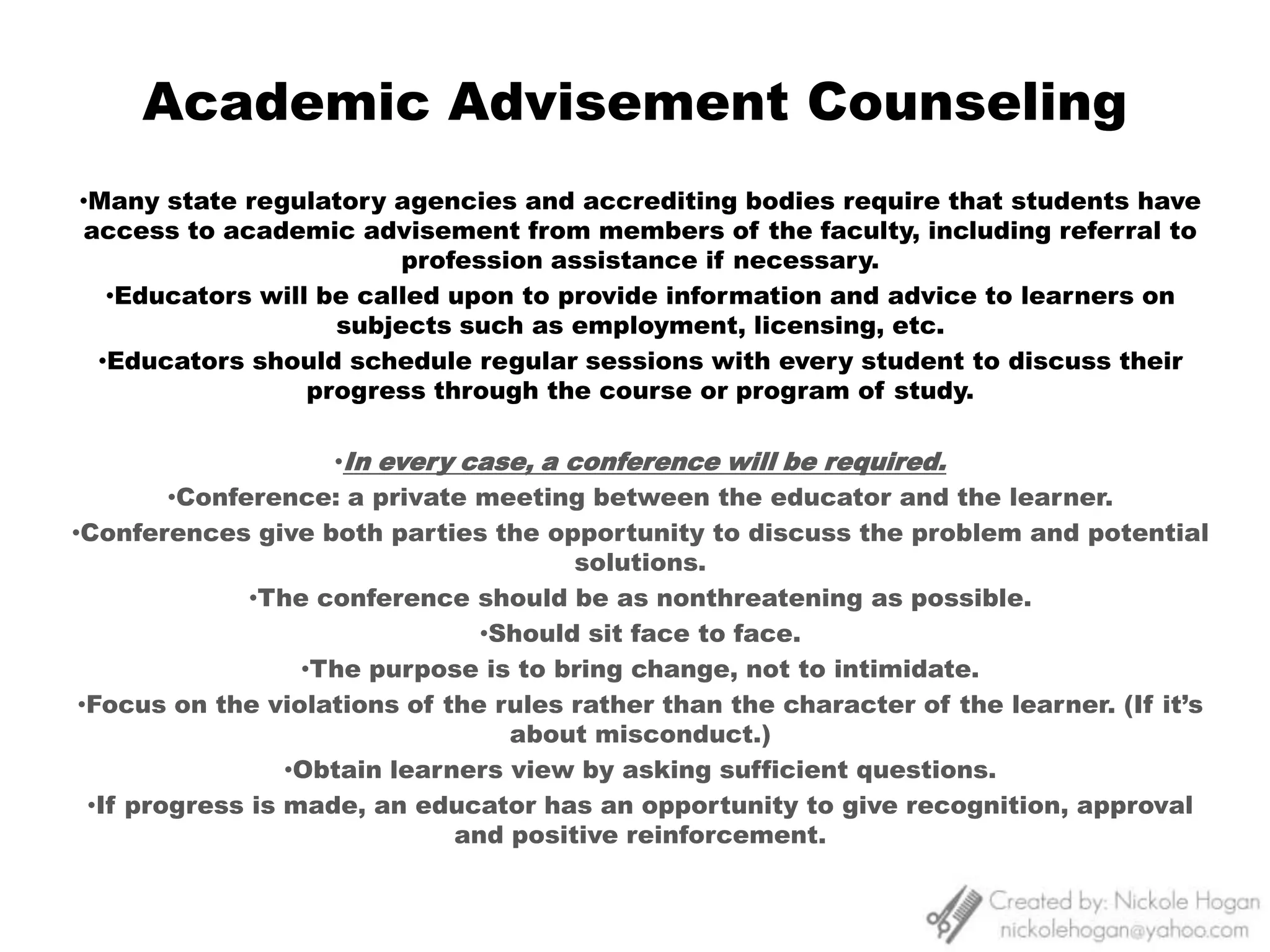
    Academic Advisement CounselingManystate regulatory agencies and accrediting bodies require that students have access to academic advisement from members of the faculty, including referral to profession assistance if necessary.
  • 41.
    Educators will becalled upon to provide information and advice to learners on subjects such as employment, licensing, etc.
  • 42.
    Educators should scheduleregular sessions with every student to discuss their progress through the course or program of study.
  • 43.
    In every case,a conference will be required.
  • 44.
    Conference: a privatemeeting between the educator and the learner.
  • 45.
    Conferences give bothparties the opportunity to discuss the problem and potential solutions.
  • 46.
    The conference shouldbe as nonthreatening as possible.
  • 47.
  • 48.
    The purpose isto bring change, not to intimidate.
  • 49.
    Focus on theviolations of the rules rather than the character of the learner. (If it’s about misconduct.)
  • 50.
    Obtain learners viewby asking sufficient questions.
  • 51.
    If progress ismade, an educator has an opportunity to give recognition, approval and positive reinforcement.Agreements or Contracts- A written contract will add meaning to an agreement.
  • 52.
    It is signedby the educator and learner.
  • 53.
    Performance Meetings- Outlineall the areas in which the learner is meeting or exceeding standards set forth for performance.
  • 54.
    The educator andlearner should agree on a plan of action to improve areas that are not satisfactory.
  • 55.
    Follow up itcritical.