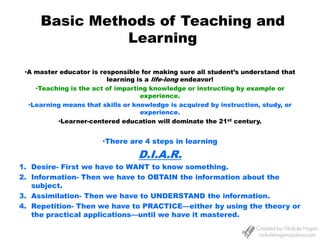
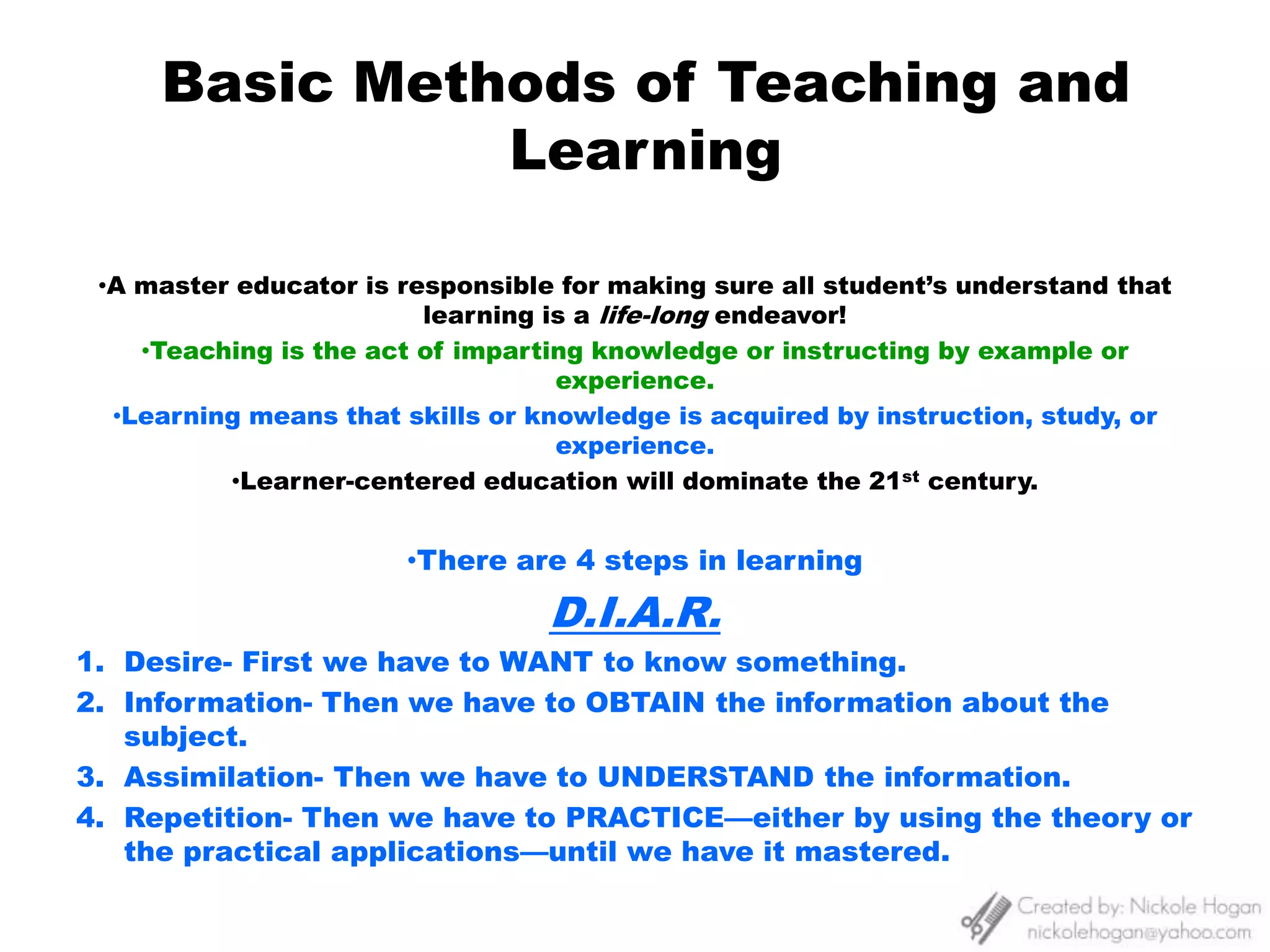
Basic Methods of Teaching and LearningA master educator is responsible for making sure all student’s understand that learning is a life-long endeavor!
Teaching is the act of imparting knowledge or instructing by example or experience.
Learning means that skills or knowledge is acquired by instruction, study, or experience.
Learner-centered education will dominate the 21st century.
There are 4 steps in learning D.I.A.R.Desire- First we have to WANT to know something.Information- Then we have to OBTAIN the information about the subject.Assimilation- Then we have to UNDERSTAND the information.Repetition- Then we have to PRACTICE—either by using the theory or the practical applications—until we have it mastered.
Teaching and Learning Methods and TechniquesTeaching Method- Represents the manner in which the educator uses the material and resources to achieve results.
Teaching methods must be appropriate for the type of lesson and the types of learners in the classroom.
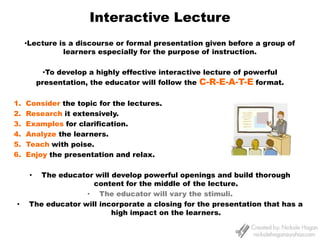
The more varied the methods, the more likely that every learner will ultimately “get it.”Interactive LectureLecture is a discourse or formal presentation given before a group of learners especially for the purpose of instruction.
To develop a highly effective interactive lecture of powerful presentation, the educator will follow the C-R-E-A-T-E format.Consider the topic for the lectures.Research it extensively.Examples for clarification.Analyze the learners.Teach with poise.Enjoy the presentation and relax.The educator will develop powerful openings and build thorough content for the middle of the lecture.
The educator will vary the stimuli.
The educator will incorporate a closing for the presentation that has a high impact on the learners.Demonstration and PracticeKey: Master educators use the demonstration method of teaching to bring the lesson or presentation to life.
Demonstration is used to clarify and instill the underlying theory of a procedure into the minds of the learners.
The 6 P’s are critical to demonstrations.  Proper preparation and planning promote positive performance.
It also requires to take necessary steps to ensure that it is effective and that objectives are met.Preparation- It includes identifying the objectives of the lessons. It also involves gathering and organizing materials and tools necessary.Demonstration- Avoid distractions, perform demonstration at an appropriate speed.  Question students during the demonstration to verify their understanding.   Do not pass around any objects around during a demonstration.  Practice or Application- After a demonstration has been completed, students must have the opportunity to practice as soon as possible.  Use the same implements as the instructor used during the demonstration.    Evaluation or Assessment- Closely supervise student practice of a skill and evaluate their performance.  Give immediate feedback.
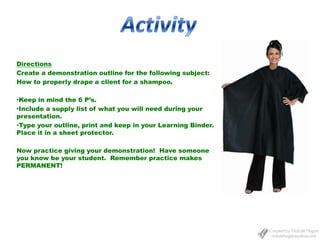
ActivityDirectionsCreate a demonstration outline for the following subject:How to properly drape a client for a shampoo.Keep in mind the 6 P’s.
Include a supply list of what you will need during your presentation.
Type your outline, print and keep in your Learning Binder.  Place it in a sheet protector.Now practice giving your demonstration!  Have someone you know be your student.  Remember practice makes PERMANENT!
Group Discussion and DiscoveryGroup learning is extremely advantageous because it requires a high degree of learner participation, which is highly motivating for adult learners.
Tips for group discovery and learning:Avoid interrupting learners and groups when at work.Provide ample time.Ensure that activity is based on problems or questions that are solvable.Allow for differences of opinions among learners.
Role-PlayingThe purpose of role-playing is to help learners understand the views and feelings of other people with respect to a wide range of personal and social issues.
The educator’s purpose is to structure the scenario and lead the follow-up discussion.
The student takes on the attitude and behavior of another person in a particular situation.

Chapter 5

  • 1.
    Basic Methods ofTeaching and LearningA master educator is responsible for making sure all student’s understand that learning is a life-long endeavor!
  • 2.
    Teaching is theact of imparting knowledge or instructing by example or experience.
  • 3.
    Learning means thatskills or knowledge is acquired by instruction, study, or experience.
  • 4.
    Learner-centered education willdominate the 21st century.
  • 5.
    There are 4steps in learning D.I.A.R.Desire- First we have to WANT to know something.Information- Then we have to OBTAIN the information about the subject.Assimilation- Then we have to UNDERSTAND the information.Repetition- Then we have to PRACTICE—either by using the theory or the practical applications—until we have it mastered.
  • 6.
    Teaching and LearningMethods and TechniquesTeaching Method- Represents the manner in which the educator uses the material and resources to achieve results.
  • 7.
    Teaching methods mustbe appropriate for the type of lesson and the types of learners in the classroom.
  • 8.
    The more variedthe methods, the more likely that every learner will ultimately “get it.”Interactive LectureLecture is a discourse or formal presentation given before a group of learners especially for the purpose of instruction.
  • 9.
    To develop ahighly effective interactive lecture of powerful presentation, the educator will follow the C-R-E-A-T-E format.Consider the topic for the lectures.Research it extensively.Examples for clarification.Analyze the learners.Teach with poise.Enjoy the presentation and relax.The educator will develop powerful openings and build thorough content for the middle of the lecture.
  • 10.
    The educator willvary the stimuli.
  • 11.
    The educator willincorporate a closing for the presentation that has a high impact on the learners.Demonstration and PracticeKey: Master educators use the demonstration method of teaching to bring the lesson or presentation to life.
  • 12.
    Demonstration is usedto clarify and instill the underlying theory of a procedure into the minds of the learners.
  • 13.
    The 6 P’sare critical to demonstrations. Proper preparation and planning promote positive performance.
  • 14.
    It also requiresto take necessary steps to ensure that it is effective and that objectives are met.Preparation- It includes identifying the objectives of the lessons. It also involves gathering and organizing materials and tools necessary.Demonstration- Avoid distractions, perform demonstration at an appropriate speed. Question students during the demonstration to verify their understanding. Do not pass around any objects around during a demonstration. Practice or Application- After a demonstration has been completed, students must have the opportunity to practice as soon as possible. Use the same implements as the instructor used during the demonstration. Evaluation or Assessment- Closely supervise student practice of a skill and evaluate their performance. Give immediate feedback.
  • 15.
    ActivityDirectionsCreate a demonstrationoutline for the following subject:How to properly drape a client for a shampoo.Keep in mind the 6 P’s.
  • 16.
    Include a supplylist of what you will need during your presentation.
  • 17.
    Type your outline,print and keep in your Learning Binder. Place it in a sheet protector.Now practice giving your demonstration! Have someone you know be your student. Remember practice makes PERMANENT!
  • 18.
    Group Discussion andDiscoveryGroup learning is extremely advantageous because it requires a high degree of learner participation, which is highly motivating for adult learners.
  • 19.
    Tips for groupdiscovery and learning:Avoid interrupting learners and groups when at work.Provide ample time.Ensure that activity is based on problems or questions that are solvable.Allow for differences of opinions among learners.
  • 20.
    Role-PlayingThe purpose ofrole-playing is to help learners understand the views and feelings of other people with respect to a wide range of personal and social issues.
  • 21.
    The educator’s purposeis to structure the scenario and lead the follow-up discussion.
  • 22.
    The student takeson the attitude and behavior of another person in a particular situation.