PBS in a NutshellGloria Wright MurphyState Support Team 6March 16, 2009Materialfrom the CSEFEL with funds from the U.S. Department of Health & Human Services, Administration for Children & Families (Cooperative Agreement N.PHS 90YD0119
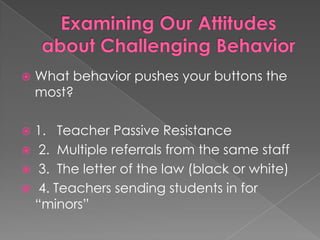
Examining Our Attitudes about Challenging BehaviorWhat behavior pushes your buttons the most?1.   Teacher Passive Resistance 2.  Multiple referrals from the same staff 3.  The letter of the law (black or white) 4. Teachers sending students in for “minors”
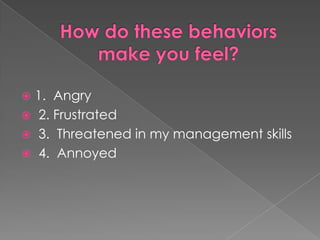
How do these behaviors make you feel?1.  Angry 2. Frustrated 3.  Threatened in my management skills 4.  Annoyed
Be honest…..How does this impact your relationship with the staff? 1. Not at all 2. Somewhat 3. Quite a bit
Integrated ExperienceStudents/staff act in a manner. Then staff /administrators react.  It is an integrated experience.We need to be proactive and “front load” interventions so that we are NOT in the reactive mode
Integrated ExperienceThere is a time to be:SupportiveDirectiveShortConciseConcrete
Necessary Emotional Skills for students (and staff)ConfidenceAbility to build good relationshipsConcentration and persistence with challenging tasksEffective communication of emotionsAbility to be attentive to instructionsAbility to solve social problems
When staff/students do not have these skills, they often exhibit challenging behaviorsWe have to teach behavior skills just as we teach academic skills
Some Basic AssumptionsChallenging behavior usually has a message – I am bored (academics are too low/too high), I am sad, You hurt my feelings, I need some attentionStudents/staff often use challenging behavior when they do not have the social or communication skills they need to engage in more appropriate interactionsBehavior that persists over time usually works for the student/staffWe need to teach what to do in place of the challenging behavior
Promote student/staff successCreate an environment where EVERY student/staff feels good about coming to schoolDesign an environment that promotes student/staff engagementFocus on teaching students/staff what TO DO!Teach expectationsTeach skills that students/staff can use in place of the challenging behaviors
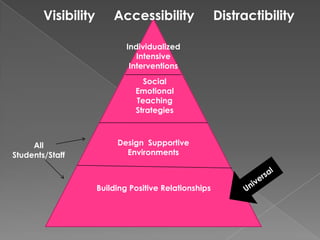
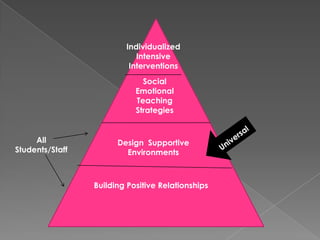
Visibility     Accessibility     DistractibilityIndividualized Intensive  InterventionsSocial  Emotional Teaching StrategiesDesign  Supportive EnvironmentsAll Students/StaffUniversalBuilding Positive Relationships
Building RelationshipsHelp EVERY student/staff feel accepted in the groupAssist student/staff in learning to communicate and get along with othersEncourage feelings of empathy and mutual respect among students and adultsProvide supportive environment in which students/staff can learn and practice appropriate and acceptable behaviors as individuals and as a group
Building Relationships with Students/StaffWhy is it important?Relationships are the foundation of everything we do. Build these relationships early on rather than waiting until there is a problemHumans learn and develop in the context of relationships that are responsive, consistent, nurturingAdult time and attention are very important to students and we need to ensure them our time and utmost attention at times other than when they are engaging in challenging behaviorsParents and other colleagues (community agencies) are critical partners in building student’s social emotional competence. Front loading success with prevent many challenging behaviors.
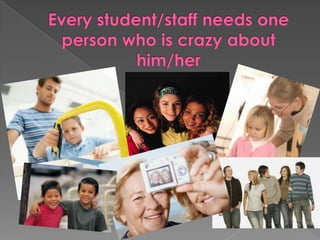
Every student/staff needs one person who is crazy about him/her
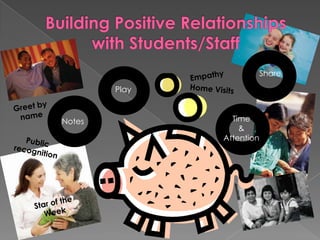
Building Positive Relationships with Students/StaffShareEmpathyPlayHome VisitsGreet by nameTime&AttentionNotesPublic recognitionStar of the Week
Individualized Intensive  InterventionsSocial  Emotional Teaching StrategiesUniversalAll Students/StaffDesign  Supportive EnvironmentsBuilding Positive Relationships
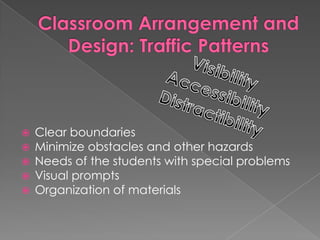
Classroom Arrangement and Design: Traffic PatternsVisibility Accessibility DistractibilityClear boundariesMinimize obstacles and other hazardsNeeds of the students with special problemsVisual promptsOrganization of materials
Schedules and RoutinesDevelop a schedule that promotes student engagement and successBalance activitiesActive and quietLarge group, small group, pairs, individual, centers & stationsTeach students the scheduleDevelop a routine and follow it consistentlyWhen changes are necessary, prepare the students ahead of time
TransitionsPlan for transitionsMinimize the number of transitions that students have to make in your classroomMinimize the length of time students spend waiting with nothing to doPrepare students for transitions by providing a warningStructure transitions so that students have something to do while they waitTeach students the expectations related to transitionsIndividualize supports (pre correct, prompt, cue)
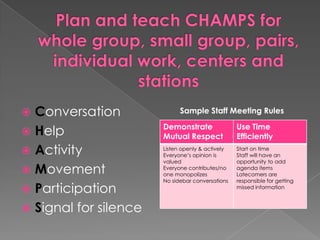
Plan and teach CHAMPS for whole group, small group, pairs, individual work, centers and stationsConversationHelpActivityMovementParticipationSignal for silenceSample Staff Meeting Rules
Large Group ActivitiesPlanning the activityConsider the lengthBe specific both in writing and verbally about the benchmark (purpose and goal) of the activityUse whole group ONLY to teach NEW informationImplementing whole groupProvide opportunities for ALL students to be actively involvedAssign jobs to students/staffVary your speech and intonation patternsHave students lead some whole group activitiesPay attention to student behavior
Large Group con’tArrange seating to make special needs students/staff accessibleDifferentiated assignments (visual, auditory, kinesthetic)Plan for late finishersPlan for early finishers (enrichment, not busy work)Interact through patterned turns, call on all students/staff equally
Small Group ActivitiesFocus of small group activitiesSkill building for students with common needsProduce a productExperience a processPlanning and ImplementingHeterogeneous and a randomly mixed equal groups (3-5) male, female, ethnicity, high, low, averageAssigned task for each participant (leader, reporter, time keeper, researcher, etc.)Required individual gradesClear goalsProvide feedback throughout
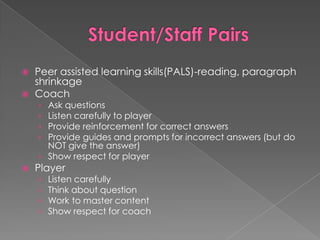
Student/Staff PairsPeer assisted learning skills(PALS)-reading, paragraph shrinkageCoachAsk questionsListen carefully to playerProvide reinforcement for correct answersProvide guides and prompts for incorrect answers (but do NOT give the answer)Show respect for playerPlayerListen carefullyThink about questionWork to master contentShow respect for coach
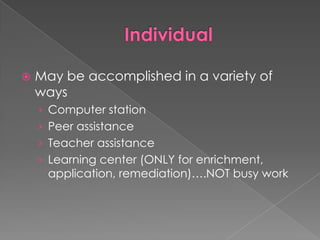
IndividualMay be accomplished in a variety of waysComputer stationPeer assistanceTeacher assistanceLearning center (ONLY for enrichment, application, remediation)….NOT busy work
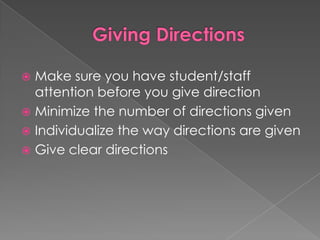
Giving DirectionsMake sure you have student/staff attention before you give directionMinimize the number of directions givenIndividualize the way directions are givenGive clear directions
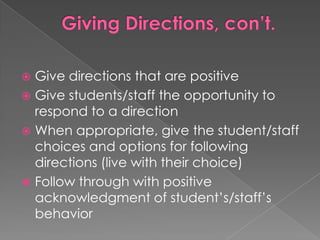
Giving Directions, con’t.Give directions that are positiveGive students/staff the opportunity to respond to a directionWhen appropriate, give the student/staff choices and options for following directions (live with their choice)Follow through with positive acknowledgment of student’s/staff’s behavior
General Guidelines about Rules3-5 simple, positively stated classroom rulesMeasurableInvolve students/staff in developing the rulesPost the rules visuallyTeach the rules systematically 5X a year (beginning , after each break, a week or two before school is finishedReinforce the rules at a high rate initially
Guidelines for Writing RulesMeasurableConsistent with school rulesUnderstandableDoableManageableAlways applicableStated positivelyConsistent with your own philosophy
Rules could address:Noise levelSpaceMaterials/suppliesPromptnessSafetyRespect for others, self, propertyWork habits
Ongoing monitoring and positive attentionGive students/staff attention when they are engaging in appropriate behaviorsMonitor our own behavior to ensure that we are spending more time using positive descriptive language and less time giving directions or correcting inappropriate behavior4:1 is the rule of thumb
Positive FeedbackContingent upon appropriate behaviorDescriptiveConveyed with enthusiasmContingent upon effort*  nonverbal forms may be used    *  individualize feedback and encouragement    * encourage all adults and students to use positive feedback and encouragement
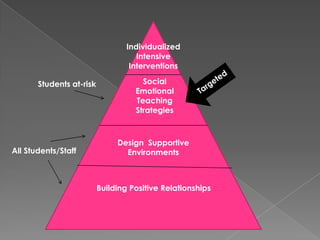
Individualized Intensive  InterventionsTargetedSocial  Emotional Teaching StrategiesStudents at-riskDesign  Supportive EnvironmentsAll Students/StaffBuilding Positive Relationships
What is Social Emotional Development?A sense of confidence and competenceAbility to develop good relationships with peer and adults/make friends/get along with othersAbility to persist at tasksAbility to follow directionsAbility to identify, understand, and communicate own feelings/emotionsAbility to constructively manage strong emotionsDevelopment of empathy
What happens when children don’t have these skills?Isolation from peers and staffFailure in academicsExhibition of inappropriate behavior due to the isolation, failure and frustration about not knowing what to do
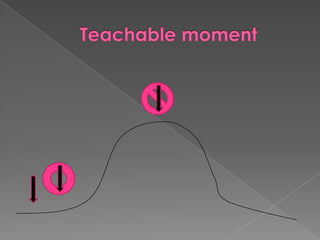
Stages of LearningAwareness – that a skill/concept is missingAcquisition – new skill/conceptFluency – ability to use the skill/concept without a promptMaintenance – continuing to use skill/concept over timeGeneralization – applying the skill/concept to new situations, people, activities, ideas and settings
Teachable moment
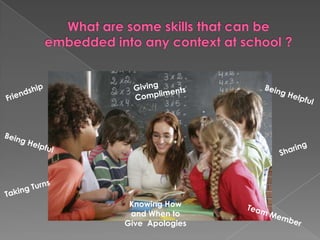
What are some skills that can be embedded into any context at school ?Giving ComplimentsFriendshipBeing HelpfulBeing HelpfulSharingTaking TurnsKnowing How and When to Give  ApologiesTeam Member
Emotional LiteracyThe ability to identify, understand, and express emotions in a healthy way
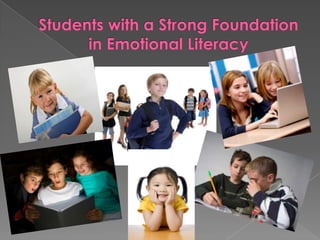
Students with a Strong Foundation in Emotional Literacy
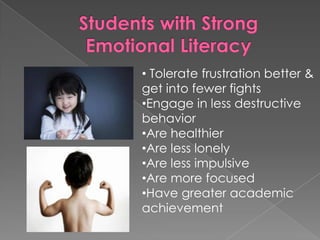
Students with Strong Emotional Literacy Tolerate frustration better & get into fewer fights
Engage in less destructive behavior
Are healthier
Are less lonely
Are less impulsive
Are more focused
Have greater academic achievementCheck In Check Out/SWISCheck In Check Out is a method of helping to work with these targeted childrenhttp://www.swis.orgStaff Member acts as a coach for the student
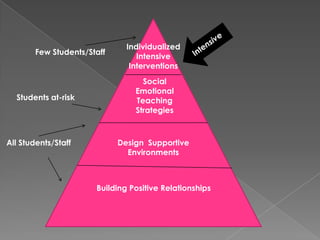
IntensiveIndividualized Intensive  InterventionsFew Students/StaffSocial  Emotional Teaching StrategiesStudents at-riskDesign  Supportive EnvironmentsAll Students/StaffBuilding Positive Relationships
Challenging BehaviorWhat are we referring to when we say “challenging behavior?Any repeated pattern of behavior that interferes with learning or engagement in prosocial interactions with peers and adults.Behaviors that are not responsive to the use of developmentally appropriate guidance proceduresProlonged tantrums, physical and verbal aggression, disruptive vocal and motor behavior (e.g. screaming, throwing), property destruction, self-injury, noncompliance, and withdrawal
Intensive Individualized InterventionsIntensive individualized interventions are used with students who have very persistent and severe challenging behavior and do not respond to the typical preventive practices, child guidance procedures, or social emotional teaching strategies that would normally work for most children
The PBS (Positive Behavior Support) approach to Intensive InterventionAn approach for changing a student’s behavior based on developing an understanding of why the student has the challenging behavior and teaching the student new skills (which get him/her what he/she wants) in place of the old challenging behaviors which have already workedAn approach the considers all of the factors that impact the student (family, school, peers, health, emotional issues, hunger, low academics, etc.)
Research on PBSEffective for all ages of individuals 2-50 years of ageEffect for diverse groups of individuals with challenges: mental retardation, oppositional defiant disorder, autism, emotional behavioral disorders, children at risk, etc.PBS is the only comprehensive and evidence-based approach to address challenging behavior within a variety of natural settings.
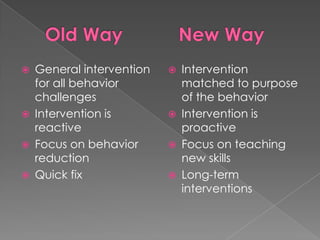
Old Way	      New WayGeneral intervention for all behavior challengesIntervention is reactiveFocus on behavior reductionQuick fixIntervention matched to purpose of the behaviorIntervention is proactiveFocus on teaching new skillsLong-term interventions
Challenging Behavior CommunicatesCommunicates a message when the student does not have the language skills necessary to communicate in another wayUsed instead of language by a student who has limited social skills or has learned that challenging behavior will result in meeting his/her need.
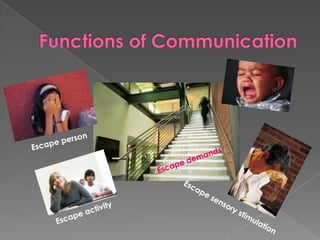
ChallengingBehavior WorksStudents engage in challenging behavior because it “works” for themChallenging behavior results in the student gaining access to something or someone (i.e. obtain/request) or avoiding something or someone (i.e. escape/protest)
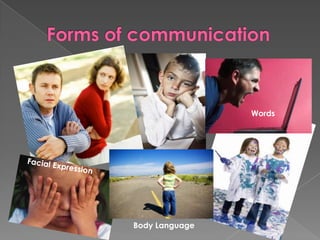
Every communicative behavior can be described by the form and functionForm: the behavior used to communicateFunction: the reason or purpose of the communicative behavior

Pbs In A Nutshell

  • 1.
    PBS in aNutshellGloria Wright MurphyState Support Team 6March 16, 2009Materialfrom the CSEFEL with funds from the U.S. Department of Health & Human Services, Administration for Children & Families (Cooperative Agreement N.PHS 90YD0119
  • 2.
    Examining Our Attitudesabout Challenging BehaviorWhat behavior pushes your buttons the most?1. Teacher Passive Resistance 2. Multiple referrals from the same staff 3. The letter of the law (black or white) 4. Teachers sending students in for “minors”
  • 3.
    How do thesebehaviors make you feel?1. Angry 2. Frustrated 3. Threatened in my management skills 4. Annoyed
  • 4.
    Be honest…..How doesthis impact your relationship with the staff? 1. Not at all 2. Somewhat 3. Quite a bit
  • 5.
    Integrated ExperienceStudents/staff actin a manner. Then staff /administrators react. It is an integrated experience.We need to be proactive and “front load” interventions so that we are NOT in the reactive mode
  • 6.
    Integrated ExperienceThere isa time to be:SupportiveDirectiveShortConciseConcrete
  • 7.
    Necessary Emotional Skillsfor students (and staff)ConfidenceAbility to build good relationshipsConcentration and persistence with challenging tasksEffective communication of emotionsAbility to be attentive to instructionsAbility to solve social problems
  • 8.
    When staff/students donot have these skills, they often exhibit challenging behaviorsWe have to teach behavior skills just as we teach academic skills
  • 9.
    Some Basic AssumptionsChallengingbehavior usually has a message – I am bored (academics are too low/too high), I am sad, You hurt my feelings, I need some attentionStudents/staff often use challenging behavior when they do not have the social or communication skills they need to engage in more appropriate interactionsBehavior that persists over time usually works for the student/staffWe need to teach what to do in place of the challenging behavior
  • 10.
    Promote student/staff successCreatean environment where EVERY student/staff feels good about coming to schoolDesign an environment that promotes student/staff engagementFocus on teaching students/staff what TO DO!Teach expectationsTeach skills that students/staff can use in place of the challenging behaviors
  • 11.
    Visibility Accessibility DistractibilityIndividualized Intensive InterventionsSocial Emotional Teaching StrategiesDesign Supportive EnvironmentsAll Students/StaffUniversalBuilding Positive Relationships
  • 12.
    Building RelationshipsHelp EVERYstudent/staff feel accepted in the groupAssist student/staff in learning to communicate and get along with othersEncourage feelings of empathy and mutual respect among students and adultsProvide supportive environment in which students/staff can learn and practice appropriate and acceptable behaviors as individuals and as a group
  • 13.
    Building Relationships withStudents/StaffWhy is it important?Relationships are the foundation of everything we do. Build these relationships early on rather than waiting until there is a problemHumans learn and develop in the context of relationships that are responsive, consistent, nurturingAdult time and attention are very important to students and we need to ensure them our time and utmost attention at times other than when they are engaging in challenging behaviorsParents and other colleagues (community agencies) are critical partners in building student’s social emotional competence. Front loading success with prevent many challenging behaviors.
  • 14.
    Every student/staff needsone person who is crazy about him/her
  • 15.
    Building Positive Relationshipswith Students/StaffShareEmpathyPlayHome VisitsGreet by nameTime&AttentionNotesPublic recognitionStar of the Week
  • 16.
    Individualized Intensive InterventionsSocial Emotional Teaching StrategiesUniversalAll Students/StaffDesign Supportive EnvironmentsBuilding Positive Relationships
  • 17.
    Classroom Arrangement andDesign: Traffic PatternsVisibility Accessibility DistractibilityClear boundariesMinimize obstacles and other hazardsNeeds of the students with special problemsVisual promptsOrganization of materials
  • 18.
    Schedules and RoutinesDevelopa schedule that promotes student engagement and successBalance activitiesActive and quietLarge group, small group, pairs, individual, centers & stationsTeach students the scheduleDevelop a routine and follow it consistentlyWhen changes are necessary, prepare the students ahead of time
  • 19.
    TransitionsPlan for transitionsMinimizethe number of transitions that students have to make in your classroomMinimize the length of time students spend waiting with nothing to doPrepare students for transitions by providing a warningStructure transitions so that students have something to do while they waitTeach students the expectations related to transitionsIndividualize supports (pre correct, prompt, cue)
  • 20.
    Plan and teachCHAMPS for whole group, small group, pairs, individual work, centers and stationsConversationHelpActivityMovementParticipationSignal for silenceSample Staff Meeting Rules
  • 21.
    Large Group ActivitiesPlanningthe activityConsider the lengthBe specific both in writing and verbally about the benchmark (purpose and goal) of the activityUse whole group ONLY to teach NEW informationImplementing whole groupProvide opportunities for ALL students to be actively involvedAssign jobs to students/staffVary your speech and intonation patternsHave students lead some whole group activitiesPay attention to student behavior
  • 22.
    Large Group con’tArrangeseating to make special needs students/staff accessibleDifferentiated assignments (visual, auditory, kinesthetic)Plan for late finishersPlan for early finishers (enrichment, not busy work)Interact through patterned turns, call on all students/staff equally
  • 23.
    Small Group ActivitiesFocusof small group activitiesSkill building for students with common needsProduce a productExperience a processPlanning and ImplementingHeterogeneous and a randomly mixed equal groups (3-5) male, female, ethnicity, high, low, averageAssigned task for each participant (leader, reporter, time keeper, researcher, etc.)Required individual gradesClear goalsProvide feedback throughout
  • 24.
    Student/Staff PairsPeer assistedlearning skills(PALS)-reading, paragraph shrinkageCoachAsk questionsListen carefully to playerProvide reinforcement for correct answersProvide guides and prompts for incorrect answers (but do NOT give the answer)Show respect for playerPlayerListen carefullyThink about questionWork to master contentShow respect for coach
  • 25.
    IndividualMay be accomplishedin a variety of waysComputer stationPeer assistanceTeacher assistanceLearning center (ONLY for enrichment, application, remediation)….NOT busy work
  • 26.
    Giving DirectionsMake sureyou have student/staff attention before you give directionMinimize the number of directions givenIndividualize the way directions are givenGive clear directions
  • 27.
    Giving Directions, con’t.Givedirections that are positiveGive students/staff the opportunity to respond to a directionWhen appropriate, give the student/staff choices and options for following directions (live with their choice)Follow through with positive acknowledgment of student’s/staff’s behavior
  • 28.
    General Guidelines aboutRules3-5 simple, positively stated classroom rulesMeasurableInvolve students/staff in developing the rulesPost the rules visuallyTeach the rules systematically 5X a year (beginning , after each break, a week or two before school is finishedReinforce the rules at a high rate initially
  • 29.
    Guidelines for WritingRulesMeasurableConsistent with school rulesUnderstandableDoableManageableAlways applicableStated positivelyConsistent with your own philosophy
  • 30.
    Rules could address:NoiselevelSpaceMaterials/suppliesPromptnessSafetyRespect for others, self, propertyWork habits
  • 31.
    Ongoing monitoring andpositive attentionGive students/staff attention when they are engaging in appropriate behaviorsMonitor our own behavior to ensure that we are spending more time using positive descriptive language and less time giving directions or correcting inappropriate behavior4:1 is the rule of thumb
  • 32.
    Positive FeedbackContingent uponappropriate behaviorDescriptiveConveyed with enthusiasmContingent upon effort* nonverbal forms may be used * individualize feedback and encouragement * encourage all adults and students to use positive feedback and encouragement
  • 33.
    Individualized Intensive InterventionsTargetedSocial Emotional Teaching StrategiesStudents at-riskDesign Supportive EnvironmentsAll Students/StaffBuilding Positive Relationships
  • 34.
    What is SocialEmotional Development?A sense of confidence and competenceAbility to develop good relationships with peer and adults/make friends/get along with othersAbility to persist at tasksAbility to follow directionsAbility to identify, understand, and communicate own feelings/emotionsAbility to constructively manage strong emotionsDevelopment of empathy
  • 35.
    What happens whenchildren don’t have these skills?Isolation from peers and staffFailure in academicsExhibition of inappropriate behavior due to the isolation, failure and frustration about not knowing what to do
  • 36.
    Stages of LearningAwareness– that a skill/concept is missingAcquisition – new skill/conceptFluency – ability to use the skill/concept without a promptMaintenance – continuing to use skill/concept over timeGeneralization – applying the skill/concept to new situations, people, activities, ideas and settings
  • 37.
  • 38.
    What are someskills that can be embedded into any context at school ?Giving ComplimentsFriendshipBeing HelpfulBeing HelpfulSharingTaking TurnsKnowing How and When to Give ApologiesTeam Member
  • 39.
    Emotional LiteracyThe abilityto identify, understand, and express emotions in a healthy way
  • 40.
    Students with aStrong Foundation in Emotional Literacy
  • 41.
    Students with StrongEmotional Literacy Tolerate frustration better & get into fewer fights
  • 42.
    Engage in lessdestructive behavior
  • 43.
  • 44.
  • 45.
  • 46.
  • 47.
    Have greater academicachievementCheck In Check Out/SWISCheck In Check Out is a method of helping to work with these targeted childrenhttp://www.swis.orgStaff Member acts as a coach for the student
  • 48.
    IntensiveIndividualized Intensive InterventionsFew Students/StaffSocial Emotional Teaching StrategiesStudents at-riskDesign Supportive EnvironmentsAll Students/StaffBuilding Positive Relationships
  • 49.
    Challenging BehaviorWhat arewe referring to when we say “challenging behavior?Any repeated pattern of behavior that interferes with learning or engagement in prosocial interactions with peers and adults.Behaviors that are not responsive to the use of developmentally appropriate guidance proceduresProlonged tantrums, physical and verbal aggression, disruptive vocal and motor behavior (e.g. screaming, throwing), property destruction, self-injury, noncompliance, and withdrawal
  • 50.
    Intensive Individualized InterventionsIntensiveindividualized interventions are used with students who have very persistent and severe challenging behavior and do not respond to the typical preventive practices, child guidance procedures, or social emotional teaching strategies that would normally work for most children
  • 51.
    The PBS (PositiveBehavior Support) approach to Intensive InterventionAn approach for changing a student’s behavior based on developing an understanding of why the student has the challenging behavior and teaching the student new skills (which get him/her what he/she wants) in place of the old challenging behaviors which have already workedAn approach the considers all of the factors that impact the student (family, school, peers, health, emotional issues, hunger, low academics, etc.)
  • 52.
    Research on PBSEffectivefor all ages of individuals 2-50 years of ageEffect for diverse groups of individuals with challenges: mental retardation, oppositional defiant disorder, autism, emotional behavioral disorders, children at risk, etc.PBS is the only comprehensive and evidence-based approach to address challenging behavior within a variety of natural settings.
  • 53.
    Old Way New WayGeneral intervention for all behavior challengesIntervention is reactiveFocus on behavior reductionQuick fixIntervention matched to purpose of the behaviorIntervention is proactiveFocus on teaching new skillsLong-term interventions
  • 54.
    Challenging Behavior CommunicatesCommunicatesa message when the student does not have the language skills necessary to communicate in another wayUsed instead of language by a student who has limited social skills or has learned that challenging behavior will result in meeting his/her need.
  • 55.
    ChallengingBehavior WorksStudents engagein challenging behavior because it “works” for themChallenging behavior results in the student gaining access to something or someone (i.e. obtain/request) or avoiding something or someone (i.e. escape/protest)
  • 56.
    Every communicative behaviorcan be described by the form and functionForm: the behavior used to communicateFunction: the reason or purpose of the communicative behavior