Working with Children The easy job
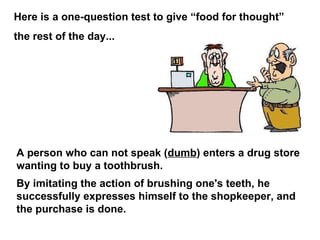
Here is a one-question test to give “food for thought”  the rest of the day... A person who can not speak ( dumb ) enters a drug store wanting to buy a toothbrush.   By imitating the action of brushing one's teeth, he successfully expresses himself to the shopkeeper, and the purchase is done.    
Now, if there is a person who is  blind  and wishes to buy a pair of sunglasses-  -How should that person express him or herself?   Think about it first before writing your answer...
It’s all in the perception / point of view! (and easy if you already knew the answer-  or if you are used to  thinking in that way …) How about: The person who is blind  opens his or her mouth and says,  "I would like to buy a pair of sunglasses"   It is a bit like that with Learning Styles: Easy if you are used to thinking in that way---but if a student thinks in one learning style while a instructor is teaching in another…
Learning Styles At WCSCC Wayne County Schools  Career Center Martha Miller-Plumb
I.  The brain and why the learning environment is important III. Learning style instruments IV. Suggestions for varied teaching II. Learning styles simplified What to expect:
I.  The brain and why the learning environment is important
The human brain-  -Obviously quite complex -The “seat” of both logic and  emotion Humans tend to learn  -More -More quickly- -If  we are in a non-threatening environment -If  we like what we are learning Learning Styles
Learning Styles Temporal lobe Hippocampus Amygdala Inside the brain: The  amygdala  and the  hippocampus   1. Work together to help humans survive 2. They can trigger the “fight or flight”  response And  3. Some believe that this area is the physical  origin of phobias (irrational fears)
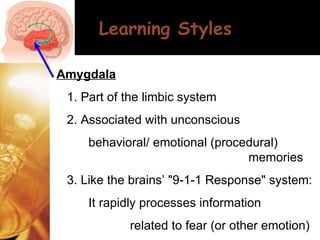
Learning Styles Amygdala   1. Part of the limbic system  2. Associated with unconscious  behavioral/ emotional (procedural)  memories  3. Like the brains’ "9-1-1 Response" system: It rapidly processes information    related to fear (or other emotion)
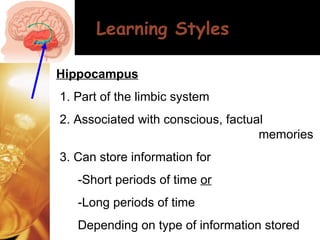
Hippocampus 1. Part of the limbic system  2. Associated with conscious, factual    memories  3. Can store information for -Short periods of time  or   -Long periods of time  Depending on type of information stored  Learning Styles
II. Learning styles simplified What to expect:
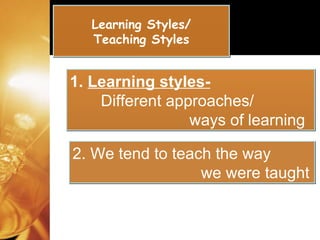
1.  Learning styles- Different approaches/  ways of learning Learning Styles/ Teaching Styles 2. We tend to teach the way we were taught
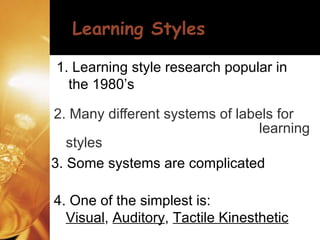
2. Many different systems of labels for  learning styles 3. Some systems are complicated 1. Learning style research popular in the 1980’s 4. One of the simplest is:  Visual ,  Auditory ,  Tactile Kinesthetic Learning Styles
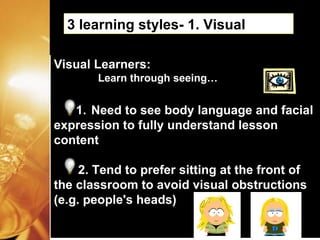
3 learning styles- 1. Visual Visual Learners: Learn through seeing… 1.   Need to see body language and facial expression to fully understand lesson content 2. Tend to prefer sitting at the front of the classroom to avoid visual obstructions (e.g. people's heads)
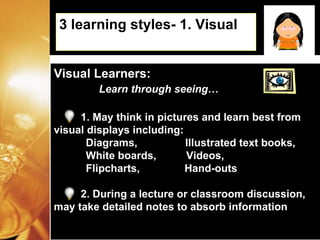
3 learning styles-  1. Visual Visual Learners: Learn through seeing … 1. May think in pictures and learn best from visual displays including:  Diagrams,  Illustrated text books,  White boards,  Videos,  Flipcharts,  Hand-outs   2. During a lecture or classroom discussion, may take detailed notes to absorb information
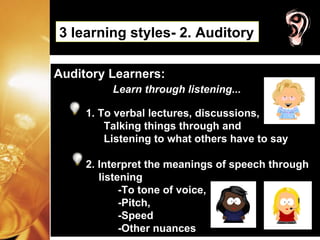
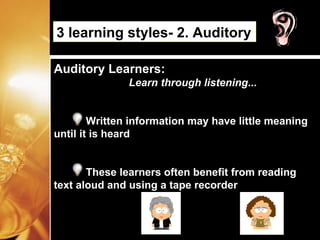
3 learning styles- 2. Auditory Auditory Learners: Learn through listening...   1. To verbal lectures, discussions,    Talking things through and    Listening to what others have to say  2. Interpret the meanings of speech through listening  -To tone of voice,  -Pitch,  -Speed  -Other nuances
3 learning styles- 2. Auditory Auditory Learners: Learn through listening...   Written information may have little meaning until it is heard  These learners often benefit from reading text aloud and using a tape recorder
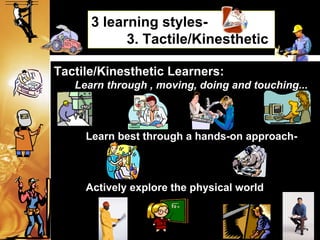
Tactile/Kinesthetic Learners: Learn through , moving, doing and touching...      Learn best through a hands-on approach- Actively explore the physical world 3 learning styles-  3. Tactile/Kinesthetic
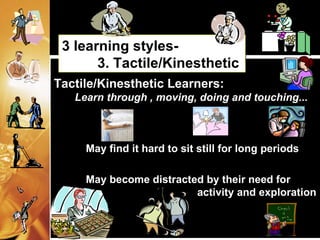
Tactile/Kinesthetic Learners: Learn through , moving, doing and touching...      May find it hard to sit still for long periods  May become distracted by their need for  activity and exploration   3 learning styles-  3. Tactile/Kinesthetic
III. Learning style instruments What to expect:
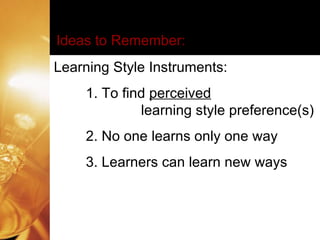
Learning Style Instruments:  1. To find  perceived       learning style preference(s) 2. No one learns only one way 3. Learners can learn new ways Ideas to Remember:
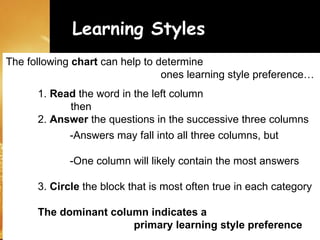
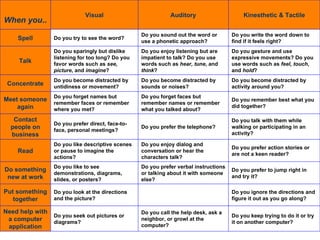
The following  chart  can help to determine    ones learning style preference…  1.  Read  the word in the left column    then  2.  Answer  the questions in the successive three columns  -Answers may fall into all three columns, but -One column will likely contain the most answers 3.  Circle  the block that is most often true in each category The dominant column indicates a  primary learning style preference Adapted from Colin Rose(1987). Accelerated Learning.     Learning Styles
Adapted from Colin Rose(1987). Accelerated Learning.     Do you keep trying to do it or try it on another computer? Do you call the help desk, ask a neighbor, or growl at the computer? Do you seek out pictures or diagrams? Need help with a computer application Do you ignore the directions and figure it out as you go along? Do you look at the directions and the picture? Put something together Do you prefer to jump right in and try it? Do you prefer verbal instructions or talking about it with someone else? Do you like to see demonstrations, diagrams, slides, or posters? Do something new at work Do you prefer action stories or are not a keen reader? Do you enjoy dialog and conversation or hear the characters talk? Do you like descriptive scenes or pause to imagine the actions? Read Do you talk with them while walking or participating in an activity? Do you prefer the telephone? Do you prefer direct, face-to-face, personal meetings? Contact people on business Do you remember best what you did together? Do you forget faces but remember names or remember what you talked about? Do you forget names but remember faces or remember where you met? Meet someone again Do you become distracted by activity around you? Do you become distracted by sounds or noises? Do you become distracted by untidiness or movement? Concentrate Do you gesture and use expressive movements? Do you use words such as  feel, touch , and  hold ? Do you enjoy listening but are impatient to talk? Do you use words such as  hear, tune , and  think ? Do you sparingly but dislike listening for too long? Do you favor words such as  see, picture , and  imagine ? Talk Do you write the word down to find if it feels right? Do you sound out the word or use a phonetic approach? Do you try to see the word? Spell Kinesthetic & Tactile Auditory Visual When you ..
1.  Learning styles- Different approaches/  ways of learning Learning Styles/ Teaching Styles 2. We tend to teach the way we were taught
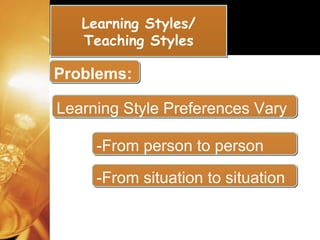
Problems: Learning Styles/ Teaching Styles Learning Style Preferences Vary -From person to person -From situation to situation
One good solution: Learning Styles/ Teaching Styles Use a variety of teaching styles!
IV. Suggestions for varied teaching What to expect:
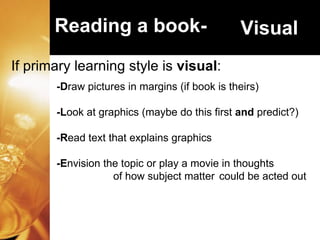
Reading a book-   If primary learning style is  visual : -D raw pictures in margins (if book is theirs) -L ook at graphics (maybe do this first  and  predict?) -R ead text that explains graphics  -E nvision the topic or play a movie in thoughts  of how subject matter   could be acted out   visual Visual
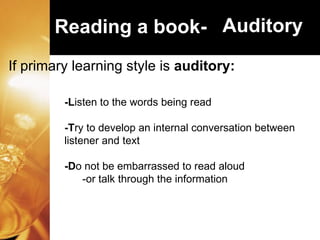
Auditory If primary learning style is  auditory: Reading a book-   -L isten to the words being read  -T ry to develop an internal conversation between listener and text -D o not be embarrassed to read aloud  -or talk through the information
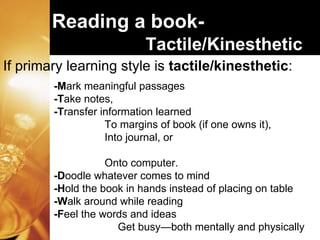
Tactile/Kinesthetic If primary learning style is  tactile/kinesthetic : -M ark meaningful passages  -T ake notes,  -T ransfer information learned  To margins of book (if one owns it),  Into journal, or  Onto computer.  -D oodle whatever comes to mind  -H old the book in hands instead of placing on table  -W alk around while reading  -F eel the words and ideas  Get busy—both mentally and physically  Reading a book-
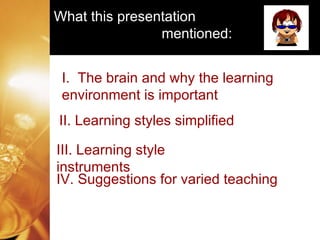
I.  The brain and why the learning environment is important III. Learning style instruments IV. Suggestions for varied teaching II. Learning styles simplified What this presentation    mentioned:
Here’s to a fantastic school year!
Sources and Further Reading http://agelesslearner.com/assess/learningstyle.html http://bostonreview.net/BR25.6/gardner.html http://www.fortnet.org/ParentToParent/PFellers/par_lern.html http://jeffcoweb.jeffco.k12.co.us/high/wotc/confli3.htm  http://members.aol.com/Rss51540/brain.html http://school.familyeducation.com/intelligence/teaching-methods/38519.html?f http://surfaquarium.com/MI/ http://www.chaminade.org/inspire/learnstl.htm http://www.abacon.com/slavin/glossary.html#a http://www.edutopia.org/php/people.php?id=c502824 http://www.emints.org/ethemes/resources/S00000718.shtml  http://www.ldpride.net/learningstyles.MI.htm#What%20are http://www.udel.edu/bateman/acei/multint9.htm