Who are you and what
do you want?
Creating Student Learning Profiles
Franchetta J. Beckford, J. D., Ph.D
8th grade ELA Differentiated Studies
Reid Ross Classical School
Cumberland County Schools
Roadmap
 Inviting students to learn (Wong)
 Student learning profiles (Tomlinson; Wormeli)
 Sample lessons designed to connect with
students and collect data (MI & Birth Order)
 My student learning profile form
 Sharing the data
 In closing
 References
 Let’s Connect
The First Days of School (Wong, 1991)
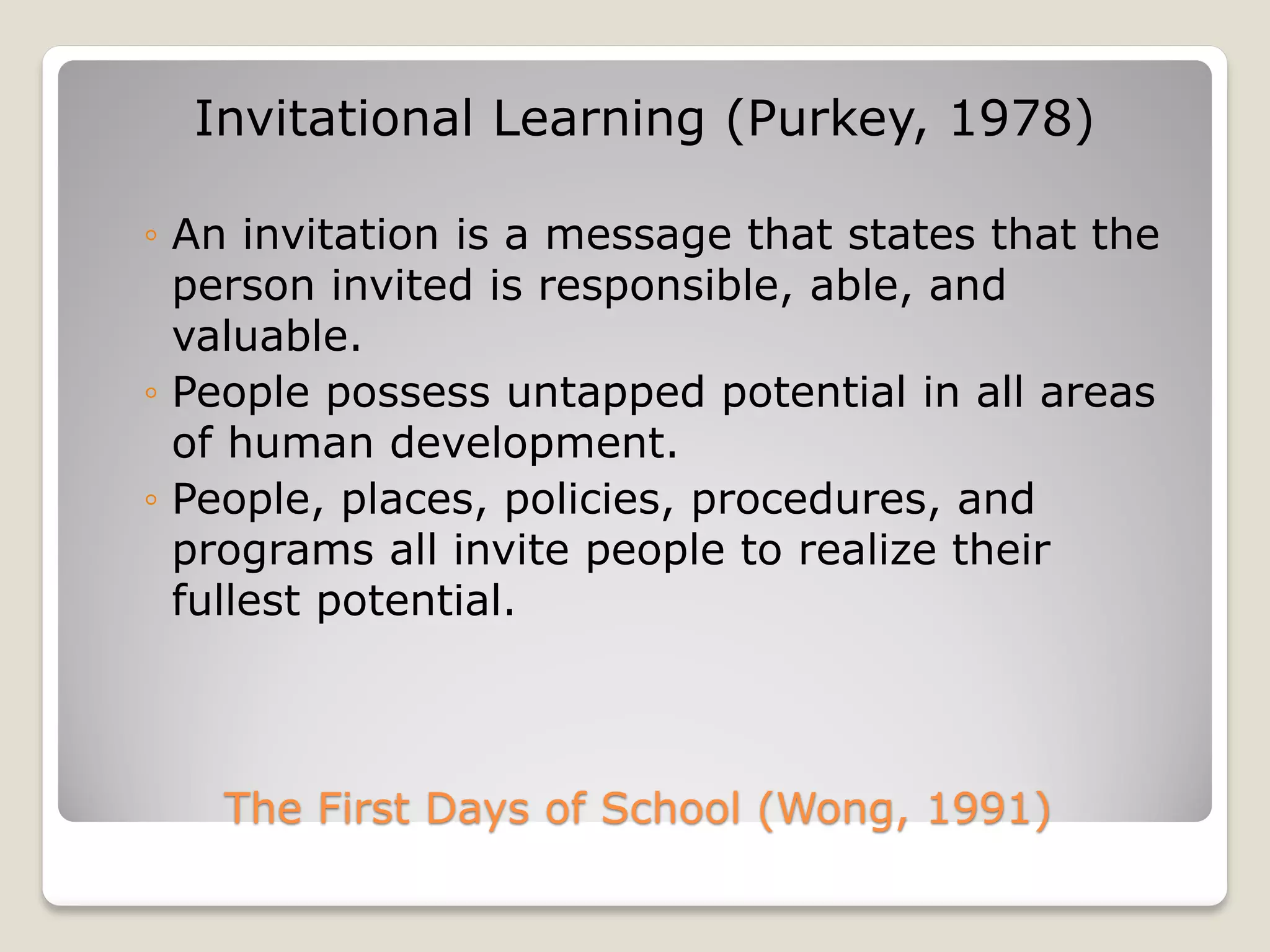
Invitational Learning (Purkey, 1978)
◦ An invitation is a message that states that the
person invited is responsible, able, and
valuable.
◦ People possess untapped potential in all areas
of human development.
◦ People, places, policies, procedures, and
programs all invite people to realize their
fullest potential.
Student Learning Profiles
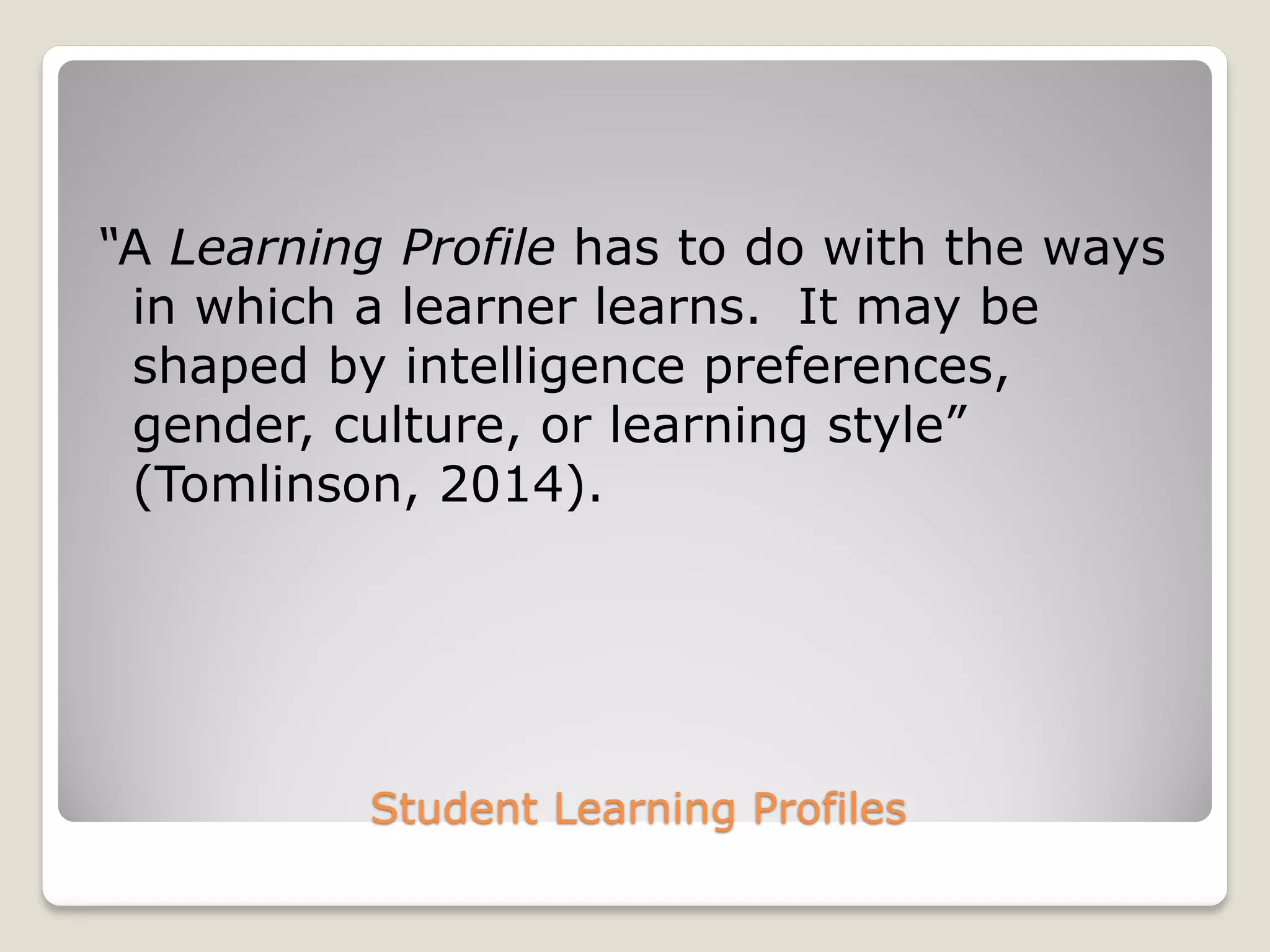
“A Learning Profile has to do with the ways
in which a learner learns. It may be
shaped by intelligence preferences,
gender, culture, or learning style”
(Tomlinson, 2014).
Student Learning Profiles
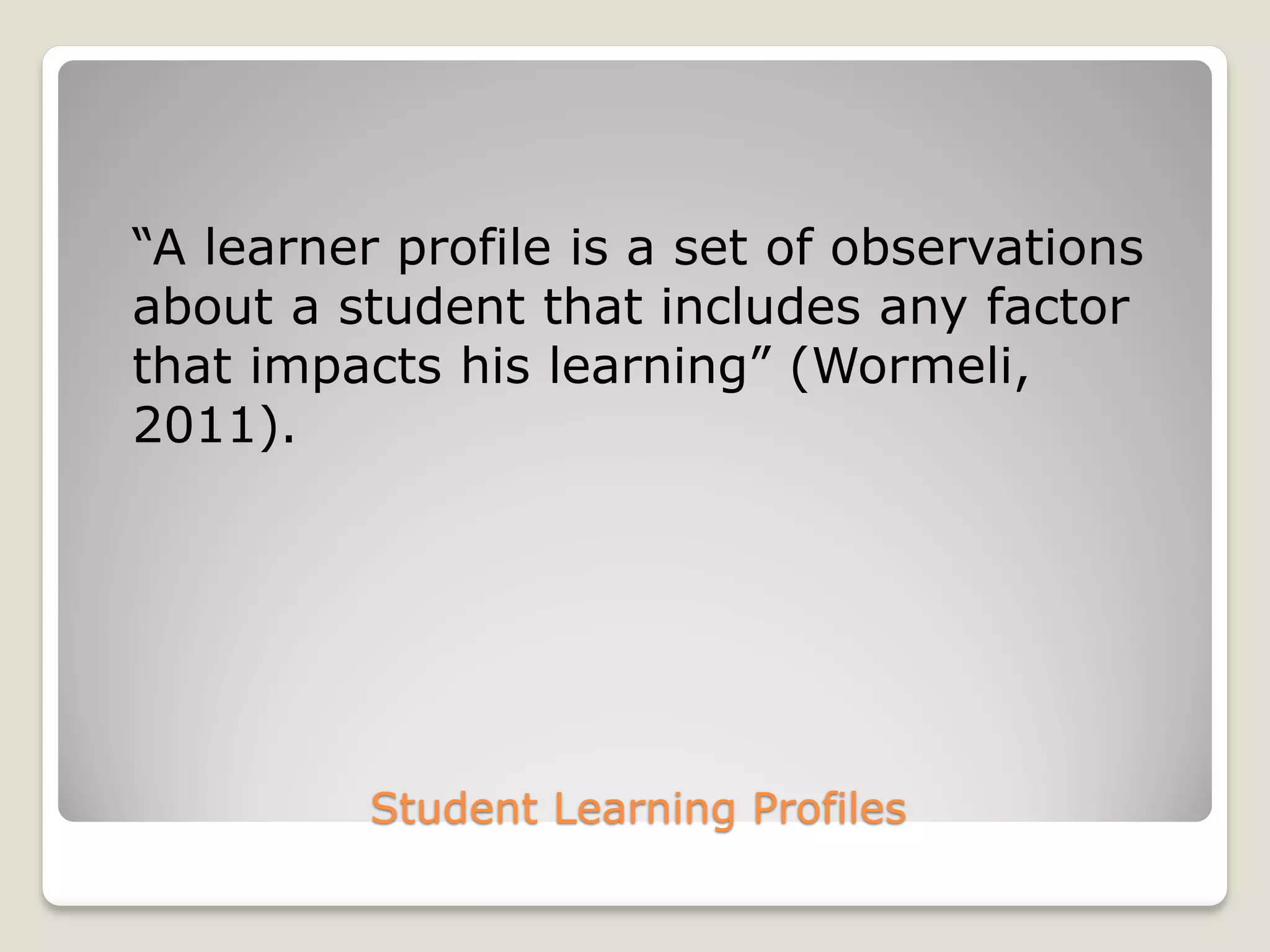
“A learner profile is a set of observations
about a student that includes any factor
that impacts his learning” (Wormeli,
2011).
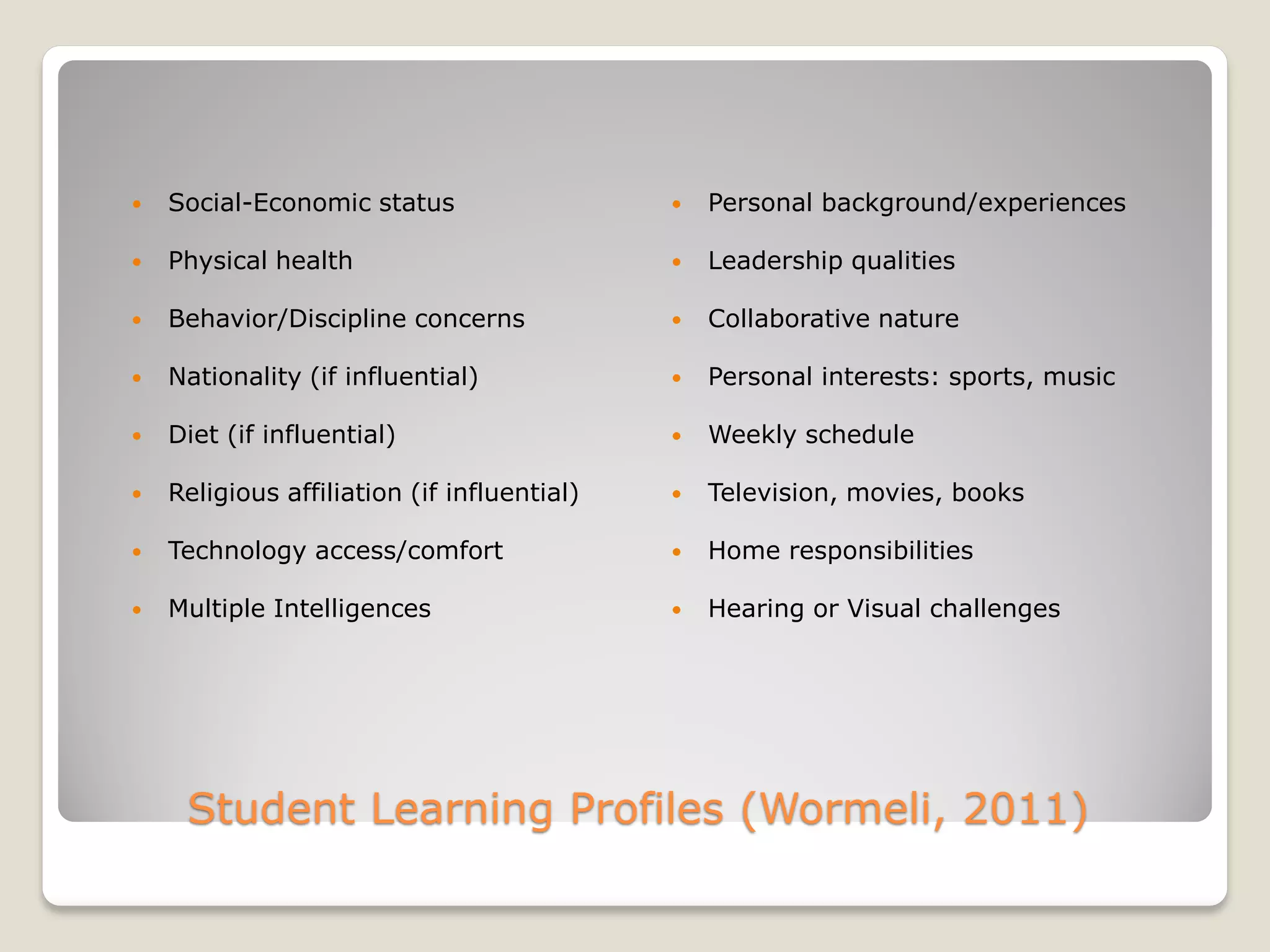
Student Learning Profiles (Wormeli, 2011)
 Social-Economic status
 Physical health
 Behavior/Discipline concerns
 Nationality (if influential)
 Diet (if influential)
 Religious affiliation (if influential)
 Technology access/comfort
 Multiple Intelligences
 Personal background/experiences
 Leadership qualities
 Collaborative nature
 Personal interests: sports, music
 Weekly schedule
 Television, movies, books
 Home responsibilities
 Hearing or Visual challenges
Station
Break
Big Data—volume/velocity/variety (Biggs, 2014)
vs.
Reflective Teacher (Anderson, 2009)
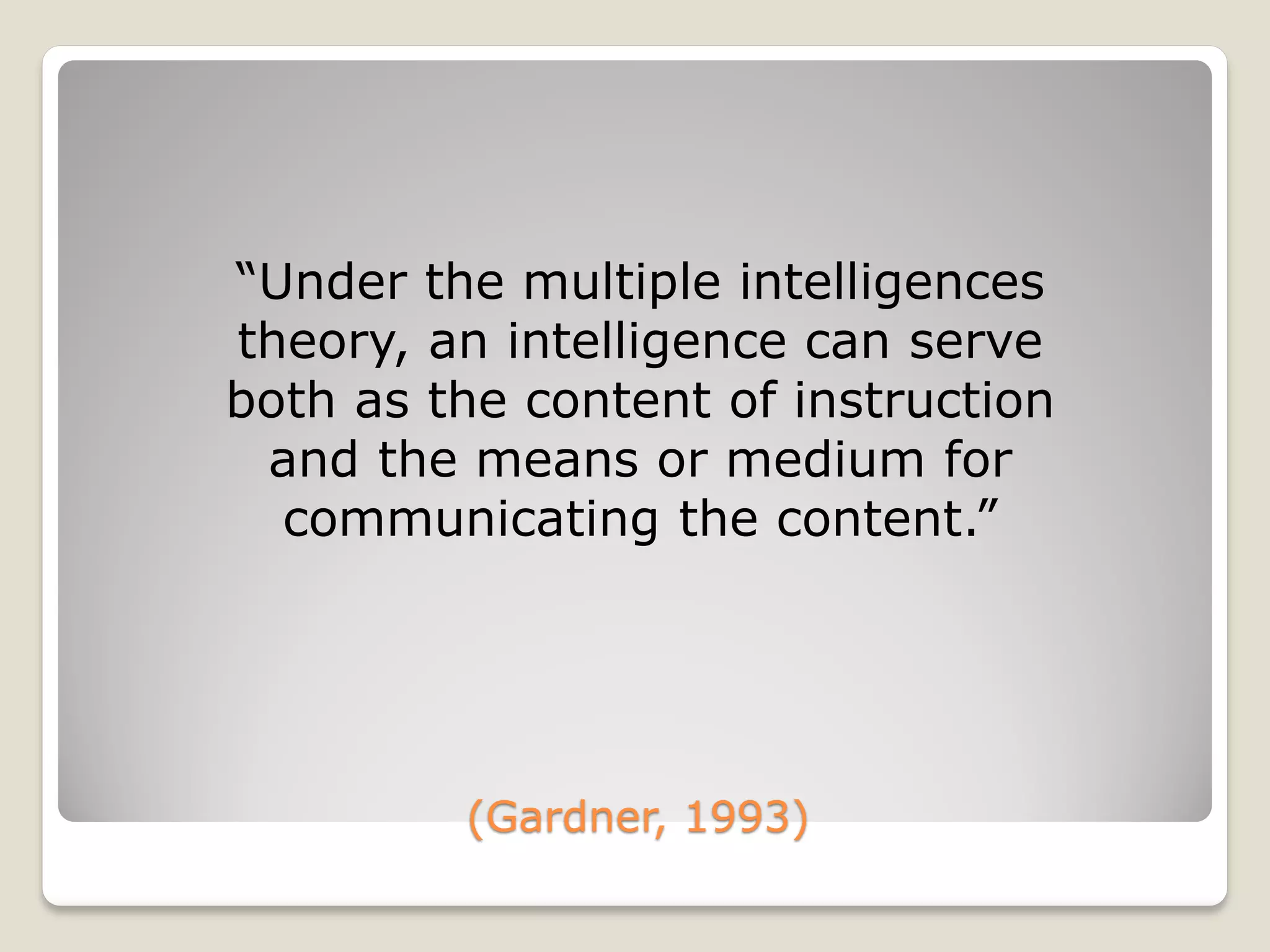
(Gardner, 1993)
“Under the multiple intelligences
theory, an intelligence can serve
both as the content of instruction
and the means or medium for
communicating the content.”
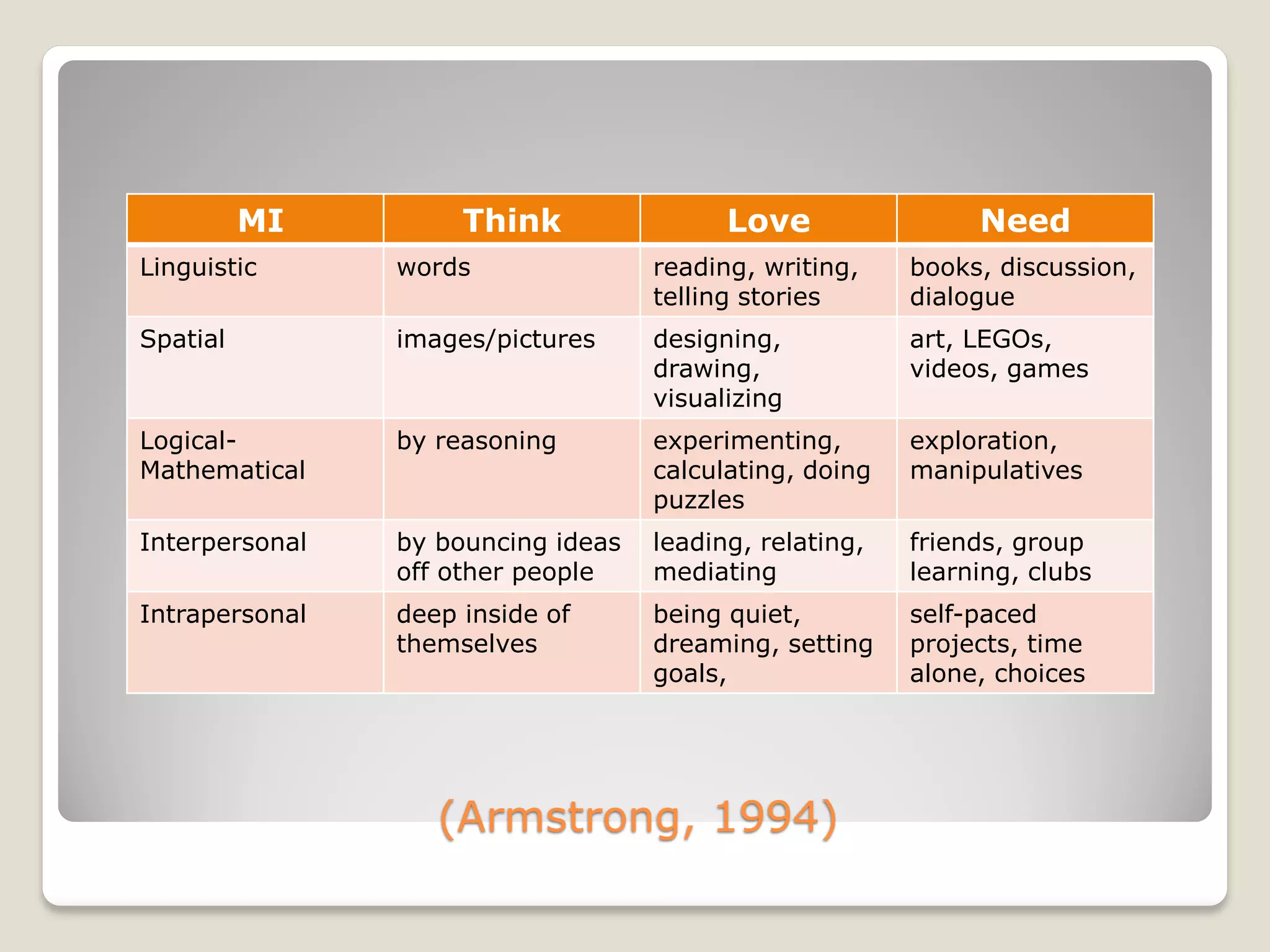
(Armstrong, 1994)
MI Think Love Need
Linguistic words reading, writing,
telling stories
books, discussion,
dialogue
Spatial images/pictures designing,
drawing,
visualizing
art, LEGOs,
videos, games
Logical-
Mathematical
by reasoning experimenting,
calculating, doing
puzzles
exploration,
manipulatives
Interpersonal by bouncing ideas
off other people
leading, relating,
mediating
friends, group
learning, clubs
Intrapersonal deep inside of
themselves
being quiet,
dreaming, setting
goals,
self-paced
projects, time
alone, choices
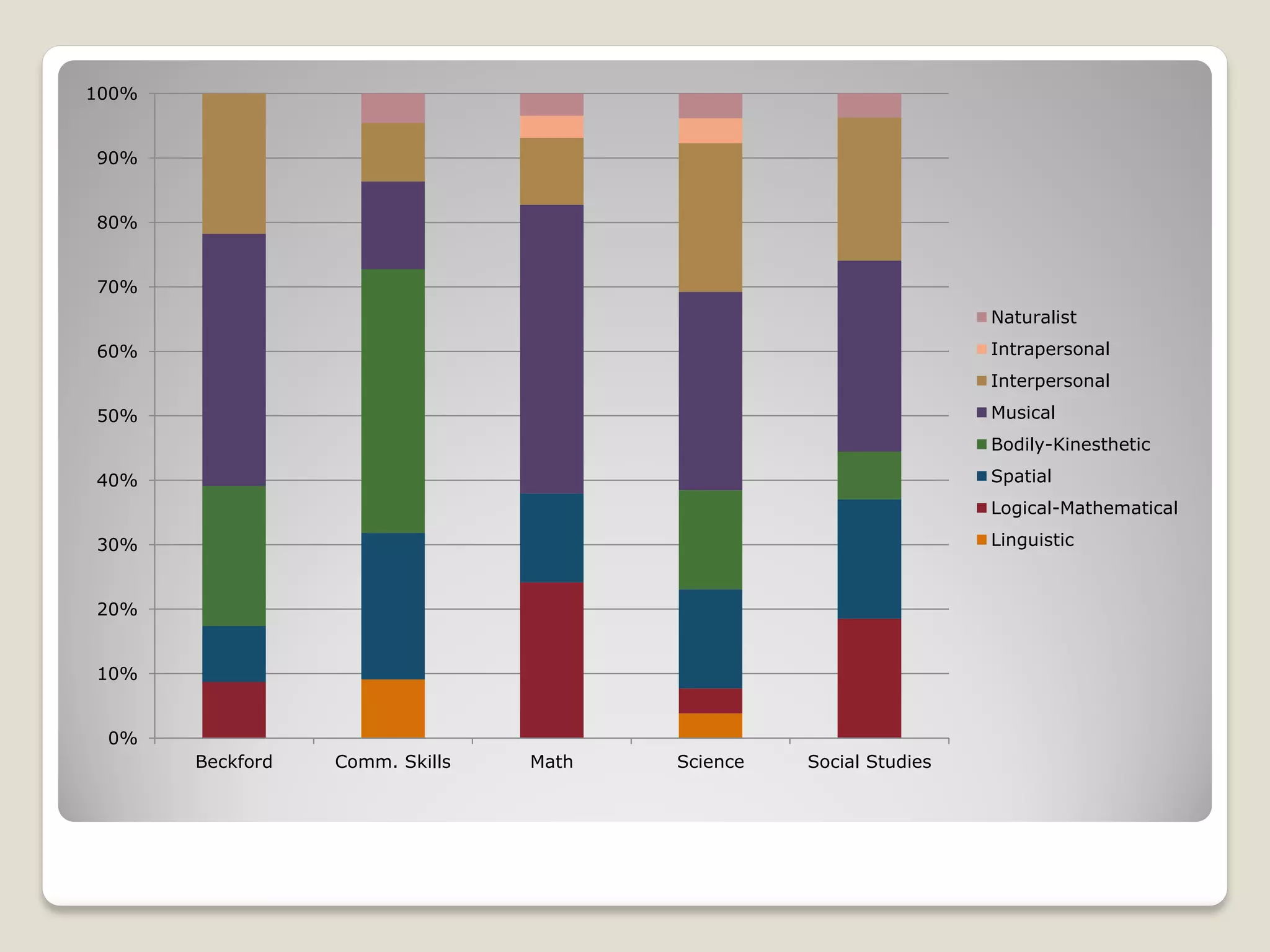
0%
10%
20%
30%
40%
50%
60%
70%
80%
90%
100%
Beckford Comm. Skills Math Science Social Studies
Naturalist
Intrapersonal
Interpersonal
Musical
Bodily-Kinesthetic
Spatial
Logical-Mathematical
Linguistic
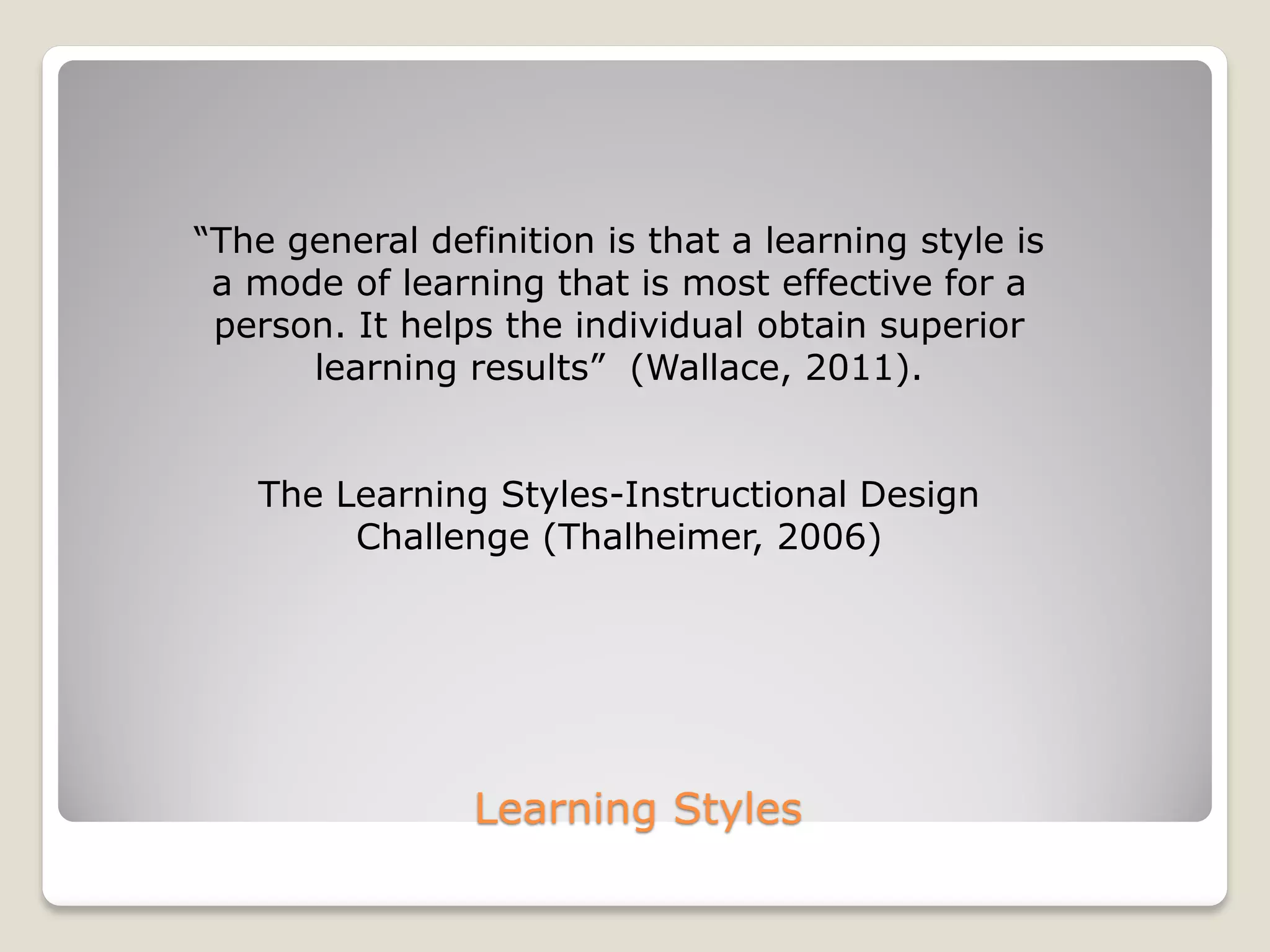
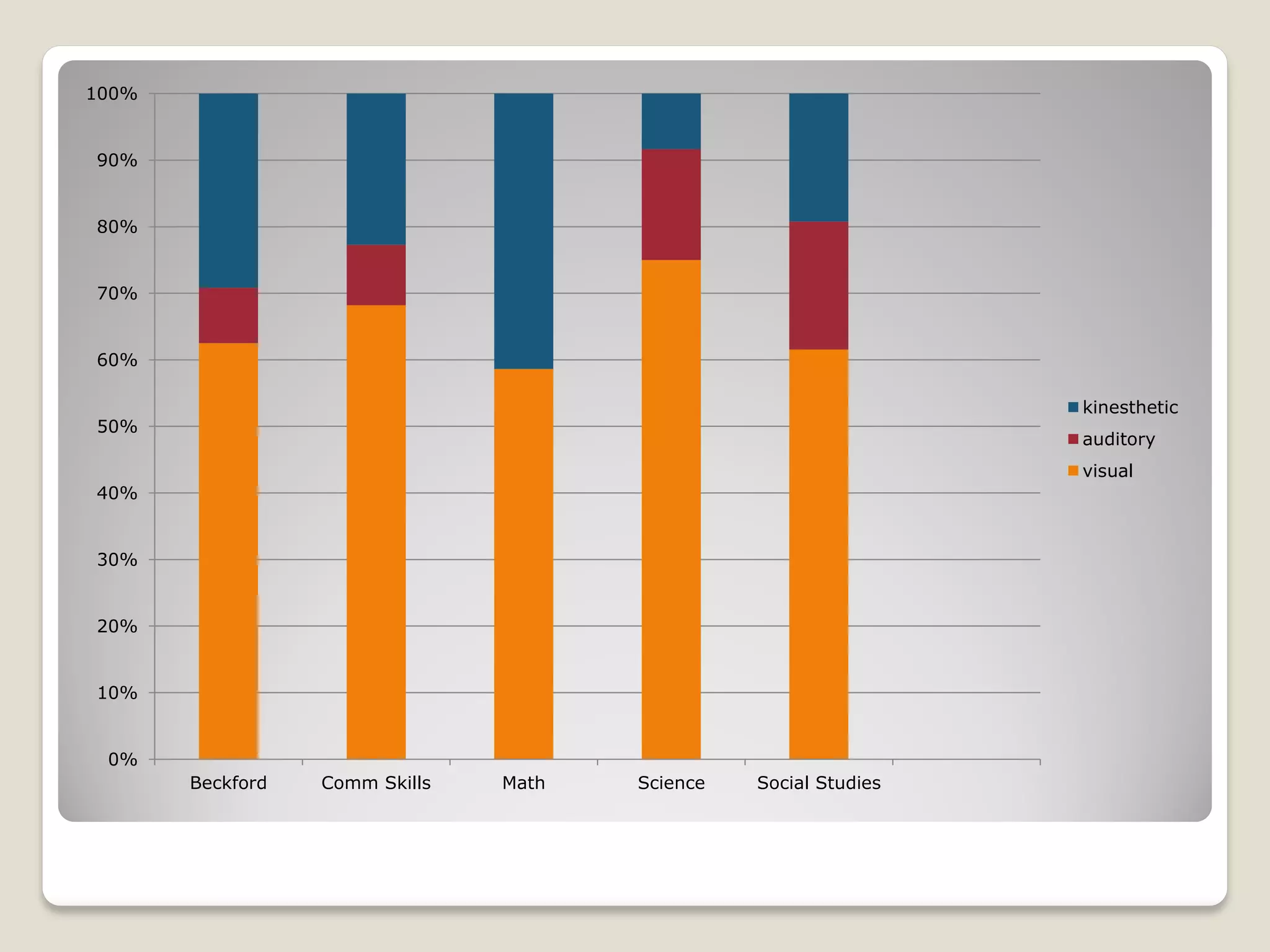
Learning Styles
“The general definition is that a learning style is
a mode of learning that is most effective for a
person. It helps the individual obtain superior
learning results” (Wallace, 2011).
The Learning Styles-Instructional Design
Challenge (Thalheimer, 2006)
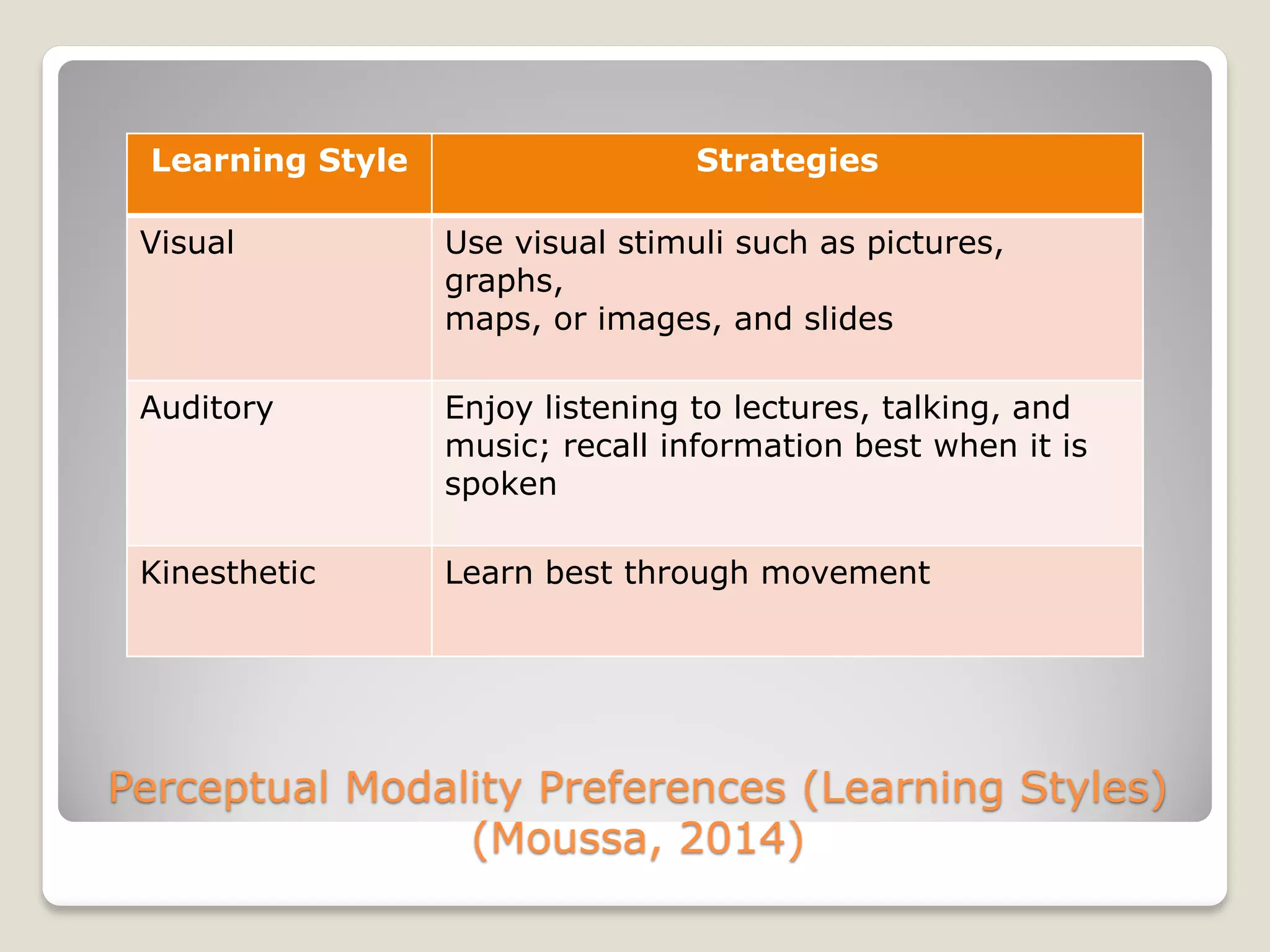
Perceptual Modality Preferences (Learning Styles)
(Moussa, 2014)
Learning Style Strategies
Visual Use visual stimuli such as pictures,
graphs,
maps, or images, and slides
Auditory Enjoy listening to lectures, talking, and
music; recall information best when it is
spoken
Kinesthetic Learn best through movement
0%
10%
20%
30%
40%
50%
60%
70%
80%
90%
100%
Beckford Comm Skills Math Science Social Studies
kinesthetic
auditory
visual
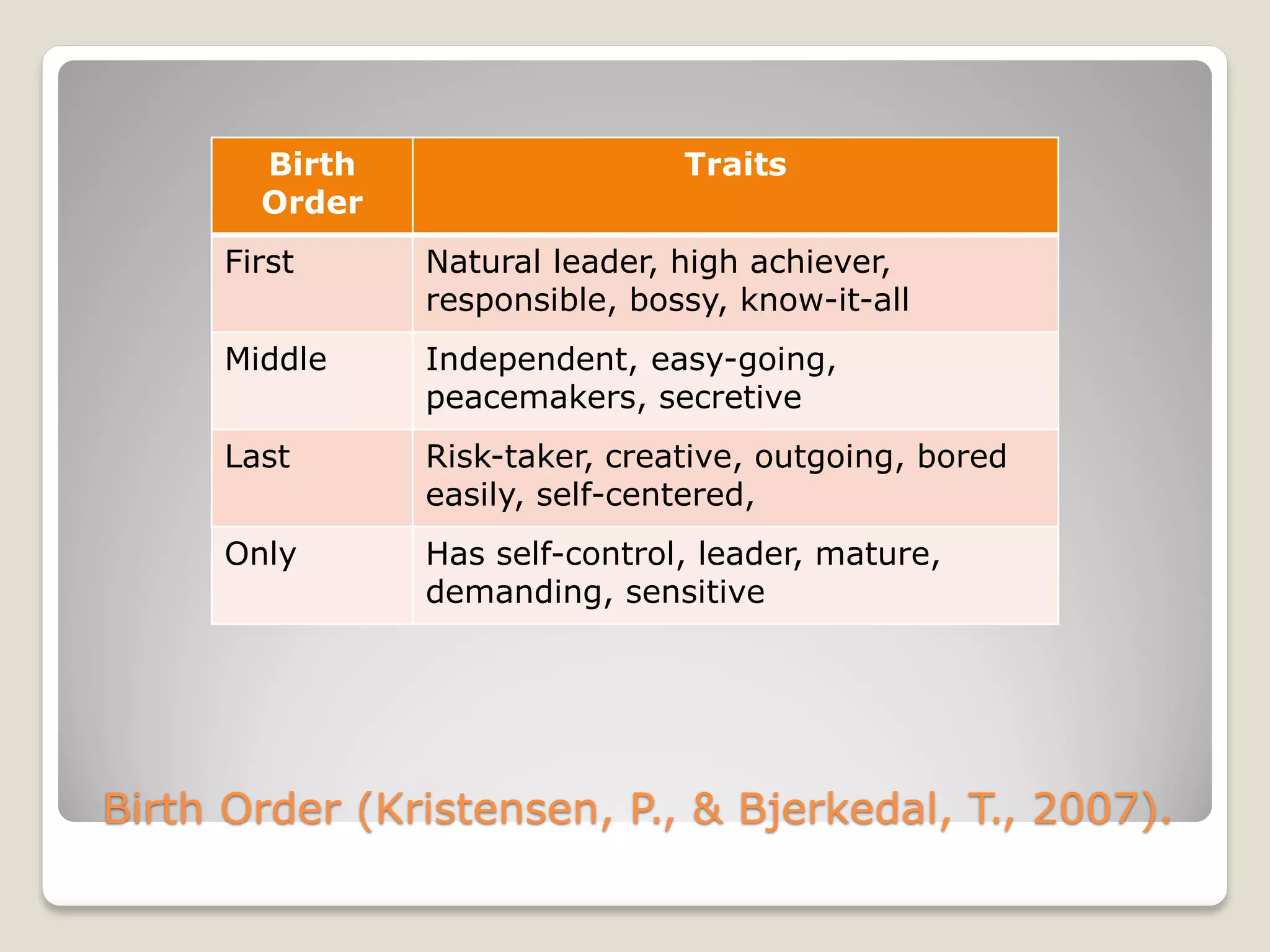
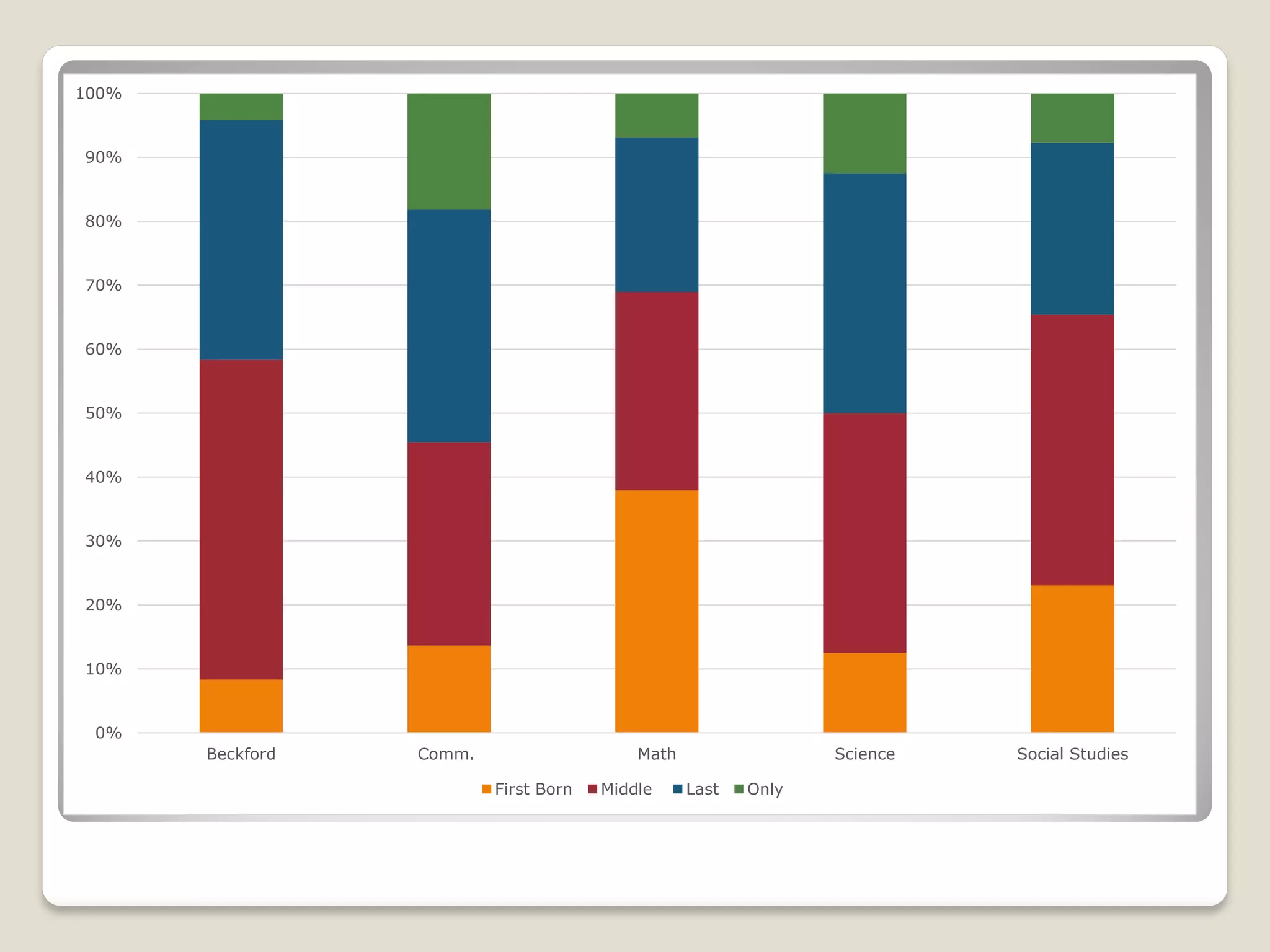
Birth Order (Kristensen, P., & Bjerkedal, T., 2007).
Birth
Order
Traits
First Natural leader, high achiever,
responsible, bossy, know-it-all
Middle Independent, easy-going,
peacemakers, secretive
Last Risk-taker, creative, outgoing, bored
easily, self-centered,
Only Has self-control, leader, mature,
demanding, sensitive
0%
10%
20%
30%
40%
50%
60%
70%
80%
90%
100%
Beckford Comm. Math Science Social Studies
First Born Middle Last Only
0%
10%
20%
30%
40%
50%
60%
70%
80%
90%
100%
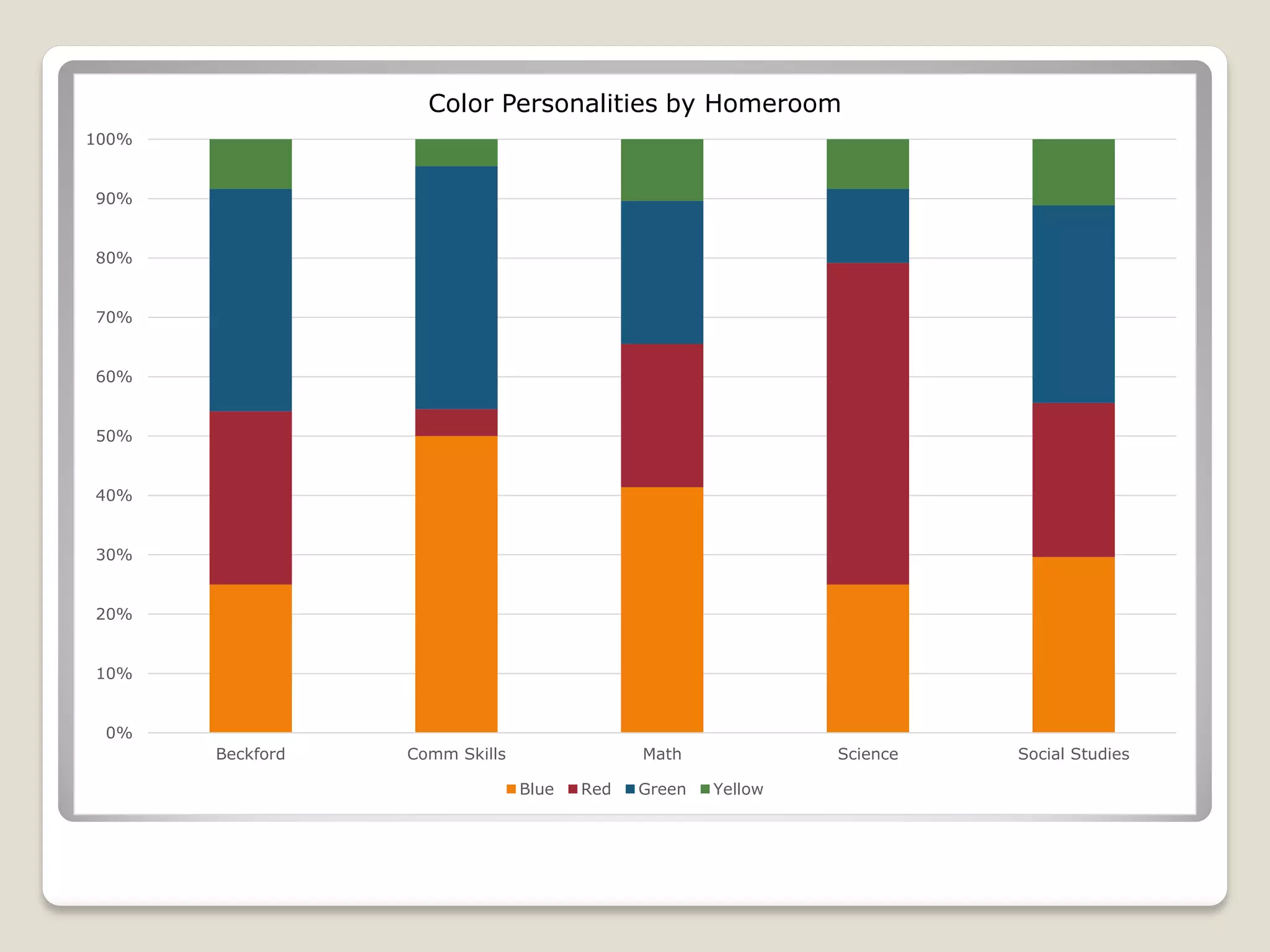
Beckford Comm Skills Math Science Social Studies
Color Personalities by Homeroom
Blue Red Green Yellow
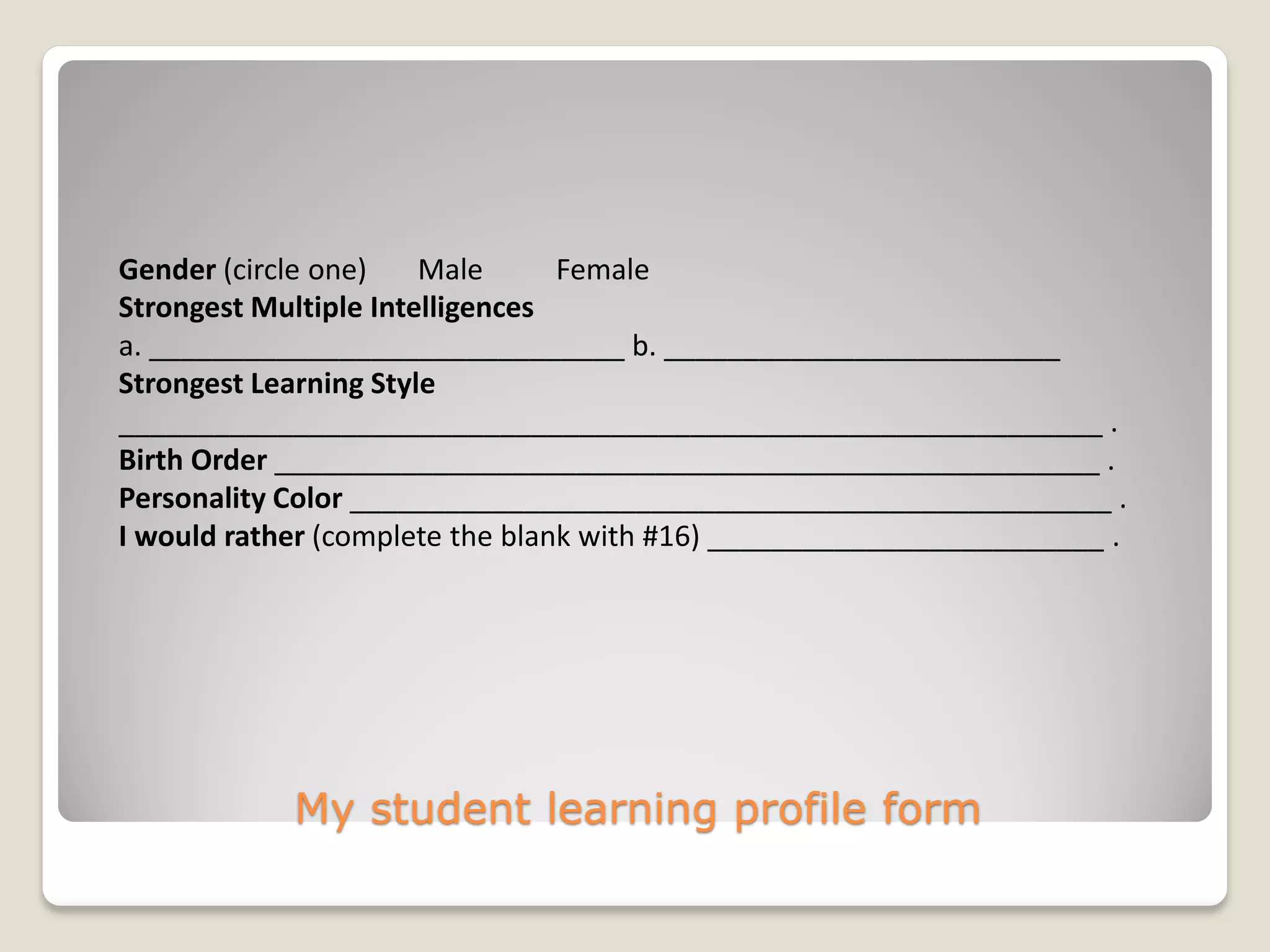
My student learning profile form
Gender (circle one) Male Female
Strongest Multiple Intelligences
a. ______________________________ b. _________________________
Strongest Learning Style
______________________________________________________________ .
Birth Order ____________________________________________________ .
Personality Color ________________________________________________ .
I would rather (complete the blank with #16) _________________________ .
In closing—What I Learned
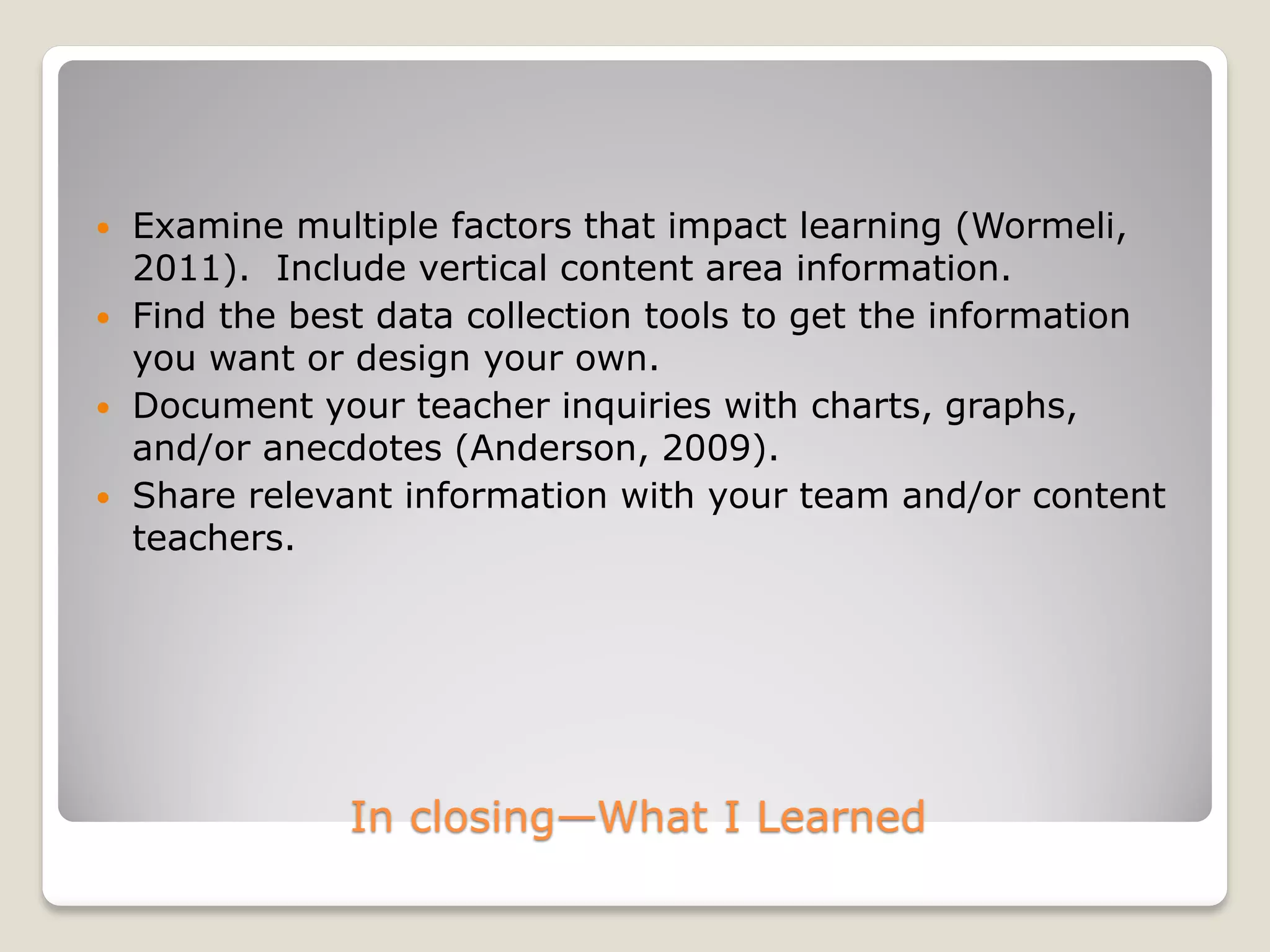
 Examine multiple factors that impact learning (Wormeli,
2011). Include vertical content area information.
 Find the best data collection tools to get the information
you want or design your own.
 Document your teacher inquiries with charts, graphs,
and/or anecdotes (Anderson, 2009).
 Share relevant information with your team and/or content
teachers.
References
 Anderson, P. M. (2009). Pedagogy. New York: Peter Lang Publishing, Inc.
 Armstrong, T. (1994). Multiple intelligences: In the classroom. Alexandria: ASCD.
 Briggs, S. (January 2014). Big Data in Education: Big Potential or Big Mistake? Retrieved from
http://www.innovationexcellence.com/blog/2014/01/29/big-data-in-education-big-potential-or-big-
mistake/#sthash.RStOBmRf.dpuf
 Gardner, H. (1993). Multiple intelligences: The theory in practice. New York: Basic Books.
 Kristensen, P., & Bjerkedal, T. (2007). Explaining the Relation between Birth Order and Intelligence.
Science, 316 (5832), 1717-1718. Summary retrieved from
http://science.sciencemag.org/content/316/5832/1717.full
 Moussa, N. (2014). The importance of learning styles in education. Institute for Learning Styles Journal,
1, 19-27. Retrieved from
http://www.auburn.edu/academic/education/ilsrj/Journal%20Volumes/Fall%202014%20Vol%201%20PDF
s/Learning%20Styles%20Nahla%20Moussa.pdf
 Peery, A. B. (2009). Writing matters in every classroom. Englewood: Advanced Learning Press.
 ReadWriteThink.org. I-search chart. Retrieved from www.readwritethink.org/classroom-
resources/printouts/search-chart-30787.html
 Thalheimer, W. (2006). Learning style-instructional design challenge. Retrieved from
http://www.willatworklearning.com/2006/08/learning_styles.html
 Tomlinson, C. A. (2014). The differentiated classroom: Responding to the needs of all learners. 2nd
edition Alexandria: ASCD.
 Wallace, G. W. (November 2011). Why is the research on learning styles still being dismissed by some
learning leaders and practitioners? eLearn Magazine. Retrieved from
http://elearnmag.acm.org/featured.cfm?aid=2070611
 Wong, H. K., & Wong, R. T. (1991). The first days of school: How to be an effective teacher.
Mountainview: Harry Wong Publications.
 Wormeli, R. (October 2011). Differentiated instruction: Setting the pedagogy straight. Retrieved from
https://spf665instructionaldesignassess.wikispaces.com/file/view/Wormeli+Setting+the+Pedagogy+Straig
ht.pdf
Let’s Connect
 Email: dr.fjbeckford@gmail.com
 School email:
franchettabeckford@ccs.k12.nc.us
 Twitter: @Dr_Beckford

Who are you and what do you want? Creating Student Learning Profiles

  • 1.
    Who are youand what do you want? Creating Student Learning Profiles Franchetta J. Beckford, J. D., Ph.D 8th grade ELA Differentiated Studies Reid Ross Classical School Cumberland County Schools
  • 2.
    Roadmap  Inviting studentsto learn (Wong)  Student learning profiles (Tomlinson; Wormeli)  Sample lessons designed to connect with students and collect data (MI & Birth Order)  My student learning profile form  Sharing the data  In closing  References  Let’s Connect
  • 3.
    The First Daysof School (Wong, 1991) Invitational Learning (Purkey, 1978) ◦ An invitation is a message that states that the person invited is responsible, able, and valuable. ◦ People possess untapped potential in all areas of human development. ◦ People, places, policies, procedures, and programs all invite people to realize their fullest potential.
  • 4.
    Student Learning Profiles “ALearning Profile has to do with the ways in which a learner learns. It may be shaped by intelligence preferences, gender, culture, or learning style” (Tomlinson, 2014).
  • 5.
    Student Learning Profiles “Alearner profile is a set of observations about a student that includes any factor that impacts his learning” (Wormeli, 2011).
  • 6.
    Student Learning Profiles(Wormeli, 2011)  Social-Economic status  Physical health  Behavior/Discipline concerns  Nationality (if influential)  Diet (if influential)  Religious affiliation (if influential)  Technology access/comfort  Multiple Intelligences  Personal background/experiences  Leadership qualities  Collaborative nature  Personal interests: sports, music  Weekly schedule  Television, movies, books  Home responsibilities  Hearing or Visual challenges
  • 7.
    Station Break Big Data—volume/velocity/variety (Biggs,2014) vs. Reflective Teacher (Anderson, 2009)
  • 8.
    (Gardner, 1993) “Under themultiple intelligences theory, an intelligence can serve both as the content of instruction and the means or medium for communicating the content.”
  • 9.
    (Armstrong, 1994) MI ThinkLove Need Linguistic words reading, writing, telling stories books, discussion, dialogue Spatial images/pictures designing, drawing, visualizing art, LEGOs, videos, games Logical- Mathematical by reasoning experimenting, calculating, doing puzzles exploration, manipulatives Interpersonal by bouncing ideas off other people leading, relating, mediating friends, group learning, clubs Intrapersonal deep inside of themselves being quiet, dreaming, setting goals, self-paced projects, time alone, choices
  • 10.
    0% 10% 20% 30% 40% 50% 60% 70% 80% 90% 100% Beckford Comm. SkillsMath Science Social Studies Naturalist Intrapersonal Interpersonal Musical Bodily-Kinesthetic Spatial Logical-Mathematical Linguistic
  • 11.
    Learning Styles “The generaldefinition is that a learning style is a mode of learning that is most effective for a person. It helps the individual obtain superior learning results” (Wallace, 2011). The Learning Styles-Instructional Design Challenge (Thalheimer, 2006)
  • 12.
    Perceptual Modality Preferences(Learning Styles) (Moussa, 2014) Learning Style Strategies Visual Use visual stimuli such as pictures, graphs, maps, or images, and slides Auditory Enjoy listening to lectures, talking, and music; recall information best when it is spoken Kinesthetic Learn best through movement
  • 13.
    0% 10% 20% 30% 40% 50% 60% 70% 80% 90% 100% Beckford Comm SkillsMath Science Social Studies kinesthetic auditory visual
  • 14.
    Birth Order (Kristensen,P., & Bjerkedal, T., 2007). Birth Order Traits First Natural leader, high achiever, responsible, bossy, know-it-all Middle Independent, easy-going, peacemakers, secretive Last Risk-taker, creative, outgoing, bored easily, self-centered, Only Has self-control, leader, mature, demanding, sensitive
  • 15.
    0% 10% 20% 30% 40% 50% 60% 70% 80% 90% 100% Beckford Comm. MathScience Social Studies First Born Middle Last Only
  • 16.
    0% 10% 20% 30% 40% 50% 60% 70% 80% 90% 100% Beckford Comm SkillsMath Science Social Studies Color Personalities by Homeroom Blue Red Green Yellow
  • 17.
    My student learningprofile form Gender (circle one) Male Female Strongest Multiple Intelligences a. ______________________________ b. _________________________ Strongest Learning Style ______________________________________________________________ . Birth Order ____________________________________________________ . Personality Color ________________________________________________ . I would rather (complete the blank with #16) _________________________ .
  • 19.
    In closing—What ILearned  Examine multiple factors that impact learning (Wormeli, 2011). Include vertical content area information.  Find the best data collection tools to get the information you want or design your own.  Document your teacher inquiries with charts, graphs, and/or anecdotes (Anderson, 2009).  Share relevant information with your team and/or content teachers.
  • 20.
    References  Anderson, P.M. (2009). Pedagogy. New York: Peter Lang Publishing, Inc.  Armstrong, T. (1994). Multiple intelligences: In the classroom. Alexandria: ASCD.  Briggs, S. (January 2014). Big Data in Education: Big Potential or Big Mistake? Retrieved from http://www.innovationexcellence.com/blog/2014/01/29/big-data-in-education-big-potential-or-big- mistake/#sthash.RStOBmRf.dpuf  Gardner, H. (1993). Multiple intelligences: The theory in practice. New York: Basic Books.  Kristensen, P., & Bjerkedal, T. (2007). Explaining the Relation between Birth Order and Intelligence. Science, 316 (5832), 1717-1718. Summary retrieved from http://science.sciencemag.org/content/316/5832/1717.full  Moussa, N. (2014). The importance of learning styles in education. Institute for Learning Styles Journal, 1, 19-27. Retrieved from http://www.auburn.edu/academic/education/ilsrj/Journal%20Volumes/Fall%202014%20Vol%201%20PDF s/Learning%20Styles%20Nahla%20Moussa.pdf  Peery, A. B. (2009). Writing matters in every classroom. Englewood: Advanced Learning Press.  ReadWriteThink.org. I-search chart. Retrieved from www.readwritethink.org/classroom- resources/printouts/search-chart-30787.html  Thalheimer, W. (2006). Learning style-instructional design challenge. Retrieved from http://www.willatworklearning.com/2006/08/learning_styles.html  Tomlinson, C. A. (2014). The differentiated classroom: Responding to the needs of all learners. 2nd edition Alexandria: ASCD.  Wallace, G. W. (November 2011). Why is the research on learning styles still being dismissed by some learning leaders and practitioners? eLearn Magazine. Retrieved from http://elearnmag.acm.org/featured.cfm?aid=2070611  Wong, H. K., & Wong, R. T. (1991). The first days of school: How to be an effective teacher. Mountainview: Harry Wong Publications.  Wormeli, R. (October 2011). Differentiated instruction: Setting the pedagogy straight. Retrieved from https://spf665instructionaldesignassess.wikispaces.com/file/view/Wormeli+Setting+the+Pedagogy+Straig ht.pdf
  • 21.
    Let’s Connect  Email:dr.fjbeckford@gmail.com  School email: franchettabeckford@ccs.k12.nc.us  Twitter: @Dr_Beckford