Is Matter Around Us Pure
Chapter 2: NCERT
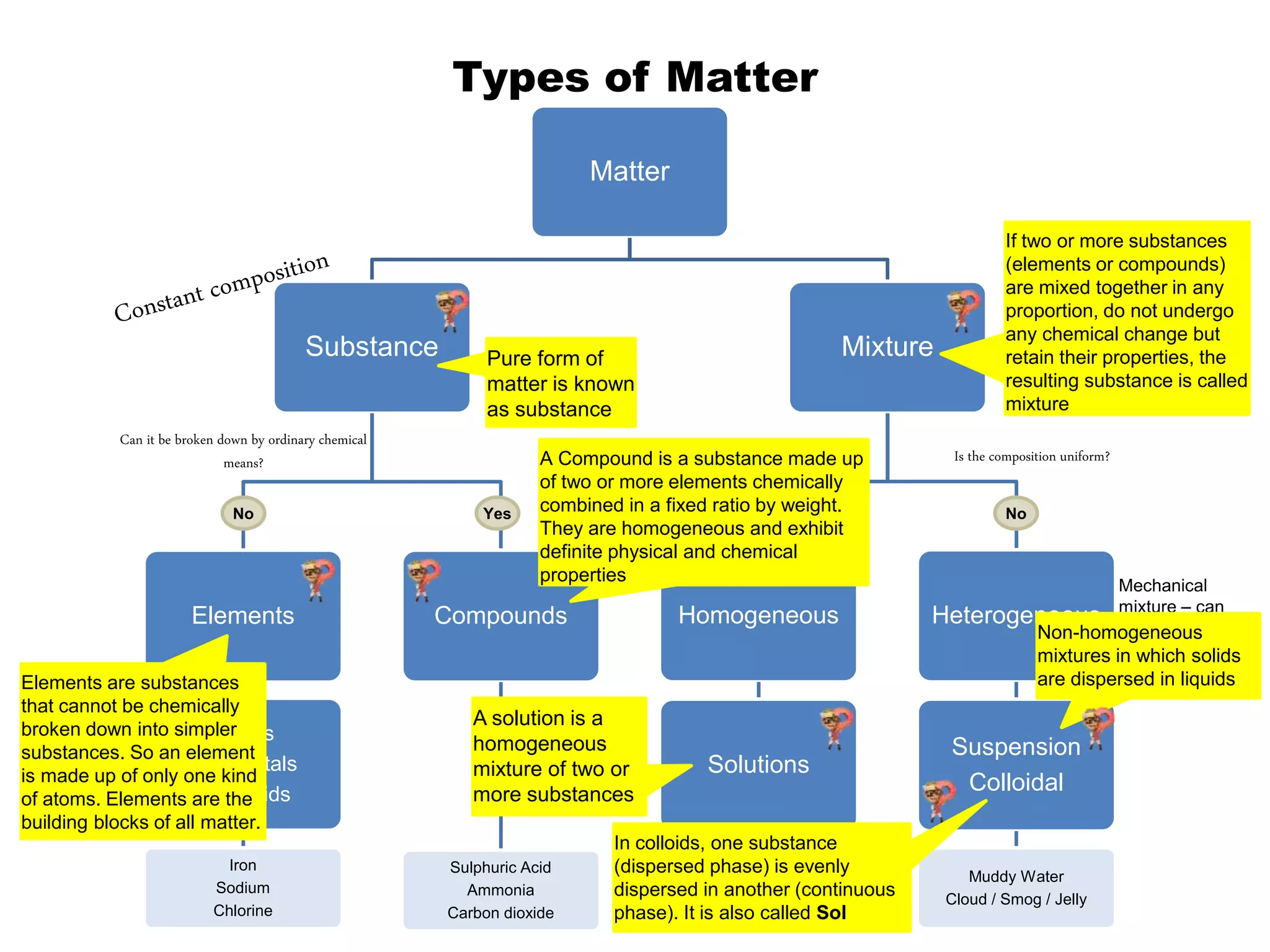
Types of Matter
Matter
Substance
Elements
Metals
Non-metals
Metalloids
Iron
Sodium
Chlorine
Compounds
Sulphuric Acid
Ammonia
Carbon dioxide
Mixture
Homogeneous
Solutions
Salt water
Mouthwash
Air
Heterogeneous
Suspension
Colloidal
Muddy Water
Cloud / Smog / Jelly
Can it be broken down by ordinary chemical
means?
YesNo
Is the composition uniform?
Yes No
Pure form of
matter is known
as substance
If two or more substances
(elements or compounds)
are mixed together in any
proportion, do not undergo
any chemical change but
retain their properties, the
resulting substance is called
mixture
A solution is a
homogeneous
mixture of two or
more substances
Elements are substances
that cannot be chemically
broken down into simpler
substances. So an element
is made up of only one kind
of atoms. Elements are the
building blocks of all matter.
A Compound is a substance made up
of two or more elements chemically
combined in a fixed ratio by weight.
They are homogeneous and exhibit
definite physical and chemical
properties
Mechanical
mixture – can
be separated
by hand
Non-homogeneous
mixtures in which solids
are dispersed in liquids
In colloids, one substance
(dispersed phase) is evenly
dispersed in another (continuous
phase). It is also called Sol
Difference between
Metals Non-metals
1. They have luster (shine) 1. They are not lustrous
2. They have silvery-grey or golden-yellow colour 2. They display a variety of colors
3. They conduct heat and electricity 3. They are poor conductors of heat and electricity
4. They are ductile (can be drawn into wires) 4. They are not ductile
5. They are malleable (can be hammered into thin sheets) 5. They are not malleable
6. They are sonorous (make a ringing sound when hit) 6. They are not sonorous
7. Examples are gold, silver, iron, potassium 7. Examples are carbon, chlorine, oxygen, iodine
Metalloids have properties between Metals and Non-metals. Examples are Boron, silicon, germanium
Compound Mixture
It is made up of two or more elements that are chemically
combined.
It is made up of two or more pure substances that are
mixed physically
A compound has definite melting and boiling points and
density
A mixture has no definite melting or boiling points and
density
The properties of a compound are entirely different from
those of its constituents
A mixture retains the properties of the components
A compound is always homogeneous A mixture is heterogeneous, and some are homogeneous
The constituents of a compound cannot be separated by
physical means
The components of a mixture can be separated by simple
physical means,( eg. dissolving, magnetic separation, etc)
Difference between
Homogeneous Mixtures Heterogeneous Mixtures
1. Homogeneous mixtures have uniform composition. 1. Heterogeneous mixtures have non uniform composition
2. It has no visible boundaries of separation between its
constituents
Particles Not visible to unaided eye
2. It has visible boundaries of separation between its
constituents
Particles may be visible to unaided eye
3. All solutions are homogenous mixture 3. All suspensions are heterogeneous mixture
4. Some examples of homogeneous mixtures are: salt in
water, sugar in water, air, blood
4. Some examples of heterogeneous mixtures are: water
and sand, oil and water, soup
Solute Solvent
1. Present in lesser proportion in the solution 1. Present in greater proportion in the solution
2. Dispersed phase 2. Medium of dispersion in a solution
3. Solution may or may not be in the same state of matter
as the solute
3. Solution will be in the same state of matter as the
solvent.
Questions
Q. What is meant by a substance?
A. Pure form of matter is known as substance.
Q. What is a solution?
A. A solution is a homogeneous mixture of two or more substances.
Type Example Solute Solvent
Gas solutions
Gas in gas Air Oxygen (gas) Nitrogen (gas)
Liquid solutions
Gas in Liquid
Liquid in Liquid
Solid in Liquid
Soda Water
Vinegar
Sea water
Tincture of Iodine
Carbon dioxide gas (gas)
Acetic acid (liquid)
Salt (solid)
Iodine (solid)
Water (liquid)
Water (liquid)
Water (liquid)
Alcohol (liquid)
Solid solutions
Liquid in solid
Solid in solid
Dental amalgam
Brass
Steel
Mercury (Liquid)
Zinc (solid)
Carbon (solid)
Silver (solid)
Copper (solid)
Iron (solid
Alloys are mixtures of two or more metals or non-
metals and cannot be separated into their
components by physical methods.
But still, an alloy is considered as a mixture because
it shows the properties of its constituents and can
have variable composition.
Example: steel (carbon + Iron), brass (zinc + copper)
Questions: Solution
Q. Give the properties of a solution?
A. (i) A solution is a homogeneous mixture.
(ii) The particles of solution are smaller than 1nm in diameter
and hence cannot be seen by naked eyes.
(iii) because of their very small size, they do not scatter beam of light
passing through them. So, path of light is not visible in a solution.
(iv) the solute particles cannot be separated from the solution
by the process of filtration.
(v) A true solution is clear and transparent; solution is stable.
Q. What is meant by solute and solvent?
A. A solution is obtained when a substance is dissolved in another substance. The
substance which is dissolved to obtain a solution is called solute, whereas the
substance in which the solute is dissolved is called solvent
Q. Concentration of a solution : Dilute / concentrated solution:-
A dilute solution is a solution in which there is a small amount of solute,
compared to the total amount of possible solute that can be dissolved in the
solvent.
A concentrated solution is when there is a lot or all solute that can possibly
fit in the solvent.
Questions: Solution
Q. What is meant by solubility?
A. The maximum amount of the solute that can be dissolved in a given amount of the
solvent is termed its solubility at that temperature
Q. What factors affect the solubility of solvent and solute?
A. Temperature: For majority of solutions of solid-in-liquid and liquid-in-liquid types,
solubility increases with temperature. However for solutions of gases-in-water type,
solubility decreases with increase in temperature.
• Pressure: It is applicable to gas-in-liquid solutions. An increase in pressure
increases the solubility of a gas. For example, aerated drinks contain carbon
dioxide gas under pressure.
• Mechanical Stirring: Mechanical stirring increases solubility. For example, sugar
dissolves faster on stirring with a spoon.
• Size of Solute Particles: Smaller the particle size of solute, greater is the solubility.
For example, it is easier to dissolve powdered sugar than granules of sugar.
Q. What is a saturated solution?
A. When no more solute can be dissolved in a solution at a given temperature, it is
called a saturated solution
Q. What is a unsaturated solution?
A. When the amount of solute contained in a solution is less than the saturation level, it
is called an unsaturated solution
Questions: Solution
Q. What is an aqueous solution?
A. Solutions that contain water as a solvent eg. Sugar in water
Q. What is a non-aqueous solution?
A. Solutions that contain a solvent other than water are called non-aqueous solutions.
Ether, benzene, petrol, carbon tetrachloride etc., are some common solvents.
Unsaturated Solution Saturated Solution Supersaturated Solution
Does not have enough solute;
more solute can dissolve
Has as much solute as the
solvent will dissolve; no more
solute dissolves
Has too much solute; becomes
unstable and crystals are
formed
Dilute Concentrated
Q. Concentration of a solution :
1. Percentage by mass: It is defined as number of parts by mass of the solute
dissolved per hundred parts by mass of the solution
2. Percentage by volume: It is defined as the number of parts by volume of the solute
dissolved in hundred parts by volume of the solution.
Questions: Suspension
Q. What is a suspension?
A. Non-homogeneous (heterogeneous) mixtures in which solids are dispersed in liquids
/ gas. Particles of suspension are visible to naked eye.
• Eg. Dust in air, muddy water
Q. Give the properties of a suspension?
A. (i) A suspension is a heterogeneous mixture.
(ii) The particles of suspension can be seen by naked eyes.
(iii) Particles of a suspension scatter beam of light passing through them and
makes the path of light visible.
(iv) the solute particles settle down when a suspension is left undisturbed, thus a
suspension is unstable.
(v) Mixture can be separated by the process of filtration.
Questions: Colloids
Q. What is a colloidal solution?
A. Particles of colloid are uniformly spread throughout the solution. As the particles are
very small, the mixture appears to be homogenous. But actually is heterogeneous. Eg.
Milk, fog, jelly, whipped cream
• Scattering of beam of light by a colloid is called the Tyndall effect
Q. Give the properties of a colloid?
A. (i) A colloid is a heterogeneous mixture.
(ii) The particles of colloid are too small
to be seen by naked eyes.
(iii) Colloids are big enough to scatter beam of light passing
through it and makes the path of light visible.
(iv) They do not settle down when left undisturbed, thus a colloid is quite stable.
(v) They cannot be separated by the process of filtration, but by special technique
called centrifugation.
Difference between
Solution Sol Suspension
1. Homogeneous mixture 1. Heterogeneous mixture 1. Heterogeneous mixture
2. Particles are less than 1 nm,
not visible to naked eye
2. Particles so small that they
are not visible to naked eye
2. Particles are visible to
unaided eye
3. They do not scatter a beam of
light
3. They scatter a beam of light
passing through them, hence
show Tyndall effect
3. They do not scatter a beam of
light passing through them
4. Solute particles cannot be
separated by the process of
filtration and sedimentation
4. Solute particles cannot be
separated by the process of
filtration and sedimentation
4. Solute particles can be
separated by the process of
filtration and sedimentation
5. Solute particles diffuses
rapidly
5. Solute particles diffuses
slowly
5. Solute particles does not
diffuse
6. They are very stable 6. They are quite stable 6. They are unstable
7. example: salt in water 7. example: milk 7. example: dust in air
8. Transparent 8. Translucent 8. Opaque
Separating the Components of a Mixture
Evaporation:
Separate the volatile
component of the mixture
from its non-volatile
component.
Example: dye from ink
Centrifugation:
Denser particles are forced to
the bottom and lighter particles
stay on top when spun.
Example: cream from milk
Chromatography:
Separate solutes that
dissolve in same solvent
according to their solubility
(adsorption)
Example: colors in a dye
Distillation:
Separate two miscible liquids
that boil without decomposing
and have sufficient difference
in their boiling points.
Example: Acetone from water
Layering:
Immiscible liquids separate
out in layers depending on
their density.
Example: kerosene oil from
water
Fractional distillation:
Homogeneous mixture can be
separated into its component
as per the difference in their
boiling point
Example: Air, crude oil
Crystallisation:
The process that separates a
pure solid in the form of its
crystals from a solution.
Example: Salt from seawater
Sedimentation:
Used to separate
heterogeneous mixture
where solid constituent is
heavier.
Example: sand from water
Hand picking:
When components are bigger
in size and distinctly visible
eg. Stones and rice
Separating the Components of Solid Mixtures
Q. What are the reasons for separating the constituents of a mixture?
• To remove any harmful or undesirable constituent.
• To obtain a pure sample of a substance.
• To obtain useful constituent from a mixture.
Sieving:
When particle size of
components are different
eg. Gram and wheat flour
Sublimation:
When one of the component
sublimes on heating
eg. Iodine and table salt
Magnetic separation:
When properties of constituent
particles are different
eg. Sulphur and iron filings
Physical and Chemical changes
Physical Change Chemical Change
1. Physical change rearranges molecules but doesn't
affect their internal structures
1. Chemical change is any change that results in the
formation of new chemical substances
2. A physical change is reversible 2. a chemical change is not
3. A physical change is a change in which no new
substance is formed
3. a chemical change results in the formation of one or
more new substances
• Texture
• Color
• Temperature
• Shape
• Change of State
• Change in Temperature
• Change in Color
• Noticeable Odor (after reaction has begun)
• Formation of a Precipitate
• Formation of Bubbles

Is Matter Around Us Pure

  • 1.
    Is Matter AroundUs Pure Chapter 2: NCERT
  • 2.
    Types of Matter Matter Substance Elements Metals Non-metals Metalloids Iron Sodium Chlorine Compounds SulphuricAcid Ammonia Carbon dioxide Mixture Homogeneous Solutions Salt water Mouthwash Air Heterogeneous Suspension Colloidal Muddy Water Cloud / Smog / Jelly Can it be broken down by ordinary chemical means? YesNo Is the composition uniform? Yes No Pure form of matter is known as substance If two or more substances (elements or compounds) are mixed together in any proportion, do not undergo any chemical change but retain their properties, the resulting substance is called mixture A solution is a homogeneous mixture of two or more substances Elements are substances that cannot be chemically broken down into simpler substances. So an element is made up of only one kind of atoms. Elements are the building blocks of all matter. A Compound is a substance made up of two or more elements chemically combined in a fixed ratio by weight. They are homogeneous and exhibit definite physical and chemical properties Mechanical mixture – can be separated by hand Non-homogeneous mixtures in which solids are dispersed in liquids In colloids, one substance (dispersed phase) is evenly dispersed in another (continuous phase). It is also called Sol
  • 3.
    Difference between Metals Non-metals 1.They have luster (shine) 1. They are not lustrous 2. They have silvery-grey or golden-yellow colour 2. They display a variety of colors 3. They conduct heat and electricity 3. They are poor conductors of heat and electricity 4. They are ductile (can be drawn into wires) 4. They are not ductile 5. They are malleable (can be hammered into thin sheets) 5. They are not malleable 6. They are sonorous (make a ringing sound when hit) 6. They are not sonorous 7. Examples are gold, silver, iron, potassium 7. Examples are carbon, chlorine, oxygen, iodine Metalloids have properties between Metals and Non-metals. Examples are Boron, silicon, germanium Compound Mixture It is made up of two or more elements that are chemically combined. It is made up of two or more pure substances that are mixed physically A compound has definite melting and boiling points and density A mixture has no definite melting or boiling points and density The properties of a compound are entirely different from those of its constituents A mixture retains the properties of the components A compound is always homogeneous A mixture is heterogeneous, and some are homogeneous The constituents of a compound cannot be separated by physical means The components of a mixture can be separated by simple physical means,( eg. dissolving, magnetic separation, etc)
  • 4.
    Difference between Homogeneous MixturesHeterogeneous Mixtures 1. Homogeneous mixtures have uniform composition. 1. Heterogeneous mixtures have non uniform composition 2. It has no visible boundaries of separation between its constituents Particles Not visible to unaided eye 2. It has visible boundaries of separation between its constituents Particles may be visible to unaided eye 3. All solutions are homogenous mixture 3. All suspensions are heterogeneous mixture 4. Some examples of homogeneous mixtures are: salt in water, sugar in water, air, blood 4. Some examples of heterogeneous mixtures are: water and sand, oil and water, soup Solute Solvent 1. Present in lesser proportion in the solution 1. Present in greater proportion in the solution 2. Dispersed phase 2. Medium of dispersion in a solution 3. Solution may or may not be in the same state of matter as the solute 3. Solution will be in the same state of matter as the solvent.
  • 5.
    Questions Q. What ismeant by a substance? A. Pure form of matter is known as substance. Q. What is a solution? A. A solution is a homogeneous mixture of two or more substances. Type Example Solute Solvent Gas solutions Gas in gas Air Oxygen (gas) Nitrogen (gas) Liquid solutions Gas in Liquid Liquid in Liquid Solid in Liquid Soda Water Vinegar Sea water Tincture of Iodine Carbon dioxide gas (gas) Acetic acid (liquid) Salt (solid) Iodine (solid) Water (liquid) Water (liquid) Water (liquid) Alcohol (liquid) Solid solutions Liquid in solid Solid in solid Dental amalgam Brass Steel Mercury (Liquid) Zinc (solid) Carbon (solid) Silver (solid) Copper (solid) Iron (solid Alloys are mixtures of two or more metals or non- metals and cannot be separated into their components by physical methods. But still, an alloy is considered as a mixture because it shows the properties of its constituents and can have variable composition. Example: steel (carbon + Iron), brass (zinc + copper)
  • 6.
    Questions: Solution Q. Givethe properties of a solution? A. (i) A solution is a homogeneous mixture. (ii) The particles of solution are smaller than 1nm in diameter and hence cannot be seen by naked eyes. (iii) because of their very small size, they do not scatter beam of light passing through them. So, path of light is not visible in a solution. (iv) the solute particles cannot be separated from the solution by the process of filtration. (v) A true solution is clear and transparent; solution is stable. Q. What is meant by solute and solvent? A. A solution is obtained when a substance is dissolved in another substance. The substance which is dissolved to obtain a solution is called solute, whereas the substance in which the solute is dissolved is called solvent Q. Concentration of a solution : Dilute / concentrated solution:- A dilute solution is a solution in which there is a small amount of solute, compared to the total amount of possible solute that can be dissolved in the solvent. A concentrated solution is when there is a lot or all solute that can possibly fit in the solvent.
  • 7.
    Questions: Solution Q. Whatis meant by solubility? A. The maximum amount of the solute that can be dissolved in a given amount of the solvent is termed its solubility at that temperature Q. What factors affect the solubility of solvent and solute? A. Temperature: For majority of solutions of solid-in-liquid and liquid-in-liquid types, solubility increases with temperature. However for solutions of gases-in-water type, solubility decreases with increase in temperature. • Pressure: It is applicable to gas-in-liquid solutions. An increase in pressure increases the solubility of a gas. For example, aerated drinks contain carbon dioxide gas under pressure. • Mechanical Stirring: Mechanical stirring increases solubility. For example, sugar dissolves faster on stirring with a spoon. • Size of Solute Particles: Smaller the particle size of solute, greater is the solubility. For example, it is easier to dissolve powdered sugar than granules of sugar. Q. What is a saturated solution? A. When no more solute can be dissolved in a solution at a given temperature, it is called a saturated solution Q. What is a unsaturated solution? A. When the amount of solute contained in a solution is less than the saturation level, it is called an unsaturated solution
  • 8.
    Questions: Solution Q. Whatis an aqueous solution? A. Solutions that contain water as a solvent eg. Sugar in water Q. What is a non-aqueous solution? A. Solutions that contain a solvent other than water are called non-aqueous solutions. Ether, benzene, petrol, carbon tetrachloride etc., are some common solvents. Unsaturated Solution Saturated Solution Supersaturated Solution Does not have enough solute; more solute can dissolve Has as much solute as the solvent will dissolve; no more solute dissolves Has too much solute; becomes unstable and crystals are formed Dilute Concentrated Q. Concentration of a solution : 1. Percentage by mass: It is defined as number of parts by mass of the solute dissolved per hundred parts by mass of the solution 2. Percentage by volume: It is defined as the number of parts by volume of the solute dissolved in hundred parts by volume of the solution.
  • 9.
    Questions: Suspension Q. Whatis a suspension? A. Non-homogeneous (heterogeneous) mixtures in which solids are dispersed in liquids / gas. Particles of suspension are visible to naked eye. • Eg. Dust in air, muddy water Q. Give the properties of a suspension? A. (i) A suspension is a heterogeneous mixture. (ii) The particles of suspension can be seen by naked eyes. (iii) Particles of a suspension scatter beam of light passing through them and makes the path of light visible. (iv) the solute particles settle down when a suspension is left undisturbed, thus a suspension is unstable. (v) Mixture can be separated by the process of filtration.
  • 10.
    Questions: Colloids Q. Whatis a colloidal solution? A. Particles of colloid are uniformly spread throughout the solution. As the particles are very small, the mixture appears to be homogenous. But actually is heterogeneous. Eg. Milk, fog, jelly, whipped cream • Scattering of beam of light by a colloid is called the Tyndall effect Q. Give the properties of a colloid? A. (i) A colloid is a heterogeneous mixture. (ii) The particles of colloid are too small to be seen by naked eyes. (iii) Colloids are big enough to scatter beam of light passing through it and makes the path of light visible. (iv) They do not settle down when left undisturbed, thus a colloid is quite stable. (v) They cannot be separated by the process of filtration, but by special technique called centrifugation.
  • 12.
    Difference between Solution SolSuspension 1. Homogeneous mixture 1. Heterogeneous mixture 1. Heterogeneous mixture 2. Particles are less than 1 nm, not visible to naked eye 2. Particles so small that they are not visible to naked eye 2. Particles are visible to unaided eye 3. They do not scatter a beam of light 3. They scatter a beam of light passing through them, hence show Tyndall effect 3. They do not scatter a beam of light passing through them 4. Solute particles cannot be separated by the process of filtration and sedimentation 4. Solute particles cannot be separated by the process of filtration and sedimentation 4. Solute particles can be separated by the process of filtration and sedimentation 5. Solute particles diffuses rapidly 5. Solute particles diffuses slowly 5. Solute particles does not diffuse 6. They are very stable 6. They are quite stable 6. They are unstable 7. example: salt in water 7. example: milk 7. example: dust in air 8. Transparent 8. Translucent 8. Opaque
  • 13.
    Separating the Componentsof a Mixture Evaporation: Separate the volatile component of the mixture from its non-volatile component. Example: dye from ink Centrifugation: Denser particles are forced to the bottom and lighter particles stay on top when spun. Example: cream from milk Chromatography: Separate solutes that dissolve in same solvent according to their solubility (adsorption) Example: colors in a dye Distillation: Separate two miscible liquids that boil without decomposing and have sufficient difference in their boiling points. Example: Acetone from water Layering: Immiscible liquids separate out in layers depending on their density. Example: kerosene oil from water Fractional distillation: Homogeneous mixture can be separated into its component as per the difference in their boiling point Example: Air, crude oil Crystallisation: The process that separates a pure solid in the form of its crystals from a solution. Example: Salt from seawater Sedimentation: Used to separate heterogeneous mixture where solid constituent is heavier. Example: sand from water
  • 14.
    Hand picking: When componentsare bigger in size and distinctly visible eg. Stones and rice Separating the Components of Solid Mixtures Q. What are the reasons for separating the constituents of a mixture? • To remove any harmful or undesirable constituent. • To obtain a pure sample of a substance. • To obtain useful constituent from a mixture. Sieving: When particle size of components are different eg. Gram and wheat flour Sublimation: When one of the component sublimes on heating eg. Iodine and table salt Magnetic separation: When properties of constituent particles are different eg. Sulphur and iron filings
  • 15.
    Physical and Chemicalchanges Physical Change Chemical Change 1. Physical change rearranges molecules but doesn't affect their internal structures 1. Chemical change is any change that results in the formation of new chemical substances 2. A physical change is reversible 2. a chemical change is not 3. A physical change is a change in which no new substance is formed 3. a chemical change results in the formation of one or more new substances • Texture • Color • Temperature • Shape • Change of State • Change in Temperature • Change in Color • Noticeable Odor (after reaction has begun) • Formation of a Precipitate • Formation of Bubbles