Chapter 14: The Presidency in Action
Section 2
Copyright © Pearson Education, Inc. Slide 2Chapter 13, Section 1
Objectives
1. Identify the sources of the President’s
power to execute federal law.
2. Define the ordinance power.
3. Explain how the appointment power
works and describe the limits on the
removal power.
4. Examine the power of executive
privilege.
Copyright © Pearson Education, Inc. Slide 3Chapter 13, Section 1
Key Terms
• executive order: directives, rules, or
regulations issued by the President that
have the force of law
• ordinance power: the authority to issue
executive orders
• executive privilege: a right claimed by
some Presidents that allows them to
refuse to provide certain information to
Congress or the federal courts
Copyright © Pearson Education, Inc. Slide 4Chapter 13, Section 1
Introduction
• What are the executive powers and how were
they established?
– The President:
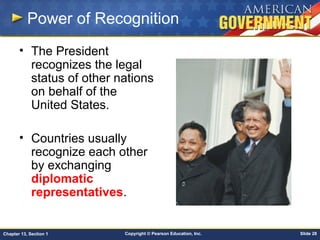
• Executes and interprets the law of the land
• Issues executive orders
• Appoints many public officials
• Removes appointed officials
• Can use executive privilege to withhold information
from Congress and the federal courts
– These powers come from the Constitution and from
acts of Congress.
Copyright © Pearson Education, Inc. Slide 5Chapter 13, Section 1
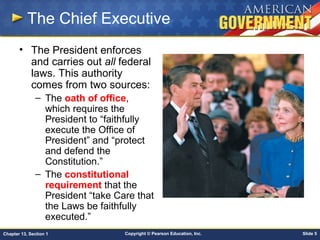
The Chief Executive
• The President enforces
and carries out all federal
laws. This authority
comes from two sources:
– The oath of office,
which requires the
President to “faithfully
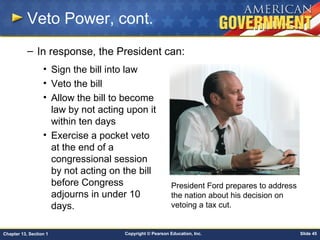
execute the Office of
President” and “protect
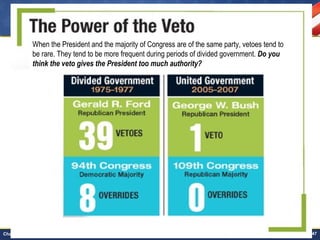
and defend the
Constitution.”
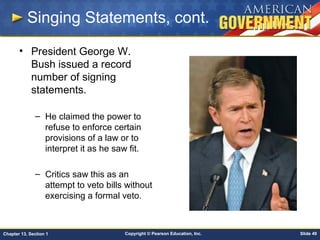
– The constitutional
requirement that the
President “take Care that
the Laws be faithfully
executed.”
Copyright © Pearson Education, Inc. Slide 6Chapter 13, Section 1
Interpreting Laws
• Congress passes many laws that set out broad
policies, but do not include specific details for
enforcement.
• The President and other members of the
executive branch must decide how these laws
should be administered and enforced.
• To do so, they must often interpret the intent of
these laws.
Copyright © Pearson Education, Inc. Slide 7Chapter 13, Section 1
The Ordinance Power
• The President can issue executive orders—rules
and regulations that have the force of law. This
is called the ordinance power.
– The President must have this authority in order to use
some of the executive powers granted by the
Constitution.
– In addition, Congress has delegated the authority to
direct and regulate many legislative policies and
programs to the President and the executive branch.
Copyright © Pearson Education, Inc. Slide 8Chapter 13, Section 1
The Appointment Power
• The Constitution grants the President
appointment power, the ability to appoint some
federal officials.
– This power is necessary to ensure that presidential
policies are carried out.
– The President appoints some 3,000 of the 2.7 million
federal workers.
– The majority of the rest are hired according to civil
service laws.
Copyright © Pearson Education, Inc. Slide 9Chapter 13, Section 1
Presidential Appointments
• Presidents appoint top-ranking officials such as:
– Cabinet members and their top aides
– Ambassadors and other diplomats
– The heads of independent agencies
– All federal judges, U.S. marshals, and
attorneys
– All officers in the U.S. armed forces
• These appointments must be a approved by a
majority vote of the Senate.
Copyright © Pearson Education, Inc. Slide 10Chapter 13, Section 1
Recess Appointments
• The president can make recess
appointments to fill vacancies when the
Senate is not in session.
– These appointments expire at the end of the
congressional term they were made.
– They are controversial because they allow the
President to bypass the Senate confirmation
process.
Copyright © Pearson Education, Inc. Slide 11Chapter 13, Section 1
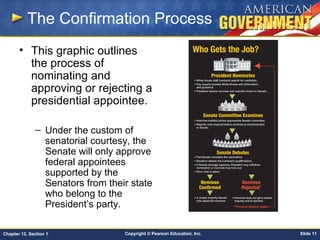
The Confirmation Process
• This graphic outlines
the process of
nominating and
approving or rejecting a
presidential appointee.
– Under the custom of
senatorial courtesy, the
Senate will only approve
federal appointees
supported by the
Senators from their state
who belong to the
President’s party.
Copyright © Pearson Education, Inc. Slide 12Chapter 13, Section 1
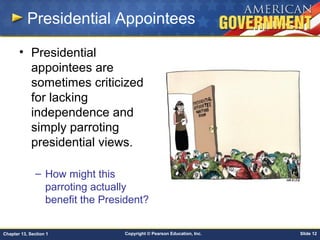
Presidential Appointees
• Presidential
appointees are
sometimes criticized
for lacking
independence and
simply parroting
presidential views.
– How might this
parroting actually
benefit the President?
Copyright © Pearson Education, Inc. Slide 13Chapter 13, Section 1
The Removal Power
• The Constitution does not say how
appointed officers should be removed.
– Some politicians wanted Senate approval
for removals as well as appointments.
– Others argued that the President must
have the power to remove incompetent
appointees.
Copyright © Pearson Education, Inc. Slide 14Chapter 13, Section 1
The Removal Power, cont.
• The First Congress gave the President
the power to remove any appointed
officer except for federal judges.
• Congress tried unsuccessfully to take
the removal power away from President
Andrew Johnson in 1867.
Copyright © Pearson Education, Inc. Slide 15Chapter 13, Section 1
The Removal Power, cont.
• In 1962, the Supreme Court ruled that the
removal power was a key part of the
President’s authority to execute the laws.
Copyright © Pearson Education, Inc. Slide 16Chapter 13, Section 1
The Removal Power, cont.
• In 1935, the Court ruled Congress can set the
conditions under which members of
independent regulatory agencies, such as the
Federal Trade Commission, may be removed
from office.
– This ruling applies only to a small number of
appointed offices.
– In general, the President can remove whomever they
appoint.
Copyright © Pearson Education, Inc. Slide 17Chapter 13, Section 1
Executive Privilege
• At times, Presidents have refused to reveal
certain information to Congress or the federal
courts.
• Congress has never officially recognized the
right of executive privilege.
– The President’s advisers and staff must be able to
speak freely to give good advice. To do so, they must
believe that their words are confidential unless the
President chooses to reveal them publicly.
– What is the court’s stand on executive privilege?
Copyright © Pearson Education, Inc. Slide 18Chapter 13, Section 1
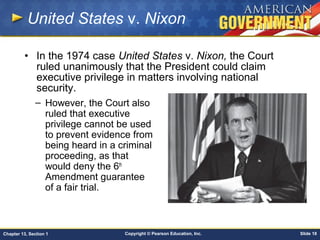
United States v. Nixon
– However, the Court also
ruled that executive
privilege cannot be used
to prevent evidence from
being heard in a criminal
proceeding, as that
would deny the 6th
Amendment guarantee
of a fair trial.
• In the 1974 case United States v. Nixon, the Court
ruled unanimously that the President could claim
executive privilege in matters involving national
security.
Copyright © Pearson Education, Inc. Slide 19Chapter 13, Section 1
Review
• Now that you have learned what they
executive powers are and how they were
established, go back to the Chapter
Essential Question.
– How much power should the president have?
Chapter 14: The Presidency in Action
Section 3
Copyright © Pearson Education, Inc. Slide 21Chapter 13, Section 1
Objectives
1. Explain how treaties are made and
approved.
2. Explain why and how executive
agreements are made.
3. Summarize how the power of recognition
is used.
4. Describe the President’s powers as
commander in chief.
Copyright © Pearson Education, Inc. Slide 22Chapter 13, Section 1
Key Terms
• treaty: a formal agreement between two or more
independent states
• executive agreement: a pact between the
President and the head of a foreign state or their
subordinates; it has the same standing as a
treaty but does not require approval by
Congress
• recognition: the act of acknowledging the legal
existence of a country and its government
• persona non grata: an unwelcome person
Copyright © Pearson Education, Inc. Slide 23Chapter 13, Section 1
Introduction
• What tools are available to the President to implement
foreign policy?
– Making treaties and executive agreements with foreign
countries
– Recognizing foreign nations
– Recalling American diplomats or expelling foreign
diplomats from U.S. soil
– Ordering the U.S. military to conduct operations on foreign
soil without a formal declaration of war
Copyright © Pearson Education, Inc. Slide 24Chapter 13, Section 1
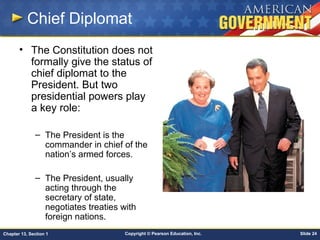
Chief Diplomat
• The Constitution does not
formally give the status of
chief diplomat to the
President. But two
presidential powers play
a key role:
– The President is the
commander in chief of the
nation’s armed forces.
– The President, usually
acting through the
secretary of state,
negotiates treaties with
foreign nations.
Copyright © Pearson Education, Inc. Slide 25Chapter 13, Section 1
Treaties
• Treaties have the same legal status as an act of
Congress.
• Congress can repeal a treaty by passing a law that
nullifies its provisions.
• An existing law can be repealed by the terms of a treaty.
• A treaty cannot conflict with any part of the Constitution.
• If a treaty and a federal law conflict, the most recently
passed measure wins.
Copyright © Pearson Education, Inc. Slide 26Chapter 13, Section 1
Treaties and the Senate
• A two-thirds majority of the Senate must approve all
treaties before they go into effect.
– This gives the Senate an important role in shaping
U.S. foreign policy.
– A Senate minority can kill a treaty. In 1920 the Senate
rejected the Treaty of Versailles.
– Presidents John Tyler and William McKinley each
overcame Senate rejections of treaties by getting joint
resolutions passed to annex Texas and Hawaii,
respectively.
Copyright © Pearson Education, Inc. Slide 27Chapter 13, Section 1
Executive Agreements
• Checkpoint: How do executive
agreements differ from treaties?
– Presidents can make executive agreements
without Senate approval.
– These agreements cannot overrule state or
federal law.
– Executive agreements do not become part of
American law. Only those agreements made
by the current President remain in force.
Copyright © Pearson Education, Inc. Slide 28Chapter 13, Section 1
Power of Recognition
• The President
recognizes the legal
status of other nations
on behalf of the
United States.
• Countries usually
recognize each other
by exchanging
diplomatic
representatives.
Copyright © Pearson Education, Inc. Slide 29Chapter 13, Section 1
Power of Recognition, cont.
• Out of political necessity, the United States
recognizes some nations whose conduct it does
not agree with.
• Recognizing a new nation, such as Panama or
Israel, can help ensure its success.
• Expelling foreign diplomats or recalling U.S.
diplomats from a foreign country is a strong
expression of disapproval and sometimes a step
toward war.
Copyright © Pearson Education, Inc. Slide 30Chapter 13, Section 1
Commander in Chief
• Presidents delegate many command
decisions to military officers, but
Presidents make the most critical
decisions and have the authority to take
command in the field.
Copyright © Pearson Education, Inc. Slide 31Chapter 13, Section 1
Commander in Chief, cont.
• It is difficult for Congress to challenge
many presidential command decisions.
• President Theodore Roosevelt once sent
the U.S. Navy halfway around the world
without consulting Congress. Legislators
had no choice but to approve funds to
bring the Navy back.
Copyright © Pearson Education, Inc. Slide 32Chapter 13, Section 1
Making Undeclared War
• Only Congress can declare war; however, many
U.S. presidents have sent armed forces into
combat abroad without a declaration of war:
– John Adams had the U.S. Navy fight French warships in
1798.
– Ronald Reagan ordered the invasion of Grenada in 1983
to block a military coup.
– George H.W. Bush ordered the ouster of Panamanian
dictator Manuel Noriega in 1989.
– Bill Clinton sent troops to the Balkans in the 1990s.
– How might a President exercise the role of commander in
chief?
Copyright © Pearson Education, Inc. Slide 33Chapter 13, Section 1
Congressional Resolutions
• Congress has not declared war since World
War II.
• However, Congress has passed eight joint
resolutions authorizing the President to use
military force abroad, such as:
– In 1955, Congress let President Dwight Eisenhower
position the U.S. Navy to block Chinese aggression toward
Taiwan.
– The Iraq Resolution of 2002 authorized the use of force
against Iraq.
Copyright © Pearson Education, Inc. Slide 34Chapter 13, Section 1
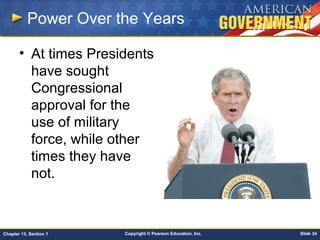
Power Over the Years
• At times Presidents
have sought
Congressional
approval for the
use of military
force, while other
times they have
not.
Copyright © Pearson Education, Inc. Slide 35Chapter 13, Section 1
War Powers Resolution
• Checkpoint: Why did Congress enact the
War Powers Act?
– The results of the undeclared Vietnam War
led Congress to pass the War Powers
Resolution of 1973.
– There is still a debate over whether this
Resolution is constitutional or not.
Copyright © Pearson Education, Inc. Slide 36Chapter 13, Section 1
War Powers Act
• The War Powers Act states that the President
can commit military forces to combat only
– If Congress has declared war, OR
– If Congress has authorized military action, OR
– If an attack on the nation or its armed forces has
taken place. In this case, Congress must be
notified within 48 hours and can end the
commitment of troops at any time.
Copyright © Pearson Education, Inc. Slide 37Chapter 13, Section 1
Review
• Now that you have learned about the tools
available to the President to implement
foreign policy, go back and answer the
Chapter Essential Question.
– How much power should the President have?
Chapter 14: The Presidency in Action
Section 4
Copyright © Pearson Education, Inc. Slide 39Chapter 13, Section 1
Objectives
1. Explain the President’s legislative
powers and how they are an important
part of the system of checks and
balances.
2. Describe the President’s major judicial
powers.
Copyright © Pearson Education, Inc. Slide 40Chapter 13, Section 1
Key Terms
• pocket veto: a method of killing a bill at
the end of a congressional session by not
acting on it before Congress adjourns
• line-item veto: the power to cancel out
specific provisions, or line items, in a bill
while approving the rest of the measure
• reprieve: the postponement of the
carrying out of a criminal sentence
Copyright © Pearson Education, Inc. Slide 41Chapter 13, Section 1
Key Terms, cont.
• pardon: the legal forgiveness of a crime
• clemency: the power of mercy or leniency
• commutation: the power to reduce a fine
or the length of a sentence imposed by a
court
• amnesty: a blanket pardon offered to a
group of law violators
Copyright © Pearson Education, Inc. Slide 42Chapter 13, Section 1
Introduction
• How can the President check the actions of the
legislative and judicial branches?
– By using the message power to influence Congress to
pass desired legislation
– By vetoing bills passed by Congress
– By issuing signing statements
– By pardoning citizens accused or convicted of crimes
– By reducing fines or the length of sentences
– By granting amnesty to groups of people
Copyright © Pearson Education, Inc. Slide 43Chapter 13, Section 1
Legislative Powers
• As party chief, the President can greatly
influence Congress.
• The President sends messages to Congress to
suggests legislation.
• There are three major messages a year:
• The State of the Union, delivered to a joint
session of Congress.
• The President’s budget message
• The Annual Economic Report
Copyright © Pearson Education, Inc. Slide 44Chapter 13, Section 1
Veto Power
• Checkpoint: What options are available to
the President when presented with a bill?
– Every bill or measure requiring the consent of
both House and Senate must be submitted to
the President.
Copyright © Pearson Education, Inc. Slide 45Chapter 13, Section 1
Veto Power, cont.
– In response, the President can:
• Sign the bill into law
• Veto the bill
• Allow the bill to become
law by not acting upon it
within ten days
• Exercise a pocket veto
at the end of a
congressional session
by not acting on the bill
before Congress
adjourns in under 10
days.
President Ford prepares to address
the nation about his decision on
vetoing a tax cut.
Copyright © Pearson Education, Inc. Slide 46Chapter 13, Section 1
Overriding a Veto
• Congress can override a veto with a two-thirds
majority, but this rarely happens.
– It is difficult to gather enough votes in each house for
a veto override.
– The mere threat of a veto can often defeat a bill or
cause changes to its provisions.
– Early Presidents rarely exercised the veto, but it is
common today.
Copyright © Pearson Education, Inc. Slide 47Chapter 13, Section 1
When the President and the majority of Congress are of the same party, vetoes tend to
be rare. They tend to be more frequent during periods of divided government. Do you
think the veto gives the President too much authority?
Copyright © Pearson Education, Inc. Slide 48Chapter 13, Section 1
Signing Statements
• Signing statements describe how a new
law should be enforced or point out
problems that the President sees with
the law.
• Presidents may issue signing statements
when signing a bill into law.
Copyright © Pearson Education, Inc. Slide 49Chapter 13, Section 1
Singing Statements, cont.
• President George W.
Bush issued a record
number of signing
statements.
– He claimed the power to
refuse to enforce certain
provisions of a law or to
interpret it as he saw fit.
– Critics saw this as an
attempt to veto bills without
exercising a formal veto.
Copyright © Pearson Education, Inc. Slide 50Chapter 13, Section 1
Line-Item Veto
• The President can either accept all of a bill
or reject all of it.
• The Supreme Court has ruled that the
line-item veto power can only be given to
the President by a constitutional
amendment.
– How is a line-item veto different from a regular
veto?
Copyright © Pearson Education, Inc. Slide 51Chapter 13, Section 1
Line-Item Veto, cont.
• The proposed line-item veto would allow the
President to cancel out some parts of a bill while
approving others.
– Supporters argue that this would cut down on
wasteful federal spending.
– Opponents argue that the line-item veto would
shift too much power from the legislative branch
to the executive branch.
Copyright © Pearson Education, Inc. Slide 52Chapter 13, Section 1
Judicial Powers
• The President can grant pardons and reprieves
in federal cases.
– The President can pardon people before they have
even been tried or convicted, though this is rare.
• President Gerald Ford famously pardoned former
President Nixon in 1974 before Nixon had
been tried.
– A person must accept a pardon for it to go
into effect.
• The Supreme Court upheld this rule in 1915.
Copyright © Pearson Education, Inc. Slide 53Chapter 13, Section 1
Judicial Powers, cont.
• Checkpoint: What powers are included
under the power to pardon?
– The President can commute, or reduce, a
fine or prison sentence.
– The President can also issue a blanket
amnesty that pardons a group of people.
• In 1893, President Benjamin Harrison pardoned all
Mormons who had violated polygamy laws.
• In 1977, President Jimmy Carter gave amnesty to
all Vietnam War draft evaders.
Copyright © Pearson Education, Inc. Slide 54Chapter 13, Section 1
Review
• Now that you have learned about the way
in which the President can check the
actions of the legislative and judicial
branches, go back and answer the
Chapter Essential Question.
– How much power should the President have?

Chapter 14

  • 1.
    Chapter 14: ThePresidency in Action Section 2
  • 2.
    Copyright © PearsonEducation, Inc. Slide 2Chapter 13, Section 1 Objectives 1. Identify the sources of the President’s power to execute federal law. 2. Define the ordinance power. 3. Explain how the appointment power works and describe the limits on the removal power. 4. Examine the power of executive privilege.
  • 3.
    Copyright © PearsonEducation, Inc. Slide 3Chapter 13, Section 1 Key Terms • executive order: directives, rules, or regulations issued by the President that have the force of law • ordinance power: the authority to issue executive orders • executive privilege: a right claimed by some Presidents that allows them to refuse to provide certain information to Congress or the federal courts
  • 4.
    Copyright © PearsonEducation, Inc. Slide 4Chapter 13, Section 1 Introduction • What are the executive powers and how were they established? – The President: • Executes and interprets the law of the land • Issues executive orders • Appoints many public officials • Removes appointed officials • Can use executive privilege to withhold information from Congress and the federal courts – These powers come from the Constitution and from acts of Congress.
  • 5.
    Copyright © PearsonEducation, Inc. Slide 5Chapter 13, Section 1 The Chief Executive • The President enforces and carries out all federal laws. This authority comes from two sources: – The oath of office, which requires the President to “faithfully execute the Office of President” and “protect and defend the Constitution.” – The constitutional requirement that the President “take Care that the Laws be faithfully executed.”
  • 6.
    Copyright © PearsonEducation, Inc. Slide 6Chapter 13, Section 1 Interpreting Laws • Congress passes many laws that set out broad policies, but do not include specific details for enforcement. • The President and other members of the executive branch must decide how these laws should be administered and enforced. • To do so, they must often interpret the intent of these laws.
  • 7.
    Copyright © PearsonEducation, Inc. Slide 7Chapter 13, Section 1 The Ordinance Power • The President can issue executive orders—rules and regulations that have the force of law. This is called the ordinance power. – The President must have this authority in order to use some of the executive powers granted by the Constitution. – In addition, Congress has delegated the authority to direct and regulate many legislative policies and programs to the President and the executive branch.
  • 8.
    Copyright © PearsonEducation, Inc. Slide 8Chapter 13, Section 1 The Appointment Power • The Constitution grants the President appointment power, the ability to appoint some federal officials. – This power is necessary to ensure that presidential policies are carried out. – The President appoints some 3,000 of the 2.7 million federal workers. – The majority of the rest are hired according to civil service laws.
  • 9.
    Copyright © PearsonEducation, Inc. Slide 9Chapter 13, Section 1 Presidential Appointments • Presidents appoint top-ranking officials such as: – Cabinet members and their top aides – Ambassadors and other diplomats – The heads of independent agencies – All federal judges, U.S. marshals, and attorneys – All officers in the U.S. armed forces • These appointments must be a approved by a majority vote of the Senate.
  • 10.
    Copyright © PearsonEducation, Inc. Slide 10Chapter 13, Section 1 Recess Appointments • The president can make recess appointments to fill vacancies when the Senate is not in session. – These appointments expire at the end of the congressional term they were made. – They are controversial because they allow the President to bypass the Senate confirmation process.
  • 11.
    Copyright © PearsonEducation, Inc. Slide 11Chapter 13, Section 1 The Confirmation Process • This graphic outlines the process of nominating and approving or rejecting a presidential appointee. – Under the custom of senatorial courtesy, the Senate will only approve federal appointees supported by the Senators from their state who belong to the President’s party.
  • 12.
    Copyright © PearsonEducation, Inc. Slide 12Chapter 13, Section 1 Presidential Appointees • Presidential appointees are sometimes criticized for lacking independence and simply parroting presidential views. – How might this parroting actually benefit the President?
  • 13.
    Copyright © PearsonEducation, Inc. Slide 13Chapter 13, Section 1 The Removal Power • The Constitution does not say how appointed officers should be removed. – Some politicians wanted Senate approval for removals as well as appointments. – Others argued that the President must have the power to remove incompetent appointees.
  • 14.
    Copyright © PearsonEducation, Inc. Slide 14Chapter 13, Section 1 The Removal Power, cont. • The First Congress gave the President the power to remove any appointed officer except for federal judges. • Congress tried unsuccessfully to take the removal power away from President Andrew Johnson in 1867.
  • 15.
    Copyright © PearsonEducation, Inc. Slide 15Chapter 13, Section 1 The Removal Power, cont. • In 1962, the Supreme Court ruled that the removal power was a key part of the President’s authority to execute the laws.
  • 16.
    Copyright © PearsonEducation, Inc. Slide 16Chapter 13, Section 1 The Removal Power, cont. • In 1935, the Court ruled Congress can set the conditions under which members of independent regulatory agencies, such as the Federal Trade Commission, may be removed from office. – This ruling applies only to a small number of appointed offices. – In general, the President can remove whomever they appoint.
  • 17.
    Copyright © PearsonEducation, Inc. Slide 17Chapter 13, Section 1 Executive Privilege • At times, Presidents have refused to reveal certain information to Congress or the federal courts. • Congress has never officially recognized the right of executive privilege. – The President’s advisers and staff must be able to speak freely to give good advice. To do so, they must believe that their words are confidential unless the President chooses to reveal them publicly. – What is the court’s stand on executive privilege?
  • 18.
    Copyright © PearsonEducation, Inc. Slide 18Chapter 13, Section 1 United States v. Nixon – However, the Court also ruled that executive privilege cannot be used to prevent evidence from being heard in a criminal proceeding, as that would deny the 6th Amendment guarantee of a fair trial. • In the 1974 case United States v. Nixon, the Court ruled unanimously that the President could claim executive privilege in matters involving national security.
  • 19.
    Copyright © PearsonEducation, Inc. Slide 19Chapter 13, Section 1 Review • Now that you have learned what they executive powers are and how they were established, go back to the Chapter Essential Question. – How much power should the president have?
  • 20.
    Chapter 14: ThePresidency in Action Section 3
  • 21.
    Copyright © PearsonEducation, Inc. Slide 21Chapter 13, Section 1 Objectives 1. Explain how treaties are made and approved. 2. Explain why and how executive agreements are made. 3. Summarize how the power of recognition is used. 4. Describe the President’s powers as commander in chief.
  • 22.
    Copyright © PearsonEducation, Inc. Slide 22Chapter 13, Section 1 Key Terms • treaty: a formal agreement between two or more independent states • executive agreement: a pact between the President and the head of a foreign state or their subordinates; it has the same standing as a treaty but does not require approval by Congress • recognition: the act of acknowledging the legal existence of a country and its government • persona non grata: an unwelcome person
  • 23.
    Copyright © PearsonEducation, Inc. Slide 23Chapter 13, Section 1 Introduction • What tools are available to the President to implement foreign policy? – Making treaties and executive agreements with foreign countries – Recognizing foreign nations – Recalling American diplomats or expelling foreign diplomats from U.S. soil – Ordering the U.S. military to conduct operations on foreign soil without a formal declaration of war
  • 24.
    Copyright © PearsonEducation, Inc. Slide 24Chapter 13, Section 1 Chief Diplomat • The Constitution does not formally give the status of chief diplomat to the President. But two presidential powers play a key role: – The President is the commander in chief of the nation’s armed forces. – The President, usually acting through the secretary of state, negotiates treaties with foreign nations.
  • 25.
    Copyright © PearsonEducation, Inc. Slide 25Chapter 13, Section 1 Treaties • Treaties have the same legal status as an act of Congress. • Congress can repeal a treaty by passing a law that nullifies its provisions. • An existing law can be repealed by the terms of a treaty. • A treaty cannot conflict with any part of the Constitution. • If a treaty and a federal law conflict, the most recently passed measure wins.
  • 26.
    Copyright © PearsonEducation, Inc. Slide 26Chapter 13, Section 1 Treaties and the Senate • A two-thirds majority of the Senate must approve all treaties before they go into effect. – This gives the Senate an important role in shaping U.S. foreign policy. – A Senate minority can kill a treaty. In 1920 the Senate rejected the Treaty of Versailles. – Presidents John Tyler and William McKinley each overcame Senate rejections of treaties by getting joint resolutions passed to annex Texas and Hawaii, respectively.
  • 27.
    Copyright © PearsonEducation, Inc. Slide 27Chapter 13, Section 1 Executive Agreements • Checkpoint: How do executive agreements differ from treaties? – Presidents can make executive agreements without Senate approval. – These agreements cannot overrule state or federal law. – Executive agreements do not become part of American law. Only those agreements made by the current President remain in force.
  • 28.
    Copyright © PearsonEducation, Inc. Slide 28Chapter 13, Section 1 Power of Recognition • The President recognizes the legal status of other nations on behalf of the United States. • Countries usually recognize each other by exchanging diplomatic representatives.
  • 29.
    Copyright © PearsonEducation, Inc. Slide 29Chapter 13, Section 1 Power of Recognition, cont. • Out of political necessity, the United States recognizes some nations whose conduct it does not agree with. • Recognizing a new nation, such as Panama or Israel, can help ensure its success. • Expelling foreign diplomats or recalling U.S. diplomats from a foreign country is a strong expression of disapproval and sometimes a step toward war.
  • 30.
    Copyright © PearsonEducation, Inc. Slide 30Chapter 13, Section 1 Commander in Chief • Presidents delegate many command decisions to military officers, but Presidents make the most critical decisions and have the authority to take command in the field.
  • 31.
    Copyright © PearsonEducation, Inc. Slide 31Chapter 13, Section 1 Commander in Chief, cont. • It is difficult for Congress to challenge many presidential command decisions. • President Theodore Roosevelt once sent the U.S. Navy halfway around the world without consulting Congress. Legislators had no choice but to approve funds to bring the Navy back.
  • 32.
    Copyright © PearsonEducation, Inc. Slide 32Chapter 13, Section 1 Making Undeclared War • Only Congress can declare war; however, many U.S. presidents have sent armed forces into combat abroad without a declaration of war: – John Adams had the U.S. Navy fight French warships in 1798. – Ronald Reagan ordered the invasion of Grenada in 1983 to block a military coup. – George H.W. Bush ordered the ouster of Panamanian dictator Manuel Noriega in 1989. – Bill Clinton sent troops to the Balkans in the 1990s. – How might a President exercise the role of commander in chief?
  • 33.
    Copyright © PearsonEducation, Inc. Slide 33Chapter 13, Section 1 Congressional Resolutions • Congress has not declared war since World War II. • However, Congress has passed eight joint resolutions authorizing the President to use military force abroad, such as: – In 1955, Congress let President Dwight Eisenhower position the U.S. Navy to block Chinese aggression toward Taiwan. – The Iraq Resolution of 2002 authorized the use of force against Iraq.
  • 34.
    Copyright © PearsonEducation, Inc. Slide 34Chapter 13, Section 1 Power Over the Years • At times Presidents have sought Congressional approval for the use of military force, while other times they have not.
  • 35.
    Copyright © PearsonEducation, Inc. Slide 35Chapter 13, Section 1 War Powers Resolution • Checkpoint: Why did Congress enact the War Powers Act? – The results of the undeclared Vietnam War led Congress to pass the War Powers Resolution of 1973. – There is still a debate over whether this Resolution is constitutional or not.
  • 36.
    Copyright © PearsonEducation, Inc. Slide 36Chapter 13, Section 1 War Powers Act • The War Powers Act states that the President can commit military forces to combat only – If Congress has declared war, OR – If Congress has authorized military action, OR – If an attack on the nation or its armed forces has taken place. In this case, Congress must be notified within 48 hours and can end the commitment of troops at any time.
  • 37.
    Copyright © PearsonEducation, Inc. Slide 37Chapter 13, Section 1 Review • Now that you have learned about the tools available to the President to implement foreign policy, go back and answer the Chapter Essential Question. – How much power should the President have?
  • 38.
    Chapter 14: ThePresidency in Action Section 4
  • 39.
    Copyright © PearsonEducation, Inc. Slide 39Chapter 13, Section 1 Objectives 1. Explain the President’s legislative powers and how they are an important part of the system of checks and balances. 2. Describe the President’s major judicial powers.
  • 40.
    Copyright © PearsonEducation, Inc. Slide 40Chapter 13, Section 1 Key Terms • pocket veto: a method of killing a bill at the end of a congressional session by not acting on it before Congress adjourns • line-item veto: the power to cancel out specific provisions, or line items, in a bill while approving the rest of the measure • reprieve: the postponement of the carrying out of a criminal sentence
  • 41.
    Copyright © PearsonEducation, Inc. Slide 41Chapter 13, Section 1 Key Terms, cont. • pardon: the legal forgiveness of a crime • clemency: the power of mercy or leniency • commutation: the power to reduce a fine or the length of a sentence imposed by a court • amnesty: a blanket pardon offered to a group of law violators
  • 42.
    Copyright © PearsonEducation, Inc. Slide 42Chapter 13, Section 1 Introduction • How can the President check the actions of the legislative and judicial branches? – By using the message power to influence Congress to pass desired legislation – By vetoing bills passed by Congress – By issuing signing statements – By pardoning citizens accused or convicted of crimes – By reducing fines or the length of sentences – By granting amnesty to groups of people
  • 43.
    Copyright © PearsonEducation, Inc. Slide 43Chapter 13, Section 1 Legislative Powers • As party chief, the President can greatly influence Congress. • The President sends messages to Congress to suggests legislation. • There are three major messages a year: • The State of the Union, delivered to a joint session of Congress. • The President’s budget message • The Annual Economic Report
  • 44.
    Copyright © PearsonEducation, Inc. Slide 44Chapter 13, Section 1 Veto Power • Checkpoint: What options are available to the President when presented with a bill? – Every bill or measure requiring the consent of both House and Senate must be submitted to the President.
  • 45.
    Copyright © PearsonEducation, Inc. Slide 45Chapter 13, Section 1 Veto Power, cont. – In response, the President can: • Sign the bill into law • Veto the bill • Allow the bill to become law by not acting upon it within ten days • Exercise a pocket veto at the end of a congressional session by not acting on the bill before Congress adjourns in under 10 days. President Ford prepares to address the nation about his decision on vetoing a tax cut.
  • 46.
    Copyright © PearsonEducation, Inc. Slide 46Chapter 13, Section 1 Overriding a Veto • Congress can override a veto with a two-thirds majority, but this rarely happens. – It is difficult to gather enough votes in each house for a veto override. – The mere threat of a veto can often defeat a bill or cause changes to its provisions. – Early Presidents rarely exercised the veto, but it is common today.
  • 47.
    Copyright © PearsonEducation, Inc. Slide 47Chapter 13, Section 1 When the President and the majority of Congress are of the same party, vetoes tend to be rare. They tend to be more frequent during periods of divided government. Do you think the veto gives the President too much authority?
  • 48.
    Copyright © PearsonEducation, Inc. Slide 48Chapter 13, Section 1 Signing Statements • Signing statements describe how a new law should be enforced or point out problems that the President sees with the law. • Presidents may issue signing statements when signing a bill into law.
  • 49.
    Copyright © PearsonEducation, Inc. Slide 49Chapter 13, Section 1 Singing Statements, cont. • President George W. Bush issued a record number of signing statements. – He claimed the power to refuse to enforce certain provisions of a law or to interpret it as he saw fit. – Critics saw this as an attempt to veto bills without exercising a formal veto.
  • 50.
    Copyright © PearsonEducation, Inc. Slide 50Chapter 13, Section 1 Line-Item Veto • The President can either accept all of a bill or reject all of it. • The Supreme Court has ruled that the line-item veto power can only be given to the President by a constitutional amendment. – How is a line-item veto different from a regular veto?
  • 51.
    Copyright © PearsonEducation, Inc. Slide 51Chapter 13, Section 1 Line-Item Veto, cont. • The proposed line-item veto would allow the President to cancel out some parts of a bill while approving others. – Supporters argue that this would cut down on wasteful federal spending. – Opponents argue that the line-item veto would shift too much power from the legislative branch to the executive branch.
  • 52.
    Copyright © PearsonEducation, Inc. Slide 52Chapter 13, Section 1 Judicial Powers • The President can grant pardons and reprieves in federal cases. – The President can pardon people before they have even been tried or convicted, though this is rare. • President Gerald Ford famously pardoned former President Nixon in 1974 before Nixon had been tried. – A person must accept a pardon for it to go into effect. • The Supreme Court upheld this rule in 1915.
  • 53.
    Copyright © PearsonEducation, Inc. Slide 53Chapter 13, Section 1 Judicial Powers, cont. • Checkpoint: What powers are included under the power to pardon? – The President can commute, or reduce, a fine or prison sentence. – The President can also issue a blanket amnesty that pardons a group of people. • In 1893, President Benjamin Harrison pardoned all Mormons who had violated polygamy laws. • In 1977, President Jimmy Carter gave amnesty to all Vietnam War draft evaders.
  • 54.
    Copyright © PearsonEducation, Inc. Slide 54Chapter 13, Section 1 Review • Now that you have learned about the way in which the President can check the actions of the legislative and judicial branches, go back and answer the Chapter Essential Question. – How much power should the President have?

Editor's Notes

  • #6 NOTE TO TEACHERS: The above image shows Ronald Reagan taking the oath of office in 1985.
  • #13 Answer: It could ensure loyalty and focus upon a single set of policy goals within the President’s administration.
  • #18 Answer: The Supreme Court recognizes the right of executive privilege in matters involving national security but does not recognize executive privilege when it is used to prevent evidence from being heard in criminal cases.
  • #19 NOTE TO TEACHERS: The above image shows Richard Nixon in April 1973.
  • #25 NOTE TO TEACHERS: The above image shows Secretary of State Madeline Albright with Israeli Prime Minister Ehud Barak in 1999.
  • #28 Checkpoint Answer: Executive agreements do no supersede federal or state laws when they come into conflict with them, whereas treaties can supersede U.S. laws. Moreover, executive agreements only have the power of law as long as the President who made the agreement remains in office. Future presidents are not bound by these agreements.
  • #29 NOTE TO TEACHERS: The above image shows Jimmy Carter meeting with Chinese leader Deng Xiaoping.
  • #33 Answer: By guiding U.S. military policy, by making major tactical and strategic decisions, by committing American forces to military actions abroad without seeking a declaration of war, or in rare occasions by taking command of military forces in the field.
  • #36 Checkpoint Answer: Specific answer: As a result of Lyndon Johnson and Richard Nixon’s use of the war-making power during the undeclared Vietnam War, which was widely viewed as a failure at the time. General answer: To attempt to curb the power of the President to deploy U.S. military forces without congressional approval.
  • #45 Checkpoint Answer: The President can sign the bill into law, veto the bill, allow it to become law through inaction, or exercise a pocket veto at the end of a session of Congress.
  • #48 Answer to feature question: Student answers will vary, depending upon their support of specific presidents or the presidency in general.
  • #51 Answer: A regular veto requires the President to reject all the provisions of a bill. A line-item veto allows the President to sign a bill into law while rejecting specific provisions within that bill, so that those provisions do not become law.
  • #54 Checkpoint Answer: The power to commute sentences and grant amnesties are included in the power to pardon individuals for federal offenses, even before they have been formally accused or tried in court.