Changes in Medieval Society
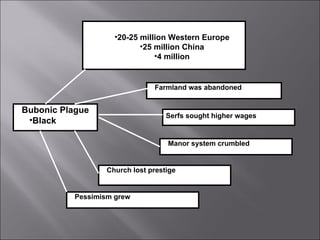
Bubonic Plague Black  Death   Population was reduce 20-25 million Western Europe 25 million China 4 million Farmland was abandoned Serfs sought higher wages Manor system crumbled Church lost prestige Pessimism grew  
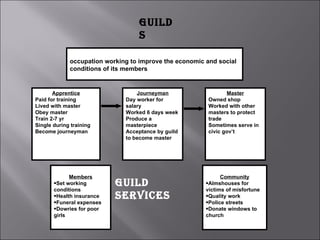
An organization of individuals in the same business or  occupation working to improve the economic and social conditions of its members Members Set working conditions Health insurance Funeral expenses Dowries for poor girls Community Almshouses for victims of misfortune Quality work Police streets Donate windows to church Apprentice Paid for training Lived with master Obey master Train 2-7 yr Single during training Become journeyman Journeyman Day worker for salary Worked 6 days week Produce a masterpiece Acceptance by guild to become master Master Owned shop Worked with other masters to protect trade Sometimes serve in civic gov’t Guilds Guild Services
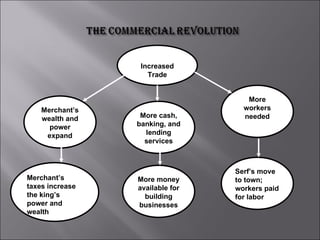
Increased Trade         More cash, banking, and lending services         Merchant’s wealth and power expand           More workers needed           Merchant’s taxes increase the king’s power and wealth           More money available for building businesses   Serf’s move to town; workers paid for labor                                                                     
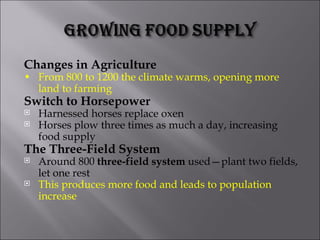
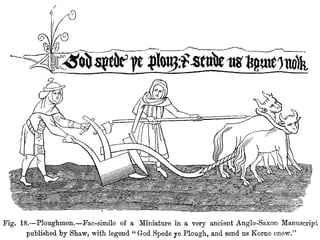
Changes in Agriculture • From 800 to 1200 the climate warms, opening more land to farming Switch to Horsepower Harnessed horses replace oxen Horses plow three times as much a day, increasing food supply The Three-Field System Around 800  three-field system  used—plant two fields, let one rest This produces more food and leads to population increase
 
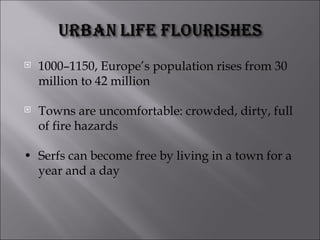
1000–1150, Europe’s population rises from 30 million to 42 million Towns are uncomfortable: crowded, dirty, full of fire hazards • Serfs can become free by living in a town for a year and a day
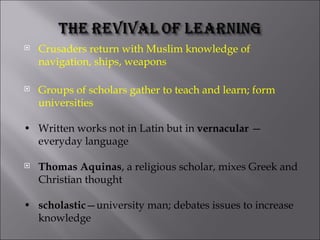
Crusaders return with Muslim knowledge of navigation, ships, weapons Groups of scholars gather to teach and learn; form universities • Written works not in Latin but in  vernacular  — everyday language Thomas Aquinas , a religious scholar, mixes Greek and Christian thought • scholastic —university man; debates issues to increase knowledge

Chp 14.2 changes in med society

  • 1.
  • 2.
    Bubonic Plague Black Death   Population was reduce 20-25 million Western Europe 25 million China 4 million Farmland was abandoned Serfs sought higher wages Manor system crumbled Church lost prestige Pessimism grew  
  • 3.
    An organization ofindividuals in the same business or occupation working to improve the economic and social conditions of its members Members Set working conditions Health insurance Funeral expenses Dowries for poor girls Community Almshouses for victims of misfortune Quality work Police streets Donate windows to church Apprentice Paid for training Lived with master Obey master Train 2-7 yr Single during training Become journeyman Journeyman Day worker for salary Worked 6 days week Produce a masterpiece Acceptance by guild to become master Master Owned shop Worked with other masters to protect trade Sometimes serve in civic gov’t Guilds Guild Services
  • 4.
    Increased Trade        More cash, banking, and lending services         Merchant’s wealth and power expand           More workers needed           Merchant’s taxes increase the king’s power and wealth           More money available for building businesses   Serf’s move to town; workers paid for labor                                                                     
  • 5.
    Changes in Agriculture• From 800 to 1200 the climate warms, opening more land to farming Switch to Horsepower Harnessed horses replace oxen Horses plow three times as much a day, increasing food supply The Three-Field System Around 800 three-field system used—plant two fields, let one rest This produces more food and leads to population increase
  • 6.
  • 7.
    1000–1150, Europe’s populationrises from 30 million to 42 million Towns are uncomfortable: crowded, dirty, full of fire hazards • Serfs can become free by living in a town for a year and a day
  • 8.
    Crusaders return withMuslim knowledge of navigation, ships, weapons Groups of scholars gather to teach and learn; form universities • Written works not in Latin but in vernacular — everyday language Thomas Aquinas , a religious scholar, mixes Greek and Christian thought • scholastic —university man; debates issues to increase knowledge