Chapter 3: The Constitution
Section 1
Copyright © Pearson Education, Inc. Slide 2Chapter 3, Section 1
Objectives
1. Understand the basic outline of the
Constitution.
2. Understand the six basic principles of the
Constitution: popular sovereignty, limited
government, separation of powers,
checks and balances, judicial review,
and federalism.
Copyright © Pearson Education, Inc. Slide 3Chapter 3, Section 1
Key Terms
• popular sovereignty: the political
principle that people are the source of all
governmental power and that government
requires the consent of the governed
• limited government: the idea that
government may only do those things that
the people have given it the power to do
• constitutionalism: the idea that
government must be conducted according
to constitutional principles
Copyright © Pearson Education, Inc. Slide 4Chapter 3, Section 1
Key Terms, cont.
• rule of law: the principle that government
and its officers must always obey the laws
of the land
• separation of powers: the principle that
each of the basic powers of government—
executive, legislative, and judicial—should
be wielded by an independent branch of
government
Copyright © Pearson Education, Inc. Slide 5Chapter 3, Section 1
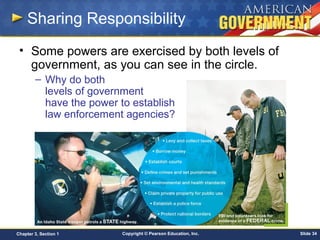
Key Terms, cont.
• checks and balances: the system under
which each branch of government can
check, or limit, the actions of the other
branches
• veto: to reject an act of Congress
• judicial review: the power of a court to
determine whether a government action is
constitutional or not
Copyright © Pearson Education, Inc. Slide 6Chapter 3, Section 1
Key Terms, cont.
• unconstitutional: in violation of a
provision of the Constitution, and therefore
illegal and of no effect
• federalism: the principle that political
power should be divided between a
central government and a number of
regional governments
Copyright © Pearson Education, Inc. Slide 7Chapter 3, Section 1
Introduction
• What are the six main principles on which the
Constitution is based?
– Popular Sovereignty
– Limited Government
– Separation of Powers
– Checks and Balances
– Judicial Review
– Federalism
– The Constitution embodies these key principles along
with describing the basic structure of our government.
Copyright © Pearson Education, Inc. Slide 8Chapter 3, Section 1
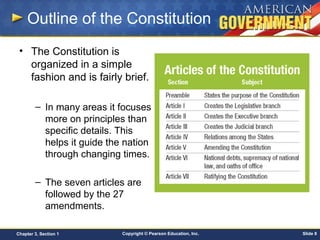
Outline of the Constitution
• The Constitution is
organized in a simple
fashion and is fairly brief.
– In many areas it focuses
more on principles than
specific details. This
helps it guide the nation
through changing times.
– The seven articles are
followed by the 27
amendments.
Copyright © Pearson Education, Inc. Slide 9Chapter 3, Section 1
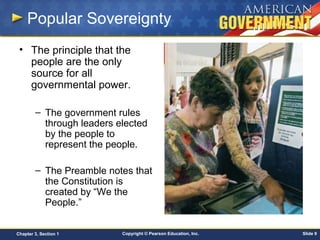
Popular Sovereignty
• The principle that the
people are the only
source for all
governmental power.
– The government rules
through leaders elected
by the people to
represent the people.
– The Preamble notes that
the Constitution is
created by “We the
People.”
Copyright © Pearson Education, Inc. Slide 10Chapter 3, Section 1
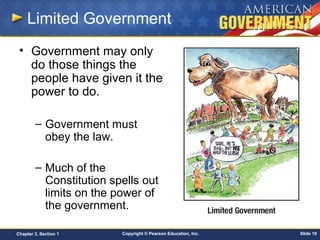
Limited Government
• Government may only
do those things the
people have given it the
power to do.
– Government must
obey the law.
– Much of the
Constitution spells out
limits on the power of
the government.
Copyright © Pearson Education, Inc. Slide 11Chapter 3, Section 1
Separation of Powers
• Checkpoint: How does the separation of powers
keep government from becoming too powerful?
– The Constitution divides power among the legislative,
executive and judicial branches.
• Congress makes the laws, the President executes and
administers the laws, and the Supreme Court interprets
the laws.
– Separation of powers keeps a strong central
government from being too powerful.
• Too much power concentrated in any one branch could
lead to abuses of that power.
Copyright © Pearson Education, Inc. Slide 12Chapter 3, Section 1
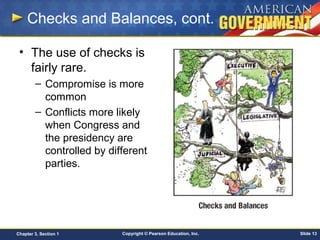
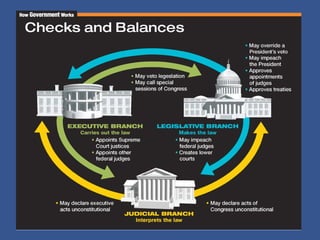
Checks and Balances
• Each branch of the federal government can check
the power of the other two.
– The President can veto bills passed by Congress, but
Congress can override a veto.
– The Senate can reject presidential appointees or refuse
to ratify a treaty.
– Congress can vote to impeach a federal official.
– The federal courts can rule that executive and legislative
acts are unconstitutional.
Copyright © Pearson Education, Inc. Slide 13Chapter 3, Section 1
Checks and Balances, cont.
• The use of checks is
fairly rare.
– Compromise is more
common
– Conflicts more likely
when Congress and
the presidency are
controlled by different
parties.
Copyright © Pearson Education, Inc. Slide 15Chapter 3, Section 1
Judicial Review
• The Courts can decide if a government action is
constitutional.
– The power of judicial review is held by all federal courts
and most state courts.
– Judicial review was established as a necessary power of
the courts by Supreme Court Chief Justice John Marshal in
the case Marbury v. Madison in 1803.
– Most acts are found to be constitutional, but the Supreme
Court has struck down many presidential, congressional,
and state measures over the years.
Copyright © Pearson Education, Inc. Slide 16Chapter 3, Section 1
Federalism
• Federalism is a compromise between an all-
powerful central government and an independent
state government.
– It corrected the weaknesses of the Articles of
Confederation without replacing them with a British-
style monarchy.
– The Framers felt that too much governmental power
threatened liberty.
– Federalism helps prevent that power from being
abused, by dividing governmental power.
Copyright © Pearson Education, Inc. Slide 17Chapter 3, Section 1
Federalism, cont.
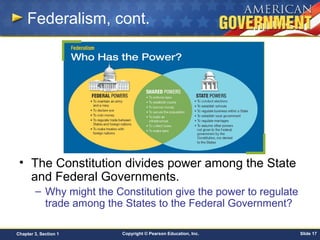
• The Constitution divides power among the State
and Federal Governments.
– Why might the Constitution give the power to regulate
trade among the States to the Federal Government?
Copyright © Pearson Education, Inc. Slide 18Chapter 3, Section 1
Review
• Now that you have learned about the six
main principles on which the Constitution
is based, go back and answer the Chapter
Essential Question.
– How has the Constitution lasted through
changing times?
Chapter 4: Federalism
Section 1
Copyright © Pearson Education, Inc. Slide 20Chapter 3, Section 1
Objectives
1. Define federalism and explain why the
Framers chose this system.
2. Identify powers delegated to and denied
to the National Government, and powers
reserved for and denied to the States.
3. Explain the difference between exclusive
and concurrent powers.
4. Examine the Constitution as “the
supreme Law of the Land.”
Copyright © Pearson Education, Inc. Slide 21Chapter 3, Section 1
Key Terms
• federalism: a system of government in which a
written constitution divides power between a central
government and several regional governments
• division of powers: assigning some powers to the
federal government and others to the States
• delegated powers: powers granted by the
Constitution
• expressed powers: powers specified clearly in the
Constitution
• implied powers: powers not specifically mentioned,
but suggested by the expressed powers
Copyright © Pearson Education, Inc. Slide 22Chapter 3, Section 1
Key Terms, cont.
• inherent powers: powers that belong to all
independent national governments
• reserved powers: powers not given to the
national government or denied to the States
• exclusive powers: powers that can only be
used by the national government
• concurrent powers: powers shared by the
national and State governments
• Supremacy Clause: the provision declaring the
Constitution to be the supreme law of the land
Copyright © Pearson Education, Inc. Slide 23Chapter 3, Section 1
Introduction
• How is power divided between the Federal
Government and the States?
– Certain exclusive powers, such as the power to coin
money, are exercised only by the federal government.
– Reserved powers, such as the power to establish
public schools, are exercised only by the States.
– Concurrent powers, such as the power to tax, are
shared by the States and the federal government.
Copyright © Pearson Education, Inc. Slide 24Chapter 3, Section 1
Federalism
• The Framers believed that government power must be
divided and limited so that it cannot threaten individual
liberty.
• The Constitution divides power between the federal
government and the States through federalism.
– Federalism creates two basic levels of government
that overlap.
– Each level has some powers denied to the other level.
Copyright © Pearson Education, Inc. Slide 25Chapter 3, Section 1
Federalism, cont.
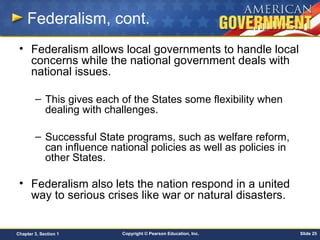
• Federalism allows local governments to handle local
concerns while the national government deals with
national issues.
– This gives each of the States some flexibility when
dealing with challenges.
– Successful State programs, such as welfare reform,
can influence national policies as well as policies in
other States.
• Federalism also lets the nation respond in a united
way to serious crises like war or natural disasters.
Copyright © Pearson Education, Inc. Slide 26Chapter 3, Section 1
Expressed Powers
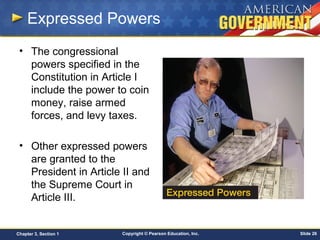
• The congressional
powers specified in the
Constitution in Article I
include the power to coin
money, raise armed
forces, and levy taxes.
• Other expressed powers
are granted to the
President in Article II and
the Supreme Court in
Article III.
Copyright © Pearson Education, Inc. Slide 27Chapter 3, Section 1
Implied Powers
• Checkpoint: Why is the Necessary and Proper
Clause sometimes referred to as the Elastic
Clause?
– The Necessary and Proper Clause gives Congress
the power to make all laws “necessary and proper” for
carrying out its expressed powers, so it is said to
stretch to cover many situations.
– Congress exercises many implied powers that are
based upon its expressed powers. These implied
powers include building the interstate highway system
and banning racial discrimination in public places.
Copyright © Pearson Education, Inc. Slide 28Chapter 3, Section 1
Inherent Powers
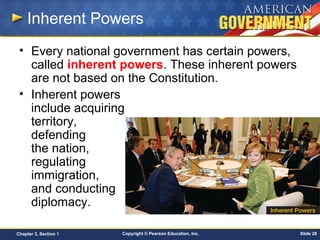
• Every national government has certain powers,
called inherent powers. These inherent powers
are not based on the Constitution.
• Inherent powers
include acquiring
territory,
defending
the nation,
regulating
immigration,
and conducting
diplomacy.
Copyright © Pearson Education, Inc. Slide 29Chapter 3, Section 1
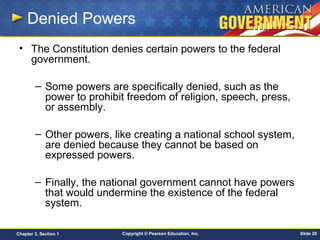
Denied Powers
• The Constitution denies certain powers to the federal
government.
– Some powers are specifically denied, such as the
power to prohibit freedom of religion, speech, press,
or assembly.
– Other powers, like creating a national school system,
are denied because they cannot be based on
expressed powers.
– Finally, the national government cannot have powers
that would undermine the existence of the federal
system.
Copyright © Pearson Education, Inc. Slide 30Chapter 3, Section 1
State Reserved Powers
• The 10th
Amendment reserves to the States all
powers not given to the federal government or
denied to the States.
– These powers include the police power, which lets a
State protect and promote public health, morals,
safety, and general welfare.
– State and local governments use the huge scope of
the reserved powers to perform many of their daily
actions.
Copyright © Pearson Education, Inc. Slide 31Chapter 3, Section 1
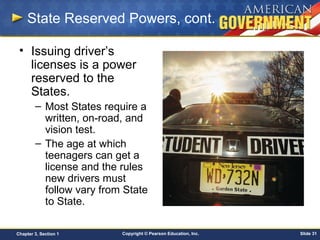
State Reserved Powers, cont.
• Issuing driver’s
licenses is a power
reserved to the
States.
– Most States require a
written, on-road, and
vision test.
– The age at which
teenagers can get a
license and the rules
new drivers must
follow vary from State
to State.
Copyright © Pearson Education, Inc. Slide 32Chapter 3, Section 1
Powers Denied the States
• The Constitution specifically denies some
powers to the States.
– Some of these powers are also denied to the federal
government.
– Other powers denied to the States are exclusive to
the federal government. For example, States
cannot tax imports or coin money, but the federal
government can.
• The States are denied some powers by the
nature of the federal system.
– No State can tax the federal government or regulate
interstate trade.
Copyright © Pearson Education, Inc. Slide 33Chapter 3, Section 1
Concurrent Powers
• Concurrent powers are shared by the federal
government and State governments. They allow
the federal system to function.
• They include all powers not exclusive to the
national government or denied to the States.
– Local governments use these powers only with the
permission of their State.
Copyright © Pearson Education, Inc. Slide 34Chapter 3, Section 1
Sharing Responsibility
• Some powers are exercised by both levels of
government, as you can see in the circle.
– Why do both
levels of government
have the power to establish
law enforcement agencies?
Copyright © Pearson Education, Inc. Slide 35Chapter 3, Section 1
Supreme Law
• The Constitution is the supreme law of the land,
standing above all treaties and acts of
Congress.
– Below these federal laws come State laws.
• In a federal system, State and federal laws
sometimes conflict.
• The Supreme Court settles conflicts between
State and federal laws.
– The Court can rule a State or federal law to be
unconstitutional.
Copyright © Pearson Education, Inc. Slide 36Chapter 3, Section 1
Supreme Law, cont.
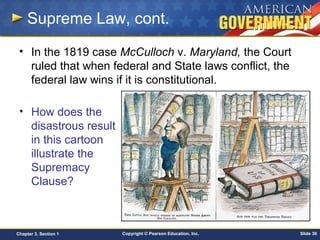
• In the 1819 case McCulloch v. Maryland, the Court
ruled that when federal and State laws conflict, the
federal law wins if it is constitutional.
• How does the
disastrous result
in this cartoon
illustrate the
Supremacy
Clause?
Copyright © Pearson Education, Inc. Slide 37Chapter 3, Section 1
Review
• Now that you have learned about how
power is divided between the Federal
Government and the States, go back and
answer the Chapter Essential Question.
– Is the federal system the best way to govern
the United States?
Chapter 3: The Constitution
Section 2
Copyright © Pearson Education, Inc. Slide 39Chapter 3, Section 1
Objectives
1. Identify the four different ways by which
the Constitution may be formally
changed.
2. Explain how the formal amendment
process illustrates the principles of
federalism and popular sovereignty.
3. Understand that several amendments
have been proposed, but not ratified.
4. Outline the 27 amendments that have
been added to the Constitution.
Copyright © Pearson Education, Inc. Slide 40Chapter 3, Section 1
Key Terms
• amendment: a change to the written words of
the Constitution
• ratification: the act of approving a proposed
amendment
• formal amendment: one of four ways to change
or add to the written language of the Constitution
• Bill of Rights: the name given to the first ten
amendments to the Constitution, which
guarantee many basic freedoms; all ten
amendments were ratified in 1791
Copyright © Pearson Education, Inc. Slide 41Chapter 3, Section 1
Introduction
• How has the Constitution been amended
through the formal amendment process?
– The majority of amendments have been
proposed by a two-thirds vote of Congress
and ratified by three-fourths of the state
legislatures.
– An amendment can also be ratified by state
conventions held in three fourths of the states.
This has only happened once.
Copyright © Pearson Education, Inc. Slide 42Chapter 3, Section 1
Changing with the Times
• The amendment process allows the
Constitution to adapt to the changing
needs of our nation and society.
– The United States has gone from a farming
nation of less than 4 million people to a high-tech
country with a population of more than 300
million.
– Portions of the Constitution have been added,
deleted, or altered as a result of amendments.
Copyright © Pearson Education, Inc. Slide 43Chapter 3, Section 1
The Amendment Process
• Article V of the Constitution describes the
amendment process.
– Amendments may be proposed:
• By a two-thirds vote of each house of
Congress. [Done for 26 of 27 amendments.]
• By a national convention called by Congress at the
request of two-thirds of the state legislatures.
[Done for the 21st
amendment.]
Copyright © Pearson Education, Inc. Slide 44Chapter 3, Section 1
The Amendment Process, cont.
• Amendments can be ratified:
– By three-fourths of
the state legislatures.
– By conventions in
three-fourths of the
states. [A method
not yet used.]
Copyright © Pearson Education, Inc. Slide 45Chapter 3, Section 1
Federalism
• Checkpoint: How does the federal amendment
process reflect the concept of federalism?
– Amendments are proposed at the national level and
ratified at the state level by legislatures or
conventions.
– A state can reject an amendment and later decide to
ratify it.
• But a state cannot change its mind after it votes to ratify
an amendment.
– The President cannot veto proposed amendments.
Copyright © Pearson Education, Inc. Slide 46Chapter 3, Section 1
Popular Sovereignty
• The amendment process is based on popular
sovereignty.
– The people elect the representatives who vote to propose
or ratify amendments.
– Some critics argue that conventions are a better way to
ratify amendments than state legislatures, because state
legislators are rarely elected based upon their views on an
amendment.
– The Supreme Court has ruled that states cannot require a
proposed amendment to be approved by popular vote
before the state legislature can ratify it.
Copyright © Pearson Education, Inc. Slide 47Chapter 3, Section 1
The Bill of Rights
• Checkpoint: What is the purpose of the Bill
of Rights?
– They spell out many basic rights and liberties.
– Many people would not support the
Constitution until a Bill of Rights was
promised.
Copyright © Pearson Education, Inc. Slide 48Chapter 3, Section 1
Proposed Amendments
• Most suggested amendments are never
proposed by Congress.
– Congress has sent only 33 of some 15,000
suggested amendments to the states.
• Six proposed amendments were not ratified by
the states.
– Congress can set a “reasonable” time limit for
ratification, usually around seven years.
• Failed amendments include one declaring the equal rights of
women (ERA) and one banning amendments dealing with
slavery.
Copyright © Pearson Education, Inc. Slide 49Chapter 3, Section 1
The 27 Amendments
• Many of the 27 current amendments were
proposed in response to legal disputes,
social conflicts, or perceived constitutional
problems.
– The 12th
Amendment resolved a problem with
the presidential election process.
– The 13th
Amendment abolished slavery.
Copyright © Pearson Education, Inc. Slide 50Chapter 3, Section 1
The 27 Amendments, cont.
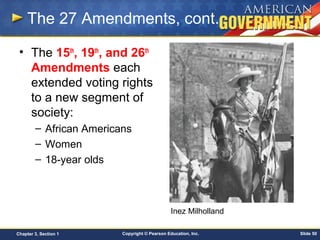
• The 15th
, 19th
, and 26th
Amendments each
extended voting rights
to a new segment of
society:
– African Americans
– Women
– 18-year olds
Inez Milholland
Copyright © Pearson Education, Inc. Slide 51Chapter 3, Section 1
• 1791 - Amendments 1-10
– Bill of Rights
• 1795 - Amendment 11
– States immune from certain lawsuits
• 1804 - Amendment 12
– Changes in electoral college
procedures
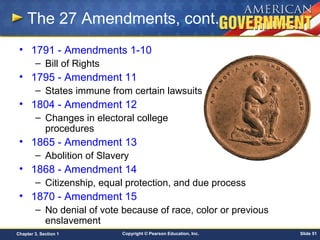
• 1865 - Amendment 13
– Abolition of Slavery
• 1868 - Amendment 14
– Citizenship, equal protection, and due process
• 1870 - Amendment 15
– No denial of vote because of race, color or previous
enslavement
The 27 Amendments, cont.
Copyright © Pearson Education, Inc. Slide 52Chapter 3, Section 1
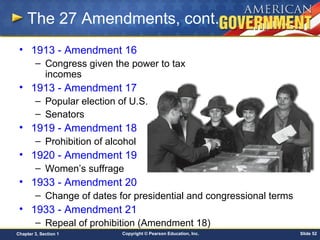
• 1913 - Amendment 16
– Congress given the power to tax
incomes
• 1913 - Amendment 17
– Popular election of U.S.
– Senators
• 1919 - Amendment 18
– Prohibition of alcohol
• 1920 - Amendment 19
– Women’s suffrage
• 1933 - Amendment 20
– Change of dates for presidential and congressional terms
• 1933 - Amendment 21
– Repeal of prohibition (Amendment 18)
The 27 Amendments, cont.
Copyright © Pearson Education, Inc. Slide 53Chapter 3, Section 1
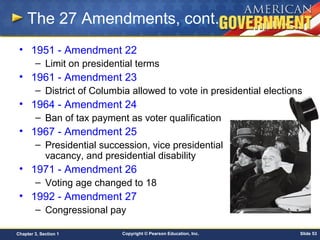
• 1951 - Amendment 22
– Limit on presidential terms
• 1961 - Amendment 23
– District of Columbia allowed to vote in presidential elections
• 1964 - Amendment 24
– Ban of tax payment as voter qualification
• 1967 - Amendment 25
– Presidential succession, vice presidential
vacancy, and presidential disability
• 1971 - Amendment 26
– Voting age changed to 18
• 1992 - Amendment 27
– Congressional pay
The 27 Amendments, cont.
Copyright © Pearson Education, Inc. Slide 54Chapter 3, Section 1
Review
• Now that you have learned how the
Constitution has been amended through
the formal amendment process, go back
and answer the Chapter Essential
Question.
– How has the Constitution lasted through
changing times?
Chapter 3: The Constitution
Section 3
Copyright © Pearson Education, Inc. Slide 56Chapter 3, Section 1
Objectives
1. Identify how basic legislation has added
to our understanding of the Constitution
over time.
2. Describe the ways in which the executive
and judicial branches have interpreted
the Constitution.
3. Analyze the role of party practices and
custom in interpreting the Constitution.
Copyright © Pearson Education, Inc. Slide 57Chapter 3, Section 1
Key Terms
• executive agreement: a pact made by
the President directly with the head of a
foreign state
• treaty: a formal agreement between two
or more independent states
• electoral college: the body of electors
that makes the formal selection of the
President
Copyright © Pearson Education, Inc. Slide 58Chapter 3, Section 1
Key Terms, cont.
• Cabinet: a body made up of the heads of
the 15 executive departments that advises
the President
• senatorial courtesy: the Senate custom
of refusing to approve any presidential
appointee unless that person has the
support of all Senators from the
appointee’s home state who belong to the
same party as the President
Copyright © Pearson Education, Inc. Slide 59Chapter 3, Section 1
Introduction
• How have the day-to-day workings of the
government affected how we interpret the
Constitution?
– Congress passes new laws.
– Presidents push to expand executive power.
– The Supreme Court makes key rulings on
constitutional issues.
– Political parties influence the governing process.
– Customs develop over time.
Copyright © Pearson Education, Inc. Slide 60Chapter 3, Section 1
The Role of Congress
• Congress has expanded upon basic
constitutional provisions.
– Congress created much of the specific structure of the
federal government.
– Congress established the federal court system—the
Constitution created only the Supreme Court.
– Congress created the many departments and agencies in
the executive branch.
– Congress has clarified issues such as the succession of
the Vice President.
Copyright © Pearson Education, Inc. Slide 61Chapter 3, Section 1
Powers of Congress
• Congress passes laws that clarify its own
constitutional powers.
– The Constitution describes some congressional
powers in vague terms.
• For example, Congress has the power to regulate
foreign trade and interstate commerce.
– Over the years, Congress has passed thousands
of laws that detail just what is meant by words like
“regulate,” “trade,” “interstate” and “commerce.” In
the process, it has interpreted the meaning of the
Constitution.
Copyright © Pearson Education, Inc. Slide 62Chapter 3, Section 1
Expanding Executive Power
• Presidents have increased their constitutional
powers by taking a broad interpretation of such
powers.
– Often this involves avoiding the need to gain
congressional approval.
• For example, only Congress can declare war. But while
acting as commander-in-chief, many Presidents have
sent military forces into combat without a formal act
of war.
• The Senate must approve formal treaties. But
Presidents can and do enter into legally binding
executive agreements with foreign leaders without
asking for Senate approval.
Copyright © Pearson Education, Inc. Slide 63Chapter 3, Section 1
Presidential Power
• The Constitution grants the President
“executive power.”
– Most Presidents argue that this power
includes the authority to do things not
specifically mentioned in the Constitution.
• For example, Thomas Jefferson used it as a
justification for acquiring new territory for the
United States when he purchased the Louisiana
Territory in 1803.
Copyright © Pearson Education, Inc. Slide 64Chapter 3, Section 1
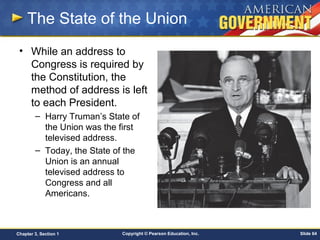
The State of the Union
• While an address to
Congress is required by
the Constitution, the
method of address is left
to each President.
– Harry Truman’s State of
the Union was the first
televised address.
– Today, the State of the
Union is an annual
televised address to
Congress and all
Americans.
Copyright © Pearson Education, Inc. Slide 65Chapter 3, Section 1
The Courts
• The nation’s courts, particularly the Supreme
Court, interpret the Constitution on a regular
basis.
– The power of judicial review gives the Court the
power to declare laws unconstitutional.
– Declaring that a law is constitutional also involves
interpreting the Constitution.
– Each type of ruling sets a precedent for interpreting
future laws.
Copyright © Pearson Education, Inc. Slide 66Chapter 3, Section 1
Political Parties
• The Constitution does not mention political
parties.
– Most of the Framers actually opposed parties,
fearing they would divide the government.
Copyright © Pearson Education, Inc. Slide 67Chapter 3, Section 1
• Yet parties are very
influential in our
political process.
– The daily business
and the committee
system of Congress
are organized around
party membership.
Political Parties, cont.
Copyright © Pearson Education, Inc. Slide 68Chapter 3, Section 1
Political Parties, cont.
• Checkpoint: How have political parties changed
the way we interpret the Constitution?
– The Constitution says nothing about the nomination
process.
– Political parties use state primaries and national
conventions to choose candidates.
– Parties also influence the selection of electors to the
electoral college.
– Party membership also influences the President’s
decision-making process when choosing political
appointees.
Copyright © Pearson Education, Inc. Slide 69Chapter 3, Section 1
Customs
• Unwritten customs can be as influential as
written laws.
– The President’s Cabinet exists solely as a
result of custom rather than any laws.
– The custom of senatorial courtesy guides the
appointment of public officials.
Copyright © Pearson Education, Inc. Slide 70Chapter 3, Section 1
Customs, cont.
• Ever since George Washington, Presidents
had limited themselves to two terms in office.
• After Franklin Roosevelt was elected to four
consecutive terms from 1932 to 1944, the
two-term limit was made into law by
passage of the 22nd
Amendment in 1951.
Copyright © Pearson Education, Inc. Slide 71Chapter 3, Section 1
Customs, cont.
• Checkpoint: Which customs did the
22nd and 25th Amendments establish
as laws?
– For years, the Vice President assumed the
office of the presidency when the President
died.
– But this was not a formal law until ratification
of the 25th
amendment in 1967.
Copyright © Pearson Education, Inc. Slide 72Chapter 3, Section 1
Review
• Now that you have learned how the day-
to-day working of the government have
affected how we interpret the Constitution,
go back and answer the Chapter Essential
Question.
– How has the Constitution lasted through
changing times?

Chapter 3

  • 1.
    Chapter 3: TheConstitution Section 1
  • 2.
    Copyright © PearsonEducation, Inc. Slide 2Chapter 3, Section 1 Objectives 1. Understand the basic outline of the Constitution. 2. Understand the six basic principles of the Constitution: popular sovereignty, limited government, separation of powers, checks and balances, judicial review, and federalism.
  • 3.
    Copyright © PearsonEducation, Inc. Slide 3Chapter 3, Section 1 Key Terms • popular sovereignty: the political principle that people are the source of all governmental power and that government requires the consent of the governed • limited government: the idea that government may only do those things that the people have given it the power to do • constitutionalism: the idea that government must be conducted according to constitutional principles
  • 4.
    Copyright © PearsonEducation, Inc. Slide 4Chapter 3, Section 1 Key Terms, cont. • rule of law: the principle that government and its officers must always obey the laws of the land • separation of powers: the principle that each of the basic powers of government— executive, legislative, and judicial—should be wielded by an independent branch of government
  • 5.
    Copyright © PearsonEducation, Inc. Slide 5Chapter 3, Section 1 Key Terms, cont. • checks and balances: the system under which each branch of government can check, or limit, the actions of the other branches • veto: to reject an act of Congress • judicial review: the power of a court to determine whether a government action is constitutional or not
  • 6.
    Copyright © PearsonEducation, Inc. Slide 6Chapter 3, Section 1 Key Terms, cont. • unconstitutional: in violation of a provision of the Constitution, and therefore illegal and of no effect • federalism: the principle that political power should be divided between a central government and a number of regional governments
  • 7.
    Copyright © PearsonEducation, Inc. Slide 7Chapter 3, Section 1 Introduction • What are the six main principles on which the Constitution is based? – Popular Sovereignty – Limited Government – Separation of Powers – Checks and Balances – Judicial Review – Federalism – The Constitution embodies these key principles along with describing the basic structure of our government.
  • 8.
    Copyright © PearsonEducation, Inc. Slide 8Chapter 3, Section 1 Outline of the Constitution • The Constitution is organized in a simple fashion and is fairly brief. – In many areas it focuses more on principles than specific details. This helps it guide the nation through changing times. – The seven articles are followed by the 27 amendments.
  • 9.
    Copyright © PearsonEducation, Inc. Slide 9Chapter 3, Section 1 Popular Sovereignty • The principle that the people are the only source for all governmental power. – The government rules through leaders elected by the people to represent the people. – The Preamble notes that the Constitution is created by “We the People.”
  • 10.
    Copyright © PearsonEducation, Inc. Slide 10Chapter 3, Section 1 Limited Government • Government may only do those things the people have given it the power to do. – Government must obey the law. – Much of the Constitution spells out limits on the power of the government.
  • 11.
    Copyright © PearsonEducation, Inc. Slide 11Chapter 3, Section 1 Separation of Powers • Checkpoint: How does the separation of powers keep government from becoming too powerful? – The Constitution divides power among the legislative, executive and judicial branches. • Congress makes the laws, the President executes and administers the laws, and the Supreme Court interprets the laws. – Separation of powers keeps a strong central government from being too powerful. • Too much power concentrated in any one branch could lead to abuses of that power.
  • 12.
    Copyright © PearsonEducation, Inc. Slide 12Chapter 3, Section 1 Checks and Balances • Each branch of the federal government can check the power of the other two. – The President can veto bills passed by Congress, but Congress can override a veto. – The Senate can reject presidential appointees or refuse to ratify a treaty. – Congress can vote to impeach a federal official. – The federal courts can rule that executive and legislative acts are unconstitutional.
  • 13.
    Copyright © PearsonEducation, Inc. Slide 13Chapter 3, Section 1 Checks and Balances, cont. • The use of checks is fairly rare. – Compromise is more common – Conflicts more likely when Congress and the presidency are controlled by different parties.
  • 15.
    Copyright © PearsonEducation, Inc. Slide 15Chapter 3, Section 1 Judicial Review • The Courts can decide if a government action is constitutional. – The power of judicial review is held by all federal courts and most state courts. – Judicial review was established as a necessary power of the courts by Supreme Court Chief Justice John Marshal in the case Marbury v. Madison in 1803. – Most acts are found to be constitutional, but the Supreme Court has struck down many presidential, congressional, and state measures over the years.
  • 16.
    Copyright © PearsonEducation, Inc. Slide 16Chapter 3, Section 1 Federalism • Federalism is a compromise between an all- powerful central government and an independent state government. – It corrected the weaknesses of the Articles of Confederation without replacing them with a British- style monarchy. – The Framers felt that too much governmental power threatened liberty. – Federalism helps prevent that power from being abused, by dividing governmental power.
  • 17.
    Copyright © PearsonEducation, Inc. Slide 17Chapter 3, Section 1 Federalism, cont. • The Constitution divides power among the State and Federal Governments. – Why might the Constitution give the power to regulate trade among the States to the Federal Government?
  • 18.
    Copyright © PearsonEducation, Inc. Slide 18Chapter 3, Section 1 Review • Now that you have learned about the six main principles on which the Constitution is based, go back and answer the Chapter Essential Question. – How has the Constitution lasted through changing times?
  • 19.
  • 20.
    Copyright © PearsonEducation, Inc. Slide 20Chapter 3, Section 1 Objectives 1. Define federalism and explain why the Framers chose this system. 2. Identify powers delegated to and denied to the National Government, and powers reserved for and denied to the States. 3. Explain the difference between exclusive and concurrent powers. 4. Examine the Constitution as “the supreme Law of the Land.”
  • 21.
    Copyright © PearsonEducation, Inc. Slide 21Chapter 3, Section 1 Key Terms • federalism: a system of government in which a written constitution divides power between a central government and several regional governments • division of powers: assigning some powers to the federal government and others to the States • delegated powers: powers granted by the Constitution • expressed powers: powers specified clearly in the Constitution • implied powers: powers not specifically mentioned, but suggested by the expressed powers
  • 22.
    Copyright © PearsonEducation, Inc. Slide 22Chapter 3, Section 1 Key Terms, cont. • inherent powers: powers that belong to all independent national governments • reserved powers: powers not given to the national government or denied to the States • exclusive powers: powers that can only be used by the national government • concurrent powers: powers shared by the national and State governments • Supremacy Clause: the provision declaring the Constitution to be the supreme law of the land
  • 23.
    Copyright © PearsonEducation, Inc. Slide 23Chapter 3, Section 1 Introduction • How is power divided between the Federal Government and the States? – Certain exclusive powers, such as the power to coin money, are exercised only by the federal government. – Reserved powers, such as the power to establish public schools, are exercised only by the States. – Concurrent powers, such as the power to tax, are shared by the States and the federal government.
  • 24.
    Copyright © PearsonEducation, Inc. Slide 24Chapter 3, Section 1 Federalism • The Framers believed that government power must be divided and limited so that it cannot threaten individual liberty. • The Constitution divides power between the federal government and the States through federalism. – Federalism creates two basic levels of government that overlap. – Each level has some powers denied to the other level.
  • 25.
    Copyright © PearsonEducation, Inc. Slide 25Chapter 3, Section 1 Federalism, cont. • Federalism allows local governments to handle local concerns while the national government deals with national issues. – This gives each of the States some flexibility when dealing with challenges. – Successful State programs, such as welfare reform, can influence national policies as well as policies in other States. • Federalism also lets the nation respond in a united way to serious crises like war or natural disasters.
  • 26.
    Copyright © PearsonEducation, Inc. Slide 26Chapter 3, Section 1 Expressed Powers • The congressional powers specified in the Constitution in Article I include the power to coin money, raise armed forces, and levy taxes. • Other expressed powers are granted to the President in Article II and the Supreme Court in Article III.
  • 27.
    Copyright © PearsonEducation, Inc. Slide 27Chapter 3, Section 1 Implied Powers • Checkpoint: Why is the Necessary and Proper Clause sometimes referred to as the Elastic Clause? – The Necessary and Proper Clause gives Congress the power to make all laws “necessary and proper” for carrying out its expressed powers, so it is said to stretch to cover many situations. – Congress exercises many implied powers that are based upon its expressed powers. These implied powers include building the interstate highway system and banning racial discrimination in public places.
  • 28.
    Copyright © PearsonEducation, Inc. Slide 28Chapter 3, Section 1 Inherent Powers • Every national government has certain powers, called inherent powers. These inherent powers are not based on the Constitution. • Inherent powers include acquiring territory, defending the nation, regulating immigration, and conducting diplomacy.
  • 29.
    Copyright © PearsonEducation, Inc. Slide 29Chapter 3, Section 1 Denied Powers • The Constitution denies certain powers to the federal government. – Some powers are specifically denied, such as the power to prohibit freedom of religion, speech, press, or assembly. – Other powers, like creating a national school system, are denied because they cannot be based on expressed powers. – Finally, the national government cannot have powers that would undermine the existence of the federal system.
  • 30.
    Copyright © PearsonEducation, Inc. Slide 30Chapter 3, Section 1 State Reserved Powers • The 10th Amendment reserves to the States all powers not given to the federal government or denied to the States. – These powers include the police power, which lets a State protect and promote public health, morals, safety, and general welfare. – State and local governments use the huge scope of the reserved powers to perform many of their daily actions.
  • 31.
    Copyright © PearsonEducation, Inc. Slide 31Chapter 3, Section 1 State Reserved Powers, cont. • Issuing driver’s licenses is a power reserved to the States. – Most States require a written, on-road, and vision test. – The age at which teenagers can get a license and the rules new drivers must follow vary from State to State.
  • 32.
    Copyright © PearsonEducation, Inc. Slide 32Chapter 3, Section 1 Powers Denied the States • The Constitution specifically denies some powers to the States. – Some of these powers are also denied to the federal government. – Other powers denied to the States are exclusive to the federal government. For example, States cannot tax imports or coin money, but the federal government can. • The States are denied some powers by the nature of the federal system. – No State can tax the federal government or regulate interstate trade.
  • 33.
    Copyright © PearsonEducation, Inc. Slide 33Chapter 3, Section 1 Concurrent Powers • Concurrent powers are shared by the federal government and State governments. They allow the federal system to function. • They include all powers not exclusive to the national government or denied to the States. – Local governments use these powers only with the permission of their State.
  • 34.
    Copyright © PearsonEducation, Inc. Slide 34Chapter 3, Section 1 Sharing Responsibility • Some powers are exercised by both levels of government, as you can see in the circle. – Why do both levels of government have the power to establish law enforcement agencies?
  • 35.
    Copyright © PearsonEducation, Inc. Slide 35Chapter 3, Section 1 Supreme Law • The Constitution is the supreme law of the land, standing above all treaties and acts of Congress. – Below these federal laws come State laws. • In a federal system, State and federal laws sometimes conflict. • The Supreme Court settles conflicts between State and federal laws. – The Court can rule a State or federal law to be unconstitutional.
  • 36.
    Copyright © PearsonEducation, Inc. Slide 36Chapter 3, Section 1 Supreme Law, cont. • In the 1819 case McCulloch v. Maryland, the Court ruled that when federal and State laws conflict, the federal law wins if it is constitutional. • How does the disastrous result in this cartoon illustrate the Supremacy Clause?
  • 37.
    Copyright © PearsonEducation, Inc. Slide 37Chapter 3, Section 1 Review • Now that you have learned about how power is divided between the Federal Government and the States, go back and answer the Chapter Essential Question. – Is the federal system the best way to govern the United States?
  • 38.
    Chapter 3: TheConstitution Section 2
  • 39.
    Copyright © PearsonEducation, Inc. Slide 39Chapter 3, Section 1 Objectives 1. Identify the four different ways by which the Constitution may be formally changed. 2. Explain how the formal amendment process illustrates the principles of federalism and popular sovereignty. 3. Understand that several amendments have been proposed, but not ratified. 4. Outline the 27 amendments that have been added to the Constitution.
  • 40.
    Copyright © PearsonEducation, Inc. Slide 40Chapter 3, Section 1 Key Terms • amendment: a change to the written words of the Constitution • ratification: the act of approving a proposed amendment • formal amendment: one of four ways to change or add to the written language of the Constitution • Bill of Rights: the name given to the first ten amendments to the Constitution, which guarantee many basic freedoms; all ten amendments were ratified in 1791
  • 41.
    Copyright © PearsonEducation, Inc. Slide 41Chapter 3, Section 1 Introduction • How has the Constitution been amended through the formal amendment process? – The majority of amendments have been proposed by a two-thirds vote of Congress and ratified by three-fourths of the state legislatures. – An amendment can also be ratified by state conventions held in three fourths of the states. This has only happened once.
  • 42.
    Copyright © PearsonEducation, Inc. Slide 42Chapter 3, Section 1 Changing with the Times • The amendment process allows the Constitution to adapt to the changing needs of our nation and society. – The United States has gone from a farming nation of less than 4 million people to a high-tech country with a population of more than 300 million. – Portions of the Constitution have been added, deleted, or altered as a result of amendments.
  • 43.
    Copyright © PearsonEducation, Inc. Slide 43Chapter 3, Section 1 The Amendment Process • Article V of the Constitution describes the amendment process. – Amendments may be proposed: • By a two-thirds vote of each house of Congress. [Done for 26 of 27 amendments.] • By a national convention called by Congress at the request of two-thirds of the state legislatures. [Done for the 21st amendment.]
  • 44.
    Copyright © PearsonEducation, Inc. Slide 44Chapter 3, Section 1 The Amendment Process, cont. • Amendments can be ratified: – By three-fourths of the state legislatures. – By conventions in three-fourths of the states. [A method not yet used.]
  • 45.
    Copyright © PearsonEducation, Inc. Slide 45Chapter 3, Section 1 Federalism • Checkpoint: How does the federal amendment process reflect the concept of federalism? – Amendments are proposed at the national level and ratified at the state level by legislatures or conventions. – A state can reject an amendment and later decide to ratify it. • But a state cannot change its mind after it votes to ratify an amendment. – The President cannot veto proposed amendments.
  • 46.
    Copyright © PearsonEducation, Inc. Slide 46Chapter 3, Section 1 Popular Sovereignty • The amendment process is based on popular sovereignty. – The people elect the representatives who vote to propose or ratify amendments. – Some critics argue that conventions are a better way to ratify amendments than state legislatures, because state legislators are rarely elected based upon their views on an amendment. – The Supreme Court has ruled that states cannot require a proposed amendment to be approved by popular vote before the state legislature can ratify it.
  • 47.
    Copyright © PearsonEducation, Inc. Slide 47Chapter 3, Section 1 The Bill of Rights • Checkpoint: What is the purpose of the Bill of Rights? – They spell out many basic rights and liberties. – Many people would not support the Constitution until a Bill of Rights was promised.
  • 48.
    Copyright © PearsonEducation, Inc. Slide 48Chapter 3, Section 1 Proposed Amendments • Most suggested amendments are never proposed by Congress. – Congress has sent only 33 of some 15,000 suggested amendments to the states. • Six proposed amendments were not ratified by the states. – Congress can set a “reasonable” time limit for ratification, usually around seven years. • Failed amendments include one declaring the equal rights of women (ERA) and one banning amendments dealing with slavery.
  • 49.
    Copyright © PearsonEducation, Inc. Slide 49Chapter 3, Section 1 The 27 Amendments • Many of the 27 current amendments were proposed in response to legal disputes, social conflicts, or perceived constitutional problems. – The 12th Amendment resolved a problem with the presidential election process. – The 13th Amendment abolished slavery.
  • 50.
    Copyright © PearsonEducation, Inc. Slide 50Chapter 3, Section 1 The 27 Amendments, cont. • The 15th , 19th , and 26th Amendments each extended voting rights to a new segment of society: – African Americans – Women – 18-year olds Inez Milholland
  • 51.
    Copyright © PearsonEducation, Inc. Slide 51Chapter 3, Section 1 • 1791 - Amendments 1-10 – Bill of Rights • 1795 - Amendment 11 – States immune from certain lawsuits • 1804 - Amendment 12 – Changes in electoral college procedures • 1865 - Amendment 13 – Abolition of Slavery • 1868 - Amendment 14 – Citizenship, equal protection, and due process • 1870 - Amendment 15 – No denial of vote because of race, color or previous enslavement The 27 Amendments, cont.
  • 52.
    Copyright © PearsonEducation, Inc. Slide 52Chapter 3, Section 1 • 1913 - Amendment 16 – Congress given the power to tax incomes • 1913 - Amendment 17 – Popular election of U.S. – Senators • 1919 - Amendment 18 – Prohibition of alcohol • 1920 - Amendment 19 – Women’s suffrage • 1933 - Amendment 20 – Change of dates for presidential and congressional terms • 1933 - Amendment 21 – Repeal of prohibition (Amendment 18) The 27 Amendments, cont.
  • 53.
    Copyright © PearsonEducation, Inc. Slide 53Chapter 3, Section 1 • 1951 - Amendment 22 – Limit on presidential terms • 1961 - Amendment 23 – District of Columbia allowed to vote in presidential elections • 1964 - Amendment 24 – Ban of tax payment as voter qualification • 1967 - Amendment 25 – Presidential succession, vice presidential vacancy, and presidential disability • 1971 - Amendment 26 – Voting age changed to 18 • 1992 - Amendment 27 – Congressional pay The 27 Amendments, cont.
  • 54.
    Copyright © PearsonEducation, Inc. Slide 54Chapter 3, Section 1 Review • Now that you have learned how the Constitution has been amended through the formal amendment process, go back and answer the Chapter Essential Question. – How has the Constitution lasted through changing times?
  • 55.
    Chapter 3: TheConstitution Section 3
  • 56.
    Copyright © PearsonEducation, Inc. Slide 56Chapter 3, Section 1 Objectives 1. Identify how basic legislation has added to our understanding of the Constitution over time. 2. Describe the ways in which the executive and judicial branches have interpreted the Constitution. 3. Analyze the role of party practices and custom in interpreting the Constitution.
  • 57.
    Copyright © PearsonEducation, Inc. Slide 57Chapter 3, Section 1 Key Terms • executive agreement: a pact made by the President directly with the head of a foreign state • treaty: a formal agreement between two or more independent states • electoral college: the body of electors that makes the formal selection of the President
  • 58.
    Copyright © PearsonEducation, Inc. Slide 58Chapter 3, Section 1 Key Terms, cont. • Cabinet: a body made up of the heads of the 15 executive departments that advises the President • senatorial courtesy: the Senate custom of refusing to approve any presidential appointee unless that person has the support of all Senators from the appointee’s home state who belong to the same party as the President
  • 59.
    Copyright © PearsonEducation, Inc. Slide 59Chapter 3, Section 1 Introduction • How have the day-to-day workings of the government affected how we interpret the Constitution? – Congress passes new laws. – Presidents push to expand executive power. – The Supreme Court makes key rulings on constitutional issues. – Political parties influence the governing process. – Customs develop over time.
  • 60.
    Copyright © PearsonEducation, Inc. Slide 60Chapter 3, Section 1 The Role of Congress • Congress has expanded upon basic constitutional provisions. – Congress created much of the specific structure of the federal government. – Congress established the federal court system—the Constitution created only the Supreme Court. – Congress created the many departments and agencies in the executive branch. – Congress has clarified issues such as the succession of the Vice President.
  • 61.
    Copyright © PearsonEducation, Inc. Slide 61Chapter 3, Section 1 Powers of Congress • Congress passes laws that clarify its own constitutional powers. – The Constitution describes some congressional powers in vague terms. • For example, Congress has the power to regulate foreign trade and interstate commerce. – Over the years, Congress has passed thousands of laws that detail just what is meant by words like “regulate,” “trade,” “interstate” and “commerce.” In the process, it has interpreted the meaning of the Constitution.
  • 62.
    Copyright © PearsonEducation, Inc. Slide 62Chapter 3, Section 1 Expanding Executive Power • Presidents have increased their constitutional powers by taking a broad interpretation of such powers. – Often this involves avoiding the need to gain congressional approval. • For example, only Congress can declare war. But while acting as commander-in-chief, many Presidents have sent military forces into combat without a formal act of war. • The Senate must approve formal treaties. But Presidents can and do enter into legally binding executive agreements with foreign leaders without asking for Senate approval.
  • 63.
    Copyright © PearsonEducation, Inc. Slide 63Chapter 3, Section 1 Presidential Power • The Constitution grants the President “executive power.” – Most Presidents argue that this power includes the authority to do things not specifically mentioned in the Constitution. • For example, Thomas Jefferson used it as a justification for acquiring new territory for the United States when he purchased the Louisiana Territory in 1803.
  • 64.
    Copyright © PearsonEducation, Inc. Slide 64Chapter 3, Section 1 The State of the Union • While an address to Congress is required by the Constitution, the method of address is left to each President. – Harry Truman’s State of the Union was the first televised address. – Today, the State of the Union is an annual televised address to Congress and all Americans.
  • 65.
    Copyright © PearsonEducation, Inc. Slide 65Chapter 3, Section 1 The Courts • The nation’s courts, particularly the Supreme Court, interpret the Constitution on a regular basis. – The power of judicial review gives the Court the power to declare laws unconstitutional. – Declaring that a law is constitutional also involves interpreting the Constitution. – Each type of ruling sets a precedent for interpreting future laws.
  • 66.
    Copyright © PearsonEducation, Inc. Slide 66Chapter 3, Section 1 Political Parties • The Constitution does not mention political parties. – Most of the Framers actually opposed parties, fearing they would divide the government.
  • 67.
    Copyright © PearsonEducation, Inc. Slide 67Chapter 3, Section 1 • Yet parties are very influential in our political process. – The daily business and the committee system of Congress are organized around party membership. Political Parties, cont.
  • 68.
    Copyright © PearsonEducation, Inc. Slide 68Chapter 3, Section 1 Political Parties, cont. • Checkpoint: How have political parties changed the way we interpret the Constitution? – The Constitution says nothing about the nomination process. – Political parties use state primaries and national conventions to choose candidates. – Parties also influence the selection of electors to the electoral college. – Party membership also influences the President’s decision-making process when choosing political appointees.
  • 69.
    Copyright © PearsonEducation, Inc. Slide 69Chapter 3, Section 1 Customs • Unwritten customs can be as influential as written laws. – The President’s Cabinet exists solely as a result of custom rather than any laws. – The custom of senatorial courtesy guides the appointment of public officials.
  • 70.
    Copyright © PearsonEducation, Inc. Slide 70Chapter 3, Section 1 Customs, cont. • Ever since George Washington, Presidents had limited themselves to two terms in office. • After Franklin Roosevelt was elected to four consecutive terms from 1932 to 1944, the two-term limit was made into law by passage of the 22nd Amendment in 1951.
  • 71.
    Copyright © PearsonEducation, Inc. Slide 71Chapter 3, Section 1 Customs, cont. • Checkpoint: Which customs did the 22nd and 25th Amendments establish as laws? – For years, the Vice President assumed the office of the presidency when the President died. – But this was not a formal law until ratification of the 25th amendment in 1967.
  • 72.
    Copyright © PearsonEducation, Inc. Slide 72Chapter 3, Section 1 Review • Now that you have learned how the day- to-day working of the government have affected how we interpret the Constitution, go back and answer the Chapter Essential Question. – How has the Constitution lasted through changing times?

Editor's Notes

  • #10 NOTE TO TEACHERS: In above image, voters express their will to the government. This concept is called popular sovereignty.
  • #12 Checkpoint Answer: By dividing power among three branches, it makes it very difficult for any one branch to assume too much authority. The only way the government could abuse its powers is if every branch agreed to work together, which is unlikely given all the different individuals and goals involved.
  • #18 Diagram question answer: Under the Articles of Confederation, states regulated trade among themselves with disastrous results for the national economy. Having interstate trade disputes settled by the central government is an efficient and fair way of ensuring that such disputes do not cause national problems.
  • #28 Checkpoint Answer: The clause can be “stretched” to provide a wide range of implied powers, as long as those powers can be seen as necessary to carry out the expressed powers granted by the Constitution.
  • #29 NOTE TO TEACHERS: In this image, President George W. Bush meets with Chancellor Angela Merkel of Germany at the 2007 G8 Summit.
  • #35 Answer: As there are separate federal and state laws, each level of government needs separate law enforcement agencies to ensure that its laws are obeyed.
  • #37 Answer: The cartoon figure of Andrew Johnson is attempting to do something that would violate the Constitution, but because it is the Supreme law of the land, he is smashed under the weight of its ultimate authority. This signifies that even the President is not above the Constitution.
  • #44 NOTE FOR TEACHERS: Today, 2/3 of the states means that 34 must propose an amendment and ¾ of the states means that 38 states must ratify an amendment. In the past 40 years, Congress has come close to calling a national convention twice at the request of the states; once to change a Supreme Court decision about voting rights, and the other time to require a balanced federal budget except in times of war or national emergency.
  • #46 Checkpoint Answer: Amendments are proposed at the federal level and ratified at the state level, thus dividing the power to change the Constitution between the central government and the states.
  • #48 Checkpoint Answer: The Constitution might never have been ratified without the promise that a bill of rights would be added to the document. Students should also note that the Bill of Rights spells out many of the fundamental liberties that Americans take for granted each day. If it were left solely to the state constitutions to protect these rights, they might not be shared by all American citizens.
  • #51 NOTE TO TEACHERS: The above image depicts Inez Milholland, who fought to amend the Constitution to allow women’s suffrage.
  • #52 NOTE TO TEACHERS: Above image shows a coin that was a symbol of the anti-slavery movement.
  • #53 NOTE TO TEACHERS: Above image shows the first women to vote in Brooklyn, New York.
  • #65 NOTE TO TEACHERS: In the image above, Harry Truman delivers the first televised State of the Union.
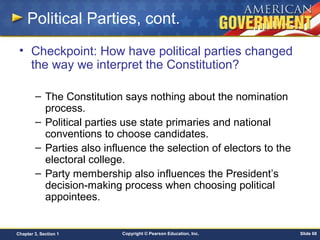
  • #68 NOTE TO TEACHERS: Image above shows a delegate. Delegates play an important role in shaping the U.S. Government.
  • #69 Checkpoint Answer: Political parties have shaped the nomination and election of the President in ways never mentioned by the Constitution. They have also influenced the process of appointing public officials, as the President must consider party affiliation when nominating appointees as well as the custom of senatorial courtesy, which is based partly on party affiliations.
  • #72 Checkpoint Answer: The two-term limit on Presidents and the official succession of the Vice President to the office of President when the President dies or is otherwise forced to step down.