Chapter 17: Foreign Policy and
National Defense
Section 1
Copyright © Pearson Education, Inc. Slide 2Chapter 17, Section 1
Objectives
1. Explain the difference between
isolationism and internationalism.
2. Define foreign policy.
3. Understand that a nation’s foreign policy
is composed of its many foreign policies.
4. Describe the functions, components, and
organization of the Department of State.
Copyright © Pearson Education, Inc. Slide 3Chapter 17, Section 1
Key Terms
• domestic affairs: events in one’s home
country
• foreign affairs: a nation’s relations with
other nations
• isolationism: a refusal to become
involved in the affairs of the rest of the
world
• foreign policy: everything a nation does
and says in world affairs
Copyright © Pearson Education, Inc. Slide 4Chapter 17, Section 1
Key Terms, cont.
• right of legation: the right to send and receive
diplomatic representatives
• ambassador: an official representative of a
sovereign state in the conduct of its foreign
affairs
• diplomatic immunity: not being subject to the
laws of a state to which one is an accredited
ambassador
• passport: a legal document that identifies
someone as a citizen of a state
• visa: a permit to enter another state
Copyright © Pearson Education, Inc. Slide 5Chapter 17, Section 1
Introduction
• How is foreign policy made and conducted?
– Foreign policy is made by the President with the
advice of the Secretary of State and State
Department.
– It is carried out in person by U.S. ambassadors and
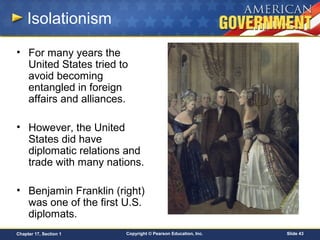
other diplomats, both individually and as members of
international organizations.
– It is also conducted by America’s stands on issues
such as international trade, human rights, and
international conflicts.
Copyright © Pearson Education, Inc. Slide 6Chapter 17, Section 1
Isolationism to Internationalism
• For nearly 150 years U.S. foreign relations
were based on isolationism, as U.S. leaders
refused to get widely involved in foreign
affairs.
• From the 1940s on, the United States has
played a major role in world affairs.
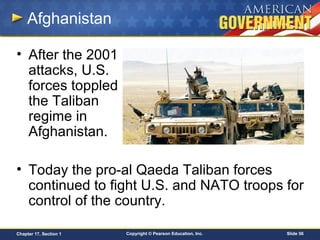
– Today America’s national security can be
endangered by terrorism and foreign conflicts.
– Additionally, the U.S. economy is now tied to the
global economy.
Copyright © Pearson Education, Inc. Slide 7Chapter 17, Section 1
Foreign Policy
• Checkpoint: What is foreign policy?
– Foreign policy consists of all the stands and actions
that a nation takes in every aspect of its relationships
with other countries – including diplomatic, military,
and economic relationships.
– These stands and actions include all of America’s
treaties, alliances, and foreign aid, as well as U.S.
policies on international trade, immigration, human
rights and the environment.
Copyright © Pearson Education, Inc. Slide 8Chapter 17, Section 1
Foreign Policy, cont.
• Foreign policy goals change over time.
• The President is the nation’s chief diplomat.
– Several Presidents have tried to broker Mideast
peace agreements.
Copyright © Pearson Education, Inc. Slide 9Chapter 17, Section 1
State Department
• The President looks to the State Department, the first
executive department created by Congress, for advice
and assistance in conducting U.S. foreign policy.
• The department is divided into bureaus that deal with
specific geographic regions or with specific foreign policy
issues.
• The State Department pursues four major foreign policy
goals:
– Protecting America
– Advancing democracy
– Protecting American values
– Supporting diplomatic officials
Copyright © Pearson Education, Inc. Slide 10Chapter 17, Section 1
Protecting America
• The State Department:
– Maintains and
strengthens diplomatic
ties with other nations
– Manages domestic
and international travel
and trade policies
– Promotes global
stability
Copyright © Pearson Education, Inc. Slide 11Chapter 17, Section 1
Advancing Democracy
• The State Department:
– Supports newly established democracies
– Promotes fair voting practices and just legal
systems
– Monitors human
rights issues globally
Copyright © Pearson Education, Inc. Slide 12Chapter 17, Section 1
Promoting American Values
• The State Department:
– Uses government-supported and other media to
provide information on American values to other
peoples
– Supports cultural exchange programs
Copyright © Pearson Education, Inc. Slide 13Chapter 17, Section 1
Supporting Diplomatic Officials
• The State Department:
– Uses the right of
legation to send
thousands of
diplomats abroad
– Protects American
diplomats and others
abroad under
international law
Copyright © Pearson Education, Inc. Slide 14Chapter 17, Section 1
Secretary of State
• The President appoints
the Secretary of State,
who is always a key
cabinet member.
• He or she helps make
and conduct policy as
well as managing the
State department.
– John Foster Dulles
(right) was an influential
Secretary of State.
Copyright © Pearson Education, Inc. Slide 15Chapter 17, Section 1
Ambassadors and Embassies
• Ambassadors are appointed by the President
with Senate approval and serve at the
President’s pleasure.
– Appointees range from political allies of the President
to career diplomats.
• The United States has embassies in more than
180 countries.
– Foreign Service officers staff more than 260
diplomatic and consular offices as well. They
encourage trade, gather intelligence, and aid
American citizens abroad.
Copyright © Pearson Education, Inc. Slide 16Chapter 17, Section 1
Diplomatic Immunity
• Ambassadors and embassy personnel are
normally granted diplomatic immunity.
– This means they cannot be arrested, sued, or
taxed by the country to which they are
ambassadors.
– Their embassies and communications cannot be
entered or searched without their consent.
– However, a host country can expel a diplomat
whose conduct it finds unacceptable.
Copyright © Pearson Education, Inc. Slide 17Chapter 17, Section 1
Diplomatic Immunity, cont.
• Diplomatic immunity is normally, but not always,
respected.
• In 1979, Iranian students violated diplomatic
immunity and international law by seizing the
American
embassy in
Tehran and
holding 52
Americans
hostage for
444 days.
Copyright © Pearson Education, Inc. Slide 18Chapter 17, Section 1
Travel Documents
Passports Visas
Issued by a government and
identifies the bearer as a citizen
or national of the issuing
country
Issued by the country the
individual requests permission
to enter
Entitles the bearer to consular
protection abroad and to return
to his or her country of
citizenship
Permits the traveler to remain
in a country for a specified
period of time, but does not
guarantee entry
Valid for 10 years Valid for only the time period
stated
Three types: diplomatic, official,
tourist
Of many types, including:
transit, tourist, business, and
student
Copyright © Pearson Education, Inc. Slide 19Chapter 17, Section 1
Review
• Now that you have learned about how
foreign policy is made and conducted, go
back and answer the Chapter Essential
Question.
– How should the United States interact with
other countries?
February 2017
Chapter 17: Foreign Policy and
National Defense
Section 2
Copyright © Pearson Education, Inc. Slide 21Chapter 17, Section 1
Objectives
1. Summarize the functions, components,
and organization of the Department of
Defense and the military departments.
2. Explain how the Director of National
Intelligence and the Department of
Homeland Security contribute to the
nation’s security.
Copyright © Pearson Education, Inc. Slide 22Chapter 17, Section 1
Key Terms
• espionage: spying
• terrorism: the use of violence to
intimidate a government or a society,
usually for reasons that are political or
have to do with the ideas and beliefs of a
group
Copyright © Pearson Education, Inc. Slide 23Chapter 17, Section 1
Introduction
• How does the Federal Government
safeguard this nation’s security?
– The President and the Department of Defense
oversee the operation of the nation’s armed forces—
the Army, Navy, Air Force and Marines.
– The Director of National Intelligence oversees the
operation of the nation’s intelligence agencies.
– The Department of Homeland Security coordinates all
national efforts to combat terrorism.
Copyright © Pearson Education, Inc. Slide 24Chapter 17, Section 1
Defense Department
• Congress created the
Defense Department
in 1947, replacing the
War and Navy
Departments.
• Today there are
nearly 1.4 million men
and women on active
duty in the military.
Copyright © Pearson Education, Inc. Slide 25Chapter 17, Section 1
Civilian Control of the Military
• The Constitution puts civilian authorities in
charge of the military.
– The President acts as commander-in-chief of the
armed forces. Congress also has broad military
powers.
– The civilian Secretary of Defense, appointed by the
President, heads the Defense Department.
– Each military department is also headed by a civilian
secretary.
Copyright © Pearson Education, Inc. Slide 26Chapter 17, Section 1
Advisers
• Checkpoint: Who advises the President on
military matters?
– The Secretary of Defense is the President’s
chief aide and advisor on defense policy.
– The six members of the Joint Chiefs of Staff,
the nation’s highest ranking uniformed
officers, also advise the President and other
key officials.
Copyright © Pearson Education, Inc. Slide 27Chapter 17, Section 1
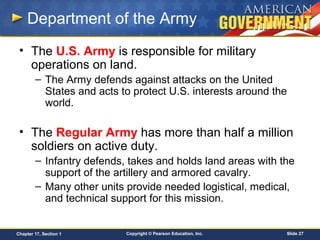
Department of the Army
• The U.S. Army is responsible for military
operations on land.
– The Army defends against attacks on the United
States and acts to protect U.S. interests around the
world.
• The Regular Army has more than half a million
soldiers on active duty.
– Infantry defends, takes and holds land areas with the
support of the artillery and armored cavalry.
– Many other units provide needed logistical, medical,
and technical support for this mission.
Copyright © Pearson Education, Inc. Slide 28Chapter 17, Section 1
Department of the Navy
• The Navy’s main responsibility is sea
warfare.
– Today the navy has some 330,000 personnel.
• The U.S. Marine Corps is a separate,
combat land force within the Navy.
– The 180,000 Marines are tasked with seizing
and defending naval bases and carrying out
other necessary land operations.
Copyright © Pearson Education, Inc. Slide 29Chapter 17, Section 1
Department of the Air Force
• The Air Force is the newest department,
established in 1947
• The Air Force has the primary responsibility for
military air and aerospace operations.
– Its 340,000 members defend the United States, attack
enemy air, ground, and sea forces, strike targets in
enemy territory, and provide transport and support for
land and naval operations.
Copyright © Pearson Education, Inc. Slide 30Chapter 17, Section 1
Major Military Deployments
• Nearly one fourth of the U.S. armed forces is stationed
abroad. Today, the top five areas to which the American
military are deployed are in East Asia, Southeast Asia,
and Europe.
– Why is it necessary to post the armed forces overseas in
order to protect national security?
Copyright © Pearson Education, Inc. Slide 31Chapter 17, Section 1
Director of National Intelligence
• Checkpoint: Why was the Office of the Director
of National Intelligence established?
– Intelligence agencies had failed to collect and share
information warning of potential terrorist attacks such
as Sept 11, 2001.
– The DNI supervises the operations of the 16 agencies
in the federal intelligence community.
– Much of this intelligence work involves spying and is
done with secrecy - even the budgets are secret.
Copyright © Pearson Education, Inc. Slide 32Chapter 17, Section 1
Dept. of Homeland Security
• The Department of Homeland Security (DHS)
was created in 2002 to protect America from
terrorism.
– It coordinates all antiterrorist activities of all public
agencies that deal with domestic security.
• The DHS operates in five key areas:
– Border and transportation security
– Infrastructure protection
– Emergency preparedness and response
– Information analysis
– Defense against chemical, biological, and nuclear
attack
Copyright © Pearson Education, Inc. Slide 33Chapter 17, Section 1
DHS, cont.
• The DHS works to detect and deter
threats by:
– Securing U.S. borders
– Enforcing immigration laws
– Strengthening
transportation
security
– Developing
detection
technology
Copyright © Pearson Education, Inc. Slide 34Chapter 17, Section 1
DHS, cont.
• The DHS works to protect the nation from
terrorism by:
– Protecting the President and other key officials
– Protecting physical and cyber infrastructure
– Fighting
financial crimes
and identity
theft
Copyright © Pearson Education, Inc. Slide 35Chapter 17, Section 1
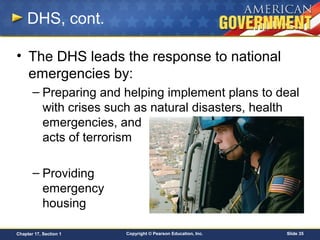
DHS, cont.
• The DHS leads the response to national
emergencies by:
– Preparing and helping implement plans to deal
with crises such as natural disasters, health
emergencies, and
acts of terrorism
– Providing
emergency
housing
Copyright © Pearson Education, Inc. Slide 36Chapter 17, Section 1
DHS, cont.
• The DHS has to protect America’s:
– Food and water supply
– Healthcare system
– Communications network
– Pipelines and power plants
– Roads, bridges,
railways,
waterways,
seaports,
and airports
– Skyscrapers
and stadiums
Copyright © Pearson Education, Inc. Slide 37Chapter 17, Section 1
Terrorism
• The sheer number of potential targets
means that the nation cannot be
completely and absolutely protected
against all possible terrorist attacks.
• The best that can be hoped for is to stop
or minimize the effect of most terrorist
attacks, and to bring those responsible for
such attacks to justice.
Copyright © Pearson Education, Inc. Slide 38Chapter 17, Section 1
Review
• Now that you have learned about how the
Federal Government safeguards this
nation’s security, go back and answer the
Chapter Essential Question.
– How should the United States interact with
other countries?
Chapter 17: Foreign Policy and
National Defense
Section 3
Copyright © Pearson Education, Inc. Slide 40Chapter 17, Section 1
Objectives
1. Summarize American foreign policy from
independence through World War I.
2. Show how the two World Wars affected
America’s traditional policy of isolationism.
3. Explain the principles of collective security and
deterrence and their use during the cold war.
4. Describe American foreign policy since the end
of the cold war.
5. Understand why the world remains a
dangerous place.
Copyright © Pearson Education, Inc. Slide 41Chapter 17, Section 1
Key Terms
• collective security: the idea that nations
will act together to protect the peace
• deterrence: keeping a strong enough
military to discourage any attack by a
hostile power
• cold war: a period of more than 40 years
of hostile U.S.-Soviet relations
• containment: the policy of keeping
communism from expanding
• détente: a relaxing of tensions
Copyright © Pearson Education, Inc. Slide 42Chapter 17, Section 1
Introduction
• How has American foreign policy changed over
time?
– For many years the United States was isolationist,
concentrating its early foreign policy efforts in the
western hemisphere.
– After taking part in the two World Wars, the United
States won the Cold War with the Soviet Union and
emerged as a major player in international affairs.
– After this, the U.S. began seeking to influence
political, economic, and military issues around the
world.
Copyright © Pearson Education, Inc. Slide 43Chapter 17, Section 1
Isolationism
• For many years the
United States tried to
avoid becoming
entangled in foreign
affairs and alliances.
• However, the United
States did have
diplomatic relations and
trade with many nations.
• Benjamin Franklin (right)
was one of the first U.S.
diplomats.
Copyright © Pearson Education, Inc. Slide 44Chapter 17, Section 1
Isolationism, cont.
• Geographic isolation, abundant national
resources, and weak U.S. armed forces all
encouraged isolationism.
• In 1823, President Monroe issued the Monroe
Doctrine, warning European powers to stay out
of the affairs of North and South America.
• By 1900, America had expanded across the
continent and overseas and sought to expand its
political influence as well.
Copyright © Pearson Education, Inc. Slide 45Chapter 17, Section 1
Intervention
• Beginning under
President Theodore
Roosevelt in the
1900s, U.S. forces
began to police Latin
America to restore
stability.
– According to the
cartoon, what was
involved in
Roosevelt’s policy?
Copyright © Pearson Education, Inc. Slide 46Chapter 17, Section 1
Intervention, cont.
• In the 1930s President Franklin Roosevelt
pursued the Good Neighbor Policy, reducing
U.S. military and political involvement.
• In the 1800s, America opened Japan to trade
and called for an Open Door policy, giving all
nations equal trade access to China.
– By the 1940s, U.S. relations with both Japan and
China were poor.
Copyright © Pearson Education, Inc. Slide 47Chapter 17, Section 1
World at War
• Checkpoint: How did World War II change the
foreign policy position of the United States?
– After entering World War I, America had isolated
itself once again until the start of World War II.
– The United States ended WW II as the world’s
major military and economic power.
– U.S. foreign policy then shifted to one of heavy
international involvement, aimed at protecting
American security and prosperity.
Copyright © Pearson Education, Inc. Slide 48Chapter 17, Section 1
Collective Security & Deterrence
• After World War II America tried to create a
world community that would unite against threats
to peace.
– The United Nations was created in 1945 to pursue
this goal, but its effectiveness was limited during the
cold war.
• The United States has also pursued a policy of
deterrence, building a military strong enough to
deter any direct attack on America.
Copyright © Pearson Education, Inc. Slide 49Chapter 17, Section 1
The Cold War
• The Cold War began after WW II as the
United States and the USSR confronted
each other in Europe and elsewhere.
– The Soviet Union occupied Eastern Europe and
set up communist regimes.
– President Truman then offered U.S. military and
financial aid to the rest of Europe.
• The U.S. policy of containment during the
Cold War sought to contain the spread of
communism.
Copyright © Pearson Education, Inc. Slide 50Chapter 17, Section 1
Cold War Confrontations
• Soviets blockaded
Berlin in 1948-49, but
a U.S. airlift of
supplies saved the
city without a fight.
• Soviets placed
nuclear missiles in
Cuba in 1962, but
backed down during
the Cuban Missile
Crisis.
Copyright © Pearson Education, Inc. Slide 51Chapter 17, Section 1
Korean and Vietnam Wars
• The Korean War (1950-53) pitted UN forces,
mainly Americans and South Koreans,
against communist North Koreans and
Chinese that were supported by the Soviets.
It ended in a stalemate.
• The Vietnam War (1965-1973) saw the
United States fighting the North Vietnamese
and communist guerillas.
– The American people were bitterly divided over
the war, and the United States eventually
withdrew.
Copyright © Pearson Education, Inc. Slide 52Chapter 17, Section 1
Copyright © Pearson Education, Inc. Slide 53Chapter 17, Section 1
Détente
• President Nixon
sought to improve
relations with the
USSR and China,
but Soviet relations
remained strained.
• The Soviet invasion of Afghanistan in 1979 led
to U.S. support of the anti-communist rebels
and a renewed containment policy.
Copyright © Pearson Education, Inc. Slide 54Chapter 17, Section 1
The Cold War Ends
• Checkpoint: What led to the end of the cold war?
– Soviet leader Mikhail Gorbachev made reforms and
met with President Reagan to ease tensions.
– Economic and political problems in Eastern Europe
and the USSR also contributed to the collapse of the
Soviet Union in 1991.
– U.S. policies of deterrence and containment worked
over time.
Copyright © Pearson Education, Inc. Slide 55Chapter 17, Section 1
Modern Dangers
• The modern world faces many threats.
– Terrorist groups like al Qaeda oppose the United States.
– Hostile nations such as Iran and North Korea may gain
nuclear weapons.
– Africa suffers from many conflicts.
– The Middle East divides U.S. interests between the need
for oil and American support for Israel. U.S. efforts to
broker a peaceful solution to the Palestinian-Israeli conflict
have had limited success.
Copyright © Pearson Education, Inc. Slide 56Chapter 17, Section 1
Afghanistan
• After the 2001
attacks, U.S.
forces toppled
the Taliban
regime in
Afghanistan.
• Today the pro-al Qaeda Taliban forces
continued to fight U.S. and NATO troops for
control of the country.
Copyright © Pearson Education, Inc. Slide 57Chapter 17, Section 1
Iraq
• The United States and its allies began the
second Gulf War in 2003.
– The goal was to end the threat posed by Saddam
Hussein’s dictatorial regime and its suspected
weapons programs.
• American forces have been involved in an
ongoing effort to stabilize and rebuild Iraq as a
democracy in the face of continued violence.
• This task will likely continue for years to come.
Copyright © Pearson Education, Inc. Slide 58Chapter 17, Section 1
Review
• Now that you have learned about how
American foreign policy has changed over
time, go back and answer the Chapter
Essential Question.
– How should the United States interact with
other countries?
Chapter 17: Foreign Policy and
National Defense
Section 4
Copyright © Pearson Education, Inc. Slide 60Chapter 17, Section 1
Objectives
1. Identify two types of foreign aid and
describe the foreign aid policy of the
United States.
2. Describe the major security alliances
developed by the United States.
3. Examine the role and structure of the
United Nations and the problems it
addresses.
Copyright © Pearson Education, Inc. Slide 61Chapter 17, Section 1
Key Terms
• foreign aid: economic and military aid given to
other countries
• regional security alliance: nations united by a
mutual defense treaty
• NATO: North Atlantic Treaty Organization; a
major security alliance including the United
States, Canada, and much of Europe
• United Nations: a global organization dedicated
to maintaining peace, security, and friendship
between nations
• Security Council: a 15-member UN council
responsible for maintaining international peace
Copyright © Pearson Education, Inc. Slide 62Chapter 17, Section 1
Introduction
• In what ways does the United States cooperate
with other nations?
– The United States provides economic and military aid
to foreign countries.
– The United States belongs to a number of regional
security alliances pledged to mutual defense.
– The United States is a leading member of the United
Nations.
Copyright © Pearson Education, Inc. Slide 63Chapter 17, Section 1
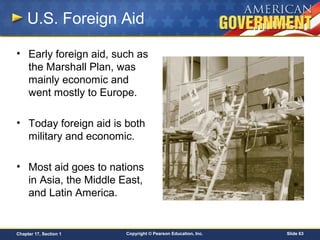
U.S. Foreign Aid
• Early foreign aid, such as
the Marshall Plan, was
mainly economic and
went mostly to Europe.
• Today foreign aid is both
military and economic.
• Most aid goes to nations
in Asia, the Middle East,
and Latin America.
Copyright © Pearson Education, Inc. Slide 64Chapter 17, Section 1
NATO
• Checkpoint: How has NATO’s purpose
changed?
– The North Atlantic Treaty Organization (NATO) was
originally formed to protect western Europe against
Soviet aggression.
– Since the collapse of the USSR, NATO has grown in
size and is no longer focused on opposing the
Soviets.
– Today NATO is focused on crisis management and
peacekeeping in Europe and around the world.
Copyright © Pearson Education, Inc. Slide 65Chapter 17, Section 1
Copyright © Pearson Education, Inc. Slide 66Chapter 17, Section 1
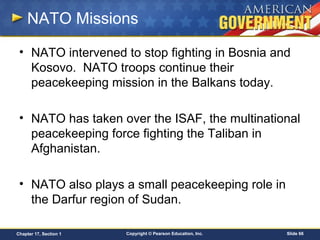
NATO Missions
• NATO intervened to stop fighting in Bosnia and
Kosovo. NATO troops continue their
peacekeeping mission in the Balkans today.
• NATO has taken over the ISAF, the multinational
peacekeeping force fighting the Taliban in
Afghanistan.
• NATO also plays a small peacekeeping role in
the Darfur region of Sudan.
Copyright © Pearson Education, Inc. Slide 67Chapter 17, Section 1
Other Security Alliances
• The Rio Pact is a mutual defense treaty
allying the United States with Canada and
32 Latin American countries.
• ANZUS is a pact uniting Australia, New
Zealand, and the United States.
• The Japanese, Korean, and Philippines
Pacts each pledge that U.S. forces will
come to the aid of their ally if needed.
Copyright © Pearson Education, Inc. Slide 68Chapter 17, Section 1
The United Nations
• The United Nations charter was written in San
Francisco in 1945. The UN first met in 1946.
• The UN’s goals are:
– Maintaining world peace and security
– Developing friendly
relations among all
nations
– Promoting justice
and solving
international disputes
Copyright © Pearson Education, Inc. Slide 69Chapter 17, Section 1
General Assembly
• Each UN member has a vote in the General
Assembly, which regularly meets once a year
in New York and in special sessions.
• The Assembly has several functions.
– It can debate issues and make nonbinding, but
influential recommendations.
– It elects the nonpermanent members of various
UN councils and courts.
– It can admit, suspend, or expel members.
– It can propose amendments to the charter.
Copyright © Pearson Education, Inc. Slide 70Chapter 17, Section 1
Security Council
• The Security Council is responsible for
maintaining international peace.
– It has 15 members. Five—the United States, China,
Britain, France, and Russia—are permanent
members. The other 10 serve two-year terms.
– With the support of at least 9 members, the Council
can call for sanctions, peace-keeping operations, or
military action.
– A permanent member can veto any major Security
Council resolution.
Copyright © Pearson Education, Inc. Slide 71Chapter 17, Section 1
Other Councils
• The Economic and Social Council has 54
members elected by the General Assembly.
They carry out the UN’s many economic,
cultural, educational, and health activities.
• The Trusteeship Council once oversaw the
treatment of colonies and former colonies.
Since these are all independent now the
Council exists in name only.
Copyright © Pearson Education, Inc. Slide 72Chapter 17, Section 1
World Court
• The International Court of Justice, or
World Court, is the UN’s judicial arm.
– The ICJ is made up of 15 judges who handle
cases brought to them voluntarily by UN
members and nonmembers.
Copyright © Pearson Education, Inc. Slide 73Chapter 17, Section 1
• The Secretariat is the UN’s civil service
branch.
– It is led by the secretary-general, elected by
the General Assembly.
– The secretary-general prepares the UN
budget, oversees day-to-day administration of
the UN, and brings key matters before the
Security Council.
The Secretariat
Copyright © Pearson Education, Inc. Slide 74Chapter 17, Section 1
The Work of the UN
• The UN has 15
specialized
agencies that provide
many economic and
social programs.
• The FAO works to
improve farming
productivity, food
quality, and living
standards in rural
nations.
Copyright © Pearson Education, Inc. Slide 75Chapter 17, Section 1
The Work of the UN, cont.
• The WHO has helped
immunize 80 percent of
the world’s children
against six fatal
diseases.
• UNESCO promotes
education, science,
culture, and freedom of
the press.
• The IMF promotes
global financial stability.
Copyright © Pearson Education, Inc. Slide 76Chapter 17, Section 1
The Work of the UN, cont.
• Peacekeeping is a major function of the UN.
• The UN promotes human rights, protects refugees, and
raises money for disaster relief.
• The UN also works closely with many NGOs, such as the
Red Cross, to aid people worldwide.
Copyright © Pearson Education, Inc. Slide 77Chapter 17, Section 1
The United States and the UN
• The United States provides major funding to
the UN.
• The UN and U.S. leaders have not always agreed.
– At times the United States has withheld funds or fought UN
policies.
– Still, the two work closely together on many issues.
Copyright © Pearson Education, Inc. Slide 78Chapter 17, Section 1
Review
• Now that you have learned about the ways
in which the United States cooperates with
other nations, go back and answer the
Chapter Essential Question.
– How should the United States interact with
other countries?

Chapter 17

  • 1.
    Chapter 17: ForeignPolicy and National Defense Section 1
  • 2.
    Copyright © PearsonEducation, Inc. Slide 2Chapter 17, Section 1 Objectives 1. Explain the difference between isolationism and internationalism. 2. Define foreign policy. 3. Understand that a nation’s foreign policy is composed of its many foreign policies. 4. Describe the functions, components, and organization of the Department of State.
  • 3.
    Copyright © PearsonEducation, Inc. Slide 3Chapter 17, Section 1 Key Terms • domestic affairs: events in one’s home country • foreign affairs: a nation’s relations with other nations • isolationism: a refusal to become involved in the affairs of the rest of the world • foreign policy: everything a nation does and says in world affairs
  • 4.
    Copyright © PearsonEducation, Inc. Slide 4Chapter 17, Section 1 Key Terms, cont. • right of legation: the right to send and receive diplomatic representatives • ambassador: an official representative of a sovereign state in the conduct of its foreign affairs • diplomatic immunity: not being subject to the laws of a state to which one is an accredited ambassador • passport: a legal document that identifies someone as a citizen of a state • visa: a permit to enter another state
  • 5.
    Copyright © PearsonEducation, Inc. Slide 5Chapter 17, Section 1 Introduction • How is foreign policy made and conducted? – Foreign policy is made by the President with the advice of the Secretary of State and State Department. – It is carried out in person by U.S. ambassadors and other diplomats, both individually and as members of international organizations. – It is also conducted by America’s stands on issues such as international trade, human rights, and international conflicts.
  • 6.
    Copyright © PearsonEducation, Inc. Slide 6Chapter 17, Section 1 Isolationism to Internationalism • For nearly 150 years U.S. foreign relations were based on isolationism, as U.S. leaders refused to get widely involved in foreign affairs. • From the 1940s on, the United States has played a major role in world affairs. – Today America’s national security can be endangered by terrorism and foreign conflicts. – Additionally, the U.S. economy is now tied to the global economy.
  • 7.
    Copyright © PearsonEducation, Inc. Slide 7Chapter 17, Section 1 Foreign Policy • Checkpoint: What is foreign policy? – Foreign policy consists of all the stands and actions that a nation takes in every aspect of its relationships with other countries – including diplomatic, military, and economic relationships. – These stands and actions include all of America’s treaties, alliances, and foreign aid, as well as U.S. policies on international trade, immigration, human rights and the environment.
  • 8.
    Copyright © PearsonEducation, Inc. Slide 8Chapter 17, Section 1 Foreign Policy, cont. • Foreign policy goals change over time. • The President is the nation’s chief diplomat. – Several Presidents have tried to broker Mideast peace agreements.
  • 9.
    Copyright © PearsonEducation, Inc. Slide 9Chapter 17, Section 1 State Department • The President looks to the State Department, the first executive department created by Congress, for advice and assistance in conducting U.S. foreign policy. • The department is divided into bureaus that deal with specific geographic regions or with specific foreign policy issues. • The State Department pursues four major foreign policy goals: – Protecting America – Advancing democracy – Protecting American values – Supporting diplomatic officials
  • 10.
    Copyright © PearsonEducation, Inc. Slide 10Chapter 17, Section 1 Protecting America • The State Department: – Maintains and strengthens diplomatic ties with other nations – Manages domestic and international travel and trade policies – Promotes global stability
  • 11.
    Copyright © PearsonEducation, Inc. Slide 11Chapter 17, Section 1 Advancing Democracy • The State Department: – Supports newly established democracies – Promotes fair voting practices and just legal systems – Monitors human rights issues globally
  • 12.
    Copyright © PearsonEducation, Inc. Slide 12Chapter 17, Section 1 Promoting American Values • The State Department: – Uses government-supported and other media to provide information on American values to other peoples – Supports cultural exchange programs
  • 13.
    Copyright © PearsonEducation, Inc. Slide 13Chapter 17, Section 1 Supporting Diplomatic Officials • The State Department: – Uses the right of legation to send thousands of diplomats abroad – Protects American diplomats and others abroad under international law
  • 14.
    Copyright © PearsonEducation, Inc. Slide 14Chapter 17, Section 1 Secretary of State • The President appoints the Secretary of State, who is always a key cabinet member. • He or she helps make and conduct policy as well as managing the State department. – John Foster Dulles (right) was an influential Secretary of State.
  • 15.
    Copyright © PearsonEducation, Inc. Slide 15Chapter 17, Section 1 Ambassadors and Embassies • Ambassadors are appointed by the President with Senate approval and serve at the President’s pleasure. – Appointees range from political allies of the President to career diplomats. • The United States has embassies in more than 180 countries. – Foreign Service officers staff more than 260 diplomatic and consular offices as well. They encourage trade, gather intelligence, and aid American citizens abroad.
  • 16.
    Copyright © PearsonEducation, Inc. Slide 16Chapter 17, Section 1 Diplomatic Immunity • Ambassadors and embassy personnel are normally granted diplomatic immunity. – This means they cannot be arrested, sued, or taxed by the country to which they are ambassadors. – Their embassies and communications cannot be entered or searched without their consent. – However, a host country can expel a diplomat whose conduct it finds unacceptable.
  • 17.
    Copyright © PearsonEducation, Inc. Slide 17Chapter 17, Section 1 Diplomatic Immunity, cont. • Diplomatic immunity is normally, but not always, respected. • In 1979, Iranian students violated diplomatic immunity and international law by seizing the American embassy in Tehran and holding 52 Americans hostage for 444 days.
  • 18.
    Copyright © PearsonEducation, Inc. Slide 18Chapter 17, Section 1 Travel Documents Passports Visas Issued by a government and identifies the bearer as a citizen or national of the issuing country Issued by the country the individual requests permission to enter Entitles the bearer to consular protection abroad and to return to his or her country of citizenship Permits the traveler to remain in a country for a specified period of time, but does not guarantee entry Valid for 10 years Valid for only the time period stated Three types: diplomatic, official, tourist Of many types, including: transit, tourist, business, and student
  • 19.
    Copyright © PearsonEducation, Inc. Slide 19Chapter 17, Section 1 Review • Now that you have learned about how foreign policy is made and conducted, go back and answer the Chapter Essential Question. – How should the United States interact with other countries? February 2017
  • 20.
    Chapter 17: ForeignPolicy and National Defense Section 2
  • 21.
    Copyright © PearsonEducation, Inc. Slide 21Chapter 17, Section 1 Objectives 1. Summarize the functions, components, and organization of the Department of Defense and the military departments. 2. Explain how the Director of National Intelligence and the Department of Homeland Security contribute to the nation’s security.
  • 22.
    Copyright © PearsonEducation, Inc. Slide 22Chapter 17, Section 1 Key Terms • espionage: spying • terrorism: the use of violence to intimidate a government or a society, usually for reasons that are political or have to do with the ideas and beliefs of a group
  • 23.
    Copyright © PearsonEducation, Inc. Slide 23Chapter 17, Section 1 Introduction • How does the Federal Government safeguard this nation’s security? – The President and the Department of Defense oversee the operation of the nation’s armed forces— the Army, Navy, Air Force and Marines. – The Director of National Intelligence oversees the operation of the nation’s intelligence agencies. – The Department of Homeland Security coordinates all national efforts to combat terrorism.
  • 24.
    Copyright © PearsonEducation, Inc. Slide 24Chapter 17, Section 1 Defense Department • Congress created the Defense Department in 1947, replacing the War and Navy Departments. • Today there are nearly 1.4 million men and women on active duty in the military.
  • 25.
    Copyright © PearsonEducation, Inc. Slide 25Chapter 17, Section 1 Civilian Control of the Military • The Constitution puts civilian authorities in charge of the military. – The President acts as commander-in-chief of the armed forces. Congress also has broad military powers. – The civilian Secretary of Defense, appointed by the President, heads the Defense Department. – Each military department is also headed by a civilian secretary.
  • 26.
    Copyright © PearsonEducation, Inc. Slide 26Chapter 17, Section 1 Advisers • Checkpoint: Who advises the President on military matters? – The Secretary of Defense is the President’s chief aide and advisor on defense policy. – The six members of the Joint Chiefs of Staff, the nation’s highest ranking uniformed officers, also advise the President and other key officials.
  • 27.
    Copyright © PearsonEducation, Inc. Slide 27Chapter 17, Section 1 Department of the Army • The U.S. Army is responsible for military operations on land. – The Army defends against attacks on the United States and acts to protect U.S. interests around the world. • The Regular Army has more than half a million soldiers on active duty. – Infantry defends, takes and holds land areas with the support of the artillery and armored cavalry. – Many other units provide needed logistical, medical, and technical support for this mission.
  • 28.
    Copyright © PearsonEducation, Inc. Slide 28Chapter 17, Section 1 Department of the Navy • The Navy’s main responsibility is sea warfare. – Today the navy has some 330,000 personnel. • The U.S. Marine Corps is a separate, combat land force within the Navy. – The 180,000 Marines are tasked with seizing and defending naval bases and carrying out other necessary land operations.
  • 29.
    Copyright © PearsonEducation, Inc. Slide 29Chapter 17, Section 1 Department of the Air Force • The Air Force is the newest department, established in 1947 • The Air Force has the primary responsibility for military air and aerospace operations. – Its 340,000 members defend the United States, attack enemy air, ground, and sea forces, strike targets in enemy territory, and provide transport and support for land and naval operations.
  • 30.
    Copyright © PearsonEducation, Inc. Slide 30Chapter 17, Section 1 Major Military Deployments • Nearly one fourth of the U.S. armed forces is stationed abroad. Today, the top five areas to which the American military are deployed are in East Asia, Southeast Asia, and Europe. – Why is it necessary to post the armed forces overseas in order to protect national security?
  • 31.
    Copyright © PearsonEducation, Inc. Slide 31Chapter 17, Section 1 Director of National Intelligence • Checkpoint: Why was the Office of the Director of National Intelligence established? – Intelligence agencies had failed to collect and share information warning of potential terrorist attacks such as Sept 11, 2001. – The DNI supervises the operations of the 16 agencies in the federal intelligence community. – Much of this intelligence work involves spying and is done with secrecy - even the budgets are secret.
  • 32.
    Copyright © PearsonEducation, Inc. Slide 32Chapter 17, Section 1 Dept. of Homeland Security • The Department of Homeland Security (DHS) was created in 2002 to protect America from terrorism. – It coordinates all antiterrorist activities of all public agencies that deal with domestic security. • The DHS operates in five key areas: – Border and transportation security – Infrastructure protection – Emergency preparedness and response – Information analysis – Defense against chemical, biological, and nuclear attack
  • 33.
    Copyright © PearsonEducation, Inc. Slide 33Chapter 17, Section 1 DHS, cont. • The DHS works to detect and deter threats by: – Securing U.S. borders – Enforcing immigration laws – Strengthening transportation security – Developing detection technology
  • 34.
    Copyright © PearsonEducation, Inc. Slide 34Chapter 17, Section 1 DHS, cont. • The DHS works to protect the nation from terrorism by: – Protecting the President and other key officials – Protecting physical and cyber infrastructure – Fighting financial crimes and identity theft
  • 35.
    Copyright © PearsonEducation, Inc. Slide 35Chapter 17, Section 1 DHS, cont. • The DHS leads the response to national emergencies by: – Preparing and helping implement plans to deal with crises such as natural disasters, health emergencies, and acts of terrorism – Providing emergency housing
  • 36.
    Copyright © PearsonEducation, Inc. Slide 36Chapter 17, Section 1 DHS, cont. • The DHS has to protect America’s: – Food and water supply – Healthcare system – Communications network – Pipelines and power plants – Roads, bridges, railways, waterways, seaports, and airports – Skyscrapers and stadiums
  • 37.
    Copyright © PearsonEducation, Inc. Slide 37Chapter 17, Section 1 Terrorism • The sheer number of potential targets means that the nation cannot be completely and absolutely protected against all possible terrorist attacks. • The best that can be hoped for is to stop or minimize the effect of most terrorist attacks, and to bring those responsible for such attacks to justice.
  • 38.
    Copyright © PearsonEducation, Inc. Slide 38Chapter 17, Section 1 Review • Now that you have learned about how the Federal Government safeguards this nation’s security, go back and answer the Chapter Essential Question. – How should the United States interact with other countries?
  • 39.
    Chapter 17: ForeignPolicy and National Defense Section 3
  • 40.
    Copyright © PearsonEducation, Inc. Slide 40Chapter 17, Section 1 Objectives 1. Summarize American foreign policy from independence through World War I. 2. Show how the two World Wars affected America’s traditional policy of isolationism. 3. Explain the principles of collective security and deterrence and their use during the cold war. 4. Describe American foreign policy since the end of the cold war. 5. Understand why the world remains a dangerous place.
  • 41.
    Copyright © PearsonEducation, Inc. Slide 41Chapter 17, Section 1 Key Terms • collective security: the idea that nations will act together to protect the peace • deterrence: keeping a strong enough military to discourage any attack by a hostile power • cold war: a period of more than 40 years of hostile U.S.-Soviet relations • containment: the policy of keeping communism from expanding • détente: a relaxing of tensions
  • 42.
    Copyright © PearsonEducation, Inc. Slide 42Chapter 17, Section 1 Introduction • How has American foreign policy changed over time? – For many years the United States was isolationist, concentrating its early foreign policy efforts in the western hemisphere. – After taking part in the two World Wars, the United States won the Cold War with the Soviet Union and emerged as a major player in international affairs. – After this, the U.S. began seeking to influence political, economic, and military issues around the world.
  • 43.
    Copyright © PearsonEducation, Inc. Slide 43Chapter 17, Section 1 Isolationism • For many years the United States tried to avoid becoming entangled in foreign affairs and alliances. • However, the United States did have diplomatic relations and trade with many nations. • Benjamin Franklin (right) was one of the first U.S. diplomats.
  • 44.
    Copyright © PearsonEducation, Inc. Slide 44Chapter 17, Section 1 Isolationism, cont. • Geographic isolation, abundant national resources, and weak U.S. armed forces all encouraged isolationism. • In 1823, President Monroe issued the Monroe Doctrine, warning European powers to stay out of the affairs of North and South America. • By 1900, America had expanded across the continent and overseas and sought to expand its political influence as well.
  • 45.
    Copyright © PearsonEducation, Inc. Slide 45Chapter 17, Section 1 Intervention • Beginning under President Theodore Roosevelt in the 1900s, U.S. forces began to police Latin America to restore stability. – According to the cartoon, what was involved in Roosevelt’s policy?
  • 46.
    Copyright © PearsonEducation, Inc. Slide 46Chapter 17, Section 1 Intervention, cont. • In the 1930s President Franklin Roosevelt pursued the Good Neighbor Policy, reducing U.S. military and political involvement. • In the 1800s, America opened Japan to trade and called for an Open Door policy, giving all nations equal trade access to China. – By the 1940s, U.S. relations with both Japan and China were poor.
  • 47.
    Copyright © PearsonEducation, Inc. Slide 47Chapter 17, Section 1 World at War • Checkpoint: How did World War II change the foreign policy position of the United States? – After entering World War I, America had isolated itself once again until the start of World War II. – The United States ended WW II as the world’s major military and economic power. – U.S. foreign policy then shifted to one of heavy international involvement, aimed at protecting American security and prosperity.
  • 48.
    Copyright © PearsonEducation, Inc. Slide 48Chapter 17, Section 1 Collective Security & Deterrence • After World War II America tried to create a world community that would unite against threats to peace. – The United Nations was created in 1945 to pursue this goal, but its effectiveness was limited during the cold war. • The United States has also pursued a policy of deterrence, building a military strong enough to deter any direct attack on America.
  • 49.
    Copyright © PearsonEducation, Inc. Slide 49Chapter 17, Section 1 The Cold War • The Cold War began after WW II as the United States and the USSR confronted each other in Europe and elsewhere. – The Soviet Union occupied Eastern Europe and set up communist regimes. – President Truman then offered U.S. military and financial aid to the rest of Europe. • The U.S. policy of containment during the Cold War sought to contain the spread of communism.
  • 50.
    Copyright © PearsonEducation, Inc. Slide 50Chapter 17, Section 1 Cold War Confrontations • Soviets blockaded Berlin in 1948-49, but a U.S. airlift of supplies saved the city without a fight. • Soviets placed nuclear missiles in Cuba in 1962, but backed down during the Cuban Missile Crisis.
  • 51.
    Copyright © PearsonEducation, Inc. Slide 51Chapter 17, Section 1 Korean and Vietnam Wars • The Korean War (1950-53) pitted UN forces, mainly Americans and South Koreans, against communist North Koreans and Chinese that were supported by the Soviets. It ended in a stalemate. • The Vietnam War (1965-1973) saw the United States fighting the North Vietnamese and communist guerillas. – The American people were bitterly divided over the war, and the United States eventually withdrew.
  • 52.
    Copyright © PearsonEducation, Inc. Slide 52Chapter 17, Section 1
  • 53.
    Copyright © PearsonEducation, Inc. Slide 53Chapter 17, Section 1 Détente • President Nixon sought to improve relations with the USSR and China, but Soviet relations remained strained. • The Soviet invasion of Afghanistan in 1979 led to U.S. support of the anti-communist rebels and a renewed containment policy.
  • 54.
    Copyright © PearsonEducation, Inc. Slide 54Chapter 17, Section 1 The Cold War Ends • Checkpoint: What led to the end of the cold war? – Soviet leader Mikhail Gorbachev made reforms and met with President Reagan to ease tensions. – Economic and political problems in Eastern Europe and the USSR also contributed to the collapse of the Soviet Union in 1991. – U.S. policies of deterrence and containment worked over time.
  • 55.
    Copyright © PearsonEducation, Inc. Slide 55Chapter 17, Section 1 Modern Dangers • The modern world faces many threats. – Terrorist groups like al Qaeda oppose the United States. – Hostile nations such as Iran and North Korea may gain nuclear weapons. – Africa suffers from many conflicts. – The Middle East divides U.S. interests between the need for oil and American support for Israel. U.S. efforts to broker a peaceful solution to the Palestinian-Israeli conflict have had limited success.
  • 56.
    Copyright © PearsonEducation, Inc. Slide 56Chapter 17, Section 1 Afghanistan • After the 2001 attacks, U.S. forces toppled the Taliban regime in Afghanistan. • Today the pro-al Qaeda Taliban forces continued to fight U.S. and NATO troops for control of the country.
  • 57.
    Copyright © PearsonEducation, Inc. Slide 57Chapter 17, Section 1 Iraq • The United States and its allies began the second Gulf War in 2003. – The goal was to end the threat posed by Saddam Hussein’s dictatorial regime and its suspected weapons programs. • American forces have been involved in an ongoing effort to stabilize and rebuild Iraq as a democracy in the face of continued violence. • This task will likely continue for years to come.
  • 58.
    Copyright © PearsonEducation, Inc. Slide 58Chapter 17, Section 1 Review • Now that you have learned about how American foreign policy has changed over time, go back and answer the Chapter Essential Question. – How should the United States interact with other countries?
  • 59.
    Chapter 17: ForeignPolicy and National Defense Section 4
  • 60.
    Copyright © PearsonEducation, Inc. Slide 60Chapter 17, Section 1 Objectives 1. Identify two types of foreign aid and describe the foreign aid policy of the United States. 2. Describe the major security alliances developed by the United States. 3. Examine the role and structure of the United Nations and the problems it addresses.
  • 61.
    Copyright © PearsonEducation, Inc. Slide 61Chapter 17, Section 1 Key Terms • foreign aid: economic and military aid given to other countries • regional security alliance: nations united by a mutual defense treaty • NATO: North Atlantic Treaty Organization; a major security alliance including the United States, Canada, and much of Europe • United Nations: a global organization dedicated to maintaining peace, security, and friendship between nations • Security Council: a 15-member UN council responsible for maintaining international peace
  • 62.
    Copyright © PearsonEducation, Inc. Slide 62Chapter 17, Section 1 Introduction • In what ways does the United States cooperate with other nations? – The United States provides economic and military aid to foreign countries. – The United States belongs to a number of regional security alliances pledged to mutual defense. – The United States is a leading member of the United Nations.
  • 63.
    Copyright © PearsonEducation, Inc. Slide 63Chapter 17, Section 1 U.S. Foreign Aid • Early foreign aid, such as the Marshall Plan, was mainly economic and went mostly to Europe. • Today foreign aid is both military and economic. • Most aid goes to nations in Asia, the Middle East, and Latin America.
  • 64.
    Copyright © PearsonEducation, Inc. Slide 64Chapter 17, Section 1 NATO • Checkpoint: How has NATO’s purpose changed? – The North Atlantic Treaty Organization (NATO) was originally formed to protect western Europe against Soviet aggression. – Since the collapse of the USSR, NATO has grown in size and is no longer focused on opposing the Soviets. – Today NATO is focused on crisis management and peacekeeping in Europe and around the world.
  • 65.
    Copyright © PearsonEducation, Inc. Slide 65Chapter 17, Section 1
  • 66.
    Copyright © PearsonEducation, Inc. Slide 66Chapter 17, Section 1 NATO Missions • NATO intervened to stop fighting in Bosnia and Kosovo. NATO troops continue their peacekeeping mission in the Balkans today. • NATO has taken over the ISAF, the multinational peacekeeping force fighting the Taliban in Afghanistan. • NATO also plays a small peacekeeping role in the Darfur region of Sudan.
  • 67.
    Copyright © PearsonEducation, Inc. Slide 67Chapter 17, Section 1 Other Security Alliances • The Rio Pact is a mutual defense treaty allying the United States with Canada and 32 Latin American countries. • ANZUS is a pact uniting Australia, New Zealand, and the United States. • The Japanese, Korean, and Philippines Pacts each pledge that U.S. forces will come to the aid of their ally if needed.
  • 68.
    Copyright © PearsonEducation, Inc. Slide 68Chapter 17, Section 1 The United Nations • The United Nations charter was written in San Francisco in 1945. The UN first met in 1946. • The UN’s goals are: – Maintaining world peace and security – Developing friendly relations among all nations – Promoting justice and solving international disputes
  • 69.
    Copyright © PearsonEducation, Inc. Slide 69Chapter 17, Section 1 General Assembly • Each UN member has a vote in the General Assembly, which regularly meets once a year in New York and in special sessions. • The Assembly has several functions. – It can debate issues and make nonbinding, but influential recommendations. – It elects the nonpermanent members of various UN councils and courts. – It can admit, suspend, or expel members. – It can propose amendments to the charter.
  • 70.
    Copyright © PearsonEducation, Inc. Slide 70Chapter 17, Section 1 Security Council • The Security Council is responsible for maintaining international peace. – It has 15 members. Five—the United States, China, Britain, France, and Russia—are permanent members. The other 10 serve two-year terms. – With the support of at least 9 members, the Council can call for sanctions, peace-keeping operations, or military action. – A permanent member can veto any major Security Council resolution.
  • 71.
    Copyright © PearsonEducation, Inc. Slide 71Chapter 17, Section 1 Other Councils • The Economic and Social Council has 54 members elected by the General Assembly. They carry out the UN’s many economic, cultural, educational, and health activities. • The Trusteeship Council once oversaw the treatment of colonies and former colonies. Since these are all independent now the Council exists in name only.
  • 72.
    Copyright © PearsonEducation, Inc. Slide 72Chapter 17, Section 1 World Court • The International Court of Justice, or World Court, is the UN’s judicial arm. – The ICJ is made up of 15 judges who handle cases brought to them voluntarily by UN members and nonmembers.
  • 73.
    Copyright © PearsonEducation, Inc. Slide 73Chapter 17, Section 1 • The Secretariat is the UN’s civil service branch. – It is led by the secretary-general, elected by the General Assembly. – The secretary-general prepares the UN budget, oversees day-to-day administration of the UN, and brings key matters before the Security Council. The Secretariat
  • 74.
    Copyright © PearsonEducation, Inc. Slide 74Chapter 17, Section 1 The Work of the UN • The UN has 15 specialized agencies that provide many economic and social programs. • The FAO works to improve farming productivity, food quality, and living standards in rural nations.
  • 75.
    Copyright © PearsonEducation, Inc. Slide 75Chapter 17, Section 1 The Work of the UN, cont. • The WHO has helped immunize 80 percent of the world’s children against six fatal diseases. • UNESCO promotes education, science, culture, and freedom of the press. • The IMF promotes global financial stability.
  • 76.
    Copyright © PearsonEducation, Inc. Slide 76Chapter 17, Section 1 The Work of the UN, cont. • Peacekeeping is a major function of the UN. • The UN promotes human rights, protects refugees, and raises money for disaster relief. • The UN also works closely with many NGOs, such as the Red Cross, to aid people worldwide.
  • 77.
    Copyright © PearsonEducation, Inc. Slide 77Chapter 17, Section 1 The United States and the UN • The United States provides major funding to the UN. • The UN and U.S. leaders have not always agreed. – At times the United States has withheld funds or fought UN policies. – Still, the two work closely together on many issues.
  • 78.
    Copyright © PearsonEducation, Inc. Slide 78Chapter 17, Section 1 Review • Now that you have learned about the ways in which the United States cooperates with other nations, go back and answer the Chapter Essential Question. – How should the United States interact with other countries?

Editor's Notes

  • #8 Checkpoint Answer: All the stands and actions that a nation takes in every aspect of its relationships with other countries, including diplomatic, military, and economic relationships.
  • #9 Answer: The cartoon shows the negotiations as standing on a house of cards, implying that the peace efforts are very unstable and easy to disrupt.
  • #11 NOTE TO TEACHERS: This image depicts Secretary of State Colin Powell arriving in Lebanon in 2002.
  • #18 NOTE TO TEACHERS: The image above shows an American hostage being paraded in front of the media by Iranian militants in 1979.
  • #27 Checkpoint Answer: The President is advised by the Secretary of Defense and the Joint Chiefs of Staff.
  • #28 NOTE TO TEACHERS: Currently some 15 percent of all Army personnel are women, with the exception of the Special Forces.
  • #29 NOTE TO TEACHERS: Currently some 15 percent of Navy personnel are women, while 6 percent of Marine personnel are women.
  • #30 NOTE TO TEACHERS: Some 20 percent of Air Force personnel are women.
  • #31 Answer: Threats against the United States can begin in foreign countries and combating them there before they reach American soil can save American lives. In addition, the United States seeks to protect critical resources needed by the nation.
  • #32 Checkpoint Answer: Because intelligence agencies had failed to adequately collect and share information prior to the 2001 attacks, the DNI was created to supervise the federal intelligence community.
  • #34 NOTE TO TEACHERS: Image above shows a U.S. Border Patrol agent examining a pedestrian barrier in New Mexico.
  • #37 NOTE TO TEACHERS: “The State of Alaska and DHS jointly protect a 800-mile pipeline that carries crude oil to a seaport (shown above).
  • #46 Answer to political cartoon question: The cartoon suggests that New Diplomacy involves the use of force (“the big stick” that Roosevelt is holding) as well as the use of arbitration, a form of negotiated settlement.
  • #48 Checkpoint Answer: U.S. involvement in World War II both convinced many Americans that overseas issues were important to national security and our economy and left the United States in a unique position of military and economic strength compared to the recovering nations of Europe and Asia.
  • #51 NOTE TO TEACHERS: The above image shows an American plane delivering badly needed supplies during the Berlin airlift.
  • #54 NOTE TO TEACHERS: This image shows President Nixon meeting with Chinese diplomats in 1972.
  • #55 Checkpoint Answer: Internal Soviet political reforms, economic and political problems in eastern Europe and the USSR, and the U.S. policies of deterrence and containment all contributed to the collapse of the Soviet Union, which effectively ended the Cold War.
  • #64 NOTE TO TEACHERS: The amount spent on foreign aid currently makes up less than 1 percent of the total federal budget. This image depicts rebuilding of West Berlin, funded by the Marshall Plan.
  • #65 Checkpoint Answer: NATO originally existed to thwart Soviet aggression in Europe, but now focuses on crisis management and peacekeeping missions, some of which take place outside of Europe.
  • #69 NOTE TO TEACHERS: The United States was the first nation to ratify the UN charter
  • #73 NOTE TO TEACHERS: The ICJ judges are appointed by the General Assembly and Security Council to serve nine-year terms, while the secretary-general serves a five-year term.
  • #75 NOTE TO TEACHERS: FAO stands for Food and Agriculture Organization
  • #76 NOTE TO TEACHERS: WHO stands for World Health Organization. UNESCO stands for United Nations Educational, Scientific, and Cultural Organization. IMF stands for International Monetary Fund
  • #77 NOTE TO TEACHERS: NGOs are Non Governmental Organizations.