Mutual Exclusion & Election Algorithms Paul Krzyzanowski [email_address] [email_address] Distributed Systems Except as otherwise noted, the content of this presentation is licensed under the Creative Commons Attribution 2.5 License.
Process Synchronization Techniques to coordinate execution among processes One process may have to wait for another Shared resource (e.g. critical section) may require exclusive access
Centralized Systems Mutual exclusion via: Test & set in hardware Semaphores Messages Condition variables
Distributed Mutual Exclusion Assume there is agreement on how a resource is identified Pass identifier with requests Create an algorithm to allow a process to obtain exclusive access to a resource.
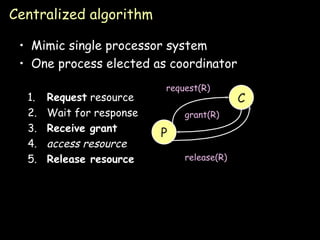
Centralized algorithm Mimic single processor system One process elected as coordinator P C request(R) grant(R) Request  resource Wait for response Receive grant access resource Release resource release(R)
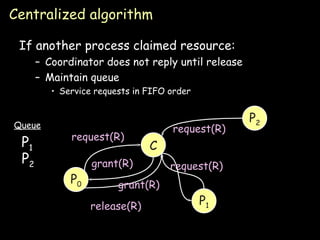
Centralized algorithm If another process claimed resource: Coordinator does not reply until release Maintain queue Service requests in FIFO order P 0 C request(R) grant(R) release(R) P 1 P 2 request(R) Queue P 1 request(R) P 2 grant(R)
Centralized algorithm Benefits Fair All requests processed in order Easy to implement, understand, verify Problems Process cannot distinguish being blocked from a dead coordinator Centralized server can be a bottleneck
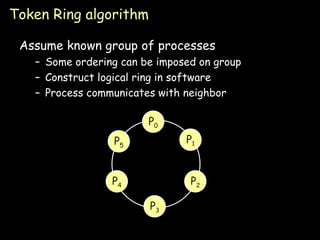
Token Ring algorithm Assume known group of processes Some ordering can be imposed on group Construct logical ring in software Process communicates with neighbor P 0 P 1 P 2 P 3 P 4 P 5
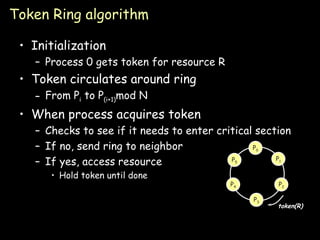
Token Ring algorithm Initialization Process 0 gets token for resource R Token circulates around ring From P i  to P (i+1) mod N When process acquires token Checks to see if it needs to enter critical section If no, send ring to neighbor If yes, access resource Hold token until done token(R) P 0 P 1 P 2 P 3 P 4 P 5
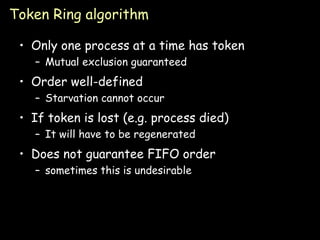
Token Ring algorithm Only one process at a time has token Mutual exclusion guaranteed Order well-defined Starvation cannot occur If token is lost (e.g. process died) It will have to be regenerated Does not guarantee FIFO order sometimes this is undesirable
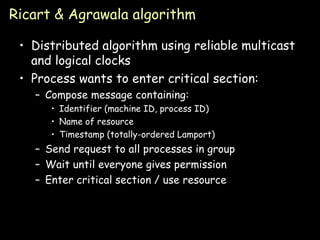
Ricart & Agrawala algorithm Distributed algorithm using reliable multicast and logical clocks Process wants to enter critical section: Compose message containing: Identifier (machine ID, process ID) Name of resource Timestamp (totally-ordered Lamport) Send request to all processes in group Wait until everyone gives permission Enter critical section / use resource
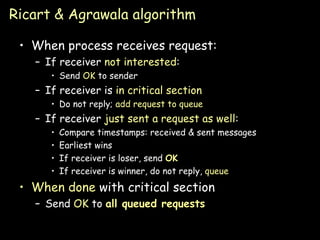
Ricart & Agrawala algorithm When process receives request: If receiver  not interested : Send  OK  to sender If receiver is  in critical section Do not reply;  add request to   queue If receiver  just sent a request as well : Compare timestamps: received & sent messages Earliest wins If receiver is loser, send  OK If receiver is winner, do not reply,  queue When done  with critical section Send  OK  to  all queued requests
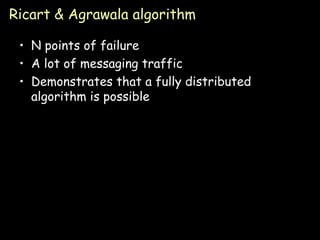
Ricart & Agrawala algorithm N points of failure A lot of messaging traffic Demonstrates that a fully distributed algorithm is possible
Lamport’s Mutual Exclusion Each process maintains request queue Contains  mutual exclusion requests Requesting critical section : Process P i  sends  request( i ,  T i )  to all nodes Places request on its own queue When a process P j  receives a request, it returns a timestamped  ack Lamport time
Lamport’s Mutual Exclusion Entering critical section  (accessing resource) : P i  received a message ( ack  or  release ) from every other process with a timestamp larger than T i P i ’s request has the earliest timestamp in its queue Difference from Ricart-Agrawala: Everyone responds … always - no hold-back Process decides to go based on whether its request is the earliest in its queue
Lamport’s Mutual Exclusion Releasing critical section : Remove request from its own queue Send a timestamped  release  message When a process receives a  release  message Removes request for that process from its queue This may cause its own entry have the earliest timestamp in the queue, enabling it to access the critical section
Election algorithms
Elections Need one process to act as coordinator Processes have no distinguishing characteristics Each process can obtain a unique ID
Bully algorithm Select process with largest ID as coordinator When process P detects dead coordinator: Send  election  message to all processes with higher IDs. If nobody responds, P wins and takes over. If any process responds, P’s job is done. Optional: Let all nodes with lower IDs know an election is taking place. If process receives an  election  message Send  OK  message back Hold election (unless it is already holding one)
Bully algorithm A process announces victory by sending all processes a message telling them that it is the new coordinator If a dead process recovers, it holds an election to find the coordinator.
Ring algorithm Ring arrangement of processes If any process detects failure of coordinator Construct  election  message with process ID and send to next process If successor is down, skip over Repeat until a running process is located Upon receiving an election message Process forwards the message, adding its process ID to the body
Ring algorithm Eventually message returns to originator Process sees its ID on list Circulates (or multicasts) a  coordinator  message announcing coordinator E.g. lowest numbered process
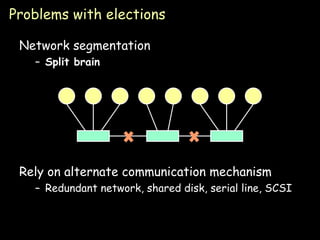
Problems with elections Network segmentation Split brain Rely on alternate communication mechanism Redundant network, shared disk, serial line, SCSI
The end.

Mutual Exclusion Election (Distributed computing)

  • 1.
    Mutual Exclusion &Election Algorithms Paul Krzyzanowski [email_address] [email_address] Distributed Systems Except as otherwise noted, the content of this presentation is licensed under the Creative Commons Attribution 2.5 License.
  • 2.
    Process Synchronization Techniquesto coordinate execution among processes One process may have to wait for another Shared resource (e.g. critical section) may require exclusive access
  • 3.
    Centralized Systems Mutualexclusion via: Test & set in hardware Semaphores Messages Condition variables
  • 4.
    Distributed Mutual ExclusionAssume there is agreement on how a resource is identified Pass identifier with requests Create an algorithm to allow a process to obtain exclusive access to a resource.
  • 5.
    Centralized algorithm Mimicsingle processor system One process elected as coordinator P C request(R) grant(R) Request resource Wait for response Receive grant access resource Release resource release(R)
  • 6.
    Centralized algorithm Ifanother process claimed resource: Coordinator does not reply until release Maintain queue Service requests in FIFO order P 0 C request(R) grant(R) release(R) P 1 P 2 request(R) Queue P 1 request(R) P 2 grant(R)
  • 7.
    Centralized algorithm BenefitsFair All requests processed in order Easy to implement, understand, verify Problems Process cannot distinguish being blocked from a dead coordinator Centralized server can be a bottleneck
  • 8.
    Token Ring algorithmAssume known group of processes Some ordering can be imposed on group Construct logical ring in software Process communicates with neighbor P 0 P 1 P 2 P 3 P 4 P 5
  • 9.
    Token Ring algorithmInitialization Process 0 gets token for resource R Token circulates around ring From P i to P (i+1) mod N When process acquires token Checks to see if it needs to enter critical section If no, send ring to neighbor If yes, access resource Hold token until done token(R) P 0 P 1 P 2 P 3 P 4 P 5
  • 10.
    Token Ring algorithmOnly one process at a time has token Mutual exclusion guaranteed Order well-defined Starvation cannot occur If token is lost (e.g. process died) It will have to be regenerated Does not guarantee FIFO order sometimes this is undesirable
  • 11.
    Ricart & Agrawalaalgorithm Distributed algorithm using reliable multicast and logical clocks Process wants to enter critical section: Compose message containing: Identifier (machine ID, process ID) Name of resource Timestamp (totally-ordered Lamport) Send request to all processes in group Wait until everyone gives permission Enter critical section / use resource
  • 12.
    Ricart & Agrawalaalgorithm When process receives request: If receiver not interested : Send OK to sender If receiver is in critical section Do not reply; add request to queue If receiver just sent a request as well : Compare timestamps: received & sent messages Earliest wins If receiver is loser, send OK If receiver is winner, do not reply, queue When done with critical section Send OK to all queued requests
  • 13.
    Ricart & Agrawalaalgorithm N points of failure A lot of messaging traffic Demonstrates that a fully distributed algorithm is possible
  • 14.
    Lamport’s Mutual ExclusionEach process maintains request queue Contains mutual exclusion requests Requesting critical section : Process P i sends request( i , T i ) to all nodes Places request on its own queue When a process P j receives a request, it returns a timestamped ack Lamport time
  • 15.
    Lamport’s Mutual ExclusionEntering critical section (accessing resource) : P i received a message ( ack or release ) from every other process with a timestamp larger than T i P i ’s request has the earliest timestamp in its queue Difference from Ricart-Agrawala: Everyone responds … always - no hold-back Process decides to go based on whether its request is the earliest in its queue
  • 16.
    Lamport’s Mutual ExclusionReleasing critical section : Remove request from its own queue Send a timestamped release message When a process receives a release message Removes request for that process from its queue This may cause its own entry have the earliest timestamp in the queue, enabling it to access the critical section
  • 17.
  • 18.
    Elections Need oneprocess to act as coordinator Processes have no distinguishing characteristics Each process can obtain a unique ID
  • 19.
    Bully algorithm Selectprocess with largest ID as coordinator When process P detects dead coordinator: Send election message to all processes with higher IDs. If nobody responds, P wins and takes over. If any process responds, P’s job is done. Optional: Let all nodes with lower IDs know an election is taking place. If process receives an election message Send OK message back Hold election (unless it is already holding one)
  • 20.
    Bully algorithm Aprocess announces victory by sending all processes a message telling them that it is the new coordinator If a dead process recovers, it holds an election to find the coordinator.
  • 21.
    Ring algorithm Ringarrangement of processes If any process detects failure of coordinator Construct election message with process ID and send to next process If successor is down, skip over Repeat until a running process is located Upon receiving an election message Process forwards the message, adding its process ID to the body
  • 22.
    Ring algorithm Eventuallymessage returns to originator Process sees its ID on list Circulates (or multicasts) a coordinator message announcing coordinator E.g. lowest numbered process
  • 23.
    Problems with electionsNetwork segmentation Split brain Rely on alternate communication mechanism Redundant network, shared disk, serial line, SCSI
  • 24.