

Operating System Support 
Including 
1.Introduction 
2.The OS layer 
3.Protection 
4.Processes & Threads 
5.Operating System Architecture
Operating System Architecture
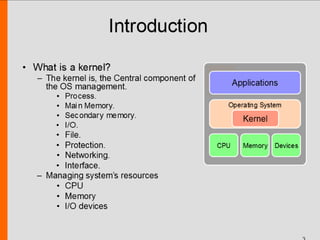
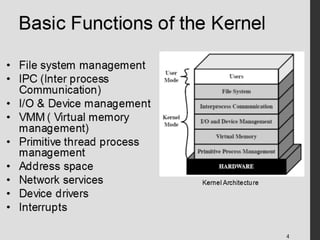
Definition of Kernel 
• The fundamental part of an operating system. 
• Responsible for providing secure access to the 
machine's hardware for various programs. 
• Responsible for deciding when and how long a 
program can use a certain hardware.
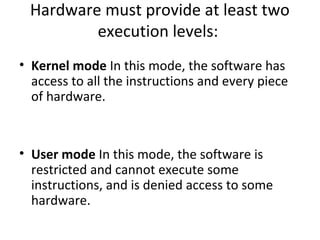
Hardware must provide at least two 
execution levels: 
• Kernel mode In this mode, the software has 
access to all the instructions and every piece 
of hardware. 
• User mode In this mode, the software is 
restricted and cannot execute some 
instructions, and is denied access to some 
hardware.
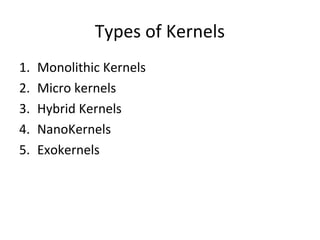
Types of Kernels 
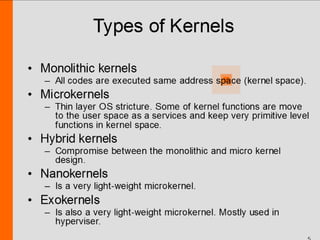
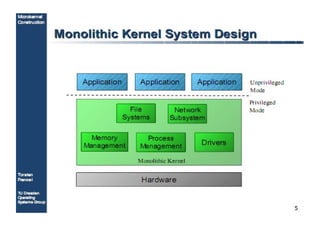
1. Monolithic Kernels 
2. Micro kernels 
3. Hybrid Kernels 
4. NanoKernels 
5. Exokernels
Monolithic Kernels 
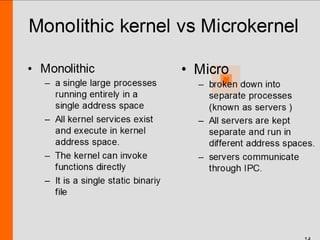
• All OS services operate in kernel space 
• Good performance 
• Execute all of their code in the same address 
space (kernel space) 
• Rich and powerful hardware access 
• Monolithic Kernel : Kernel Image = (Kernel 
Core+Kernel Services). When system boots up 
entire services are loaded and resides in 
memory. 
• Example: Windows and Unix.
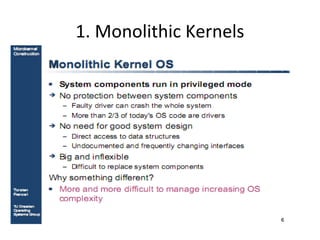
1. Monolithic Kernels
Disadvantages 
 Disadvantages 
 The dependencies between system components 
 A bug in a driver might crash the entire system 
 Large kernels → very difficult to maintain 
• E.g. Unix, Linux
Microkernels 
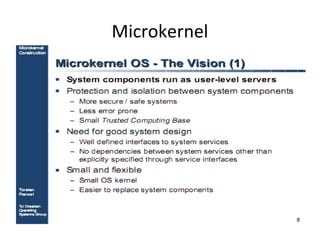
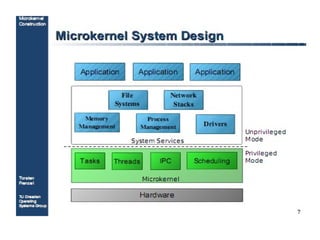
• Minimalist approach 
– IPC, virtual memory, thread scheduling 
• Put the rest into user space 
– Device drivers, networking, file system, user interface 
• Run most of their services in user space 
→improve maintainability and modularity 
• Micro kernel : Kernel Image = Kernel Core. Services are 
build into special modules which can be loaded and 
unloaded as per need.
Microkernel
• Disadvantages 
– Lot of system calls and context switches 
• E.g. Mach, L4, AmigaOS, K42
Operating System Architecture 
Monolithic Kernel Microkernel 
S4 
Server: Dynamically loaded Kernel code and data: server program: 
17 
....... 
....... 
Key: 
S1 ....... 
S1 S2 S3 
S2 S3 S4 
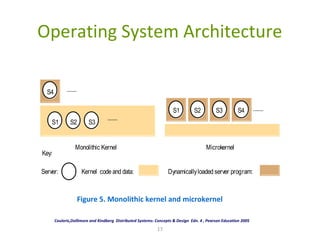
Figure 5. Monolithic kernel and microkernel 
Couloris,Dollimore and Kindberg Distributed Systems: Concepts & Design Edn. 4 , Pearson Education 2005
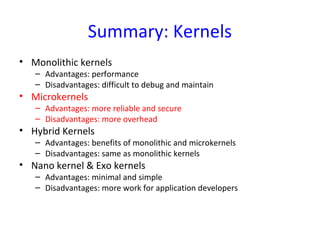
Summary: Kernels 
• Monolithic kernels 
– Advantages: performance 
– Disadvantages: difficult to debug and maintain 
• Microkernels 
– Advantages: more reliable and secure 
– Disadvantages: more overhead 
• Hybrid Kernels 
– Advantages: benefits of monolithic and microkernels 
– Disadvantages: same as monolithic kernels 
• Nano kernel & Exo kernels 
– Advantages: minimal and simple 
– Disadvantages: more work for application developers
Thank You

2. microkernel new

  • 1.
    Operating System Support Including 1.Introduction 2.The OS layer 3.Protection 4.Processes & Threads 5.Operating System Architecture
  • 2.
  • 3.
    Definition of Kernel • The fundamental part of an operating system. • Responsible for providing secure access to the machine's hardware for various programs. • Responsible for deciding when and how long a program can use a certain hardware.
  • 6.
    Hardware must provideat least two execution levels: • Kernel mode In this mode, the software has access to all the instructions and every piece of hardware. • User mode In this mode, the software is restricted and cannot execute some instructions, and is denied access to some hardware.
  • 7.
    Types of Kernels 1. Monolithic Kernels 2. Micro kernels 3. Hybrid Kernels 4. NanoKernels 5. Exokernels
  • 9.
    Monolithic Kernels •All OS services operate in kernel space • Good performance • Execute all of their code in the same address space (kernel space) • Rich and powerful hardware access • Monolithic Kernel : Kernel Image = (Kernel Core+Kernel Services). When system boots up entire services are loaded and resides in memory. • Example: Windows and Unix.
  • 10.
  • 11.
    Disadvantages  Disadvantages  The dependencies between system components  A bug in a driver might crash the entire system  Large kernels → very difficult to maintain • E.g. Unix, Linux
  • 13.
    Microkernels • Minimalistapproach – IPC, virtual memory, thread scheduling • Put the rest into user space – Device drivers, networking, file system, user interface • Run most of their services in user space →improve maintainability and modularity • Micro kernel : Kernel Image = Kernel Core. Services are build into special modules which can be loaded and unloaded as per need.
  • 14.
  • 15.
    • Disadvantages –Lot of system calls and context switches • E.g. Mach, L4, AmigaOS, K42
  • 17.
    Operating System Architecture Monolithic Kernel Microkernel S4 Server: Dynamically loaded Kernel code and data: server program: 17 ....... ....... Key: S1 ....... S1 S2 S3 S2 S3 S4 Figure 5. Monolithic kernel and microkernel Couloris,Dollimore and Kindberg Distributed Systems: Concepts & Design Edn. 4 , Pearson Education 2005
  • 20.
    Summary: Kernels •Monolithic kernels – Advantages: performance – Disadvantages: difficult to debug and maintain • Microkernels – Advantages: more reliable and secure – Disadvantages: more overhead • Hybrid Kernels – Advantages: benefits of monolithic and microkernels – Disadvantages: same as monolithic kernels • Nano kernel & Exo kernels – Advantages: minimal and simple – Disadvantages: more work for application developers
  • 21.