Slides for Chapter 2: 
Architectural Models 
From Coulouris, Dollimore and Kindberg 
Distributed Systems: 
Concepts and Design 
Edition 4, © Pearson Education 2005
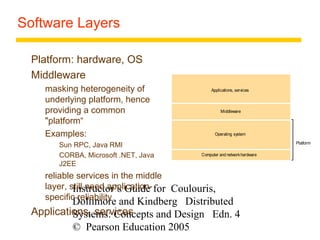
Software Layers 
Platform: hardware, OS 
Middleware 
masking heterogeneity of 
underlying platform, hence 
providing a common 
platform“ 
Examples: 
Sun RPC, Java RMI 
CORBA, Microsoft .NET, Java 
J2EE 
reliable services in the middle 
layer, still need application-specific 
Middleware 
Instructor’s Guide for Coulouris, 
Dollimore reliability 
and Kindberg Distributed 
Systems: Concepts and Design Edn. 4 
© Pearson Education 2005 
Applications, services 
Computer and network hardware 
Platform 
Operating system
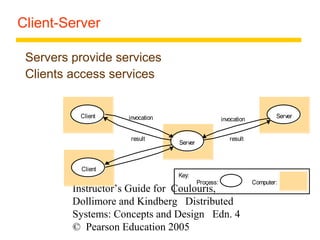
Client-Server 
Servers provide services 
Clients access services 
Server 
Client 
Client 
invocation 
result 
invocation Server 
result 
Process: 
Key: 
Instructor’s Guide for Coulouris, 
Dollimore and Kindberg Distributed 
Systems: Concepts and Design Edn. 4 
© Pearson Education 2005 
Computer:
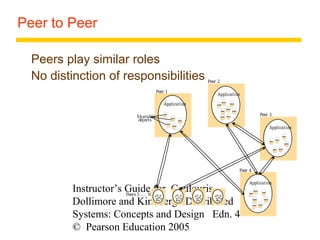
Peer to Peer 
Peers play similar roles 
No distinction of responsibilities 
Application 
Application 
Sharable 
objects 
Peer 4 
Instructor’s Guide for Coulouris, 
Dollimore and Kindberg Distributed 
Systems: Concepts and Design Edn. 4 
© Pearson Education 2005 
Application 
Peer 1 
Peer 2 
Peer 3 
Peers 5 .... N 
Application
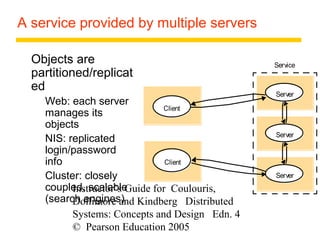
A service provided by multiple servers 
Objects are 
partitioned/replicat 
ed 
Web: each server 
manages its 
objects 
NIS: replicated 
login/password 
info 
Cluster: closely 
coupled, scalable 
(search engines) 
Instructor’s Guide for Coulouris, 
Dollimore and Kindberg Distributed 
Systems: Concepts and Design Edn. 4 
© Pearson Education 2005 
Service 
Server 
Server 
Server 
Client 
Client
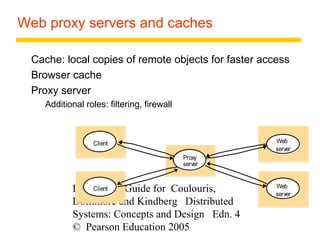
Web proxy servers and caches 
Cache: local copies of remote objects for faster access 
Browser cache 
Proxy server 
Additional roles: filtering, firewall 
Client 
Proxy 
Instructor’s Guide for Coulouris, 
Dollimore and Kindberg Distributed 
Systems: Concepts and Design Edn. 4 
© Pearson Education 2005 
Web 
server 
server 
Web 
server 
Client
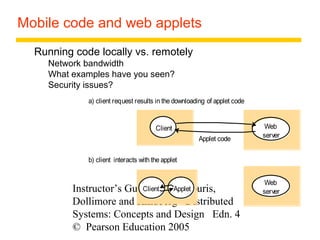
Mobile code and web applets 
 Running code locally vs. remotely 
 Network bandwidth 
 What examples have you seen? 
 Security issues? 
a) client request results in the downloading of applet code 
Applet code 
Instructor’s Guide for Coulouris, 
Dollimore and Kindberg Distributed 
Systems: Concepts and Design Edn. 4 
© Pearson Education 2005 
Web 
server 
Client 
Web 
Applet server 
Client 
b) client interacts with the applet
Mobile agents 
 Running program that travels from one 
computer to another 
 Perform tasks on users’ behalf 
 Security issues 
 How does it compare to one client interacting 
with multiple servers? 
 What if the program needs to access a lot of remote 
data? 
 How does it compare with applets? 
 Agents can provide functionality a remote web 
site does not provide, but allows access to data. 
Instructor’s Guide for Coulouris, 
Dollimore and Kindberg Distributed 
Systems: Concepts and Design Edn. 4 
© Pearson Education 2005
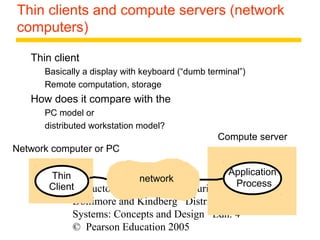
Thin clients and compute servers (network 
computers) 
 Thin client 
 Basically a display with keyboard (“dumb terminal”) 
 Remote computation, storage 
 How does it compare with the 
 PC model or 
 distributed workstation model? 
Network computer or PC 
Thin 
Client 
Compute server 
Application 
Process 
network 
Instructor’s Guide for Coulouris, 
Dollimore and Kindberg Distributed 
Systems: Concepts and Design Edn. 4 
© Pearson Education 2005
Mobile devices and spontaneous interoperation 
 Laptops, PDA’s, cell phones, wearable computers… 
 Metropolitan (GSM, CDPD): hundreds of meters, 100s 
Kb/s 
 Local Area (BlueTooth, infra-red): meters, 10 Mb/s 
 Infrastructure vs ad-hoc networking 
 Accessing services, variable bandwidth/connectivity, 
power supply, security, 
 Spontaneous interoperation--easy connection and 
location of services 
Instructor’s Guide for Coulouris, 
Dollimore and Kindberg Distributed 
Systems: Concepts and Design Edn. 4 
© Pearson Education 2005 
 Service discovery 
 Context-aware
Interfaces and objects 
 At the programming level 
 Need standard interfaces 
 Access/provide services/objects 
 RPC/RMI 
Instructor’s Guide for Coulouris, 
Dollimore and Kindberg Distributed 
Systems: Concepts and Design Edn. 4 
© Pearson Education 2005
Design requirements for distributed architectures 
 Performance 
 Responsiveness, throughput, load balancing 
 Quality of service (QoS) 
 time-critical applications (real-time apps) 
 guarantee certain level of quality delivered by the deadline 
 allocation of computation and communication resources 
 Caching and replication 
 web caching: server provides expiration time 
 Dependability 
 fault tolerance: redundancy, recovery 
 security 
Instructor’s Guide for Coulouris, 
Dollimore and Kindberg Distributed 
Systems: Concepts and Design Edn. 4 
© Pearson Education 2005
Fundamental Models 
 Fundamental properties in processes and 
communication, shared among different 
architectures discussed previously 
Instructor’s Guide for Coulouris, 
Dollimore and Kindberg Distributed 
Systems: Concepts and Design Edn. 4 
© Pearson Education 2005
Interaction model (1) 
 sequential vs. distributed algorithms timing, 
distributed state 
 performance of communication channels 
 latency: transmission, access, os 
 bandwidth 
 jitter: variation among messages 
 clocks and timing events 
 clock drift 
 synchronization 
Instructor’s Guide for Coulouris, 
Dollimore and Kindberg Distributed 
Systems: Concepts and Design Edn. 4 
© Pearson Education 2005
Interaction Model (2) [Synchronous vs 
Asynchronous] 
 synchronous distributed systems 
 lower and upper bounds for execution of a step 
 message transmission in bounded time 
 clock drift rate is bounded 
 failures can be detected when bounds are exceeded 
 accomplished by allocating sufficient resources 
 asynchronous distributed systems 
 no bounds on process speed, message delay, clock 
drift rate 
 failures are harder to detect 
 performance can't be guaranteed 
Instructor’s Guide for Coulouris, 
Dollimore and Kindberg Distributed 
Systems: Concepts and Design Edn. 4 
© Pearson Education 2005
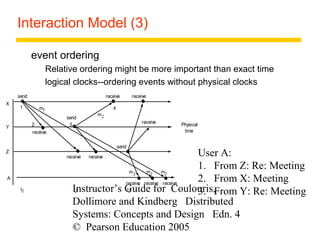
Interaction Model (3) 
 event ordering 
 Relative ordering might be more important than exact time 
 logical clocks--ordering events without physical clocks 
Instructor’s Guide for Coulouris, 
Dollimore and Kindberg Distributed 
Systems: Concepts and Design Edn. 4 
© Pearson Education 2005 
send 
receive 
send 
receive 
m1 m2 
2 
1 
3 
4 
X 
Y 
Z 
Physical 
time 
A 
m3 
receive receive 
send 
receive receive receive 
t1 t2 t3 
receive 
receive 
m2 
m1 
User A: 
1. From Z: Re: Meeting 
2. From X: Meeting 
3. From Y: Re: Meeting
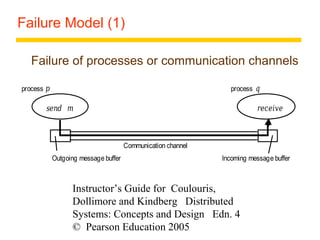
Failure Model (1) 
 Failure of processes or communication channels 
process p process q 
m receive 
Communication channel 
Instructor’s Guide for Coulouris, 
Dollimore and Kindberg Distributed 
Systems: Concepts and Design Edn. 4 
© Pearson Education 2005 
send 
Outgoing message buffer Incoming message buffer
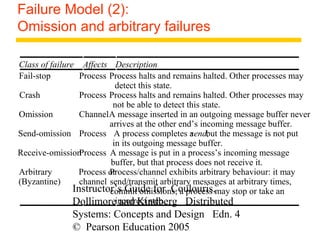
Failure Model (2): 
Omission and arbitrary failures 
Class of failure Affects Description 
Fail-stop Process Process halts and remains halted. Other processes may 
detect this state. 
Crash Process Process halts and remains halted. Other processes may 
not be able to detect this state. 
Omission ChannelA message inserted in an outgoing message buffer never 
arrives at the other end’s incoming message buffer. 
Send-omission Process A process completes as endb, ut the message is not put 
in its outgoing message buffer. 
Receive-omissionProcess A message is put in a process’s incoming message 
buffer, but that process does not receive it. 
Instructor’s Guide for Coulouris, 
Dollimore and Kindberg Distributed 
Systems: Concepts and Design Edn. 4 
© Pearson Education 2005 
Arbitrary 
(Byzantine) 
Process or 
channel 
Process/channel exhibits arbitrary behaviour: it may 
send/transmit arbitrary messages at arbitrary times, 
commit omissions; a process may stop or take an 
incorrect step.
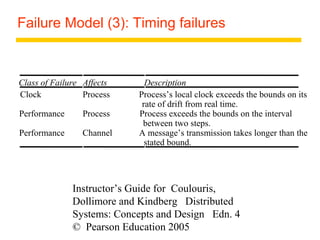
Failure Model (3): Timing failures 
Class of Failure Affects Description 
Clock Process Process’s local clock exceeds the bounds on its 
rate of drift from real time. 
Performance Process Process exceeds the bounds on the interval 
between two steps. 
Performance Channel A message’s transmission takes longer than the 
stated bound. 
Instructor’s Guide for Coulouris, 
Dollimore and Kindberg Distributed 
Systems: Concepts and Design Edn. 4 
© Pearson Education 2005
Failure Model (4) 
 masking failures 
 hiding--use another server to respond 
 converting it into more acceptable--drop the packet if 
it is corrupted 
 reliable one-to-one communication 
 validity: eventually delivered 
 integrity: content not corrupted or duplicated 
Instructor’s Guide for Coulouris, 
Dollimore and Kindberg Distributed 
Systems: Concepts and Design Edn. 4 
© Pearson Education 2005
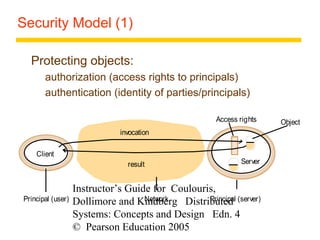
Security Model (1) 
 Protecting objects: 
 authorization (access rights to principals) 
 authentication (identity of parties/principals) 
invocation 
result 
Access rights Object 
Instructor’s Guide for Coulouris, 
Dollimore and Kindberg Network 
Distributed 
Systems: Concepts and Design Edn. 4 
© Pearson Education 2005 
Client 
Server 
Principal (user) Principal (server)
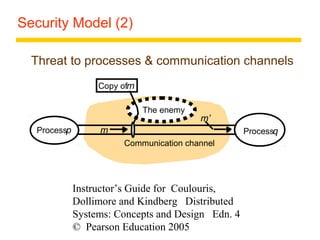
Security Model (2) 
 Threat to processes  communication channels 
Copy of m 
The enemy 
m’ 
Processp m Processq 
Communication channel 
Instructor’s Guide for Coulouris, 
Dollimore and Kindberg Distributed 
Systems: Concepts and Design Edn. 4 
© Pearson Education 2005
Security Model (3) 
 Threat to processes  communication channels 
 Denial of service 
 Mobile code 
 Cryptography: science of keeping messages secret 
 encryption: process of scrambling a message to hid its content 
 secret keys--large numbers that are difficult to guess 
 authentication--encrypt the identity, check the decrypted identity 
 secured channels--authentication, privacy/integrity, time stamp 
to prevent replaying and reordering 
Instructor’s Guide for Coulouris, 
Dollimore and Kindberg Distributed 
Systems: Concepts and Design Edn. 4 
© Pearson Education 2005

Chapter 2 system models

  • 1.
    Slides for Chapter2: Architectural Models From Coulouris, Dollimore and Kindberg Distributed Systems: Concepts and Design Edition 4, © Pearson Education 2005
  • 2.
    Software Layers Platform:hardware, OS Middleware masking heterogeneity of underlying platform, hence providing a common platform“ Examples: Sun RPC, Java RMI CORBA, Microsoft .NET, Java J2EE reliable services in the middle layer, still need application-specific Middleware Instructor’s Guide for Coulouris, Dollimore reliability and Kindberg Distributed Systems: Concepts and Design Edn. 4 © Pearson Education 2005 Applications, services Applications, services Computer and network hardware Platform Operating system
  • 3.
    Client-Server Servers provideservices Clients access services Server Client Client invocation result invocation Server result Process: Key: Instructor’s Guide for Coulouris, Dollimore and Kindberg Distributed Systems: Concepts and Design Edn. 4 © Pearson Education 2005 Computer:
  • 4.
    Peer to Peer Peers play similar roles No distinction of responsibilities Application Application Sharable objects Peer 4 Instructor’s Guide for Coulouris, Dollimore and Kindberg Distributed Systems: Concepts and Design Edn. 4 © Pearson Education 2005 Application Peer 1 Peer 2 Peer 3 Peers 5 .... N Application
  • 5.
    A service providedby multiple servers Objects are partitioned/replicat ed Web: each server manages its objects NIS: replicated login/password info Cluster: closely coupled, scalable (search engines) Instructor’s Guide for Coulouris, Dollimore and Kindberg Distributed Systems: Concepts and Design Edn. 4 © Pearson Education 2005 Service Server Server Server Client Client
  • 6.
    Web proxy serversand caches Cache: local copies of remote objects for faster access Browser cache Proxy server Additional roles: filtering, firewall Client Proxy Instructor’s Guide for Coulouris, Dollimore and Kindberg Distributed Systems: Concepts and Design Edn. 4 © Pearson Education 2005 Web server server Web server Client
  • 7.
    Mobile code andweb applets Running code locally vs. remotely Network bandwidth What examples have you seen? Security issues? a) client request results in the downloading of applet code Applet code Instructor’s Guide for Coulouris, Dollimore and Kindberg Distributed Systems: Concepts and Design Edn. 4 © Pearson Education 2005 Web server Client Web Applet server Client b) client interacts with the applet
  • 8.
    Mobile agents Running program that travels from one computer to another Perform tasks on users’ behalf Security issues How does it compare to one client interacting with multiple servers? What if the program needs to access a lot of remote data? How does it compare with applets? Agents can provide functionality a remote web site does not provide, but allows access to data. Instructor’s Guide for Coulouris, Dollimore and Kindberg Distributed Systems: Concepts and Design Edn. 4 © Pearson Education 2005
  • 9.
    Thin clients andcompute servers (network computers) Thin client Basically a display with keyboard (“dumb terminal”) Remote computation, storage How does it compare with the PC model or distributed workstation model? Network computer or PC Thin Client Compute server Application Process network Instructor’s Guide for Coulouris, Dollimore and Kindberg Distributed Systems: Concepts and Design Edn. 4 © Pearson Education 2005
  • 10.
    Mobile devices andspontaneous interoperation Laptops, PDA’s, cell phones, wearable computers… Metropolitan (GSM, CDPD): hundreds of meters, 100s Kb/s Local Area (BlueTooth, infra-red): meters, 10 Mb/s Infrastructure vs ad-hoc networking Accessing services, variable bandwidth/connectivity, power supply, security, Spontaneous interoperation--easy connection and location of services Instructor’s Guide for Coulouris, Dollimore and Kindberg Distributed Systems: Concepts and Design Edn. 4 © Pearson Education 2005 Service discovery Context-aware
  • 11.
    Interfaces and objects At the programming level Need standard interfaces Access/provide services/objects RPC/RMI Instructor’s Guide for Coulouris, Dollimore and Kindberg Distributed Systems: Concepts and Design Edn. 4 © Pearson Education 2005
  • 12.
    Design requirements fordistributed architectures Performance Responsiveness, throughput, load balancing Quality of service (QoS) time-critical applications (real-time apps) guarantee certain level of quality delivered by the deadline allocation of computation and communication resources Caching and replication web caching: server provides expiration time Dependability fault tolerance: redundancy, recovery security Instructor’s Guide for Coulouris, Dollimore and Kindberg Distributed Systems: Concepts and Design Edn. 4 © Pearson Education 2005
  • 13.
    Fundamental Models Fundamental properties in processes and communication, shared among different architectures discussed previously Instructor’s Guide for Coulouris, Dollimore and Kindberg Distributed Systems: Concepts and Design Edn. 4 © Pearson Education 2005
  • 14.
    Interaction model (1) sequential vs. distributed algorithms timing, distributed state performance of communication channels latency: transmission, access, os bandwidth jitter: variation among messages clocks and timing events clock drift synchronization Instructor’s Guide for Coulouris, Dollimore and Kindberg Distributed Systems: Concepts and Design Edn. 4 © Pearson Education 2005
  • 15.
    Interaction Model (2)[Synchronous vs Asynchronous] synchronous distributed systems lower and upper bounds for execution of a step message transmission in bounded time clock drift rate is bounded failures can be detected when bounds are exceeded accomplished by allocating sufficient resources asynchronous distributed systems no bounds on process speed, message delay, clock drift rate failures are harder to detect performance can't be guaranteed Instructor’s Guide for Coulouris, Dollimore and Kindberg Distributed Systems: Concepts and Design Edn. 4 © Pearson Education 2005
  • 16.
    Interaction Model (3) event ordering Relative ordering might be more important than exact time logical clocks--ordering events without physical clocks Instructor’s Guide for Coulouris, Dollimore and Kindberg Distributed Systems: Concepts and Design Edn. 4 © Pearson Education 2005 send receive send receive m1 m2 2 1 3 4 X Y Z Physical time A m3 receive receive send receive receive receive t1 t2 t3 receive receive m2 m1 User A: 1. From Z: Re: Meeting 2. From X: Meeting 3. From Y: Re: Meeting
  • 17.
    Failure Model (1) Failure of processes or communication channels process p process q m receive Communication channel Instructor’s Guide for Coulouris, Dollimore and Kindberg Distributed Systems: Concepts and Design Edn. 4 © Pearson Education 2005 send Outgoing message buffer Incoming message buffer
  • 18.
    Failure Model (2): Omission and arbitrary failures Class of failure Affects Description Fail-stop Process Process halts and remains halted. Other processes may detect this state. Crash Process Process halts and remains halted. Other processes may not be able to detect this state. Omission ChannelA message inserted in an outgoing message buffer never arrives at the other end’s incoming message buffer. Send-omission Process A process completes as endb, ut the message is not put in its outgoing message buffer. Receive-omissionProcess A message is put in a process’s incoming message buffer, but that process does not receive it. Instructor’s Guide for Coulouris, Dollimore and Kindberg Distributed Systems: Concepts and Design Edn. 4 © Pearson Education 2005 Arbitrary (Byzantine) Process or channel Process/channel exhibits arbitrary behaviour: it may send/transmit arbitrary messages at arbitrary times, commit omissions; a process may stop or take an incorrect step.
  • 19.
    Failure Model (3):Timing failures Class of Failure Affects Description Clock Process Process’s local clock exceeds the bounds on its rate of drift from real time. Performance Process Process exceeds the bounds on the interval between two steps. Performance Channel A message’s transmission takes longer than the stated bound. Instructor’s Guide for Coulouris, Dollimore and Kindberg Distributed Systems: Concepts and Design Edn. 4 © Pearson Education 2005
  • 20.
    Failure Model (4) masking failures hiding--use another server to respond converting it into more acceptable--drop the packet if it is corrupted reliable one-to-one communication validity: eventually delivered integrity: content not corrupted or duplicated Instructor’s Guide for Coulouris, Dollimore and Kindberg Distributed Systems: Concepts and Design Edn. 4 © Pearson Education 2005
  • 21.
    Security Model (1) Protecting objects: authorization (access rights to principals) authentication (identity of parties/principals) invocation result Access rights Object Instructor’s Guide for Coulouris, Dollimore and Kindberg Network Distributed Systems: Concepts and Design Edn. 4 © Pearson Education 2005 Client Server Principal (user) Principal (server)
  • 22.
    Security Model (2) Threat to processes communication channels Copy of m The enemy m’ Processp m Processq Communication channel Instructor’s Guide for Coulouris, Dollimore and Kindberg Distributed Systems: Concepts and Design Edn. 4 © Pearson Education 2005
  • 23.
    Security Model (3) Threat to processes communication channels Denial of service Mobile code Cryptography: science of keeping messages secret encryption: process of scrambling a message to hid its content secret keys--large numbers that are difficult to guess authentication--encrypt the identity, check the decrypted identity secured channels--authentication, privacy/integrity, time stamp to prevent replaying and reordering Instructor’s Guide for Coulouris, Dollimore and Kindberg Distributed Systems: Concepts and Design Edn. 4 © Pearson Education 2005