Characterization of Distributed 
Systems 
From Coulouris, Dollimore and Kindberg 
Distributed Systems: 
Concepts and Design 
Edition 4, © Pearson Education 2005
Networking and Parallel Computing 
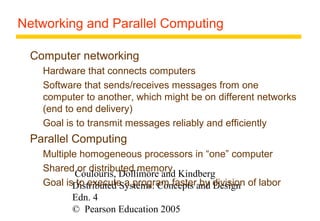
Computer networking 
Hardware that connects computers 
Software that sends/receives messages from one 
computer to another, which might be on different networks 
(end to end delivery) 
Goal is to transmit messages reliably and efficiently 
Parallel Computing 
Multiple homogeneous processors in “one” computer 
Shared or distributed memory 
Goal is to execute a program faster by division of labor 
Coulouris, Dollimore and Kindberg 
Distributed Systems: Concepts and Design 
Edn. 4 
© Pearson Education 2005
Distributed Computing 
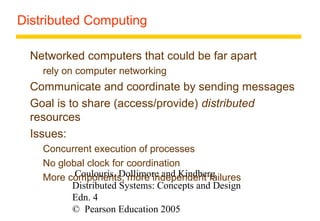
Networked computers that could be far apart 
rely on computer networking 
Communicate and coordinate by sending messages 
Goal is to share (access/provide) distributed 
resources 
Issues: 
Concurrent execution of processes 
No global clock for coordination 
More components, more independent failures 
Coulouris, Dollimore and Kindberg 
Distributed Systems: Concepts and Design 
Edn. 4 
© Pearson Education 2005
Examples of Distributed Systems 
Global Internet 
Organizational Intranets--behind router/firewall 
Mobile Computing -- computers move 
Ubiquitous Computing -- computers embedded 
everywhere 
Issues: 
discovery of resources in different host environments 
dynamic reconfiguration 
limited connectivity 
privacy and security guarantees to the user and the host 
environment 
Coulouris, Dollimore and Kindberg 
Distributed Systems: Concepts and Design 
Edn. 4 
© Pearson Education 2005
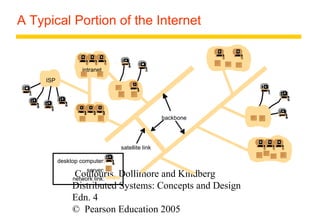
A Typical Portion of the Internet 
intranet 
Coulouris, Dollimore and Kindberg 
Distributed Systems: Concepts and Design 
Edn. 4 
© Pearson Education 2005 
ISP 
desktop computer: 
backbone 
satellite link 
server: 
 
network link:
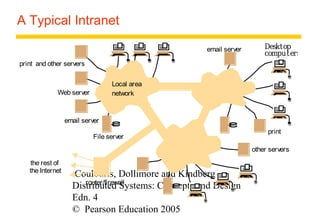
A Typical Intranet 
Web server 
Coulouris, Dollimore and Kindberg 
Distributed Systems: Concepts and Design 
Edn. 4 
© Pearson Education 2005 
the rest of 
email server 
Desktop 
computers 
File server 
router/firewall 
print and other servers 
print 
other servers 
Local area 
network 
email server 
the Internet
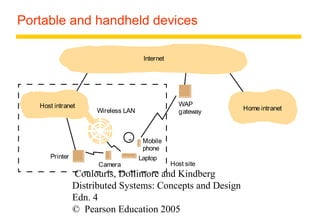
Portable and handheld devices 
Mobile 
Laptop 
Coulouris, Dollimore and Kindberg 
Distributed Systems: Concepts and Design 
Edn. 4 
© Pearson Education 2005 
Printer 
Camera 
Internet 
Host intranet WAP Home intranet 
Wireless LAN 
phone 
gateway 
Host site
Resource Sharing and the Web 
 HTML, Hyper Text Markup Language 
 URL, Uniform Resource Locator 
 http://servername[:port] [/pathname] [?arguments] 
 HTTP, HyperText Transfer Protocol 
 request-reply protocol (client-server) 
 content types--MIME types, multipurpose internet mail 
extensions 
 one resource per request 
 simple access control (mostly public) 
Coulouris, Dollimore and Kindberg 
Distributed Systems: Concepts and Design 
Edn. 4 
© Pearson Education 2005
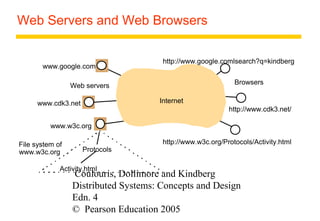
Web Servers and Web Browsers 
www.google.com 
http://www.google.comlsearch?q=kindberg 
Web servers Browsers 
Internet 
www.cdk3.net 
www.w3c.org 
Protocols 
Activity.html 
http://www.cdk3.net/ 
http://www.w3c.org/Protocols/Activity.html 
Coulouris, Dollimore and Kindberg 
Distributed Systems: Concepts and Design 
Edn. 4 
© Pearson Education 2005 
File system of 
www.w3c.org
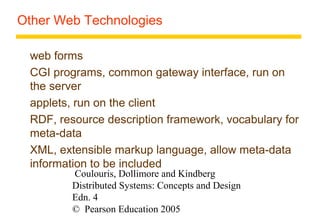
Other Web Technologies 
 web forms 
 CGI programs, common gateway interface, run on 
the server 
 applets, run on the client 
 RDF, resource description framework, vocabulary for 
meta-data 
 XML, extensible markup language, allow meta-data 
information to be included 
Coulouris, Dollimore and Kindberg 
Distributed Systems: Concepts and Design 
Edn. 4 
© Pearson Education 2005
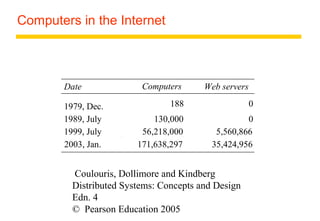
Computers in the Internet 
Date Computers Web servers 
1979, Dec. 188 0 
1989, July 130,000 0 
1999, July 56,218,000 5,560,866 
2003, Jan. 171,638,297 35,424,956 
Coulouris, Dollimore and Kindberg 
Distributed Systems: Concepts and Design 
Edn. 4 
© Pearson Education 2005
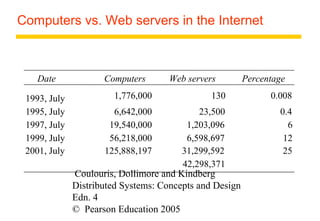
Computers vs. Web servers in the Internet 
Date Computers Web servers Percentage 
1993, July 1,776,000 130 0.008 
1995, July 6,642,000 23,500 0.4 
1997, July 19,540,000 1,203,096 6 
1999, July 56,218,000 6,598,697 12 
2001, July 125,888,197 31,299,592 25 
42,298,371 
Coulouris, Dollimore and Kindberg 
Distributed Systems: Concepts and Design 
Edn. 4 
© Pearson Education 2005
Challenges and Issues (1) 
 Heterogeneity 
 networks, hardware, os, languages... 
 middleware—corba 
 mobile code, virtual machines 
 Openness 
 extended and re-implemented in various ways 
 standard published interfaces 
 RFC, request for comments 
Coulouris, Dollimore and Kindberg 
Distributed Systems: Concepts and Design 
Edn. 4 
© Pearson Education 2005 
 Security 
 confidentiality 
 integrity 
 availability
Challenges and Issues (2) 
 Scalability 
 effective with significant increase in resources 
 cost 
 performance 
 Failure handling 
 detecting 
 masking—hide, less severe (retransmit) 
 tolerating--ignore, timeout 
 recovery--logs, rollback 
 Redundancy 
Coulouris, Dollimore and Kindberg 
Distributed Systems: Concepts and Design 
Edn. 4 
© Pearson Education 2005 
 Concurrency
Challenges and Issues (3) 
 Transparency 
 Access transparency: enables local and remote resources 
to be accessed using identical operations. 
 Location transparency: enables resources to be accessed 
without knowledge of their physical or network location (for 
example, which building or IP address). 
 Concurrency transparency: enables several processes to 
operate concurrently using shared resources without 
interference between them. 
 Replication transparency: enables multiple instances of 
resources to be used to increase reliability and 
performance without knowledge of the replicas by users or 
application programmers. 
Coulouris, Dollimore and Kindberg 
Distributed Systems: Concepts and Design 
Edn. 4 
© Pearson Education 2005
Challenges and Issues (4) 
 Transparency 
 Failure transparency: enables the concealment of faults, 
allowing users and application programs to complete their 
tasks despite the failure of hardware or software 
components. 
 Mobility transparency: allows the movement of resources 
and clients within a system without affecting the operation 
of users or programs. 
 Performance transparency: allows the system to be 
reconfigured to improve performance as loads vary. 
 Scaling transparency: allows the system and applications 
to expand in scale without change to the system structure 
or the application algorithms. 
Coulouris, Dollimore and Kindberg 
Distributed Systems: Concepts and Design 
Edn. 4 
© Pearson Education 2005

Chapter 1 characterisation of distributed systems

  • 1.
    Characterization of Distributed Systems From Coulouris, Dollimore and Kindberg Distributed Systems: Concepts and Design Edition 4, © Pearson Education 2005
  • 2.
    Networking and ParallelComputing Computer networking Hardware that connects computers Software that sends/receives messages from one computer to another, which might be on different networks (end to end delivery) Goal is to transmit messages reliably and efficiently Parallel Computing Multiple homogeneous processors in “one” computer Shared or distributed memory Goal is to execute a program faster by division of labor Coulouris, Dollimore and Kindberg Distributed Systems: Concepts and Design Edn. 4 © Pearson Education 2005
  • 3.
    Distributed Computing Networkedcomputers that could be far apart rely on computer networking Communicate and coordinate by sending messages Goal is to share (access/provide) distributed resources Issues: Concurrent execution of processes No global clock for coordination More components, more independent failures Coulouris, Dollimore and Kindberg Distributed Systems: Concepts and Design Edn. 4 © Pearson Education 2005
  • 4.
    Examples of DistributedSystems Global Internet Organizational Intranets--behind router/firewall Mobile Computing -- computers move Ubiquitous Computing -- computers embedded everywhere Issues: discovery of resources in different host environments dynamic reconfiguration limited connectivity privacy and security guarantees to the user and the host environment Coulouris, Dollimore and Kindberg Distributed Systems: Concepts and Design Edn. 4 © Pearson Education 2005
  • 5.
    A Typical Portionof the Internet intranet Coulouris, Dollimore and Kindberg Distributed Systems: Concepts and Design Edn. 4 © Pearson Education 2005 ISP desktop computer: backbone satellite link server: network link:
  • 6.
    A Typical Intranet Web server Coulouris, Dollimore and Kindberg Distributed Systems: Concepts and Design Edn. 4 © Pearson Education 2005 the rest of email server Desktop computers File server router/firewall print and other servers print other servers Local area network email server the Internet
  • 7.
    Portable and handhelddevices Mobile Laptop Coulouris, Dollimore and Kindberg Distributed Systems: Concepts and Design Edn. 4 © Pearson Education 2005 Printer Camera Internet Host intranet WAP Home intranet Wireless LAN phone gateway Host site
  • 8.
    Resource Sharing andthe Web HTML, Hyper Text Markup Language URL, Uniform Resource Locator http://servername[:port] [/pathname] [?arguments] HTTP, HyperText Transfer Protocol request-reply protocol (client-server) content types--MIME types, multipurpose internet mail extensions one resource per request simple access control (mostly public) Coulouris, Dollimore and Kindberg Distributed Systems: Concepts and Design Edn. 4 © Pearson Education 2005
  • 9.
    Web Servers andWeb Browsers www.google.com http://www.google.comlsearch?q=kindberg Web servers Browsers Internet www.cdk3.net www.w3c.org Protocols Activity.html http://www.cdk3.net/ http://www.w3c.org/Protocols/Activity.html Coulouris, Dollimore and Kindberg Distributed Systems: Concepts and Design Edn. 4 © Pearson Education 2005 File system of www.w3c.org
  • 10.
    Other Web Technologies web forms CGI programs, common gateway interface, run on the server applets, run on the client RDF, resource description framework, vocabulary for meta-data XML, extensible markup language, allow meta-data information to be included Coulouris, Dollimore and Kindberg Distributed Systems: Concepts and Design Edn. 4 © Pearson Education 2005
  • 11.
    Computers in theInternet Date Computers Web servers 1979, Dec. 188 0 1989, July 130,000 0 1999, July 56,218,000 5,560,866 2003, Jan. 171,638,297 35,424,956 Coulouris, Dollimore and Kindberg Distributed Systems: Concepts and Design Edn. 4 © Pearson Education 2005
  • 12.
    Computers vs. Webservers in the Internet Date Computers Web servers Percentage 1993, July 1,776,000 130 0.008 1995, July 6,642,000 23,500 0.4 1997, July 19,540,000 1,203,096 6 1999, July 56,218,000 6,598,697 12 2001, July 125,888,197 31,299,592 25 42,298,371 Coulouris, Dollimore and Kindberg Distributed Systems: Concepts and Design Edn. 4 © Pearson Education 2005
  • 13.
    Challenges and Issues(1) Heterogeneity networks, hardware, os, languages... middleware—corba mobile code, virtual machines Openness extended and re-implemented in various ways standard published interfaces RFC, request for comments Coulouris, Dollimore and Kindberg Distributed Systems: Concepts and Design Edn. 4 © Pearson Education 2005 Security confidentiality integrity availability
  • 14.
    Challenges and Issues(2) Scalability effective with significant increase in resources cost performance Failure handling detecting masking—hide, less severe (retransmit) tolerating--ignore, timeout recovery--logs, rollback Redundancy Coulouris, Dollimore and Kindberg Distributed Systems: Concepts and Design Edn. 4 © Pearson Education 2005 Concurrency
  • 15.
    Challenges and Issues(3) Transparency Access transparency: enables local and remote resources to be accessed using identical operations. Location transparency: enables resources to be accessed without knowledge of their physical or network location (for example, which building or IP address). Concurrency transparency: enables several processes to operate concurrently using shared resources without interference between them. Replication transparency: enables multiple instances of resources to be used to increase reliability and performance without knowledge of the replicas by users or application programmers. Coulouris, Dollimore and Kindberg Distributed Systems: Concepts and Design Edn. 4 © Pearson Education 2005
  • 16.
    Challenges and Issues(4) Transparency Failure transparency: enables the concealment of faults, allowing users and application programs to complete their tasks despite the failure of hardware or software components. Mobility transparency: allows the movement of resources and clients within a system without affecting the operation of users or programs. Performance transparency: allows the system to be reconfigured to improve performance as loads vary. Scaling transparency: allows the system and applications to expand in scale without change to the system structure or the application algorithms. Coulouris, Dollimore and Kindberg Distributed Systems: Concepts and Design Edn. 4 © Pearson Education 2005