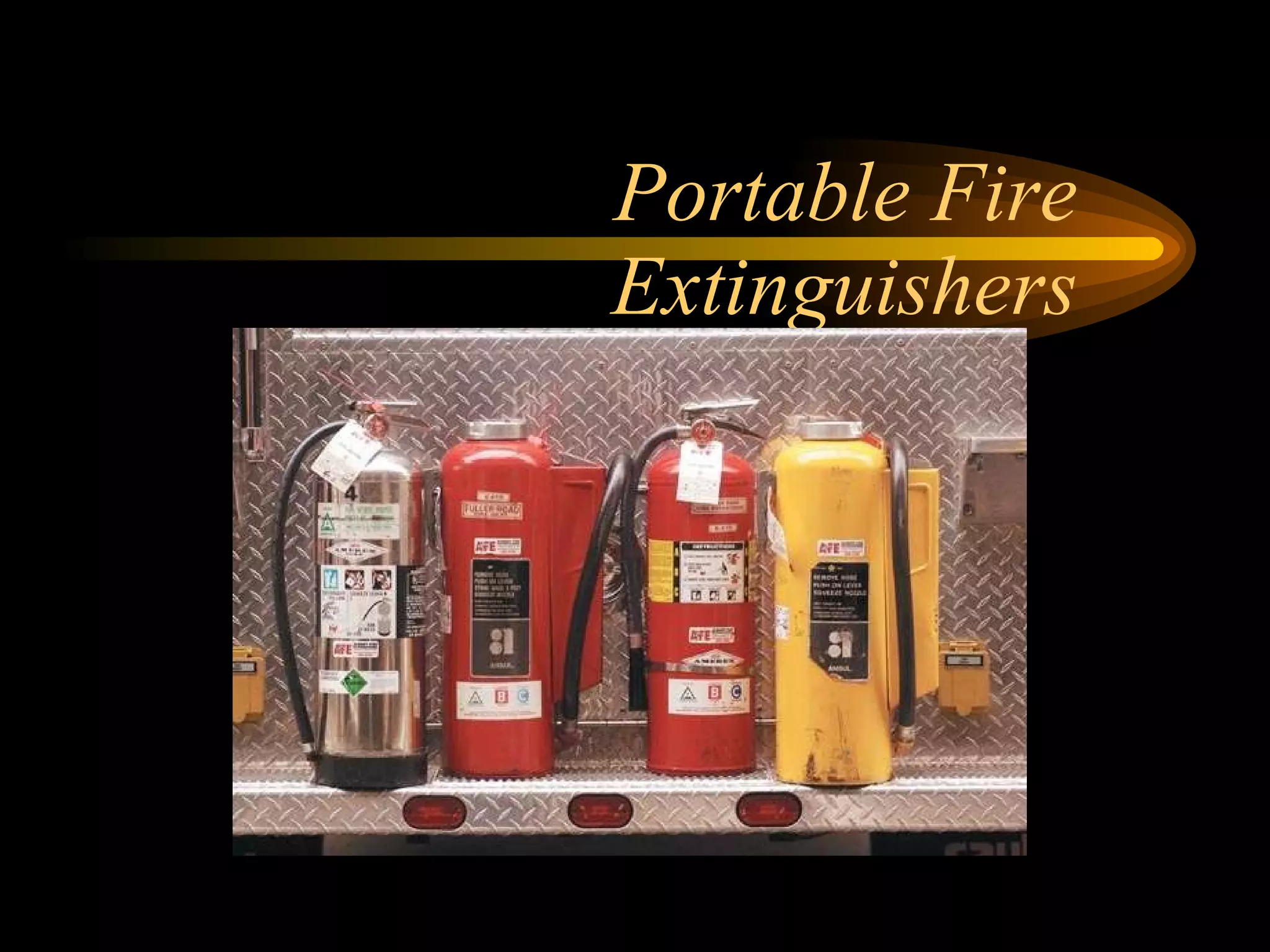
Portable Fire Extinguishers
Objectives  (1 of 2) Explain the five classes of fire and the risks associated with each class. Identify the kinds of fire extinguishers used for each class. Explain the rating systems of portable extinguishers for Classes A,B, and C. Identify the limitations of portable extinguishers.
Objectives  (2 of 2) Demonstrate the operation of portable fire extinguishers. Explain the care and maintenance of portable fire extinguishers. Discuss the inspection requirements of portable fire extinguishers.
Introduction  (1 of 3) Click Here to View Video: Portable Fire Extinguishers
Introduction  (2 of 3) Portable fire extinguishers are designed to fight small incipient fires. Firefighters must know how to use extinguishers and be able to teach others. Proper instruction can improve department effectiveness and reduce damage costs.  Fire extinguishers come in a variety of types and sizes.
Introduction  (3 of 3) Firefighters should know the extinguishers carried on apparatus. Firefighters should be capable of answering questions regarding fire extinguishers.  Citizens will often request information and training on the use of extinguishers.
FIRE EXTINGUISHERS:  ONE OF THE MOST COMMON FIRE-PROTECTION APPLIANCES USED TODAY 1ST LINE OF DEFENSE AGAINST FIRES EXCELLENT TOOL FOR EXTINQUISHING INCIPIENT FIRES CAN OFTEN EXTINGUISH A SMALL FIRE IN LESS TIME THAN DEPLOYING A HOSE LINE
GENERAL : It is important that firefighters be knowledgeable about the different types of portable fire extinguishers and their use. We will discuss the various types of portable fire extinguishers that firefighters are likely to encounter. NFPA 10, Standard for Portable Fire Extinguishers provides information on rating, placement and use.
GENERAL : Firefighters should rely on extinguishers carried on their apparatus and not those found in occupancies. Two portable extinguishers are required on fire apparatus by NFPA standard 1901 One suitable for class B and C fires and one for class A Sizes are as follows: Co2 rated 10 BC, Dry Chemical rated 80 BC, & 2.5 Gal H2o for Class A
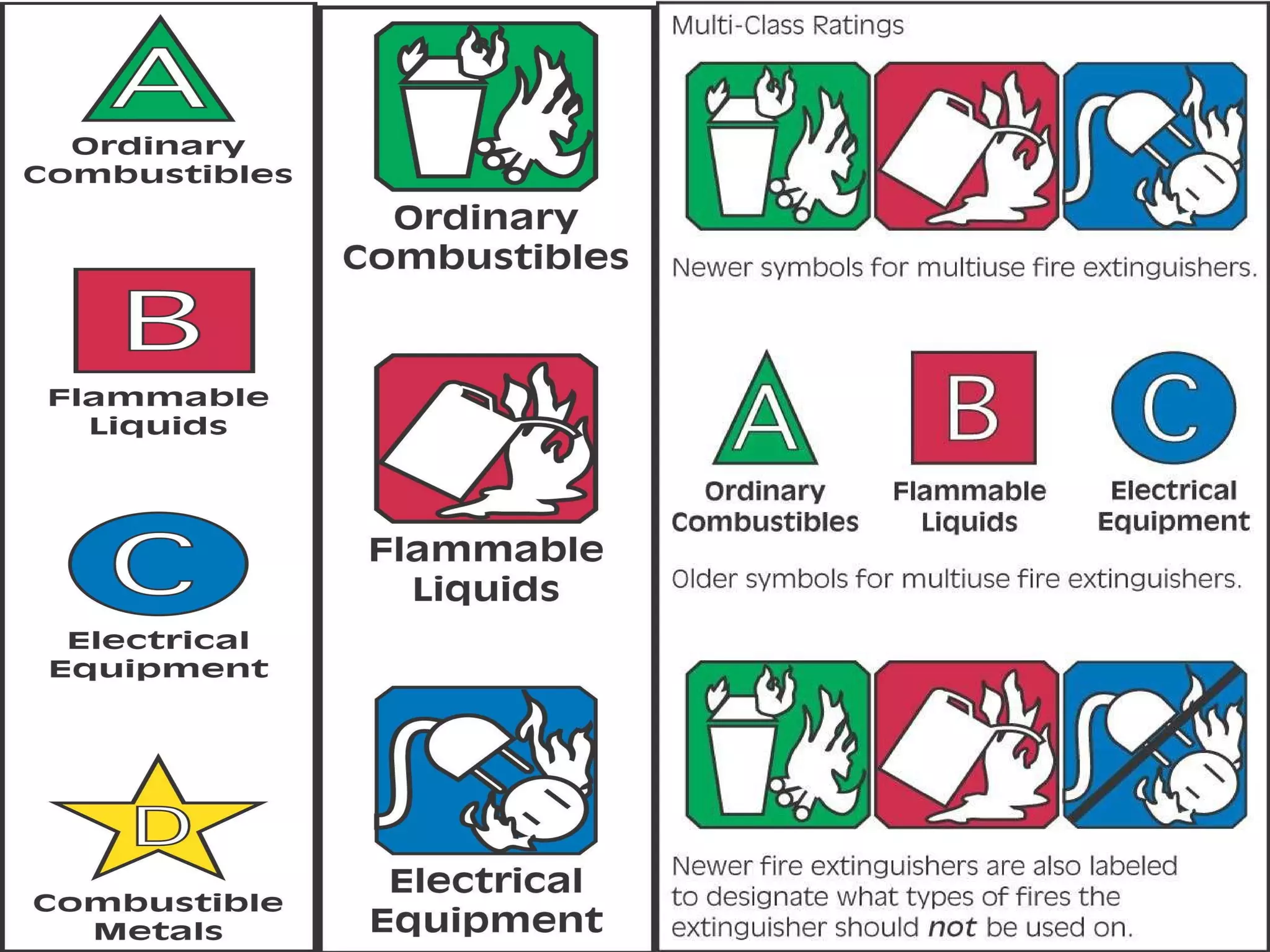
Fire Classification and Risk The type and nature of the burning material (fuel) defines the fire. There are five classes of fire. Class A Class B Class C Class D Class K  (As of 1998)
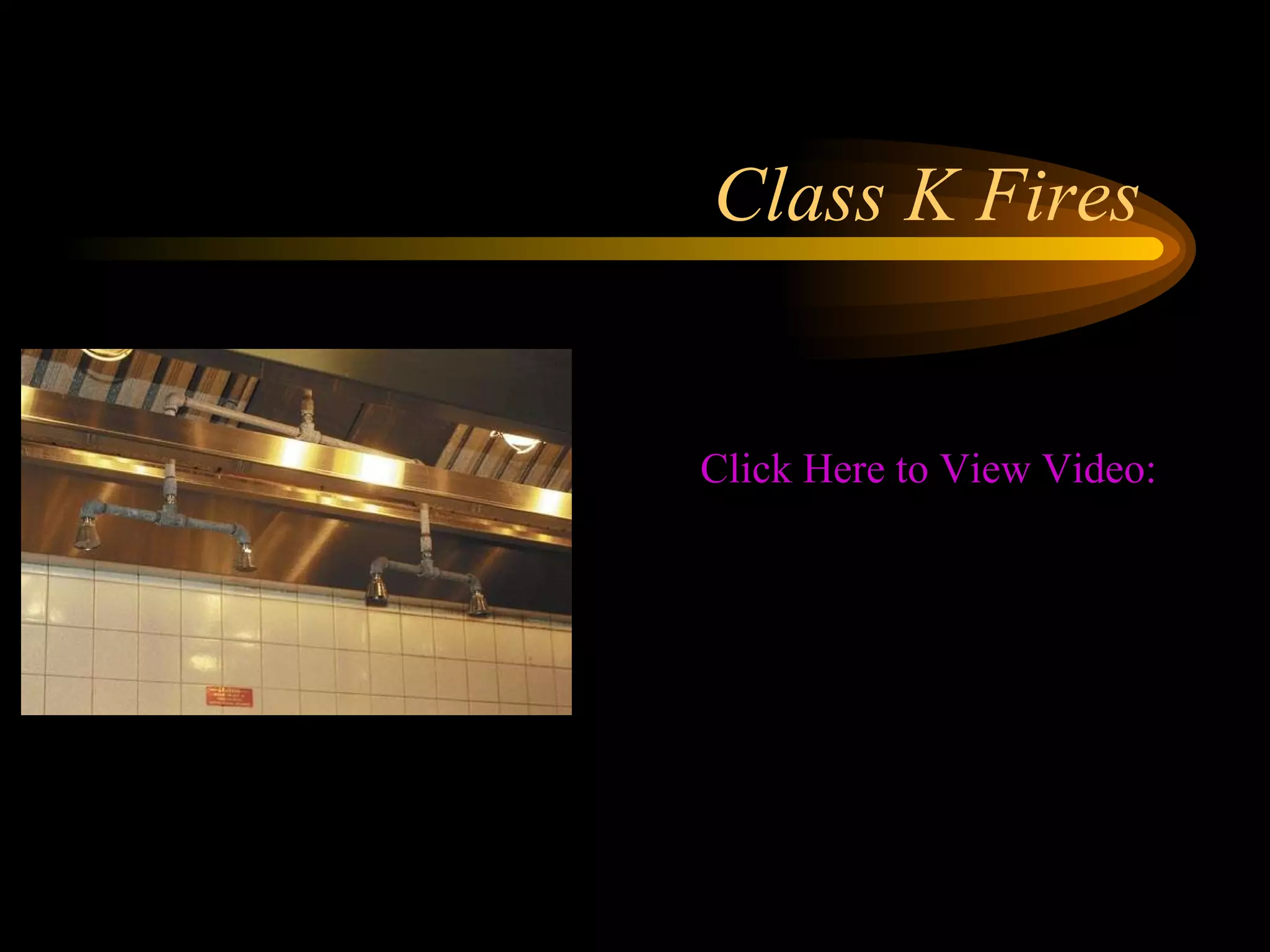
Class K Fires Click Here to View Video: Class K Fires
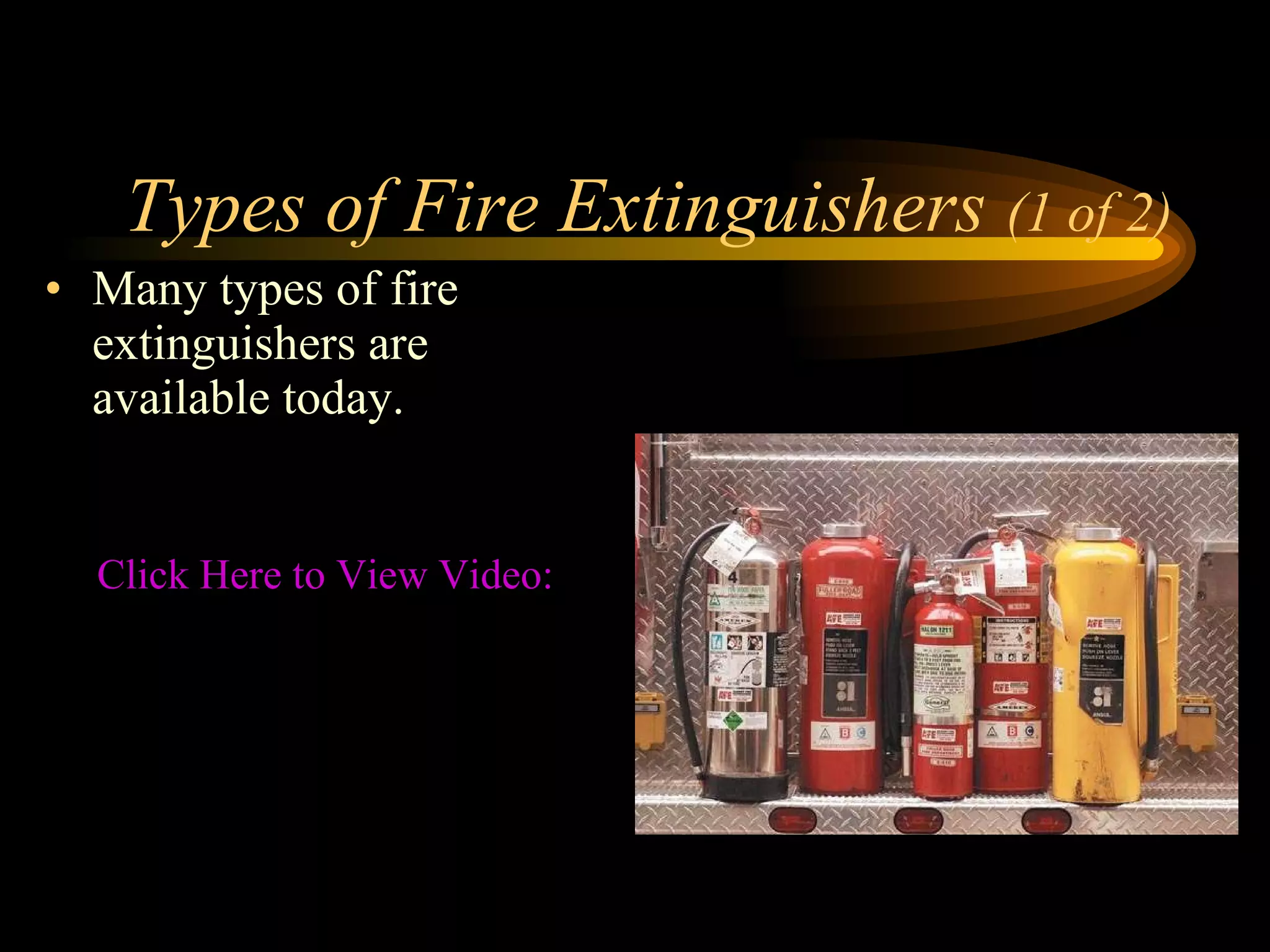
Types of Fire Extinguishers  (1 of 2) Many types of fire extinguishers are available today. Click Here to View Video: Fire Extinguisher Functions/Ratings
Types of Fire Extinguishers  (2 of 2) Many factors need to be considered before using an extinguisher. Type and amount of fuel User and occupancy Building construction Environmental conditions Type of equipment being protected
Types of Extinguishing  Agents  (1 of 2) Water is the basic agent for Class A fires. Water-based foam extinguishers for class B fires have either AFFF or FFFP. CO 2  is an inert gas stored under pressure. CO 2  is effective on Class B or C fires. Dry chemical agents are particles propelled by a gaseous medium. There are three categories of dry chemicals.
Types of Extinguishing  Agents  (2 of 2) Wet chemicals are water-based solutions. Wet chemicals are used for Class K fires. Clean agents have replaced halons. Clean agents do not conduct electricity or leave a residue. There are two classes. Halocarbon agents and inerting gases
Kinds of Extinguishers Pump-type extinguishers are hand-pumped devices. Pressurized extinguishers operate by expelling gas that propels the agent out.  Cartridge-operated extinguishers are used for dry chemical and most dry powder Class D extinguishers.
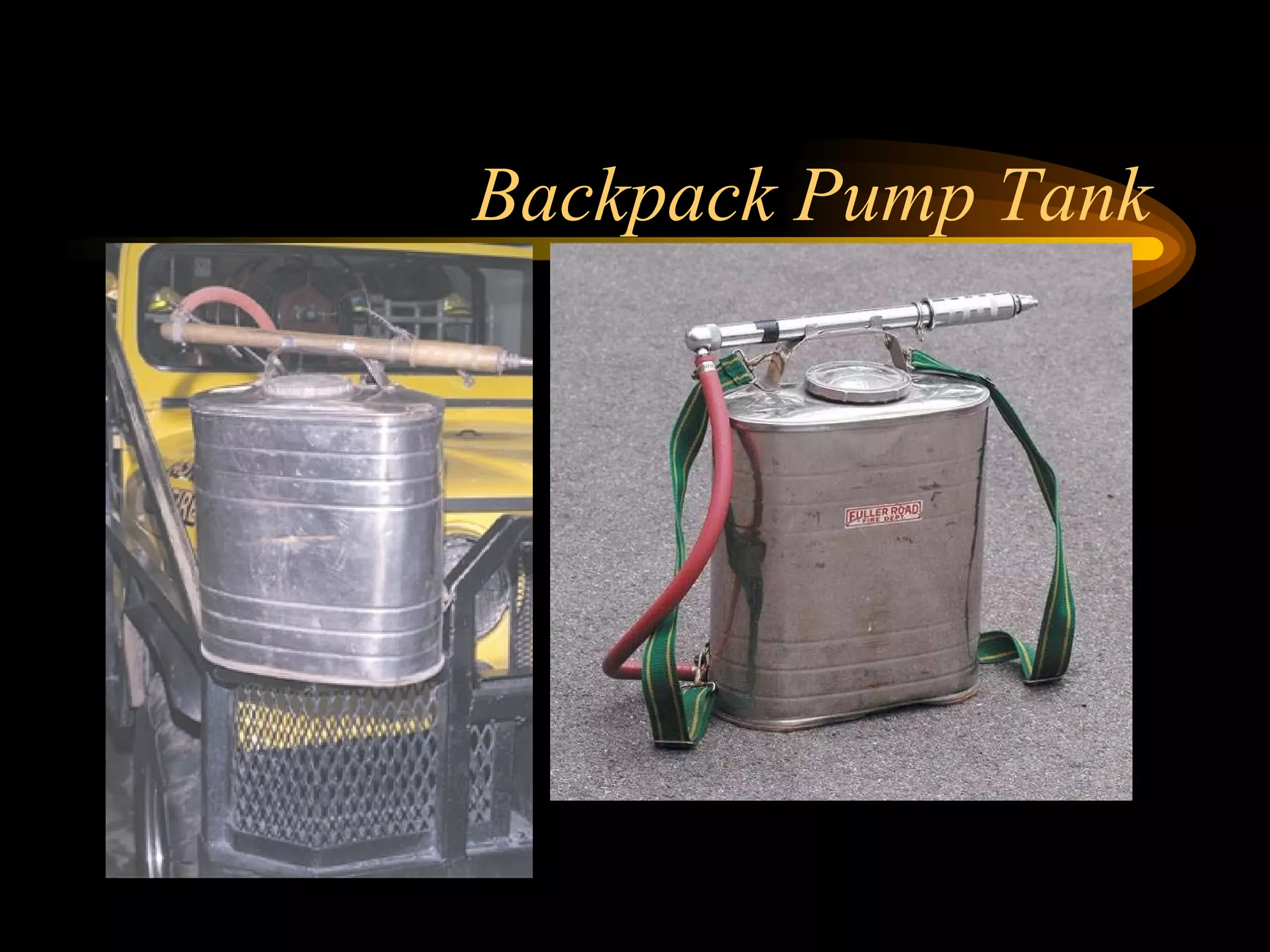
Backpack Pump Tank
PUMP-TANK WATER  STREAM REACH  – 30 to 40 ft. DISCHARGE TIME  – 45 sec. To 3 min.
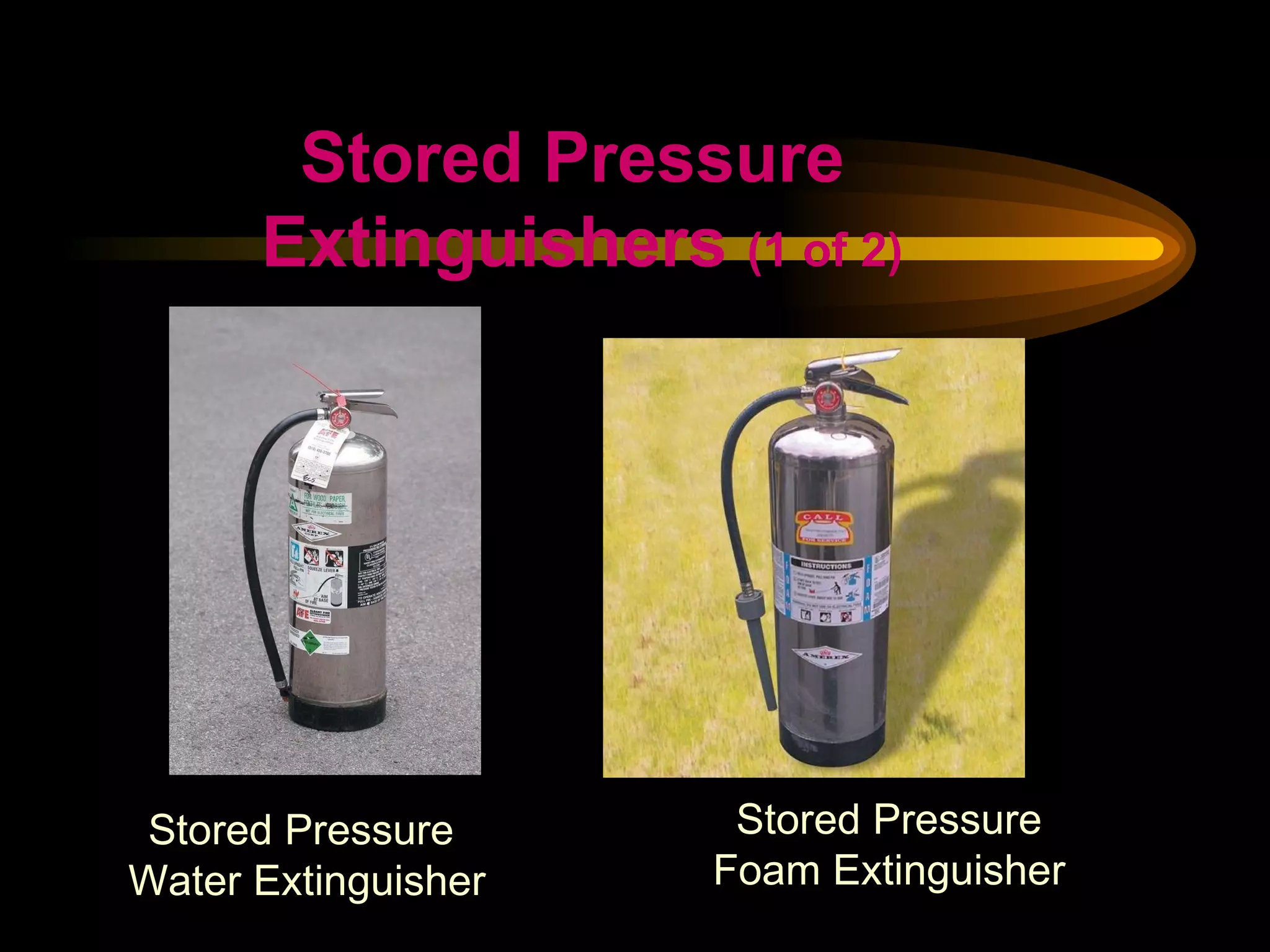
Stored Pressure  Water Extinguisher Stored Pressure Foam Extinguisher Stored Pressure  Extinguishers  (1 of 2)
STORED-PRESSURE WATER  STREAM REACH  - 30 to 40 ft. DISCHARGE TIME  - 45 sec. To 60 sec.
FOAM EXTINGUISHERS: STREAM REACH -  20 to 25 ft. DISCHARGE TIME -  Approx. 50 sec. AFFF - USED ON CLASS B FIRES NOT INVOLVING WATER SOLUABLE LIQUIDS (POLAR SOLVENTS) AIR ASPIRATING CREATING A BLANKET FFFP - USED ON CLASS B FIRES INVOLVING ALCOHOL RESISTANT LIQUIDS (SMOTHERS)
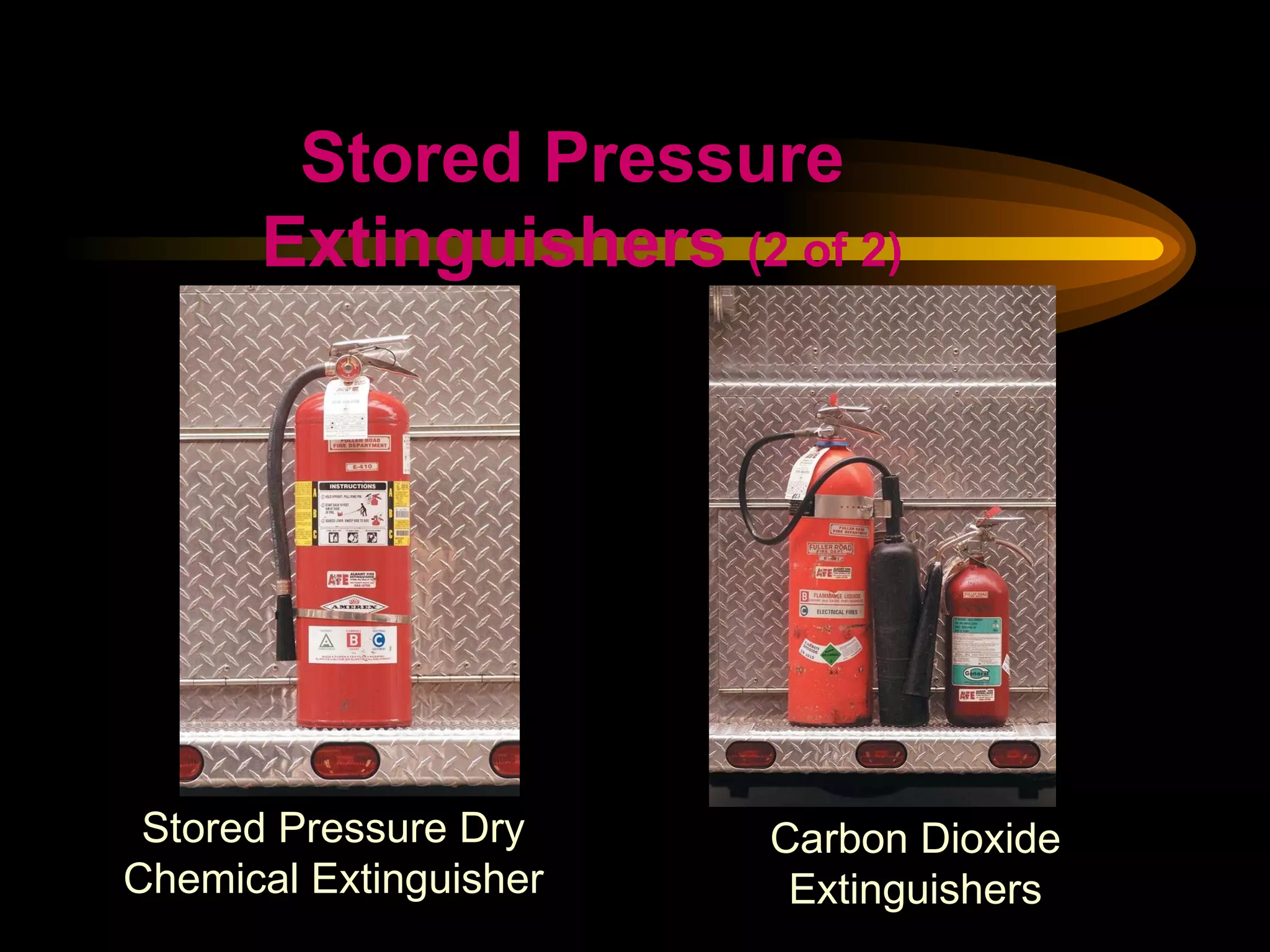
Stored Pressure Dry Chemical Extinguisher Carbon Dioxide Extinguishers Stored Pressure  Extinguishers  (2 of 2)
DRY CHEMICAL EXTINGUISHERS ABC  ( MULTI- PURPOSE)- MOST COMMON USED  (MONOAMMONIUM PHOSPHATE) BC  (REGULAR, OR SODIUM BICARBONATE) POTASIUM BICARBONATE AMMONIUM PHOSPHATE POTASIUM CHLORIDE PKP  (POTASSIUM BICARBONATE)  USED FOR MOST CLASSES OF FIRES
DRY CHEMICAL EXTINGUISHERS STREAM REACH: 5 TO 20 Ft. DISCHARGE TIME: 8 TO 25 Sec. !!!!!! NEVER MIX DRY CHEMICAL WITH OTHER TYPES OF AGENTS , MAY CAUSE A DANGEROUS RISE IN PRESSURE INSIDE EXTINGUISHER NON-TOXIC ONLY AN IRRITANT
HALON EXTINGUISHERS: 1211 - CLEAR LIQUID STREAM Stream Reach - 8 to 18 ft. Discharge Time - 8 to 18 sec. 1301 -FIXED SYSTEMS (FLOODING) Stream Reach - 4 to 6 ft Discharge Time - 8 to 10 sec. NEARLY INVISIBLE (WIND) HALOTRON (CLEAN-AGENT)- B&C  NON OZONE DEPLETER, ENVIRONMENTALLY SAFE
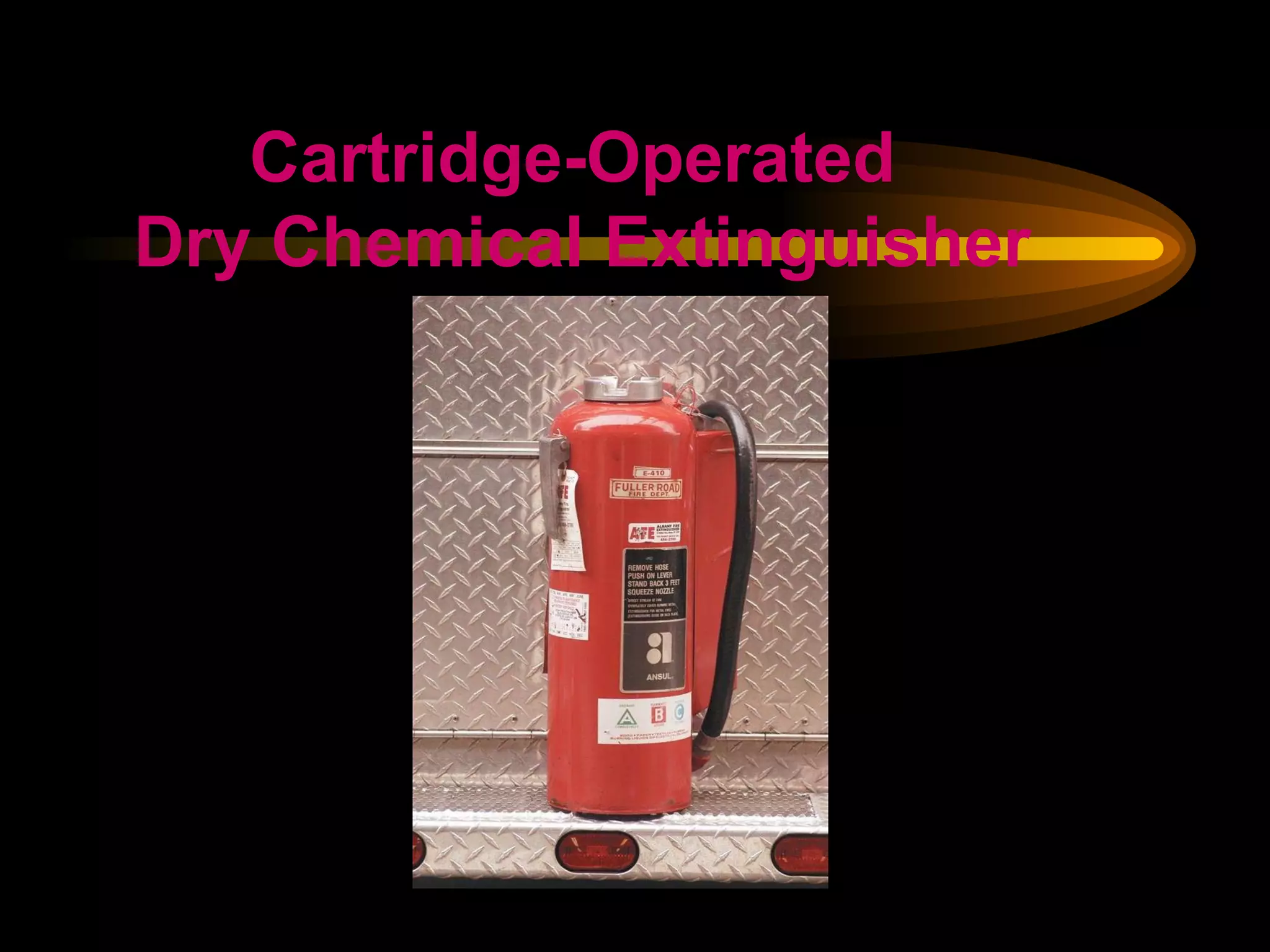
Cartridge-Operated  Dry Chemical Extinguisher
CARBON DIOXIDE EXTINGUISHERS STREAM REACH - 3 to 8 ft. DISCHARGE TIME - 8 to 30 sec. HORN- DISPERSION UNLIKE OTHERS ITS STORED UNDER ITS OWN PRESSURE
DRY POWDER EXTINGUISHERS: DRY POWDER ( LITH-X) - EXTINGUISH COMBUSTIBLE METALS NOT EVERY DRY POWDER EXTINGUISHER WILL WORK ON ANY COMBUSTIBLE METAL FIRE GRAY OR BLACK IN COLOR APPLY WITH SUFFICIENT DEPTH
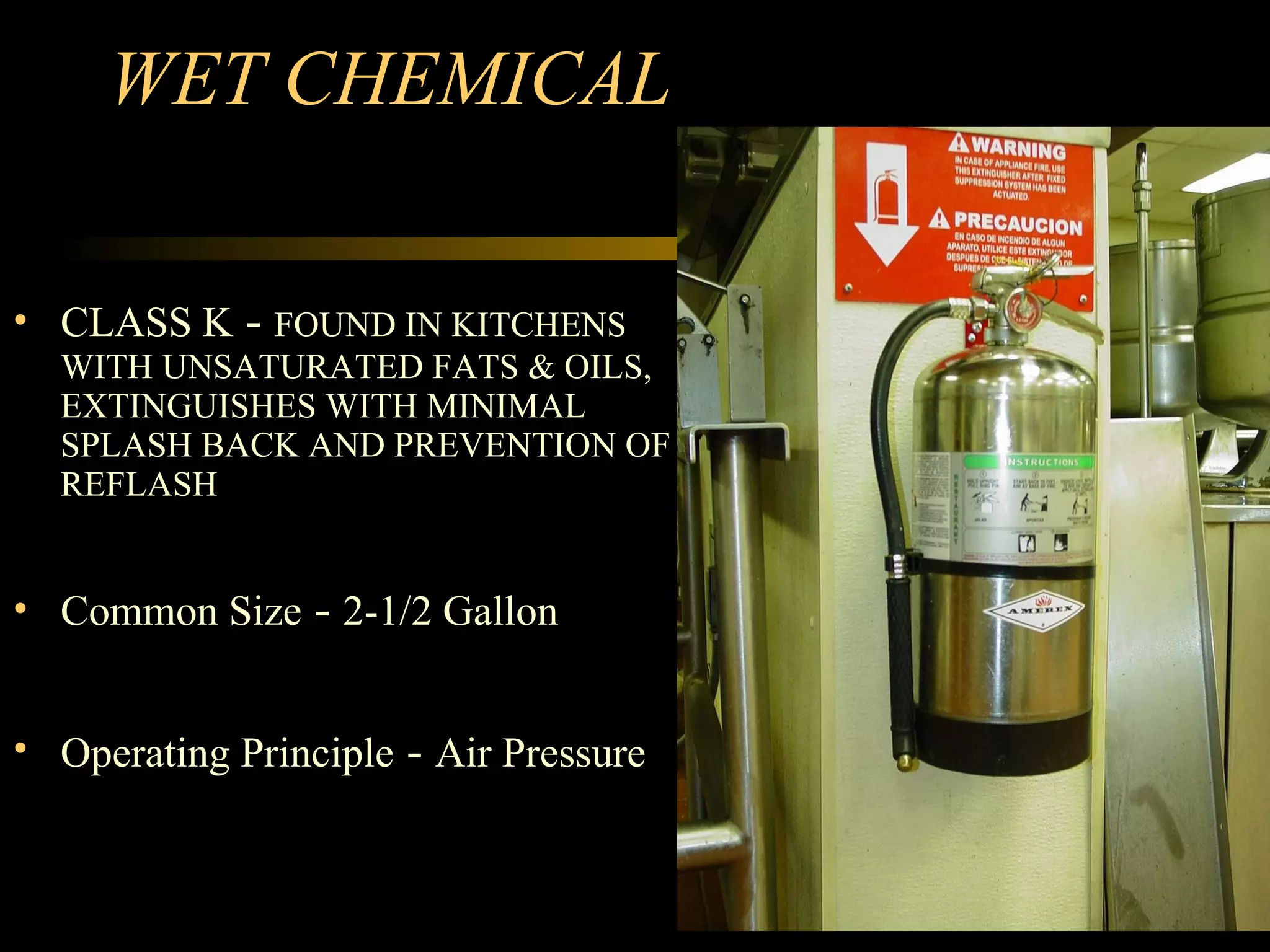
WET CHEMICAL CLASS K  -  FOUND IN KITCHENS WITH UNSATURATED FATS & OILS, EXTINGUISHES WITH MINIMAL SPLASH BACK AND PREVENTION OF REFLASH Common Size  -  2-1/2 Gallon Operating Principle  -  Air Pressure
WET CHEMICAL CLASS K -  STREAM REACH - 8 to 12 ft. DISCHARGE TIME - 75 to 80 sec.
 
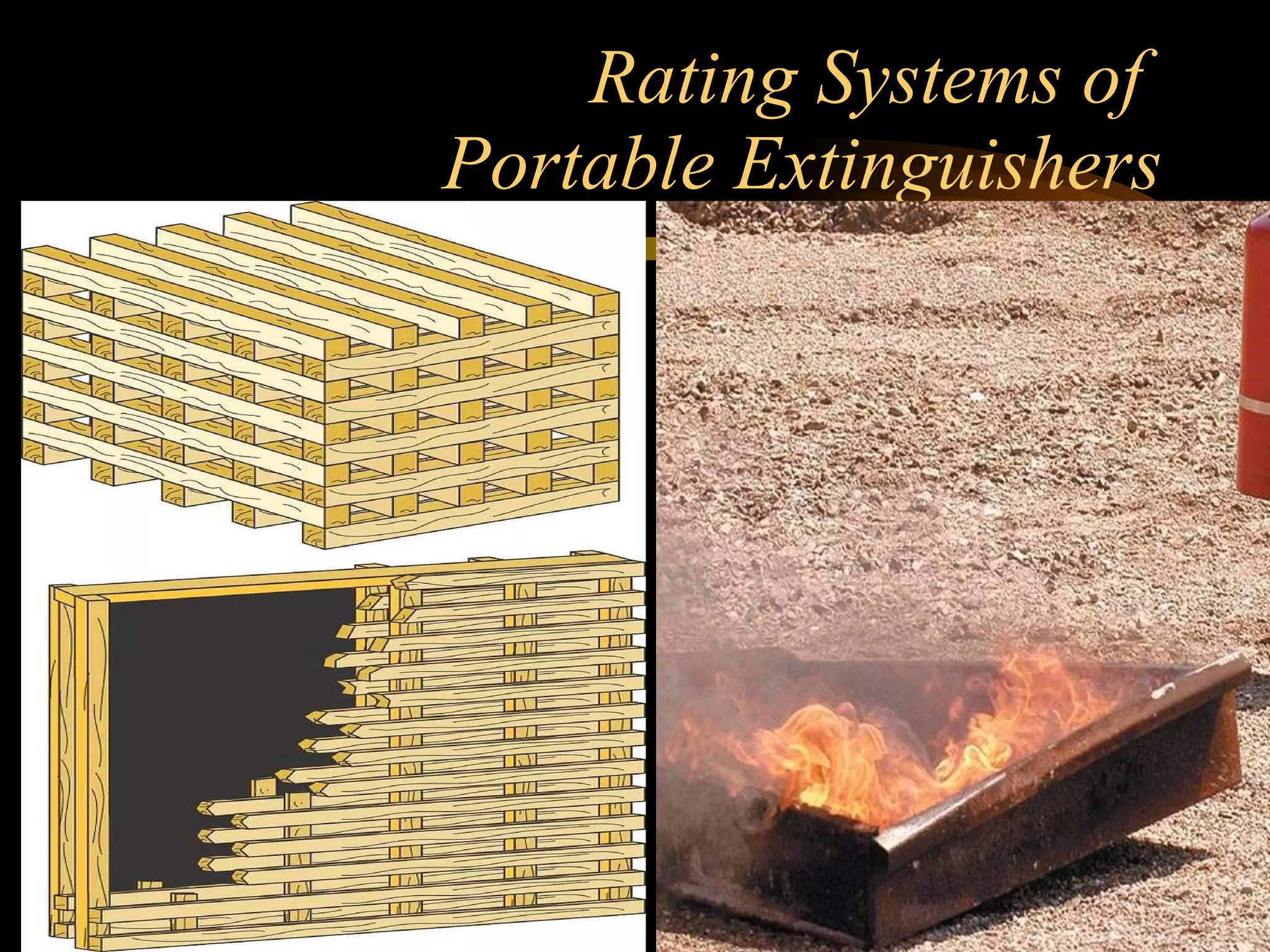
Rating Systems of  Portable Extinguishers Each class of fuel is subject to a separate type of rating test. Class A rating test uses wooden cribbing test. Class B rating test uses a pan of flammable liquid. Class C rating test only involves conductivity of the agent and the nozzle or hose and nozzle combination.
Rating Systems of  Portable Extinguishers
CLASS A RATINGS: CLASS A RATINGS RANGE FROM 1-ATO 40-A 1-A EQUALS 11/4 GAL.OF WATER  (BENCH MARK) 2-A HAS TWO TIMES THE EXTINGUISHING CAPABILITY OF A 1-A ACCORDING TO OCCUPANCY HAZARD,MAXIMUM FLOOR AREA PER UNIT, PER EXTINGUISHER, AND MAXIMUM TRAVEL DISTANCE TO EXTINGUISHER
CLASS B RATING: CLASS B RATINGS RANGE FROM 1-B TO 640-B THE 1-B RATING EQUALING 1 SQUARE FOOT THE TEST CONSIST OF THE APPROXIMATE SQUARE FOOT AREA OF A FLAMMABLE LIQUID FIRE THAT A NON-EXPERT OPERATOR CAN EXTINGUISH
CLASS C & D RATINGS: CLASS C FIRES ARE TYPICALLY CLASS A OR B FIRES INVOLVING ENERGIZED EQUIPMENT (AGENT  NON-CONDUCTIVE) THERE IS NO EXTINGUISHER WITH A CLASS A-C RATING CLASS D FIRES EXTINGUISHING CAPABILITY VARIES WITH THE FUEL METAL BEING BURNED CLASS D EXTINGUISHERS ARE NOT GIVEN A MULTI PURPOSE RATING
Limitations of Portable Extinguishers Extinguishers have limited capabilities. They are designed and rated for certain types and sizes of fire. The wrong extinguisher will create greater problems. You need to use the right extinguisher for the fire present.
Extinguisher Operation P ull the pin. A im the nozzle. S queeze the handle. S weep the nozzle. Click Here to View Video: PASS Procedure/Fire Extinguisher Maintenance
OPERATION OF EXTINGUISHER: SELECTING QUICK INSPECTION APPROACH APPLICATION
SELECTION: CHOOSE PROPER EXTINGUISHER ACCORDING TO SIZE OF FIRE, TYPE OF FIRE. CHOOSE AN EXTINGUISHER THAT WILL EFFECTIVELY DO THE JOB WITHOUT RISK TO LIFE AND PROPERTY
QUICK INSPECTION: EXTERNAL DAMAGE HOSE-HORN/NOZZLE ARE IN PLACE PROPER WEIGHT OF EXTINGUISHER PRESSURE GAUGE IN OPERATING RANGE
APPROACH: SAFETY IS PARAMOUNT !!!!!!!!!!!!!!!!!!! NEVER RUN WITH EXTINGUISHER APPROACH FROM WINWARD SIDE MAKE SURE AGENT REACHES FIRE WATCH FOR RADIANT HEAT
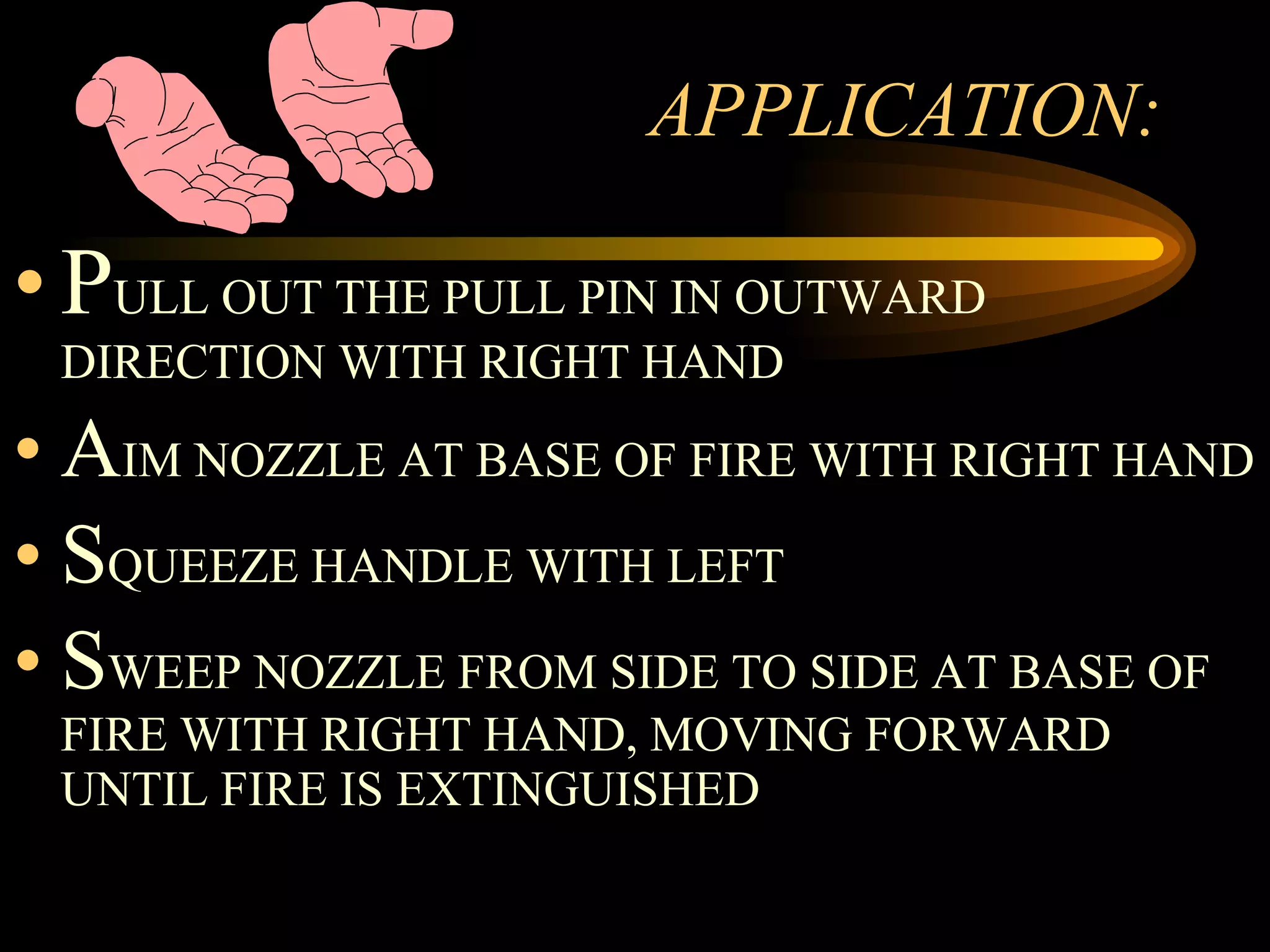
APPLICATION: P ULL OUT THE PULL PIN IN OUTWARD DIRECTION WITH RIGHT HAND A IM NOZZLE AT BASE OF FIRE WITH RIGHT HAND S QUEEZE HANDLE WITH LEFT S WEEP NOZZLE FROM SIDE TO SIDE AT BASE OF FIRE WITH RIGHT HAND, MOVING FORWARD  UNTIL FIRE IS EXTINGUISHED
Obsolete Extinguishers Firefighters should never operate obsolete extinguishers. Soda acid Chemical foam (except film-forming) Vaporizing liquids Cartridge-operated water or loaded stream Copper or brass extinguishers Click Here to View Video: Obsolete Fire Extinguishers
Care and Maintenance of Portable Extinguishers Carefully inspect before placing in service. Remove them from bracket periodically. Occasionally invert dry chemical extinguishers. Clean dirt and grit to maintain good working order.
Inspection Requirements  (1 of 2) First, perform visual inspection.  It should be checked every 30 days. Pin seal should be in place. Gauge should register proper pressure.
Inspection Requirements  (2 of 2) Some extinguishers, such as CO 2 , are only checked by weighing. Weight is stamped on the cylinder. Check for hydrostatic testing.
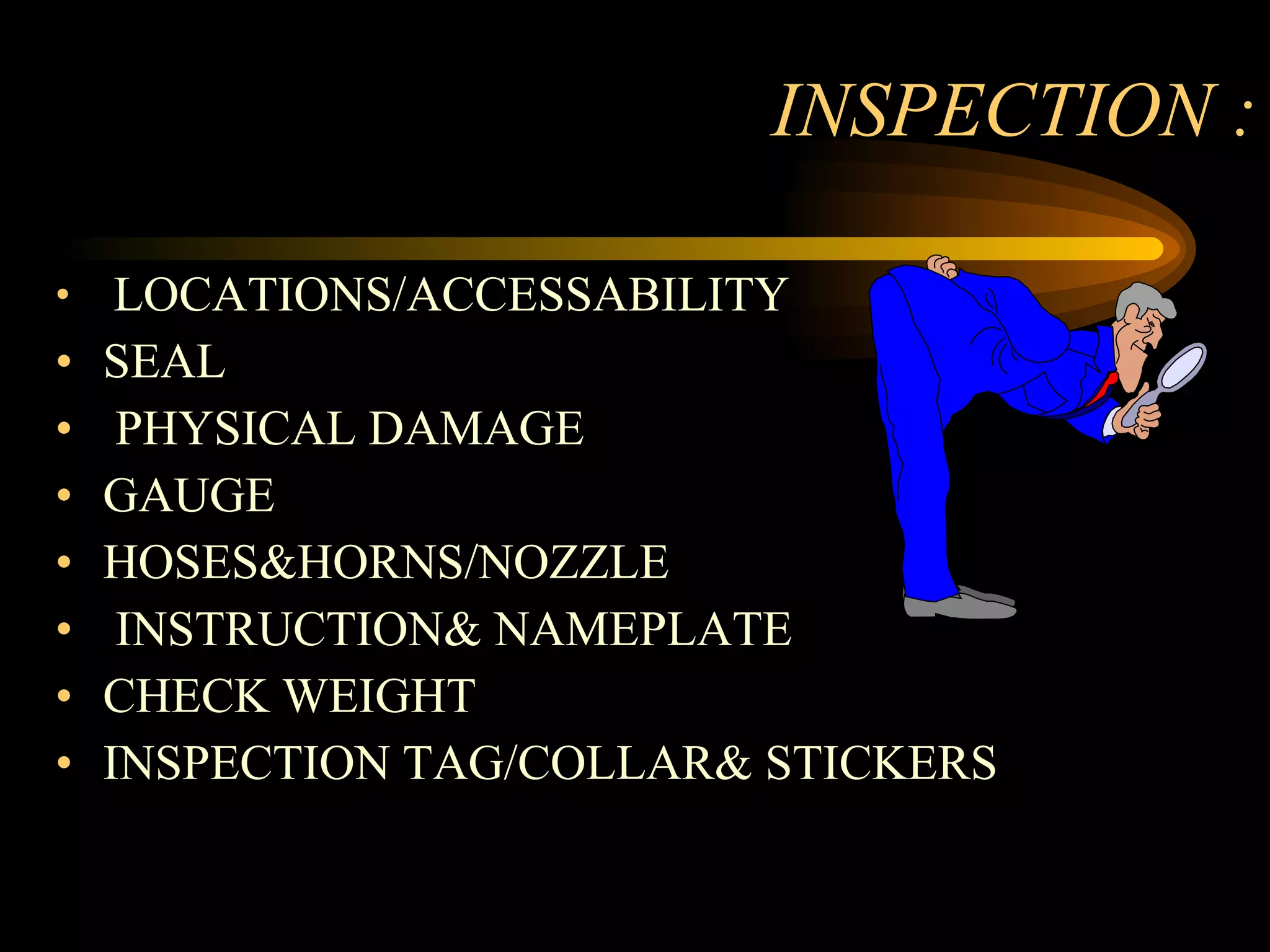
INSPECTION : LOCATIONS/ACCESSABILITY SEAL PHYSICAL DAMAGE GAUGE  HOSES&HORNS/NOZZLE INSTRUCTION& NAMEPLATE CHECK WEIGHT  INSPECTION TAG/COLLAR& STICKERS
LOCATION/ACCESSABILITY: IN DESIGNATED LOCATION IN BRACKET/CASE CLEAR OF OBSTRUCTIONS
SEAL/PIN: PIN IS IN SEAL IS NOT BROKEN PROPER TYPE OF SEAL AND PIN IS ON EXTINGUISHER
PHYSICAL DAMAGE: DENTS CRACKS CORROSION BROKEN OR BENT HANDLES CRACKED OR BROKEN HOSES/NOZZLES
GAUGE: IN OPERATION RANGE NO WATER IN IT BENT LEAKING BLOWOUT DISC NEEDLE NOT BROKE
HOSES&HORNS/NOZZLES FREE OF OBSTRUCTIONS CRACKED OR SPLIT MELTED FITTINGS ALL CO2 HOSES REQUIRE A CONDUCTIVITY TEST LABEL
INSTRUCTIONS/NAMEPLATE: THERE LEGIBLE RATING SYMBOL
WEIGHT: LIFTING SCALE GAUGE NAMEPLATE
INSPECTION TAG/COLLAR& STICKERS : DATE OF INSPECTION,MAINTENANCE,OR RECHARGING ANY EXTINGUISHER SERVICED AFTER JANUARY 1999, SHALL HAVE A SERVICE COLLAR ALL EXTINGUISHERS MADE OR SERVICED AFTER 1989 SHALLHAVE HMIS LABEL OR STICKER HYDROSTATIC STICKER 6YR STICKER
MAINTENANCE/SERVICING: RESPONSIBILITY ANNUAL SERVICE 6YR MAINTENANCE  HYDROSTATIC TEST
RESPONSIBLILITY: THE BUILDING OCCUPANT PROPERTY OWNER LICENSED COMPANIES CERTIFIED EXTINGUISHER TECHNICIANS
ANNUAL SERVICE: INSPECTED ANNUALLY EITHER BY BUILDING OWNER, FIRE INSPECTOR, LICENSED BUISNESS CHECK HOSE CHECK GAUGE CHECK SEAL CHECK LABELS WEIGHT
6 YEAR MAINTENANCE: COMPLETED EVERY 6 YEARS AFTER MANUFACTURED, OR HYDROSTACIALLY TESTED COMPLETE TEARDOWN CHECK VALVE STEM CHECK O-RING AGENT OVERALL EXTINGUISHER
HYDRO-STATIC TESTING: DRY CHEM/POWDER- 12 YEARS HALON- 12 YEARS CO2- 5 YEARS FOAM- 5 YEARS( AGENT EVERY 3)
HYDRO CONT: WATER- 5 YEARS COMPLETE TEARDOWN DEFORMATIES, DENTS, SCRATCHES ALL STORED PRESSURE EXTINGUISHERS THAT REQUIRE A 12 YEAR HYDRO ARE REQUIRED TO UNDERGO A 6 YEAR MAINTENANCE
IF ANY OF THE ITEMS LISTED ARE FOUND DEFICIENT IN EITHER INSPECTION OR  MAINTENANCE, THE EXTINGUISHER SHOULD BE REMOVED FROM SERVICE, AND REPAIRED IN ACCORDANCE WITH DEPARTMENT POLICIES
Summary There are various classes of fires. There are various kinds of extinguishers. The proper type of extinguisher is needed for various classes of fire. It is important to remember extinguishers have limitations. Extinguishers need to be maintained, serviced, and inspected regularly.

Chapter 8 fire extinquishers 4 07

  • 1.
  • 2.
    Objectives (1of 2) Explain the five classes of fire and the risks associated with each class. Identify the kinds of fire extinguishers used for each class. Explain the rating systems of portable extinguishers for Classes A,B, and C. Identify the limitations of portable extinguishers.
  • 3.
    Objectives (2of 2) Demonstrate the operation of portable fire extinguishers. Explain the care and maintenance of portable fire extinguishers. Discuss the inspection requirements of portable fire extinguishers.
  • 4.
    Introduction (1of 3) Click Here to View Video: Portable Fire Extinguishers
  • 5.
    Introduction (2of 3) Portable fire extinguishers are designed to fight small incipient fires. Firefighters must know how to use extinguishers and be able to teach others. Proper instruction can improve department effectiveness and reduce damage costs. Fire extinguishers come in a variety of types and sizes.
  • 6.
    Introduction (3of 3) Firefighters should know the extinguishers carried on apparatus. Firefighters should be capable of answering questions regarding fire extinguishers. Citizens will often request information and training on the use of extinguishers.
  • 7.
    FIRE EXTINGUISHERS: ONE OF THE MOST COMMON FIRE-PROTECTION APPLIANCES USED TODAY 1ST LINE OF DEFENSE AGAINST FIRES EXCELLENT TOOL FOR EXTINQUISHING INCIPIENT FIRES CAN OFTEN EXTINGUISH A SMALL FIRE IN LESS TIME THAN DEPLOYING A HOSE LINE
  • 8.
    GENERAL : Itis important that firefighters be knowledgeable about the different types of portable fire extinguishers and their use. We will discuss the various types of portable fire extinguishers that firefighters are likely to encounter. NFPA 10, Standard for Portable Fire Extinguishers provides information on rating, placement and use.
  • 9.
    GENERAL : Firefightersshould rely on extinguishers carried on their apparatus and not those found in occupancies. Two portable extinguishers are required on fire apparatus by NFPA standard 1901 One suitable for class B and C fires and one for class A Sizes are as follows: Co2 rated 10 BC, Dry Chemical rated 80 BC, & 2.5 Gal H2o for Class A
  • 10.
    Fire Classification andRisk The type and nature of the burning material (fuel) defines the fire. There are five classes of fire. Class A Class B Class C Class D Class K (As of 1998)
  • 11.
    Class K FiresClick Here to View Video: Class K Fires
  • 12.
    Types of FireExtinguishers (1 of 2) Many types of fire extinguishers are available today. Click Here to View Video: Fire Extinguisher Functions/Ratings
  • 13.
    Types of FireExtinguishers (2 of 2) Many factors need to be considered before using an extinguisher. Type and amount of fuel User and occupancy Building construction Environmental conditions Type of equipment being protected
  • 14.
    Types of Extinguishing Agents (1 of 2) Water is the basic agent for Class A fires. Water-based foam extinguishers for class B fires have either AFFF or FFFP. CO 2 is an inert gas stored under pressure. CO 2 is effective on Class B or C fires. Dry chemical agents are particles propelled by a gaseous medium. There are three categories of dry chemicals.
  • 15.
    Types of Extinguishing Agents (2 of 2) Wet chemicals are water-based solutions. Wet chemicals are used for Class K fires. Clean agents have replaced halons. Clean agents do not conduct electricity or leave a residue. There are two classes. Halocarbon agents and inerting gases
  • 16.
    Kinds of ExtinguishersPump-type extinguishers are hand-pumped devices. Pressurized extinguishers operate by expelling gas that propels the agent out. Cartridge-operated extinguishers are used for dry chemical and most dry powder Class D extinguishers.
  • 17.
  • 18.
    PUMP-TANK WATER STREAM REACH – 30 to 40 ft. DISCHARGE TIME – 45 sec. To 3 min.
  • 19.
    Stored Pressure Water Extinguisher Stored Pressure Foam Extinguisher Stored Pressure Extinguishers (1 of 2)
  • 20.
    STORED-PRESSURE WATER STREAM REACH - 30 to 40 ft. DISCHARGE TIME - 45 sec. To 60 sec.
  • 21.
    FOAM EXTINGUISHERS: STREAMREACH - 20 to 25 ft. DISCHARGE TIME - Approx. 50 sec. AFFF - USED ON CLASS B FIRES NOT INVOLVING WATER SOLUABLE LIQUIDS (POLAR SOLVENTS) AIR ASPIRATING CREATING A BLANKET FFFP - USED ON CLASS B FIRES INVOLVING ALCOHOL RESISTANT LIQUIDS (SMOTHERS)
  • 22.
    Stored Pressure DryChemical Extinguisher Carbon Dioxide Extinguishers Stored Pressure Extinguishers (2 of 2)
  • 23.
    DRY CHEMICAL EXTINGUISHERSABC ( MULTI- PURPOSE)- MOST COMMON USED (MONOAMMONIUM PHOSPHATE) BC (REGULAR, OR SODIUM BICARBONATE) POTASIUM BICARBONATE AMMONIUM PHOSPHATE POTASIUM CHLORIDE PKP (POTASSIUM BICARBONATE) USED FOR MOST CLASSES OF FIRES
  • 24.
    DRY CHEMICAL EXTINGUISHERSSTREAM REACH: 5 TO 20 Ft. DISCHARGE TIME: 8 TO 25 Sec. !!!!!! NEVER MIX DRY CHEMICAL WITH OTHER TYPES OF AGENTS , MAY CAUSE A DANGEROUS RISE IN PRESSURE INSIDE EXTINGUISHER NON-TOXIC ONLY AN IRRITANT
  • 25.
    HALON EXTINGUISHERS: 1211- CLEAR LIQUID STREAM Stream Reach - 8 to 18 ft. Discharge Time - 8 to 18 sec. 1301 -FIXED SYSTEMS (FLOODING) Stream Reach - 4 to 6 ft Discharge Time - 8 to 10 sec. NEARLY INVISIBLE (WIND) HALOTRON (CLEAN-AGENT)- B&C NON OZONE DEPLETER, ENVIRONMENTALLY SAFE
  • 26.
    Cartridge-Operated DryChemical Extinguisher
  • 27.
    CARBON DIOXIDE EXTINGUISHERSSTREAM REACH - 3 to 8 ft. DISCHARGE TIME - 8 to 30 sec. HORN- DISPERSION UNLIKE OTHERS ITS STORED UNDER ITS OWN PRESSURE
  • 28.
    DRY POWDER EXTINGUISHERS:DRY POWDER ( LITH-X) - EXTINGUISH COMBUSTIBLE METALS NOT EVERY DRY POWDER EXTINGUISHER WILL WORK ON ANY COMBUSTIBLE METAL FIRE GRAY OR BLACK IN COLOR APPLY WITH SUFFICIENT DEPTH
  • 29.
    WET CHEMICAL CLASSK - FOUND IN KITCHENS WITH UNSATURATED FATS & OILS, EXTINGUISHES WITH MINIMAL SPLASH BACK AND PREVENTION OF REFLASH Common Size - 2-1/2 Gallon Operating Principle - Air Pressure
  • 30.
    WET CHEMICAL CLASSK - STREAM REACH - 8 to 12 ft. DISCHARGE TIME - 75 to 80 sec.
  • 31.
  • 32.
    Rating Systems of Portable Extinguishers Each class of fuel is subject to a separate type of rating test. Class A rating test uses wooden cribbing test. Class B rating test uses a pan of flammable liquid. Class C rating test only involves conductivity of the agent and the nozzle or hose and nozzle combination.
  • 33.
    Rating Systems of Portable Extinguishers
  • 34.
    CLASS A RATINGS:CLASS A RATINGS RANGE FROM 1-ATO 40-A 1-A EQUALS 11/4 GAL.OF WATER (BENCH MARK) 2-A HAS TWO TIMES THE EXTINGUISHING CAPABILITY OF A 1-A ACCORDING TO OCCUPANCY HAZARD,MAXIMUM FLOOR AREA PER UNIT, PER EXTINGUISHER, AND MAXIMUM TRAVEL DISTANCE TO EXTINGUISHER
  • 35.
    CLASS B RATING:CLASS B RATINGS RANGE FROM 1-B TO 640-B THE 1-B RATING EQUALING 1 SQUARE FOOT THE TEST CONSIST OF THE APPROXIMATE SQUARE FOOT AREA OF A FLAMMABLE LIQUID FIRE THAT A NON-EXPERT OPERATOR CAN EXTINGUISH
  • 36.
    CLASS C &D RATINGS: CLASS C FIRES ARE TYPICALLY CLASS A OR B FIRES INVOLVING ENERGIZED EQUIPMENT (AGENT NON-CONDUCTIVE) THERE IS NO EXTINGUISHER WITH A CLASS A-C RATING CLASS D FIRES EXTINGUISHING CAPABILITY VARIES WITH THE FUEL METAL BEING BURNED CLASS D EXTINGUISHERS ARE NOT GIVEN A MULTI PURPOSE RATING
  • 37.
    Limitations of PortableExtinguishers Extinguishers have limited capabilities. They are designed and rated for certain types and sizes of fire. The wrong extinguisher will create greater problems. You need to use the right extinguisher for the fire present.
  • 38.
    Extinguisher Operation Pull the pin. A im the nozzle. S queeze the handle. S weep the nozzle. Click Here to View Video: PASS Procedure/Fire Extinguisher Maintenance
  • 39.
    OPERATION OF EXTINGUISHER:SELECTING QUICK INSPECTION APPROACH APPLICATION
  • 40.
    SELECTION: CHOOSE PROPEREXTINGUISHER ACCORDING TO SIZE OF FIRE, TYPE OF FIRE. CHOOSE AN EXTINGUISHER THAT WILL EFFECTIVELY DO THE JOB WITHOUT RISK TO LIFE AND PROPERTY
  • 41.
    QUICK INSPECTION: EXTERNALDAMAGE HOSE-HORN/NOZZLE ARE IN PLACE PROPER WEIGHT OF EXTINGUISHER PRESSURE GAUGE IN OPERATING RANGE
  • 42.
    APPROACH: SAFETY ISPARAMOUNT !!!!!!!!!!!!!!!!!!! NEVER RUN WITH EXTINGUISHER APPROACH FROM WINWARD SIDE MAKE SURE AGENT REACHES FIRE WATCH FOR RADIANT HEAT
  • 43.
    APPLICATION: P ULLOUT THE PULL PIN IN OUTWARD DIRECTION WITH RIGHT HAND A IM NOZZLE AT BASE OF FIRE WITH RIGHT HAND S QUEEZE HANDLE WITH LEFT S WEEP NOZZLE FROM SIDE TO SIDE AT BASE OF FIRE WITH RIGHT HAND, MOVING FORWARD UNTIL FIRE IS EXTINGUISHED
  • 44.
    Obsolete Extinguishers Firefightersshould never operate obsolete extinguishers. Soda acid Chemical foam (except film-forming) Vaporizing liquids Cartridge-operated water or loaded stream Copper or brass extinguishers Click Here to View Video: Obsolete Fire Extinguishers
  • 45.
    Care and Maintenanceof Portable Extinguishers Carefully inspect before placing in service. Remove them from bracket periodically. Occasionally invert dry chemical extinguishers. Clean dirt and grit to maintain good working order.
  • 46.
    Inspection Requirements (1 of 2) First, perform visual inspection. It should be checked every 30 days. Pin seal should be in place. Gauge should register proper pressure.
  • 47.
    Inspection Requirements (2 of 2) Some extinguishers, such as CO 2 , are only checked by weighing. Weight is stamped on the cylinder. Check for hydrostatic testing.
  • 48.
    INSPECTION : LOCATIONS/ACCESSABILITYSEAL PHYSICAL DAMAGE GAUGE HOSES&HORNS/NOZZLE INSTRUCTION& NAMEPLATE CHECK WEIGHT INSPECTION TAG/COLLAR& STICKERS
  • 49.
    LOCATION/ACCESSABILITY: IN DESIGNATEDLOCATION IN BRACKET/CASE CLEAR OF OBSTRUCTIONS
  • 50.
    SEAL/PIN: PIN ISIN SEAL IS NOT BROKEN PROPER TYPE OF SEAL AND PIN IS ON EXTINGUISHER
  • 51.
    PHYSICAL DAMAGE: DENTSCRACKS CORROSION BROKEN OR BENT HANDLES CRACKED OR BROKEN HOSES/NOZZLES
  • 52.
    GAUGE: IN OPERATIONRANGE NO WATER IN IT BENT LEAKING BLOWOUT DISC NEEDLE NOT BROKE
  • 53.
    HOSES&HORNS/NOZZLES FREE OFOBSTRUCTIONS CRACKED OR SPLIT MELTED FITTINGS ALL CO2 HOSES REQUIRE A CONDUCTIVITY TEST LABEL
  • 54.
  • 55.
    WEIGHT: LIFTING SCALEGAUGE NAMEPLATE
  • 56.
    INSPECTION TAG/COLLAR& STICKERS: DATE OF INSPECTION,MAINTENANCE,OR RECHARGING ANY EXTINGUISHER SERVICED AFTER JANUARY 1999, SHALL HAVE A SERVICE COLLAR ALL EXTINGUISHERS MADE OR SERVICED AFTER 1989 SHALLHAVE HMIS LABEL OR STICKER HYDROSTATIC STICKER 6YR STICKER
  • 57.
    MAINTENANCE/SERVICING: RESPONSIBILITY ANNUALSERVICE 6YR MAINTENANCE HYDROSTATIC TEST
  • 58.
    RESPONSIBLILITY: THE BUILDINGOCCUPANT PROPERTY OWNER LICENSED COMPANIES CERTIFIED EXTINGUISHER TECHNICIANS
  • 59.
    ANNUAL SERVICE: INSPECTEDANNUALLY EITHER BY BUILDING OWNER, FIRE INSPECTOR, LICENSED BUISNESS CHECK HOSE CHECK GAUGE CHECK SEAL CHECK LABELS WEIGHT
  • 60.
    6 YEAR MAINTENANCE:COMPLETED EVERY 6 YEARS AFTER MANUFACTURED, OR HYDROSTACIALLY TESTED COMPLETE TEARDOWN CHECK VALVE STEM CHECK O-RING AGENT OVERALL EXTINGUISHER
  • 61.
    HYDRO-STATIC TESTING: DRYCHEM/POWDER- 12 YEARS HALON- 12 YEARS CO2- 5 YEARS FOAM- 5 YEARS( AGENT EVERY 3)
  • 62.
    HYDRO CONT: WATER-5 YEARS COMPLETE TEARDOWN DEFORMATIES, DENTS, SCRATCHES ALL STORED PRESSURE EXTINGUISHERS THAT REQUIRE A 12 YEAR HYDRO ARE REQUIRED TO UNDERGO A 6 YEAR MAINTENANCE
  • 63.
    IF ANY OFTHE ITEMS LISTED ARE FOUND DEFICIENT IN EITHER INSPECTION OR MAINTENANCE, THE EXTINGUISHER SHOULD BE REMOVED FROM SERVICE, AND REPAIRED IN ACCORDANCE WITH DEPARTMENT POLICIES
  • 64.
    Summary There arevarious classes of fires. There are various kinds of extinguishers. The proper type of extinguisher is needed for various classes of fire. It is important to remember extinguishers have limitations. Extinguishers need to be maintained, serviced, and inspected regularly.