Fire Protection Systems
Third Edition
Chapter 11 — Portable Fire Extinguishers
Objectives
‣Discuss the fire extinguisher classification system.
‣List the different extinguishing agents and their applications.
‣Discuss the fire extinguisher rating system and identify to which
classifications of extinguishers it applies.
Objectives
‣Explain why a certain extinguisher classification requires a
conductivity test.
‣Describe the different types of fire extinguishers and how they
operate.
Objectives
‣Explain the acronym PASS in relation to fire extinguisher
operation.
‣Discuss the inspection, testing, and maintenance procedures for
portable fire extinguishers.
Introduction
‣Portable fire extinguishers are valuable suppression tools.
‣Used at incipient stage or when water is not an option
‣Have a fixed amount of suppression agent
‣Must be quickly accessible and correct type for class of fire
‣Are labeled for type of fire, require (minimal) training, and
are designed for easy use
Introduction
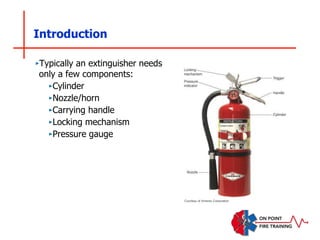
‣Typically an extinguisher needs
only a few components:
‣Cylinder
‣Nozzle/horn
‣Carrying handle
‣Locking mechanism
‣Pressure gauge
Courtesy of Amerex Corporation
Introduction
‣Knowledge of extinguishers and suppression agents enables
proper selection and operation of extinguishers.
Code Requirements for Fire Extinguishers
‣Code requirements for installation are included in all the model
codes.
‣Use and occupancy conditions
‣Managing specific hazards, industrial processes, equipment,
special events
‣IBC® and IFC® follow installation requirements of NFPA 10
but offer additional guidance and information.
Code Requirements for Fire Extinguishers
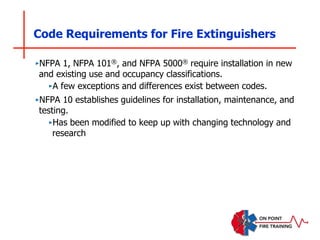
‣NFPA 1, NFPA 101®, and NFPA 5000® require installation in new
and existing use and occupancy classifications.
‣A few exceptions and differences exist between codes.
‣NFPA 10 establishes guidelines for installation, maintenance, and
testing.
‣Has been modified to keep up with changing technology and
research
Fire Extinguisher Classification
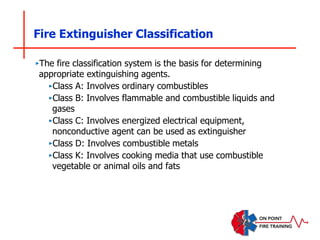
‣The fire classification system is the basis for determining
appropriate extinguishing agents.
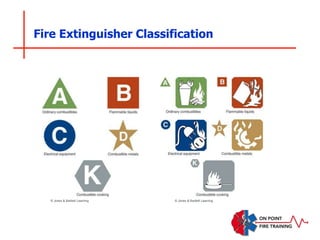
‣Class A: Involves ordinary combustibles
‣Class B: Involves flammable and combustible liquids and
gases
‣Class C: Involves energized electrical equipment,
nonconductive agent can be used as extinguisher
‣Class D: Involves combustible metals
‣Class K: Involves cooking media that use combustible
vegetable or animal oils and fats
Fire Extinguisher Classification
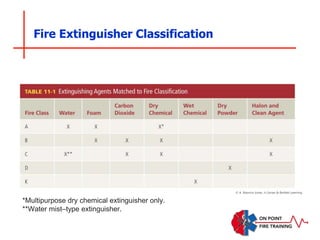
© A. Maurice Jones, Jr./Jones & Bartlett Learning
*Multipurpose dry chemical extinguisher only.
**Water mist–type extinguisher.
Fire Extinguisher Classification
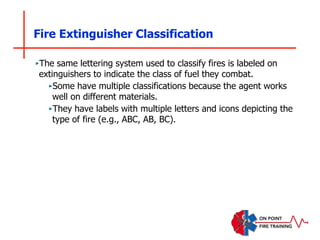
‣The same lettering system used to classify fires is labeled on
extinguishers to indicate the class of fuel they combat.
‣Some have multiple classifications because the agent works
well on different materials.
‣They have labels with multiple letters and icons depicting the
type of fire (e.g., ABC, AB, BC).
Fire Extinguisher Classification
© Jones & Bartlett Learning © Jones & Bartlett Learning
Fire Extinguisher Classification
‣Water
‣One of the best agents; can absorb most heat per pound
‣Most effective on Class A fires
‣Extinguishers using water should not be exposed to cold
conditions.
‣Water can freeze unless mixed with antifreeze.
Fire Extinguisher Classification
‣Foam
‣Good for Class A and B fires
‣Becomes a vapor barrier between fuel and atmosphere
‣Two types: AFFF and FFFP
‣Not as effective if flammable-liquid fires are under pressure,
or on cooking grease fires
‣Mixes with water so does not work well in freezing
temperatures
Fire Extinguisher Classification
‣Carbon dioxide
‣Good for Class B and C fires and has limited use on Class A
fires
‣Liquid state in tank; expands to gas upon release
‣No pressure gauges; agent quantity determined by weighing
tank
‣Works by depleting oxygen surrounding a fire
‣Must be discharged at close range
‣In confined space, protect against asphyxiation.
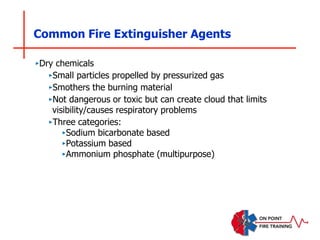
Common Fire Extinguisher Agents
‣Dry chemicals
‣Small particles propelled by pressurized gas
‣Smothers the burning material
‣Not dangerous or toxic but can create cloud that limits
visibility/causes respiratory problems
‣Three categories:
‣Sodium bicarbonate based
‣Potassium based
‣Ammonium phosphate (multipurpose)
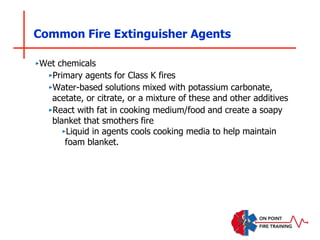
Common Fire Extinguisher Agents
‣Wet chemicals
‣Primary agents for Class K fires
‣Water-based solutions mixed with potassium carbonate,
acetate, or citrate, or a mixture of these and other additives
‣React with fat in cooking medium/food and create a soapy
blanket that smothers fire
‣Liquid in agents cools cooking media to help maintain
foam blanket.
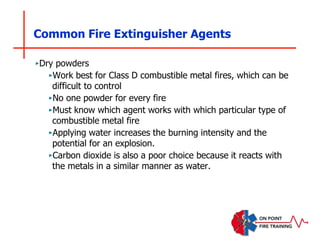
Common Fire Extinguisher Agents
‣Dry powders
‣Work best for Class D combustible metal fires, which can be
difficult to control
‣No one powder for every fire
‣Must know which agent works with which particular type of
combustible metal fire
‣Applying water increases the burning intensity and the
potential for an explosion.
‣Carbon dioxide is also a poor choice because it reacts with
the metals in a similar manner as water.
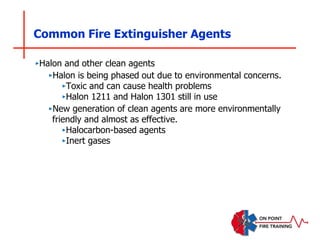
Common Fire Extinguisher Agents
‣Halon and other clean agents
‣Halon is being phased out due to environmental concerns.
‣Toxic and can cause health problems
‣Halon 1211 and Halon 1301 still in use
‣New generation of clean agents are more environmentally
friendly and almost as effective.
‣Halocarbon-based agents
‣Inert gases
Fire Extinguisher Ratings
‣The number represents how much fire the extinguisher should
be able to handle.
‣Class A and B groups have additional number rating to indicate
performance.
‣Class A: 1-A, 2-A, 3-A, 4-A, 6-A, 10-A, 20-A, 40-A
‣Each increment of 1 equals same capacity as 1.25 gallons
of water.
‣Class B: 1-B, 2-B, 5-B, 10-B, 20-B, 30-B, 60-B, 80-B, 12-B,
160-B, 240-B, 320-B, 480-B, 640-B
‣Tested by setting a flammable liquid fire in a pan and
measuring square footage
Fire Extinguisher Ratings
‣Class C extinguishers do not have a rating because there is no
fire test.
‣Conductivity tests can determine conductivity between agent,
horn/hose and nozzle, and electrically energized source.
‣Desired result is no conductivity to protect against arcing and
shock, and to prevent injury.
Types of Fire Extinguishers
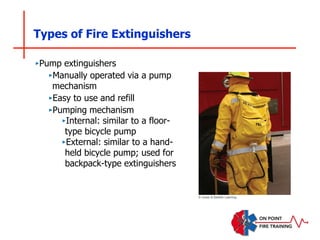
‣Pump extinguishers
‣Manually operated via a pump
mechanism
‣Easy to use and refill
‣Pumping mechanism
‣Internal: similar to a floor-
type bicycle pump
‣External: similar to a hand-
held bicycle pump; used for
backpack-type extinguishers
© Jones & Bartlett Learning
Types of Fire Extinguishers
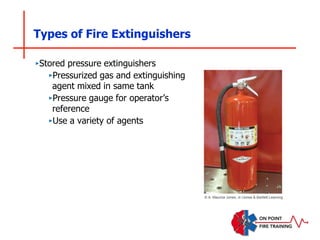
‣Stored pressure extinguishers
‣Pressurized gas and extinguishing
agent mixed in same tank
‣Pressure gauge for operator’s
reference
‣Use a variety of agents
© A. Maurice Jones, Jr./Jones & Bartlett Learning
Types of Fire Extinguishers
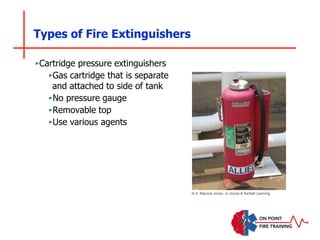
‣Cartridge pressure extinguishers
‣Gas cartridge that is separate
and attached to side of tank
‣No pressure gauge
‣Removable top
‣Use various agents
© A. Maurice Jones, Jr./Jones & Bartlett Learning
Types of Fire Extinguishers
‣Obsolete types of fire extinguishers
‣Many types are no longer approved for use.
‣Some are unsafe.
‣Some contain corrosive or conductive products.
‣A few examples include:
‣Soda acid
‣Carbon dioxide extinguishers with metal horns
‣Any that need to be inverted for operation
‣Stored pressure water extinguishers with fiberglass shells
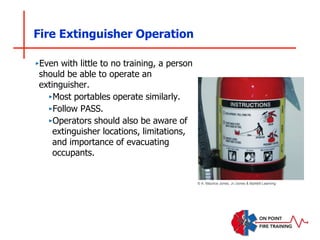
Fire Extinguisher Operation
‣Even with little to no training, a person
should be able to operate an
extinguisher.
‣Most portables operate similarly.
‣Follow PASS.
‣Operators should also be aware of
extinguisher locations, limitations,
and importance of evacuating
occupants.
© A. Maurice Jones, Jr./Jones & Bartlett Learning
Inspection, Testing, and Maintenance
‣These activities are keys to ensuring extinguishers work properly
when needed.
‣They are responsibility of property owner or representative.
‣Inspectors must be trained and certified.
‣There are many different activities, which can identify
impairments before they become problems.
Inspection, Testing, and Maintenance
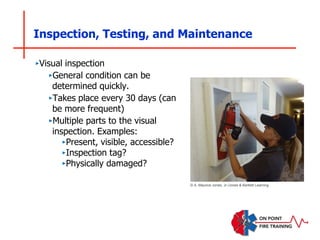
‣Visual inspection
‣General condition can be
determined quickly.
‣Takes place every 30 days (can
be more frequent)
‣Multiple parts to the visual
inspection. Examples:
‣Present, visible, accessible?
‣Inspection tag?
‣Physically damaged?
© A. Maurice Jones, Jr./Jones & Bartlett Learning
Inspection, Testing, and Maintenance
‣Visual inspection (cont’d)
‣Some functions are now performed through electronic
monitoring systems.
‣Also through fire alarm system or monitoring panel
‣Changes in normal parameters alert monitoring center so
that investigation can begin immediately.
‣NFPA 1 and IFC® recognize electronic monitoring as
viable technology.
Inspection, Testing, and Maintenance
‣Maintenance
‣Follows manufacturer’s requirements and is more thorough
than visual inspection
‣Usually occurs annually (may be more frequent)
‣Internal examinations are required at various intervals (every
1, 3, 5, or 6 years).
‣Inspectors must determine if problems can be fixed.
‣Some tasks are dangerous; prepare personnel.
Inspection, Testing, and Maintenance
‣Testing
‣Hydrostatic testing ensures extinguishers will not fail due to
unnoticed conditions (e.g., corrosion).
‣Involves disassembling extinguisher, filling component
with water, immersing it in water, and pressurizing it
‣Tests occur every 5 or 12 years based on extinguisher type.

1540 Ch 11 PowerPoint.pptx

  • 1.
    Fire Protection Systems ThirdEdition Chapter 11 — Portable Fire Extinguishers
  • 2.
    Objectives ‣Discuss the fireextinguisher classification system. ‣List the different extinguishing agents and their applications. ‣Discuss the fire extinguisher rating system and identify to which classifications of extinguishers it applies.
  • 3.
    Objectives ‣Explain why acertain extinguisher classification requires a conductivity test. ‣Describe the different types of fire extinguishers and how they operate.
  • 4.
    Objectives ‣Explain the acronymPASS in relation to fire extinguisher operation. ‣Discuss the inspection, testing, and maintenance procedures for portable fire extinguishers.
  • 5.
    Introduction ‣Portable fire extinguishersare valuable suppression tools. ‣Used at incipient stage or when water is not an option ‣Have a fixed amount of suppression agent ‣Must be quickly accessible and correct type for class of fire ‣Are labeled for type of fire, require (minimal) training, and are designed for easy use
  • 6.
    Introduction ‣Typically an extinguisherneeds only a few components: ‣Cylinder ‣Nozzle/horn ‣Carrying handle ‣Locking mechanism ‣Pressure gauge Courtesy of Amerex Corporation
  • 7.
    Introduction ‣Knowledge of extinguishersand suppression agents enables proper selection and operation of extinguishers.
  • 8.
    Code Requirements forFire Extinguishers ‣Code requirements for installation are included in all the model codes. ‣Use and occupancy conditions ‣Managing specific hazards, industrial processes, equipment, special events ‣IBC® and IFC® follow installation requirements of NFPA 10 but offer additional guidance and information.
  • 9.
    Code Requirements forFire Extinguishers ‣NFPA 1, NFPA 101®, and NFPA 5000® require installation in new and existing use and occupancy classifications. ‣A few exceptions and differences exist between codes. ‣NFPA 10 establishes guidelines for installation, maintenance, and testing. ‣Has been modified to keep up with changing technology and research
  • 10.
    Fire Extinguisher Classification ‣Thefire classification system is the basis for determining appropriate extinguishing agents. ‣Class A: Involves ordinary combustibles ‣Class B: Involves flammable and combustible liquids and gases ‣Class C: Involves energized electrical equipment, nonconductive agent can be used as extinguisher ‣Class D: Involves combustible metals ‣Class K: Involves cooking media that use combustible vegetable or animal oils and fats
  • 11.
    Fire Extinguisher Classification ©A. Maurice Jones, Jr./Jones & Bartlett Learning *Multipurpose dry chemical extinguisher only. **Water mist–type extinguisher.
  • 12.
    Fire Extinguisher Classification ‣Thesame lettering system used to classify fires is labeled on extinguishers to indicate the class of fuel they combat. ‣Some have multiple classifications because the agent works well on different materials. ‣They have labels with multiple letters and icons depicting the type of fire (e.g., ABC, AB, BC).
  • 13.
    Fire Extinguisher Classification ©Jones & Bartlett Learning © Jones & Bartlett Learning
  • 14.
    Fire Extinguisher Classification ‣Water ‣Oneof the best agents; can absorb most heat per pound ‣Most effective on Class A fires ‣Extinguishers using water should not be exposed to cold conditions. ‣Water can freeze unless mixed with antifreeze.
  • 15.
    Fire Extinguisher Classification ‣Foam ‣Goodfor Class A and B fires ‣Becomes a vapor barrier between fuel and atmosphere ‣Two types: AFFF and FFFP ‣Not as effective if flammable-liquid fires are under pressure, or on cooking grease fires ‣Mixes with water so does not work well in freezing temperatures
  • 16.
    Fire Extinguisher Classification ‣Carbondioxide ‣Good for Class B and C fires and has limited use on Class A fires ‣Liquid state in tank; expands to gas upon release ‣No pressure gauges; agent quantity determined by weighing tank ‣Works by depleting oxygen surrounding a fire ‣Must be discharged at close range ‣In confined space, protect against asphyxiation.
  • 17.
    Common Fire ExtinguisherAgents ‣Dry chemicals ‣Small particles propelled by pressurized gas ‣Smothers the burning material ‣Not dangerous or toxic but can create cloud that limits visibility/causes respiratory problems ‣Three categories: ‣Sodium bicarbonate based ‣Potassium based ‣Ammonium phosphate (multipurpose)
  • 18.
    Common Fire ExtinguisherAgents ‣Wet chemicals ‣Primary agents for Class K fires ‣Water-based solutions mixed with potassium carbonate, acetate, or citrate, or a mixture of these and other additives ‣React with fat in cooking medium/food and create a soapy blanket that smothers fire ‣Liquid in agents cools cooking media to help maintain foam blanket.
  • 19.
    Common Fire ExtinguisherAgents ‣Dry powders ‣Work best for Class D combustible metal fires, which can be difficult to control ‣No one powder for every fire ‣Must know which agent works with which particular type of combustible metal fire ‣Applying water increases the burning intensity and the potential for an explosion. ‣Carbon dioxide is also a poor choice because it reacts with the metals in a similar manner as water.
  • 20.
    Common Fire ExtinguisherAgents ‣Halon and other clean agents ‣Halon is being phased out due to environmental concerns. ‣Toxic and can cause health problems ‣Halon 1211 and Halon 1301 still in use ‣New generation of clean agents are more environmentally friendly and almost as effective. ‣Halocarbon-based agents ‣Inert gases
  • 21.
    Fire Extinguisher Ratings ‣Thenumber represents how much fire the extinguisher should be able to handle. ‣Class A and B groups have additional number rating to indicate performance. ‣Class A: 1-A, 2-A, 3-A, 4-A, 6-A, 10-A, 20-A, 40-A ‣Each increment of 1 equals same capacity as 1.25 gallons of water. ‣Class B: 1-B, 2-B, 5-B, 10-B, 20-B, 30-B, 60-B, 80-B, 12-B, 160-B, 240-B, 320-B, 480-B, 640-B ‣Tested by setting a flammable liquid fire in a pan and measuring square footage
  • 22.
    Fire Extinguisher Ratings ‣ClassC extinguishers do not have a rating because there is no fire test. ‣Conductivity tests can determine conductivity between agent, horn/hose and nozzle, and electrically energized source. ‣Desired result is no conductivity to protect against arcing and shock, and to prevent injury.
  • 23.
    Types of FireExtinguishers ‣Pump extinguishers ‣Manually operated via a pump mechanism ‣Easy to use and refill ‣Pumping mechanism ‣Internal: similar to a floor- type bicycle pump ‣External: similar to a hand- held bicycle pump; used for backpack-type extinguishers © Jones & Bartlett Learning
  • 24.
    Types of FireExtinguishers ‣Stored pressure extinguishers ‣Pressurized gas and extinguishing agent mixed in same tank ‣Pressure gauge for operator’s reference ‣Use a variety of agents © A. Maurice Jones, Jr./Jones & Bartlett Learning
  • 25.
    Types of FireExtinguishers ‣Cartridge pressure extinguishers ‣Gas cartridge that is separate and attached to side of tank ‣No pressure gauge ‣Removable top ‣Use various agents © A. Maurice Jones, Jr./Jones & Bartlett Learning
  • 26.
    Types of FireExtinguishers ‣Obsolete types of fire extinguishers ‣Many types are no longer approved for use. ‣Some are unsafe. ‣Some contain corrosive or conductive products. ‣A few examples include: ‣Soda acid ‣Carbon dioxide extinguishers with metal horns ‣Any that need to be inverted for operation ‣Stored pressure water extinguishers with fiberglass shells
  • 27.
    Fire Extinguisher Operation ‣Evenwith little to no training, a person should be able to operate an extinguisher. ‣Most portables operate similarly. ‣Follow PASS. ‣Operators should also be aware of extinguisher locations, limitations, and importance of evacuating occupants. © A. Maurice Jones, Jr./Jones & Bartlett Learning
  • 28.
    Inspection, Testing, andMaintenance ‣These activities are keys to ensuring extinguishers work properly when needed. ‣They are responsibility of property owner or representative. ‣Inspectors must be trained and certified. ‣There are many different activities, which can identify impairments before they become problems.
  • 29.
    Inspection, Testing, andMaintenance ‣Visual inspection ‣General condition can be determined quickly. ‣Takes place every 30 days (can be more frequent) ‣Multiple parts to the visual inspection. Examples: ‣Present, visible, accessible? ‣Inspection tag? ‣Physically damaged? © A. Maurice Jones, Jr./Jones & Bartlett Learning
  • 30.
    Inspection, Testing, andMaintenance ‣Visual inspection (cont’d) ‣Some functions are now performed through electronic monitoring systems. ‣Also through fire alarm system or monitoring panel ‣Changes in normal parameters alert monitoring center so that investigation can begin immediately. ‣NFPA 1 and IFC® recognize electronic monitoring as viable technology.
  • 31.
    Inspection, Testing, andMaintenance ‣Maintenance ‣Follows manufacturer’s requirements and is more thorough than visual inspection ‣Usually occurs annually (may be more frequent) ‣Internal examinations are required at various intervals (every 1, 3, 5, or 6 years). ‣Inspectors must determine if problems can be fixed. ‣Some tasks are dangerous; prepare personnel.
  • 32.
    Inspection, Testing, andMaintenance ‣Testing ‣Hydrostatic testing ensures extinguishers will not fail due to unnoticed conditions (e.g., corrosion). ‣Involves disassembling extinguisher, filling component with water, immersing it in water, and pressurizing it ‣Tests occur every 5 or 12 years based on extinguisher type.