10
Chapter
Understanding
Groups and
Managing
Work Teams
Copyright ©2011 Pearson Education, Inc.
Publishing as Prentice Hall.
9-2
Learning Outcomes
• Define a group and describe the stages of
group development
• Describe the major concepts of group
behavior
• Discuss how groups are turned into effective
teams
• Discuss contemporary issues in managing
teams
Copyright ©2011 Pearson Education, Inc.
Publishing as Prentice Hall.
9-3
What Is a Group?
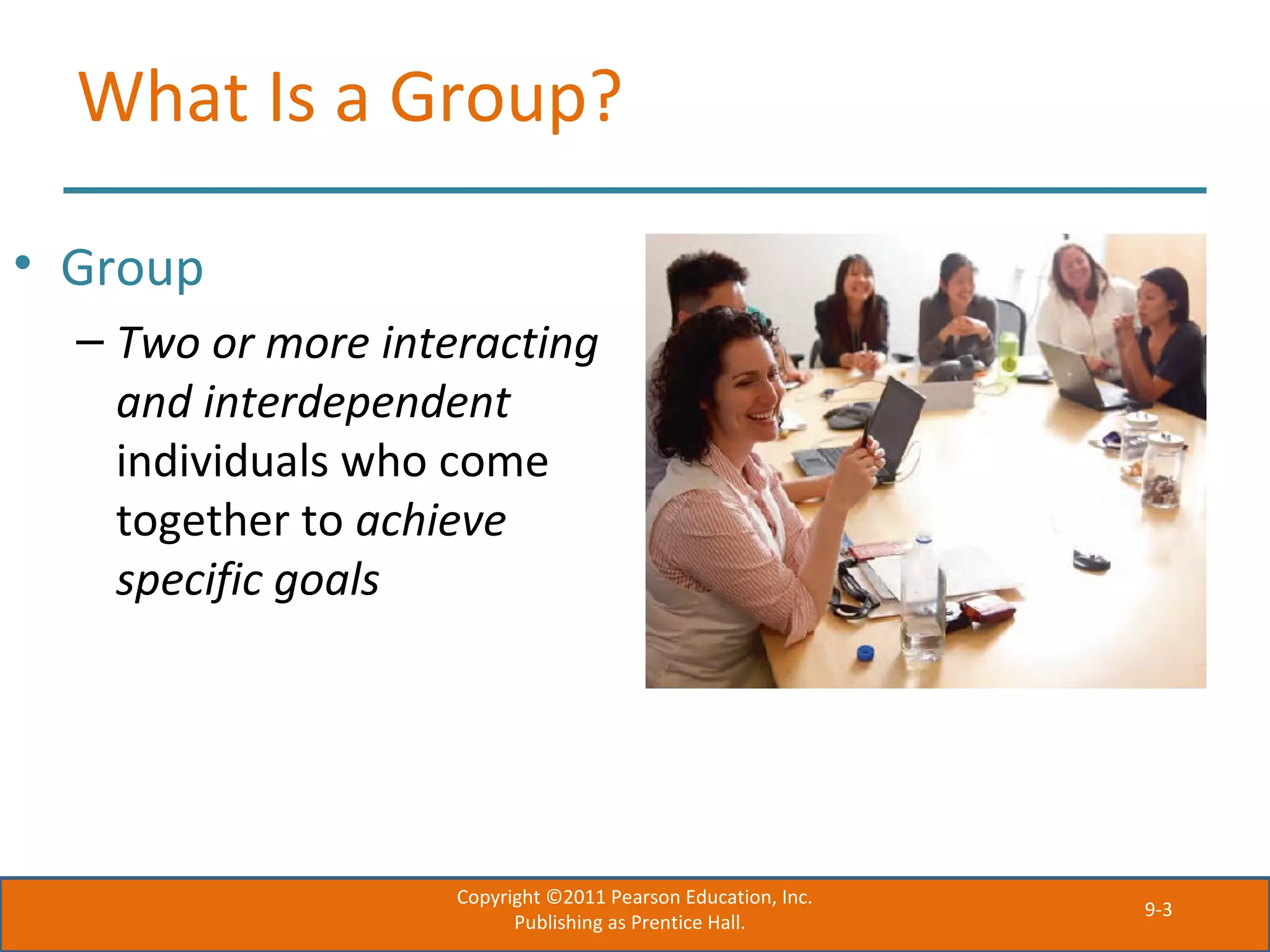
• Group
– Two or more interacting
and interdependent
individuals who come
together to achieve
specific goals
Copyright ©2011 Pearson Education, Inc.
Publishing as Prentice Hall.
9-4
Copyright ©2011 Pearson Education, Inc.
Publishing as Prentice Hall.
9-5
What Are the Stages of Group
Development?
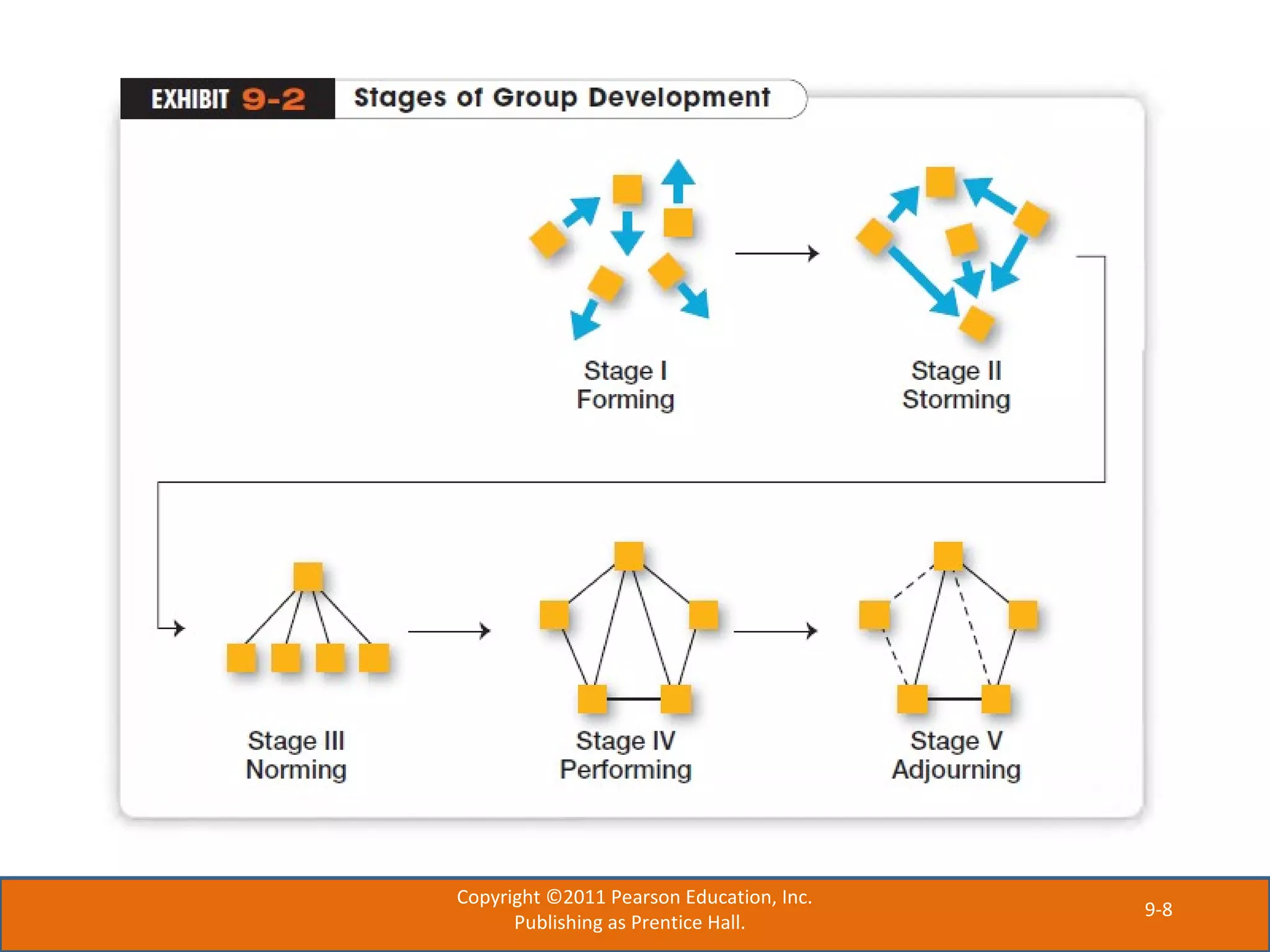
• Forming Stage
– The first stage of group development in which
people join the group and then define the group’s
purpose, structure, and leadership
• Storming Stage
– The second stage of group development, which is
characterized by intragroup conflict
Copyright ©2011 Pearson Education, Inc.
Publishing as Prentice Hall.
9-6
Group Development Stages (cont.)
• Norming Stage
– The third stage of group development, which is
characterized by close relationships and
cohesiveness
• Performing Stage
– The fourth stage of group development, when the
group is fully functional and works on the group
task
Copyright ©2011 Pearson Education, Inc.
Publishing as Prentice Hall.
9-7
Group Development Stages (cont.)
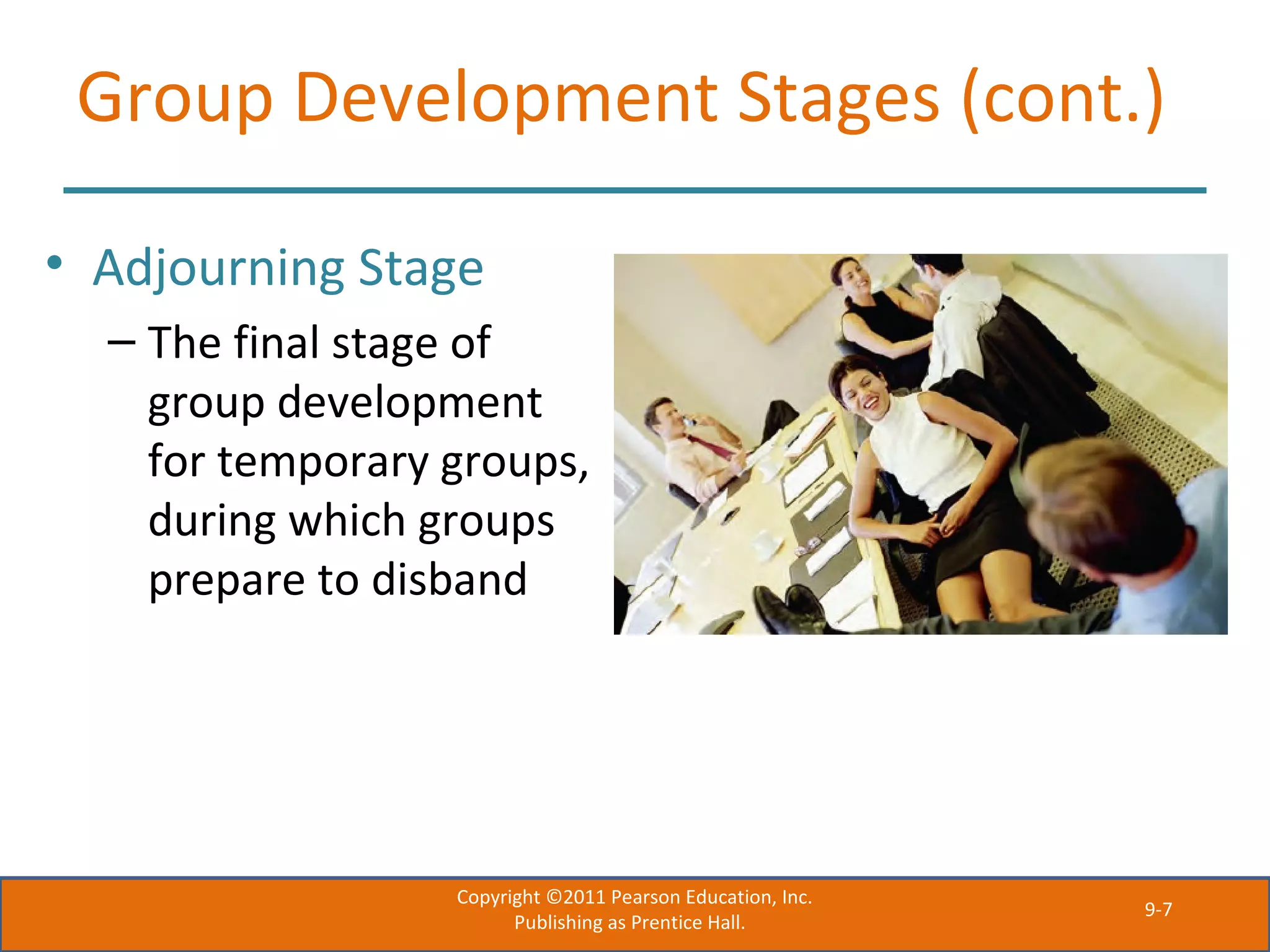
• Adjourning Stage
– The final stage of
group development
for temporary groups,
during which groups
prepare to disband
Copyright ©2011 Pearson Education, Inc.
Publishing as Prentice Hall.
9-8
Copyright ©2011 Pearson Education, Inc.
Publishing as Prentice Hall.
9-9
What Are the Major Concepts of
Group Behavior?
• Role
– Behavior patterns expected of someone who
occupies a given position in a social unit
• Norms
– Standards or expectations that are accepted and
shared by a group’s members
Copyright ©2011 Pearson Education, Inc.
Publishing as Prentice Hall.
9-10
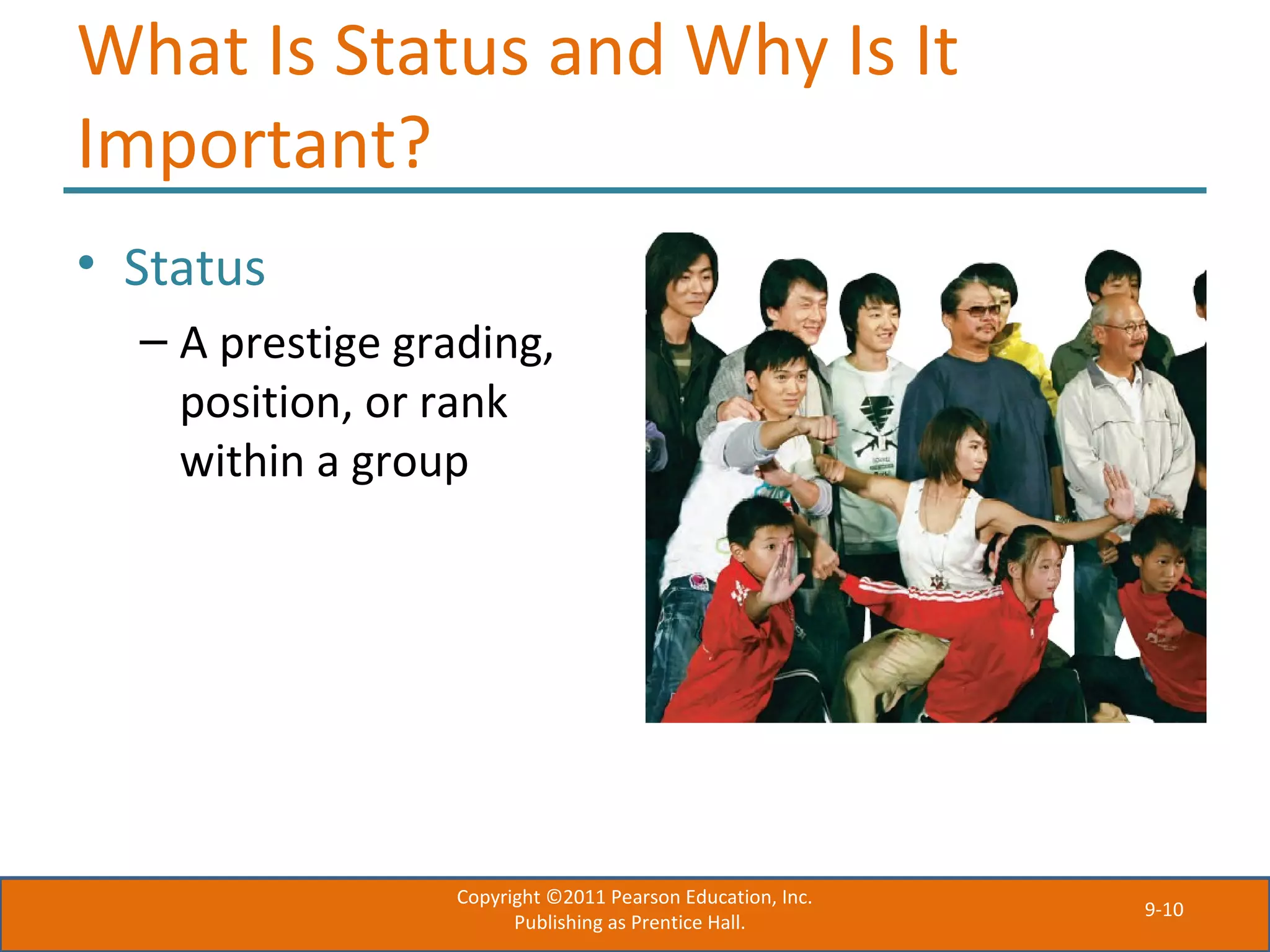
What Is Status and Why Is It
Important?
• Status
– A prestige grading,
position, or rank
within a group
Copyright ©2011 Pearson Education, Inc.
Publishing as Prentice Hall.
9-11
Does Group Size Affect Behavior?
Large Groups
– are good for gaining diverse input
Small Groups
– Are typically faster at implementation
• Social Loafing
– The tendency for individuals to expend less effort
when working collectively than when working
individually
Copyright ©2011 Pearson Education, Inc.
Publishing as Prentice Hall.
9-12
How Are Groups Turned into
Effective Teams?
• 80 percent of Fortune 500 use teams
• Teams typically outperform individuals when the
tasks require multiple skills, judgment, and
experience
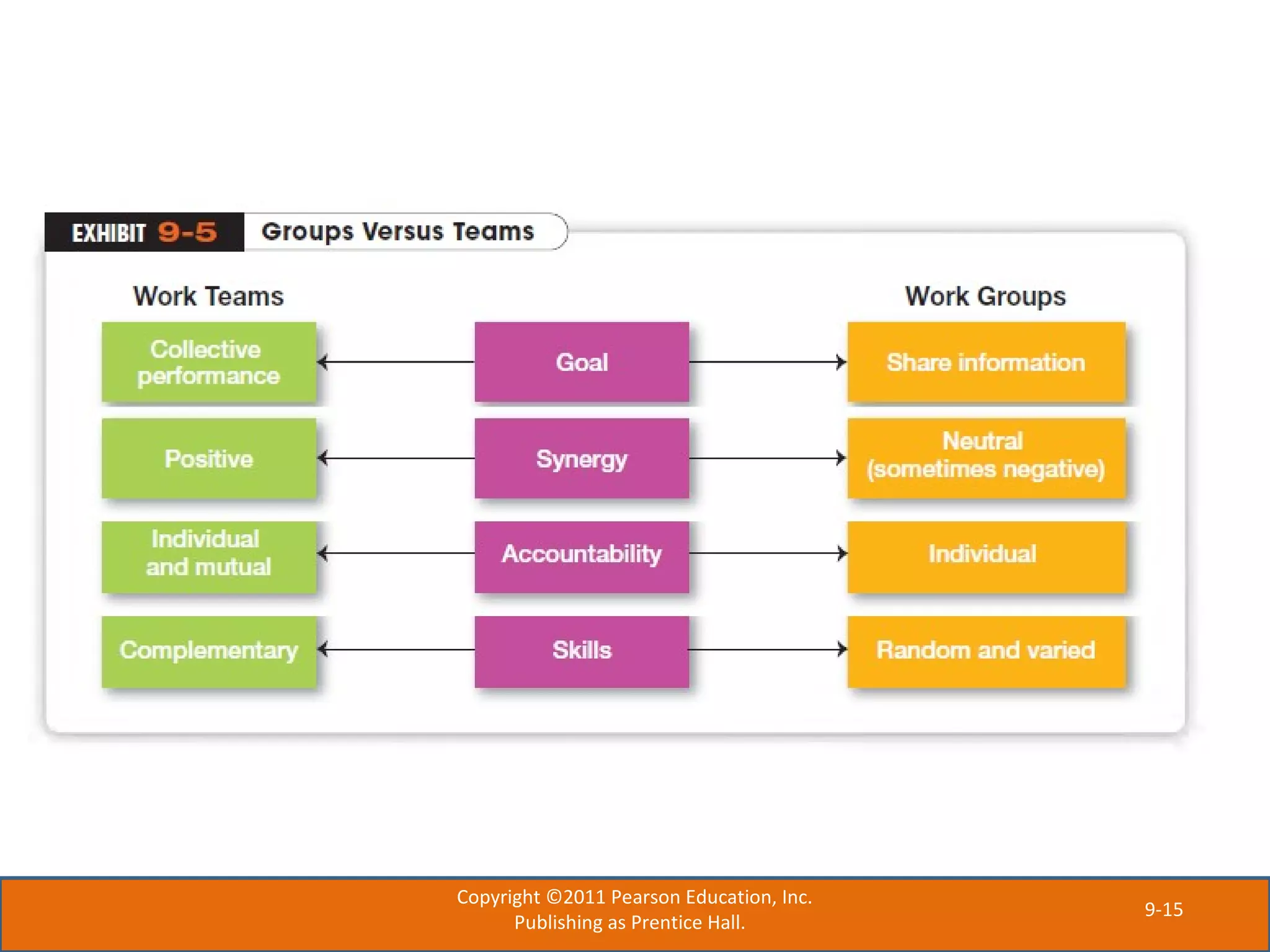
• Work Teams
– Groups whose members work intensely on
specific, common goals using their positive
synergy, individual and mutual accountability, and
complementary skills
Copyright ©2011 Pearson Education, Inc.
Publishing as Prentice Hall.
9-13
Types of Work Teams
• Problem-Solving Teams
– A team from the same department or functional
area that’s involved in efforts to improve work
activities or to solve specific problems
• Self-Managed Work Team
– A type of work team that operates without a
manager and is responsible for a complete work
process or segment
Copyright ©2011 Pearson Education, Inc.
Publishing as Prentice Hall.
9-14
Types of Teams (cont.)
• Cross-Functional Team
– Teams made up of individuals from various
departments and that cross traditional
departmental lines
• Virtual Team
– A type of work team that uses technology to link
physically dispersed members in order to achieve
a common goal
Copyright ©2011 Pearson Education, Inc.
Publishing as Prentice Hall.
9-15
Copyright ©2011 Pearson Education, Inc.
Publishing as Prentice Hall.
9-16
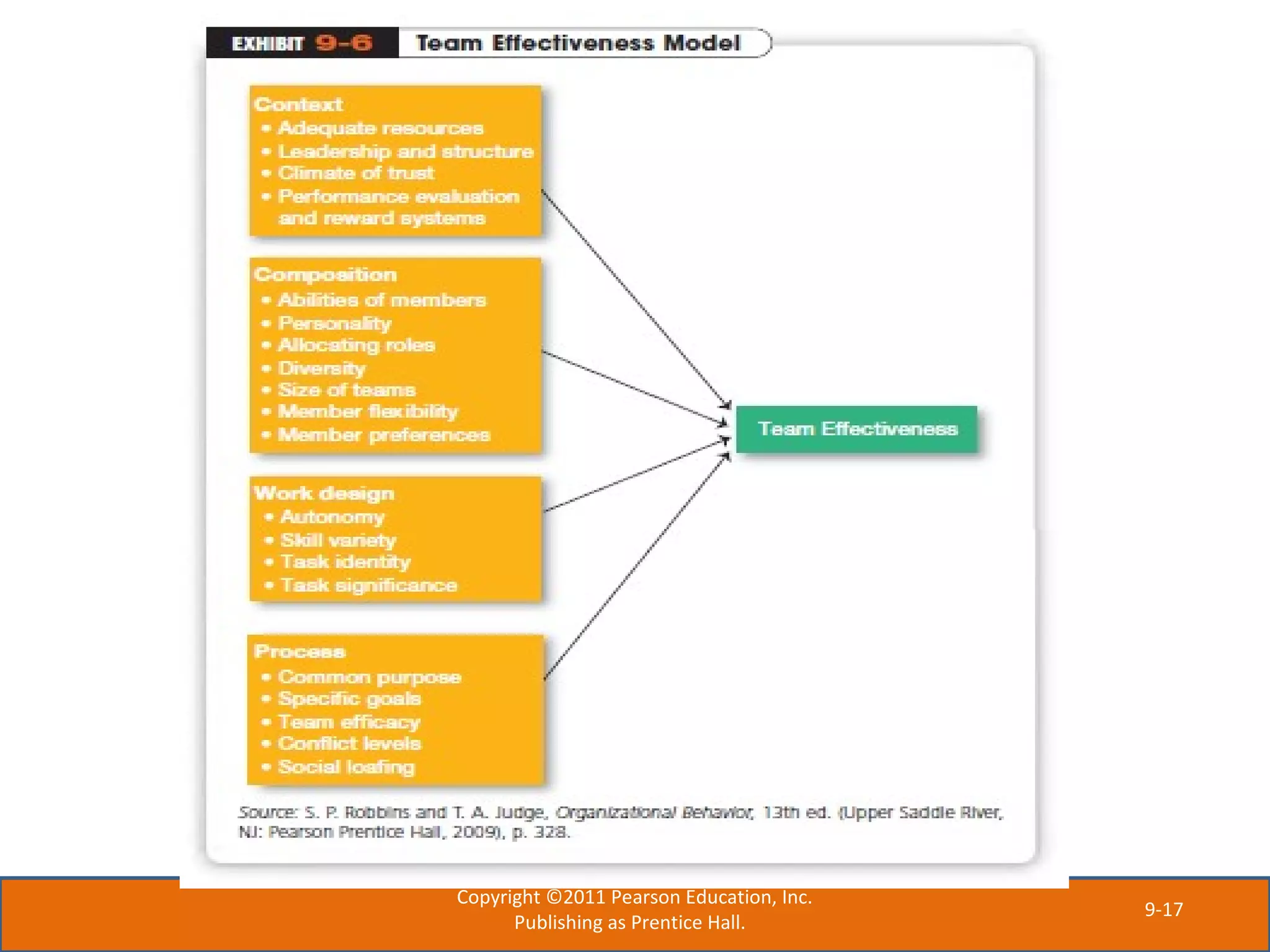
WHAT FACTORS MAKE A TEAM
EFFECTIVE?
• Adequate Resources
– the team’s ability is reduced without adequate resources
• Team Leadership and Structure
– all members contribute in the work
• Trust
– Team members must trust each
• Performance Evaluation and Reward System
– Members have to be accountable both individually and
jointly
Copyright ©2011 Pearson Education, Inc.
Publishing as Prentice Hall.
9-17
Copyright ©2011 Pearson Education, Inc.
Publishing as Prentice Hall.
9-18
Copyright ©2011 Pearson Education, Inc.
Publishing as Prentice Hall.

Chapter 10 groups&teams

  • 1.
    10 Chapter Understanding Groups and Managing Work Teams Copyright©2011 Pearson Education, Inc. Publishing as Prentice Hall.
  • 2.
    9-2 Learning Outcomes • Definea group and describe the stages of group development • Describe the major concepts of group behavior • Discuss how groups are turned into effective teams • Discuss contemporary issues in managing teams Copyright ©2011 Pearson Education, Inc. Publishing as Prentice Hall.
  • 3.
    9-3 What Is aGroup? • Group – Two or more interacting and interdependent individuals who come together to achieve specific goals Copyright ©2011 Pearson Education, Inc. Publishing as Prentice Hall.
  • 4.
    9-4 Copyright ©2011 PearsonEducation, Inc. Publishing as Prentice Hall.
  • 5.
    9-5 What Are theStages of Group Development? • Forming Stage – The first stage of group development in which people join the group and then define the group’s purpose, structure, and leadership • Storming Stage – The second stage of group development, which is characterized by intragroup conflict Copyright ©2011 Pearson Education, Inc. Publishing as Prentice Hall.
  • 6.
    9-6 Group Development Stages(cont.) • Norming Stage – The third stage of group development, which is characterized by close relationships and cohesiveness • Performing Stage – The fourth stage of group development, when the group is fully functional and works on the group task Copyright ©2011 Pearson Education, Inc. Publishing as Prentice Hall.
  • 7.
    9-7 Group Development Stages(cont.) • Adjourning Stage – The final stage of group development for temporary groups, during which groups prepare to disband Copyright ©2011 Pearson Education, Inc. Publishing as Prentice Hall.
  • 8.
    9-8 Copyright ©2011 PearsonEducation, Inc. Publishing as Prentice Hall.
  • 9.
    9-9 What Are theMajor Concepts of Group Behavior? • Role – Behavior patterns expected of someone who occupies a given position in a social unit • Norms – Standards or expectations that are accepted and shared by a group’s members Copyright ©2011 Pearson Education, Inc. Publishing as Prentice Hall.
  • 10.
    9-10 What Is Statusand Why Is It Important? • Status – A prestige grading, position, or rank within a group Copyright ©2011 Pearson Education, Inc. Publishing as Prentice Hall.
  • 11.
    9-11 Does Group SizeAffect Behavior? Large Groups – are good for gaining diverse input Small Groups – Are typically faster at implementation • Social Loafing – The tendency for individuals to expend less effort when working collectively than when working individually Copyright ©2011 Pearson Education, Inc. Publishing as Prentice Hall.
  • 12.
    9-12 How Are GroupsTurned into Effective Teams? • 80 percent of Fortune 500 use teams • Teams typically outperform individuals when the tasks require multiple skills, judgment, and experience • Work Teams – Groups whose members work intensely on specific, common goals using their positive synergy, individual and mutual accountability, and complementary skills Copyright ©2011 Pearson Education, Inc. Publishing as Prentice Hall.
  • 13.
    9-13 Types of WorkTeams • Problem-Solving Teams – A team from the same department or functional area that’s involved in efforts to improve work activities or to solve specific problems • Self-Managed Work Team – A type of work team that operates without a manager and is responsible for a complete work process or segment Copyright ©2011 Pearson Education, Inc. Publishing as Prentice Hall.
  • 14.
    9-14 Types of Teams(cont.) • Cross-Functional Team – Teams made up of individuals from various departments and that cross traditional departmental lines • Virtual Team – A type of work team that uses technology to link physically dispersed members in order to achieve a common goal Copyright ©2011 Pearson Education, Inc. Publishing as Prentice Hall.
  • 15.
    9-15 Copyright ©2011 PearsonEducation, Inc. Publishing as Prentice Hall.
  • 16.
    9-16 WHAT FACTORS MAKEA TEAM EFFECTIVE? • Adequate Resources – the team’s ability is reduced without adequate resources • Team Leadership and Structure – all members contribute in the work • Trust – Team members must trust each • Performance Evaluation and Reward System – Members have to be accountable both individually and jointly Copyright ©2011 Pearson Education, Inc. Publishing as Prentice Hall.
  • 17.
    9-17 Copyright ©2011 PearsonEducation, Inc. Publishing as Prentice Hall.
  • 18.
    9-18 Copyright ©2011 PearsonEducation, Inc. Publishing as Prentice Hall.

Editor's Notes

  • #4 A group is defined as two or more interacting and interdependent individuals who come together to achieve specific goals. Formal groups are work groups that are defined by the organization’s structure and have designated work assignments and specific tasks directed at accomplishing organizational goals
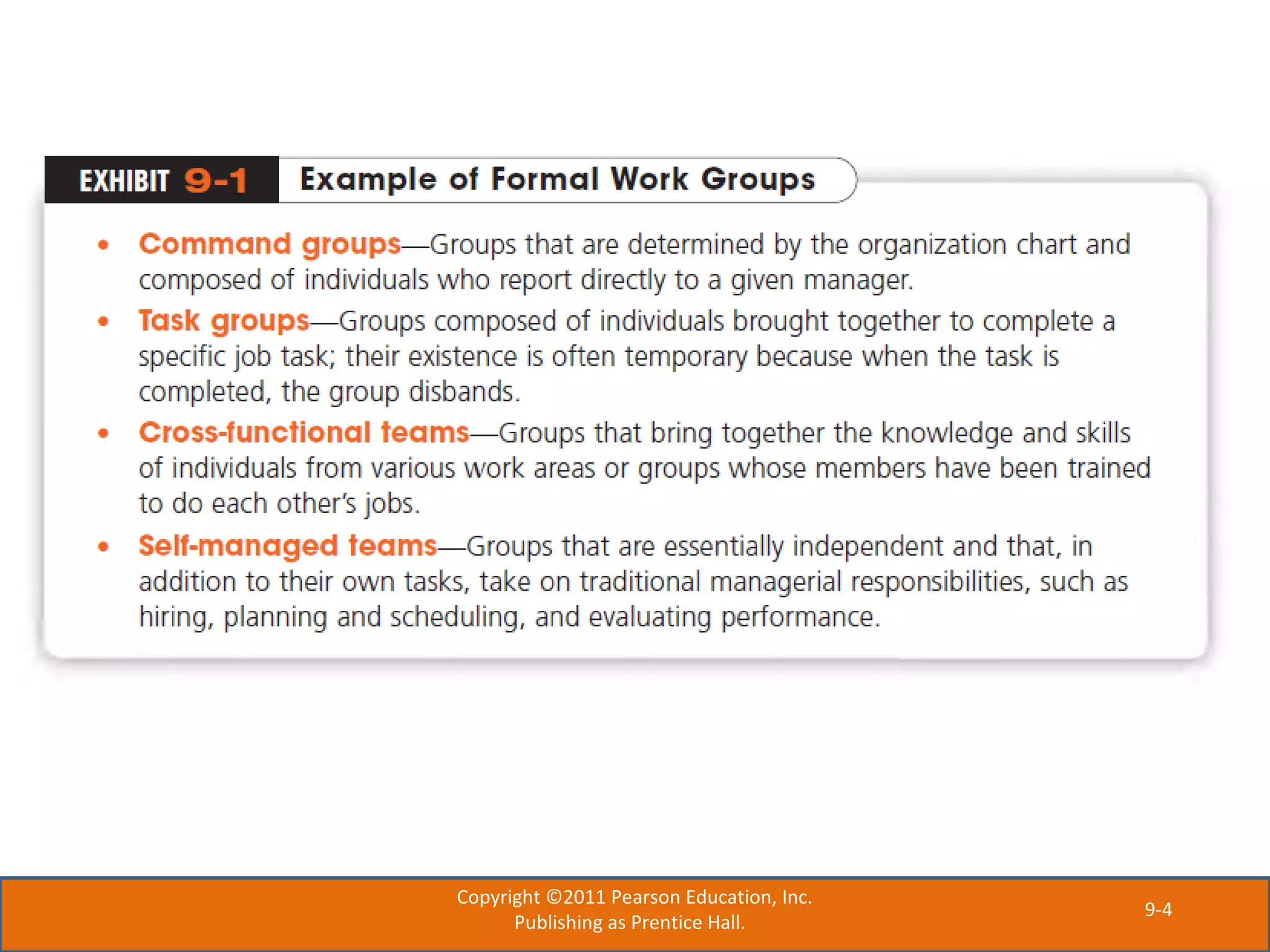
  • #5 Exhibit 9-1 provides some examples of formal groups
  • #6 The forming stage has two phases. The first occurs as people join the group. In a formal group, people join because of some work assignment. Once they’ve joined, the second phase begins: defining the group’s purpose, structure, and leadership. The storming stage is appropriately named because of the intragroup conflict. There’s conflict over who will control the group and what the group needs to be doing.
  • #7 The norming stage is one in which close relationships develop and the group becomes cohesive. There’s now a strong sense of group identity and camaraderie. The fourth stage is performing. The group structure is in place and accepted by group members. Their energies have moved from getting to know and understand each other to working on the group’s task.
  • #8 The final stage is adjourning. In this stage, the group prepares to disband. Attention is focused on wrapping up activities instead of task performance
  • #9 Research shows that groups develop through five stages.3 As shown in Exhibit 9-2, these five stages are: forming, storming, norming, performing, and adjourning.
  • #10 A role refers to behavior patterns expected of someone who occupies a given position in a social unit. Individuals play multiple roles, , adjusting their roles to the group to which they belong at the time. All groups have established norms, acceptable standards that are shared by the group’s members. Norms dictate output levels, absenteeism rates, promptness or tardiness, the amount of socializing allowed on the job, and so on.
  • #11 Status is a prestige grading, position, or rank within a group. As far back as scientists have been able to trace human groupings, they’ve found status hierarchies: tribal chiefs and their followers, nobles and peasants, the haves and the have-nots. Status systems are important factors in understanding behavior
  • #12 The size of a group affects that group’s behavior. However, that effect depends on what criteria you’re looking at. The evidence indicates, for instance, that small groups complete tasks faster than larger ones. However, if a group is engaged in problem solving, large groups consistently get better marks than their smaller counterparts. Groups of approximately five to seven members tend to act more effectively
  • #13 When companies like W. L. Gore, Volvo, and Kraft Foods introduced teams into their production processes, it made news because no one else was doing it. Today, it’s just the opposite—the organization that doesn’t use teams would be newsworthy. It’s estimated that some 80 percent of Fortune 500 companies have at least half of their employees on teams. And over 70 percent of U.S. manufacturers use work teams
  • #14 When work teams first became popular, most were problem-solving teams, which are teams from the same department or functional area involved in efforts to improve work activities or to solve specific problems. Members share ideas or offer suggestions on how work processes and methods can be improved. A self-managed work team is a formal group of employees who operate without a manager and are responsible for a complete work process or segment. A self-managed team is responsible for getting the work done and for managing themselves
  • #15 The third type of team is the cross-functional team, which we introduced in Chapter 5 and defined as a work team composed of individuals from various specialties. Many organizations use cross-functional teams. The final type of team is the virtual team, which is a team that uses technology to link physically dispersed members in order to achieve a common goal. For instance, a virtual team at Boeing-Rocketdyne played a pivotal role in developing a radically new product.
  • #17 Four contextual factors appear to be most significantly related to team performance. These include adequate resources, leadership and structure, a climate of trust, and performance evaluation and reward systems.
  • #18 Much research has been done on what it is that makes a team effective. Out of these efforts, we now have a fairly focused model identifying those characteristics. Exhibit 9-6 summarizes what we currently know about what makes a team effective
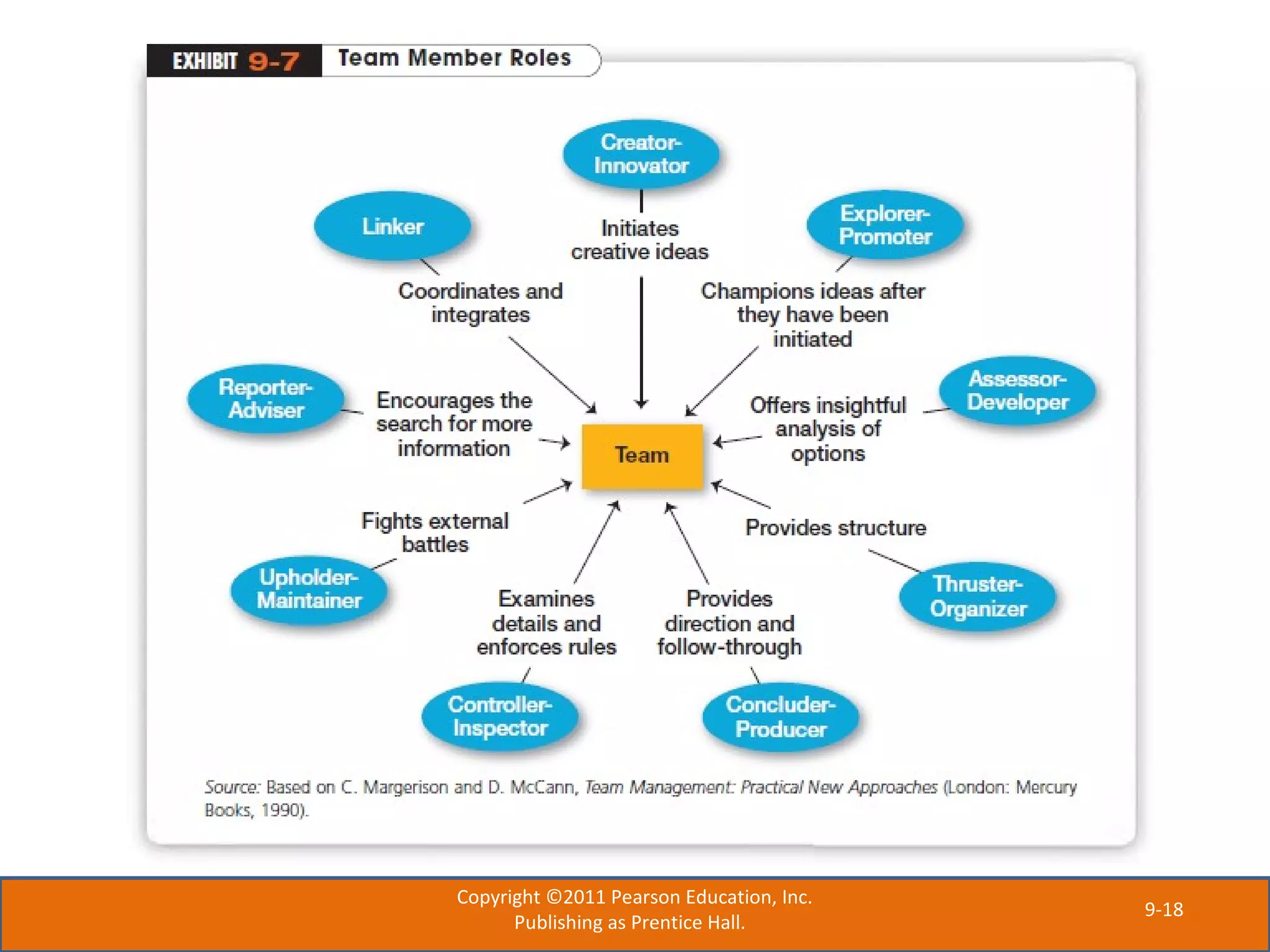
  • #19 Nine potential team roles have been identified. (See Exhibit 9-7.) High-performing work teams have people to fill all these roles and have selected people to fulfill these roles based on their skills and preferences.