
Module III Individual in the
Group
GROUP PROCESSES
NATURE OF GROUPS
• Group refers to a collection of two or more
interacting individuals with a stable pattern of
relationships between them, who share common
goals & who percieve themselves as being a
group.
• Group possesses 4 common characteristics:
a) Interaction among members
b) Common interests or goals
c) People see themselves as members
d) 2 or more people are needed to form groups.
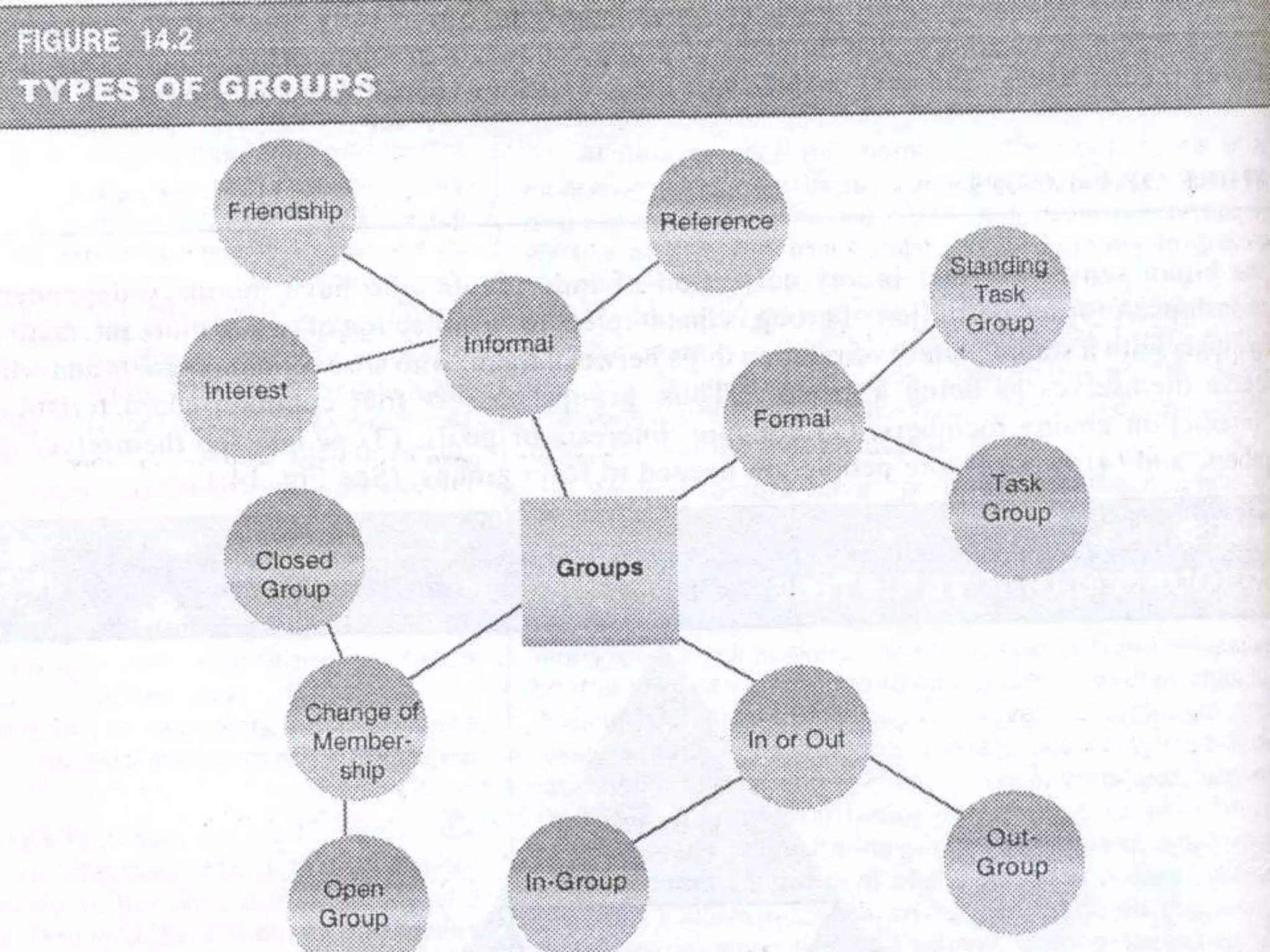
TYPES OF GROUPS
Formal Group
• Deliberately created to perform a specific
task.
• A number of people assigned to a specific
task form a formal group.
• A distinctive feature of formal groups is that a
hierarchy of authority exists, with specified
member rules & regulations.
STANDING TASK GROUP
• Also known as command group.
• Consists of a supervisor who exercises formal
authority over subordinates.
TASK GROUP
• It is a temporary formal group that is created to
solve specific problems.
• The group comprises employees who work
together to complete a particular task or project,
but who do not necessarily report to the same
supervisor.
• The employees belong to different departments.
• They stay together till the task is completed 7
once the work is completed, the task group
usually disbands & members return to their
respective task groups.
INFORMAL GROUP
• Also called a clique.
• It is an alliance that is neither formally
structured nor organisationally determined.
• Informal groups are natural formations in the
work enviroment which appear in response to
the need for social contact.
• They often develop within formal groups &
may also develop outside formal groups.
Interest group
• It is made up of individuals who affiliate to
achieve an objective of mutual interest that
may have nothingto do with their formal task
group memberships.
FRIENDSHIP GROUP
• Develops on common characteristics such as
martial status, political views, college
affiliations, & sports.
• Friendship groups are important bbecause
they satisfy affiliation needs of their members.
REFERENCE GROUP
• It is any group with which an individual
identifies for the purpose of forming opinions
or making decisions.
why do people join groups ?
• Interaction & influence
• Security
• Esteem
• Affiliation
• Power
• Identity
• Huddling (executives make use of informal get
togethers )
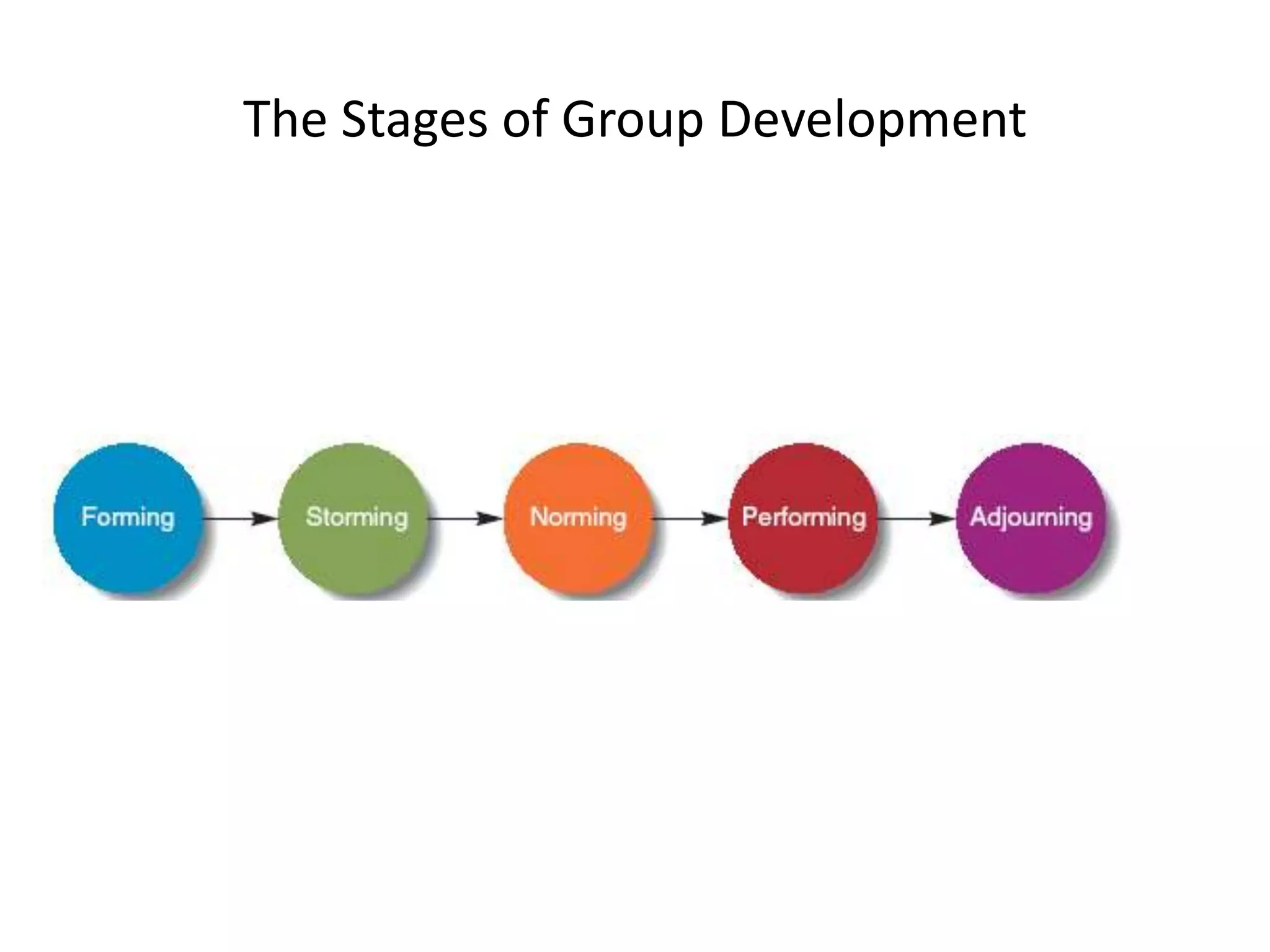
The Stages of Group Development
Stages of Group Development
• Forming
– Group members get to know each other and
reach common goals.
• Storming
– Group members disagree on direction and
leadership. Managers need to be sure the conflict
stays focused.
• Norming
– Close ties and consensus begin to develop
between group members.
Stages of Group Development
• Performing
– The group begins to do its real work.
• Adjourning
Separation, satisfaction
ALTERNATIVE THEORY OF GROUP
DEVELOPMENT
• Consists of 4 stages –
a) Mutual Acceptance
b) Communication & Decision Making
c) Motivation & Productivity
d) Control & Organisation
USEFULNESS OF GROUPS IN
ORGANISATIONS
• Organisational Task Accomplishment
Social Loafing also known as Ringlemann Effect
acknowledges that people may tend not to work as
hard in groups as they would individually. This is
because their contribution is less noticeable &
because they like to see others carry the work load.
PITFALLS OF GROUPS
• Status differentials
• Group norms
• Groupthink - refers to the tendency of members in a
highly cohesive group to lose their critical, evaluative
capabilities.
DETERMINANTS OF GROUP
BEHAVIOUR
• They influence group performance & satisfaction
• EXTERNAL CONDITIONS
a) Organisational strategy
b) Authority structure
c) Formal regulations
d) Organisational Resources
e) Procurement of Personnel
f) Performance Appraisal & Reward System
g) Organisational Culture
h) Physical Work Setting
• GROUP MEMBERS RESOURCES
a) Abilities of members
b) Personality Characteristics
• GROUP STRUCTURE
GROUP STRUCTURE
• Work groups are organised systems.
• They have a structure that shapes the behaviour of
members & makes it possible to explain & predict a
large portion of individual behaviour within the group
as well as the performance of the group itself.
• It includes –
a) Leadership
b) Roles
c) Group Size
d) Group norms
e) Group Task
f) Status Congruence
g) Group Cohesiveness – Cohesiveness is extent of
liking each member has towards others & how far
everyone wants to remain as a member of the group.
h) Decision Making
APPROACHES TO GROUP DECISION
MAKING
• Autocratic decision making- Leader makes a decision
by himself / herself
• Expert member soliciting – Advice of an individual
who is expert in the concerned area, is obtained &
decision is then made.
• Consultative Decision Making – Obtaining inputs
from those responsible for & affected by the decision
& then making a decision independently.
• Minority Control – Allowing a small number
of people in the group to make a decision.
• Majority Control – Majority of members
involve themselves in decision making.
• Consensus – Finding a proposal acceptable to
all members. This is a ‘win – win’ situation.
ADVANTAGES & DISADVANTAGES OF
GROUP DECISION MAKING
CONSIDERATIONS IN GROUP DECISION
MAKING
• Time
• Member Competence
• Autonomy & Self direction
• Availability of information
• Group Size
• Degree of participation
Introduction to team
TEAM
• It is a small number of people with
complimentary skills who are committed to a
common purpose, common performance goals
& an approach for which they hold themselves
mutually accountable.
Distinction between Groups and Teams
• A work group is a number of persons, usually
reporting to common superiors and having some
face-to-face interaction, who have some degree of
interdependence in carrying out tasks for the purpose
of achieving organizational goals.
• A team is a small number of people with
complimentary skills who are committed to a
common purpose, set of performance goals, and
approach for which they hold themselves mutually
accountable.
• A team has some characteristics in greater degree
than ordinary groups, including a higher commitment
to common goals and a higher degree of
interdependency and interaction.
BENEFITS FROM TEAMS
• Enhanced Performance
• Reduced stress
• Quality decisions
• Improved processes
• Organisational enhancements which include
increased innovation, creativity & flexibility
TYPES OF TEAMS
• Work teams – Concerned with the work done by the
organisation such as developing & manufacturing
new products, providing services for customers.
• Problem solving teams – Temporary teams
established to attack specific problems in workplace.
After solving problems, the team is usually disbanded
allowing members to return too their normal work.
• Management Teams – Consists of managers from
various areas & coordinate work teams. They are
relatively permanent. Primary job is to coach &
counsel other teams.
• Virtual teams – Activities take place on computer &
other electronic information systems. They may never
actually meet.
IMPLEMENTING TEAMS IN
ORGANISATIONS
• Planning the change
• Making the decision
• Implementing the decision
Phase 1 - Management must create performance conditions
for the teams. This means providing to the teams all the
needed materials & equipments to do the job.
Phase 2 – Establish boundaries that is who is & who is not in the
team, arrive at an agreement regarding the tasks to be
performed, Clarify the behaviours expected of each team
member.
TEAM ISSUES
• Performance
• Norms
• Roles
• Cohesiveness
• TQM – Total Quality Management, An
organisational strategy to improving customer
satisfaction by developing techniques to
carefully manage output quality.
EFFECTIVE TEAMWORK
• Cooperation
• Trust
• Training
• Rewards
Teams in organisations
• Quality Circles
• Self Managed Teams
POWER & POLITICS

Module iii individual in the group fs

  • 1.
  • 2.
  • 3.
    NATURE OF GROUPS •Group refers to a collection of two or more interacting individuals with a stable pattern of relationships between them, who share common goals & who percieve themselves as being a group. • Group possesses 4 common characteristics: a) Interaction among members b) Common interests or goals c) People see themselves as members d) 2 or more people are needed to form groups.
  • 4.
  • 6.
    Formal Group • Deliberatelycreated to perform a specific task. • A number of people assigned to a specific task form a formal group. • A distinctive feature of formal groups is that a hierarchy of authority exists, with specified member rules & regulations.
  • 7.
    STANDING TASK GROUP •Also known as command group. • Consists of a supervisor who exercises formal authority over subordinates.
  • 8.
    TASK GROUP • Itis a temporary formal group that is created to solve specific problems. • The group comprises employees who work together to complete a particular task or project, but who do not necessarily report to the same supervisor. • The employees belong to different departments. • They stay together till the task is completed 7 once the work is completed, the task group usually disbands & members return to their respective task groups.
  • 9.
    INFORMAL GROUP • Alsocalled a clique. • It is an alliance that is neither formally structured nor organisationally determined. • Informal groups are natural formations in the work enviroment which appear in response to the need for social contact. • They often develop within formal groups & may also develop outside formal groups.
  • 10.
    Interest group • Itis made up of individuals who affiliate to achieve an objective of mutual interest that may have nothingto do with their formal task group memberships.
  • 11.
    FRIENDSHIP GROUP • Developson common characteristics such as martial status, political views, college affiliations, & sports. • Friendship groups are important bbecause they satisfy affiliation needs of their members.
  • 12.
    REFERENCE GROUP • Itis any group with which an individual identifies for the purpose of forming opinions or making decisions.
  • 13.
    why do peoplejoin groups ? • Interaction & influence • Security • Esteem • Affiliation • Power • Identity • Huddling (executives make use of informal get togethers )
  • 14.
    The Stages ofGroup Development
  • 15.
    Stages of GroupDevelopment • Forming – Group members get to know each other and reach common goals. • Storming – Group members disagree on direction and leadership. Managers need to be sure the conflict stays focused. • Norming – Close ties and consensus begin to develop between group members.
  • 16.
    Stages of GroupDevelopment • Performing – The group begins to do its real work. • Adjourning Separation, satisfaction
  • 17.
    ALTERNATIVE THEORY OFGROUP DEVELOPMENT • Consists of 4 stages – a) Mutual Acceptance b) Communication & Decision Making c) Motivation & Productivity d) Control & Organisation
  • 18.
    USEFULNESS OF GROUPSIN ORGANISATIONS • Organisational Task Accomplishment Social Loafing also known as Ringlemann Effect acknowledges that people may tend not to work as hard in groups as they would individually. This is because their contribution is less noticeable & because they like to see others carry the work load.
  • 19.
    PITFALLS OF GROUPS •Status differentials • Group norms • Groupthink - refers to the tendency of members in a highly cohesive group to lose their critical, evaluative capabilities.
  • 20.
    DETERMINANTS OF GROUP BEHAVIOUR •They influence group performance & satisfaction • EXTERNAL CONDITIONS a) Organisational strategy b) Authority structure c) Formal regulations d) Organisational Resources e) Procurement of Personnel f) Performance Appraisal & Reward System g) Organisational Culture h) Physical Work Setting
  • 21.
    • GROUP MEMBERSRESOURCES a) Abilities of members b) Personality Characteristics • GROUP STRUCTURE
  • 22.
    GROUP STRUCTURE • Workgroups are organised systems. • They have a structure that shapes the behaviour of members & makes it possible to explain & predict a large portion of individual behaviour within the group as well as the performance of the group itself.
  • 23.
    • It includes– a) Leadership b) Roles c) Group Size d) Group norms e) Group Task
  • 24.
    f) Status Congruence g)Group Cohesiveness – Cohesiveness is extent of liking each member has towards others & how far everyone wants to remain as a member of the group. h) Decision Making
  • 25.
    APPROACHES TO GROUPDECISION MAKING • Autocratic decision making- Leader makes a decision by himself / herself • Expert member soliciting – Advice of an individual who is expert in the concerned area, is obtained & decision is then made. • Consultative Decision Making – Obtaining inputs from those responsible for & affected by the decision & then making a decision independently.
  • 26.
    • Minority Control– Allowing a small number of people in the group to make a decision. • Majority Control – Majority of members involve themselves in decision making. • Consensus – Finding a proposal acceptable to all members. This is a ‘win – win’ situation.
  • 27.
    ADVANTAGES & DISADVANTAGESOF GROUP DECISION MAKING
  • 28.
    CONSIDERATIONS IN GROUPDECISION MAKING • Time • Member Competence • Autonomy & Self direction • Availability of information • Group Size • Degree of participation
  • 29.
  • 30.
    TEAM • It isa small number of people with complimentary skills who are committed to a common purpose, common performance goals & an approach for which they hold themselves mutually accountable.
  • 31.
    Distinction between Groupsand Teams • A work group is a number of persons, usually reporting to common superiors and having some face-to-face interaction, who have some degree of interdependence in carrying out tasks for the purpose of achieving organizational goals. • A team is a small number of people with complimentary skills who are committed to a common purpose, set of performance goals, and approach for which they hold themselves mutually accountable. • A team has some characteristics in greater degree than ordinary groups, including a higher commitment to common goals and a higher degree of interdependency and interaction.
  • 32.
    BENEFITS FROM TEAMS •Enhanced Performance • Reduced stress • Quality decisions • Improved processes • Organisational enhancements which include increased innovation, creativity & flexibility
  • 33.
    TYPES OF TEAMS •Work teams – Concerned with the work done by the organisation such as developing & manufacturing new products, providing services for customers. • Problem solving teams – Temporary teams established to attack specific problems in workplace. After solving problems, the team is usually disbanded allowing members to return too their normal work.
  • 34.
    • Management Teams– Consists of managers from various areas & coordinate work teams. They are relatively permanent. Primary job is to coach & counsel other teams. • Virtual teams – Activities take place on computer & other electronic information systems. They may never actually meet.
  • 35.
    IMPLEMENTING TEAMS IN ORGANISATIONS •Planning the change • Making the decision • Implementing the decision Phase 1 - Management must create performance conditions for the teams. This means providing to the teams all the needed materials & equipments to do the job. Phase 2 – Establish boundaries that is who is & who is not in the team, arrive at an agreement regarding the tasks to be performed, Clarify the behaviours expected of each team member.
  • 36.
    TEAM ISSUES • Performance •Norms • Roles • Cohesiveness • TQM – Total Quality Management, An organisational strategy to improving customer satisfaction by developing techniques to carefully manage output quality.
  • 37.
    EFFECTIVE TEAMWORK • Cooperation •Trust • Training • Rewards
  • 38.
    Teams in organisations •Quality Circles • Self Managed Teams
  • 39.