• Prepared by:
  EVALUATING               Ancel Lopez
                     & Nielzen Joy Melo
   EMPLOYEE
PERFORMANCE
(Paul J. Jerome)
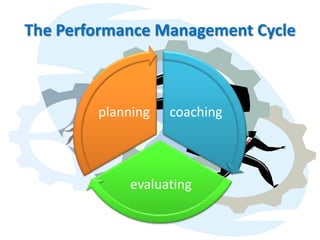
The Performance Management Cycle


        planning   coaching


            evaluating
The Performance Management Cycle
           • Position description : define the
             responsibility of a job and include
             evaluation measurements
           • Performance Objectives: define
             individual objectives for which the
             employee will be held accountable,
Planning     in addition to the Position
             Description
 phase
           • Performance action Plan: explain
             how these objectives will be
             achieved.
The Performance Management Cycle


           •The    agreed    upon
            performance plans are
Coaching    implemented here
 phase
The Performance Management Cycle


             •Throughout the process
              you’re            also
              documenting how your
Evaluating    team members are
  phase
              doing
• Provides a way to describe your
                team members have performed on
                the job, and how they improve
                their performance in the future so
                that all will benefit.
              • It also provides opportunity to
 Purpose of     mutually develop work objectives
                and ways to achieve them
Performance   • It provides documentation to
 Evaluation     support all personnel decisions
                (e.g., promotions, salary
                adjustments, terminations, etc.)
• Introductory Performance Evaluation
                • - conducted between 1 to 6
                  months after an employee ‘s hire
                  date to determine if the employee
                  is a match for the job.
              • Annual Performance Evaluation
                • - are what everyone usually get so
  Types of        worked up about. This formal
Performance       annual documentation of
                  performance highlights or lowlights
 Evaluation       strongly influences personnel
                  decisions and ends up in a special
                  employee file.
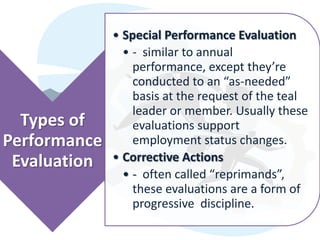
• Special Performance Evaluation
                • - similar to annual
                  performance, except they’re
                  conducted to an “as-needed”
                  basis at the request of the teal
                  leader or member. Usually these
  Types of        evaluations support
Performance       employment status changes.
 Evaluation   • Corrective Actions
                • - often called “reprimands”,
                  these evaluations are a form of
                  progressive discipline.
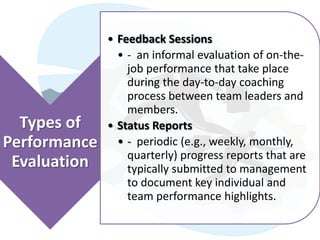
• Feedback Sessions
                • - an informal evaluation of on-the-
                  job performance that take place
                  during the day-to-day coaching
                  process between team leaders and
                  members.
  Types of    • Status Reports
Performance     • - periodic (e.g., weekly, monthly,
                  quarterly) progress reports that are
 Evaluation       typically submitted to management
                  to document key individual and
                  team performance highlights.
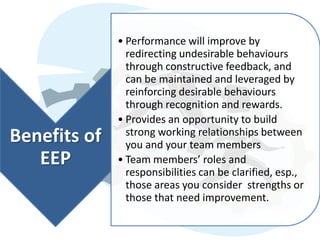
• Performance will improve by
                redirecting undesirable behaviours
                through constructive feedback, and
                can be maintained and leveraged by
                reinforcing desirable behaviours
                through recognition and rewards.
              • Provides an opportunity to build
Benefits of     strong working relationships between
                you and your team members
   EEP        • Team members’ roles and
                responsibilities can be clarified, esp.,
                those areas you consider strengths or
                those that need improvement.
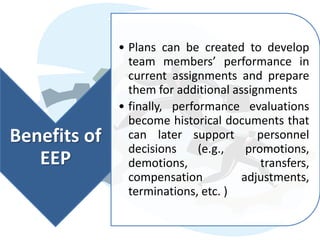
• Plans can be created to develop
                team members’ performance in
                current assignments and prepare
                them for additional assignments
              • finally, performance evaluations
                become historical documents that
Benefits of     can later support        personnel
                decisions     (e.g.,   promotions,
   EEP          demotions,                transfers,
                compensation          adjustments,
                terminations, etc. )
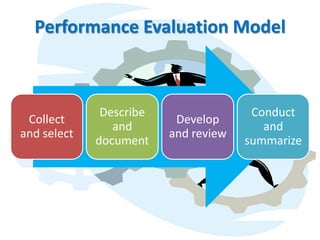
Performance Evaluation Model


              Describe                 Conduct
 Collect                  Develop
                and                      and
and select               and review
             document                 summarize
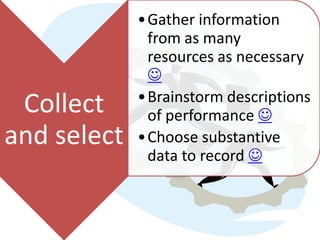
•Gather information
              from as many
              resources as necessary
              
             •Brainstorm descriptions
 Collect      of performance 
and select   •Choose substantive
              data to record 
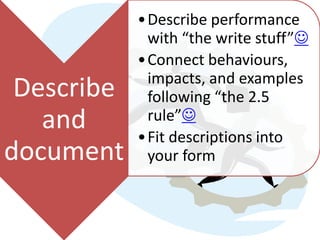
•Describe performance
             with “the write stuff”
            •Connect behaviours,
             impacts, and examples
 Describe    following “the 2.5
   and       rule”
            •Fit descriptions into
document     your form
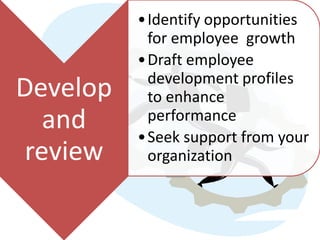
•Identify opportunities
           for employee growth
          •Draft employee
           development profiles
Develop    to enhance
   and     performance
          •Seek support from your
 review    organization
•Create a comfortable
             environment
            •Share highlights to
             build understanding
 Conduct     and appreciation
   and      •Finalize commitments
             and collaborate toward
summarize    mutual goals
•Corrective action must
              be uniform and
              progressive, so that all
              employees in an
              organization know
Corrective    what to expect
 Actions     •Also known as
              ‘discipline’
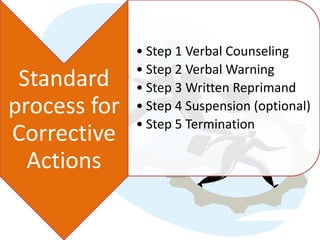
• Step 1 Verbal Counseling
              • Step 2 Verbal Warning
 Standard     • Step 3 Written Reprimand
process for   • Step 4 Suspension (optional)
              • Step 5 Termination
Corrective
  Actions
• First, describe the “Areas of
                   Needed Improvement” --- what
                   your team member is doing, the
                   undesirable impacts from his
                   behaviour, and examples.
                 • Next, discuss alternative
                   behaviours for the employee, you,
                   and theirs to take to redirect his
Step 1: Verbal     current behaviour and reach
                   desirable results. Solicit and
 Counseling        respond to your team member’s
                   concern and suggestions.
                 • Last, summarize key steps for you
                   and your team member to take,
                   and schedule a review session.
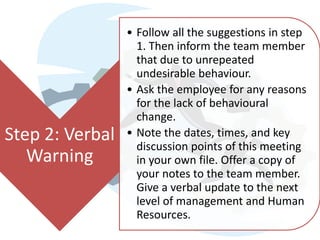
• Follow all the suggestions in step
                   1. Then inform the team member
                   that due to unrepeated
                   undesirable behaviour.
                 • Ask the employee for any reasons
                   for the lack of behavioural
                   change.
Step 2: Verbal   • Note the dates, times, and key
                   discussion points of this meeting
   Warning         in your own file. Offer a copy of
                   your notes to the team member.
                   Give a verbal update to the next
                   level of management and Human
                   Resources.
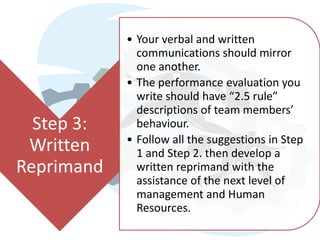
• Your verbal and written
              communications should mirror
              one another.
            • The performance evaluation you
              write should have “2.5 rule”
              descriptions of team members’
  Step 3:     behaviour.
            • Follow all the suggestions in Step
 Written      1 and Step 2. then develop a
Reprimand     written reprimand with the
              assistance of the next level of
              management and Human
              Resources.
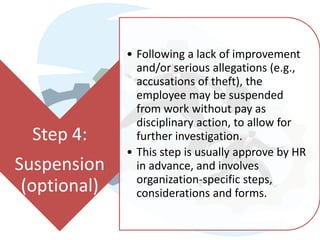
• Following a lack of improvement
                and/or serious allegations (e.g.,
                accusations of theft), the
                employee may be suspended
                from work without pay as
                disciplinary action, to allow for
  Step 4:       further investigation.
              • This step is usually approve by HR
Suspension      in advance, and involves
                organization-specific steps,
 (optional)     considerations and forms.
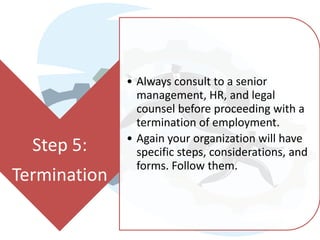
• Always consult to a senior
                management, HR, and legal
                counsel before proceeding with a
                termination of employment.
              • Again your organization will have
  Step 5:       specific steps, considerations, and
                forms. Follow them.
Termination
• Performance Evaluation is... An
            ongoing, interactive process, not
            a form of an annual meeting
          • Focused consistently and
            objectively on performance
            behaviours, not the person
          • A shared and participative
            process of documenting past
Summary     performance and exploring future
            potential.
          • A helpful and necessary tool to
            reinforce or redirect performance
•NOW WE
       KNOW!!!!!!
END
       

Evaluating employee performance (compensation)

  • 1.
    • Prepared by: EVALUATING Ancel Lopez & Nielzen Joy Melo EMPLOYEE PERFORMANCE (Paul J. Jerome)
  • 2.
    The Performance ManagementCycle planning coaching evaluating
  • 3.
    The Performance ManagementCycle • Position description : define the responsibility of a job and include evaluation measurements • Performance Objectives: define individual objectives for which the employee will be held accountable, Planning in addition to the Position Description phase • Performance action Plan: explain how these objectives will be achieved.
  • 4.
    The Performance ManagementCycle •The agreed upon performance plans are Coaching implemented here phase
  • 5.
    The Performance ManagementCycle •Throughout the process you’re also documenting how your Evaluating team members are phase doing
  • 6.
    • Provides away to describe your team members have performed on the job, and how they improve their performance in the future so that all will benefit. • It also provides opportunity to Purpose of mutually develop work objectives and ways to achieve them Performance • It provides documentation to Evaluation support all personnel decisions (e.g., promotions, salary adjustments, terminations, etc.)
  • 7.
    • Introductory PerformanceEvaluation • - conducted between 1 to 6 months after an employee ‘s hire date to determine if the employee is a match for the job. • Annual Performance Evaluation • - are what everyone usually get so Types of worked up about. This formal Performance annual documentation of performance highlights or lowlights Evaluation strongly influences personnel decisions and ends up in a special employee file.
  • 8.
    • Special PerformanceEvaluation • - similar to annual performance, except they’re conducted to an “as-needed” basis at the request of the teal leader or member. Usually these Types of evaluations support Performance employment status changes. Evaluation • Corrective Actions • - often called “reprimands”, these evaluations are a form of progressive discipline.
  • 9.
    • Feedback Sessions • - an informal evaluation of on-the- job performance that take place during the day-to-day coaching process between team leaders and members. Types of • Status Reports Performance • - periodic (e.g., weekly, monthly, quarterly) progress reports that are Evaluation typically submitted to management to document key individual and team performance highlights.
  • 10.
    • Performance willimprove by redirecting undesirable behaviours through constructive feedback, and can be maintained and leveraged by reinforcing desirable behaviours through recognition and rewards. • Provides an opportunity to build Benefits of strong working relationships between you and your team members EEP • Team members’ roles and responsibilities can be clarified, esp., those areas you consider strengths or those that need improvement.
  • 11.
    • Plans canbe created to develop team members’ performance in current assignments and prepare them for additional assignments • finally, performance evaluations become historical documents that Benefits of can later support personnel decisions (e.g., promotions, EEP demotions, transfers, compensation adjustments, terminations, etc. )
  • 12.
    Performance Evaluation Model Describe Conduct Collect Develop and and and select and review document summarize
  • 13.
    •Gather information from as many resources as necessary  •Brainstorm descriptions Collect of performance  and select •Choose substantive data to record 
  • 14.
    •Describe performance with “the write stuff” •Connect behaviours, impacts, and examples Describe following “the 2.5 and rule” •Fit descriptions into document your form
  • 15.
    •Identify opportunities for employee growth •Draft employee development profiles Develop to enhance and performance •Seek support from your review organization
  • 16.
    •Create a comfortable environment •Share highlights to build understanding Conduct and appreciation and •Finalize commitments and collaborate toward summarize mutual goals
  • 17.
    •Corrective action must be uniform and progressive, so that all employees in an organization know Corrective what to expect Actions •Also known as ‘discipline’
  • 18.
    • Step 1Verbal Counseling • Step 2 Verbal Warning Standard • Step 3 Written Reprimand process for • Step 4 Suspension (optional) • Step 5 Termination Corrective Actions
  • 19.
    • First, describethe “Areas of Needed Improvement” --- what your team member is doing, the undesirable impacts from his behaviour, and examples. • Next, discuss alternative behaviours for the employee, you, and theirs to take to redirect his Step 1: Verbal current behaviour and reach desirable results. Solicit and Counseling respond to your team member’s concern and suggestions. • Last, summarize key steps for you and your team member to take, and schedule a review session.
  • 20.
    • Follow allthe suggestions in step 1. Then inform the team member that due to unrepeated undesirable behaviour. • Ask the employee for any reasons for the lack of behavioural change. Step 2: Verbal • Note the dates, times, and key discussion points of this meeting Warning in your own file. Offer a copy of your notes to the team member. Give a verbal update to the next level of management and Human Resources.
  • 21.
    • Your verbaland written communications should mirror one another. • The performance evaluation you write should have “2.5 rule” descriptions of team members’ Step 3: behaviour. • Follow all the suggestions in Step Written 1 and Step 2. then develop a Reprimand written reprimand with the assistance of the next level of management and Human Resources.
  • 22.
    • Following alack of improvement and/or serious allegations (e.g., accusations of theft), the employee may be suspended from work without pay as disciplinary action, to allow for Step 4: further investigation. • This step is usually approve by HR Suspension in advance, and involves organization-specific steps, (optional) considerations and forms.
  • 23.
    • Always consultto a senior management, HR, and legal counsel before proceeding with a termination of employment. • Again your organization will have Step 5: specific steps, considerations, and forms. Follow them. Termination
  • 24.
    • Performance Evaluationis... An ongoing, interactive process, not a form of an annual meeting • Focused consistently and objectively on performance behaviours, not the person • A shared and participative process of documenting past Summary performance and exploring future potential. • A helpful and necessary tool to reinforce or redirect performance
  • 25.
    •NOW WE KNOW!!!!!! END 