Essentials of Organizational Behavior 12th Edition Robbins Solutions Manual
1.
Essentials of OrganizationalBehavior 12th
Edition Robbins Solutions Manual download
https://testbankfan.com/product/essentials-of-organizational-
behavior-12th-edition-robbins-solutions-manual/
Visit testbankfan.com today to download the complete set of
test bank or solution manual
2.
Here are somerecommended products for you. Click the link to
download, or explore more at testbankfan.com
Essentials of Organizational Behavior 12th Edition Robbins
Test Bank
https://testbankfan.com/product/essentials-of-organizational-
behavior-12th-edition-robbins-test-bank/
Essentials of Organizational Behavior 13th Edition Robbins
Solutions Manual
https://testbankfan.com/product/essentials-of-organizational-
behavior-13th-edition-robbins-solutions-manual/
Essentials of Organizational Behavior 14th Edition Robbins
Solutions Manual
https://testbankfan.com/product/essentials-of-organizational-
behavior-14th-edition-robbins-solutions-manual/
University Physics with Modern Physics 4th Edition Young
Test Bank
https://testbankfan.com/product/university-physics-with-modern-
physics-4th-edition-young-test-bank/
3.
Accounting Volume 2Canadian 9th Edition Horngren Test
Bank
https://testbankfan.com/product/accounting-volume-2-canadian-9th-
edition-horngren-test-bank/
Federal Taxation Basic Principles 2013 1st Edition
Harmelink Test Bank
https://testbankfan.com/product/federal-taxation-basic-
principles-2013-1st-edition-harmelink-test-bank/
Understanding Canadian Business Canadian 8th Edition
Nickels Solutions Manual
https://testbankfan.com/product/understanding-canadian-business-
canadian-8th-edition-nickels-solutions-manual/
Human Anatomy 9th Edition Martini Test Bank
https://testbankfan.com/product/human-anatomy-9th-edition-martini-
test-bank/
Business Intelligence and Analytics Systems for Decision
Support 10th Edition Sharda Test Bank
https://testbankfan.com/product/business-intelligence-and-analytics-
systems-for-decision-support-10th-edition-sharda-test-bank/
4.
Essentials of AmericanGovernment Roots and Reform 2011
10th Edition OConnor Test Bank
https://testbankfan.com/product/essentials-of-american-government-
roots-and-reform-2011-10th-edition-oconnor-test-bank/
legs. All theriveters of the “Black Watch” and “Gordon Highlanders”
were employed for a month in putting the Lotus together; she was
ready when I passed, and instructed the Naval officer in charge to
proceed.
Half a mile in front was an ugly belt of rocks, which extended,
indeed, for 80 miles south of Wadi Haifa, and from a look in the
Naval officer’s face I turned back and said: “Now, while I should
regret the loss of the steamer, please understand I would prefer she
should lie at the bottom rather than you did not try to get through.”
“Yes, I understand.” “Would you like to have it in writing?” “No, I
understand you accept all responsibility.”
Nevertheless, as I travelled up the Nile, at each successive
telegraph station I received telegrams more and more pessimistic
from the officer commanding the Lotus, and eventually he declined
the task. Colonel Wynne,
273
who was the Station Staff-officer on the
Line of Communication, telegraphed at the same time: “I have seen
the Naval officer’s opinion, and while I agree there is danger, request
permission to order the Bluejackets and Voyageurs off the steamer,
and let me take her through hauled by Egyptian soldiers.” This he
did; the Lotus proved to be worth her weight in gold to us in
bringing down stream wounded and sick soldiers.
274
When I was riding up the Nile the Consul-General in Cairo asked
me my wishes about retaining command of the Egyptian Army,
assuming that reductions then contemplated were carried out; and I
replied, on the 10th December, that I wished to remain until
Khartoum was taken, but afterwards not to remain on any terms.
Father Brindle
275
was travelling up in the boats of the Royal
Irish, and I had determined, if it were possible, to overtake him and
give him a Christmas dinner. We crossed to the left bank of the Nile,
where the whalers moored, and were waiting, when the leading boat
of the Irish appeared, the Reverend Father pulling stroke oar. His
features were burnt by the sun, and, like his hands, were covered
with blisters, as he stepped out of the boat stiff with the fatigue of
19.
pulling against thefast-running stream. Said I: “Father, why are you
working like that?” “Oh, to encourage them.” “Any result?” “Very
little.” The fact being, that the ordinary human creature was not
endowed with the same energy and devotion as was my friend.
Nevertheless the battalion won Lord Wolseley’s prize of £100 for the
best time, from Wadi Halfa to Korti, and smallest loss of Supplies.
Father Brindle was doubtless the most popular man in the
Expedition. His own flock naturally loved him, and he was respected
by everyone, from Bugler to Lord Wolseley, who more than once
tried to get him knighted. He had a pony which he never rode, it
being used to carry footsore men in turn. Preaching one day in the
desert during Lent, he said: “Now, my men, I cannot ask you here
on Service to abstain, but you might do something which would be
pleasing to the Almighty, and will gratify me,—abstain from the use
of bad language.” Looking into the upturned faces, he thought from
their sympathetic expression he had effected some good. When the
parade was dismissed he stood for a few minutes speaking to some
officers, and ten minutes later, walking behind two of his recent
congregation, who, talking eagerly did not notice his footsteps on
the soft sand, he overheard one say: “Bill, that was a bloody fine
sermon the Father gave us.”
When Lord Wolseley heard at Korti that General Sir Herbert
Stewart was dangerously wounded he sent Sir Redvers Buller across
the Bayuda Desert to replace him, and I became Chief of the Staff,
General Grenfell replacing me on the Line of Communication. A few
days later Lord Wolseley heard that Gordon had been killed at
Khartoum; and the accounts he received from the troops on the Nile
at Metemmeh being unsatisfactory, he despatched me as his
Representative, with instructions, after consulting with Buller, to
order a retirement if it seemed to be necessary.
I started within an hour, although I was in pain, for two days
previously I had sat down in a fold-up chair with my finger between
the joints, crushing the top so that it was in a jelly-like condition.
The arm was in a sling, and it is difficult to get on a camel, which
20.
puts its headback and tries to take a piece out of your leg as you
mount, if you have only one hand. I reached Gakdul, however, on
the 18th February, to find that Sir Redvers and his column were then
returning from Abu Klea.
There was no longer any hope of further offensive operations.
Although 2200 camels had crossed the desert on the first journey,
the Heavy Cavalry Regiment had now only 22 riding and 10 baggage
camels. The Light Cavalry Regiment was 100 short, and the
transport animals had all died from overwork.
Buller went on to rejoin Lord Wolseley on the Nile, while I
remained at Gakdul until sunset on the 3rd March, clearing out the
sick and wounded, then ammunition, and last of all stores.
276
We
remained until the whole of the water in the big pools had been
exhausted, and had men 30 feet down in wells, bailing up water in
pannikins, to give the friendly Arabs who were carrying the stores as
much time as possible.
The third day I was in the bivouac, for there were no tents
except for the wounded. I went to a Station Hospital to have my
finger dressed, which was necessary three times a day, as the smell
from it was so unpleasant. The Medical Officer in charge was
doubtless as much overworked as I was, and said shortly: “I tell you
what it is, sir, if you were a soldier I should say, ‘Sit down, my man,
and I will pull out that finger-nail.’” “I am a soldier.” “Yes, but you are
a General.” When he had dressed the finger I went back to my tree
and sent for Doctor Conolly, a friend, and telling him what had
passed, asked: “Please advise me, will this nail ever reunite?” “No, it
never can, as it is crushed down to the root.” “How do you pull it
out?” “Slit the nail down the centre, and then take hold of one half
with a pair of forceps, and pull.” This I did, but when the first half
came out I asked for some stimulant, and then I said: “Now please,
I will look away while you take out the other half.”
277
The valley in which the wells were situated was shut in. Two of
the regiments, for want of ordinary precautions, let a few Arabs
21.
drive off theirslaughter oxen. The work of supervising a retirement
is always depressing, and this, with the anxiety of getting some 2000
men across a waterless desert of 100 miles, told on my health and
temper.
The discipline of some regiments was not satisfactory. Wine had
been taken out to Metemmeh, which was wrong, as the men had no
beer or spirits, and when Colonel Gough
278
and I rode round the
bivouac lines after the troops had moved off to the point of
Assembly we found two corps had left some ball ammunition on the
ground. Near at hand were camels, one carrying mess kit, another
wine-cases. We saw the loads exchanged and the camels started,
the wine remaining for the Dervishes. Perhaps I felt the more angry
as I had been there three weeks without wine or stimulant of any
sort, but anyhow my temper was irritable, and ten minutes later I
used offensive, improper language to an officer who made a stupid
mistake in forming up his men on parade. Ashamed of my bad
language, I turned away and saw Father Brindle, with a pained look
in his face. Next day when I was feeling much happier he came up
behind me, and putting his arm on my shoulder, said: “I hope your
poor brain is somewhat rested?” The hope was justified, for I had
induced the camel owners to carry double loads, relieving me of
anxiety about ammunition. I had also heard from Lord Wolseley, who
was arranging at Korti for further operations in the autumn: “When
we advance finally you may count on being one of the Generals to
have a command.”
We marched from 5 till 11 p.m. in a hollow square, for there
were a few Arabs about, when we lay down for three hours. It was
very hot in the day, and my baggage camel with blankets not being
available, I found it difficult to sleep from the cold, although
probably the temperature was not really low as it seemed to me,
wearing serge weighing only 3 lbs. I was lying with my knees drawn
up for the sake of warmth when I felt a grateful weight on my
shoulders, and my first inclination with the increased warmth was to
sleep, but with an effort I sat up and saw Walkinshaw fifty yards
22.
away, walking upand down in his shirt sleeves, having put his serge
over me.
The return to Korti was painful; the men who, intent on saving
Gordon, had marched with elastic step, heads up, and shoulders
back, were no longer the same soldiers. Depressed by the sense of
failure, they straggled, and the bonds of discipline being relaxed,
some gave in while still capable of exertion.
They had, however, been severely tried; roused an hour before
dawn, with the thermometer at that hour always above 60°, they
had pulled or tracked whaleboats for a month 420 miles, against a
rapidly flowing river, under a burning sun, and many were nearly
bootless.
279
The discipline of the Mounted Infantry sections, who acted
throughout as Rear guard, remained perfect. No men fell out on the
line of march, though their camels had been taken from them to
carry ammunition. During a halt, I having remained behind the
Column to encourage stragglers to persevere, strolled round the
Rear guard position. All except the sentries were asleep, and I
counted rather more than two-thirds who were marching without
boots, some wearing socks, and some strips of cloth. The sound
principle of Lord Wolseley’s proposal, vetoed by the Commander-in-
Chief in 1873 for the Ashantee Expedition, was thoroughly shown in
this, and in the second Expedition to Ashantee in 1896, when
sections of selected men represented different battalions. The
Regimental feeling was thus strongly evoked, and the Sections vied
with each other in maintaining the reputation of their Corps. Behind
the Mounted Infantry sections, Major French,
280
19th Hussars, with
about 20 of his men, followed in Rear of all, and was always alert,
bright, and cheerful.
I rejoined Lord Wolseley at Korti on the 14th March, and three
days later was ordered to take two Squadrons of the 19th Hussars
and bring back by force the Aden camel men. They had been
enlisted without sufficient forethought, on a six months’
23.
engagement, which hadlong since expired, and the General in
command of “the Nile column” had coaxed them into remaining
overtime by promising they should be discharged on their return to
Korti. When they found the promise was not redeemed, leaving their
camels tethered, they marched off in a body down the river. I
ordered the Squadrons to parade at daylight on the 18th, and,
accompanied by Lieutenant Wingate, rode after the fugitives,
overtaking most of them before night fell on the 17th March.
I explained the situation, and the impossibility of their reaching
Aden against the will of the Government: next day they returned,
and by offering them enhanced terms they agreed to remain until I
could get some Sudanees to feed and care for the camels.
On New Year’s day, 1885, I had received from the Sheiks of the
Korosko Desert a telegraphic greeting, for which they paid, as they
also did for one which they despatched to Lady Wood in England. On
my return to Korti they sent me another message, and in honour of
my being back safely on the Nile they killed a camel, a peculiar
compliment. I heard afterwards that they were nervous for my
safety while I was at Gakdul, for they had an exaggerated opinion of
the power of the Mahdi.
Lord Wolseley and the Headquarters Staff went down stream
from Korti on the 24th March, and having cleared up the camp, I
followed next day. From a mistake in the execution of some orders I
was obliged to ride 70 miles in the hot sun, and thus brought on a
recurrence of diarrhœa, from which I had previously suffered from
the 23rd of February to the 9th of March, and which clung to me so
persistently that I was never free from pain and inconvenience until I
got on board a ship in the Suez Canal on my way to England.
Throughout March the doctors urged me to go down the river, but
anticipating an Autumn campaign, and with the promise of a
command, I evaded compliance till May, when the doctors became
more insistent, and I less capable of resistance.
My health improved at Debbeh, where I commanded about 6400
men, spread out on the bank of the Nile from Old Dongola to
24.
Hamdab. The menwere employed in hutting themselves, and the
work was certainly beneficial in the trying climate. It was generally
cool, for the Sudan, from 3 a.m. to 6 a.m., but occasionally even at
that hour the thermometer stood at 77°. From 10 a.m. to 4 p.m.
daily, unless there happened to be a dust storm to add to our
discomfort, there was as a rule not a breath of air, and even lizards
and flies clustered under camel saddles to avoid the sun.
While two soldiers were working together one of them grumbled
at the intensity of the heat, and was rebuked by his comrade,
saying, “What is the use of your grousing? Don’t you know there is
only a bit of brown paper between us and hell?” The grumbler
retorted, “And I expect that bit of paper is scorched.” The Nile,
always a rest for our parched eyes, at the end of March showed half
a mile of mud between the banks, and little more than 100 yards of
water opposite to my tent.
The soldiers had been on half rations of groceries for some
weeks, and now we ran out of sugar. Officers scrambled for a 1-lb.
tin of cocoa and milk at six shillings, while invalided officers sent
down the river sold alcohol at thirty shillings a bottle.
The spirits of the troops had recovered from the depressing
effect of the failure to save Gordon, and, in spite of all discomforts,
remained good as a rule, though the difference of feeling in the
camps varied according to the temperament of the general in
command. Major-General the Honourable J. Dormer
281
wrote to me
from Tani on the 16th of April, “Everyone here is cheery and
contented, there is no grumbling.” This, however, was primarily due
to his own buoyant spirits. Two Sheiks rode into the General’s camp
with a message from the Mahdi, exhorting him and his followers to
submit, and thus save their bodies in this world, and their souls in
the next, by embracing the Mohammedan faith. The Sheik talked of
the wondrous powers of the Mahdi, and when Dormer differed with
him, said, “Well, can you do the marvellous things the Mahdi
performs, such as praying for rain and ensure its falling?” Dormer,
like all of us, knew that the Mahdi only prayed for rain when his
25.
barometer was falling,and having himself but one eye, he turned his
back to the Sheiks, and taking out his glass eye he threw it up in the
air and caught it, saying, “Can your Mahdi do that?” The Sheiks
turned and ran without another word.
On the 31st March I handed over the command of the Egyptian
Army to Sir Francis Grenfell, who became Sirdar. I had overworked
myself for two and a half years, spending £1600 of my capital, and
missed all chance of joining in the fights near Suakin in 1884. His
Highness the Khedive wrote me some very gracious letters, and sent
me the Cordon of the Medjidie, but he could not forget how Arabi
and the Egyptian soldiers had treated him in 1882, and never trusted
the Fellaheen soldiery again. During my two and a half years’
command he never gave them a word of praise.
I greatly admired the ability of our Consul-General, Sir Evelyn
Baring,
282
a part of whose work I had shared, and was gratified by
the feeling that my esteem for him was reciprocated by that
singularly undemonstrative Briton.
The Commander-in-Chief, on the motion of the Secretary of
State for the Colonies, was pleased to record his approbation of my
efforts in endeavouring to create an Egyptian Army. The real
pleasure to me was the expression of regard I received from the
band of officers who came under my command in January 1883. As I
wrote in my farewell order: “He believes no body of officers have
ever worked with more unremitting devotion.”
Lord Wolseley’s opinion of our work during the campaign was
favourable.
283
26.
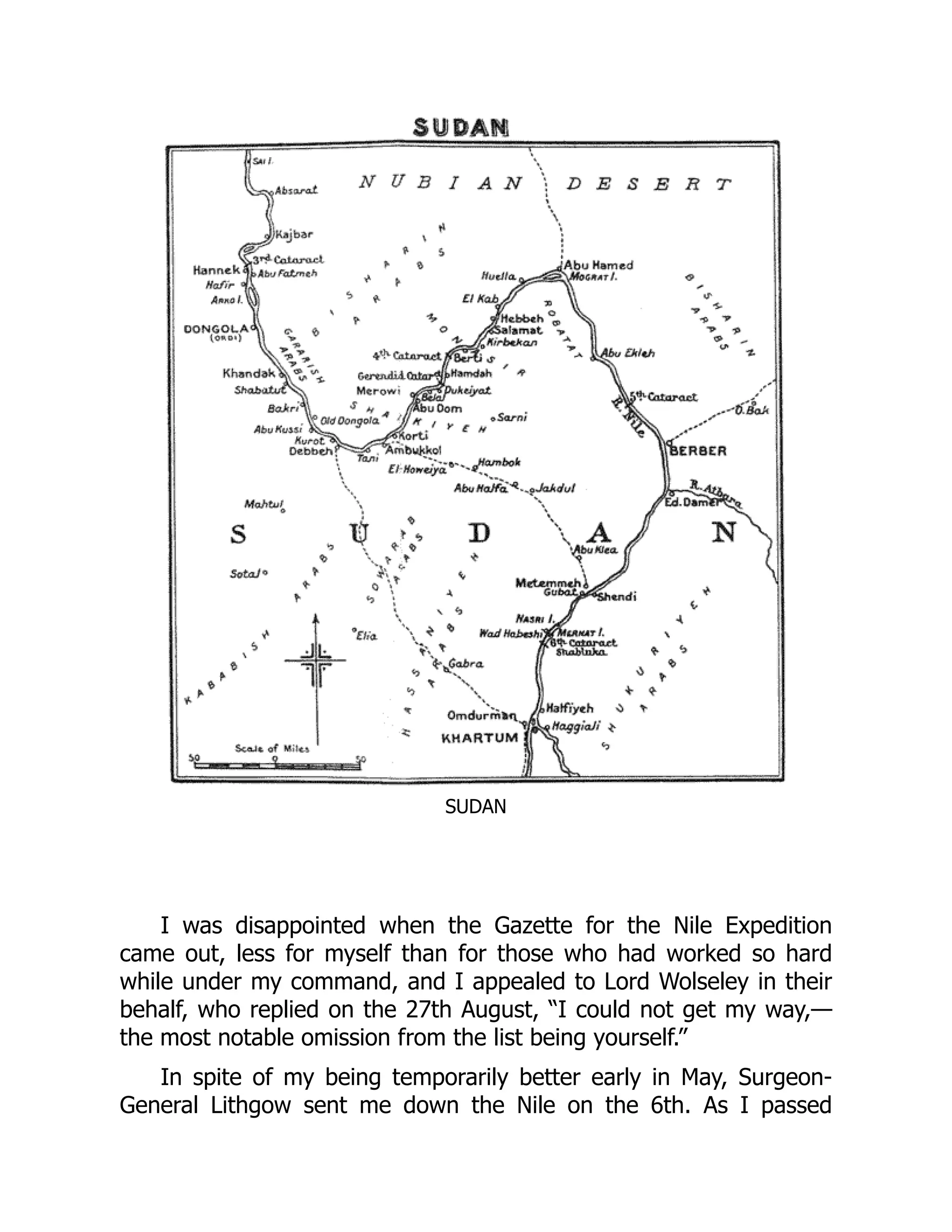
SUDAN
I was disappointedwhen the Gazette for the Nile Expedition
came out, less for myself than for those who had worked so hard
while under my command, and I appealed to Lord Wolseley in their
behalf, who replied on the 27th August, “I could not get my way,—
the most notable omission from the list being yourself.”
In spite of my being temporarily better early in May, Surgeon-
General Lithgow sent me down the Nile on the 6th. As I passed
27.
Korosko the Ababdehshanded me a sword which the Sheiks then in
Cairo had left for me, and a silver-mounted riding stick for Lady
Wood, and they came to see me off the day I left the capital.
Lord Wolseley had expressed astonishment on my declining his
offer of the Frontier command, but on seeing my thin body and
haggard face, was so startled that he tried to send me off to
England the day I reached Cairo. This I earnestly represented was
not necessary, as it was important that I should spend a few days in
order to settle matters at the Egyptian War Office.
28.
I
CHAPTER XLIII
1885–6–7–8—COLCHESTER DISTRICT
TheLand League—Mr. Wrench—Life at Colchester—Useless
Sentries—Reforms in Canteens—Nett profit trebled in twelve
months—3rd Class shots—An unusual Inspection—My last lie—
Visit to Corunna—Albuera.
REACHED London on the 19th of June, lighter in body than I
had been for many years, and I did not recover entirely from
intestinal troubles till late in the year. I was no sooner home than I had
some interesting correspondence with Mr. Wrench, my brother-in-law’s
agent at Clones in the north of Ireland. Since I assumed supervision of
the estate in 1867, we had lived on amicable terms with the tenants,
but in 1880 the Land League had formed branches in the north of
Ireland, and most of the Clones tenantry joined the League, in 1885–6.
One farmer quarrelled with the League agents, who ordered his
labourers to leave him, and the tenant appealed to Mr. Wrench for
permission to hire the pig-carriers, who on the weekly market day
carried pigs from the carts to the weighbridge, earning enough to
enable them to remain idle for the rest of the week. Mr. Wrench
observed, “I don’t care what the men do, but you cannot have them on
market day,” and they worked for the former Land Leaguer. The local
agent now wrote a demand to Mr. Wrench to dismiss the men from the
pig-carrying job, which being referred to me was summarily refused.
The League ordered that no pig buyer should go to Clones market, and
as it was not only a question of principle, but also of the tolls of the
market, worth £300 a year, we issued a notice that we would buy all
pigs at a fair rate which were not sold on market days. As trouble was
29.
anticipated, Colonel E.Saunderson, M.P., and some of his friends
attended the next market, to support Mr. Wrench, but the Boycott was
carried out without violence.
Mr. Wrench endeavoured to obtain buyers from Belfast, Drogheda,
Newry, and other towns, but the League was too firmly established to
enable him to succeed, and on the 23rd October I received the
following telegram:—“Sending you 642 pigs next week—Wrench.”
This was handed to me on my way to the War Office, and taking it
to the City, I obtained the names of three respectable pig salesmen.
Going to one shop in Smithfield, I asked, “What can you do for me,
about 600 pigs on Tuesday next?” The man said, “Are they ‘Lights’ or
‘Heavies’?” Now I knew something about Light and Heavy cavalry, but
the term as regards pigs was unfathomable, and like Tittlebat
Titmouse,
284
I said, “Little of both.” The salesman looked me over, and
contemptuously declined to quote a price, and so going farther down to
another firm I repeated the question, only putting it, “What can you get
me for ‘Lights,’ and what for ‘Heavies’?” and having obtained an
answer, I went outside, and telegraphed it to Wrench, adding, “Have
you tried at Londonderry?”
Londonderry bought all our pigs, and after six months’ quarrel the
Land League giving in, rescinded their notice about the carriers, my
brother-in-law’s whole loss in the transaction being something less than
a hundred pounds.
I took over the Command of the Eastern District from General
White on the 31st March, and spent therein three very happy years. As
soon as I had finished the inspection of the Regulars, and ten Militia,
and all the Volunteer Battalions in the district, I turned my attention to
“Long distance rides” for the Cavalry, and to initiating the practice of
Night marches for the Infantry, beginning by training Officers and
Sergeants, and the progress in the Army is shown by the fact that now
brigades march many miles by compass bearings without difficulty,
whereas, when I began at Colchester, the units became excited, and
lost their way, in crossing diagonally the Abbey Field, the parade
ground, of a few hundred yards in extent. Both officers and men took
30.
much interest intheir work, the Artillery binding their gun-wheels with
straw, to deaden the sound.
Most soldiers know the story of a sentry posted in the garden of
the Kremlin at Moscow, over a plant in which the Empress Catherine
was interested. The plant died in the winter, but the sentry post was
maintained for over a hundred years. I believe, however, many of my
comrades did not realise until the Boer War, the absurdities to be seen
in our garrisons. It was so easy under most Generals to get a sentry
posted; few even thought of removing a guard!
The day I assumed command at Colchester a sentry “Presented
Arms” to me at the office. “What does he do here?” “Oh, sir, he is your
sentry.” “Send him away; I don’t want him.” Next day I asked, “Why is
he still here?” “Oh, he’s sentry over Ordnance Stores, as well as over
your office.” There was a wall, 10 feet high, intervening between the
office and the Stores, so I ordered the post to be placed within the
enclosure. When on the third morning I found the man still at the office
door, I posted him myself inside the enclosure, but the Ordnance
officer, thinking the place was safer if it was kept locked, begged he
might be taken away.
Some days later, on visiting the huts forming the Garrison Hospital,
I found a sentry over a prisoners’ ward. “Open the door.” “Please, sir,
it’s locked.” “Yes, open it.” “I’ve got no key.” “Then call the Sergeant of
the guard; I want to see the prisoner.” “Please, sir, there is no prisoner.”
I said to the Medical Officer accompanying me, “What folly!” “Oh, there
was a prisoner, quite recently.” An indiscreet Lance-Corporal, of the
Army Hospital Corps, remarked, “There has been no prisoner for three
months.”
* * * * *
A perusal of the Crime statistics induced a visit to Harwich, where
one company of Garrison Artillery had more prisoners than 700 other
Artillerymen, in the Eastern District. Harwich and Landguard were not
responsible for this unpleasant fact, but Shotley Magazine Guard, a
detachment of some 25 Gunners stationed on a promontory between
the Stour and Orwell rivers. The Guard duties were not heavy, but
31.
there was absolutelyno means of recreation for the men. The nearest
farm was 2000 yards distant, but a public-house stood just outside the
fort.
I imagine that the prestige of the Master-General of the Ordnance,
typified by the Duke of Wellington, had not then died out, for I was
warned by my Staff not to interfere with a Magazine. I disregarded
their friendly counsels; removed all the celibate Artillery men, leaving a
Master Gunner and seven married men, one of whom had to sleep
dressed in the guard-room as a watchman, and to touch a tell-tale
clock thrice every night, at varying hours, as ordered by the Warrant
officer. This system has answered well to the present time.
* * * * *
In the Summer-time the officer commanding a Militia Battalion
complained to me that the officer commanding a Line Battalion
managing the canteen
285
would not give him sufficient for his share of
the profits. Both parties agreed to accept my decision, but the line
officer on my saying, “Well, give him from twenty to thirty pounds,”
observed, “We don’t make that in a quarter,” “Then you do your work
badly.” “If you think, sir, you could do it better, you had better try.”
“Yes, and I give you notice now, that I will manage it personally
through one of your officers, and non-commissioned officers, from the
1st October.” I made various innovations, advertising for tenders for
beer, and sending for two old soldiers out of each Company, who were
supplied with bread and cheese, desired them to pronounce as to the
merits of samples. They all asked whose beer it was they were
drinking? but the officers, who handed it out through a trap door, said,
by my direction, that they were to make a choice, without receiving
such information. A local Brewer obtained and kept the contract for
many years.
I published a Quarterly statement of accounts, which was hung up
in the canteen, and eventually paid £600 for rather more than half of a
bathing-place, 100 feet × 50, the War Office granting the remainder.
During the Summer-time I borrowed one of the bands twice a week to
play in the evenings outside the canteen, under a large awning, and
32.
encouraged the marriedfamilies to occupy the chairs I had placed for
them. I entirely failed, however, to induce them to take the tea and
coffee, which I persevered in providing, at somewhat less than cost
price, for several weeks.
The year before I took over the Command the divisible profit was
under £340, whereas after twelve months I divided £1400, and the
next year £1540. This money was earned to the detriment of the small
public-houses in the vicinity of the barracks. I made the canteen as far
as possible like a respectable music saloon, allowing free choice of
music, admitting even songs which I thought vulgar, if they were not of
an immoral tendency. I replaced the old beer-stained barrack tables
and forms by arm-chairs and marble-topped tables. The commanding
officers assured me I did not know what I was doing, and that there
would be no arm on a chair in three months’ time. Nevertheless I
persevered, although I admit I had some misgivings when I put two
large glass mirrors, 9 feet by 6, to light up the room, which being partly
underground was dark, as I thought it was possible some drunken
soldier might throw a pewter pot at them. Nothing untoward occurred
in my time, however, nor had there been a single breakage when I
visited the canteen some eight years afterwards. It is more remarkable
that one of my successors, General Burnett, ten years later made a
somewhat greater profit out of two Battalions, the garrison having
been temporarily reduced during the building of the barracks, and
mainly by raising the tone of the Entertainment.
The Adjutant-General wrote, the Eastern District was a model, and
the Canteen Regulations I had then drawn up, have with some
improvements since been adopted for the Army.
The Adjutant-General, Lord Wolseley, not only supported me
officially in my efforts to raise the tone of the Rank and File by trusting
them, but his private correspondence also was a great encouragement.
I mentioned to him I meant to persevere against the views of my
commanding officers, and in reply he wrote: our letter: every word of it
is after my own heart, I have always believed in trusting the British
soldier.”
33.
I had muchcorrespondence with him throughout 1886, ’87, and
’88, he putting me on many War Office Committees; one of these was
to decide whether the magazine of the new rifle should be Permanent
or Detachable; he himself was in favour of the latter, and was
proportionately disappointed when I took him the report of the
Committee, which, with one dissentient, was in favour of the
permanent arrangement. He asked, “Who is the one wise man?” I said,
“I am, sir.” “Then why did not you say so?” “Well, I thought it would
look as if I were conceited.” “But you are quite right.” “Yes, I think so.”
Two days later two of those who had voted for the permanent
arrangement came round and asked to be allowed to withdraw their
vote. Eventually difficulties of manufacture in the permanent system
caused the better method, the detachable, to be adopted.
In 1877 the Military Secretary asked if I was willing to be
considered for an appointment as Commandant-General in Australia.
Although I was advised by my Aide-de-Camp, a Tasmanian born, that
Federation was too far off to justify my hoping to succeed in
amalgamating the forces, I answered I would go if selected, but for
reasons unconnected with me, the idea at that time was not carried
out.
I was working throughout 1887 and 1888 on the subject of
diminishing the number of third-class shots in the Eastern District,
corresponding with the School of Musketry at Hythe, and we effected
some good, although the percentage of men useless with the Rifle
remained high.
The new Drill book was handed over to me for report, and many of
the antiquated movements formed the subject of somewhat heated
discussion between those who held Lord Wolseley’s views, which I was
advocating, and the Old School. My opinions were summed up in a
letter to his lordship, dated 8.8.87, “I hope, however, we may recognise
now, all our Drill is for the more ready destruction of our enemies, with
a minimum loss to ourselves, and that we prescribe formations
accordingly.”
I was frequently consulted on the vexed question of Chief of the
Staff, or Adjutant-General, and Quartermaster-General, on which the
34.
Commander-in-Chief and Adjutant-Generalcould not agree. The latter
system was maintained in Peace for eighteen years longer, but was
abandoned for warlike operations.
286
Lord Wolseley employed me constantly throughout the three years
I was at Colchester, with reference to his attempts to modernise the
Army; and the work he gave me, coupled with a close inspection of
every unit, Regulars and Auxiliary Forces, in the Eastern District, kept
me fully employed.
An interesting duty which came to me in July 1888 was the
selecting of positions to defend the approaches to London from the
eastward. The Headquarters Staff were unable at first to accept my
views, and came down three times, and on the last occasion with Lord
Wolseley, and the result was that he confirmed my judgment.
My father had lived, much respected, for forty years in Essex; my
elder brother, Charles Page Wood, farming his estate 10 miles distant,
was often in Colchester on market days, and being very popular I had
the advantage of the friendships they had made, when I wanted the
use of private lands for the training of troops. The occupiers near the
Barracks were very generous in allowing me to practise Outposts of all
Arms, and I often had a long line, mostly on arable land, without
serious complaint, though on one occasion a farmer aggrieved by
officers riding over a crop, ignoring my rank, said, “If you do that again
I’ll tell Mr. Evelyn Wood of you.”
I inspected the Infantry of the District as outposts by day and
night, and on the first occasion had to find grave fault with the
arrangements of a Battalion of which I had then, and have had ever
since, the highest opinion. I began my inspection on the left of a line of
3 miles, the Piquet in front of which was badly placed. No. 7 Company
was worse. On passing behind No. 6, a sentry who should have been
standing motionless looking to his front, faced about and “Presented
Arms” to me. Losing patience, I ordered the Battalion home, saw the
officers in the orderly room, and expressed very decided opinions as to
the want of instruction, indicated that morning. As I finished, saying,
“Gentlemen, I will see you again when your Commanding officer says
you are ready for inspection;” he observed, “It is just lunch time, sir,
35.
will you comein?” I did so, and my friendship with that Battalion has
been uninterrupted ever since.
A few evenings later, a Subaltern of the Battalion dining with me
alone, said, “We had such bad luck with you, General, last week, the
Regiment has now been inspected for 150 years, and you are the first
general who ever began on the left of the line, and we knew when the
word was passed up that you had started there, that we should have
an unhappy morning, for Bobby ——, our show captain,
288
was on the
right with the most capable officers, and on the extreme left were the
most inefficient. Now it generally happens that a general when he has
seen half a long outpost line well posted, being satisfied, goes home,
and we were calculating on a stereotyped inspection.”
In the middle of July, after seeing some interesting Artillery practice
on Dartmoor, I took my horses on to Exmoor, where Mr. Basset, the
Master of the Devon and Somerset Staghounds, had a meet for my
pleasure, and gave me a most enjoyable run.
* * * * *
Yielding to a warm invitation from Canon Bell, I went to
Marlborough at the end of the month, for the double purpose of
attending the breaking-up day and inspecting the Cadet companies.
While the Head was giving out prizes, he asked, “Sir Evelyn, did you
learn much Latin here?” “Not much, I’m afraid.” “Perhaps Greek?” “I
think less.” “Then may I ask what you did learn?” “Oh, I’ll tell you
presently, as you say I have got to speak to the School.”
When I got up, in the course of my speech I mentioned this fact,
and said, “I promised to tell the Head, and you at the same time. You
are probably envious of those boys who have taken prizes. In your
place I should have been, for I never took a prize during the five years
I was at school, but I learned something, and within 20 feet of where I
am now standing, in May 1851. The Reverend J. Biden was an ardent
fisherman, and one afternoon when our task was Arithmetic, somewhat
scamped in work in those days, we knew that ‘Jacky’ was anxious to
get out to the banks of the Kennet. He gave me four Addition sums out
of Colenso’s Arithmetic, which he apparently copied out of the book.
36.
After allowing aninterval of a quarter of an hour to elapse, I, taking
the answers from the book, wrote them down, and went up, expecting
to see a big ‘R’ across the slate, and an intimation that I might go. To
my horror he looked over the sums saying, ‘But you have fudged this?’
‘No, sir.’ ‘But you have.’ ‘No, sir.’ Now, if ‘Jacky’ had ordered me to
‘Stand round,’ I might have continued to tell lies till to-day; he said,
however, ‘I thought you were a brave little boy, and only cowards tell
lies.’ I say to you, Boys, whether you believe me or not, I have never
told a lie since, and that lesson was worth more than all the learning
acquired by all the prize-takers who have just now been up to this
table.”
I travelled Westward that evening, joining Sir John Pender, who
took a party in the S.S. Electra to the Mediterranean for a trip, inducing
Sir John to invite my friend, Colonel Ardagh,
289
for whom indeed he
waited till 1 a.m. on the 2nd September, when we sailed for Corunna. I
saw a great deal of Dean Bradley, who was a sympathetic companion,
and Sir Robert Herbert, whose charming personality was well known.
When we got into the Bay on the 3rd, I gave a lecture on Sir John
Moore’s battle, the scene of which we successfully visited next day,
except that Dean Bradley had a bad fall from a donkey, which rolled
over him. Our impression, which I imagine is that of everyone who has
visited the Field, was that Moore did very well under unusually difficult
circumstances.
We steamed round the coast of Portugal, waiting on the King at
Lisbon, and my kind host being greatly distressed to find I had no
medals, insisted on my wearing on my evening coat, which we put on
at midday, for our Royal audience, a C.M.G. Next day Ardagh and I
visited Torres Vedras, on which immensely strong position the works
erected by Wellington are apparently much as they were at the time of
their occupation, A.D. 1810.
The party now separated, Ardagh and I going by train to Badajos,
whence we visited the field of Albuera.
The young Spanish officer sent to us as a guide at Badajos because
he spoke a little French, was not aware that the British had successfully
assaulted the place, his knowledge of the operations of the Sieges
37.
being confined tothe attacks, and defence of the French and
Spaniards. It will repay any soldier even now to visit Badajos, for it is
easy to follow Napier’s wonderful description of the Assault.
Probably all soldiers have heard the story, that Lord Beresford had
ordered a retreat from Albuera when it was countermanded, and how
the gallant charge of the Fusilier Brigade snatched victory from the
French at the last moment. At Gibraltar, coming fresh from the
battlefield, I asked General Sir Arthur Hardinge, the Governor, “Did your
father ever talk to you of Albuera?” “Yes, very often.” “Is it true that he
was the Staff officer who countermanded Beresford’s order to retreat?”
“No, no one did so; but my father went to Beresford, and said, ‘You
have got, sir, a Court-martial on one hand, and a Peerage on the other,’
and he replied slowly, ‘I will try for the Peerage,’ and himself gave the
order to stop the retreat, and my father then ordered the Fusilier
Brigade to advance.”
When the ship reached Cadiz, on the 13th August, I received a
telegram from my wife, to whom a friend had confided the information
that Sir Archibald Alison was about to vacate the Aldershot command,
to join the India Council. Lord Wolseley had told me on many occasions
he intended to press for my appointment to that command, and at one
time he imagined the chances of my getting it were at ten to one; later,
my chances sank to even betting. I thought, in any case, it would be
wise for me to return home, and obtained the assent of our kind host
to my leaving the ship at Barcelona.
Nothing could exceed his generosity; he not only entertained us
perfectly on board, but insisted on paying our expenses on shore, even
to our washing bills, when we were at Granada, where I lingered for
forty-eight hours to enjoy more fully the Alhambra. Ardagh and I
returned from Barcelona, after a delightful trip, and I reached
Colchester after an absence of three weeks.
When the Headquarters Staff returned to London after the
holidays, there was a protracted discussion over the question of my
succeeding Sir Archibald Alison at Aldershot. Lord Wolseley advocated it
strenuously, as he expressly said, not for any regard for me, but
because he thought I was more successful in instructing
290
Regiments
38.
than any oneelse he knew. I was also, he thought, fit to take the
Division abroad should it be necessary.
The Commander-in-Chief wished to appoint an office for much
longer service, and after weeks of argument the matter was left to the
decision of Mr. Stanhope, the Secretary of State. He sent for Sir
Redvers Buller, who was Quartermaster-General, and asked for his
views. Buller replied, “I have seen three disasters in my service, and
they all came from want of instruction. Do you believe that Evelyn
Wood is a good teacher?” “Yes,” said Mr. Stanhope, “I am told he is
quite satisfactory in that respect.” “Then I advise you to appoint him.”
Mr. Stanhope was kind enough to say to me, when telling me the story,
“I am glad I did so.”
39.
A
CHAPTER XLIV
1889—ALDERSHOT
£3000 borrowedfor Installation—Rebuilding of Barracks
in Company blocks—Names of Barracks—A
troublesome inheritance of debt—Personal Staff—
Lonsdale Hale—Henderson—Commander-in-Chief
disapproves of Night Marches—The German
Emperor—Mr. Stanhope.
LTHOUGH I had some horses and sufficient furniture for the
house hired by Government for the General of the Eastern
District at Colchester, yet I had to borrow £3000 to instal myself at
Aldershot, where I took over Command on the 1st January. I
returned to Colchester twice for farewell festivities, which the
Residents kindly insisted on offering me. I received not only in Essex
but in East Anglia much hospitality during my Command.
On getting to my new station I had a conference on musketry,
but there being a Divisional Inspector for Aldershot I had merely to
indicate my wishes, and support him in trying to improve the
shooting of the troops.
I knew the wretched accommodation provided for the troops,
neither wind nor rain proof, having been quartered in the North and
South Camps twenty years earlier. The contractor in 1855 had
guaranteed the huts for thirteen years, so his work was good; but
40.
the annual upkeepamounted in the eighties to £7000, with a
constantly increasing outlay, in spite of the fact that the barracks of
three battalions in the North Camp had been rebuilt in brick, on the
bungalow principle.
I strongly advocated the immediate reconstruction of the South
Camp, and the rebuilding in brick for the units still hutted in the
North Camp, but on a different system. I had been striving for years
to get a fuller recognition of the Company system, the value of
which had been impressed on me in 1867–8, when I lived as Brigade
Major in the Lines of the 68th battalion (1st Durham Light Infantry).
One morning about 4 a.m., the Assistant Adjutant-General and I
having spent the night at Sandhurst College helping to extinguish a
fire, were parting close to his hut, when he said, “Send three more
companies over at once.” “Yes, sir.” “Which shall you send?” “68th.”
“Why, are they first for duty?” “Oh, I don’t know, nor care, for I am
tired; and if they go, I need not get up at 6.30. to ensure their
breakfasts are sent over.” When the battalion was leaving Aldershot,
General Sir Alfred Horsford said: “Wood, the 68th is the best
organised battalion I have ever known. Find out the reason.” Instead
of riding down to the station, I walked on in advance with the
Quarter-Master, Mr. Sladen, and from him elicited the fact that the
Company system had been started in the forties, and maintained
ever since, which accounted for the smoothness of running in the
battalion.
The Commanding officer’s or Adjutant’s battalion is good enough
for Peace and Show, but is ill-adapted for emergencies, and breaks-
down on service. The disadvantage of breaking up units, now
generally admitted in the army, was so little understood even thirty
years ago, that a common order was: “Send a strong squadron, or a
strong company;” and in 1881 when I demurred to sending from
Natal “a strong Company,” at least 120, to the mouth of the St. John
river, my brother General at Cape Town declined my alternative
proposal to send one Company, about 90, or two Companies, about
180 strong; and as I would not give way, the dispute was
telegraphed to the War Office, and the Adjutant-General, Lord
41.
Wolseley, approved ofmy action. I advocated, therefore, from
experience that the new barracks to be built should be in Company
blocks, and after some discussion this was approved. My
recommendation that each barrack should in name commemorate a
British victory, was approved only after repeated applications. I
personally “sited” all barracks built in my time, at a cost of about
£1,500,000. The Adjutant-General and Inspector-General of
Fortifications, who came to criticise before approving, on their
departure said frankly, “In London we did not like your scheme at all,
but are now in complete agreement with your views.” Later, when
the Plans, Prices, and Execution were questioned in the House of
Commons, the Secretary of State appointed a committee of Civilian
Architects and builders, who reported that the Royal Engineers had
made good plans, the Contractors had done their part satisfactorily,
and the country had obtained full value for its expenditure.
I inherited a troublesome task in the Officers’ Club-house, which
I found with an increasing debt, the liabilities standing at £1100, and
my brother officers disagreed with my economically drastic proposals
for meeting our liabilities, offering several impracticable suggestions;
one, that we should borrow the money in the name of the Division. I
asked the General officer who made this proposal if he would sign a
paper as one of the guarantors of the debt, but this he absolutely
declined! I then offered to put down; £100 on the table as my share,
if every officer in the Division would subscribe in proportion to his
pay, based on my pay and contribution. The Seniors at once vetoed
this suggestion, and my plans were eventually accepted, with the
result that four years later all the liabilities had been met, and I
handed a cash balance of over £1600 to my successor. This
satisfactory result was mainly owing to the business-like aptitudes of
my senior Aide-de-camp, Major C. Parsons,
291
Royal Artillery, who
made a profit of £550 out of Subscription dances.
Like Major Parsons, my Cavalry Aides-de-camp were selected on
military grounds; indeed I did not know personally either Captain
42.
Babington, 16th Lancers,or his successor, Captain H. D. Fanshawe,
19th Hussars, before they came to Aldershot.
Babington had been described to me as a keen soldier, and one
of the best “across country” men in the Cavalry, and he fully merited
the description. When he was obliged to rejoin his Regiment, on its
departure for India, I invited Hew Fanshawe to succeed him on my
personal Staff; I had noticed his singularly quiet but determined
manner, and thorough knowledge of all Regimental details two years
previously, when inspecting the Regiment of which he was Adjutant.
He was, moreover, a thorough sportsman, and in spite of being
badly off, hunted the Regimental pack of Staghounds while
quartered at Norwich, and was known to have got single-handed, in
Arran, on 12th August 1888, 161 grouse with 200 cartridges. I never
met a harder working officer, or one who understood better, stable
management. His horses never refused their food, though I have
known him rail them to Reading, ride 17 miles to meet the South
Oxfordshire hounds, and return at night to Aldershot. Such practical
sportsmen were of great assistance to me in the outdoor work which
now engaged most of my time.
The system of umpiring at tactical exercises with Opposing
forces was unsatisfactory, and it had the effect of stopping all
initiative on the part of the cavalry. In one of our first exercises I
came on a brigade halted near a small wood. I asked, “What is it;
why are you stopping?” “There are Infantry in the wood.” “How
many?” “We don’t know.” “Then why don’t you ascertain?” “If we go
forward and ascertain, the Umpire will send us home.” “Well, I shall
do that now, if you stop here doing nothing.” Then Sir Drury Lowe,
who commanded the Cavalry brigade, and with whom I had had the
pleasure of serving in India, and I set to work to improve matters.
We took command of opposing forces, Cavalry against Infantry, and
acted also as Umpires on terms of equality, and soon had the
satisfaction of seeing an improvement.
The Gunners had been dominated by the result of imaginary
Infantry fire, the effect of which was estimated by the results of
43.
target practice onknown ranges, and insufficient consideration had
been credited to the Artillery for the effect of their fire on the
opposing Infantry. The Artillery were still practising drill in use during
the Peninsula War; one of the favourite movements, and perhaps
the most useless, being “Changing front, right, and left, on the
centre sub-division.” I found there were two standards of Efficiency,
the Aldershot ideal, which may be described as smartness in turn-
out, and mobility, Regimentally known as “First gun off”; and the
Okehampton ideal, the motto for which was “Hit, Hit, Hit.” I tried to
combine the better points of the two systems. The General in
command of the Artillery, who possessed a high sense of duty, was,
however, best known in the Army from his desire to advance to
decisive Ranges. He talked openly, as indeed he wrote, against the
work at Okehampton, where, however, he had never seen his men
practise.
On the other hand, a very clever officer, who had the ear of the
Artillery authorities in Pall Mall, was engaged in editing a new drill
book, already in type, the key-note of which was “Service
conditions.” It inculculated, however, too strongly, in my opinion,
caution in order to avoid losses. I endeavoured to find a middle way
between these opposing views, and to some extent succeeded,
laying down the principle that our ideal should be the destruction of
the enemy as cheaply as possible, but when necessary at all costs.
After my first Artillery tactical exercise I remarked to the officers
assembled at the conference, that I had looked through the sights of
ten guns in one position, and found seven of them laid in the air.
The Artillery tactical days I initiated in 1890 induced greater
attention being paid to the handling of brigades when coming into
action, and enabled me to classify the individual skill of the
Lieutenant-Colonels in command. No part of my instructional duties
has given me so much pleasure as I got from working with the
Artillery, from the zest and broad-minded spirit with which Gunners
of all Ranks took up the new system. I do not know any compliment
which has pleased me so much as that paid to me by the Council in
1892, in enrolling me an honorary member of the Institution of the
44.
Royal Artillery, inrecognition of my efforts to improve the war
training of the Arm. The letter offering me the distinction was
couched in such appreciatory words as to enhance the value of the
honour.
I saw each Infantry Brigade separately, and created some
astonishment by the attention I demanded to exactitude in the
Manual exercises and in parade movements. One General said to
me, “We thought you did not care for such details.” I replied, “I do
not think battles are won by them, and want to do as little as
possible of them; but what we do should be done as well, and with
as much exactitude, as possible.”
While I was at Colchester I got three selected captains in
different Battalions to draw up a form of report of Company training,
which I introduced at Aldershot, and on which 82 Captains reported
at the end of the first and second years’ training. They were
practically unanimous in favour of it, suggesting only minor
alterations; and eighteen months later the Adjutant-General wrote:
“As the system of Company training introduced at Colchester and at
Aldershot by you has proved so successful, I am directed to ask you
to consider the larger question of training Battalions throughout the
year at all other Stations.”
I began in 1889 with Companies of Infantry, then in succession
giving my attention to the instruction of Battalions and Brigades, and
later, the handling of Forces of all Arms; and endeavoured to work
out the most useful method of applying Cavalry combined with
Mounted Infantry, both in Strategical and Tactical operations. In the
latter I made a point of never criticising adversely anyone, of
whatever rank, for having failed to carry out orders, if he had a
sound reason for not doing so.
In my criticisms on Tactical operations I was greatly assisted by
the friendly advice of an old comrade, Colonel Lonsdale Hale, a man
of calm judgment and of great military knowledge. He had at his
fingers’ ends every incident of the Franco-Prussian War, both as
regards the operations on the eastern frontier and those on the
45.
Welcome to ourwebsite – the perfect destination for book lovers and
knowledge seekers. We believe that every book holds a new world,
offering opportunities for learning, discovery, and personal growth.
That’s why we are dedicated to bringing you a diverse collection of
books, ranging from classic literature and specialized publications to
self-development guides and children's books.
More than just a book-buying platform, we strive to be a bridge
connecting you with timeless cultural and intellectual values. With an
elegant, user-friendly interface and a smart search system, you can
quickly find the books that best suit your interests. Additionally,
our special promotions and home delivery services help you save time
and fully enjoy the joy of reading.
Join us on a journey of knowledge exploration, passion nurturing, and
personal growth every day!
testbankfan.com