Measurement in ChemistryChapter 1
Lesson ObjectivesName appropriate apparatus for the measurement of time, temperature, mass and volume, including burettes, pipettes, measuring cylinders and gas syringesSuggest suitable apparatus, given relevant information, for a variety of simple experiments, including collection of gases
IntroductionIn order to communicate effectively, scientists all over the world use the International System of Units (S.I. units) as a common standard for their measurements.In laboratory, measurements are usually carried out to find the following:Mass of substancesVolumes of liquids and gasesTemperature of substancesTime taken for reactions
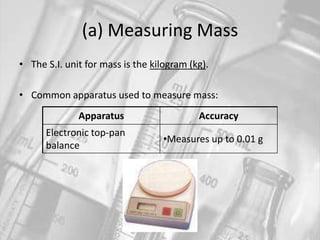
(a) Measuring MassThe S.I. unit for mass is the kilogram (kg).Common apparatus used to measure mass:
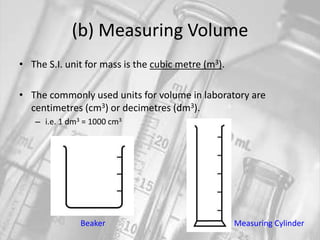
(b) Measuring VolumeThe S.I. unit for mass is the cubic metre (m3).The commonly used units for volume in laboratory are centimetres (cm3) or decimetres (dm3).i.e. 1 dm3 = 1000 cm3BeakerMeasuring Cylinder
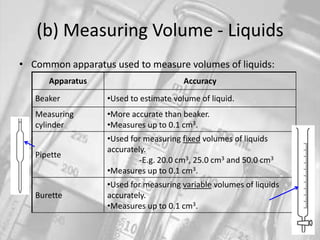
(b) Measuring Volume - LiquidsCommon apparatus used to measure volumes of liquids:
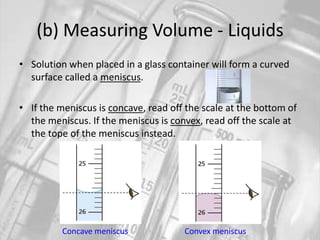
(b) Measuring Volume - LiquidsSolution when placed in a glass container will form a curved surface called a meniscus.If the meniscus is concave, read off the scale at the bottom of the meniscus. If the meniscus is convex, read off the scale at the tope of the meniscus instead.Concave meniscusConvex meniscus
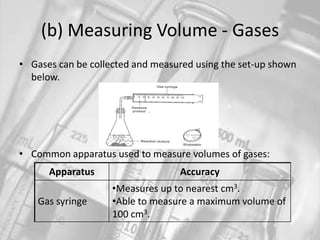
(b) Measuring Volume - GasesGases can be collected and measured using the set-up shown below.Common apparatus used to measure volumes of gases:
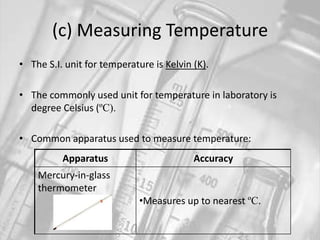
(c) Measuring TemperatureThe S.I. unit for temperature is Kelvin (K).The commonly used unit for temperature in laboratory is degree Celsius (ºC).Common apparatus used to measure temperature:
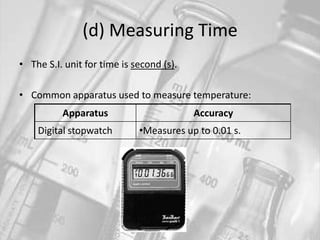
(d) Measuring TimeThe S.I. unit for time is second (s).Common apparatus used to measure temperature:
Objectives ChecklistName appropriate apparatus for the measurement of time, temperature, mass and volume, including burettes, pipettes, measuring cylinders and gas syringesSuggest suitable apparatus, given relevant information, for a variety of simple experiments, including collection of gases

Chapter 1 Slides

  • 1.
  • 2.
    Lesson ObjectivesName appropriateapparatus for the measurement of time, temperature, mass and volume, including burettes, pipettes, measuring cylinders and gas syringesSuggest suitable apparatus, given relevant information, for a variety of simple experiments, including collection of gases
  • 3.
    IntroductionIn order tocommunicate effectively, scientists all over the world use the International System of Units (S.I. units) as a common standard for their measurements.In laboratory, measurements are usually carried out to find the following:Mass of substancesVolumes of liquids and gasesTemperature of substancesTime taken for reactions
  • 4.
    (a) Measuring MassTheS.I. unit for mass is the kilogram (kg).Common apparatus used to measure mass:
  • 5.
    (b) Measuring VolumeTheS.I. unit for mass is the cubic metre (m3).The commonly used units for volume in laboratory are centimetres (cm3) or decimetres (dm3).i.e. 1 dm3 = 1000 cm3BeakerMeasuring Cylinder
  • 6.
    (b) Measuring Volume- LiquidsCommon apparatus used to measure volumes of liquids:
  • 7.
    (b) Measuring Volume- LiquidsSolution when placed in a glass container will form a curved surface called a meniscus.If the meniscus is concave, read off the scale at the bottom of the meniscus. If the meniscus is convex, read off the scale at the tope of the meniscus instead.Concave meniscusConvex meniscus
  • 8.
    (b) Measuring Volume- GasesGases can be collected and measured using the set-up shown below.Common apparatus used to measure volumes of gases:
  • 9.
    (c) Measuring TemperatureTheS.I. unit for temperature is Kelvin (K).The commonly used unit for temperature in laboratory is degree Celsius (ºC).Common apparatus used to measure temperature:
  • 10.
    (d) Measuring TimeTheS.I. unit for time is second (s).Common apparatus used to measure temperature:
  • 11.
    Objectives ChecklistName appropriateapparatus for the measurement of time, temperature, mass and volume, including burettes, pipettes, measuring cylinders and gas syringesSuggest suitable apparatus, given relevant information, for a variety of simple experiments, including collection of gases