1 of 40 © Boardworks Ltd 2008
2 of 40 © Boardworks Ltd 2008
3 of 40 © Boardworks Ltd 2008
Puberty: Body changes &
differences
© Changing Faces 2009 Registered Charity No. 1011222 Charity registered in Scotland SC039725
4 of 40 © Boardworks Ltd 2008
What happens during puberty?
Humans are born with a complete set
of sex organs. However, they do not
usually become active until between
the ages of 10 and 18.
In males, the testes start to make
sperm, and in females, the ovaries
start to release eggs.
This stage of development is called
puberty, and is caused by hormones.
During this important time, many
changes take place in the bodies
of young men and women.
5 of 40 © Boardworks Ltd 2008
Hormones
Hormones are chemicals that are
produced in one part of the body,
circulates all round the body in the blood
but only has an effect on a specific part
of the body.
At the age of 10 – 13 in girls and 12 – 14
in boys, the pituitary glands (beneath
the brain) secrete growth hormones
and gonadotropin.
Gonadotropin stimulates the production
of sex hormones.
6 of 40 © Boardworks Ltd 2008
In females the sex hormones produced
are oestrogen and progesterone
(produced in the ovaries).
In males the sex hormones produced is
testosterone (produced in the testicles).
The sex hormones cause the sex organs
to develop fully.
They work with the growth hormones
and cause the body to develop
(secondary sexual characteristics)
7 of 40 © Boardworks Ltd 2008
• What is puberty?
• What changes can we expect?
• A look at the differences between
girls and boys and amongst each
other
What this lesson will cover…What this lesson will cover…
8 of 40 © Boardworks Ltd 2008
What is puberty?
• PubertyPuberty is the time in life when you begin to become
an adult. This means a lot of changing and growing –
both inside and out.
• Some of the changes that happen in puberty are also
known as adolescenceadolescence..
• Puberty starts because of sex hormonessex hormones (chemicals in
our bodies that send messages about our
development).
• In adolescence a person also develops adult emotions
and social skills.
9 of 40 © Boardworks Ltd 2008
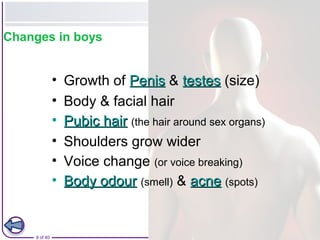
Changes in boys
• Growth of PenisPenis & testestestes (size)
• Body & facial hair
• Pubic hairPubic hair (the hair around sex organs)
• Shoulders grow wider
• Voice change (or voice breaking)
• Body odourBody odour (smell) & acneacne (spots)
10 of 40 © Boardworks Ltd 2008
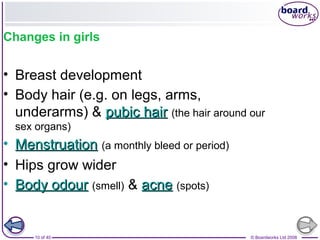
Changes in girls
• Breast development
• Body hair (e.g. on legs, arms,
underarms) & pubic hairpubic hair (the hair around our
sex organs)
• MenstruationMenstruation (a monthly bleed or period)
• Hips grow wider
• Body odourBody odour (smell) & acneacne (spots)
11 of 40 © Boardworks Ltd 2008
What is reproduction?
Reproduction is one of the
seven life processes.
Humans use sexual
reproduction to
produce their young.
In order to do this, the two
parents (male and female)
have different reproductive
systems and organs that
produce different sex cells.
All living things reproduce.
12 of 40 © Boardworks Ltd 2008
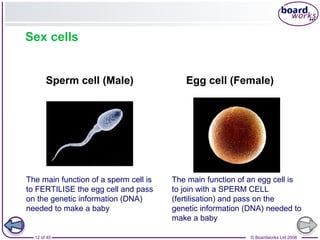
Sex cells
Sperm cell (Male) Egg cell (Female)
The main function of a sperm cell is
to FERTILISE the egg cell and pass
on the genetic information (DNA)
needed to make a baby
The main function of an egg cell is
to join with a SPERM CELL
(fertilisation) and pass on the
genetic information (DNA) needed to
make a baby
13 of 40 © Boardworks Ltd 2008
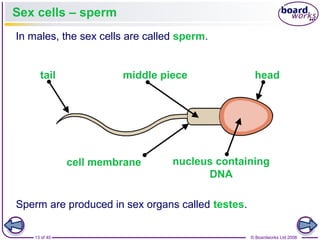
Sex cells – sperm
Sperm are produced in sex organs called testes.
In males, the sex cells are called sperm.
headtail middle piece
cell membrane nucleus containing
DNA
14 of 40 © Boardworks Ltd 2008
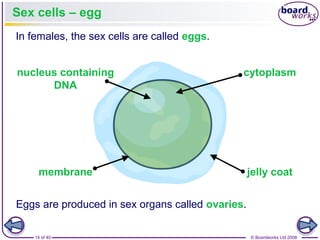
Sex cells – egg
Eggs are produced in sex organs called ovaries.
In females, the sex cells are called eggs.
nucleus containing
DNA
membrane jelly coat
cytoplasm
15 of 40 © Boardworks Ltd 2008
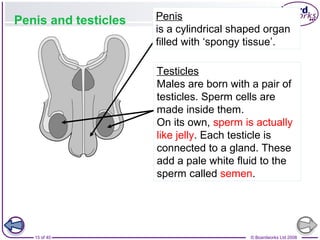
Penis and testicles Penis
is a cylindrical shaped organ
filled with ‘spongy tissue’.
Testicles
Males are born with a pair of
testicles. Sperm cells are
made inside them.
On its own, sperm is actually
like jelly. Each testicle is
connected to a gland. These
add a pale white fluid to the
sperm called semen.
16 of 40 © Boardworks Ltd 2008
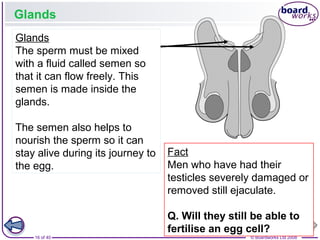
Glands
The sperm must be mixed
with a fluid called semen so
that it can flow freely. This
semen is made inside the
glands.
The semen also helps to
nourish the sperm so it can
stay alive during its journey to
the egg.
Fact
Men who have had their
testicles severely damaged or
removed still ejaculate.
Q. Will they still be able to
fertilise an egg cell?
Glands
17 of 40 © Boardworks Ltd 2008
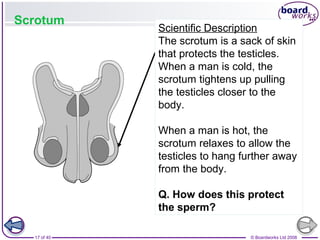
Scrotum
Scientific Description
The scrotum is a sack of skin
that protects the testicles.
When a man is cold, the
scrotum tightens up pulling
the testicles closer to the
body.
When a man is hot, the
scrotum relaxes to allow the
testicles to hang further away
from the body.
Q. How does this protect
the sperm?
18 of 40 © Boardworks Ltd 2008
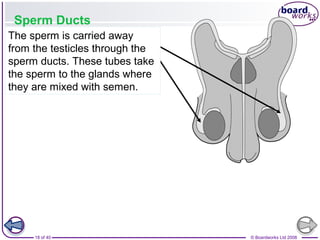
Sperm Ducts
The sperm is carried away
from the testicles through the
sperm ducts. These tubes take
the sperm to the glands where
they are mixed with semen.
19 of 40 © Boardworks Ltd 2008
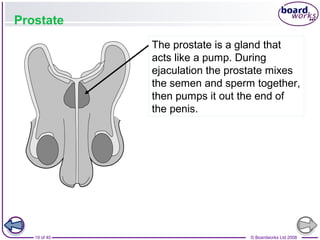
Prostate
The prostate is a gland that
acts like a pump. During
ejaculation the prostate mixes
the semen and sperm together,
then pumps it out the end of
the penis.
20 of 40 © Boardworks Ltd 2008
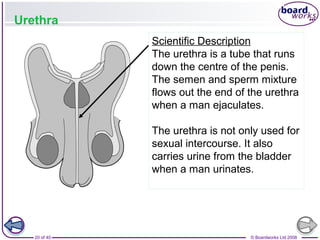
Urethra
Scientific Description
The urethra is a tube that runs
down the centre of the penis.
The semen and sperm mixture
flows out the end of the urethra
when a man ejaculates.
The urethra is not only used for
sexual intercourse. It also
carries urine from the bladder
when a man urinates.
21 of 40 © Boardworks Ltd 2008
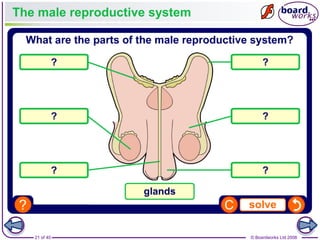
The male reproductive system
22 of 40 © Boardworks Ltd 2008
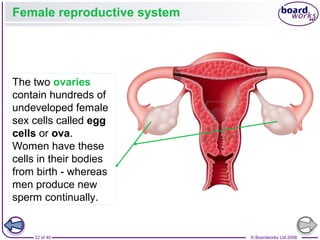
Female reproductive system
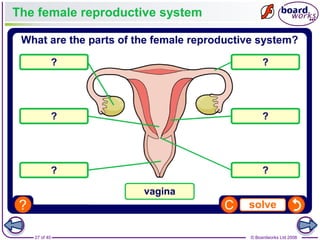
The two ovaries
contain hundreds of
undeveloped female
sex cells called egg
cells or ova.
Women have these
cells in their bodies
from birth - whereas
men produce new
sperm continually.
23 of 40 © Boardworks Ltd 2008
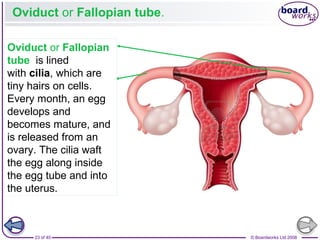
Oviduct or Fallopian tube.
Oviduct or Fallopian
tube is lined
with cilia, which are
tiny hairs on cells.
Every month, an egg
develops and
becomes mature, and
is released from an
ovary. The cilia waft
the egg along inside
the egg tube and into
the uterus.
24 of 40 © Boardworks Ltd 2008
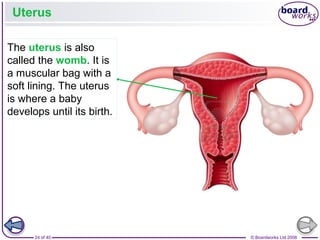
Uterus
The uterus is also
called the womb. It is
a muscular bag with a
soft lining. The uterus
is where a baby
develops until its birth.
25 of 40 © Boardworks Ltd 2008
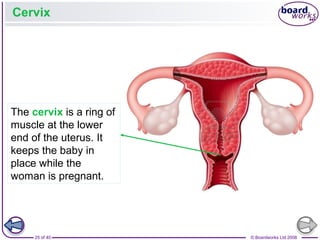
Cervix
The cervix is a ring of
muscle at the lower
end of the uterus. It
keeps the baby in
place while the
woman is pregnant.
26 of 40 © Boardworks Ltd 2008
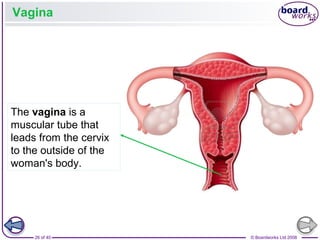
Vagina
The vagina is a
muscular tube that
leads from the cervix
to the outside of the
woman's body.
27 of 40 © Boardworks Ltd 2008
The female reproductive system
28 of 40 © Boardworks Ltd 2008
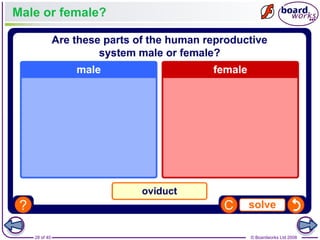
Male or female?
29 of 40 © Boardworks Ltd 2008
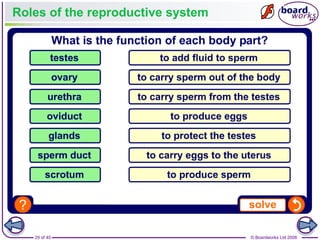
Roles of the reproductive system
30 of 40 © Boardworks Ltd 2008
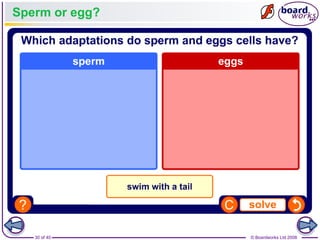
Sperm or egg?
31 of 40 © Boardworks Ltd 2008
32 of 40 © Boardworks Ltd 2008
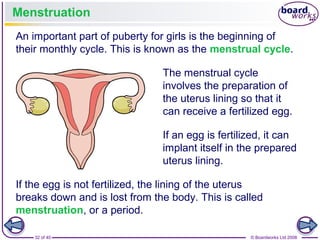
Menstruation
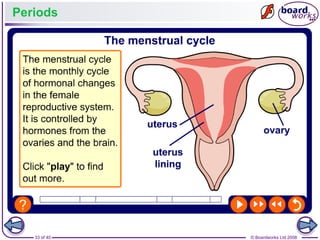
An important part of puberty for girls is the beginning of
their monthly cycle. This is known as the menstrual cycle.
The menstrual cycle
involves the preparation of
the uterus lining so that it
can receive a fertilized egg.
If an egg is fertilized, it can
implant itself in the prepared
uterus lining.
If the egg is not fertilized, the lining of the uterus
breaks down and is lost from the body. This is called
menstruation, or a period.
33 of 40 © Boardworks Ltd 2008
Periods
34 of 40 © Boardworks Ltd 2008
What is fertilization?
Fertilization is the fusing of an egg and a sperm cell. In this
process the sperm’s nucleus will join with the egg’s nucleus.
For a woman to become pregnant fertilization must occur.
Females produce an egg
approximately every 28 days.
This is called ovulation.
Males continually produce
sperm in the testes.
How do these cells come into close contact with each other?
35 of 40 © Boardworks Ltd 2008
Sexual intercourse
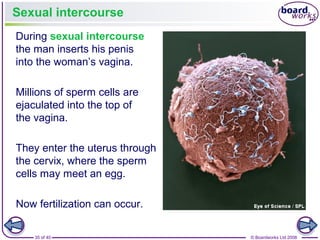
During sexual intercourse
the man inserts his penis
into the woman’s vagina.
Millions of sperm cells are
ejaculated into the top of
the vagina.
They enter the uterus through
the cervix, where the sperm
cells may meet an egg.
Now fertilization can occur.
36 of 40 © Boardworks Ltd 2008
Fertilization and implantation
37 of 40 © Boardworks Ltd 2008
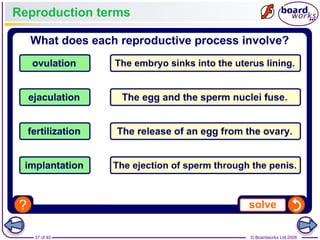
Reproduction terms
38 of 40 © Boardworks Ltd 2008
39 of 40 © Boardworks Ltd 2008
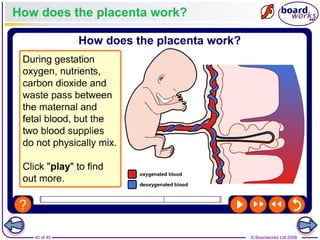
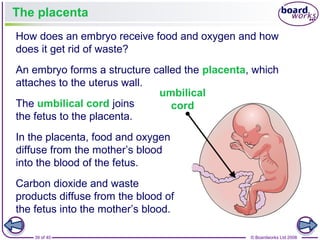
The placenta
How does an embryo receive food and oxygen and how
does it get rid of waste?
An embryo forms a structure called the placenta, which
attaches to the uterus wall.
The umbilical cord joins
the fetus to the placenta.
In the placenta, food and oxygen
diffuse from the mother’s blood
into the blood of the fetus.
Carbon dioxide and waste
products diffuse from the blood of
the fetus into the mother’s blood.
umbilical
cord
40 of 40 © Boardworks Ltd 2008
How does the placenta work?
41 of 40 © Boardworks Ltd 2008
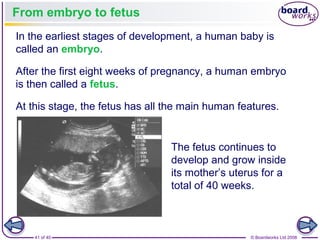
From embryo to fetus
In the earliest stages of development, a human baby is
called an embryo.
After the first eight weeks of pregnancy, a human embryo
is then called a fetus.
At this stage, the fetus has all the main human features.
The fetus continues to
develop and grow inside
its mother’s uterus for a
total of 40 weeks.
42 of 40 © Boardworks Ltd 2008
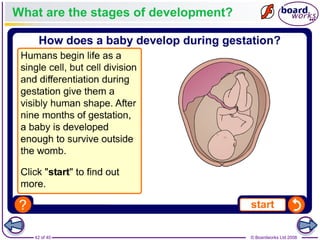
What are the stages of development?
43 of 40 © Boardworks Ltd 2008
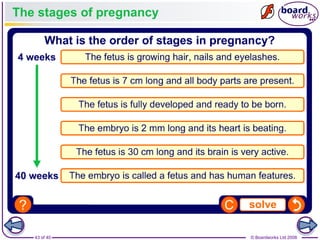
The stages of pregnancy
44 of 40 © Boardworks Ltd 2008
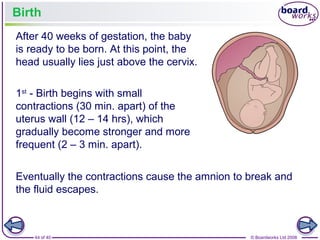
Birth
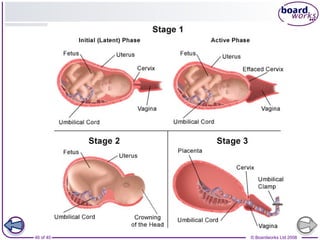
After 40 weeks of gestation, the baby
is ready to be born. At this point, the
head usually lies just above the cervix.
Eventually the contractions cause the amnion to break and
the fluid escapes.
1st
- Birth begins with small
contractions (30 min. apart) of the
uterus wall (12 – 14 hrs), which
gradually become stronger and more
frequent (2 – 3 min. apart).
45 of 40 © Boardworks Ltd 2008
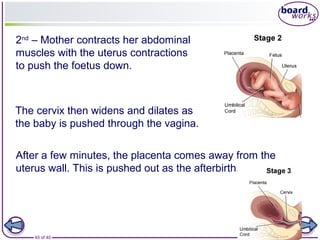
After a few minutes, the placenta comes away from the
uterus wall. This is pushed out as the afterbirth.
The cervix then widens and dilates as
the baby is pushed through the vagina.
2nd
– Mother contracts her abdominal
muscles with the uterus contractions
to push the foetus down.
46 of 40 © Boardworks Ltd 2008
47 of 40 © Boardworks Ltd 2008
48 of 40 © Boardworks Ltd 2008
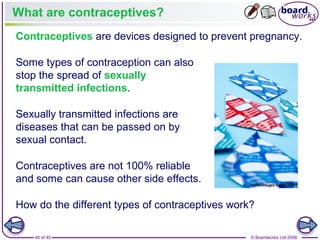
What are contraceptives?
Contraceptives are devices designed to prevent pregnancy.
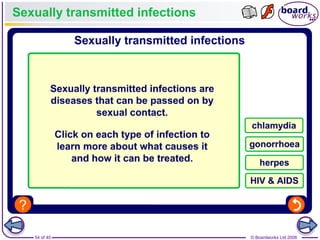
Sexually transmitted infections are
diseases that can be passed on by
sexual contact.
How do the different types of contraceptives work?
Contraceptives are not 100% reliable
and some can cause other side effects.
Some types of contraception can also
stop the spread of sexually
transmitted infections.
49 of 40 © Boardworks Ltd 2008
Different types of contraceptives
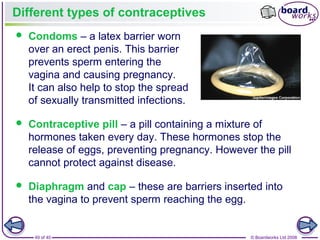
 Condoms – a latex barrier worn
over an erect penis. This barrier
prevents sperm entering the
vagina and causing pregnancy.
It can also help to stop the spread
of sexually transmitted infections.
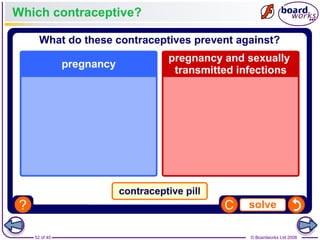
 Contraceptive pill – a pill containing a mixture of
hormones taken every day. These hormones stop the
release of eggs, preventing pregnancy. However the pill
cannot protect against disease.
 Diaphragm and cap – these are barriers inserted into
the vagina to prevent sperm reaching the egg.
50 of 40 © Boardworks Ltd 2008
Alternatives to contraception
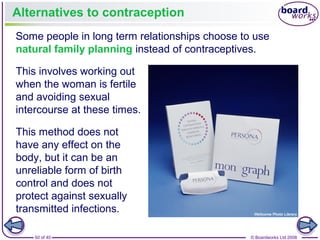
Some people in long term relationships choose to use
natural family planning instead of contraceptives.
This involves working out
when the woman is fertile
and avoiding sexual
intercourse at these times.
This method does not
have any effect on the
body, but it can be an
unreliable form of birth
control and does not
protect against sexually
transmitted infections.
51 of 40 © Boardworks Ltd 2008
Emergency contraception
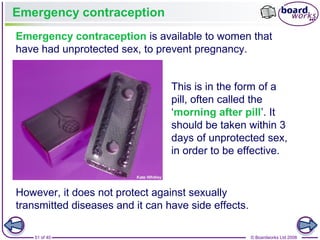
Emergency contraception is available to women that
have had unprotected sex, to prevent pregnancy.
This is in the form of a
pill, often called the
‘morning after pill’. It
should be taken within 3
days of unprotected sex,
in order to be effective.
However, it does not protect against sexually
transmitted diseases and it can have side effects.
52 of 40 © Boardworks Ltd 2008
Which contraceptive?
53 of 40 © Boardworks Ltd 2008
54 of 40 © Boardworks Ltd 2008
Sexually transmitted infections
55 of 40 © Boardworks Ltd 2008
HIV and AIDS
56 of 40 © Boardworks Ltd 2008
57 of 40 © Boardworks Ltd 2008
Glossary
58 of 40 © Boardworks Ltd 2008
Anagrams
59 of 40 © Boardworks Ltd 2008
Multiple-choice quiz

Ch.6.reproduction in humans

  • 1.
    1 of 40© Boardworks Ltd 2008
  • 2.
    2 of 40© Boardworks Ltd 2008
  • 3.
    3 of 40© Boardworks Ltd 2008 Puberty: Body changes & differences © Changing Faces 2009 Registered Charity No. 1011222 Charity registered in Scotland SC039725
  • 4.
    4 of 40© Boardworks Ltd 2008 What happens during puberty? Humans are born with a complete set of sex organs. However, they do not usually become active until between the ages of 10 and 18. In males, the testes start to make sperm, and in females, the ovaries start to release eggs. This stage of development is called puberty, and is caused by hormones. During this important time, many changes take place in the bodies of young men and women.
  • 5.
    5 of 40© Boardworks Ltd 2008 Hormones Hormones are chemicals that are produced in one part of the body, circulates all round the body in the blood but only has an effect on a specific part of the body. At the age of 10 – 13 in girls and 12 – 14 in boys, the pituitary glands (beneath the brain) secrete growth hormones and gonadotropin. Gonadotropin stimulates the production of sex hormones.
  • 6.
    6 of 40© Boardworks Ltd 2008 In females the sex hormones produced are oestrogen and progesterone (produced in the ovaries). In males the sex hormones produced is testosterone (produced in the testicles). The sex hormones cause the sex organs to develop fully. They work with the growth hormones and cause the body to develop (secondary sexual characteristics)
  • 7.
    7 of 40© Boardworks Ltd 2008 • What is puberty? • What changes can we expect? • A look at the differences between girls and boys and amongst each other What this lesson will cover…What this lesson will cover…
  • 8.
    8 of 40© Boardworks Ltd 2008 What is puberty? • PubertyPuberty is the time in life when you begin to become an adult. This means a lot of changing and growing – both inside and out. • Some of the changes that happen in puberty are also known as adolescenceadolescence.. • Puberty starts because of sex hormonessex hormones (chemicals in our bodies that send messages about our development). • In adolescence a person also develops adult emotions and social skills.
  • 9.
    9 of 40© Boardworks Ltd 2008 Changes in boys • Growth of PenisPenis & testestestes (size) • Body & facial hair • Pubic hairPubic hair (the hair around sex organs) • Shoulders grow wider • Voice change (or voice breaking) • Body odourBody odour (smell) & acneacne (spots)
  • 10.
    10 of 40© Boardworks Ltd 2008 Changes in girls • Breast development • Body hair (e.g. on legs, arms, underarms) & pubic hairpubic hair (the hair around our sex organs) • MenstruationMenstruation (a monthly bleed or period) • Hips grow wider • Body odourBody odour (smell) & acneacne (spots)
  • 11.
    11 of 40© Boardworks Ltd 2008 What is reproduction? Reproduction is one of the seven life processes. Humans use sexual reproduction to produce their young. In order to do this, the two parents (male and female) have different reproductive systems and organs that produce different sex cells. All living things reproduce.
  • 12.
    12 of 40© Boardworks Ltd 2008 Sex cells Sperm cell (Male) Egg cell (Female) The main function of a sperm cell is to FERTILISE the egg cell and pass on the genetic information (DNA) needed to make a baby The main function of an egg cell is to join with a SPERM CELL (fertilisation) and pass on the genetic information (DNA) needed to make a baby
  • 13.
    13 of 40© Boardworks Ltd 2008 Sex cells – sperm Sperm are produced in sex organs called testes. In males, the sex cells are called sperm. headtail middle piece cell membrane nucleus containing DNA
  • 14.
    14 of 40© Boardworks Ltd 2008 Sex cells – egg Eggs are produced in sex organs called ovaries. In females, the sex cells are called eggs. nucleus containing DNA membrane jelly coat cytoplasm
  • 15.
    15 of 40© Boardworks Ltd 2008 Penis and testicles Penis is a cylindrical shaped organ filled with ‘spongy tissue’. Testicles Males are born with a pair of testicles. Sperm cells are made inside them. On its own, sperm is actually like jelly. Each testicle is connected to a gland. These add a pale white fluid to the sperm called semen.
  • 16.
    16 of 40© Boardworks Ltd 2008 Glands The sperm must be mixed with a fluid called semen so that it can flow freely. This semen is made inside the glands. The semen also helps to nourish the sperm so it can stay alive during its journey to the egg. Fact Men who have had their testicles severely damaged or removed still ejaculate. Q. Will they still be able to fertilise an egg cell? Glands
  • 17.
    17 of 40© Boardworks Ltd 2008 Scrotum Scientific Description The scrotum is a sack of skin that protects the testicles. When a man is cold, the scrotum tightens up pulling the testicles closer to the body. When a man is hot, the scrotum relaxes to allow the testicles to hang further away from the body. Q. How does this protect the sperm?
  • 18.
    18 of 40© Boardworks Ltd 2008 Sperm Ducts The sperm is carried away from the testicles through the sperm ducts. These tubes take the sperm to the glands where they are mixed with semen.
  • 19.
    19 of 40© Boardworks Ltd 2008 Prostate The prostate is a gland that acts like a pump. During ejaculation the prostate mixes the semen and sperm together, then pumps it out the end of the penis.
  • 20.
    20 of 40© Boardworks Ltd 2008 Urethra Scientific Description The urethra is a tube that runs down the centre of the penis. The semen and sperm mixture flows out the end of the urethra when a man ejaculates. The urethra is not only used for sexual intercourse. It also carries urine from the bladder when a man urinates.
  • 21.
    21 of 40© Boardworks Ltd 2008 The male reproductive system
  • 22.
    22 of 40© Boardworks Ltd 2008 Female reproductive system The two ovaries contain hundreds of undeveloped female sex cells called egg cells or ova. Women have these cells in their bodies from birth - whereas men produce new sperm continually.
  • 23.
    23 of 40© Boardworks Ltd 2008 Oviduct or Fallopian tube. Oviduct or Fallopian tube is lined with cilia, which are tiny hairs on cells. Every month, an egg develops and becomes mature, and is released from an ovary. The cilia waft the egg along inside the egg tube and into the uterus.
  • 24.
    24 of 40© Boardworks Ltd 2008 Uterus The uterus is also called the womb. It is a muscular bag with a soft lining. The uterus is where a baby develops until its birth.
  • 25.
    25 of 40© Boardworks Ltd 2008 Cervix The cervix is a ring of muscle at the lower end of the uterus. It keeps the baby in place while the woman is pregnant.
  • 26.
    26 of 40© Boardworks Ltd 2008 Vagina The vagina is a muscular tube that leads from the cervix to the outside of the woman's body.
  • 27.
    27 of 40© Boardworks Ltd 2008 The female reproductive system
  • 28.
    28 of 40© Boardworks Ltd 2008 Male or female?
  • 29.
    29 of 40© Boardworks Ltd 2008 Roles of the reproductive system
  • 30.
    30 of 40© Boardworks Ltd 2008 Sperm or egg?
  • 31.
    31 of 40© Boardworks Ltd 2008
  • 32.
    32 of 40© Boardworks Ltd 2008 Menstruation An important part of puberty for girls is the beginning of their monthly cycle. This is known as the menstrual cycle. The menstrual cycle involves the preparation of the uterus lining so that it can receive a fertilized egg. If an egg is fertilized, it can implant itself in the prepared uterus lining. If the egg is not fertilized, the lining of the uterus breaks down and is lost from the body. This is called menstruation, or a period.
  • 33.
    33 of 40© Boardworks Ltd 2008 Periods
  • 34.
    34 of 40© Boardworks Ltd 2008 What is fertilization? Fertilization is the fusing of an egg and a sperm cell. In this process the sperm’s nucleus will join with the egg’s nucleus. For a woman to become pregnant fertilization must occur. Females produce an egg approximately every 28 days. This is called ovulation. Males continually produce sperm in the testes. How do these cells come into close contact with each other?
  • 35.
    35 of 40© Boardworks Ltd 2008 Sexual intercourse During sexual intercourse the man inserts his penis into the woman’s vagina. Millions of sperm cells are ejaculated into the top of the vagina. They enter the uterus through the cervix, where the sperm cells may meet an egg. Now fertilization can occur.
  • 36.
    36 of 40© Boardworks Ltd 2008 Fertilization and implantation
  • 37.
    37 of 40© Boardworks Ltd 2008 Reproduction terms
  • 38.
    38 of 40© Boardworks Ltd 2008
  • 39.
    39 of 40© Boardworks Ltd 2008 The placenta How does an embryo receive food and oxygen and how does it get rid of waste? An embryo forms a structure called the placenta, which attaches to the uterus wall. The umbilical cord joins the fetus to the placenta. In the placenta, food and oxygen diffuse from the mother’s blood into the blood of the fetus. Carbon dioxide and waste products diffuse from the blood of the fetus into the mother’s blood. umbilical cord
  • 40.
    40 of 40© Boardworks Ltd 2008 How does the placenta work?
  • 41.
    41 of 40© Boardworks Ltd 2008 From embryo to fetus In the earliest stages of development, a human baby is called an embryo. After the first eight weeks of pregnancy, a human embryo is then called a fetus. At this stage, the fetus has all the main human features. The fetus continues to develop and grow inside its mother’s uterus for a total of 40 weeks.
  • 42.
    42 of 40© Boardworks Ltd 2008 What are the stages of development?
  • 43.
    43 of 40© Boardworks Ltd 2008 The stages of pregnancy
  • 44.
    44 of 40© Boardworks Ltd 2008 Birth After 40 weeks of gestation, the baby is ready to be born. At this point, the head usually lies just above the cervix. Eventually the contractions cause the amnion to break and the fluid escapes. 1st - Birth begins with small contractions (30 min. apart) of the uterus wall (12 – 14 hrs), which gradually become stronger and more frequent (2 – 3 min. apart).
  • 45.
    45 of 40© Boardworks Ltd 2008 After a few minutes, the placenta comes away from the uterus wall. This is pushed out as the afterbirth. The cervix then widens and dilates as the baby is pushed through the vagina. 2nd – Mother contracts her abdominal muscles with the uterus contractions to push the foetus down.
  • 46.
    46 of 40© Boardworks Ltd 2008
  • 47.
    47 of 40© Boardworks Ltd 2008
  • 48.
    48 of 40© Boardworks Ltd 2008 What are contraceptives? Contraceptives are devices designed to prevent pregnancy. Sexually transmitted infections are diseases that can be passed on by sexual contact. How do the different types of contraceptives work? Contraceptives are not 100% reliable and some can cause other side effects. Some types of contraception can also stop the spread of sexually transmitted infections.
  • 49.
    49 of 40© Boardworks Ltd 2008 Different types of contraceptives  Condoms – a latex barrier worn over an erect penis. This barrier prevents sperm entering the vagina and causing pregnancy. It can also help to stop the spread of sexually transmitted infections.  Contraceptive pill – a pill containing a mixture of hormones taken every day. These hormones stop the release of eggs, preventing pregnancy. However the pill cannot protect against disease.  Diaphragm and cap – these are barriers inserted into the vagina to prevent sperm reaching the egg.
  • 50.
    50 of 40© Boardworks Ltd 2008 Alternatives to contraception Some people in long term relationships choose to use natural family planning instead of contraceptives. This involves working out when the woman is fertile and avoiding sexual intercourse at these times. This method does not have any effect on the body, but it can be an unreliable form of birth control and does not protect against sexually transmitted infections.
  • 51.
    51 of 40© Boardworks Ltd 2008 Emergency contraception Emergency contraception is available to women that have had unprotected sex, to prevent pregnancy. This is in the form of a pill, often called the ‘morning after pill’. It should be taken within 3 days of unprotected sex, in order to be effective. However, it does not protect against sexually transmitted diseases and it can have side effects.
  • 52.
    52 of 40© Boardworks Ltd 2008 Which contraceptive?
  • 53.
    53 of 40© Boardworks Ltd 2008
  • 54.
    54 of 40© Boardworks Ltd 2008 Sexually transmitted infections
  • 55.
    55 of 40© Boardworks Ltd 2008 HIV and AIDS
  • 56.
    56 of 40© Boardworks Ltd 2008
  • 57.
    57 of 40© Boardworks Ltd 2008 Glossary
  • 58.
    58 of 40© Boardworks Ltd 2008 Anagrams
  • 59.
    59 of 40© Boardworks Ltd 2008 Multiple-choice quiz

Editor's Notes

  • #2 This presentation has links with PSHE.
  • #5 Teacher notes This section has cross curricular links with PSHE.
  • #12 Photo credit: Jupiterimages Corporation
  • #35 Photo credit: Jupiterimages Corporation
  • #36 Photo credit: Eye of Science/SPL
  • #49 Teachers notesHuman reproduction worksheet 1 accompanies this section on contraception. It could be used as a summary activity at the end of this section.
  • #50 Photo credit: Jupiterimages Corporation Teacher notes A female condom is also available. It loosely lines the vagina, forming a barrier preventing semen from meeting an egg.
  • #51 Photo credit: Wellcome Photo Library
  • #52 Photo credit: Kate Whitley Teacher notes Photo: Pack of progesterone-only morning after pill with the box. This type of emergency contraception is available over the counter from a pharmacist. It could be made clear here that it is called emergency contraception because it should be used as a last resort. Ideally people should use other methods of contraception before or during sex. Emergency contraception should not be used as a substitute for other types of contraception. If appropriate you may want to tell the students that the emergency contraception can be obtained from a doctor or pharmacy.
  • #55 Teachers notes HIV and AIDS has only been covered briefly in this flash activity. It may be useful to provide pupils with a more detailed explanation covering the difference between being HIV-positive and having AIDS. See the ‘Microbes and Disease’ presentation for more about infectious diseases.
  • #56 Human reproduction worksheet 1 accompanies this slide Teachers notes The yellow boxes show how many people are living with HIV in each country. Globally 33.2 million adults and children are living with HIV/AIDS.
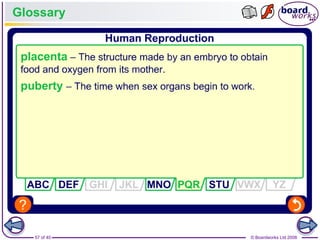
  • #58 contraceptive – A method or device used to prevent pregnancy, including the condom and contraceptive pill. egg – The female sex cell. embryo – An unborn baby during its first two months of development. fertilization – When the egg and sperm nuclei fuse. menstrual cycle – The monthly cycle in females. ovary – The part of the female reproductive system that produces eggs. ovulation – The release of an egg from the ovary. placenta – The structure made by an embryo to obtain food and oxygen from its mother. puberty – The time when sex organs begin to work. sexually transmitted infection – A disease that can be transmitted via sexual contact. sperm – The male sex cell. testis – The part of the male reproductive system that produces sperm.