CHAPTER 1SECTION 1,2,3
1: Human Origins in Africa
2: Humans Try to Control Nature
3: Civilizations Develop
Human Origins
in Africa
Chapter 1 Section 1
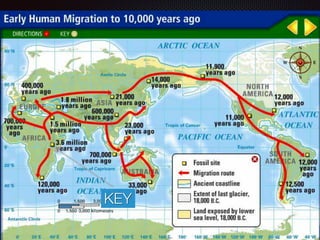
Humans migrate throughout
much of the world and begin
to develop tools, art,
agriculture and cities.
KEY
What is
Prehistory?
Time BEFORE the
invention of writing, so
about 5,000+ years ago
So how do historians study
prehistory?
Several occupations specialize in
investigating what happened in the
“before history” period:
archeologists, anthropologists, and
paleontologists.
ARCHEOLOGISTS
…learn about the earliest people
through excavating their settlements.
They utilize bones and artifacts to
come up with theories about how
humans lived in the past.
Examples?
How does this system work?
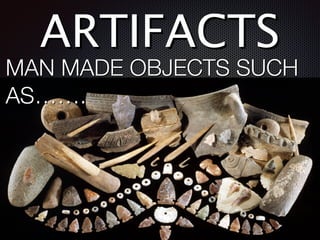
ARTIFACTS
MAN MADE OBJECTS SUCH
AS…….
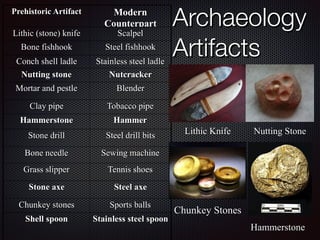
Archaeology
Artifacts
Prehistoric Artifact Modern
Counterpart
Lithic (stone) knife Scalpel
Bone fishhook Steel fishhook
Conch shell ladle Stainless steel ladle
Nutting stone Nutcracker
Mortar and pestle Blender
Clay pipe Tobacco pipe
Hammerstone Hammer
Stone drill Steel drill bits
Bone needle Sewing machine
Grass slipper Tennis shoes
Stone axe Steel axe
Chunkey stones Sports balls
Shell spoon Stainless steel spoon
Lithic Knife Nutting Stone
Hammerstone
Chunkey Stones
EXAMPLE SCENARIO
You are an archeologist you find
remains of a civilization where all
the houses are of equal sizes,
with musical instruments, and
large walls built around the city.

What can you
deduce?
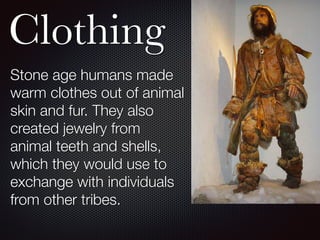
Clothing
Stone age humans made
warm clothes out of animal
skin and fur. They also
created jewelry from
animal teeth and shells,
which they would use to
exchange with individuals
from other tribes.
ANTHROPOLOGISTS
Study the cultures of ancient
peoples. They use artifacts and
other sources of information to
learn about the life style, social
dynamics, beliefs, and values
historical cultures possessed.
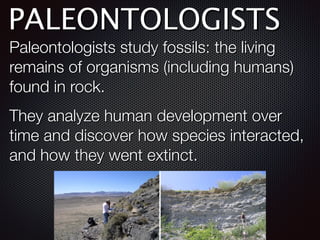
PALEONTOLOGISTS
Paleontologists study fossils: the living
remains of organisms (including humans)
found in rock.
They analyze human development over
time and discover how species interacted,
and how they went extinct.
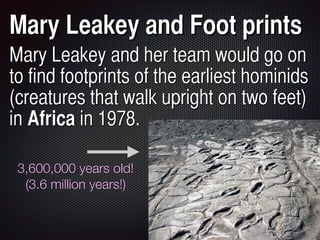
Mary Leakey and Foot prints
Mary Leakey and her team would go on
to find footprints of the earliest hominids
(creatures that walk upright on two feet)
in Africa in 1978.
3,600,000 years old!
(3.6 million years!)
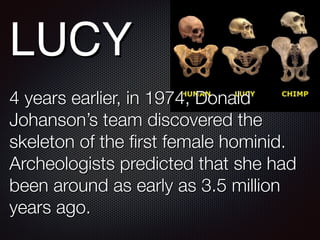
LUCY
4 years earlier, in 1974, Donald
Johanson’s team discovered the
skeleton of the first female hominid.
Archeologists predicted that she had
been around as early as 3.5 million
years ago.
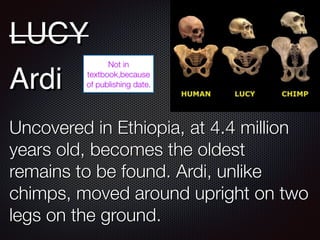
LUCY
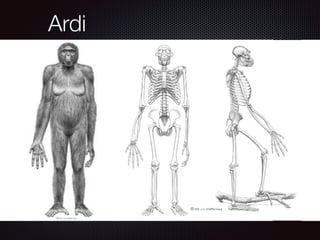
Ardi
Uncovered in Ethiopia, at 4.4 million
years old, becomes the oldest
remains to be found. Ardi, unlike
chimps, moved around upright on two
legs on the ground.
Not in
textbook,because
of publishing date.
Ardi
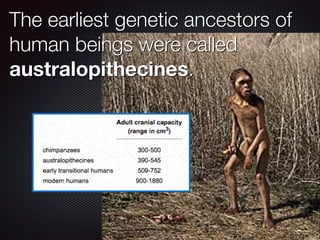
The earliest genetic ancestors of
human beings were called
australopithecines.
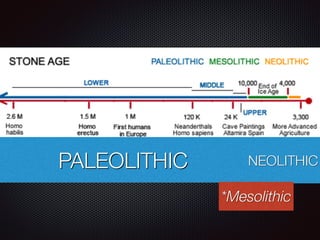
THE STONE AGES
Refers to 2.5 million years ago
to 3,000 BC
The Paleolithic is the Old Stone Age
The Neolithic is the New Stone Age
PALEOLITHIC NEOLITHIC
*Mesolithic
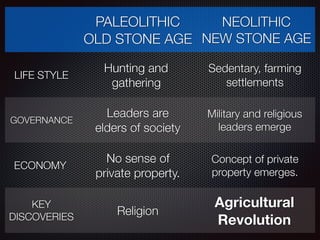
PALEOLITHIC

OLD STONE AGE
NEOLITHIC

NEW STONE AGE
LIFE STYLE
Hunting and
gathering
Sedentary, farming
settlements
GOVERNANCE
Leaders are
elders of society
Military and religious
leaders emerge
ECONOMY	
No sense of
private property.
Concept of private
property emerges.
KEY
DISCOVERIES
Religion
Agricultural
Revolution
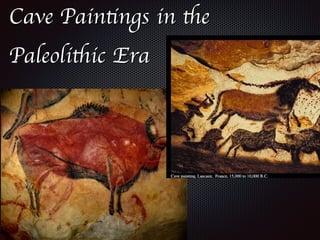
Cave Paintings in the
Paleolithic Era
No Agreement about the Meaning
1. Spirituality: paintings for shamans and religious
purposes.
2. Art for arts sake.
3. Hunting Information: Pictures provide images
for hunters in regards to animals they need to
hunt for.
4. Marking territory.
5. Initiation rites: Children when reaching a certain
age would be taken to the cave to see the
paintings.
The HOMO-HABILIS
The group following australopithecines was
the new hominids (or transitional humans) that
a appeared in Africa 2.5 million years later.
One of the earliest new hominids was known
as Homo Habilis, “Man of skill”, since they
utilized tools to survive.
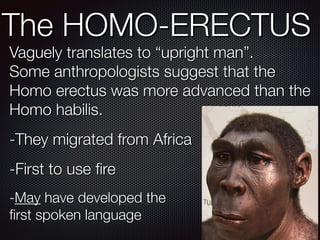
The HOMO-ERECTUS
Vaguely translates to “upright man”. 

Some anthropologists suggest that the
Homo erectus was more advanced than the
Homo habilis.
-They migrated from Africa
-First to use fire
-May have developed the
first spoken language
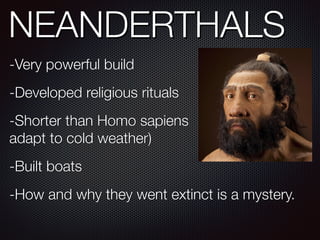
NEANDERTHALS
-Very powerful build
-Developed religious rituals
-Shorter than Homo sapiens (to
adapt to cold weather)
-Built boats
-How and why they went extinct is a mystery.
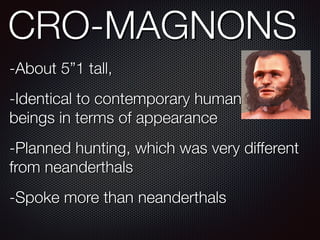
CRO-MAGNONS
-About 5”1 tall,
-Identical to contemporary human
beings in terms of appearance
-Planned hunting, which was very different
from neanderthals
-Spoke more than neanderthals
The HOMO SAPIENS
The Homo erectus would eventually develop
into what human beings are today, Homo
sapiens.
-Means “wise men”
-Physically very similar to the Homo erectus,
however, has a much larger brain.
Why Homo-Sapiens?
Not only were homo sapiens “smarter”
with a larger brain, but they also had a
greater social network of relying on each
other. This social network may have
helped humans survive during times the
neanderthals and cro-magnons could
not.
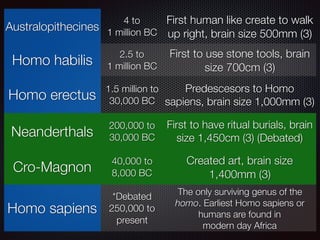
Australopithecines
4 to
1 million BC
First human like create to walk
up right, brain size 500mm (3)
Homo habilis
2.5 to
1 million BC
First to use stone tools, brain
size 700cm (3)
Homo erectus
1.5 million to
30,000 BC
Predescesors to Homo
sapiens, brain size 1,000mm (3)
Neanderthals
200,000 to
30,000 BC
First to have ritual burials, brain
size 1,450cm (3) (Debated)
Cro-Magnon
40,000 to
8,000 BC
Created art, brain size
1,400mm (3)
Homo sapiens
*Debated

250,000 to
present
The only surviving genus of the
homo. Earliest Homo sapiens or
humans are found in 

modern day Africa
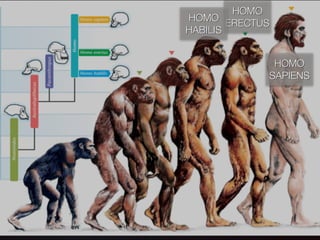
HOMO
ERECTUS
HOMO
SAPIENS
HOMO
HABILIS
Humans try to
Control Nature
Chapter 1 Section 2
40,000 years ago, Homo
sapiens began to look very
similar to modern humans.
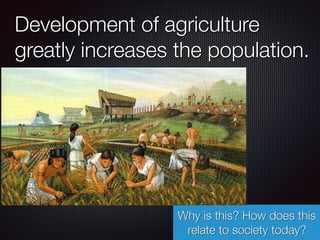
Development of agriculture
greatly increases the population.
Why is this? How does this
relate to society today?
EARLY ADVANCES
IN TECHNOLOGY
-The earliest groups were nomads that
hunted and gathered.
-In order to survive they created
weapons to hunt down animals and
various tools to butcher animals and to
sew their hides into clothing.
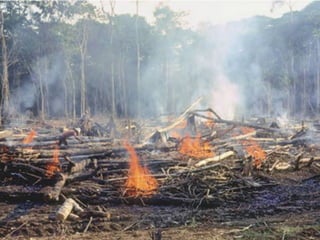
SLASH AND BURN
AGRICULTURE
This was done by clearing land by
cutting and burning trees, then moving
on to new soil every 1-2 years. It was
not a sustainable method of farming
because the nutrients in the soil could
not be replenished.
SLASH AND BURN
TODAY
Still utilized in various locations today
and has resulted in massive
deforestation and soil erosion.
It is especially common in central Africa,
northern South America and Southeast
Asia.
DOMESTICATION
Domestication refers to the taming of
wild animals such as horses, dogs,
goats, and pigs.
It was a critical breakthrough for
human beings because domestication
meant a constant food source was
available.
Villages Grow Around the World
Places near rivers prosper.
-Africa: Near the Nile River
-China: Near the Yellow River
-Central America: An increase in beans and
squash.
-Peru: Growth in tomatoes, sweet potatoes and
white potatoes.
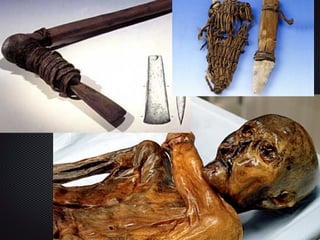
Neolithic Ice Man
In 1991, two German hikers accidentally
discovered the remains of a prehistoric man
that had been there for over 5000 years.
He was nicknamed the “Ice Man”, this early
human was not empty handed and had a
tool kit including a longbow.
The Ice Man can be seen at a museum in
Italy today.
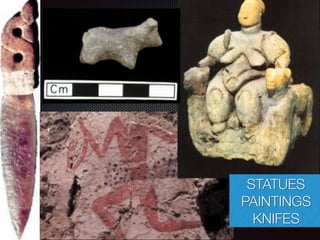
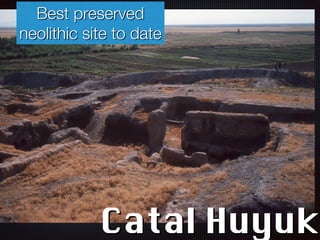
Catal Huyuk
Best preserved neolithic site to date
Discovered in 1958.
Farming thrived from 8,000 years ago,
population grew with the availability of crops.
Various remains are found including
paintings, religious shrines, sculptures.
STATUES
PAINTINGS
KNIFES
Best preserved
neolithic site to date
Catal Huyuk
Interesting Facts
-No public buildings, all domestic living spaces.
-Mud-brick houses (reenforced with wood).
-Shows how society began to change from
hunting and gathering to herding and farming.
-No streets.
pronounced cha-tel hoo-yek
Civilizations
Develop
Chapter 1 Section 3
IRRIGATION SYSTEMS
In order to create stable communities
based on agriculture, cities began to
develop a system of irrigation to make
farming easier.
Easier access to food created more time
so specialist jobs could develop.
Specialists were craftspeople who
created pottery, metal objects, and
clothing.
The formation of specific jobs also began
to create a system of classes.
HOWDOCIVILIZATIONS
DEVELOP?
A civilization requires five basic
components:
A.S.C.R.A
ADVANCED CITIES
The civilization must have a “city
center” a type of location, where
the main decisions for the city is
made.
These areas also tend to have the
most dense populations.
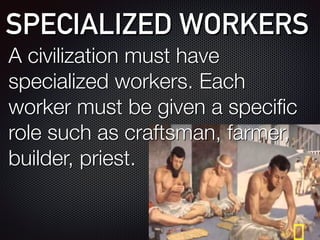
SPECIALIZED WORKERS
A civilization must have
specialized workers. Each
worker must be given a specific
role such as craftsman, farmer,
builder, priest.
COMPLEX INSTITUTIONS
Institutions, especially governments
are established in order to guarantee
that there is a society with order.
Religious institutions are also
considered to be complex
institutions.
RECORD KEEPING
Societies need individuals to keep
record of all events that occur.
These records not only include basic
events of the history of the
civilization, but also business
transactions.
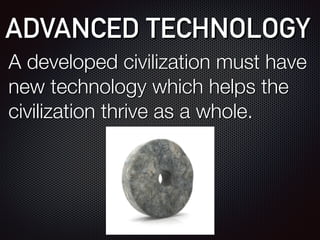
ADVANCED TECHNOLOGY
A developed civilization must have
new technology which helps the
civilization thrive as a whole.
CASE	STUDY	
		SUMER
Major city at the center of
civilization. (A)
Uruk: population of about 50,000,
which doubled in two centuries.
Lagash: population of
10,000-50,000
Specialized workers existed.
In Sumer people had different
type of jobs, priests, farmers,
merchants.
The society had Complex
Institutions (C)
Formal governments with
officials and laws, priests with
religious and political power.
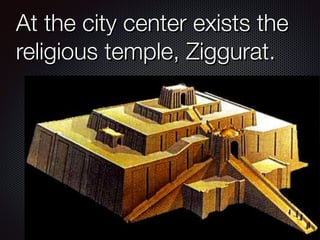
At the city center exists the
religious temple, Ziggurat.
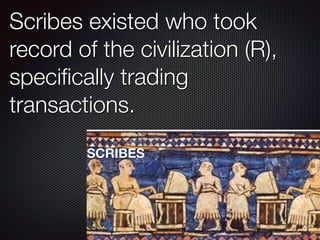
Scribes existed who took
record of the civilization (R),
specifically trading
transactions.
SCRIBES
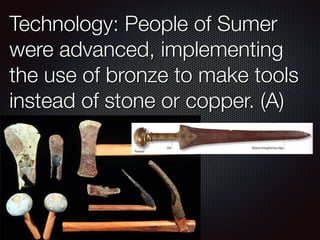
Technology: People of Sumer
were advanced, implementing
the use of bronze to make tools
instead of stone or copper. (A)
Is SUMER an
early
“Civilization”?
YES!
How does this concept work
on modern day societies.
Advanced City(ies)
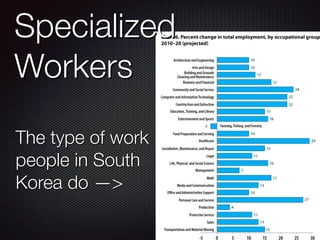
Specialized
Workers
The type of work
people in South
Korea do —>
Complex Institutions
1. National Government and local
governments exist.
2. Religious institutions exist.
3. Various businesses exist.
4. Various misc. institutions exist, for
example the institution to protect wild life in
S. Korea.
Record Keeping
Record keeping is done
at various levels for
various organizations
(police, education,
government).
The Big Freeze, expands ice caps and lowers
sea levels (2.58 million years ago).
Animals and humans as a result colonize newly
found low-lying lands.
Its not until 7000 BC that the climate returns to
a climate similar to today, this change helps
separate Eurasia from the Americas and
Southeast Asia into an archipelago.
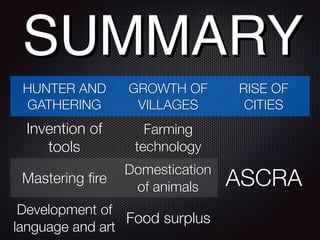
SUMMARY
HUNTER AND
GATHERING
GROWTH OF
VILLAGES
RISE OF
CITIES
Invention of
tools
Farming
technology
ASCRAMastering fire
Domestication
of animals
Development of
language and art
Food surplus

Chapter 1 GS9

  • 1.
    CHAPTER 1SECTION 1,2,3 1:Human Origins in Africa 2: Humans Try to Control Nature 3: Civilizations Develop
  • 2.
  • 3.
    Humans migrate throughout muchof the world and begin to develop tools, art, agriculture and cities.
  • 4.
  • 5.
  • 6.
    Time BEFORE the inventionof writing, so about 5,000+ years ago So how do historians study prehistory?
  • 7.
    Several occupations specializein investigating what happened in the “before history” period: archeologists, anthropologists, and paleontologists.
  • 8.
    ARCHEOLOGISTS …learn about theearliest people through excavating their settlements. They utilize bones and artifacts to come up with theories about how humans lived in the past. Examples? How does this system work?
  • 9.
  • 10.
    Archaeology Artifacts Prehistoric Artifact Modern Counterpart Lithic(stone) knife Scalpel Bone fishhook Steel fishhook Conch shell ladle Stainless steel ladle Nutting stone Nutcracker Mortar and pestle Blender Clay pipe Tobacco pipe Hammerstone Hammer Stone drill Steel drill bits Bone needle Sewing machine Grass slipper Tennis shoes Stone axe Steel axe Chunkey stones Sports balls Shell spoon Stainless steel spoon Lithic Knife Nutting Stone Hammerstone Chunkey Stones
  • 11.
    EXAMPLE SCENARIO You arean archeologist you find remains of a civilization where all the houses are of equal sizes, with musical instruments, and large walls built around the city. What can you deduce?
  • 12.
    Clothing Stone age humansmade warm clothes out of animal skin and fur. They also created jewelry from animal teeth and shells, which they would use to exchange with individuals from other tribes.
  • 13.
    ANTHROPOLOGISTS Study the culturesof ancient peoples. They use artifacts and other sources of information to learn about the life style, social dynamics, beliefs, and values historical cultures possessed.
  • 14.
    PALEONTOLOGISTS Paleontologists study fossils:the living remains of organisms (including humans) found in rock. They analyze human development over time and discover how species interacted, and how they went extinct.
  • 15.
    Mary Leakey andFoot prints Mary Leakey and her team would go on to find footprints of the earliest hominids (creatures that walk upright on two feet) in Africa in 1978. 3,600,000 years old! (3.6 million years!)
  • 16.
    LUCY 4 years earlier,in 1974, Donald Johanson’s team discovered the skeleton of the first female hominid. Archeologists predicted that she had been around as early as 3.5 million years ago.
  • 17.
    LUCY Ardi Uncovered in Ethiopia,at 4.4 million years old, becomes the oldest remains to be found. Ardi, unlike chimps, moved around upright on two legs on the ground. Not in textbook,because of publishing date.
  • 18.
  • 19.
    The earliest geneticancestors of human beings were called australopithecines.
  • 20.
    THE STONE AGES Refersto 2.5 million years ago to 3,000 BC The Paleolithic is the Old Stone Age The Neolithic is the New Stone Age
  • 21.
  • 22.
    PALEOLITHIC
 OLD STONE AGE NEOLITHIC
 NEWSTONE AGE LIFE STYLE Hunting and gathering Sedentary, farming settlements GOVERNANCE Leaders are elders of society Military and religious leaders emerge ECONOMY No sense of private property. Concept of private property emerges. KEY DISCOVERIES Religion Agricultural Revolution
  • 23.
    Cave Paintings inthe Paleolithic Era
  • 24.
    No Agreement aboutthe Meaning 1. Spirituality: paintings for shamans and religious purposes. 2. Art for arts sake. 3. Hunting Information: Pictures provide images for hunters in regards to animals they need to hunt for. 4. Marking territory. 5. Initiation rites: Children when reaching a certain age would be taken to the cave to see the paintings.
  • 25.
    The HOMO-HABILIS The groupfollowing australopithecines was the new hominids (or transitional humans) that a appeared in Africa 2.5 million years later. One of the earliest new hominids was known as Homo Habilis, “Man of skill”, since they utilized tools to survive.
  • 26.
    The HOMO-ERECTUS Vaguely translatesto “upright man”. 
 Some anthropologists suggest that the Homo erectus was more advanced than the Homo habilis. -They migrated from Africa -First to use fire -May have developed the first spoken language
  • 27.
    NEANDERTHALS -Very powerful build -Developedreligious rituals -Shorter than Homo sapiens (to adapt to cold weather) -Built boats -How and why they went extinct is a mystery.
  • 28.
    CRO-MAGNONS -About 5”1 tall, -Identicalto contemporary human beings in terms of appearance -Planned hunting, which was very different from neanderthals -Spoke more than neanderthals
  • 29.
    The HOMO SAPIENS TheHomo erectus would eventually develop into what human beings are today, Homo sapiens. -Means “wise men” -Physically very similar to the Homo erectus, however, has a much larger brain.
  • 30.
    Why Homo-Sapiens? Not onlywere homo sapiens “smarter” with a larger brain, but they also had a greater social network of relying on each other. This social network may have helped humans survive during times the neanderthals and cro-magnons could not.
  • 31.
    Australopithecines 4 to 1 millionBC First human like create to walk up right, brain size 500mm (3) Homo habilis 2.5 to 1 million BC First to use stone tools, brain size 700cm (3) Homo erectus 1.5 million to 30,000 BC Predescesors to Homo sapiens, brain size 1,000mm (3) Neanderthals 200,000 to 30,000 BC First to have ritual burials, brain size 1,450cm (3) (Debated) Cro-Magnon 40,000 to 8,000 BC Created art, brain size 1,400mm (3) Homo sapiens *Debated
 250,000 to present The only surviving genus of the homo. Earliest Homo sapiens or humans are found in 
 modern day Africa
  • 32.
  • 33.
    Humans try to ControlNature Chapter 1 Section 2
  • 34.
    40,000 years ago,Homo sapiens began to look very similar to modern humans.
  • 35.
    Development of agriculture greatlyincreases the population. Why is this? How does this relate to society today?
  • 36.
    EARLY ADVANCES IN TECHNOLOGY -Theearliest groups were nomads that hunted and gathered. -In order to survive they created weapons to hunt down animals and various tools to butcher animals and to sew their hides into clothing.
  • 37.
    SLASH AND BURN AGRICULTURE Thiswas done by clearing land by cutting and burning trees, then moving on to new soil every 1-2 years. It was not a sustainable method of farming because the nutrients in the soil could not be replenished.
  • 38.
    SLASH AND BURN TODAY Stillutilized in various locations today and has resulted in massive deforestation and soil erosion. It is especially common in central Africa, northern South America and Southeast Asia.
  • 40.
    DOMESTICATION Domestication refers tothe taming of wild animals such as horses, dogs, goats, and pigs. It was a critical breakthrough for human beings because domestication meant a constant food source was available.
  • 41.
    Villages Grow Aroundthe World Places near rivers prosper. -Africa: Near the Nile River -China: Near the Yellow River -Central America: An increase in beans and squash. -Peru: Growth in tomatoes, sweet potatoes and white potatoes.
  • 42.
    Neolithic Ice Man In1991, two German hikers accidentally discovered the remains of a prehistoric man that had been there for over 5000 years. He was nicknamed the “Ice Man”, this early human was not empty handed and had a tool kit including a longbow. The Ice Man can be seen at a museum in Italy today.
  • 44.
    Catal Huyuk Best preservedneolithic site to date Discovered in 1958. Farming thrived from 8,000 years ago, population grew with the availability of crops. Various remains are found including paintings, religious shrines, sculptures.
  • 45.
  • 46.
    Best preserved neolithic siteto date Catal Huyuk
  • 47.
    Interesting Facts -No publicbuildings, all domestic living spaces. -Mud-brick houses (reenforced with wood). -Shows how society began to change from hunting and gathering to herding and farming. -No streets. pronounced cha-tel hoo-yek
  • 48.
  • 49.
    IRRIGATION SYSTEMS In orderto create stable communities based on agriculture, cities began to develop a system of irrigation to make farming easier.
  • 50.
    Easier access tofood created more time so specialist jobs could develop. Specialists were craftspeople who created pottery, metal objects, and clothing. The formation of specific jobs also began to create a system of classes.
  • 51.
  • 52.
    ADVANCED CITIES The civilizationmust have a “city center” a type of location, where the main decisions for the city is made. These areas also tend to have the most dense populations.
  • 53.
    SPECIALIZED WORKERS A civilizationmust have specialized workers. Each worker must be given a specific role such as craftsman, farmer, builder, priest.
  • 54.
    COMPLEX INSTITUTIONS Institutions, especiallygovernments are established in order to guarantee that there is a society with order. Religious institutions are also considered to be complex institutions.
  • 55.
    RECORD KEEPING Societies needindividuals to keep record of all events that occur. These records not only include basic events of the history of the civilization, but also business transactions.
  • 56.
    ADVANCED TECHNOLOGY A developedcivilization must have new technology which helps the civilization thrive as a whole.
  • 57.
  • 58.
    Major city atthe center of civilization. (A) Uruk: population of about 50,000, which doubled in two centuries. Lagash: population of 10,000-50,000
  • 59.
    Specialized workers existed. InSumer people had different type of jobs, priests, farmers, merchants.
  • 60.
    The society hadComplex Institutions (C) Formal governments with officials and laws, priests with religious and political power.
  • 61.
    At the citycenter exists the religious temple, Ziggurat.
  • 62.
    Scribes existed whotook record of the civilization (R), specifically trading transactions. SCRIBES
  • 63.
    Technology: People ofSumer were advanced, implementing the use of bronze to make tools instead of stone or copper. (A)
  • 64.
  • 65.
    How does thisconcept work on modern day societies.
  • 66.
  • 67.
    Specialized Workers The type ofwork people in South Korea do —>
  • 68.
    Complex Institutions 1. NationalGovernment and local governments exist. 2. Religious institutions exist. 3. Various businesses exist. 4. Various misc. institutions exist, for example the institution to protect wild life in S. Korea.
  • 69.
    Record Keeping Record keepingis done at various levels for various organizations (police, education, government).
  • 70.
    The Big Freeze,expands ice caps and lowers sea levels (2.58 million years ago). Animals and humans as a result colonize newly found low-lying lands. Its not until 7000 BC that the climate returns to a climate similar to today, this change helps separate Eurasia from the Americas and Southeast Asia into an archipelago.
  • 71.
    SUMMARY HUNTER AND GATHERING GROWTH OF VILLAGES RISEOF CITIES Invention of tools Farming technology ASCRAMastering fire Domestication of animals Development of language and art Food surplus