ALEXANDER’S
EMPIRE
SECTION 4
Warm-Up:
What does it mean to be a
good leader?
Who are great leaders in
history? What makes them
“great”?
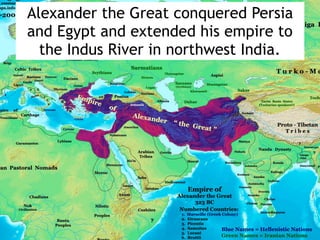
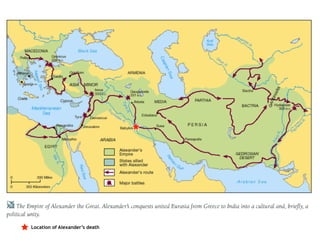
Alexander the Great conquered Persia
and Egypt and extended his empire to
the Indus River in northwest India.
Philip Builds Macedonian Power
• Macedonia—kingdom of mountain
villages north of Greece
• King Philip II—ruler, brilliant
general; dreams of controlling Greece
• Macedonians call themselves
Greek; the rest of Greece does not.
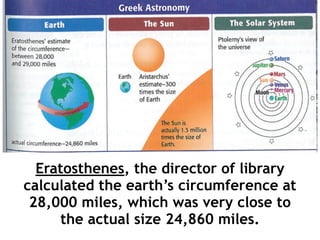
Very important
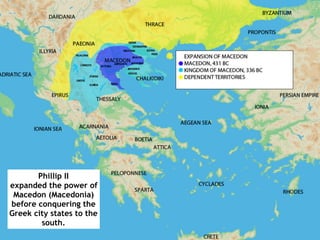
Phillip II
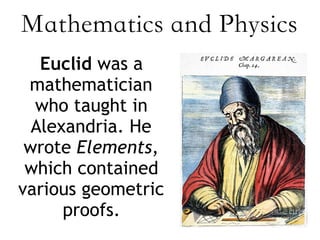
expanded the power of
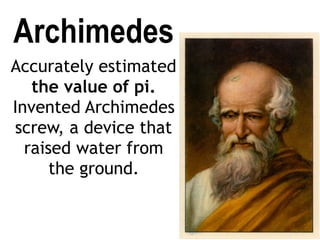
Macedon (Macedonia)
before conquering the
Greek city states to the
south.
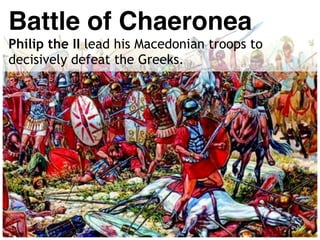
Battle of Chaeronea
Philip the II lead his Macedonian troops to
decisively defeat the Greeks.
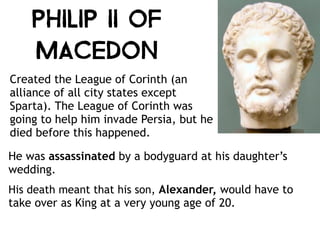
Philip II of
Macedon
Created the League of Corinth (an
alliance of all city states except
Sparta). The League of Corinth was
going to help him invade Persia, but he
died before this happened.
He was assassinated by a bodyguard at his daughter’s
wedding.
His death meant that his son, Alexander, would have to
take over as King at a very young age of 20.
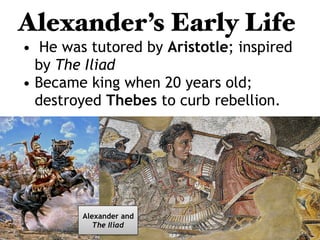
Alexander’s Early Life
• He was tutored by Aristotle; inspired
by The Iliad
• Became king when 20 years old;
destroyed Thebes to curb rebellion.
Continued . . .
Alexander and
The Iliad
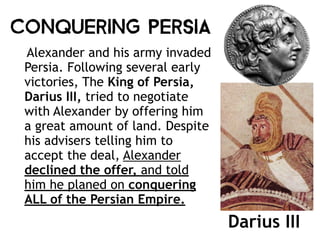
Conquering Persia
Alexander and his army invaded
Persia. Following several early
victories, The King of Persia,
Darius III, tried to negotiate
with Alexander by offering him
a great amount of land. Despite
his advisers telling him to
accept the deal, Alexander
declined the offer, and told
him he planed on conquering
ALL of the Persian Empire.
Darius III
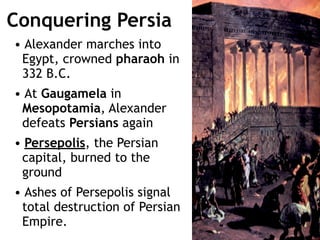
Conquering Persia
• Alexander marches into
Egypt, crowned pharaoh in
332 B.C.
• At Gaugamela in
Mesopotamia, Alexander
defeats Persians again
• Persepolis, the Persian
capital, burned to the
ground
• Ashes of Persepolis signal
total destruction of Persian
Empire.
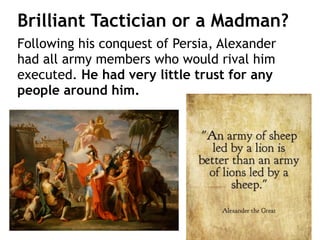
Brilliant Tactician or a Madman?
Following his conquest of Persia, Alexander
had all army members who would rival him
executed. He had very little trust for any
people around him.
Location of Alexander’s death
Alexander founded 20+ cities that were named
after him (Alexandria).
The most famous of these “Alexandrias” was the
one located in Egypt, which had one of the
largest libraries in the world, The Royal Library
of Alexandria.
Another one of his legacies is that by conquering
numerous lands, it allowed Greek language and
culture to spread to distant places.
The Death of
Alexander
the Great
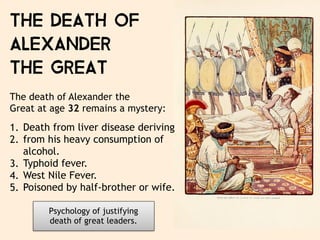
The death of Alexander the
Great at age 32 remains a mystery:
1. Death from liver disease deriving
2. from his heavy consumption of
alcohol.
3. Typhoid fever.
4. West Nile Fever.
5. Poisoned by half-brother or wife.
Psychology of justifying
death of great leaders.
Alexander’s Legacy
Alexander helped meld the Greek and
Persian cultures together.
Future conquerors like Napoleon
Bonaparte admired him.
After he died, his empire became three
kingdoms: 

(1) Macedonia & Greek city-states
(2) Egypt
(3) Persia, also known as Seleucid kingdom
CHAPTER 5
SECTION 5
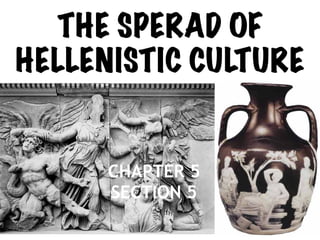
THE SPERAD OF
HELLENISTIC CULTURE
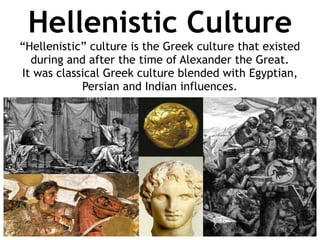
Hellenistic Culture
“Hellenistic” culture is the Greek culture that existed
during and after the time of Alexander the Great.
It was classical Greek culture blended with Egyptian,
Persian and Indian influences.
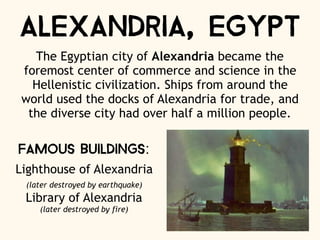
Alexandria, Egypt
The Egyptian city of Alexandria became the
foremost center of commerce and science in the
Hellenistic civilization. Ships from around the
world used the docks of Alexandria for trade, and
the diverse city had over half a million people.
Famous Buildings:
Lighthouse of Alexandria
(later destroyed by earthquake)
Library of Alexandria
(later destroyed by fire)
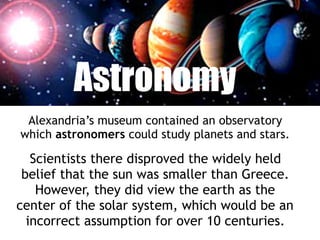
Astronomy
Alexandria’s museum contained an observatory
which astronomers could study planets and stars.
Scientists there disproved the widely held
belief that the sun was smaller than Greece.
However, they did view the earth as the
center of the solar system, which would be an
incorrect assumption for over 10 centuries.
Eratosthenes, the director of library
calculated the earth’s circumference at
28,000 miles, which was very close to
the actual size 24,860 miles.
Mathematics and Physics
Euclid was a
mathematician
who taught in
Alexandria. He
wrote Elements,
which contained
various geometric
proofs.
Archimedes
Accurately estimated
the value of pi.
Invented Archimedes
screw, a device that
raised water from
the ground.
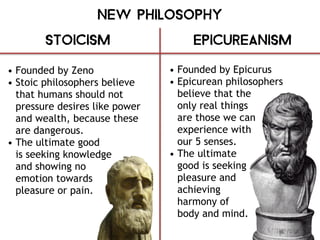
New Philosophy
Stoicism Epicureanism
• Founded by Zeno
• Stoic philosophers believe
that humans should not
pressure desires like power
and wealth, because these
are dangerous.
• The ultimate good
is seeking knowledge
and showing no
emotion towards
pleasure or pain.
• Founded by Epicurus
• Epicurean philosophers
believe that the
only real things
are those we can
experience with
our 5 senses.
• The ultimate
good is seeking
pleasure and
achieving
harmony of
body and mind.

Chapter 5: Alexander the Great

  • 1.
  • 2.
    Warm-Up: What does itmean to be a good leader? Who are great leaders in history? What makes them “great”?
  • 3.
    Alexander the Greatconquered Persia and Egypt and extended his empire to the Indus River in northwest India.
  • 4.
    Philip Builds MacedonianPower • Macedonia—kingdom of mountain villages north of Greece • King Philip II—ruler, brilliant general; dreams of controlling Greece • Macedonians call themselves Greek; the rest of Greece does not. Very important
  • 5.
    Phillip II expanded thepower of Macedon (Macedonia) before conquering the Greek city states to the south.
  • 6.
    Battle of Chaeronea Philipthe II lead his Macedonian troops to decisively defeat the Greeks.
  • 7.
    Philip II of Macedon Createdthe League of Corinth (an alliance of all city states except Sparta). The League of Corinth was going to help him invade Persia, but he died before this happened. He was assassinated by a bodyguard at his daughter’s wedding. His death meant that his son, Alexander, would have to take over as King at a very young age of 20.
  • 8.
    Alexander’s Early Life •He was tutored by Aristotle; inspired by The Iliad • Became king when 20 years old; destroyed Thebes to curb rebellion. Continued . . . Alexander and The Iliad
  • 9.
    Conquering Persia Alexander andhis army invaded Persia. Following several early victories, The King of Persia, Darius III, tried to negotiate with Alexander by offering him a great amount of land. Despite his advisers telling him to accept the deal, Alexander declined the offer, and told him he planed on conquering ALL of the Persian Empire. Darius III
  • 10.
    Conquering Persia • Alexandermarches into Egypt, crowned pharaoh in 332 B.C. • At Gaugamela in Mesopotamia, Alexander defeats Persians again • Persepolis, the Persian capital, burned to the ground • Ashes of Persepolis signal total destruction of Persian Empire.
  • 11.
    Brilliant Tactician ora Madman? Following his conquest of Persia, Alexander had all army members who would rival him executed. He had very little trust for any people around him.
  • 12.
  • 13.
    Alexander founded 20+cities that were named after him (Alexandria). The most famous of these “Alexandrias” was the one located in Egypt, which had one of the largest libraries in the world, The Royal Library of Alexandria. Another one of his legacies is that by conquering numerous lands, it allowed Greek language and culture to spread to distant places.
  • 14.
    The Death of Alexander theGreat The death of Alexander the Great at age 32 remains a mystery: 1. Death from liver disease deriving 2. from his heavy consumption of alcohol. 3. Typhoid fever. 4. West Nile Fever. 5. Poisoned by half-brother or wife. Psychology of justifying death of great leaders.
  • 15.
    Alexander’s Legacy Alexander helpedmeld the Greek and Persian cultures together. Future conquerors like Napoleon Bonaparte admired him. After he died, his empire became three kingdoms: 
 (1) Macedonia & Greek city-states (2) Egypt (3) Persia, also known as Seleucid kingdom
  • 16.
    CHAPTER 5 SECTION 5 THESPERAD OF HELLENISTIC CULTURE
  • 17.
    Hellenistic Culture “Hellenistic” cultureis the Greek culture that existed during and after the time of Alexander the Great. It was classical Greek culture blended with Egyptian, Persian and Indian influences.
  • 18.
    Alexandria, Egypt The Egyptiancity of Alexandria became the foremost center of commerce and science in the Hellenistic civilization. Ships from around the world used the docks of Alexandria for trade, and the diverse city had over half a million people. Famous Buildings: Lighthouse of Alexandria (later destroyed by earthquake) Library of Alexandria (later destroyed by fire)
  • 19.
    Astronomy Alexandria’s museum containedan observatory which astronomers could study planets and stars. Scientists there disproved the widely held belief that the sun was smaller than Greece. However, they did view the earth as the center of the solar system, which would be an incorrect assumption for over 10 centuries.
  • 20.
    Eratosthenes, the directorof library calculated the earth’s circumference at 28,000 miles, which was very close to the actual size 24,860 miles.
  • 21.
    Mathematics and Physics Euclidwas a mathematician who taught in Alexandria. He wrote Elements, which contained various geometric proofs.
  • 22.
    Archimedes Accurately estimated the valueof pi. Invented Archimedes screw, a device that raised water from the ground.
  • 23.
    New Philosophy Stoicism Epicureanism •Founded by Zeno • Stoic philosophers believe that humans should not pressure desires like power and wealth, because these are dangerous. • The ultimate good is seeking knowledge and showing no emotion towards pleasure or pain. • Founded by Epicurus • Epicurean philosophers believe that the only real things are those we can experience with our 5 senses. • The ultimate good is seeking pleasure and achieving harmony of body and mind.