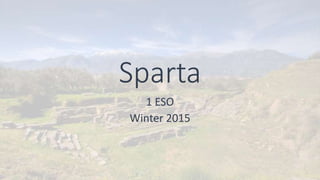
Sparta
1 ESO
Winter 2015
Government
•Oligarchy
•Elements of Monarchy (2 Kings)
•Elements of Democracy (election of Council &
Senators)
•Elements of Aristocracy (rule by the upper class)
Government
• 2 Kings: generals in command of the armies, some
religious duties.
• 5 Overseers (ephors): elected every year, ran the day-
to-day operations of Sparta.
• Council/Senate: 28 councilmen and the 2 kings. They
acted as judges and proposed laws.
• Assembly: all Spartan males aged 30 or over could
support or veto the council's recommendations.
Social Structure
• 3 Classes
• 1st = Spartiates: military professionals who lived
mostly in barracks and whose land was farmed by
serfs; they served in the army and could vote.
• 2nd = Perioeci: "neighbors/outsiders" who were
freemen.
• 3rd = Helots: serfs descended from those peoples who
had resisted enslavement by Sparta. They were
treated like slaves.
Everyday Life
• Militaristic values.
• Children of citizens were raised to be "Spartan",
taught to get along with almost nothing.
• Spartiate citizens were not permitted to own gold or
silver or luxuries.
• Spartan children were taught to respect elderly,
women, and warriors.
• Spartan mothers would say to their sons, "Either come
back with your shield or on it“.
Family
• Children were children of the state more than of their
parents. They were raised to be soldiers, loyal to the state,
strong and self-disciplined.
• When a Spartan baby was born, soldiers came to the house
and examined it carefully to determine its strength.
• The baby was bathed in wine to see its reaction. If a baby
was weak, the Spartans exposed it on the hillside or took it
away to become a slave (helot).
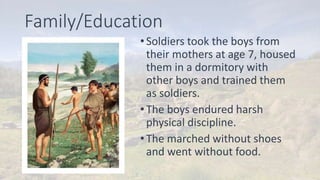
Family/Education
•Soldiers took the boys from
their mothers at age 7, housed
them in a dormitory with
other boys and trained them
as soldiers.
•The boys endured harsh
physical discipline.
•The marched without shoes
and went without food.
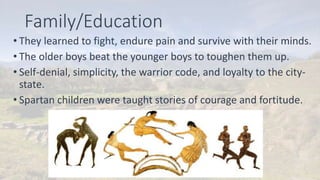
Family/Education
• They learned to fight, endure pain and survive with their minds.
• The older boys beat the younger boys to toughen them up.
• Self-denial, simplicity, the warrior code, and loyalty to the city-
state.
• Spartan children were taught stories of courage and fortitude.
Family
• At 20, the boys had to pass a hard test to graduate and
become full citizens.
• If they failed their tests they never became citizens, but
became perioeci.
• Soldiers lived in the barracks and trained as soldiers but were
required to marry to produce new young Spartans.
• The state gave them a piece of land which was farmed by
slaves and which they did nothing to tend.
• At 30 they were allowed to live with their families, but kept
training until they were 60.
Role of Women
• https://www.youtube.com/watch?v=WX9spQBSLVo&list=WL
&index=189
• Women enjoyed much greater freedom and independence in
Sparta than in other Greek city-states.
• Because mothers had little responsibility for the care of their
children, they were not as tied to the home as most Greek
women were.
• They were allowed to walk abroad in the city and transact
their own affairs.
• They owned their own property. Their husbands were only a
minor part of their lives.
Role of Women/Family/Education
• Girls were removed from the home at 7 and sent to school.
They learned wrestling, gymnastics, fighting, and other
physical training.
• If girls passed their citizen tests, they were assigned a
husband at 18-20.
• Men and women did not live together, but met occasionally
for procreation.
• There were more women than men in Sparta and women
often had more than one father for their children, and a
several men might share a wife.
Education
• https://www.youtube.com/watch?v=jEItBM1dc9o&index=16
6&list=WL
Diet and Dress
• Spartan Broth consisted of pork, blood, salt and vinegar.
• Spartans were trained to dislike luxuries and fancy foods.
• The Spartan way of dressing was very much like their
attitude to life, simple, organized and uncluttered.
• The Spartans were known in Ancient Greece for liking to
not wear any clothes at all.
Diet and Dress
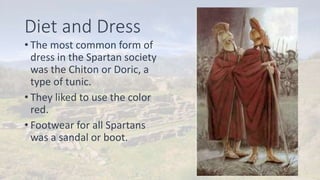
• The most common form of
dress in the Spartan society
was the Chiton or Doric, a
type of tunic.
• They liked to use the color
red.
• Footwear for all Spartans
was a sandal or boot.
Sparta
• https://www.youtube.com/watch?v=qSLmYg1nJ7A&index=165&list=
WL

Ancient Sparta

  • 1.
  • 2.
    Government •Oligarchy •Elements of Monarchy(2 Kings) •Elements of Democracy (election of Council & Senators) •Elements of Aristocracy (rule by the upper class)
  • 3.
    Government • 2 Kings:generals in command of the armies, some religious duties. • 5 Overseers (ephors): elected every year, ran the day- to-day operations of Sparta. • Council/Senate: 28 councilmen and the 2 kings. They acted as judges and proposed laws. • Assembly: all Spartan males aged 30 or over could support or veto the council's recommendations.
  • 4.
    Social Structure • 3Classes • 1st = Spartiates: military professionals who lived mostly in barracks and whose land was farmed by serfs; they served in the army and could vote. • 2nd = Perioeci: "neighbors/outsiders" who were freemen. • 3rd = Helots: serfs descended from those peoples who had resisted enslavement by Sparta. They were treated like slaves.
  • 5.
    Everyday Life • Militaristicvalues. • Children of citizens were raised to be "Spartan", taught to get along with almost nothing. • Spartiate citizens were not permitted to own gold or silver or luxuries. • Spartan children were taught to respect elderly, women, and warriors. • Spartan mothers would say to their sons, "Either come back with your shield or on it“.
  • 6.
    Family • Children werechildren of the state more than of their parents. They were raised to be soldiers, loyal to the state, strong and self-disciplined. • When a Spartan baby was born, soldiers came to the house and examined it carefully to determine its strength. • The baby was bathed in wine to see its reaction. If a baby was weak, the Spartans exposed it on the hillside or took it away to become a slave (helot).
  • 7.
    Family/Education •Soldiers took theboys from their mothers at age 7, housed them in a dormitory with other boys and trained them as soldiers. •The boys endured harsh physical discipline. •The marched without shoes and went without food.
  • 8.
    Family/Education • They learnedto fight, endure pain and survive with their minds. • The older boys beat the younger boys to toughen them up. • Self-denial, simplicity, the warrior code, and loyalty to the city- state. • Spartan children were taught stories of courage and fortitude.
  • 9.
    Family • At 20,the boys had to pass a hard test to graduate and become full citizens. • If they failed their tests they never became citizens, but became perioeci. • Soldiers lived in the barracks and trained as soldiers but were required to marry to produce new young Spartans. • The state gave them a piece of land which was farmed by slaves and which they did nothing to tend. • At 30 they were allowed to live with their families, but kept training until they were 60.
  • 10.
    Role of Women •https://www.youtube.com/watch?v=WX9spQBSLVo&list=WL &index=189 • Women enjoyed much greater freedom and independence in Sparta than in other Greek city-states. • Because mothers had little responsibility for the care of their children, they were not as tied to the home as most Greek women were. • They were allowed to walk abroad in the city and transact their own affairs. • They owned their own property. Their husbands were only a minor part of their lives.
  • 11.
    Role of Women/Family/Education •Girls were removed from the home at 7 and sent to school. They learned wrestling, gymnastics, fighting, and other physical training. • If girls passed their citizen tests, they were assigned a husband at 18-20. • Men and women did not live together, but met occasionally for procreation. • There were more women than men in Sparta and women often had more than one father for their children, and a several men might share a wife.
  • 12.
  • 13.
    Diet and Dress •Spartan Broth consisted of pork, blood, salt and vinegar. • Spartans were trained to dislike luxuries and fancy foods. • The Spartan way of dressing was very much like their attitude to life, simple, organized and uncluttered. • The Spartans were known in Ancient Greece for liking to not wear any clothes at all.
  • 14.
    Diet and Dress •The most common form of dress in the Spartan society was the Chiton or Doric, a type of tunic. • They liked to use the color red. • Footwear for all Spartans was a sandal or boot.
  • 15.