World History: Connection to Today  Chapter 1 Toward Civilization (Prehistory–3000 B.C.)   Copyright © 2003 by Pearson Education, Inc., publishing as Prentice Hall, Upper Saddle River, NJ. All rights reserved.
Copyright © 2003 by Pearson Education, Inc., publishing as Prentice Hall, Upper Saddle River, NJ. All rights reserved. Chapter 1: Toward Civilization (Prehistory–3000 B.C.) Section 1:  Understanding Our Past Section 2:  The Dawn of History Section 3:  Beginnings of Civilization World History: Connection to Today
How are geography and history linked? How do anthropologists and archaeologists find out about early peoples? How do historians try to reconstruct the past? Understanding Our Past 1
Geography and History Geography  is the study of people, their environments, and the resources available to them.   History uses written evidence to tell us how people lived in the past.   By showing  how people  lived in different times and  places, geographers have added to our knowledge  of human history.   1
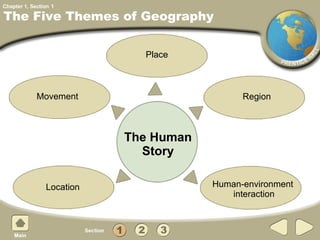
The Five Themes of Geography Place Region The Human Story Human-environment  interaction Location Movement 1
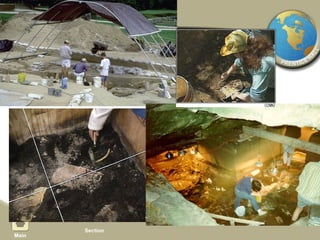
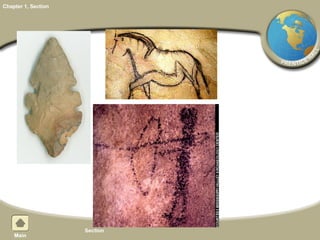
Anthropologists & Archaeologists  Anthropology  is the study of the origins and development of people and their societies.  Archaeology  is a specialized branch of anthropology.  They study past people and cultures Archaeologists study  artifacts , objects made by human beings.  By looking at artifacts they can see how people developed  technology , the skills and tools people use to meet their basic needs. 1
 
How Do Historians Reconstruct the Past? Historians  rely primarily on written evidence to determine how people lived in the past. Recorded history began about 5,000 years ago, when people began to keep written records. Historians are like detectives Sometimes they come to different conclusions. 1
Section 1 Assessment Which of the following is not an example of an artifact? a)  clothing b)  weapons c)  rivers d)  tools What do historians look at to learn how people lived in the past? a) They focus on the environments in which early    people lived.    b) They primarily look at written records.  c) They primarily dig for artifacts. d) They primarily look at landforms. 1 Want to connect to the World History link for this section?  Click Here.
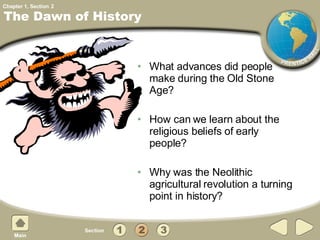
What advances did people make during the Old Stone Age? How can we learn about the religious beliefs of early people? Why was the Neolithic agricultural revolution a turning point in history? The Dawn of History 2
Prehistory The time period before writing was invented is known as Prehistory. History is the time period after writing was invented. Prehistory is also known as the Stone Age. The Stone Age has two parts: Old Stone Age or Paleolithic New Stone Age or Neolithic
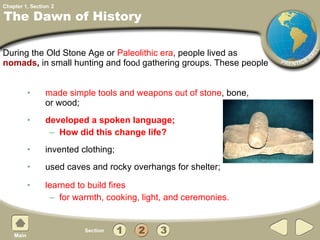
made simple tools and weapons out of stone , bone, or wood;  developed a spoken language; How did this change life? invented clothing;  used caves and rocky overhangs for shelter; learned to build fires  for warmth, cooking, light, and ceremonies.  The Dawn of History During the Old Stone Age or  Paleolithic era , people lived as  nomads ,  in   small hunting and foo d  gathering groups. These people 2
 
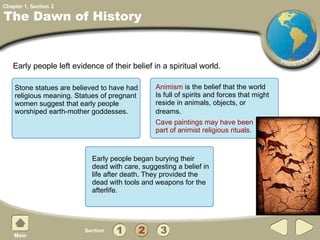
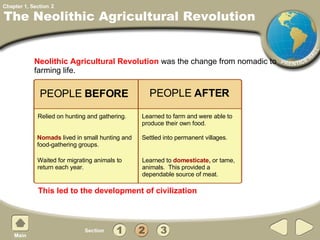
Early people left evidence of their belief in a spiritual world. Animism  is the belief that the world  Is full of spirits and forces that might  reside in animals, objects, or  dreams.   Cave paintings may have been  part of animist religious rituals. Stone statues are believed to have had religious meaning. Statues of pregnant women suggest that early people worshiped earth-mother goddesses. Early people began burying their dead with care, suggesting a belief in life after death. They provided the dead with tools and weapons for the afterlife. The Dawn of History 2
The Neolithic Agricultural Revolution Neolithic Agricultural Revolution  was the change from nomadic to farming life.  PEOPLE  BEFORE PEOPLE  AFTER Learned to farm and were able to produce their own food. Settled into permanent villages. Learned to  domesticate,  or tame, animals.  This provided a dependable source of meat. Relied on hunting and gathering. Nomads  lived in small hunting and food-gathering groups. Waited for migrating animals to return each year. 2 This led to the development of civilization
Neolithic In the Neolithic era or New Stone Age people built civilizations near rivers. Why? Advantages? Disadvantages?
Section 2 Assessment Which of the following suggests that early people held religious beliefs? a) They buried their dead with tools, weapons, and other items needed in the afterlife.  b) They learned to produce their own food. c) They developed a spoken language. d) They lived in caves or under rocky overhangs. Which was an advance of the Neolithic Agricultural Revolution? a) Early people learned to gather nuts and berries. b) Early people learned to hunt. c) Early people learned to produce their own food. d) Early people became nomads. 2 Want to connect to the World History link for this section?  Click Here.
How did the first cities emerge? What are the basic features of civilizations? How do cultures spread and change? Beginnings of Civilization 3
 
What Are the Basic Features of Civilizations? Farmers began cultivating lands  along river valleys  and producing  surplus,  or extra, food. Surpluses helped populations expand. As populations grew, some villages swelled into cities.   3
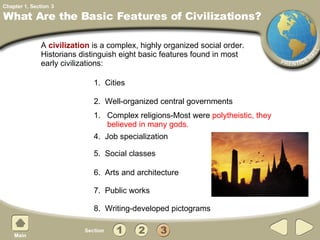
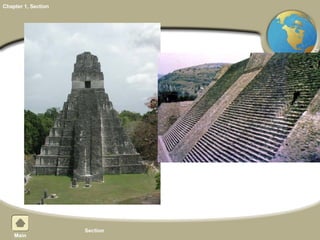
What Are the Basic Features of Civilizations? 8.  Writing-developed pictograms 7.  Public works 6.  Arts and architecture 5.  Social classes 4.  Job specialization Complex religions-Most were  polytheistic, they believed in many gods. 2.  Well-organized central governments 1.  Cities A  civilization   is a complex, highly organized social order. Historians distinguish eight basic features found in most  early civilizations: 3
 
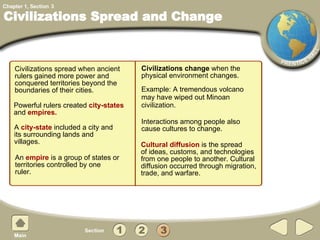
Civilizations spread   when ancient rulers gained more power and conquered territories beyond the boundaries of their cities. Civilizations Spread and Change Interactions among people also  cause cultures to change. Powerful rulers created  city-states   and  empires.   Civilizations change  when the  physical environment changes.  3 An  empire  is a group of states   or territories controlled by one ruler. A  city-state  included a city and its surrounding lands and villages. Example: A tremendous volcano may have wiped out Minoan civilization. Cultural diffusion  is the spread  of ideas, customs, and technologies from one people to another.   Cultural diffusion occurred through migration, trade, and warfare.
Section 3 Assessment Which of the following is not a feature of early civilizations?  a)  cities  b)  well-organized central government  c)  cultural diffusion  d)  public works Cultural diffusion occurs through  a) hunting and gathering.  b) migration, civilization, and warfare.  c) migration, trade, and warfare.  d) religion, trade, and warfare. 3 Want to connect to the World History link for this section?  Click Here.
Which of the following is not a feature of early civilizations?  a)  cities  b)  well-organized central government  c)  cultural diffusion   d)  public works Cultural diffusion occurs through  a) hunting and gathering.  b) migration, civilization, and warfare.  c) migration, trade, and warfare.   d) religion, trade, and warfare. Section 3 Assessment 3 Want to connect to the World History link for this section?  Click Here.

Stone Age

  • 1.
    World History: Connectionto Today Chapter 1 Toward Civilization (Prehistory–3000 B.C.) Copyright © 2003 by Pearson Education, Inc., publishing as Prentice Hall, Upper Saddle River, NJ. All rights reserved.
  • 2.
    Copyright © 2003by Pearson Education, Inc., publishing as Prentice Hall, Upper Saddle River, NJ. All rights reserved. Chapter 1: Toward Civilization (Prehistory–3000 B.C.) Section 1: Understanding Our Past Section 2: The Dawn of History Section 3: Beginnings of Civilization World History: Connection to Today
  • 3.
    How are geographyand history linked? How do anthropologists and archaeologists find out about early peoples? How do historians try to reconstruct the past? Understanding Our Past 1
  • 4.
    Geography and HistoryGeography is the study of people, their environments, and the resources available to them. History uses written evidence to tell us how people lived in the past. By showing how people lived in different times and places, geographers have added to our knowledge of human history. 1
  • 5.
    The Five Themesof Geography Place Region The Human Story Human-environment interaction Location Movement 1
  • 6.
    Anthropologists & Archaeologists Anthropology is the study of the origins and development of people and their societies. Archaeology is a specialized branch of anthropology. They study past people and cultures Archaeologists study artifacts , objects made by human beings. By looking at artifacts they can see how people developed technology , the skills and tools people use to meet their basic needs. 1
  • 7.
  • 8.
    How Do HistoriansReconstruct the Past? Historians rely primarily on written evidence to determine how people lived in the past. Recorded history began about 5,000 years ago, when people began to keep written records. Historians are like detectives Sometimes they come to different conclusions. 1
  • 9.
    Section 1 AssessmentWhich of the following is not an example of an artifact? a) clothing b) weapons c) rivers d) tools What do historians look at to learn how people lived in the past? a) They focus on the environments in which early people lived. b) They primarily look at written records. c) They primarily dig for artifacts. d) They primarily look at landforms. 1 Want to connect to the World History link for this section? Click Here.
  • 10.
    Section 1 AssessmentWhich of the following is not an example of an artifact? a) clothing b) weapons c) rivers d) tools What do historians look at to learn how people lived in the past? a) They focus on the environments in which early people lived. b) They primarily look at written records. c) They primarily dig for artifacts. d) They primarily look at landforms. 1 Want to connect to the World History link for this section? Click Here.
  • 11.
    What advances didpeople make during the Old Stone Age? How can we learn about the religious beliefs of early people? Why was the Neolithic agricultural revolution a turning point in history? The Dawn of History 2
  • 12.
    Prehistory The timeperiod before writing was invented is known as Prehistory. History is the time period after writing was invented. Prehistory is also known as the Stone Age. The Stone Age has two parts: Old Stone Age or Paleolithic New Stone Age or Neolithic
  • 13.
    made simple toolsand weapons out of stone , bone, or wood; developed a spoken language; How did this change life? invented clothing; used caves and rocky overhangs for shelter; learned to build fires for warmth, cooking, light, and ceremonies. The Dawn of History During the Old Stone Age or Paleolithic era , people lived as nomads , in small hunting and foo d gathering groups. These people 2
  • 14.
  • 15.
    Early people leftevidence of their belief in a spiritual world. Animism is the belief that the world Is full of spirits and forces that might reside in animals, objects, or dreams. Cave paintings may have been part of animist religious rituals. Stone statues are believed to have had religious meaning. Statues of pregnant women suggest that early people worshiped earth-mother goddesses. Early people began burying their dead with care, suggesting a belief in life after death. They provided the dead with tools and weapons for the afterlife. The Dawn of History 2
  • 16.
    The Neolithic AgriculturalRevolution Neolithic Agricultural Revolution was the change from nomadic to farming life. PEOPLE BEFORE PEOPLE AFTER Learned to farm and were able to produce their own food. Settled into permanent villages. Learned to domesticate, or tame, animals. This provided a dependable source of meat. Relied on hunting and gathering. Nomads lived in small hunting and food-gathering groups. Waited for migrating animals to return each year. 2 This led to the development of civilization
  • 17.
    Neolithic In theNeolithic era or New Stone Age people built civilizations near rivers. Why? Advantages? Disadvantages?
  • 18.
    Section 2 AssessmentWhich of the following suggests that early people held religious beliefs? a) They buried their dead with tools, weapons, and other items needed in the afterlife. b) They learned to produce their own food. c) They developed a spoken language. d) They lived in caves or under rocky overhangs. Which was an advance of the Neolithic Agricultural Revolution? a) Early people learned to gather nuts and berries. b) Early people learned to hunt. c) Early people learned to produce their own food. d) Early people became nomads. 2 Want to connect to the World History link for this section? Click Here.
  • 19.
    Section 2 AssessmentWhich of the following suggests that early people held religious beliefs? a) They buried their dead with tools, weapons, and other items needed in the afterlife. b) They learned to produce their own food. c) They developed a spoken language. d) They lived in caves or under rocky overhangs. Which was an advance of the Neolithic Agricultural Revolution? a) Early people learned to gather nuts and berries. b) Early people learned to hunt. c) Early people learned to produce their own food. d) Early people became nomads. 2 Want to connect to the World History link for this section? Click Here.
  • 20.
    How did thefirst cities emerge? What are the basic features of civilizations? How do cultures spread and change? Beginnings of Civilization 3
  • 21.
  • 22.
    What Are theBasic Features of Civilizations? Farmers began cultivating lands along river valleys and producing surplus, or extra, food. Surpluses helped populations expand. As populations grew, some villages swelled into cities. 3
  • 23.
    What Are theBasic Features of Civilizations? 8. Writing-developed pictograms 7. Public works 6. Arts and architecture 5. Social classes 4. Job specialization Complex religions-Most were polytheistic, they believed in many gods. 2. Well-organized central governments 1. Cities A civilization is a complex, highly organized social order. Historians distinguish eight basic features found in most early civilizations: 3
  • 24.
  • 25.
    Civilizations spread when ancient rulers gained more power and conquered territories beyond the boundaries of their cities. Civilizations Spread and Change Interactions among people also cause cultures to change. Powerful rulers created city-states and empires. Civilizations change when the physical environment changes. 3 An empire is a group of states or territories controlled by one ruler. A city-state included a city and its surrounding lands and villages. Example: A tremendous volcano may have wiped out Minoan civilization. Cultural diffusion is the spread of ideas, customs, and technologies from one people to another. Cultural diffusion occurred through migration, trade, and warfare.
  • 26.
    Section 3 AssessmentWhich of the following is not a feature of early civilizations? a) cities b) well-organized central government c) cultural diffusion d) public works Cultural diffusion occurs through a) hunting and gathering. b) migration, civilization, and warfare. c) migration, trade, and warfare. d) religion, trade, and warfare. 3 Want to connect to the World History link for this section? Click Here.
  • 27.
    Which of thefollowing is not a feature of early civilizations? a) cities b) well-organized central government c) cultural diffusion d) public works Cultural diffusion occurs through a) hunting and gathering. b) migration, civilization, and warfare. c) migration, trade, and warfare. d) religion, trade, and warfare. Section 3 Assessment 3 Want to connect to the World History link for this section? Click Here.