The Song Dynasty
宋
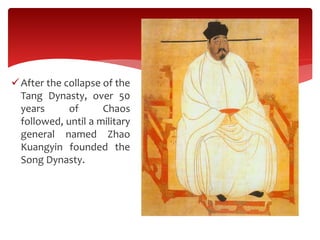
After the collapse of the
Tang Dynasty, over 50
years of Chaos
followed, until a military
general named Zhao
Kuangyin founded the
Song Dynasty.
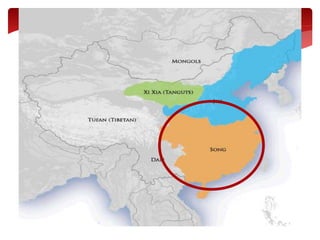
 The Song Dynasty is divided into two distinct periods: the Northern
Song and Southern Song. During the Northern Song (960–1127),
the Song capital was in the northern city of Bianjing (now Kaifeng),
and the dynasty controlled most of inner China.
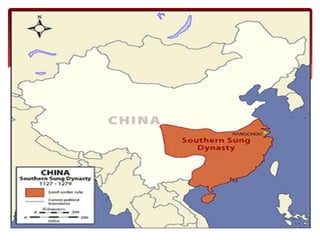
 The Southern Song (1127–1279) refers to the period after the Song
lost control of northern China to the Jin Dynasty in the Jin–Song
wars. During this time, the Song court retreated south of
the Yangtze River and established their capital at Lin'an
(now Hangzhou).
 Although the Song Dynasty had lost control of the traditional
birthplace of Chinese civilization along the Yellow River, the Song
economy was not in ruins, as the Southern Song Empire contained
60 percent of China's population and a majority of the most
productive agricultural land.
 The Southern Song Dynasty considerably bolstered
its naval strength to defend its waters and land borders and to
conduct maritime missions abroad.
 When Emperor Taizu came to power, he expanded the civil service
examination system and oversaw a project to map the entire empire.
The Song saw a revival of Confucianism and greater prominence of
the scholar official class.
 So the Song dynasty moved south, and despite losing a large amount
of territory, the Southern Song period was one of prosperity, with
flourishing art and culture, as well as technological advancements.
 the Song developed revolutionary new military technology
augmented by the use of gunpowder. In 1234, the Jin Dynasty was
conquered by the Mongols, who took control of northern China,
maintaining uneasy relations with the Southern Song.
 During the Song, the government started to grant farmers ownership
of land, which led to a huge increase in rice production. The economy
started to change from a purely agricultural economy to a
commercial one, with peasants selling their surplices to buy a wide
range of goods, such as tea, coal, oil and wine. With the growth in
the economy, so grew the population, hitting 100 million by the year
1100AD.
Society and culture
The Song Dynasty was an era of administrative sophistication and complex
social organization. Some of the largest cities in the world were found in China
during this period (Kaifeng and Hangzhou had populations of over a
million).[ People enjoyed various social clubs and entertainment in the cities,
and there were many schools and temples to provide the people with
education and religious services. The Song government supported multiple
forms of social welfare programs, including the establishment of retirement
homes, public clinics, and pauper's graveyards.
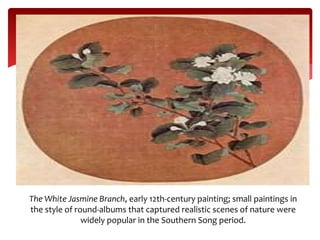
The White Jasmine Branch, early 12th-century painting; small paintings in
the style of round-albums that captured realistic scenes of nature were
widely popular in the Southern Song period.
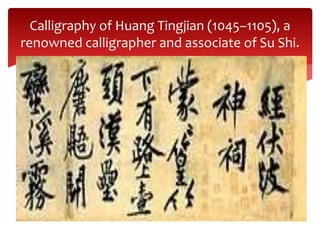
Calligraphy of Huang Tingjian (1045–1105), a
renowned calligrapher and associate of Su Shi.
Civil service examinations
and the gentry
The civil service system became institutionalized on a small scale during
the Sui and Tang dynasties, but by the Song period it became virtually the
only means for drafting officials into the government
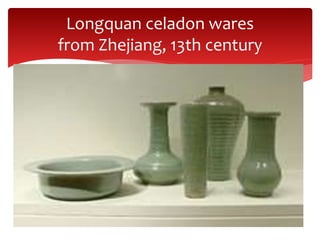
Longquan celadon wares
from Zhejiang, 13th century
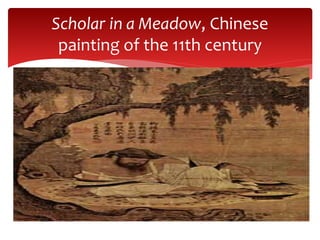
Scholar in a Meadow, Chinese
painting of the 11th century
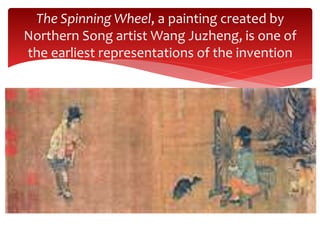
The Spinning Wheel, a painting created by
Northern Song artist Wang Juzheng, is one of
the earliest representations of the invention
Law, justice, and forensic
science
The Song judicial system retained most of the legal code of the
earlier Tang Dynasty, the basis of traditional Chinese law up until
the modern era.
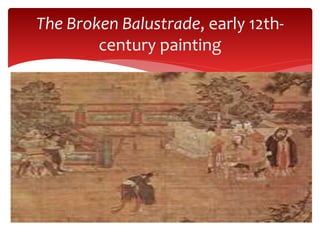
The Broken Balustrade, early 12th-
century painting
Military and methods
of warfare
The Song military was chiefly organized to ensure that the
army could not threaten Imperial control, often at the
expense of effectiveness in war
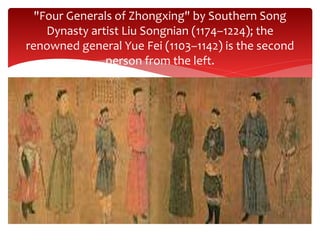
"Four Generals of Zhongxing" by Southern Song
Dynasty artist Liu Songnian (1174–1224); the
renowned general Yue Fei (1103–1142) is the second
person from the left.
Arts, literature, and
philosophy
The visual arts during the Song Dynasty were heightened by new
developments such as advances in landscape and portrait painting. The
gentry elite engaged in the arts as accepted pastimes of the cultured
scholar-official, including painting, composing poetry, and
writing calligraphy.
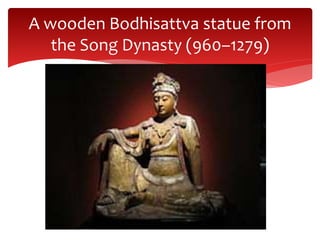
A wooden Bodhisattva statue from
the Song Dynasty (960–1279)
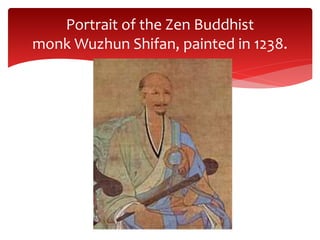
Portrait of the Zen Buddhist
monk Wuzhun Shifan, painted in 1238.
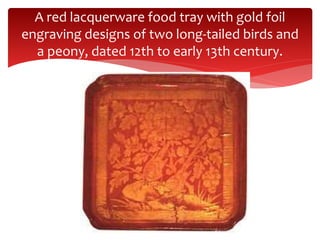
A red lacquerware food tray with gold foil
engraving designs of two long-tailed birds and
a peony, dated 12th to early 13th century.
Economy, industry, and
trade
The Song Dynasty had one of the most prosperous and
advanced economies in the medieval world. Song Chinese
invested their funds injoint stock companies and in multiple
sailing vessels at a time when monetary gain was assured
from the vigorous overseas trade and domestic trade along
the Grand Canal and Yangzi River.
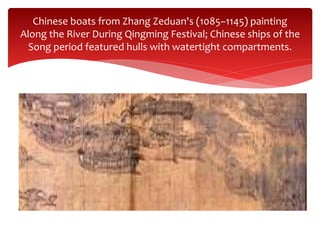
Chinese boats from Zhang Zeduan's (1085–1145) painting
Along the River During Qingming Festival; Chinese ships of the
Song period featured hulls with watertight compartments.
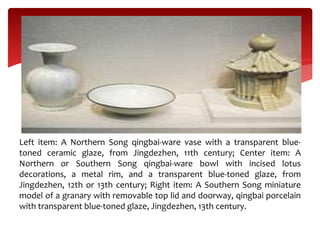
Left item: A Northern Song qingbai-ware vase with a transparent blue-
toned ceramic glaze, from Jingdezhen, 11th century; Center item: A
Northern or Southern Song qingbai-ware bowl with incised lotus
decorations, a metal rim, and a transparent blue-toned glaze, from
Jingdezhen, 12th or 13th century; Right item: A Southern Song miniature
model of a granary with removable top lid and doorway, qingbai porcelain
with transparent blue-toned glaze, Jingdezhen, 13th century.
Technology, science, and
engineering
Gunpowder warfare
Advancements in weapons technology enhanced by gunpowder, including
the evolution of the early flamethrower, explosive grenade, firearm,
cannon, and land mine, enabled the Song Chinese to ward off their militant
enemies until the Song's ultimate collapse in the late 13th century.
As early as the Han Dynasty, when the state needed to
effectively measure distances traveled throughout the
empire, the Chinese relied on the mechanical odometer
device.
Measuring distance and mechanical
navigation
Structural engineering and
architecture
Architecture during the Song period reached new heights
of sophistication. Authors such as Yu Hao and Shen
Kuo wrote books outlining the field of architectural
layouts, craftsmanship, and structural engineering in the
10th and 11th centuries, respectively.
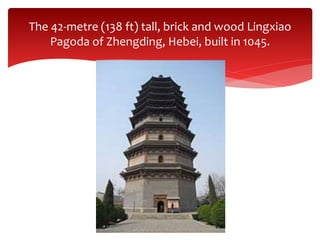
The 42-metre (138 ft) tall, brick and wood Lingxiao
Pagoda of Zhengding, Hebei, built in 1045.
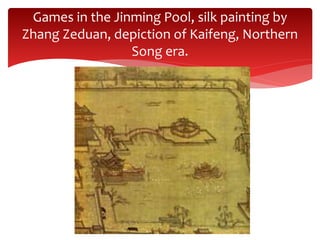
Games in the Jinming Pool, silk painting by
Zhang Zeduan, depiction of Kaifeng, Northern
Song era.
Thank you

The song dynasty

  • 1.
  • 3.
    After the collapseof the Tang Dynasty, over 50 years of Chaos followed, until a military general named Zhao Kuangyin founded the Song Dynasty.
  • 4.
     The SongDynasty is divided into two distinct periods: the Northern Song and Southern Song. During the Northern Song (960–1127), the Song capital was in the northern city of Bianjing (now Kaifeng), and the dynasty controlled most of inner China.  The Southern Song (1127–1279) refers to the period after the Song lost control of northern China to the Jin Dynasty in the Jin–Song wars. During this time, the Song court retreated south of the Yangtze River and established their capital at Lin'an (now Hangzhou).  Although the Song Dynasty had lost control of the traditional birthplace of Chinese civilization along the Yellow River, the Song economy was not in ruins, as the Southern Song Empire contained 60 percent of China's population and a majority of the most productive agricultural land.  The Southern Song Dynasty considerably bolstered its naval strength to defend its waters and land borders and to conduct maritime missions abroad.
  • 5.
     When EmperorTaizu came to power, he expanded the civil service examination system and oversaw a project to map the entire empire. The Song saw a revival of Confucianism and greater prominence of the scholar official class.  So the Song dynasty moved south, and despite losing a large amount of territory, the Southern Song period was one of prosperity, with flourishing art and culture, as well as technological advancements.  the Song developed revolutionary new military technology augmented by the use of gunpowder. In 1234, the Jin Dynasty was conquered by the Mongols, who took control of northern China, maintaining uneasy relations with the Southern Song.  During the Song, the government started to grant farmers ownership of land, which led to a huge increase in rice production. The economy started to change from a purely agricultural economy to a commercial one, with peasants selling their surplices to buy a wide range of goods, such as tea, coal, oil and wine. With the growth in the economy, so grew the population, hitting 100 million by the year 1100AD.
  • 6.
    Society and culture TheSong Dynasty was an era of administrative sophistication and complex social organization. Some of the largest cities in the world were found in China during this period (Kaifeng and Hangzhou had populations of over a million).[ People enjoyed various social clubs and entertainment in the cities, and there were many schools and temples to provide the people with education and religious services. The Song government supported multiple forms of social welfare programs, including the establishment of retirement homes, public clinics, and pauper's graveyards.
  • 7.
    The White JasmineBranch, early 12th-century painting; small paintings in the style of round-albums that captured realistic scenes of nature were widely popular in the Southern Song period.
  • 8.
    Calligraphy of HuangTingjian (1045–1105), a renowned calligrapher and associate of Su Shi.
  • 9.
    Civil service examinations andthe gentry The civil service system became institutionalized on a small scale during the Sui and Tang dynasties, but by the Song period it became virtually the only means for drafting officials into the government
  • 10.
    Longquan celadon wares fromZhejiang, 13th century
  • 11.
    Scholar in aMeadow, Chinese painting of the 11th century
  • 12.
    The Spinning Wheel,a painting created by Northern Song artist Wang Juzheng, is one of the earliest representations of the invention
  • 13.
    Law, justice, andforensic science The Song judicial system retained most of the legal code of the earlier Tang Dynasty, the basis of traditional Chinese law up until the modern era.
  • 14.
    The Broken Balustrade,early 12th- century painting
  • 15.
    Military and methods ofwarfare The Song military was chiefly organized to ensure that the army could not threaten Imperial control, often at the expense of effectiveness in war
  • 16.
    "Four Generals ofZhongxing" by Southern Song Dynasty artist Liu Songnian (1174–1224); the renowned general Yue Fei (1103–1142) is the second person from the left.
  • 17.
    Arts, literature, and philosophy Thevisual arts during the Song Dynasty were heightened by new developments such as advances in landscape and portrait painting. The gentry elite engaged in the arts as accepted pastimes of the cultured scholar-official, including painting, composing poetry, and writing calligraphy.
  • 18.
    A wooden Bodhisattvastatue from the Song Dynasty (960–1279)
  • 19.
    Portrait of theZen Buddhist monk Wuzhun Shifan, painted in 1238.
  • 20.
    A red lacquerwarefood tray with gold foil engraving designs of two long-tailed birds and a peony, dated 12th to early 13th century.
  • 21.
    Economy, industry, and trade TheSong Dynasty had one of the most prosperous and advanced economies in the medieval world. Song Chinese invested their funds injoint stock companies and in multiple sailing vessels at a time when monetary gain was assured from the vigorous overseas trade and domestic trade along the Grand Canal and Yangzi River.
  • 22.
    Chinese boats fromZhang Zeduan's (1085–1145) painting Along the River During Qingming Festival; Chinese ships of the Song period featured hulls with watertight compartments.
  • 23.
    Left item: ANorthern Song qingbai-ware vase with a transparent blue- toned ceramic glaze, from Jingdezhen, 11th century; Center item: A Northern or Southern Song qingbai-ware bowl with incised lotus decorations, a metal rim, and a transparent blue-toned glaze, from Jingdezhen, 12th or 13th century; Right item: A Southern Song miniature model of a granary with removable top lid and doorway, qingbai porcelain with transparent blue-toned glaze, Jingdezhen, 13th century.
  • 24.
  • 25.
    Gunpowder warfare Advancements inweapons technology enhanced by gunpowder, including the evolution of the early flamethrower, explosive grenade, firearm, cannon, and land mine, enabled the Song Chinese to ward off their militant enemies until the Song's ultimate collapse in the late 13th century.
  • 26.
    As early asthe Han Dynasty, when the state needed to effectively measure distances traveled throughout the empire, the Chinese relied on the mechanical odometer device. Measuring distance and mechanical navigation
  • 27.
    Structural engineering and architecture Architectureduring the Song period reached new heights of sophistication. Authors such as Yu Hao and Shen Kuo wrote books outlining the field of architectural layouts, craftsmanship, and structural engineering in the 10th and 11th centuries, respectively.
  • 28.
    The 42-metre (138ft) tall, brick and wood Lingxiao Pagoda of Zhengding, Hebei, built in 1045.
  • 29.
    Games in theJinming Pool, silk painting by Zhang Zeduan, depiction of Kaifeng, Northern Song era.
  • 31.