Living in the Stone AgeLiving in the Stone Age
Examining History:Examining History:
PrehistoryPrehistory
 PRE-HISTORYPRE-HISTORY- period before written history- period before written history
 Approximately 1.75 million years ago, earliestApproximately 1.75 million years ago, earliest
people first began using small pieces of rockpeople first began using small pieces of rock
as toolsas tools
 Massive development of humans over years inMassive development of humans over years in
4 major groups:4 major groups:
1) Homo Habilis (2 million years ago)1) Homo Habilis (2 million years ago)
2) Homo Erectus (1 million years ago)2) Homo Erectus (1 million years ago)
3) Neanderthal (100 000 years ago)3) Neanderthal (100 000 years ago)
4) Cro-Magnon (50 000 years ago)4) Cro-Magnon (50 000 years ago)
Development of HumansDevelopment of Humans
Homo HabilisHomo Habilis
 Latin for “handy man”Latin for “handy man”
 Lived in eastern Africa > spreadLived in eastern Africa > spread
north to Asianorth to Asia
 fossilized human bones foundfossilized human bones found
with stone tools and animalwith stone tools and animal
fossilsfossils
 Skulls – humans had a flatterSkulls – humans had a flatter
head with a brain only 2/3 size;head with a brain only 2/3 size;
approximately 1.5 m tallapproximately 1.5 m tall
 Built shelters of braches andBuilt shelters of braches and
collected bird eggs and wildcollected bird eggs and wild
berries for food; hunted wild pigsberries for food; hunted wild pigs
 Tools / weapons = rocks,Tools / weapons = rocks,
braches, sharp stonesbraches, sharp stones
 No clothesNo clothes
 Did not know how to use fireDid not know how to use fire
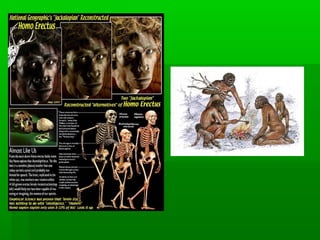
Homo ErectusHomo Erectus
 Latin for “upright man”Latin for “upright man”
 Discoveries of “Java Man” (Indonesia) andDiscoveries of “Java Man” (Indonesia) and
“Peking Man” (China”“Peking Man” (China”
 Lived in Afria, south Europe, AsiaLived in Afria, south Europe, Asia
 Skulls- humans had long, flat and sharply angledSkulls- humans had long, flat and sharply angled
at back (between ape and human head)at back (between ape and human head)
 Thighbone- identical to modern humans > walkThighbone- identical to modern humans > walk
uprightupright
 Charred animals bones found = they used fire toCharred animals bones found = they used fire to
cookcook
 Belief that homo erectus was a descendant ofBelief that homo erectus was a descendant of
homo habilishomo habilis
 Make fire= first by coals or volcanic ash; later byMake fire= first by coals or volcanic ash; later by
friction= made life easier as they could survive infriction= made life easier as they could survive in
colder climatescolder climates
 Tools / weapons= bones, rocks, blades forTools / weapons= bones, rocks, blades for
carving, spearscarving, spears
Homo SapiensHomo Sapiens
 Latin for “reasoning man”Latin for “reasoning man”
 250 000 years ago= emergence of Homo Sapiens250 000 years ago= emergence of Homo Sapiens
who evolved from homo erectuswho evolved from homo erectus
 is the species to which all modern day peopleis the species to which all modern day people
belongbelong
Neanderthals vs CroNeanderthals vs Cro
MagnonMagnon
NEANDERATHALNEANDERATHAL
 Neander Valley- GermanyNeander Valley- Germany
 6 cm taller than homo erectus;6 cm taller than homo erectus;
thick eyebrow ridgethick eyebrow ridge
 Tools= knives, spear sharpenersTools= knives, spear sharpeners
made from chipped rockmade from chipped rock
 Animals hides worn as clothesAnimals hides worn as clothes
 Lived in caves kept warm with fireLived in caves kept warm with fire
 First to bury the dead (gravesFirst to bury the dead (graves
with bodies carefully preparedwith bodies carefully prepared
CRO MAGNONCRO MAGNON
 South France- clearing awaySouth France- clearing away
earth from back of a rock shelterearth from back of a rock shelter
locally known as Cro-Magnonlocally known as Cro-Magnon
 First appeared in Europe 30 000First appeared in Europe 30 000
years ago following ice ageyears ago following ice age
 Brain as large as modern dayBrain as large as modern day
human; approx. 2 metres tall withhuman; approx. 2 metres tall with
modern “faces”modern “faces”
 Tools= slim, sharp edge blades,Tools= slim, sharp edge blades,
chisels, knives, spearheads,chisels, knives, spearheads,
lamps (stone bowl with animallamps (stone bowl with animal
grease and lit fur or moss)grease and lit fur or moss)
 Animals bones and teeth used toAnimals bones and teeth used to
make musical instruments,make musical instruments,
jewelleryjewellery
 Cave paintingsCave paintings
 Fierce warriorsFierce warriors
 Wiped out NeanderthalsWiped out Neanderthals
Great Leap ForwardGreat Leap Forward
 35 000 years ago when changes brought about innovation,35 000 years ago when changes brought about innovation,
creativity to humans (Homo Sapiens Sapiens)creativity to humans (Homo Sapiens Sapiens)
2 FUNDAMENTAL CHANGES OCCURRED:2 FUNDAMENTAL CHANGES OCCURRED:
1)1) Development of modern anatomyDevelopment of modern anatomy
2)2) Beginning of innovative behaviourBeginning of innovative behaviour
EFFECTSEFFECTS
 Production of crafted tools and more sophisticatedProduction of crafted tools and more sophisticated
weaponsweapons
 development of trade for raw materials and ornamentsdevelopment of trade for raw materials and ornaments
 Emergence of sculptures, paintings and crafted objectsEmergence of sculptures, paintings and crafted objects
that showcased beauty and religionthat showcased beauty and religion
““Lithos” = stoneLithos” = stone
Paleolithic AgePaleolithic Age
 Greek “paleo” meansGreek “paleo” means
“old”“old”
 Upper Paleolithic ageUpper Paleolithic age
was 50 000 – 10 000was 50 000 – 10 000
years agoyears ago
Neolithic AgeNeolithic Age
 Greek “neo” meansGreek “neo” means
“new”“new”
 Neolithic RevolutionNeolithic Revolution
occurred betweenoccurred between
9000 – 4000 BCE9000 – 4000 BCE
Comparing theComparing the
Stone AgesStone Ages
PALEOLITHICPALEOLITHIC
 small groups of 5-10small groups of 5-10
familiesfamilies
 Nomadic to semi-Nomadic to semi-
nomadicnomadic
 Closer relationshipsCloser relationships
between bands of peoplebetween bands of people
ie. Cro-Magnon societyie. Cro-Magnon society
NEOLITHICNEOLITHIC
 People abandoned semi-People abandoned semi-
nomadic life and begannomadic life and began
farmingfarming
 Agricultural revolutionAgricultural revolution
was a progression of thewas a progression of the
“Great Leap Forward”“Great Leap Forward”
 planting of cropsplanting of crops
 domesticating of animalsdomesticating of animals
 Better tools & weaponsBetter tools & weapons
Social Structure:Social Structure:
Paleolithic AgePaleolithic Age
 closer social relationshipscloser social relationships
 Social stratificationSocial stratification== emergence of leadershipemergence of leadership
and beginning of social classesand beginning of social classes
 Social roles: patriarchal; men were big gameSocial roles: patriarchal; men were big game
huntershunters
 women captured small game and madewomen captured small game and made
clothing; women & children were gatherersclothing; women & children were gatherers
Social Structure:Social Structure:
Neolithic AgeNeolithic Age
 Increasing knowledge = more control of food supplyIncreasing knowledge = more control of food supply
 End of Ice Age = better for agricultureEnd of Ice Age = better for agriculture
 As population grew, so did the competition for landAs population grew, so did the competition for land
 Shift fromShift from semi-nomadicsemi-nomadic toto permanent towns and citiespermanent towns and cities
(first city was Jericho, in Mesopotamia between 8000 –(first city was Jericho, in Mesopotamia between 8000 –
7000 BCE) and more occupations7000 BCE) and more occupations
 Trade by barter system (Trade by barter system (obsidianobsidian – most valued traded– most valued traded
material traded for farm produce)material traded for farm produce)
 Development of hierarchical class systemDevelopment of hierarchical class system
Religion & Art inReligion & Art in
Paleolithic AgePaleolithic Age
 The Paleolithic Age (Cro-Magnon) was the first toThe Paleolithic Age (Cro-Magnon) was the first to
develop fine art as drawingsdevelop fine art as drawings
 CAVE PAINTINGS of deer, horses and animals whichCAVE PAINTINGS of deer, horses and animals which
are now extinctare now extinct
 cultural explosion in art as more tools, jewellery, andcultural explosion in art as more tools, jewellery, and
sculptures/ figurines of clay, ivory and stone emergedsculptures/ figurines of clay, ivory and stone emerged
 More advanced spiritual practices with graves foundMore advanced spiritual practices with graves found
jewellery and spears made of mammoth tusks buriedjewellery and spears made of mammoth tusks buried
with bodies = this suggests a ritual burial with a view ofwith bodies = this suggests a ritual burial with a view of
an afterlifean afterlife
Caves at Lascaux [lass co]Caves at Lascaux [lass co]
 Painting at Lascaux Caves (south central France) found in 15 000 BCEPainting at Lascaux Caves (south central France) found in 15 000 BCE
 Painters used irregularities in cave walls to add a 3-D effect to figuresPainters used irregularities in cave walls to add a 3-D effect to figures
 Paintings portray an awe and reverence towards animals which shows thatPaintings portray an awe and reverence towards animals which shows that
for the first time people were expressing religious beliefs (rituals related tofor the first time people were expressing religious beliefs (rituals related to
hunting magic; sacrifices of animals)hunting magic; sacrifices of animals)
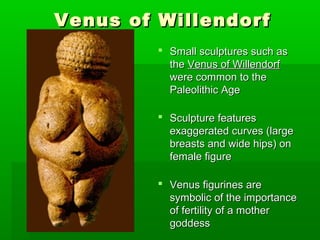
Venus of WillendorfVenus of Willendorf
 Small sculptures such asSmall sculptures such as
thethe Venus of WillendorfVenus of Willendorf
were common to thewere common to the
Paleolithic AgePaleolithic Age
 Sculpture featuresSculpture features
exaggerated curves (largeexaggerated curves (large
breasts and wide hips) onbreasts and wide hips) on
female figurefemale figure
 Venus figurines areVenus figurines are
symbolic of the importancesymbolic of the importance
of fertility of a motherof fertility of a mother
goddessgoddess
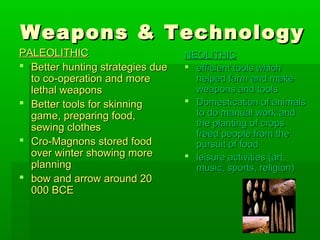
Weapons & TechnologyWeapons & Technology
PALEOLITHICPALEOLITHIC
 Better hunting strategies dueBetter hunting strategies due
to co-operation and moreto co-operation and more
lethal weaponslethal weapons
 Better tools for skinningBetter tools for skinning
game, preparing food,game, preparing food,
sewing clothessewing clothes
 Cro-Magnons stored foodCro-Magnons stored food
over winter showing moreover winter showing more
planningplanning
 bow and arrow around 20bow and arrow around 20
000 BCE000 BCE
NEOLITHICNEOLITHIC
 efficient tools whichefficient tools which
helped farm and makehelped farm and make
weapons and toolsweapons and tools
 Domestication of animalsDomestication of animals
to do manual work andto do manual work and
the planting of cropsthe planting of crops
freed people from thefreed people from the
pursuit of foodpursuit of food
 leisure activities (art,leisure activities (art,
music, sports, religion)music, sports, religion)
STONEHENGESTONEHENGE
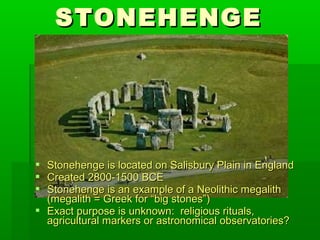
 Stonehenge is located on Salisbury Plain in EnglandStonehenge is located on Salisbury Plain in England
 Created 2800-1500 BCECreated 2800-1500 BCE
 Stonehenge is an example of a Neolithic megalithStonehenge is an example of a Neolithic megalith
(megalith = Greek for “big stones”)(megalith = Greek for “big stones”)
 Exact purpose is unknown: religious rituals,Exact purpose is unknown: religious rituals,
agricultural markers or astronomical observatories?agricultural markers or astronomical observatories?
Mystery of StonehengeMystery of Stonehenge
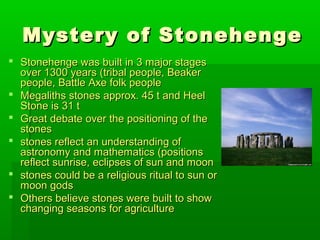
 Stonehenge was built in 3 major stagesStonehenge was built in 3 major stages
over 1300 years (tribal people, Beakerover 1300 years (tribal people, Beaker
people, Battle Axe folk peoplepeople, Battle Axe folk people
 Megaliths stones approx. 45 t and HeelMegaliths stones approx. 45 t and Heel
Stone is 31 tStone is 31 t
 Great debate over the positioning of theGreat debate over the positioning of the
stonesstones
 stones reflect an understanding ofstones reflect an understanding of
astronomy and mathematics (positionsastronomy and mathematics (positions
reflect sunrise, eclipses of sun and moonreflect sunrise, eclipses of sun and moon
 stones could be a religious ritual to sun orstones could be a religious ritual to sun or
moon godsmoon gods
 Others believe stones were built to showOthers believe stones were built to show
changing seasons for agriculturechanging seasons for agriculture
Major Innovations ofMajor Innovations of
the Stone Agethe Stone Age
 More complex human societies (from semi-More complex human societies (from semi-
nomadic to permanent cities; domestication ofnomadic to permanent cities; domestication of
animals; leisure time)animals; leisure time)
 Development of social hierarchiesDevelopment of social hierarchies
 Development of alliances and cooperationDevelopment of alliances and cooperation
 Marriage customsMarriage customs
 Development of trade goods and routesDevelopment of trade goods and routes
 Religious ritualsReligious rituals
 Refined sense of artistic beautyRefined sense of artistic beauty
ALL THESEALL THESE
LEAD TO THELEAD TO THE
FIRSTFIRST
“CIVILIZATIO“CIVILIZATIO
N”N”

Living stone age

  • 1.
    Living in theStone AgeLiving in the Stone Age
  • 2.
    Examining History:Examining History: PrehistoryPrehistory PRE-HISTORYPRE-HISTORY- period before written history- period before written history  Approximately 1.75 million years ago, earliestApproximately 1.75 million years ago, earliest people first began using small pieces of rockpeople first began using small pieces of rock as toolsas tools  Massive development of humans over years inMassive development of humans over years in 4 major groups:4 major groups: 1) Homo Habilis (2 million years ago)1) Homo Habilis (2 million years ago) 2) Homo Erectus (1 million years ago)2) Homo Erectus (1 million years ago) 3) Neanderthal (100 000 years ago)3) Neanderthal (100 000 years ago) 4) Cro-Magnon (50 000 years ago)4) Cro-Magnon (50 000 years ago)
  • 3.
    Development of HumansDevelopmentof Humans Homo HabilisHomo Habilis  Latin for “handy man”Latin for “handy man”  Lived in eastern Africa > spreadLived in eastern Africa > spread north to Asianorth to Asia  fossilized human bones foundfossilized human bones found with stone tools and animalwith stone tools and animal fossilsfossils  Skulls – humans had a flatterSkulls – humans had a flatter head with a brain only 2/3 size;head with a brain only 2/3 size; approximately 1.5 m tallapproximately 1.5 m tall  Built shelters of braches andBuilt shelters of braches and collected bird eggs and wildcollected bird eggs and wild berries for food; hunted wild pigsberries for food; hunted wild pigs  Tools / weapons = rocks,Tools / weapons = rocks, braches, sharp stonesbraches, sharp stones  No clothesNo clothes  Did not know how to use fireDid not know how to use fire Homo ErectusHomo Erectus  Latin for “upright man”Latin for “upright man”  Discoveries of “Java Man” (Indonesia) andDiscoveries of “Java Man” (Indonesia) and “Peking Man” (China”“Peking Man” (China”  Lived in Afria, south Europe, AsiaLived in Afria, south Europe, Asia  Skulls- humans had long, flat and sharply angledSkulls- humans had long, flat and sharply angled at back (between ape and human head)at back (between ape and human head)  Thighbone- identical to modern humans > walkThighbone- identical to modern humans > walk uprightupright  Charred animals bones found = they used fire toCharred animals bones found = they used fire to cookcook  Belief that homo erectus was a descendant ofBelief that homo erectus was a descendant of homo habilishomo habilis  Make fire= first by coals or volcanic ash; later byMake fire= first by coals or volcanic ash; later by friction= made life easier as they could survive infriction= made life easier as they could survive in colder climatescolder climates  Tools / weapons= bones, rocks, blades forTools / weapons= bones, rocks, blades for carving, spearscarving, spears Homo SapiensHomo Sapiens  Latin for “reasoning man”Latin for “reasoning man”  250 000 years ago= emergence of Homo Sapiens250 000 years ago= emergence of Homo Sapiens who evolved from homo erectuswho evolved from homo erectus  is the species to which all modern day peopleis the species to which all modern day people belongbelong
  • 5.
    Neanderthals vs CroNeanderthalsvs Cro MagnonMagnon NEANDERATHALNEANDERATHAL  Neander Valley- GermanyNeander Valley- Germany  6 cm taller than homo erectus;6 cm taller than homo erectus; thick eyebrow ridgethick eyebrow ridge  Tools= knives, spear sharpenersTools= knives, spear sharpeners made from chipped rockmade from chipped rock  Animals hides worn as clothesAnimals hides worn as clothes  Lived in caves kept warm with fireLived in caves kept warm with fire  First to bury the dead (gravesFirst to bury the dead (graves with bodies carefully preparedwith bodies carefully prepared CRO MAGNONCRO MAGNON  South France- clearing awaySouth France- clearing away earth from back of a rock shelterearth from back of a rock shelter locally known as Cro-Magnonlocally known as Cro-Magnon  First appeared in Europe 30 000First appeared in Europe 30 000 years ago following ice ageyears ago following ice age  Brain as large as modern dayBrain as large as modern day human; approx. 2 metres tall withhuman; approx. 2 metres tall with modern “faces”modern “faces”  Tools= slim, sharp edge blades,Tools= slim, sharp edge blades, chisels, knives, spearheads,chisels, knives, spearheads, lamps (stone bowl with animallamps (stone bowl with animal grease and lit fur or moss)grease and lit fur or moss)  Animals bones and teeth used toAnimals bones and teeth used to make musical instruments,make musical instruments, jewelleryjewellery  Cave paintingsCave paintings  Fierce warriorsFierce warriors  Wiped out NeanderthalsWiped out Neanderthals
  • 6.
    Great Leap ForwardGreatLeap Forward  35 000 years ago when changes brought about innovation,35 000 years ago when changes brought about innovation, creativity to humans (Homo Sapiens Sapiens)creativity to humans (Homo Sapiens Sapiens) 2 FUNDAMENTAL CHANGES OCCURRED:2 FUNDAMENTAL CHANGES OCCURRED: 1)1) Development of modern anatomyDevelopment of modern anatomy 2)2) Beginning of innovative behaviourBeginning of innovative behaviour EFFECTSEFFECTS  Production of crafted tools and more sophisticatedProduction of crafted tools and more sophisticated weaponsweapons  development of trade for raw materials and ornamentsdevelopment of trade for raw materials and ornaments  Emergence of sculptures, paintings and crafted objectsEmergence of sculptures, paintings and crafted objects that showcased beauty and religionthat showcased beauty and religion
  • 7.
    ““Lithos” = stoneLithos”= stone Paleolithic AgePaleolithic Age  Greek “paleo” meansGreek “paleo” means “old”“old”  Upper Paleolithic ageUpper Paleolithic age was 50 000 – 10 000was 50 000 – 10 000 years agoyears ago Neolithic AgeNeolithic Age  Greek “neo” meansGreek “neo” means “new”“new”  Neolithic RevolutionNeolithic Revolution occurred betweenoccurred between 9000 – 4000 BCE9000 – 4000 BCE
  • 8.
    Comparing theComparing the StoneAgesStone Ages PALEOLITHICPALEOLITHIC  small groups of 5-10small groups of 5-10 familiesfamilies  Nomadic to semi-Nomadic to semi- nomadicnomadic  Closer relationshipsCloser relationships between bands of peoplebetween bands of people ie. Cro-Magnon societyie. Cro-Magnon society NEOLITHICNEOLITHIC  People abandoned semi-People abandoned semi- nomadic life and begannomadic life and began farmingfarming  Agricultural revolutionAgricultural revolution was a progression of thewas a progression of the “Great Leap Forward”“Great Leap Forward”  planting of cropsplanting of crops  domesticating of animalsdomesticating of animals  Better tools & weaponsBetter tools & weapons
  • 9.
    Social Structure:Social Structure: PaleolithicAgePaleolithic Age  closer social relationshipscloser social relationships  Social stratificationSocial stratification== emergence of leadershipemergence of leadership and beginning of social classesand beginning of social classes  Social roles: patriarchal; men were big gameSocial roles: patriarchal; men were big game huntershunters  women captured small game and madewomen captured small game and made clothing; women & children were gatherersclothing; women & children were gatherers
  • 10.
    Social Structure:Social Structure: NeolithicAgeNeolithic Age  Increasing knowledge = more control of food supplyIncreasing knowledge = more control of food supply  End of Ice Age = better for agricultureEnd of Ice Age = better for agriculture  As population grew, so did the competition for landAs population grew, so did the competition for land  Shift fromShift from semi-nomadicsemi-nomadic toto permanent towns and citiespermanent towns and cities (first city was Jericho, in Mesopotamia between 8000 –(first city was Jericho, in Mesopotamia between 8000 – 7000 BCE) and more occupations7000 BCE) and more occupations  Trade by barter system (Trade by barter system (obsidianobsidian – most valued traded– most valued traded material traded for farm produce)material traded for farm produce)  Development of hierarchical class systemDevelopment of hierarchical class system
  • 11.
    Religion & ArtinReligion & Art in Paleolithic AgePaleolithic Age  The Paleolithic Age (Cro-Magnon) was the first toThe Paleolithic Age (Cro-Magnon) was the first to develop fine art as drawingsdevelop fine art as drawings  CAVE PAINTINGS of deer, horses and animals whichCAVE PAINTINGS of deer, horses and animals which are now extinctare now extinct  cultural explosion in art as more tools, jewellery, andcultural explosion in art as more tools, jewellery, and sculptures/ figurines of clay, ivory and stone emergedsculptures/ figurines of clay, ivory and stone emerged  More advanced spiritual practices with graves foundMore advanced spiritual practices with graves found jewellery and spears made of mammoth tusks buriedjewellery and spears made of mammoth tusks buried with bodies = this suggests a ritual burial with a view ofwith bodies = this suggests a ritual burial with a view of an afterlifean afterlife
  • 12.
    Caves at Lascaux[lass co]Caves at Lascaux [lass co]  Painting at Lascaux Caves (south central France) found in 15 000 BCEPainting at Lascaux Caves (south central France) found in 15 000 BCE  Painters used irregularities in cave walls to add a 3-D effect to figuresPainters used irregularities in cave walls to add a 3-D effect to figures  Paintings portray an awe and reverence towards animals which shows thatPaintings portray an awe and reverence towards animals which shows that for the first time people were expressing religious beliefs (rituals related tofor the first time people were expressing religious beliefs (rituals related to hunting magic; sacrifices of animals)hunting magic; sacrifices of animals)
  • 13.
    Venus of WillendorfVenusof Willendorf  Small sculptures such asSmall sculptures such as thethe Venus of WillendorfVenus of Willendorf were common to thewere common to the Paleolithic AgePaleolithic Age  Sculpture featuresSculpture features exaggerated curves (largeexaggerated curves (large breasts and wide hips) onbreasts and wide hips) on female figurefemale figure  Venus figurines areVenus figurines are symbolic of the importancesymbolic of the importance of fertility of a motherof fertility of a mother goddessgoddess
  • 14.
    Weapons & TechnologyWeapons& Technology PALEOLITHICPALEOLITHIC  Better hunting strategies dueBetter hunting strategies due to co-operation and moreto co-operation and more lethal weaponslethal weapons  Better tools for skinningBetter tools for skinning game, preparing food,game, preparing food, sewing clothessewing clothes  Cro-Magnons stored foodCro-Magnons stored food over winter showing moreover winter showing more planningplanning  bow and arrow around 20bow and arrow around 20 000 BCE000 BCE NEOLITHICNEOLITHIC  efficient tools whichefficient tools which helped farm and makehelped farm and make weapons and toolsweapons and tools  Domestication of animalsDomestication of animals to do manual work andto do manual work and the planting of cropsthe planting of crops freed people from thefreed people from the pursuit of foodpursuit of food  leisure activities (art,leisure activities (art, music, sports, religion)music, sports, religion)
  • 17.
    STONEHENGESTONEHENGE  Stonehenge islocated on Salisbury Plain in EnglandStonehenge is located on Salisbury Plain in England  Created 2800-1500 BCECreated 2800-1500 BCE  Stonehenge is an example of a Neolithic megalithStonehenge is an example of a Neolithic megalith (megalith = Greek for “big stones”)(megalith = Greek for “big stones”)  Exact purpose is unknown: religious rituals,Exact purpose is unknown: religious rituals, agricultural markers or astronomical observatories?agricultural markers or astronomical observatories?
  • 18.
    Mystery of StonehengeMysteryof Stonehenge  Stonehenge was built in 3 major stagesStonehenge was built in 3 major stages over 1300 years (tribal people, Beakerover 1300 years (tribal people, Beaker people, Battle Axe folk peoplepeople, Battle Axe folk people  Megaliths stones approx. 45 t and HeelMegaliths stones approx. 45 t and Heel Stone is 31 tStone is 31 t  Great debate over the positioning of theGreat debate over the positioning of the stonesstones  stones reflect an understanding ofstones reflect an understanding of astronomy and mathematics (positionsastronomy and mathematics (positions reflect sunrise, eclipses of sun and moonreflect sunrise, eclipses of sun and moon  stones could be a religious ritual to sun orstones could be a religious ritual to sun or moon godsmoon gods  Others believe stones were built to showOthers believe stones were built to show changing seasons for agriculturechanging seasons for agriculture
  • 19.
    Major Innovations ofMajorInnovations of the Stone Agethe Stone Age  More complex human societies (from semi-More complex human societies (from semi- nomadic to permanent cities; domestication ofnomadic to permanent cities; domestication of animals; leisure time)animals; leisure time)  Development of social hierarchiesDevelopment of social hierarchies  Development of alliances and cooperationDevelopment of alliances and cooperation  Marriage customsMarriage customs  Development of trade goods and routesDevelopment of trade goods and routes  Religious ritualsReligious rituals  Refined sense of artistic beautyRefined sense of artistic beauty
  • 20.
    ALL THESEALL THESE LEADTO THELEAD TO THE FIRSTFIRST “CIVILIZATIO“CIVILIZATIO N”N”

Editor's Notes

  • #4 Homo Habilis Latin for “handy man” Discoveries in 1930s by Louis and Mary Leakey Lived in eastern Africa > spread north to Asia fossilized human bones found with stone tools and animal fossils Skulls – humans had a flatter head with a brain only 2/3 size; approximately 1.5 m tall Built shelters of braches and collected bird eggs and wild berries for food; hunted wild pigs Tools / weapons = rocks, braches, sharp stones No clothes Did not know how to use fire
  • #9 Paleolithic-1) People lived in small groups of 5-10 families 2) Nomadic to semi-nomadic (hunting and gathering) 3) close relationships between bands of people ie. Cro-Magnon societyNEOLITHIC 1) People abandoned semi-nomadic life and began farming
  • #10 1) Beginnings of closer social relationships (arranged marriages with other bands, bartering for raw materials) 2) Beginning of stratification= emergence of leadership and beginning of social classes (age, gender, experiences) 3) men were big game hunters; women captured small game 4) women & children were gatherers (approx. 60-70% of diet came from roots, potatoes, fruits, berries) 5) Women made clothing from animal hides and nurtured children
  • #11 Increasing knowledge of plants and animals allowed more control of food supply End of Ice Age brought a warmer, wetter climate which brought new wild grasses and grains As population grew, so did the competition for land Shift from semi-nomadic to the building of permanent towns and cities (first city was Jericho, in Mesopotamia between 8000 – 7000 BCE) Trade by barter system was a crucial factor in the origin of cities (obsidian – a volcanic glass was one of the most valued traded materials (tools, weapons, art) would be traded for farm produce Development of hierarchical class system Domestication animals (cattle, sheep, goats, pigs) More occupations emerged with more permanent cities and towns
  • #12 The Paleolithic Age (Cro-Magnon) was the first to develop fine art as drawings Over 100 European caves showcase CAVE PAINTINGS of deer, horses and animals which are now extinct Beginnings of cultural explosion in art as more tools, pendants, jewellery, and sculptures/ figurines of clay, ivory and stone emerged More advanced spiritual practices emerged as graves were found containing beads, ivory jewellery and spears made of mammoth tusks buried with bodies = this suggests a ritual burial with a view of an afterlife
  • #15 PALEOLITHIC Better hunting strategies due to co-operation and more lethal weapons Better tools for skinning game, preparing food, sewing clothes Cro-Magnons stored food over winter showing more planning Invention of the bow and arrow around 20 000 BCE made hunting more easy NEOLITHIC More efficient tools (sickle made of flint blades and antler; axes, hoe, copper use) which helped farm and make weapons and tools Domestication of animals to do manual work and the planting of crops freed people from the pursuit of food New time for leisure activities (art, music, sports, religion)