Cellular Respiration:
Harvesting of
Cellular Energy
Chapter 09
Learning objectivesLearning objectives
• Describe energy flow in the biosphere according toDescribe energy flow in the biosphere according to
the principle endergonic and exergonic reactionthe principle endergonic and exergonic reaction
cycles.cycles.
• Describe how energy is obtained through the redoxDescribe how energy is obtained through the redox
reactions of cellular respiration in mitochondriareactions of cellular respiration in mitochondria
• Name the major input and output compounds forName the major input and output compounds for
glycolysis, transition, Krebs cycle and Electronglycolysis, transition, Krebs cycle and Electron
Transport/ATP synthaseTransport/ATP synthase
• Explain how fermentation provides for ATP in theExplain how fermentation provides for ATP in the
absence of oxygenabsence of oxygen
• Describe how the mitochondria provides forDescribe how the mitochondria provides for
synthesis of macromoleculessynthesis of macromolecules
• Compare and differentiate mitochondria andCompare and differentiate mitochondria and
chloroplasts in terms of major reactants and prod.chloroplasts in terms of major reactants and prod.
Chapter 09
Respiration
Chapter 09
Respiration
OutlineOutline
1.1. GlycolysisGlycolysis
2.2. Transition ReactionTransition Reaction
3.3. Citric Acid CycleCitric Acid Cycle
4.4. Electron Transport SystemElectron Transport System
5.5. FermentationFermentation
6.6. Metabolic PoolMetabolic Pool
 CatabolismCatabolism
 AnabolismAnabolism
Chapter 09
Respiration
Cellular RespirationCellular Respiration
A cellular process that requires oxygen andA cellular process that requires oxygen and
gives off carbon dioxidegives off carbon dioxide
Usually involves breakdown of glucose toUsually involves breakdown of glucose to
carbon dioxide and watercarbon dioxide and water
Energy extracted from glucose molecule:Energy extracted from glucose molecule:
­ Released step-wiseReleased step-wise
­ Allows ATP to be produced efficientlyAllows ATP to be produced efficiently
 Coenzymes NADCoenzymes NAD++
FAD deliver high energyFAD deliver high energy
electrons to Oxidation-reduction chain inelectrons to Oxidation-reduction chain in
mitochondrial membranemitochondrial membrane
Chapter 09
Respiration
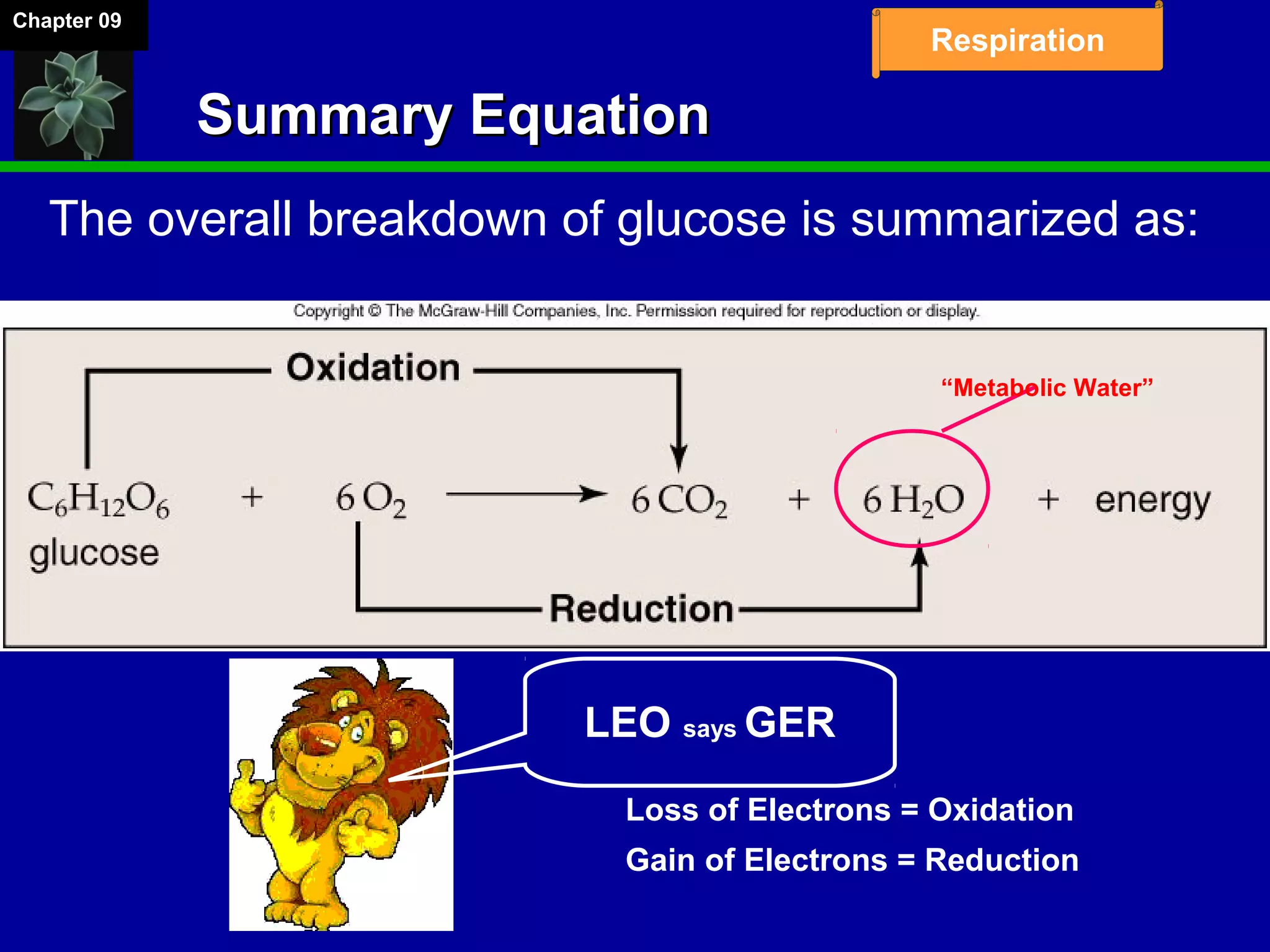
Summary EquationSummary Equation
LEO says GER
Loss of Electrons = Oxidation
Gain of Electrons = Reduction
The overall breakdown of glucose is summarized as:
“Metabolic Water”
Chapter 09
Respiration
Coenzymes:Coenzymes:
NADNAD++
and FADand FAD
1. NAD1. NAD++
(nicotinamide adenine dinucleotide)(nicotinamide adenine dinucleotide)
­ Oxidize a metabolite by accepting electronsOxidize a metabolite by accepting electrons
­ Reduce a metabolite by giving up electronsReduce a metabolite by giving up electrons
(Each NAD(Each NAD++
molecule used over and over again)molecule used over and over again)
2. FAD (flavin adenine dinucleotide)2. FAD (flavin adenine dinucleotide)
Sometimes used instead of NADSometimes used instead of NAD++
Accepts two electrons and two hydrogen ionsAccepts two electrons and two hydrogen ions
(H(H++
) to become FADH) to become FADH22
Chapter 09
Respiration
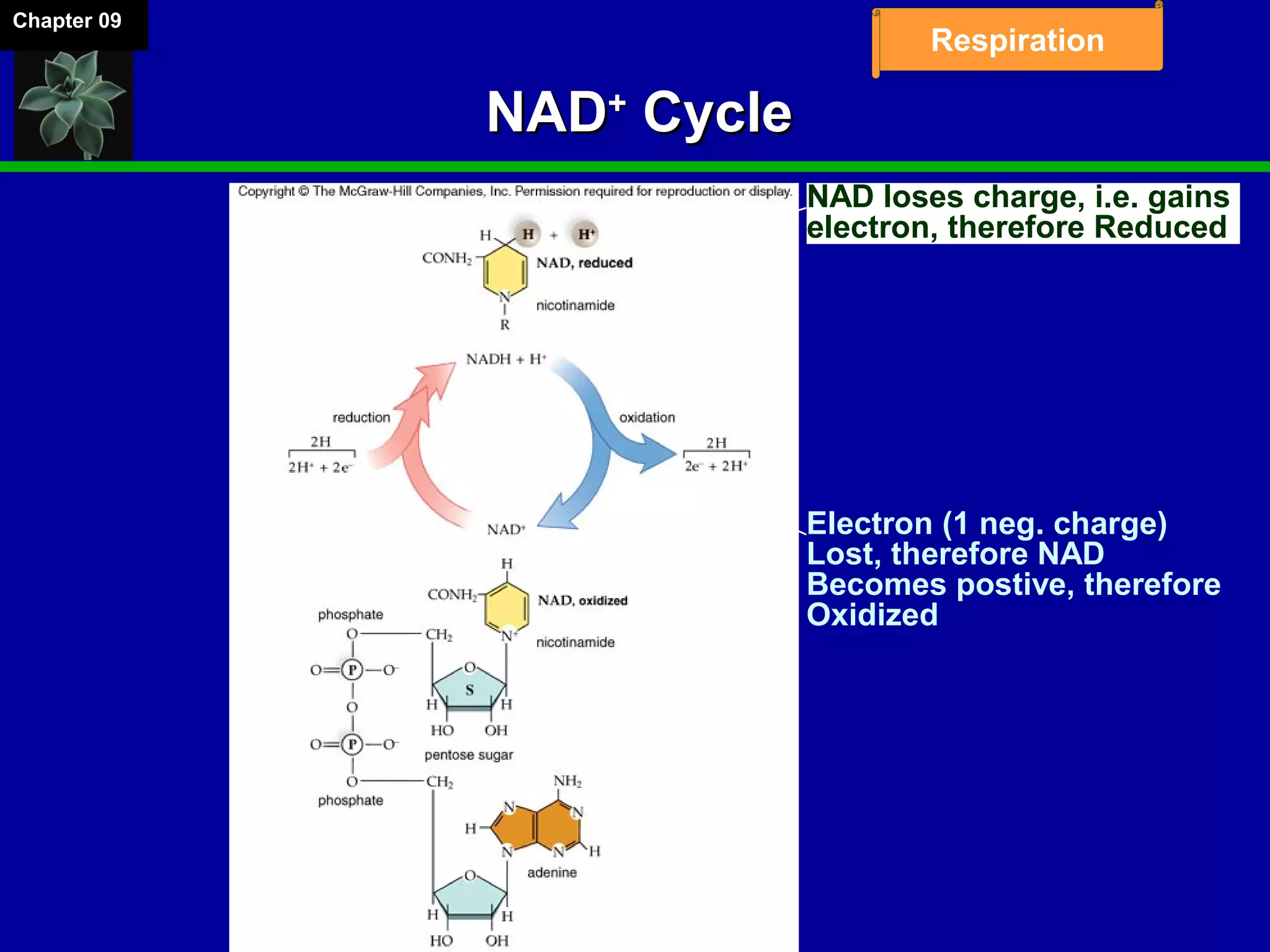
NADNAD++
CycleCycle
Electron (1 neg. charge)
Lost, therefore NAD
Becomes postive, therefore
Oxidized
NAD loses charge, i.e. gains
electron, therefore Reduced
Chapter 09
Respiration
Cellular Respiration:Cellular Respiration:
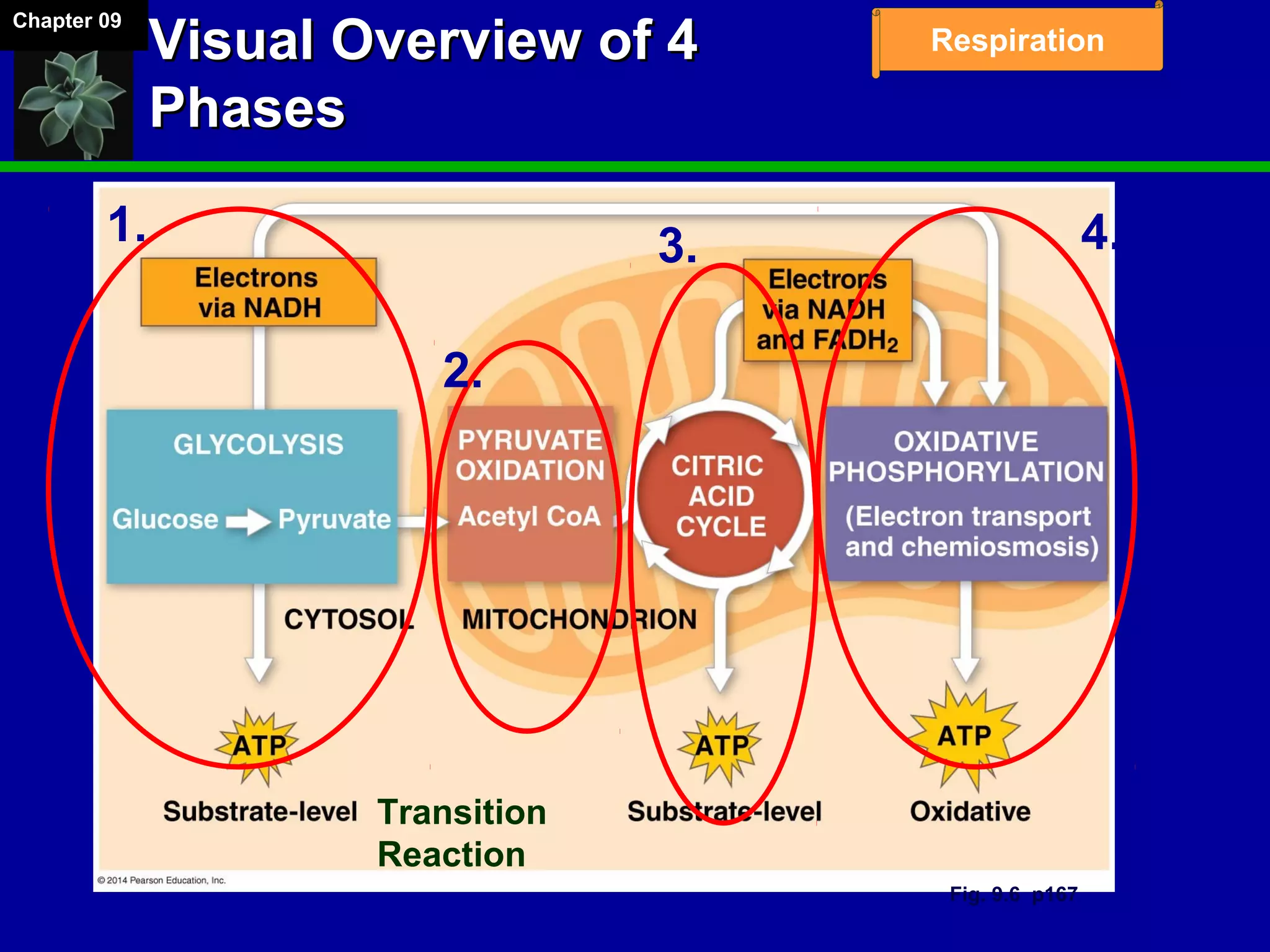
Overview of 4 PhasesOverview of 4 Phases
1. Glycolysis:1. Glycolysis: glucose to pyruvateglucose to pyruvate
 Occurs in cytoplasmOccurs in cytoplasm
 Glucose broken down to two molecules of pyruvateGlucose broken down to two molecules of pyruvate
 ATP is formedATP is formed
2. Transition / Preparatory reaction:2. Transition / Preparatory reaction: pruvate to acetyl-CoApruvate to acetyl-CoA
 Both pyruvates are oxidizedBoth pyruvates are oxidized
 Electron energy is stored in NADHElectron energy is stored in NADH
 Two carbons are released as COTwo carbons are released as CO22
3. Citric acid cycle:3. Citric acid cycle: electrons removed from acetyl groups (oxid.)electrons removed from acetyl groups (oxid.)
 Electron energy is stored in NADH and FADHElectron energy is stored in NADH and FADH22
 ATP is formedATP is formed
 Four carbons are released as COFour carbons are released as CO22
4. Electron transport chain:4. Electron transport chain: energy extracted from electrons.energy extracted from electrons.
 Extracts energy from NADH & FADHExtracts energy from NADH & FADH22
 Produces 32 or 34 molecules of ATPProduces 32 or 34 molecules of ATP
Pyruvate converted to
acetyl-CoA and
enters mitochondria
Chapter 09
RespirationVisual Overview of 4Visual Overview of 4
PhasesPhases
Transition
Reaction
1.
2.
3. 4.
Fig. 9.6 p167
Chapter 09
Respiration
Glucose Breakdown:Glucose Breakdown:
1. Glycolysis1. Glycolysis
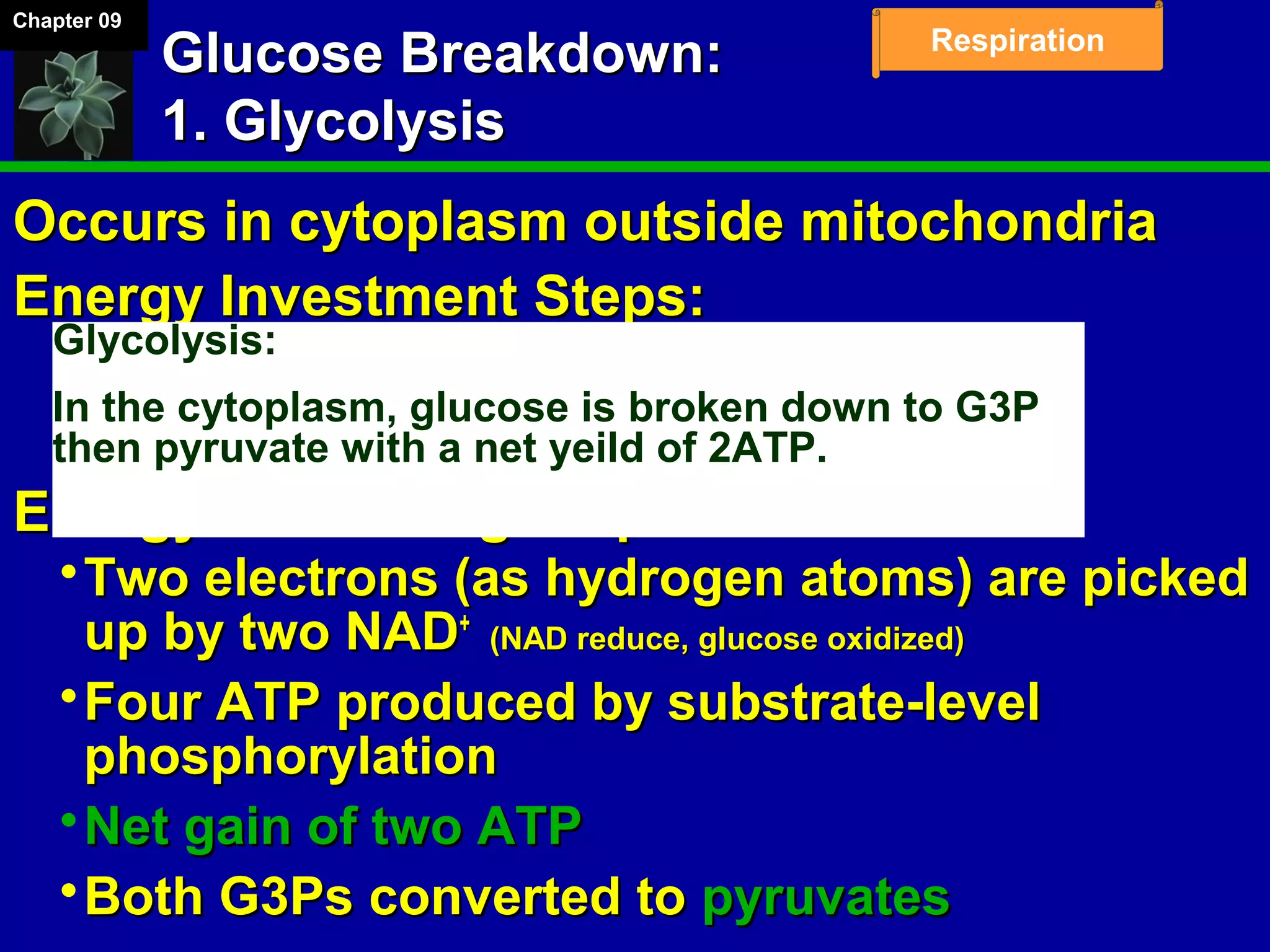
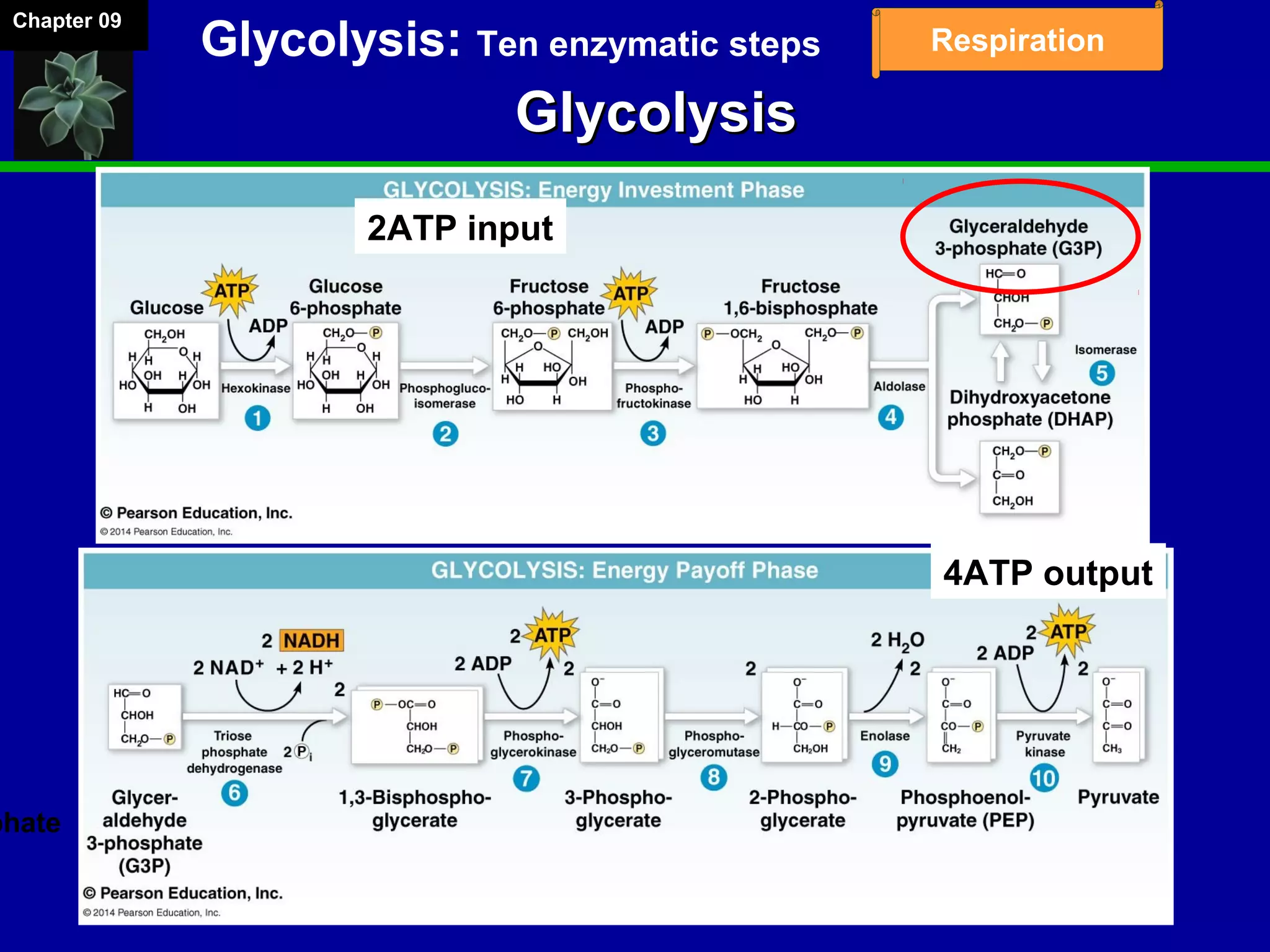
Occurs in cytoplasm outside mitochondriaOccurs in cytoplasm outside mitochondria
Energy Investment Steps:Energy Investment Steps:
Two ATP are used to activate glucoseTwo ATP are used to activate glucose
Glucose splits into two G3P moleculesGlucose splits into two G3P molecules
Energy Harvesting Steps:Energy Harvesting Steps:
Two electrons (as hydrogen atoms) are pickedTwo electrons (as hydrogen atoms) are picked
up by two NADup by two NAD++
(NAD reduce, glucose oxidized)(NAD reduce, glucose oxidized)
Four ATP produced by substrate-levelFour ATP produced by substrate-level
phosphorylationphosphorylation
Net gain of two ATPNet gain of two ATP
Both G3Ps converted toBoth G3Ps converted to pyruvatespyruvates
Glycolysis:
In the cytoplasm, glucose is broken down to G3P
then pyruvate with a net yeild of 2ATP.
Chapter 09
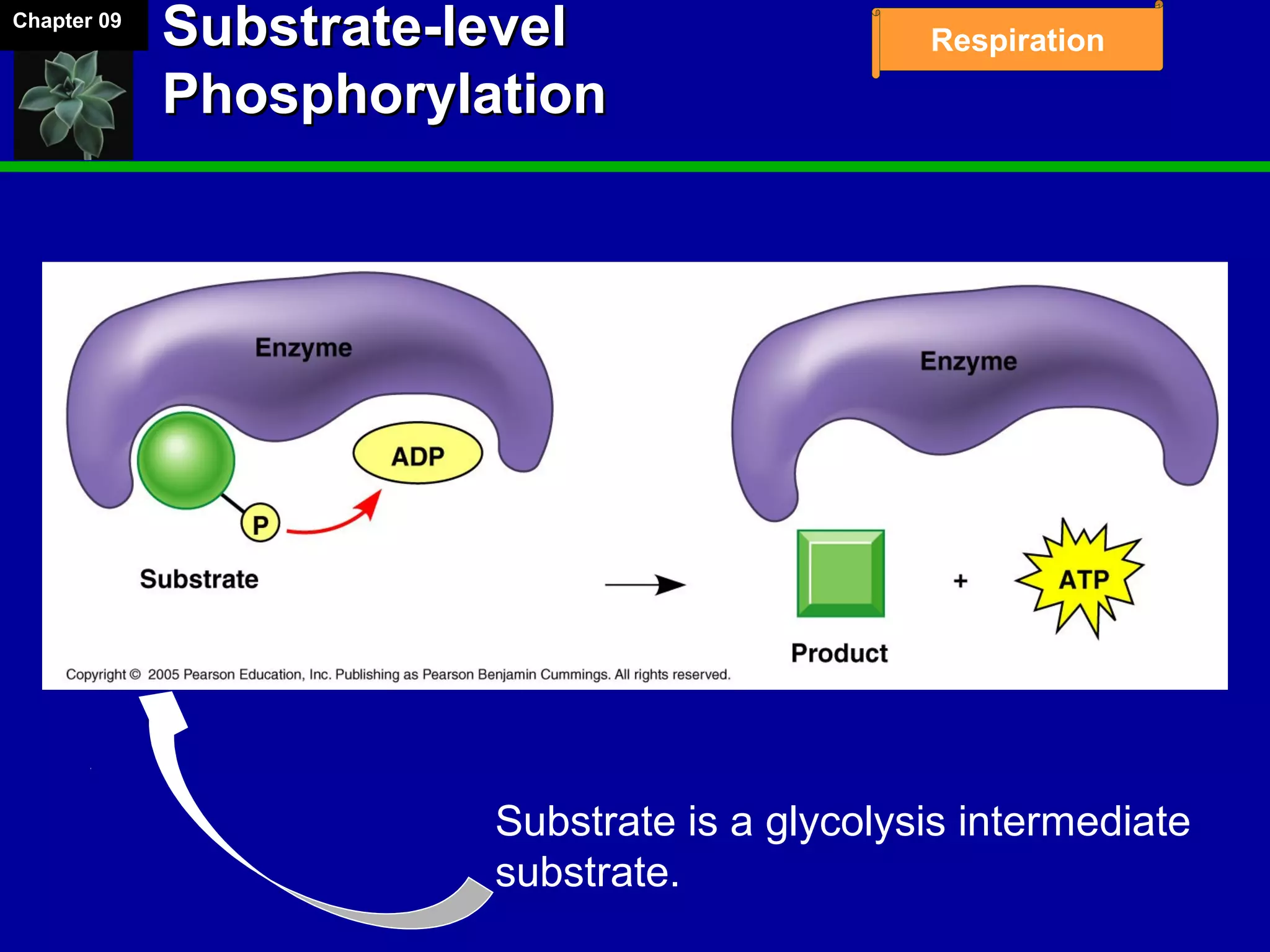
RespirationSubstrate-levelSubstrate-level
PhosphorylationPhosphorylation
Substrate is a glycolysis intermediate
substrate.
Chapter 09
Respiration
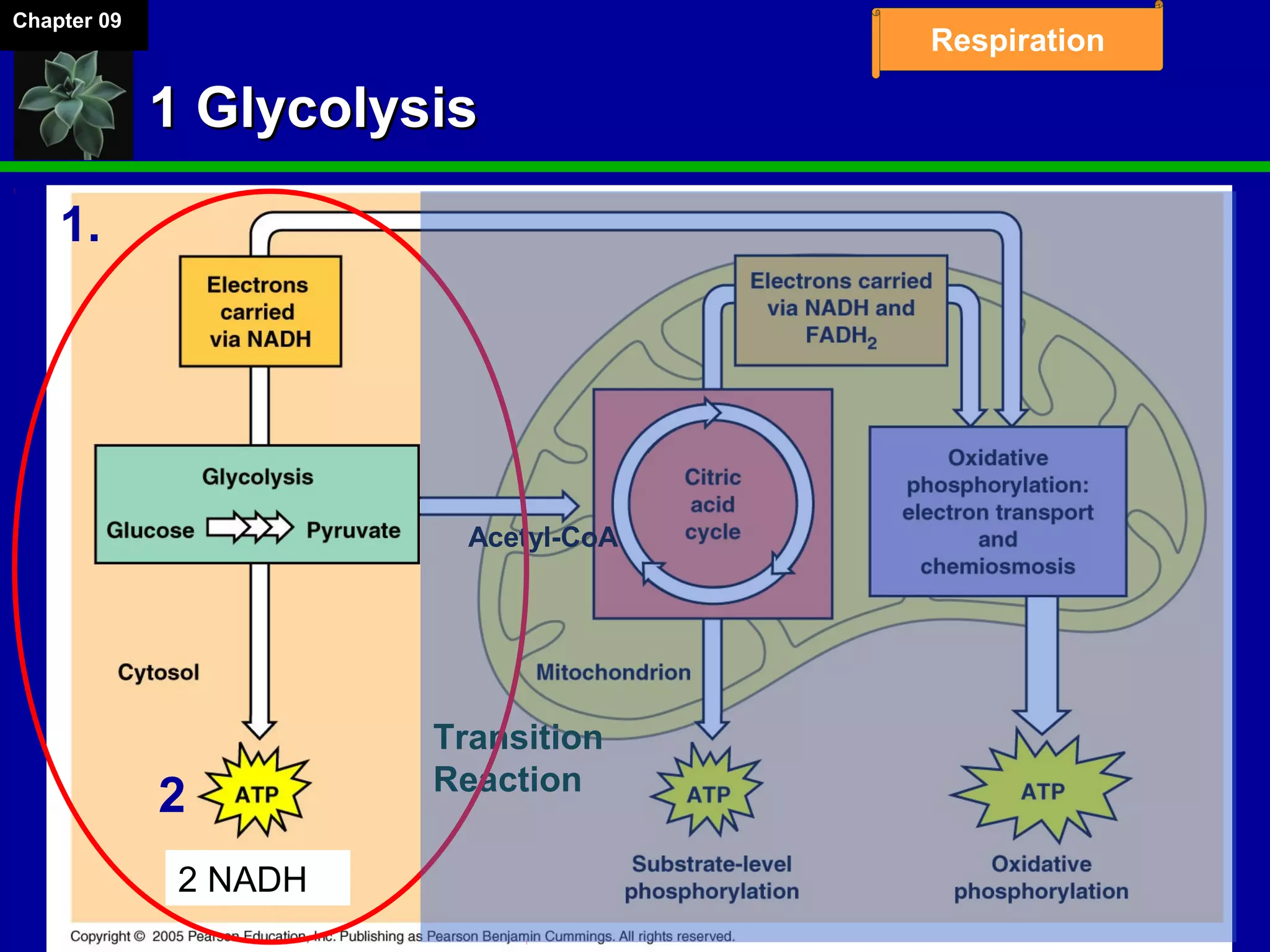
1 Glycolysis1 Glycolysis
Transition
Reaction
1.
2
Acetyl-CoA
2 NADH
Chapter 09
Respiration
GlycolysisGlycolysis
Glycolysis: Ten enzymatic steps
phate
2ATP input
4ATP output
Chapter 09
Respiration
Glucose Breakdown:Glucose Breakdown:
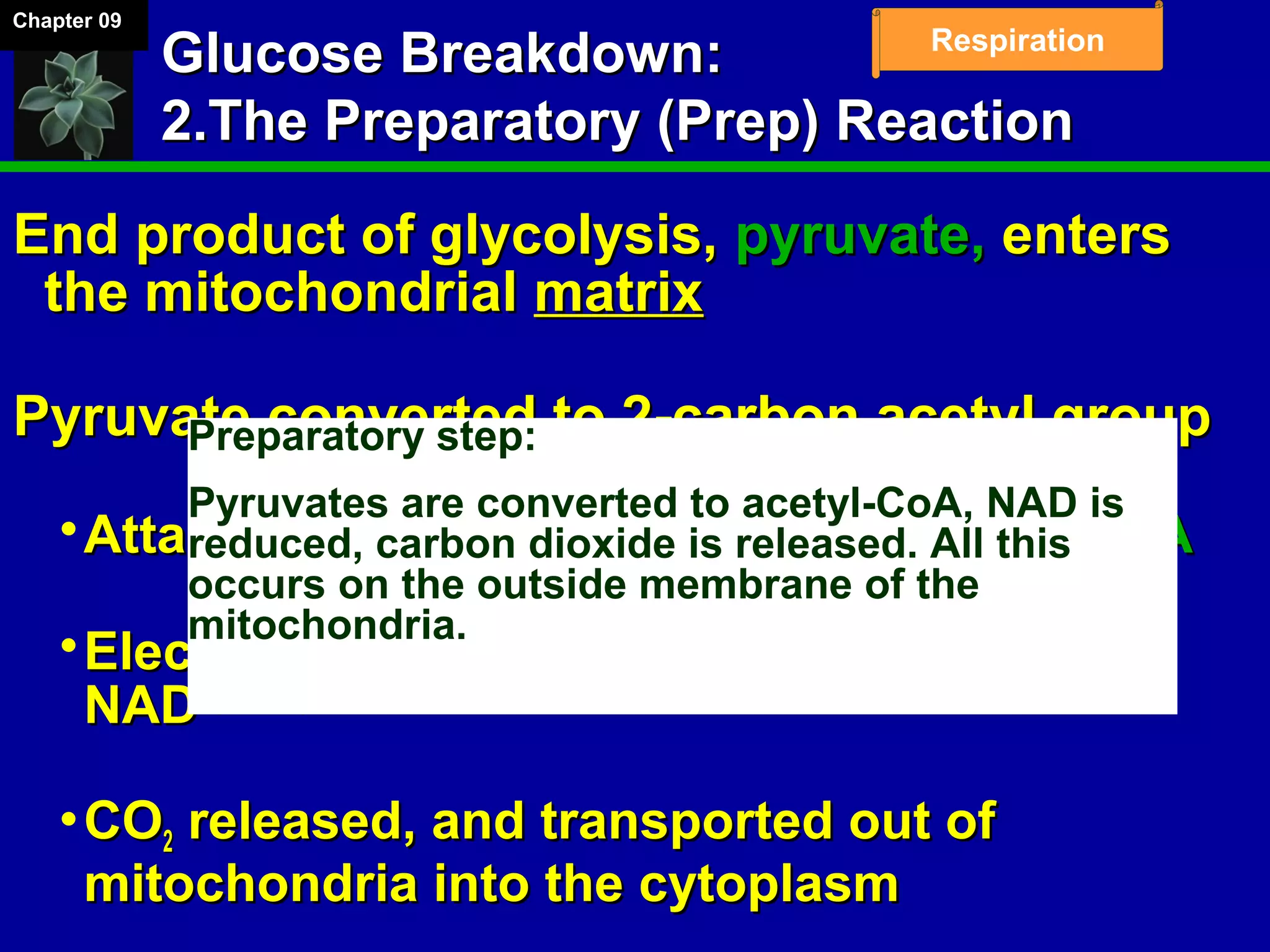
2.The Preparatory (Prep) Reaction2.The Preparatory (Prep) Reaction
End product of glycolysis,End product of glycolysis, pyruvate,pyruvate, entersenters
the mitochondrialthe mitochondrial matrixmatrix
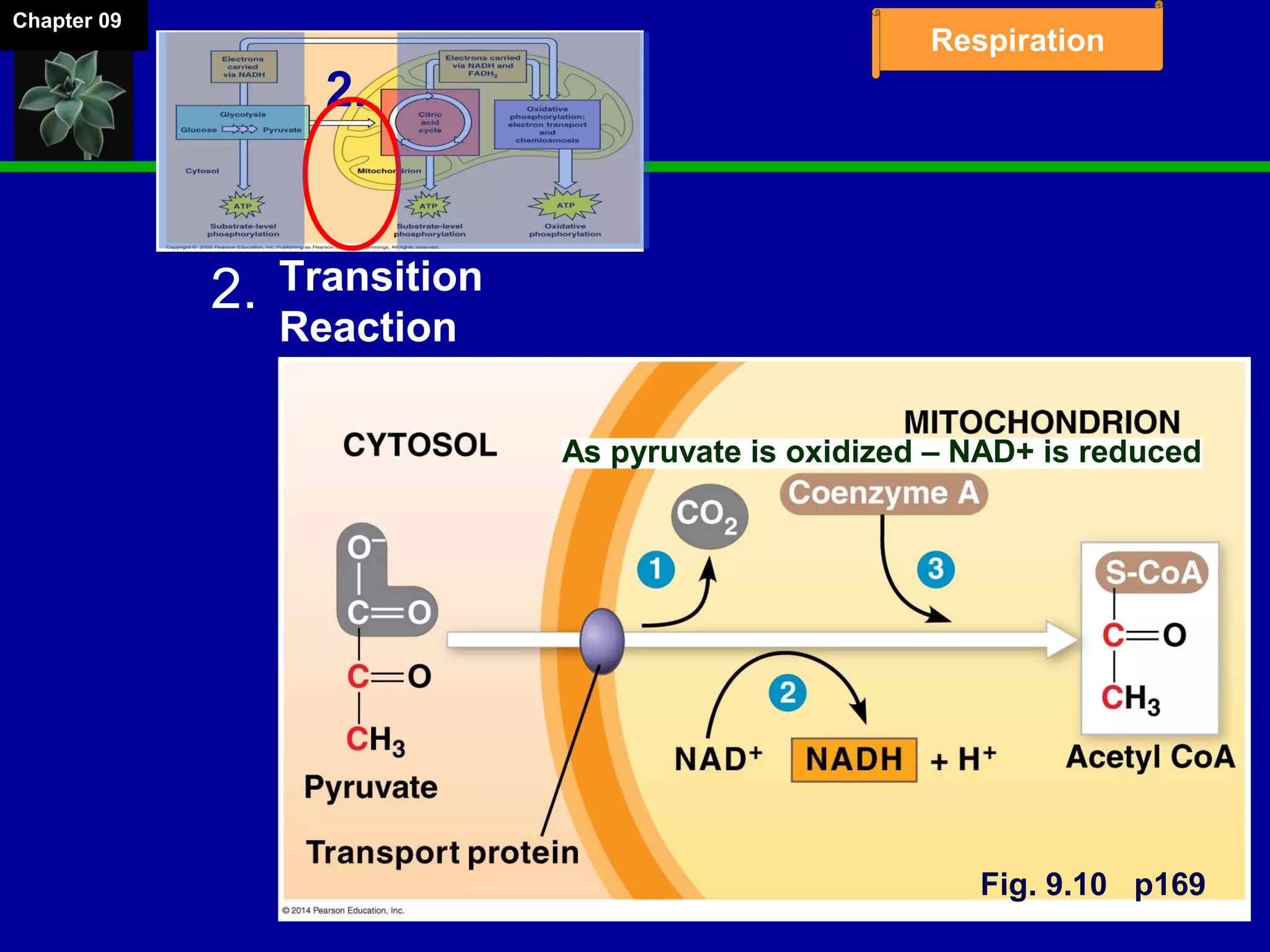
Pyruvate converted to 2-carbon acetyl groupPyruvate converted to 2-carbon acetyl group
Attached to Coenzyme A to formAttached to Coenzyme A to form acetyl-CoAacetyl-CoA
Electrons picked up (as hydrogen atom) byElectrons picked up (as hydrogen atom) by
NADNAD+ (reduction)+ (reduction)
COCO22 released, and transported out ofreleased, and transported out of
mitochondria into the cytoplasmmitochondria into the cytoplasm
Preparatory step:
Pyruvates are converted to acetyl-CoA, NAD is
reduced, carbon dioxide is released. All this
occurs on the outside membrane of the
mitochondria.
Chapter 09
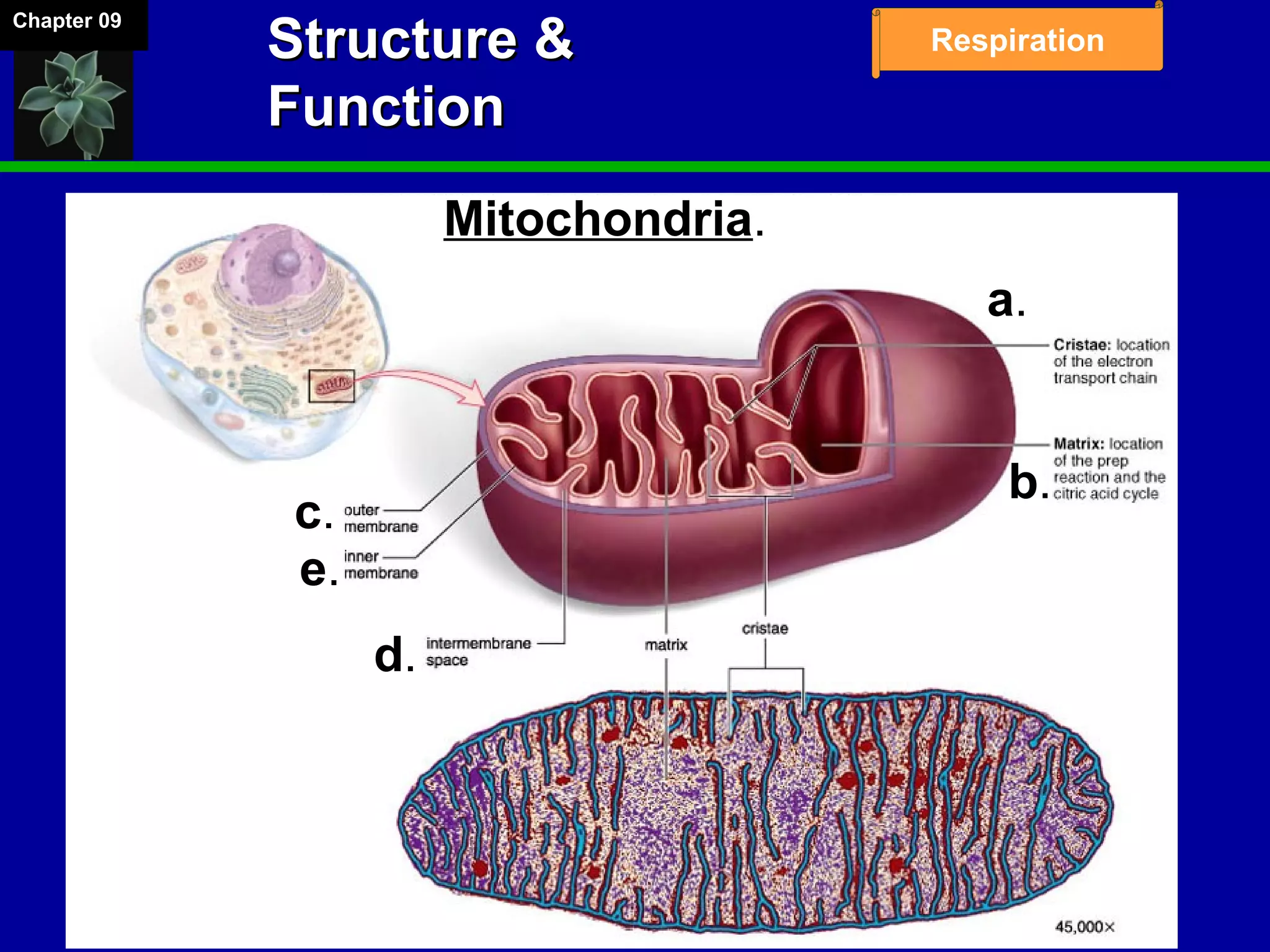
RespirationStructure &Structure &
FunctionFunction
a.
b.
c.
e.
d.
Mitochondria.
Chapter 09
Respiration
As pyruvate is oxidized – NAD+ is reduced
Transition
Reaction
2.
2.
Fig. 9.10 p169
Chapter 09
Respiration
Glucose Breakdown:Glucose Breakdown:
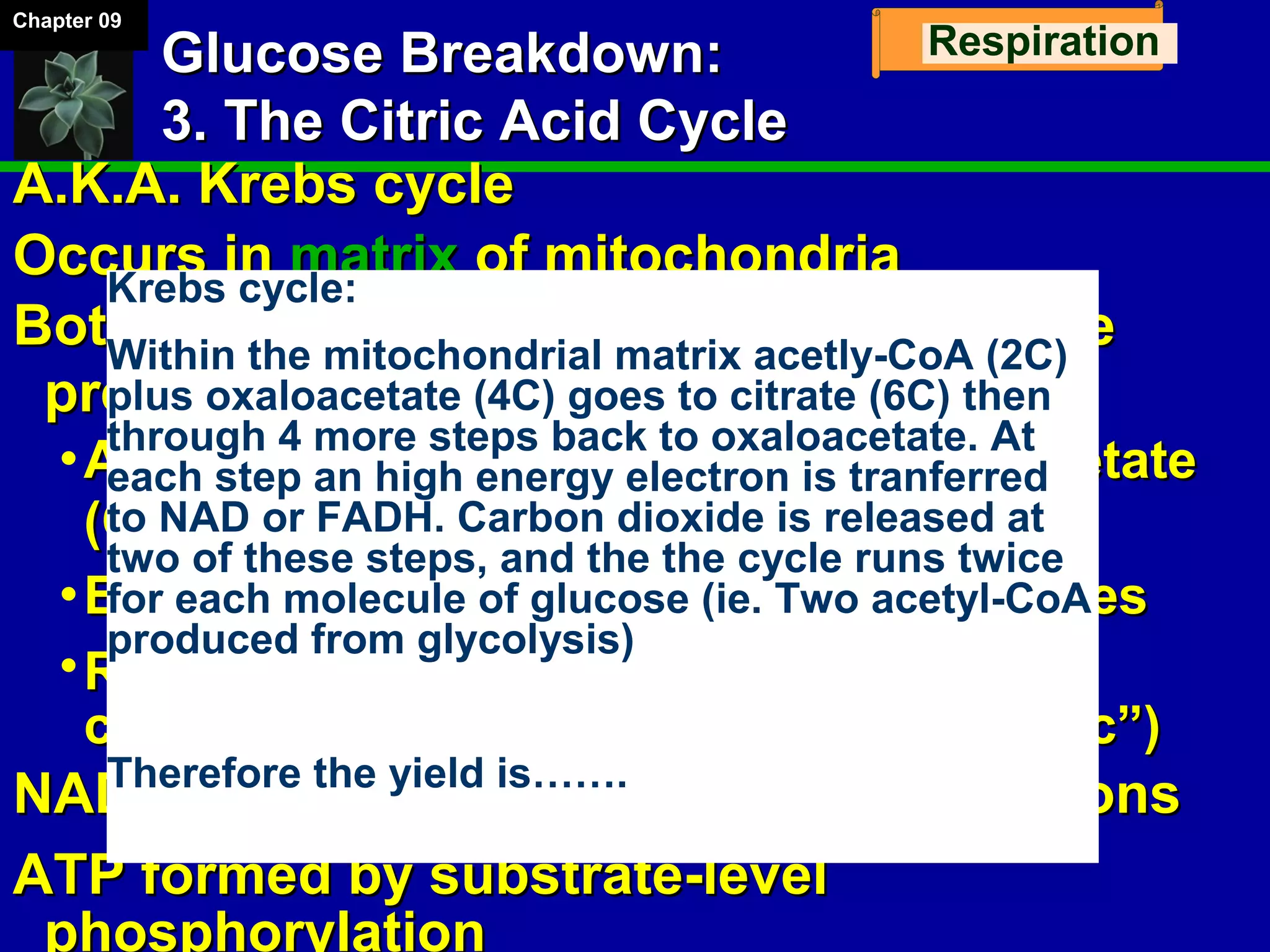
3. The Citric Acid Cycle3. The Citric Acid Cycle
A.K.A. Krebs cycleA.K.A. Krebs cycle
Occurs inOccurs in matrixmatrix of mitochondriaof mitochondria
Both acetyl (CBoth acetyl (C22) groups received from the) groups received from the
preparatory reaction:preparatory reaction:
Acetyl (CAcetyl (C22) group transferred to oxaloacetate) group transferred to oxaloacetate
(C(C22) to make citrate (C) to make citrate (C66))
Each acetyl oxidized to two COEach acetyl oxidized to two CO22 moleculesmolecules
Remaining 4 carbons from oxaloacetateRemaining 4 carbons from oxaloacetate
converted restart the cycle. (thus “cyclic”)converted restart the cycle. (thus “cyclic”)
NADH, FADHNADH, FADH22 capture energy rich electronscapture energy rich electrons
ATP formed by substrate-levelATP formed by substrate-level
phosphorylation
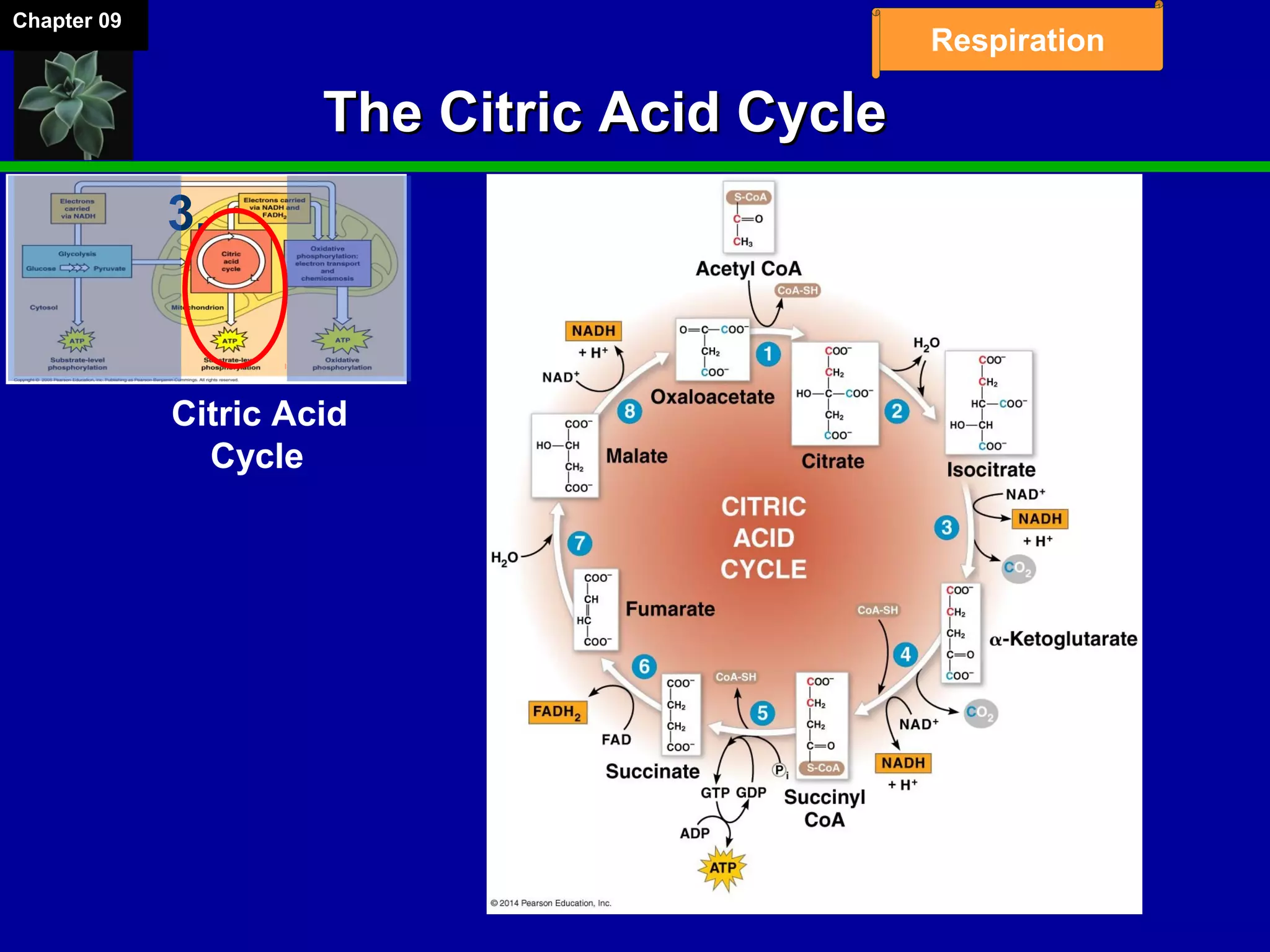
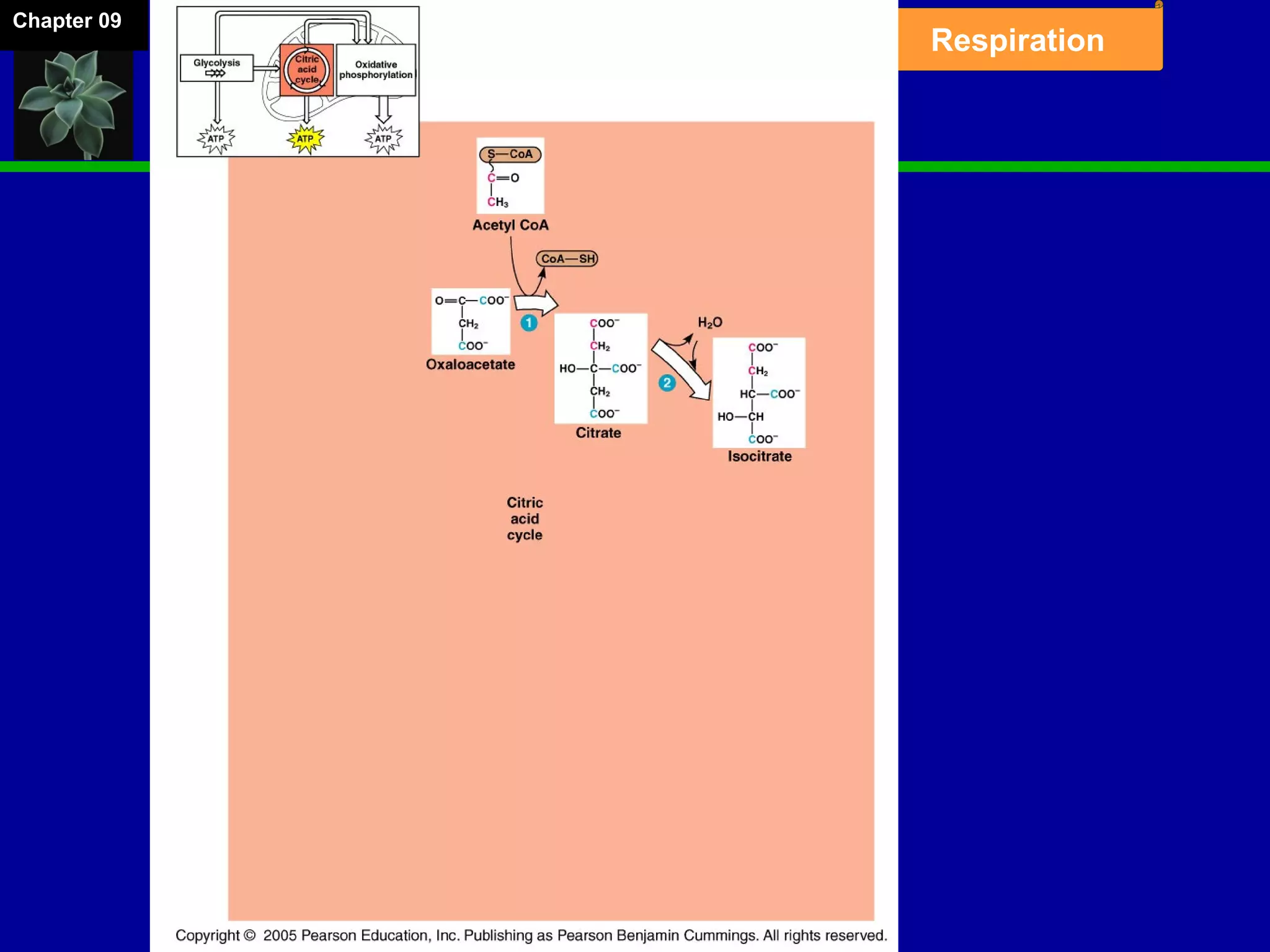
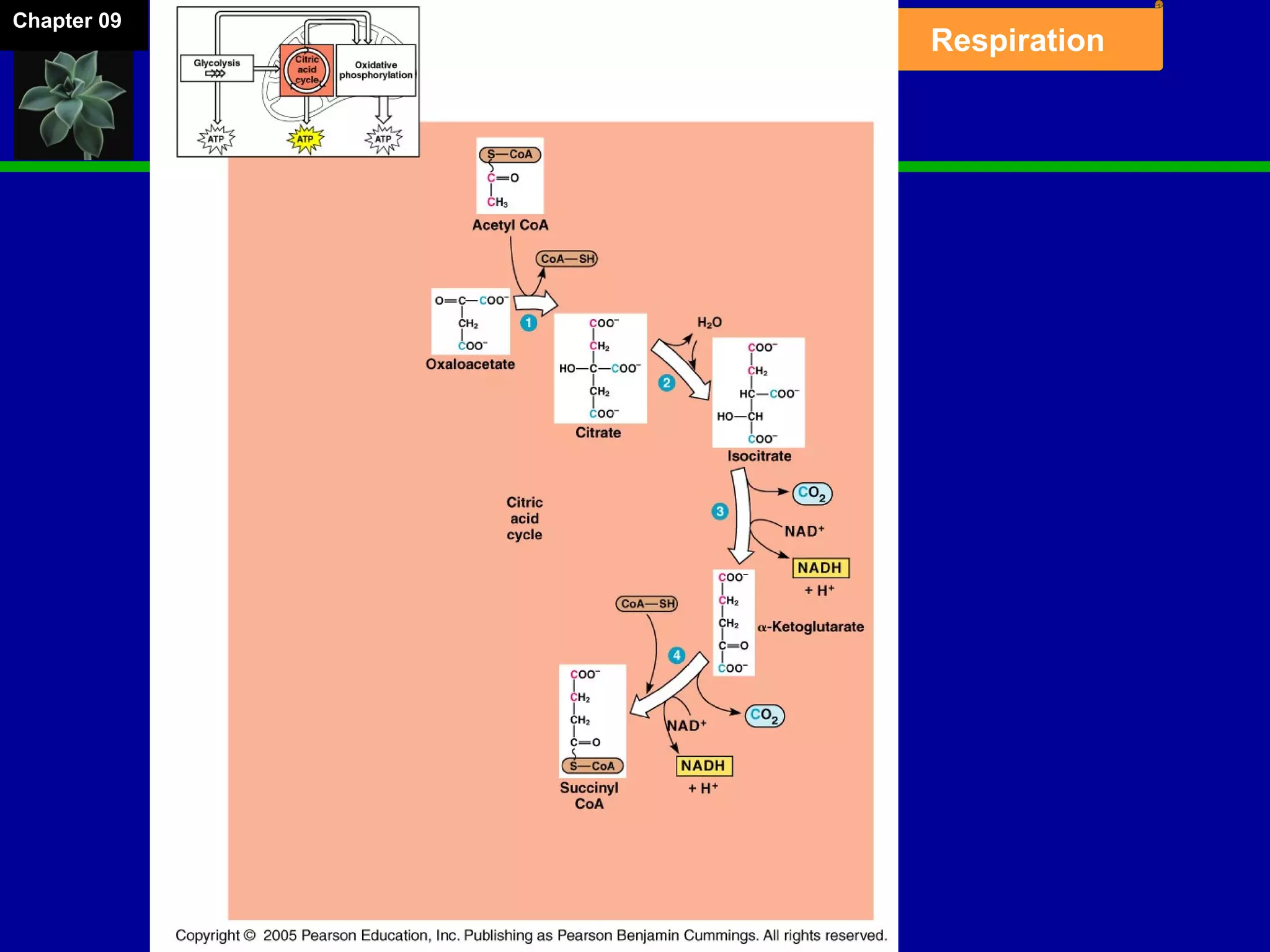
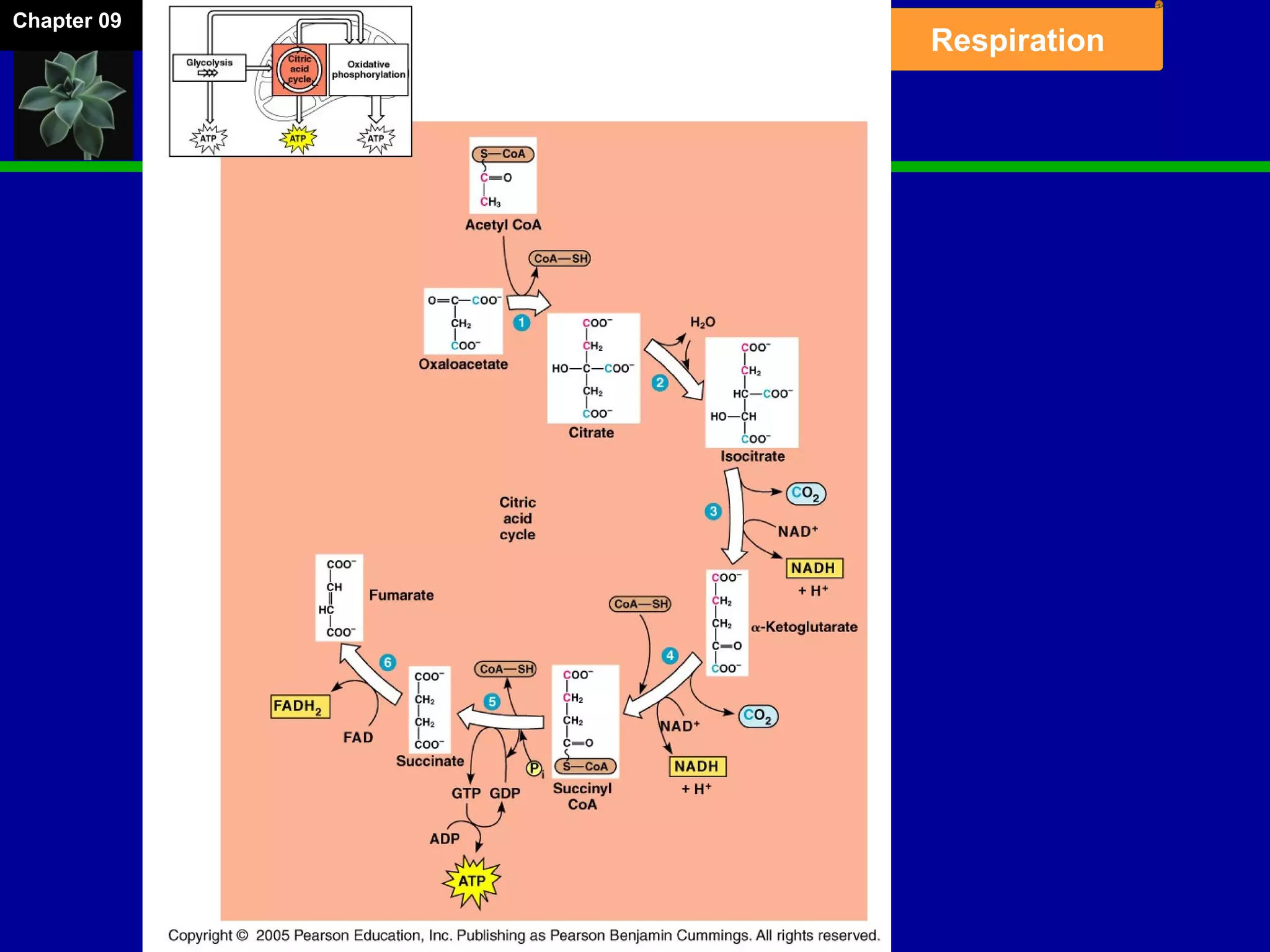
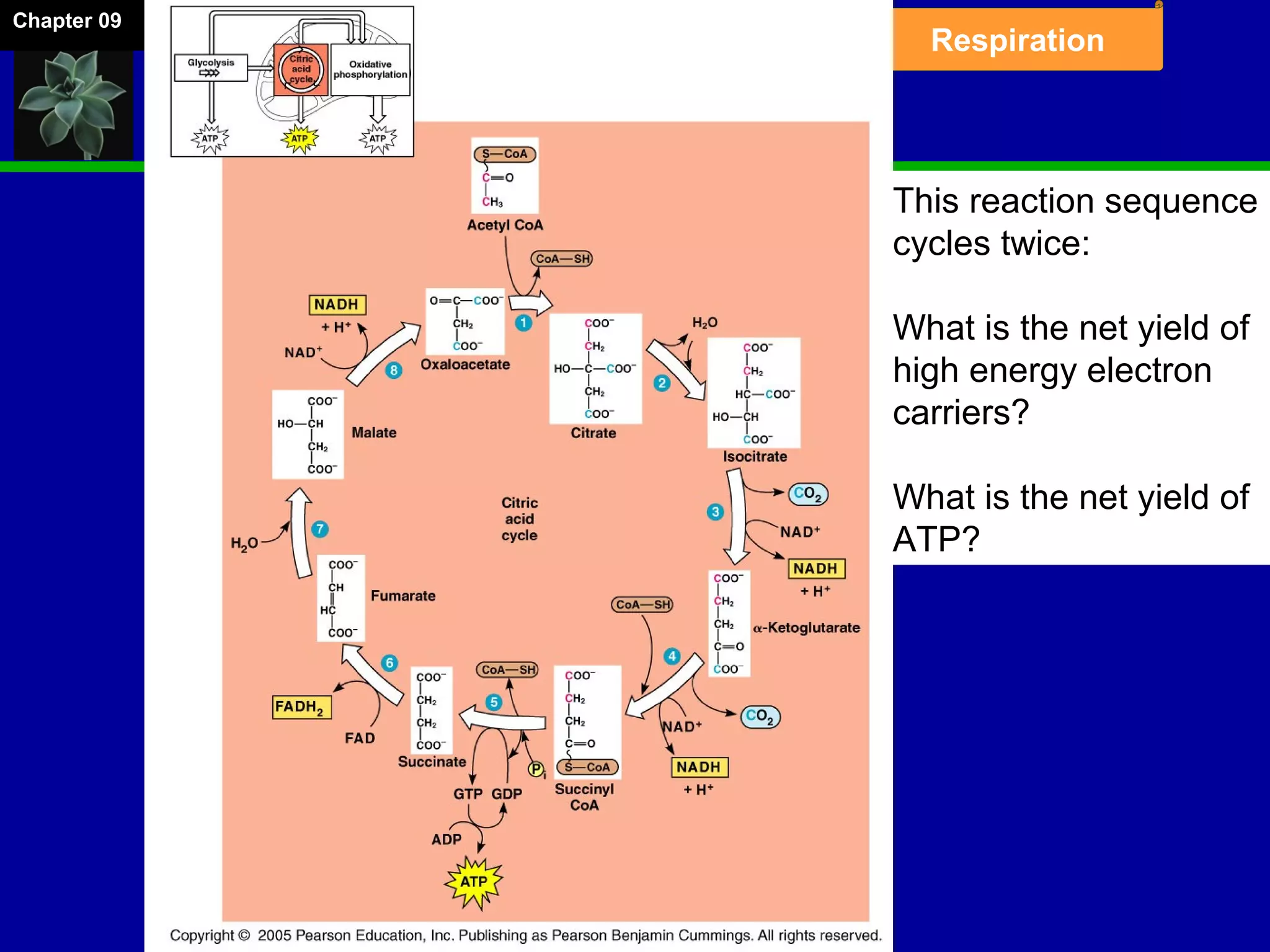
Krebs cycle:
Within the mitochondrial matrix acetly-CoA (2C)
plus oxaloacetate (4C) goes to citrate (6C) then
through 4 more steps back to oxaloacetate. At
each step an high energy electron is tranferred
to NAD or FADH. Carbon dioxide is released at
two of these steps, and the the cycle runs twice
for each molecule of glucose (ie. Two acetyl-CoA
produced from glycolysis)
Therefore the yield is…….
Respiration
Chapter 09
Respiration
Citric Acid
Cycle
3.
The Citric Acid CycleThe Citric Acid Cycle
Chapter 09
Respiration
Chapter 09
Respiration
Chapter 09
Respiration
Chapter 09
Respiration
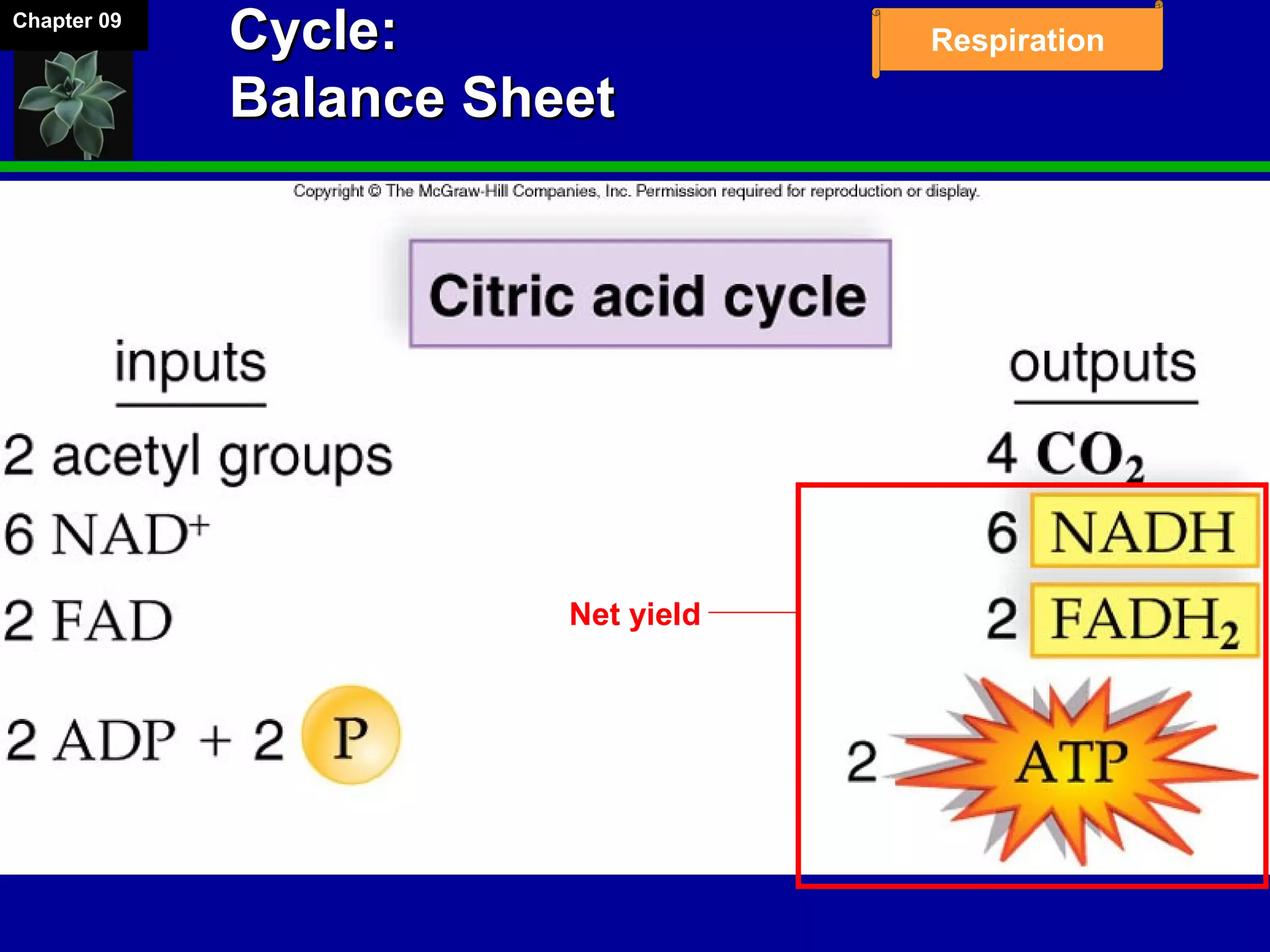
This reaction sequence
cycles twice:
What is the net yield of
high energy electron
carriers?
What is the net yield of
ATP?
Chapter 09
RespirationCycle:Cycle:
Balance SheetBalance Sheet
Net yield
Chapter 09
Respiration
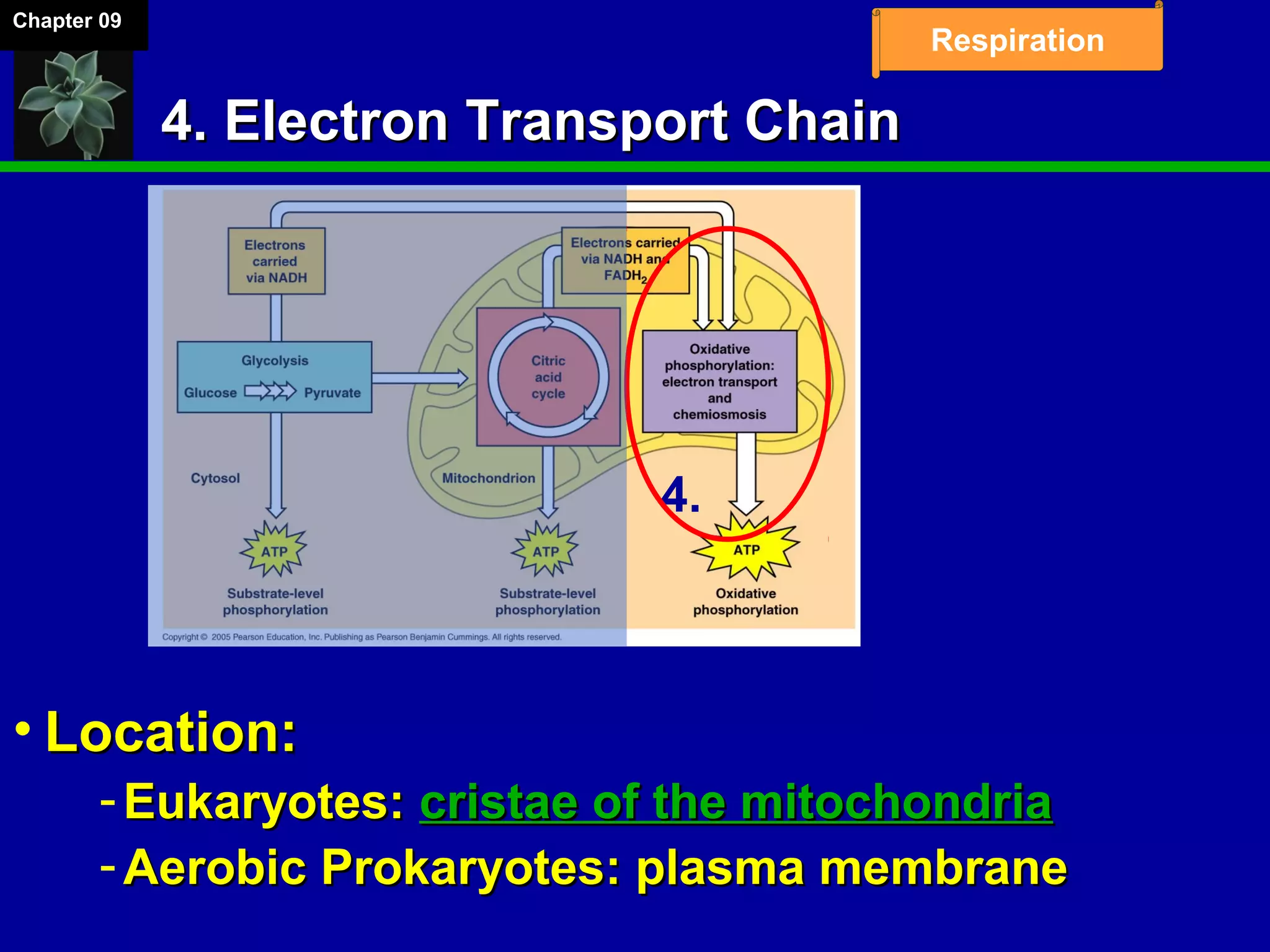
4. Electron Transport Chain4. Electron Transport Chain
• Location:Location:
­ Eukaryotes:Eukaryotes: cristae of the mitochondriacristae of the mitochondria
­ Aerobic Prokaryotes: plasma membraneAerobic Prokaryotes: plasma membrane
4.
Chapter 09
Respiration
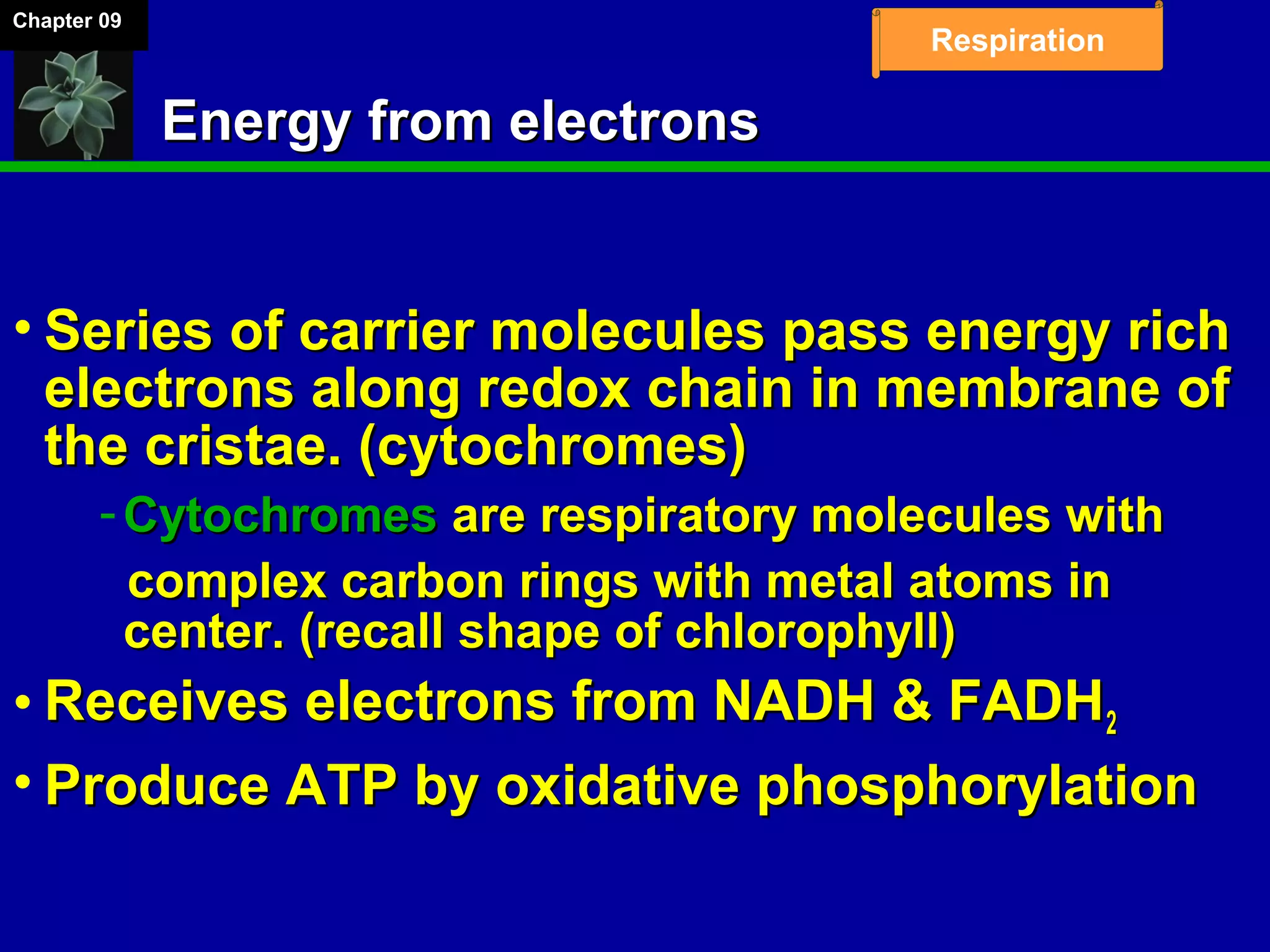
Energy from electronsEnergy from electrons
• Series of carrier molecules pass energy richSeries of carrier molecules pass energy rich
electrons along redox chain in membrane ofelectrons along redox chain in membrane of
the cristae. (cytochromes)the cristae. (cytochromes)
­ CytochromesCytochromes are respiratory molecules withare respiratory molecules with
complex carbon rings with metal atoms incomplex carbon rings with metal atoms in
center. (recall shape of chlorophyll)center. (recall shape of chlorophyll)
• Receives electrons from NADH & FADHReceives electrons from NADH & FADH22
• Produce ATP by oxidative phosphorylationProduce ATP by oxidative phosphorylation
Chapter 09
Respiration
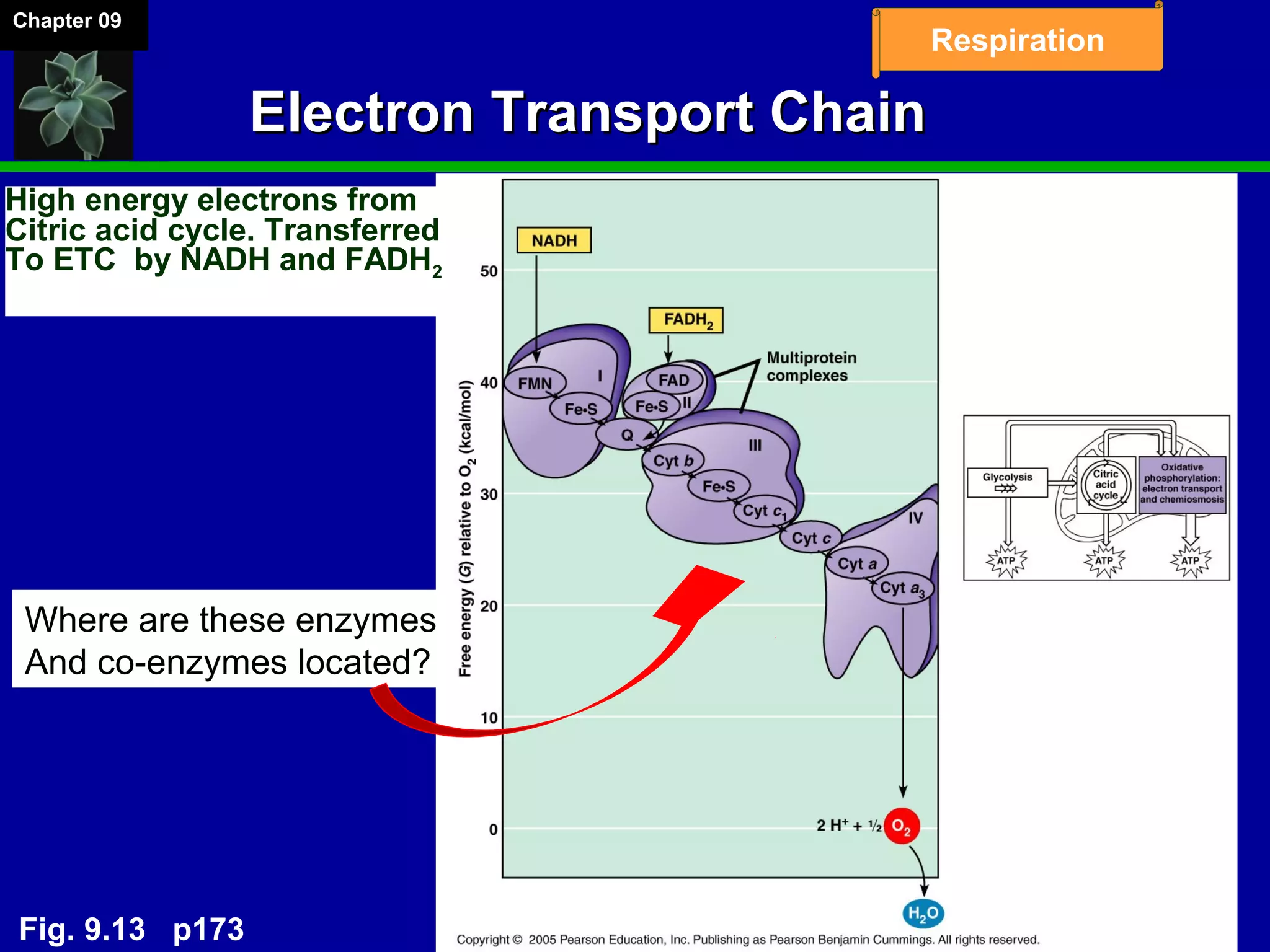
Electron Transport ChainElectron Transport Chain
High energy electrons from
Citric acid cycle. Transferred
To ETC by NADH and FADH2
Where are these enzymes
And co­enzymes located?
Fig. 9.13 p173
Chapter 09
Respiration
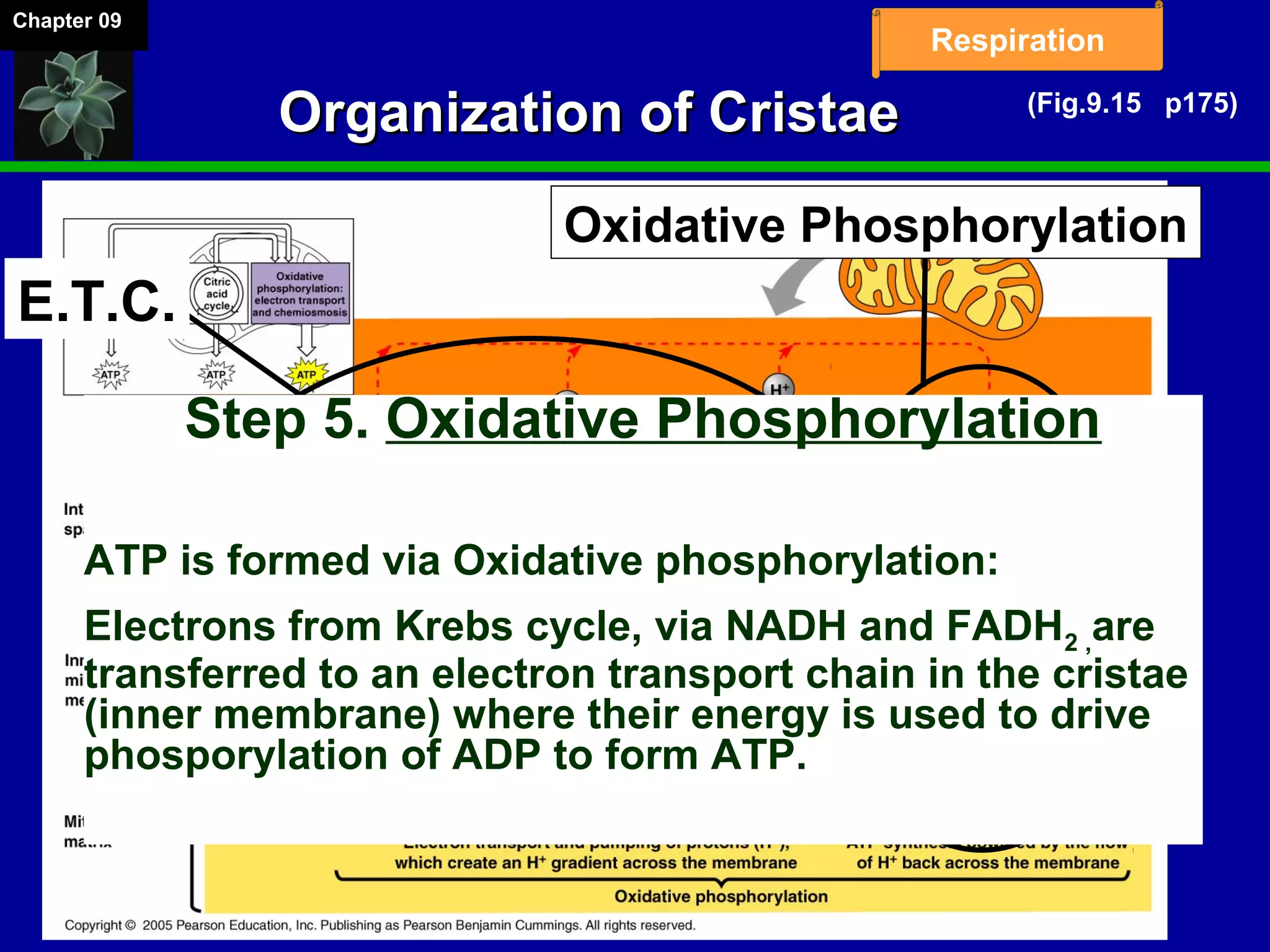
Organization of CristaeOrganization of Cristae
E.T.C.
Oxidative Phosphorylation
Step 5. Oxidative Phosphorylation
ATP is formed via Oxidative phosphorylation:
Electrons from Krebs cycle, via NADH and FADH2 ,are
transferred to an electron transport chain in the cristae
(inner membrane) where their energy is used to drive
phosporylation of ADP to form ATP.
(Fig.9.15 p175)
Chapter 09
Respiration
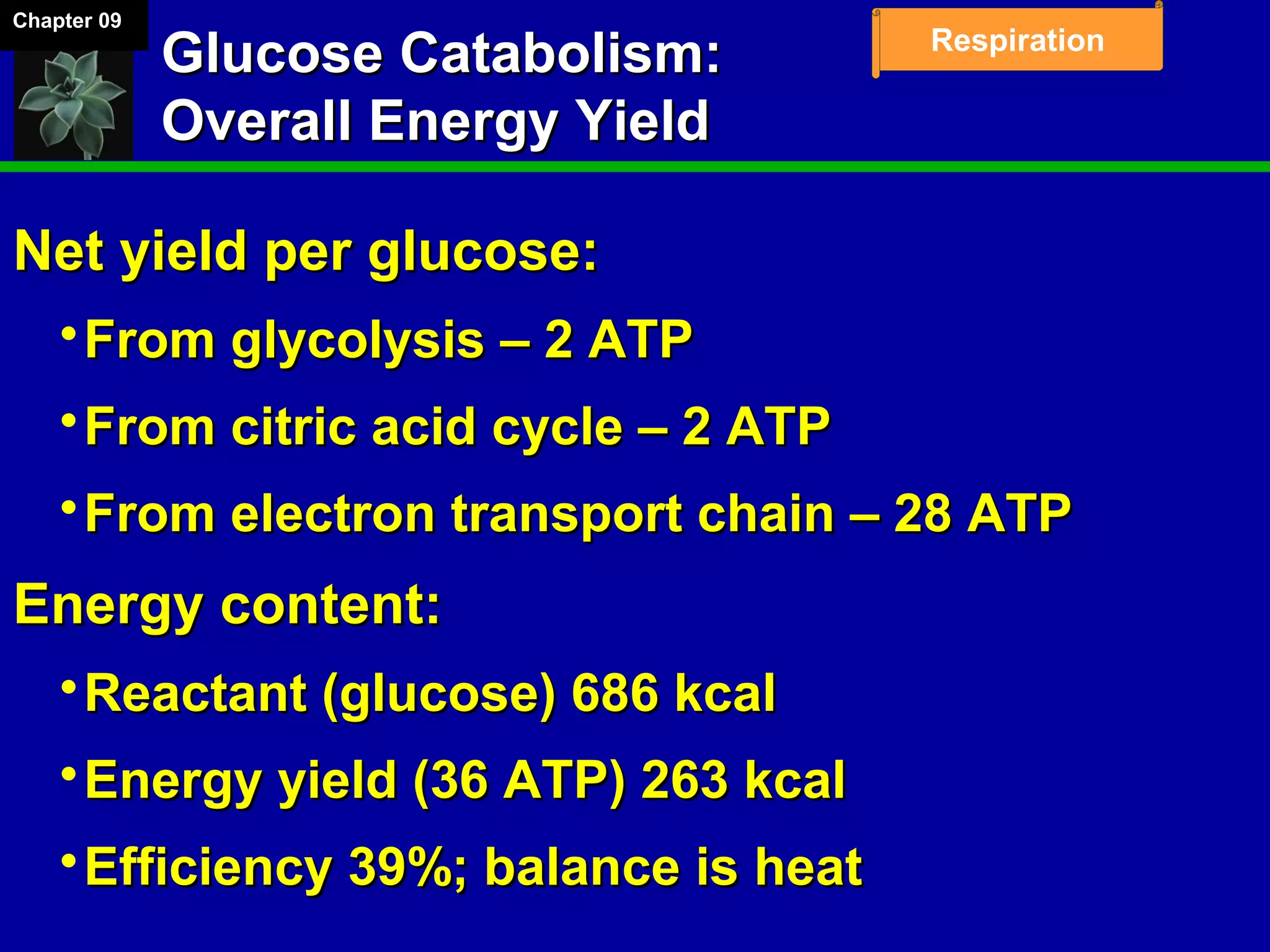
Glucose Catabolism:Glucose Catabolism:
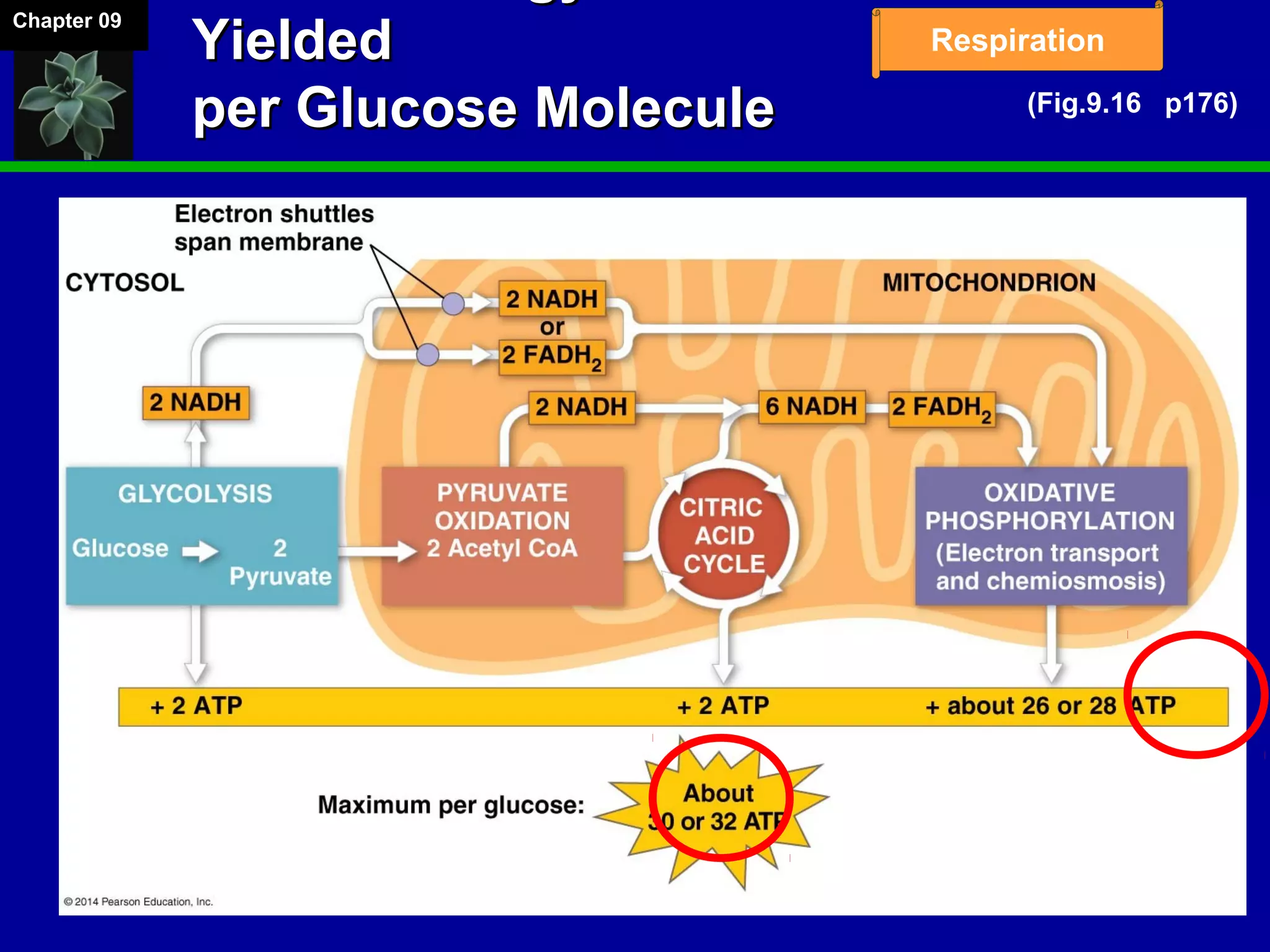
Overall Energy YieldOverall Energy Yield
Net yield per glucose:Net yield per glucose:
From glycolysis – 2 ATPFrom glycolysis – 2 ATP
From citric acid cycle – 2 ATPFrom citric acid cycle – 2 ATP
From electron transport chain – 28 ATPFrom electron transport chain – 28 ATP
Energy content:Energy content:
Reactant (glucose) 686 kcalReactant (glucose) 686 kcal
Energy yield (36 ATP) 263 kcalEnergy yield (36 ATP) 263 kcal
Efficiency 39%; balance is heatEfficiency 39%; balance is heat
Chapter 09
RespirationYieldedYielded
per Glucose Moleculeper Glucose Molecule (Fig.9.16 p176)
Chapter 09
Respiration
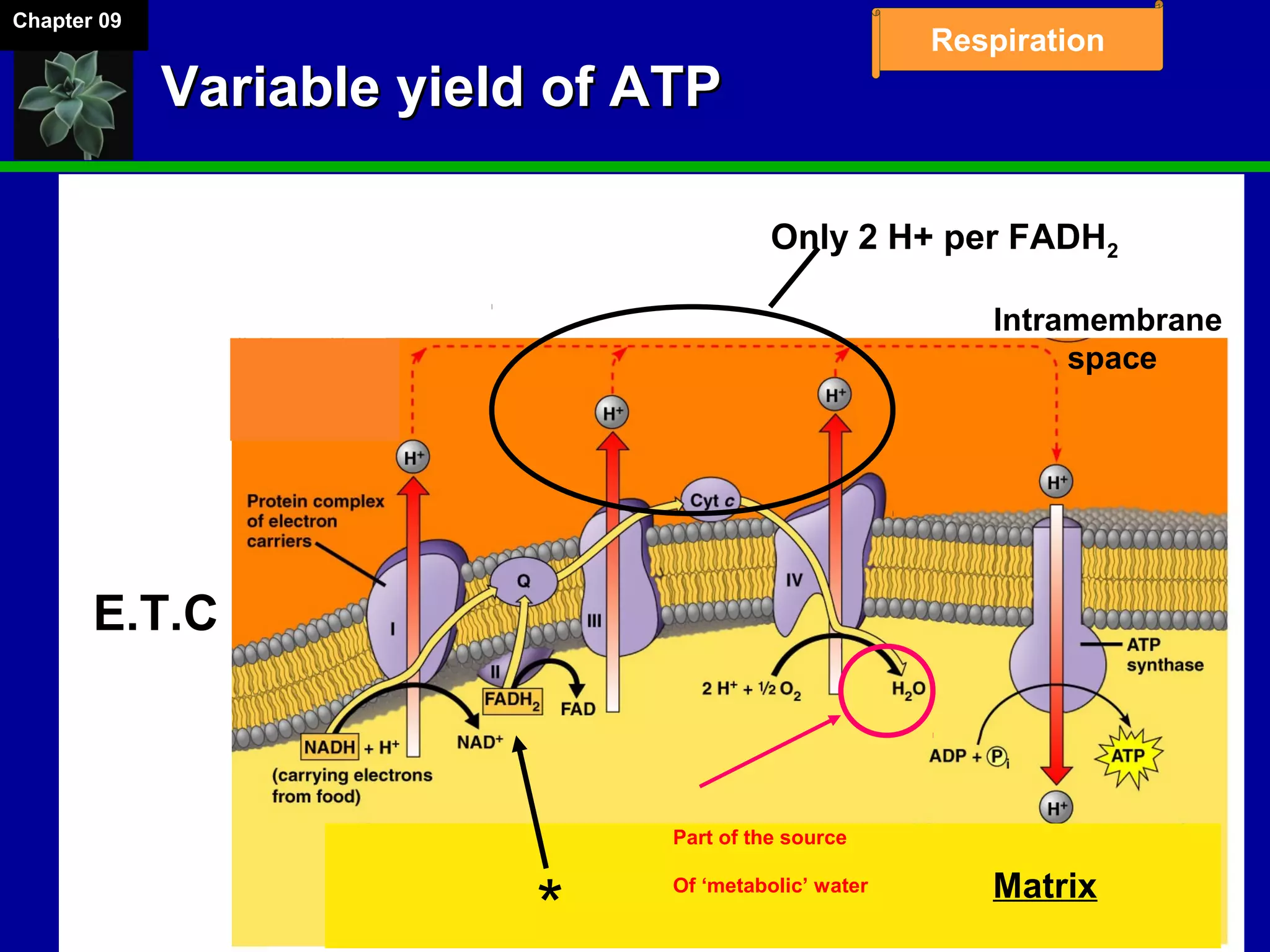
Variable yield of ATPVariable yield of ATP
Only 2 H+ per FADH2
*
Intramembrane
space
Matrix
E.T.C
Part of the source
Of ‘metabolic’ water
Chapter 09
Respiration
Oxygen and fate of electronsOxygen and fate of electrons
The fate of the hydrogens:The fate of the hydrogens:
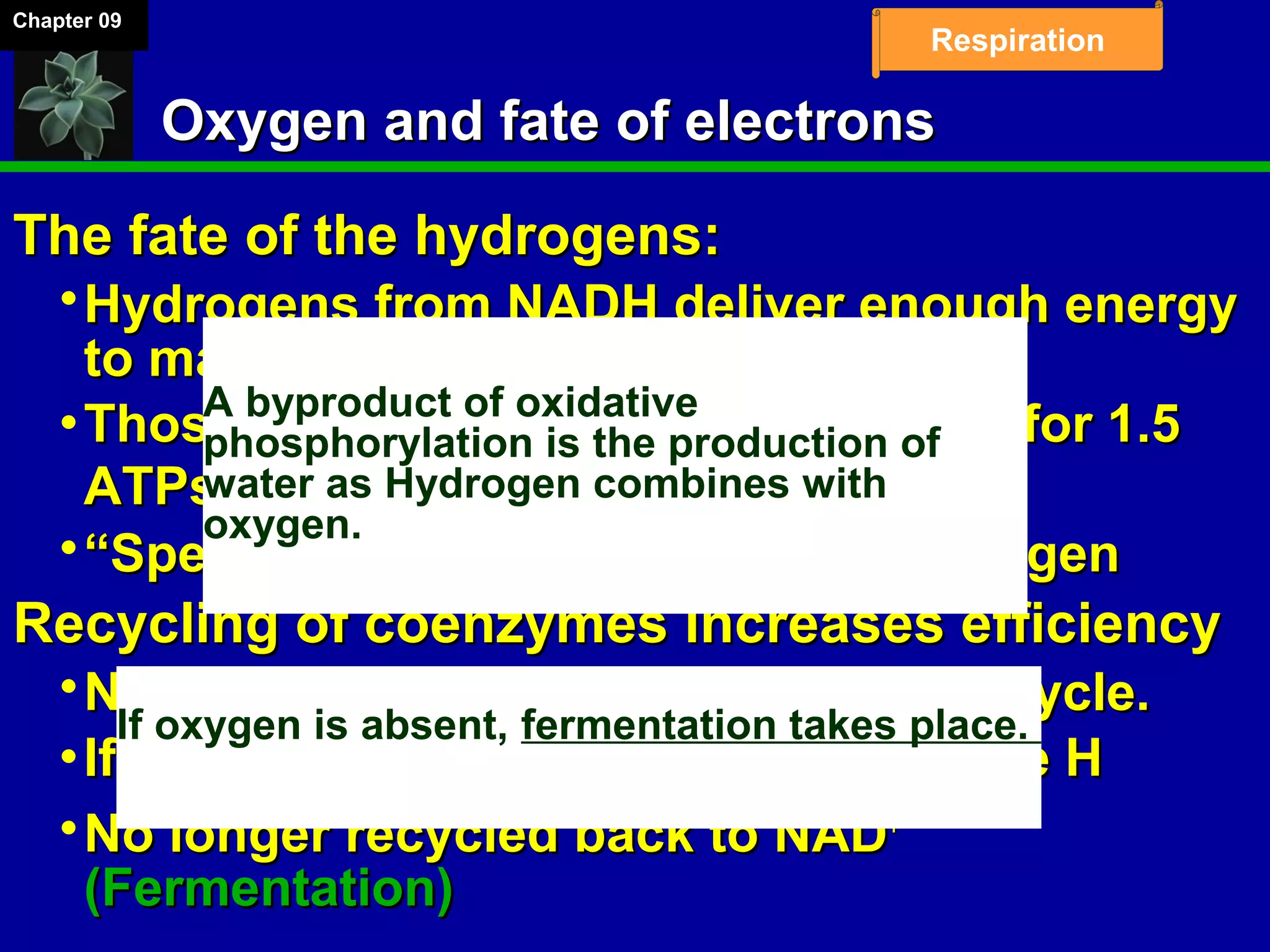
Hydrogens from NADH deliver enough energyHydrogens from NADH deliver enough energy
to make 2.5 ATPsto make 2.5 ATPs
Those from FADHThose from FADH22 have only enough for 1.5have only enough for 1.5
ATPsATPs
““Spent” hydrogens combine with oxygenSpent” hydrogens combine with oxygen
Recycling of coenzymes increases efficiencyRecycling of coenzymes increases efficiency
NAD+ and FADH return to the Krebs cycle.NAD+ and FADH return to the Krebs cycle.
If OIf O22 not present, NADH cannot release Hnot present, NADH cannot release H
No longer recycled back to NADNo longer recycled back to NAD++
(Fermentation)(Fermentation)
A byproduct of oxidative
phosphorylation is the production of
water as Hydrogen combines with
oxygen.
If oxygen is absent, fermentation takes place.
Chapter 09
Respiration
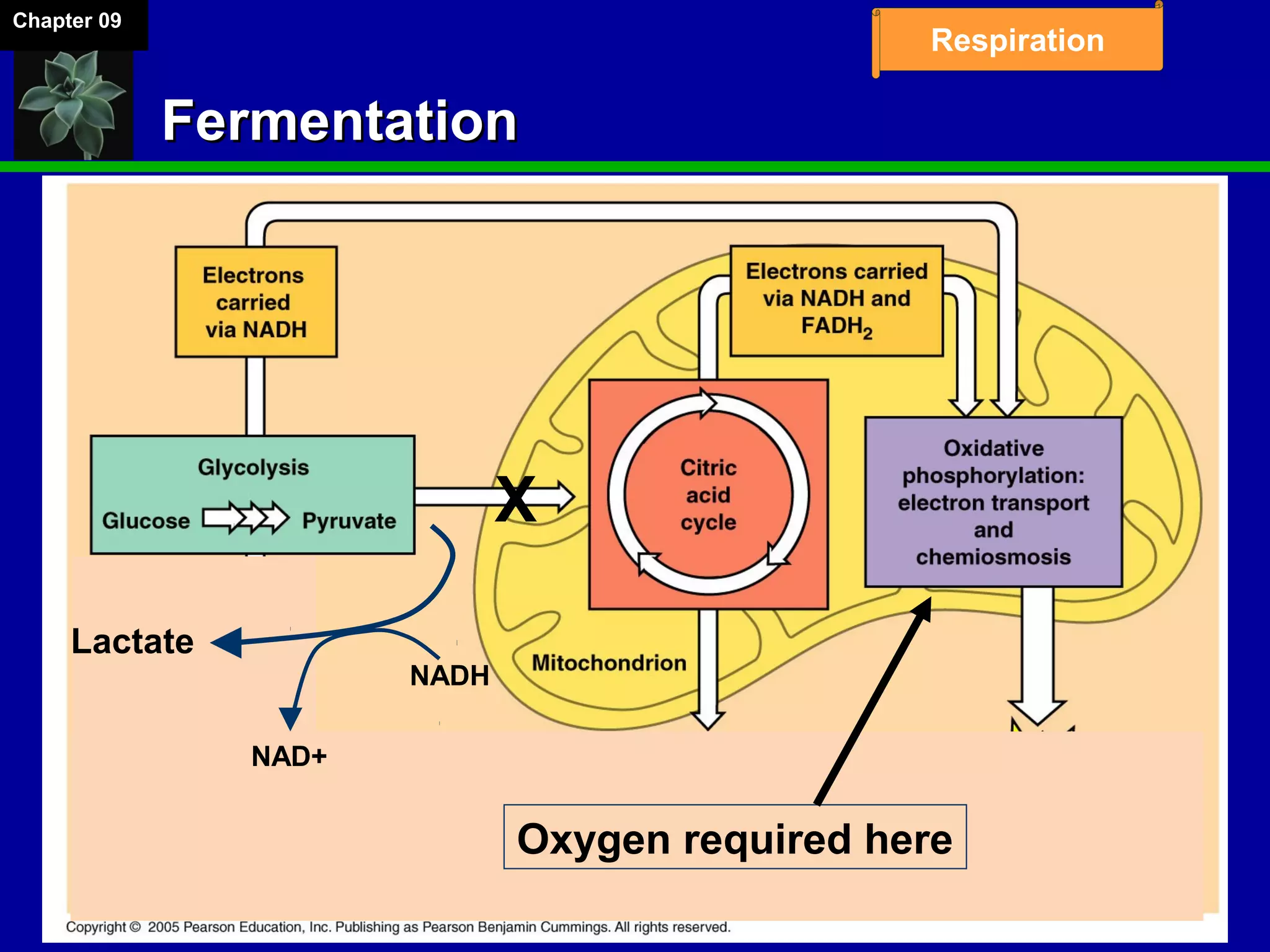
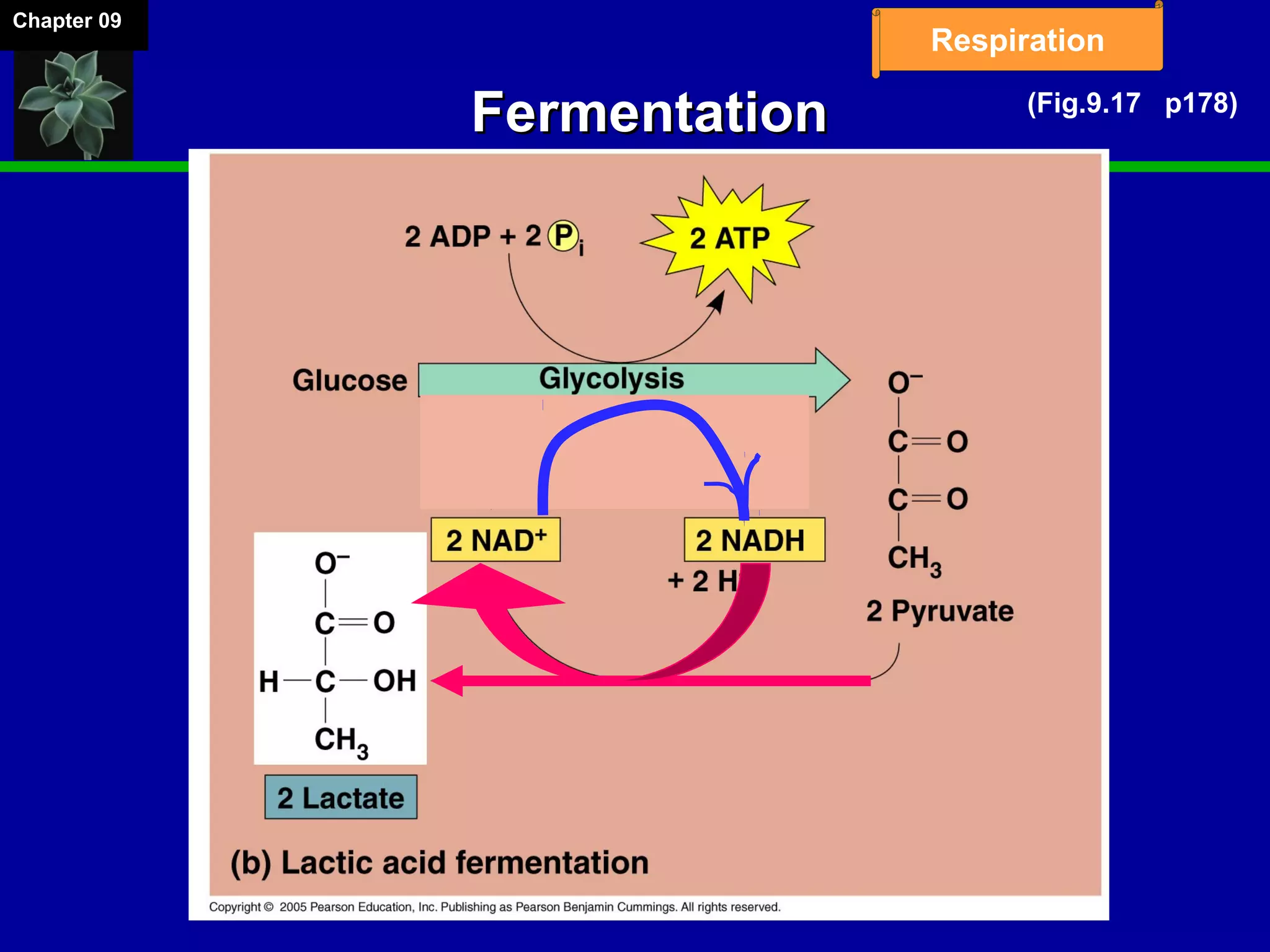
FermentationFermentation
Oxygen required here
X
Lactate
NADH
NAD+
Chapter 09
Respiration
FermentationFermentation (Fig.9.17 p178)
Chapter 09
Respiration
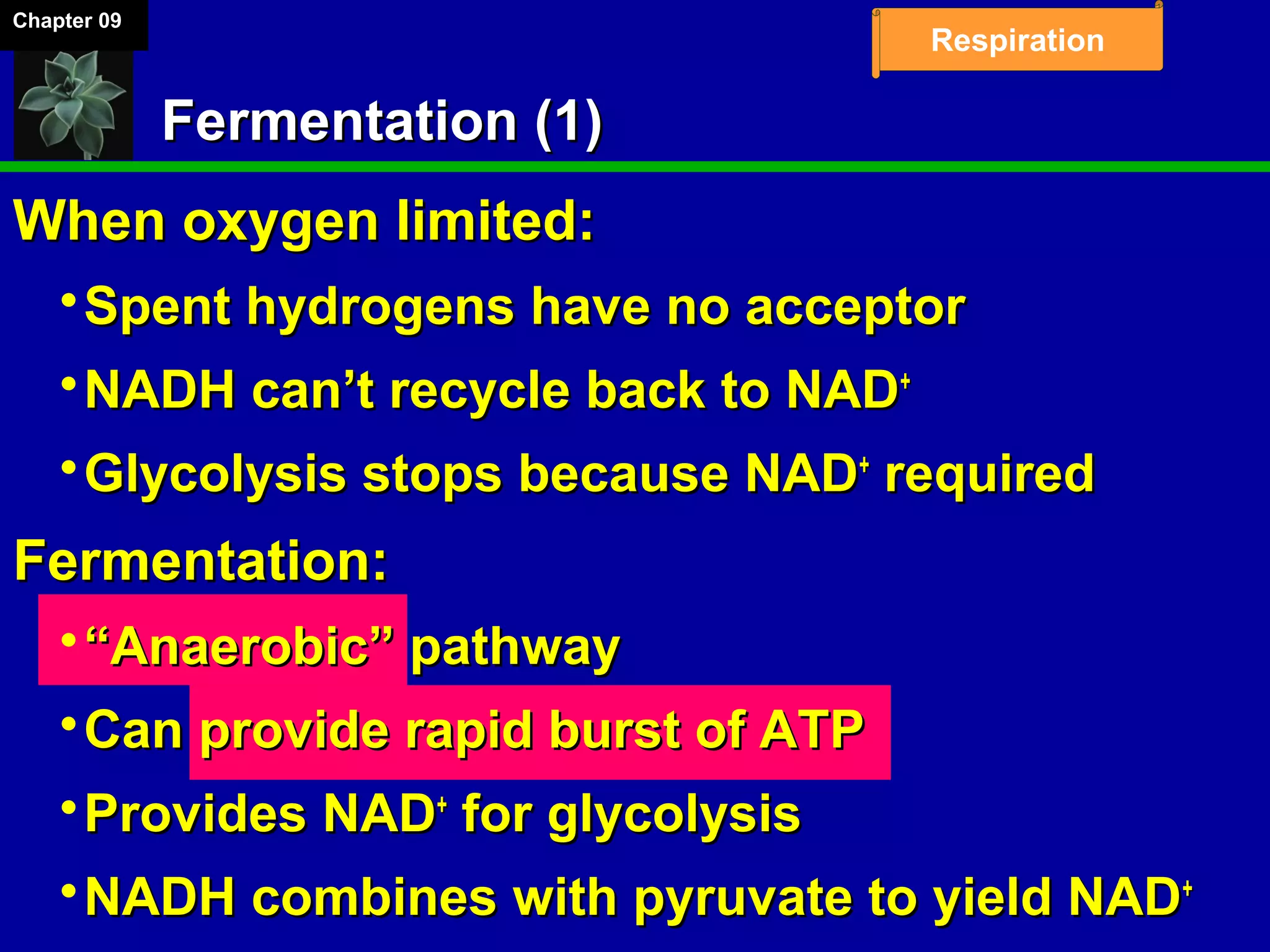
Fermentation (1)Fermentation (1)
When oxygen limited:When oxygen limited:
Spent hydrogens have no acceptorSpent hydrogens have no acceptor
NADH can’t recycle back to NADNADH can’t recycle back to NAD++
Glycolysis stops because NADGlycolysis stops because NAD++
requiredrequired
Fermentation:Fermentation:
““Anaerobic” pathwayAnaerobic” pathway
Can provide rapid burst of ATPCan provide rapid burst of ATP
Provides NADProvides NAD++
for glycolysisfor glycolysis
NADH combines with pyruvate to yield NADNADH combines with pyruvate to yield NAD++
Chapter 09
Respiration
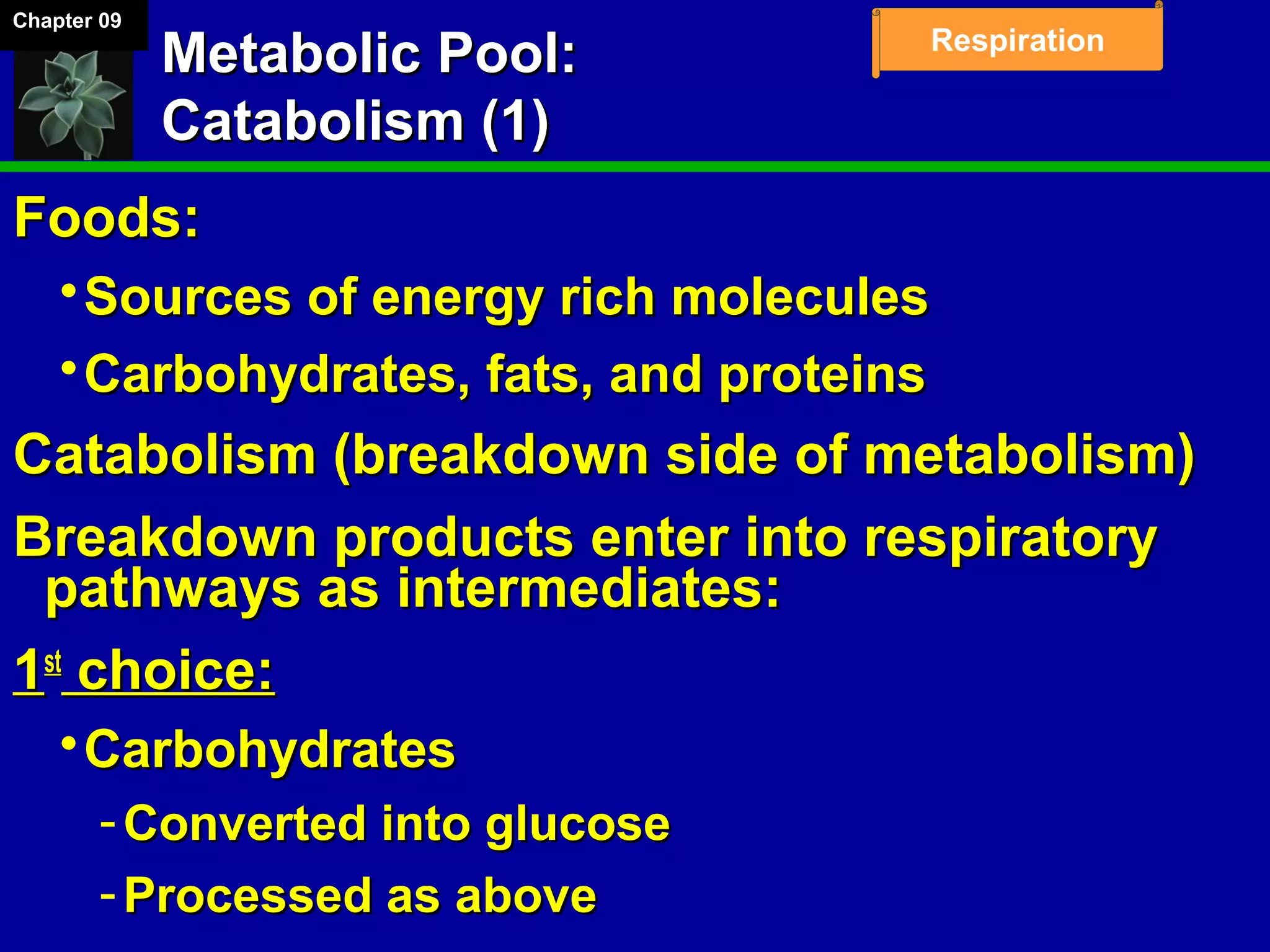
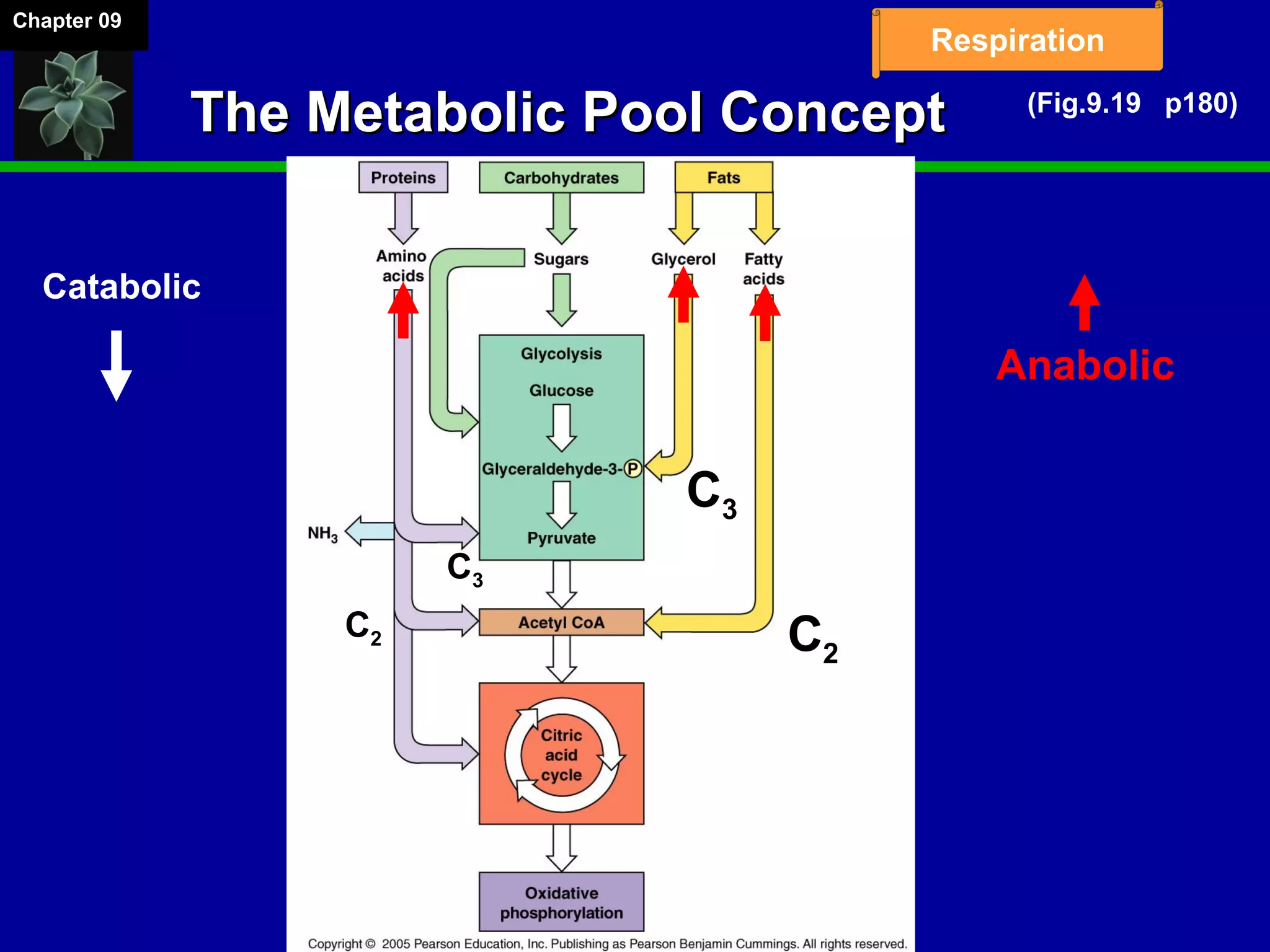
Metabolic Pool:Metabolic Pool:
Catabolism (1)Catabolism (1)
Foods:Foods:
Sources of energy rich moleculesSources of energy rich molecules
Carbohydrates, fats, and proteinsCarbohydrates, fats, and proteins
Catabolism (breakdown side of metabolism)Catabolism (breakdown side of metabolism)
Breakdown products enter into respiratoryBreakdown products enter into respiratory
pathways as intermediates:pathways as intermediates:
11stst
choice:choice:
CarbohydratesCarbohydrates
­ Converted into glucoseConverted into glucose
­ Processed as aboveProcessed as above
Chapter 09
Respiration
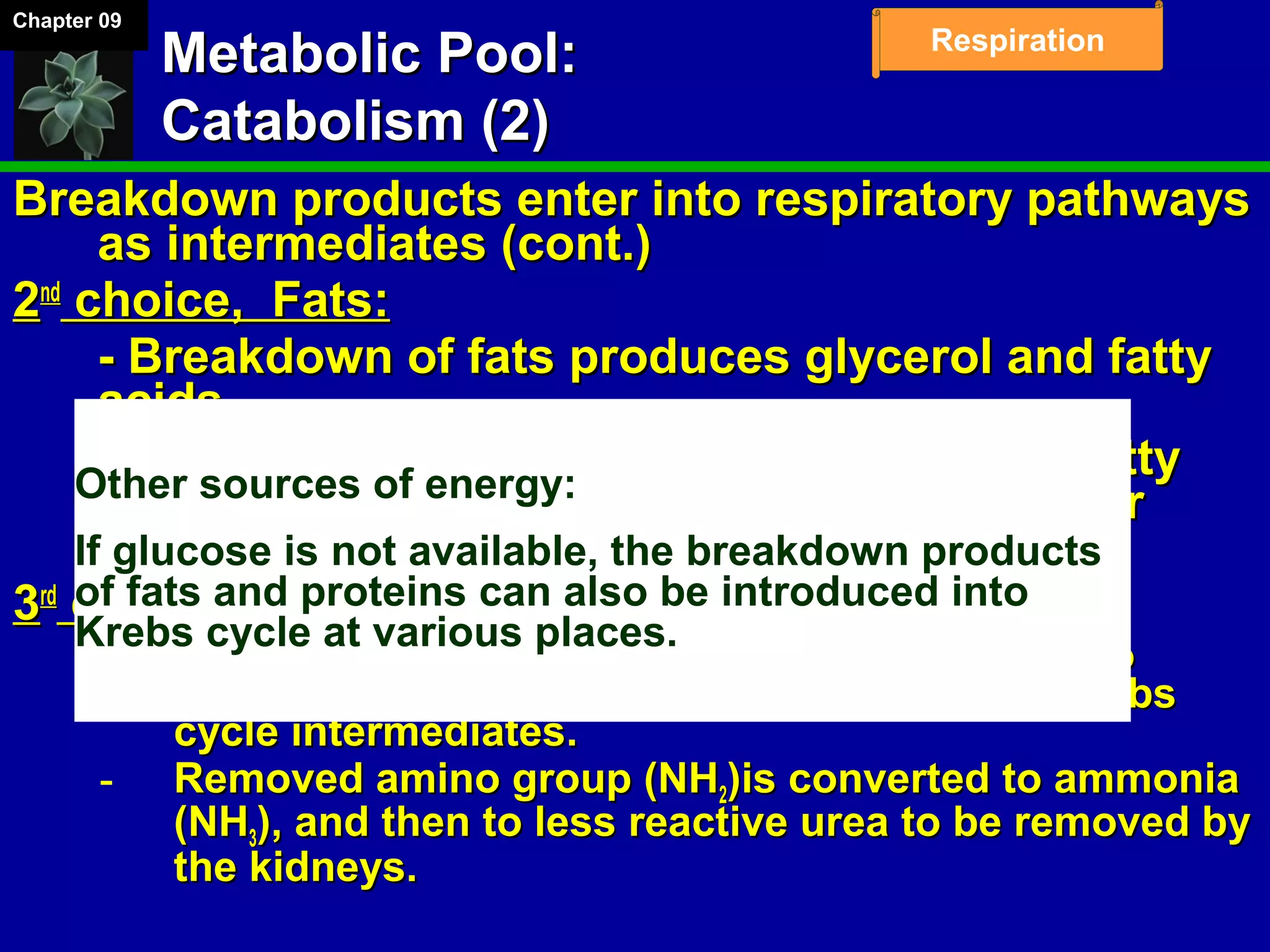
Metabolic Pool:Metabolic Pool:
Catabolism (2)Catabolism (2)
Breakdown products enter into respiratory pathwaysBreakdown products enter into respiratory pathways
as intermediates (cont.)as intermediates (cont.)
22ndnd
choice, Fats:choice, Fats:
- Breakdown of fats produces glycerol and fatty- Breakdown of fats produces glycerol and fatty
acids.acids.
- Glycerol enters the glycolysis pathway, Fatty- Glycerol enters the glycolysis pathway, Fatty
acids are converted to actetyl-CoA and enteracids are converted to actetyl-CoA and enter
Krebs cycle.Krebs cycle.
33rdrd
choice, Proteins:choice, Proteins:
­ Deaminated in the liver and can be converted toDeaminated in the liver and can be converted to
pyruvate, or acetyl-CoA, or one of the other Krebspyruvate, or acetyl-CoA, or one of the other Krebs
cycle intermediates.cycle intermediates.
­ Removed amino group (NHRemoved amino group (NH22)is converted to ammonia)is converted to ammonia
(NH(NH33), and then to less reactive urea to be removed by), and then to less reactive urea to be removed by
the kidneys.the kidneys.
Other sources of energy:
If glucose is not available, the breakdown products
of fats and proteins can also be introduced into
Krebs cycle at various places.
Chapter 09
Respiration
Metabolic Pool:Metabolic Pool:
Anabolism (1)Anabolism (1)
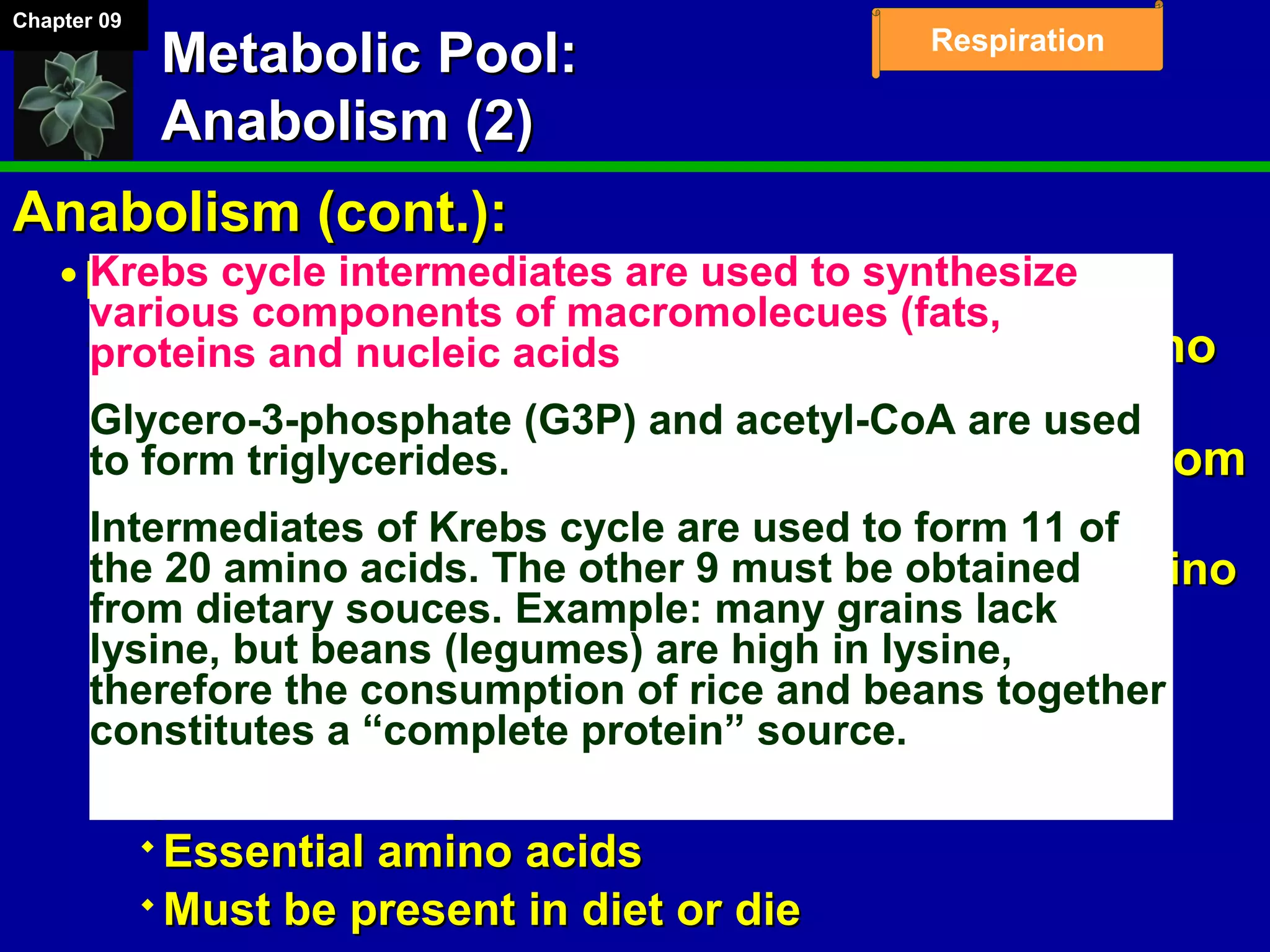
All metabolic reactions part of metabolic poolAll metabolic reactions part of metabolic pool
Intermediates from respiratory pathways can beIntermediates from respiratory pathways can be
used for anabolismused for anabolism
Anabolism (build-up side of metabolism):Anabolism (build-up side of metabolism):
 Carbs:Carbs:
­ Start with acetyl-CoAStart with acetyl-CoA
­ Basically reverses glycolysis (but different pathway)Basically reverses glycolysis (but different pathway)
 FatsFats
­ G3P converted to glycerolG3P converted to glycerol
­ Acetyls connected in pairs to form fatty acidsAcetyls connected in pairs to form fatty acids
­ Note – dietary carbohydrate RARELY converted to fat inNote – dietary carbohydrate RARELY converted to fat in
humans!humans!
Chapter 09
Respiration
Metabolic Pool:Metabolic Pool:
Anabolism (2)Anabolism (2)
Anabolism (cont.):Anabolism (cont.):
Proteins:Proteins:
­ Made up of combinations of 20 different aminoMade up of combinations of 20 different amino
acidsacids
­ Some amino acids (11) can be synthesized fromSome amino acids (11) can be synthesized from
respiratory intermediatesrespiratory intermediates
 organic acids in citric acid cycle can make aminoorganic acids in citric acid cycle can make amino
acidsacids
 Add NHAdd NH22 – transamination– transamination
­ However, other amino acids (9) cannot beHowever, other amino acids (9) cannot be
synthesized by humanssynthesized by humans
 Essential amino acidsEssential amino acids
 Must be present in diet or dieMust be present in diet or die
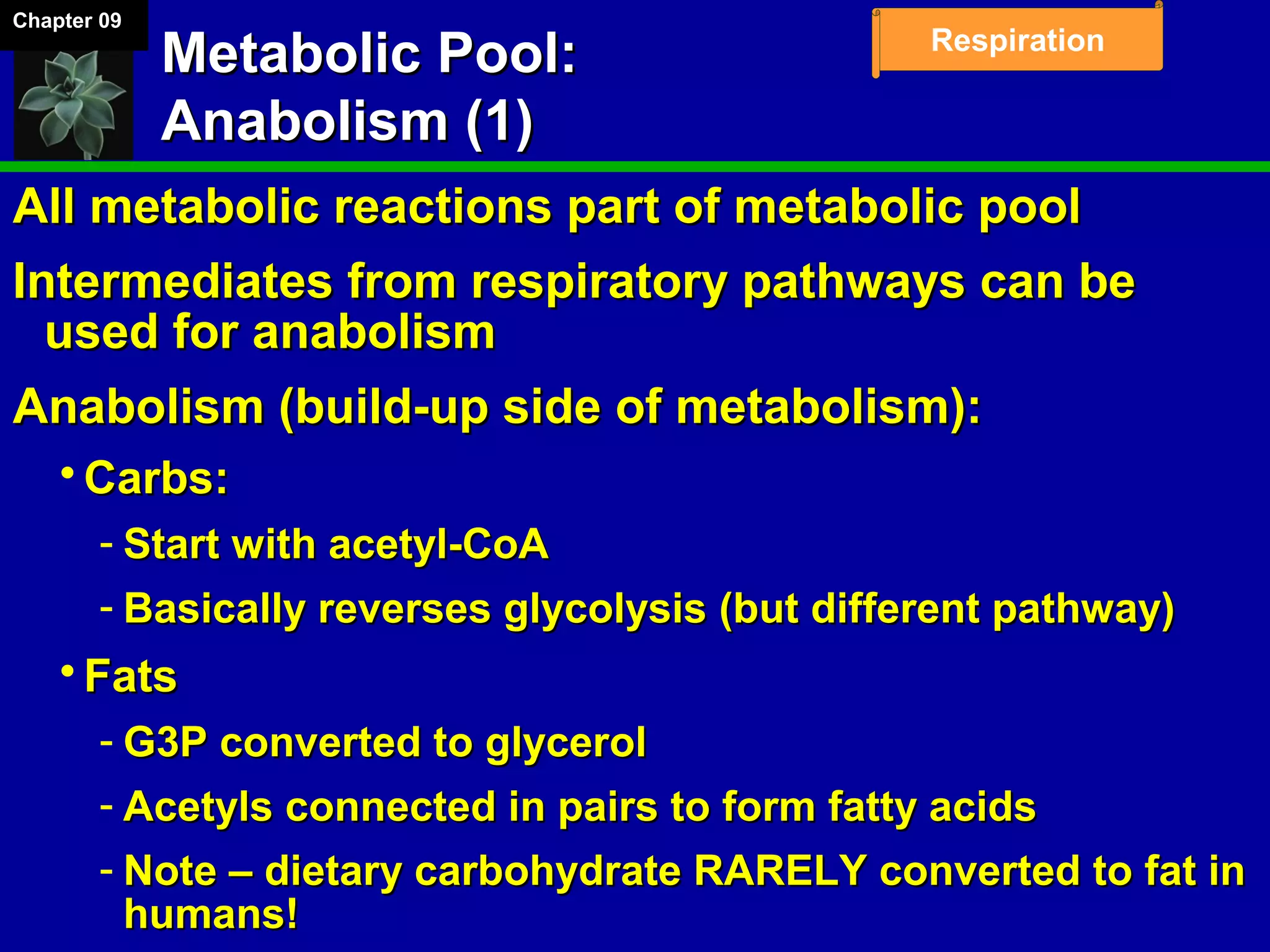
Krebs cycle intermediates are used to synthesize
various components of macromolecues (fats,
proteins and nucleic acids
Glycero-3-phosphate (G3P) and acetyl-CoA are used
to form triglycerides.
Intermediates of Krebs cycle are used to form 11 of
the 20 amino acids. The other 9 must be obtained
from dietary souces. Example: many grains lack
lysine, but beans (legumes) are high in lysine,
therefore the consumption of rice and beans together
constitutes a “complete protein” source.
Chapter 09
Respiration
The Metabolic Pool ConceptThe Metabolic Pool Concept
C3
C2
C3
C2
Catabolic
Anabolic
(Fig.9.19 p180)
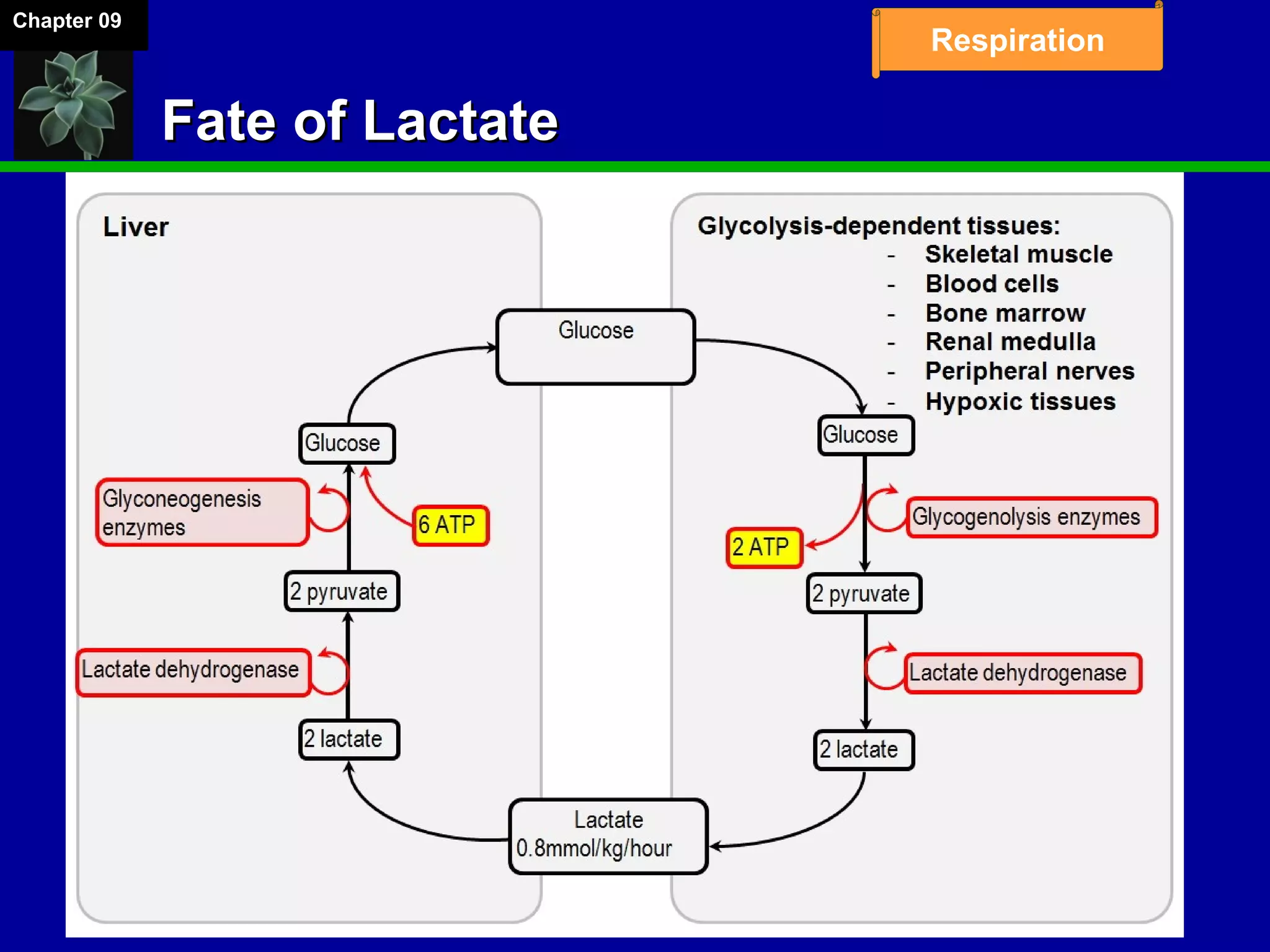
Fate of LactateFate of Lactate
Chapter 09
Respiration
Chapter 09
Respiration
ReviewReview
GlycolysisGlycolysis
Transition ReactionTransition Reaction
Citric Acid CycleCitric Acid Cycle
Electron Transport SystemElectron Transport System
FermentationFermentation
Metabolic PoolMetabolic Pool
CatabolismCatabolism
AnabolismAnabolism
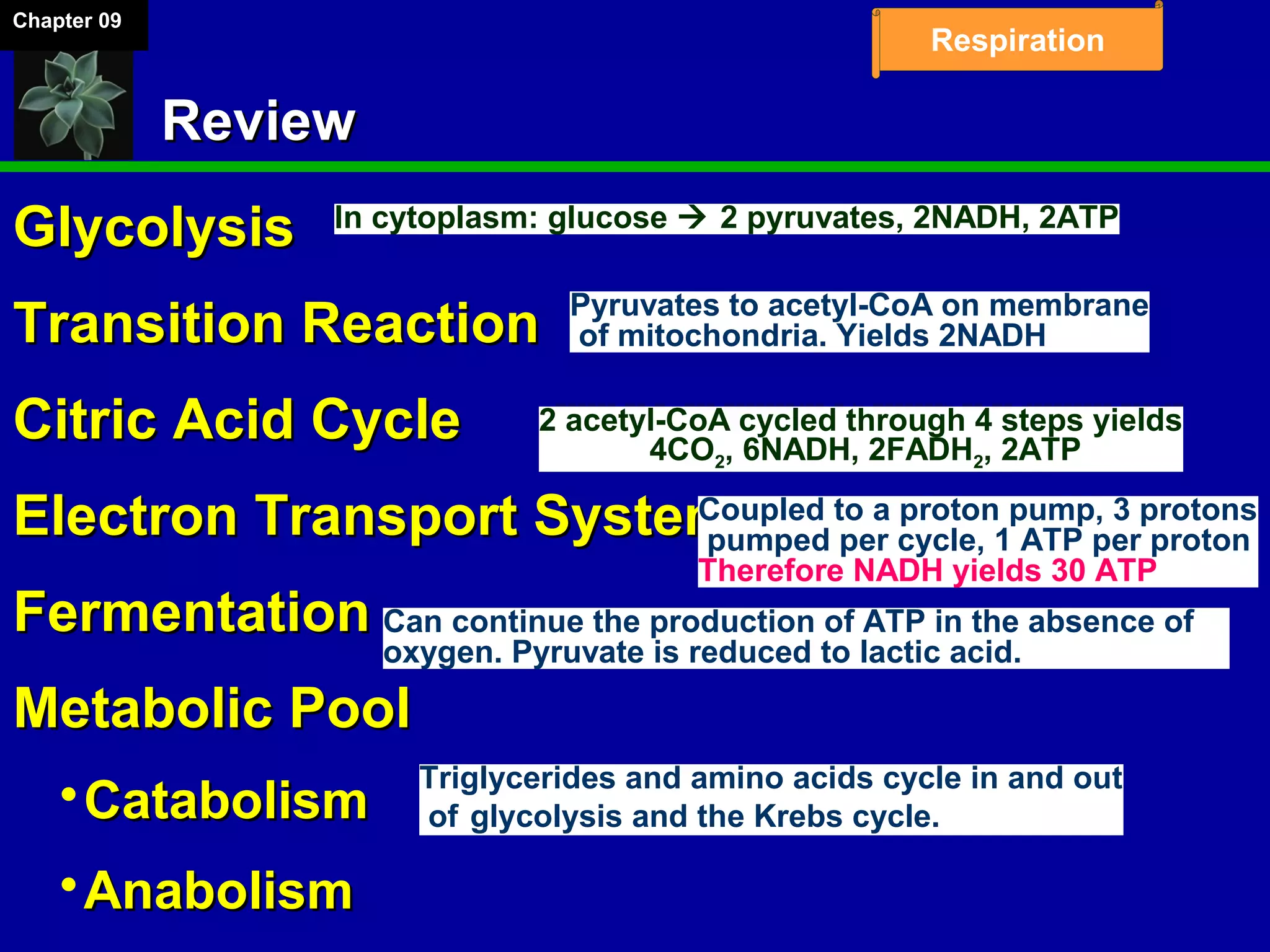
In cytoplasm: glucose  2 pyruvates, 2NADH, 2ATP
Pyruvates to acetyl-CoA on membrane
of mitochondria. Yields 2NADH
2 acetyl-CoA cycled through 4 steps yields
4CO2, 6NADH, 2FADH2, 2ATP
Coupled to a proton pump, 3 protons
pumped per cycle, 1 ATP per proton
Therefore NADH yields 30 ATP
Can continue the production of ATP in the absence of
oxygen. Pyruvate is reduced to lactic acid.
Triglycerides and amino acids cycle in and out
of glycolysis and the Krebs cycle.

Chapter 09 Cellular Respiration

  • 1.
  • 2.
    Learning objectivesLearning objectives •Describe energy flow in the biosphere according toDescribe energy flow in the biosphere according to the principle endergonic and exergonic reactionthe principle endergonic and exergonic reaction cycles.cycles. • Describe how energy is obtained through the redoxDescribe how energy is obtained through the redox reactions of cellular respiration in mitochondriareactions of cellular respiration in mitochondria • Name the major input and output compounds forName the major input and output compounds for glycolysis, transition, Krebs cycle and Electronglycolysis, transition, Krebs cycle and Electron Transport/ATP synthaseTransport/ATP synthase • Explain how fermentation provides for ATP in theExplain how fermentation provides for ATP in the absence of oxygenabsence of oxygen • Describe how the mitochondria provides forDescribe how the mitochondria provides for synthesis of macromoleculessynthesis of macromolecules • Compare and differentiate mitochondria andCompare and differentiate mitochondria and chloroplasts in terms of major reactants and prod.chloroplasts in terms of major reactants and prod. Chapter 09 Respiration
  • 3.
    Chapter 09 Respiration OutlineOutline 1.1. GlycolysisGlycolysis 2.2.Transition ReactionTransition Reaction 3.3. Citric Acid CycleCitric Acid Cycle 4.4. Electron Transport SystemElectron Transport System 5.5. FermentationFermentation 6.6. Metabolic PoolMetabolic Pool  CatabolismCatabolism  AnabolismAnabolism
  • 4.
    Chapter 09 Respiration Cellular RespirationCellularRespiration A cellular process that requires oxygen andA cellular process that requires oxygen and gives off carbon dioxidegives off carbon dioxide Usually involves breakdown of glucose toUsually involves breakdown of glucose to carbon dioxide and watercarbon dioxide and water Energy extracted from glucose molecule:Energy extracted from glucose molecule: ­ Released step-wiseReleased step-wise ­ Allows ATP to be produced efficientlyAllows ATP to be produced efficiently  Coenzymes NADCoenzymes NAD++ FAD deliver high energyFAD deliver high energy electrons to Oxidation-reduction chain inelectrons to Oxidation-reduction chain in mitochondrial membranemitochondrial membrane
  • 5.
    Chapter 09 Respiration Summary EquationSummaryEquation LEO says GER Loss of Electrons = Oxidation Gain of Electrons = Reduction The overall breakdown of glucose is summarized as: “Metabolic Water”
  • 6.
    Chapter 09 Respiration Coenzymes:Coenzymes: NADNAD++ and FADandFAD 1. NAD1. NAD++ (nicotinamide adenine dinucleotide)(nicotinamide adenine dinucleotide) ­ Oxidize a metabolite by accepting electronsOxidize a metabolite by accepting electrons ­ Reduce a metabolite by giving up electronsReduce a metabolite by giving up electrons (Each NAD(Each NAD++ molecule used over and over again)molecule used over and over again) 2. FAD (flavin adenine dinucleotide)2. FAD (flavin adenine dinucleotide) Sometimes used instead of NADSometimes used instead of NAD++ Accepts two electrons and two hydrogen ionsAccepts two electrons and two hydrogen ions (H(H++ ) to become FADH) to become FADH22
  • 7.
    Chapter 09 Respiration NADNAD++ CycleCycle Electron (1neg. charge) Lost, therefore NAD Becomes postive, therefore Oxidized NAD loses charge, i.e. gains electron, therefore Reduced
  • 8.
    Chapter 09 Respiration Cellular Respiration:CellularRespiration: Overview of 4 PhasesOverview of 4 Phases 1. Glycolysis:1. Glycolysis: glucose to pyruvateglucose to pyruvate  Occurs in cytoplasmOccurs in cytoplasm  Glucose broken down to two molecules of pyruvateGlucose broken down to two molecules of pyruvate  ATP is formedATP is formed 2. Transition / Preparatory reaction:2. Transition / Preparatory reaction: pruvate to acetyl-CoApruvate to acetyl-CoA  Both pyruvates are oxidizedBoth pyruvates are oxidized  Electron energy is stored in NADHElectron energy is stored in NADH  Two carbons are released as COTwo carbons are released as CO22 3. Citric acid cycle:3. Citric acid cycle: electrons removed from acetyl groups (oxid.)electrons removed from acetyl groups (oxid.)  Electron energy is stored in NADH and FADHElectron energy is stored in NADH and FADH22  ATP is formedATP is formed  Four carbons are released as COFour carbons are released as CO22 4. Electron transport chain:4. Electron transport chain: energy extracted from electrons.energy extracted from electrons.  Extracts energy from NADH & FADHExtracts energy from NADH & FADH22  Produces 32 or 34 molecules of ATPProduces 32 or 34 molecules of ATP Pyruvate converted to acetyl-CoA and enters mitochondria
  • 9.
    Chapter 09 RespirationVisual Overviewof 4Visual Overview of 4 PhasesPhases Transition Reaction 1. 2. 3. 4. Fig. 9.6 p167
  • 10.
    Chapter 09 Respiration Glucose Breakdown:GlucoseBreakdown: 1. Glycolysis1. Glycolysis Occurs in cytoplasm outside mitochondriaOccurs in cytoplasm outside mitochondria Energy Investment Steps:Energy Investment Steps: Two ATP are used to activate glucoseTwo ATP are used to activate glucose Glucose splits into two G3P moleculesGlucose splits into two G3P molecules Energy Harvesting Steps:Energy Harvesting Steps: Two electrons (as hydrogen atoms) are pickedTwo electrons (as hydrogen atoms) are picked up by two NADup by two NAD++ (NAD reduce, glucose oxidized)(NAD reduce, glucose oxidized) Four ATP produced by substrate-levelFour ATP produced by substrate-level phosphorylationphosphorylation Net gain of two ATPNet gain of two ATP Both G3Ps converted toBoth G3Ps converted to pyruvatespyruvates Glycolysis: In the cytoplasm, glucose is broken down to G3P then pyruvate with a net yeild of 2ATP.
  • 11.
  • 12.
    Chapter 09 Respiration 1 Glycolysis1Glycolysis Transition Reaction 1. 2 Acetyl-CoA 2 NADH
  • 13.
    Chapter 09 Respiration GlycolysisGlycolysis Glycolysis: Tenenzymatic steps phate 2ATP input 4ATP output
  • 14.
    Chapter 09 Respiration Glucose Breakdown:GlucoseBreakdown: 2.The Preparatory (Prep) Reaction2.The Preparatory (Prep) Reaction End product of glycolysis,End product of glycolysis, pyruvate,pyruvate, entersenters the mitochondrialthe mitochondrial matrixmatrix Pyruvate converted to 2-carbon acetyl groupPyruvate converted to 2-carbon acetyl group Attached to Coenzyme A to formAttached to Coenzyme A to form acetyl-CoAacetyl-CoA Electrons picked up (as hydrogen atom) byElectrons picked up (as hydrogen atom) by NADNAD+ (reduction)+ (reduction) COCO22 released, and transported out ofreleased, and transported out of mitochondria into the cytoplasmmitochondria into the cytoplasm Preparatory step: Pyruvates are converted to acetyl-CoA, NAD is reduced, carbon dioxide is released. All this occurs on the outside membrane of the mitochondria.
  • 15.
    Chapter 09 RespirationStructure &Structure& FunctionFunction a. b. c. e. d. Mitochondria.
  • 16.
    Chapter 09 Respiration As pyruvateis oxidized – NAD+ is reduced Transition Reaction 2. 2. Fig. 9.10 p169
  • 17.
    Chapter 09 Respiration Glucose Breakdown:GlucoseBreakdown: 3. The Citric Acid Cycle3. The Citric Acid Cycle A.K.A. Krebs cycleA.K.A. Krebs cycle Occurs inOccurs in matrixmatrix of mitochondriaof mitochondria Both acetyl (CBoth acetyl (C22) groups received from the) groups received from the preparatory reaction:preparatory reaction: Acetyl (CAcetyl (C22) group transferred to oxaloacetate) group transferred to oxaloacetate (C(C22) to make citrate (C) to make citrate (C66)) Each acetyl oxidized to two COEach acetyl oxidized to two CO22 moleculesmolecules Remaining 4 carbons from oxaloacetateRemaining 4 carbons from oxaloacetate converted restart the cycle. (thus “cyclic”)converted restart the cycle. (thus “cyclic”) NADH, FADHNADH, FADH22 capture energy rich electronscapture energy rich electrons ATP formed by substrate-levelATP formed by substrate-level phosphorylation Krebs cycle: Within the mitochondrial matrix acetly-CoA (2C) plus oxaloacetate (4C) goes to citrate (6C) then through 4 more steps back to oxaloacetate. At each step an high energy electron is tranferred to NAD or FADH. Carbon dioxide is released at two of these steps, and the the cycle runs twice for each molecule of glucose (ie. Two acetyl-CoA produced from glycolysis) Therefore the yield is……. Respiration
  • 18.
    Chapter 09 Respiration Citric Acid Cycle 3. TheCitric Acid CycleThe Citric Acid Cycle
  • 19.
  • 20.
  • 21.
  • 22.
    Chapter 09 Respiration This reactionsequence cycles twice: What is the net yield of high energy electron carriers? What is the net yield of ATP?
  • 23.
  • 24.
    Chapter 09 Respiration 4. ElectronTransport Chain4. Electron Transport Chain • Location:Location: ­ Eukaryotes:Eukaryotes: cristae of the mitochondriacristae of the mitochondria ­ Aerobic Prokaryotes: plasma membraneAerobic Prokaryotes: plasma membrane 4.
  • 25.
    Chapter 09 Respiration Energy fromelectronsEnergy from electrons • Series of carrier molecules pass energy richSeries of carrier molecules pass energy rich electrons along redox chain in membrane ofelectrons along redox chain in membrane of the cristae. (cytochromes)the cristae. (cytochromes) ­ CytochromesCytochromes are respiratory molecules withare respiratory molecules with complex carbon rings with metal atoms incomplex carbon rings with metal atoms in center. (recall shape of chlorophyll)center. (recall shape of chlorophyll) • Receives electrons from NADH & FADHReceives electrons from NADH & FADH22 • Produce ATP by oxidative phosphorylationProduce ATP by oxidative phosphorylation
  • 26.
    Chapter 09 Respiration Electron TransportChainElectron Transport Chain High energy electrons from Citric acid cycle. Transferred To ETC by NADH and FADH2 Where are these enzymes And co­enzymes located? Fig. 9.13 p173
  • 27.
    Chapter 09 Respiration Organization ofCristaeOrganization of Cristae E.T.C. Oxidative Phosphorylation Step 5. Oxidative Phosphorylation ATP is formed via Oxidative phosphorylation: Electrons from Krebs cycle, via NADH and FADH2 ,are transferred to an electron transport chain in the cristae (inner membrane) where their energy is used to drive phosporylation of ADP to form ATP. (Fig.9.15 p175)
  • 28.
    Chapter 09 Respiration Glucose Catabolism:GlucoseCatabolism: Overall Energy YieldOverall Energy Yield Net yield per glucose:Net yield per glucose: From glycolysis – 2 ATPFrom glycolysis – 2 ATP From citric acid cycle – 2 ATPFrom citric acid cycle – 2 ATP From electron transport chain – 28 ATPFrom electron transport chain – 28 ATP Energy content:Energy content: Reactant (glucose) 686 kcalReactant (glucose) 686 kcal Energy yield (36 ATP) 263 kcalEnergy yield (36 ATP) 263 kcal Efficiency 39%; balance is heatEfficiency 39%; balance is heat
  • 29.
    Chapter 09 RespirationYieldedYielded per GlucoseMoleculeper Glucose Molecule (Fig.9.16 p176)
  • 30.
    Chapter 09 Respiration Variable yieldof ATPVariable yield of ATP Only 2 H+ per FADH2 * Intramembrane space Matrix E.T.C Part of the source Of ‘metabolic’ water
  • 31.
    Chapter 09 Respiration Oxygen andfate of electronsOxygen and fate of electrons The fate of the hydrogens:The fate of the hydrogens: Hydrogens from NADH deliver enough energyHydrogens from NADH deliver enough energy to make 2.5 ATPsto make 2.5 ATPs Those from FADHThose from FADH22 have only enough for 1.5have only enough for 1.5 ATPsATPs ““Spent” hydrogens combine with oxygenSpent” hydrogens combine with oxygen Recycling of coenzymes increases efficiencyRecycling of coenzymes increases efficiency NAD+ and FADH return to the Krebs cycle.NAD+ and FADH return to the Krebs cycle. If OIf O22 not present, NADH cannot release Hnot present, NADH cannot release H No longer recycled back to NADNo longer recycled back to NAD++ (Fermentation)(Fermentation) A byproduct of oxidative phosphorylation is the production of water as Hydrogen combines with oxygen. If oxygen is absent, fermentation takes place.
  • 32.
  • 33.
  • 34.
    Chapter 09 Respiration Fermentation (1)Fermentation(1) When oxygen limited:When oxygen limited: Spent hydrogens have no acceptorSpent hydrogens have no acceptor NADH can’t recycle back to NADNADH can’t recycle back to NAD++ Glycolysis stops because NADGlycolysis stops because NAD++ requiredrequired Fermentation:Fermentation: ““Anaerobic” pathwayAnaerobic” pathway Can provide rapid burst of ATPCan provide rapid burst of ATP Provides NADProvides NAD++ for glycolysisfor glycolysis NADH combines with pyruvate to yield NADNADH combines with pyruvate to yield NAD++
  • 35.
    Chapter 09 Respiration Metabolic Pool:MetabolicPool: Catabolism (1)Catabolism (1) Foods:Foods: Sources of energy rich moleculesSources of energy rich molecules Carbohydrates, fats, and proteinsCarbohydrates, fats, and proteins Catabolism (breakdown side of metabolism)Catabolism (breakdown side of metabolism) Breakdown products enter into respiratoryBreakdown products enter into respiratory pathways as intermediates:pathways as intermediates: 11stst choice:choice: CarbohydratesCarbohydrates ­ Converted into glucoseConverted into glucose ­ Processed as aboveProcessed as above
  • 36.
    Chapter 09 Respiration Metabolic Pool:MetabolicPool: Catabolism (2)Catabolism (2) Breakdown products enter into respiratory pathwaysBreakdown products enter into respiratory pathways as intermediates (cont.)as intermediates (cont.) 22ndnd choice, Fats:choice, Fats: - Breakdown of fats produces glycerol and fatty- Breakdown of fats produces glycerol and fatty acids.acids. - Glycerol enters the glycolysis pathway, Fatty- Glycerol enters the glycolysis pathway, Fatty acids are converted to actetyl-CoA and enteracids are converted to actetyl-CoA and enter Krebs cycle.Krebs cycle. 33rdrd choice, Proteins:choice, Proteins: ­ Deaminated in the liver and can be converted toDeaminated in the liver and can be converted to pyruvate, or acetyl-CoA, or one of the other Krebspyruvate, or acetyl-CoA, or one of the other Krebs cycle intermediates.cycle intermediates. ­ Removed amino group (NHRemoved amino group (NH22)is converted to ammonia)is converted to ammonia (NH(NH33), and then to less reactive urea to be removed by), and then to less reactive urea to be removed by the kidneys.the kidneys. Other sources of energy: If glucose is not available, the breakdown products of fats and proteins can also be introduced into Krebs cycle at various places.
  • 37.
    Chapter 09 Respiration Metabolic Pool:MetabolicPool: Anabolism (1)Anabolism (1) All metabolic reactions part of metabolic poolAll metabolic reactions part of metabolic pool Intermediates from respiratory pathways can beIntermediates from respiratory pathways can be used for anabolismused for anabolism Anabolism (build-up side of metabolism):Anabolism (build-up side of metabolism):  Carbs:Carbs: ­ Start with acetyl-CoAStart with acetyl-CoA ­ Basically reverses glycolysis (but different pathway)Basically reverses glycolysis (but different pathway)  FatsFats ­ G3P converted to glycerolG3P converted to glycerol ­ Acetyls connected in pairs to form fatty acidsAcetyls connected in pairs to form fatty acids ­ Note – dietary carbohydrate RARELY converted to fat inNote – dietary carbohydrate RARELY converted to fat in humans!humans!
  • 38.
    Chapter 09 Respiration Metabolic Pool:MetabolicPool: Anabolism (2)Anabolism (2) Anabolism (cont.):Anabolism (cont.): Proteins:Proteins: ­ Made up of combinations of 20 different aminoMade up of combinations of 20 different amino acidsacids ­ Some amino acids (11) can be synthesized fromSome amino acids (11) can be synthesized from respiratory intermediatesrespiratory intermediates  organic acids in citric acid cycle can make aminoorganic acids in citric acid cycle can make amino acidsacids  Add NHAdd NH22 – transamination– transamination ­ However, other amino acids (9) cannot beHowever, other amino acids (9) cannot be synthesized by humanssynthesized by humans  Essential amino acidsEssential amino acids  Must be present in diet or dieMust be present in diet or die Krebs cycle intermediates are used to synthesize various components of macromolecues (fats, proteins and nucleic acids Glycero-3-phosphate (G3P) and acetyl-CoA are used to form triglycerides. Intermediates of Krebs cycle are used to form 11 of the 20 amino acids. The other 9 must be obtained from dietary souces. Example: many grains lack lysine, but beans (legumes) are high in lysine, therefore the consumption of rice and beans together constitutes a “complete protein” source.
  • 39.
    Chapter 09 Respiration The MetabolicPool ConceptThe Metabolic Pool Concept C3 C2 C3 C2 Catabolic Anabolic (Fig.9.19 p180)
  • 40.
    Fate of LactateFateof Lactate Chapter 09 Respiration
  • 41.
    Chapter 09 Respiration ReviewReview GlycolysisGlycolysis Transition ReactionTransitionReaction Citric Acid CycleCitric Acid Cycle Electron Transport SystemElectron Transport System FermentationFermentation Metabolic PoolMetabolic Pool CatabolismCatabolism AnabolismAnabolism In cytoplasm: glucose  2 pyruvates, 2NADH, 2ATP Pyruvates to acetyl-CoA on membrane of mitochondria. Yields 2NADH 2 acetyl-CoA cycled through 4 steps yields 4CO2, 6NADH, 2FADH2, 2ATP Coupled to a proton pump, 3 protons pumped per cycle, 1 ATP per proton Therefore NADH yields 30 ATP Can continue the production of ATP in the absence of oxygen. Pyruvate is reduced to lactic acid. Triglycerides and amino acids cycle in and out of glycolysis and the Krebs cycle.