Unit 1: Chapter 1


                Chapter 1:
  From the Origins of Agriculture to the
     First River-Valley Civilizations
                    8000-1500 B.C.E.
Unit 1: Chapter 1: Section 1: Before Civilization


          Section 1: Before Civilization
Unit 1: Chapter 1: Section 1: Before Civilization

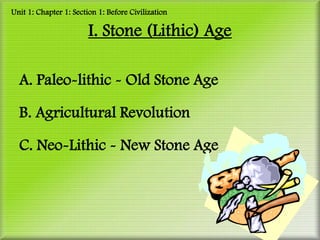
                        I. Stone (Lithic) Age

  A. Paleo-lithic - Old Stone Age

  B. Agricultural Revolution

  C. Neo-Lithic - New Stone Age
Unit 1: Chapter 1: Section 1: Before Civilization

  A. Paleolithic Age
  1. Communities – Hunter (men) & Gatherer (women)
  2. Tools – bone, skin, wood, & stone
  3. Food – vegetables, nuts & fruits - very little meat
  4. Family – women raised children, cooking, sewing
  5. Shelter – natural shelters or mobile tents
  6. Activities – art, tool making, religious practices,
     social gatherings
  7. Religion – belief in afterlife, complicated deity
     system
Unit 1: Chapter 1: Section 1: Before Civilization

  B. Agricultural Revolution
  1. Domestication – plants & animals
      a.    Agriculture – cultivation- needed fertile soil & rivers
      b.    Animals – transportation and ag. Purposes
      c.    Americas – limited due to few suitable species – llama S.A.
      d.    Africa & Asia – cattle
      e.    M.E. – camel & donkey
  2. Result – Population increase & stable communities
Unit 1: Chapter 1: Section 1: Before Civilization

                            What to Plant?
  •   Mediterranean area - Wheat and Barley
  •   Sub-Saharan Africa - Sorghum, Millet, Teff
  •   Equatorial West Africa - Yams
  •   Eastern and Southern Asia - Rice
  •   America - Maize, Potatoes, Quinoa, Manioc
Unit 1: Chapter 1: Section 1: Before Civilization

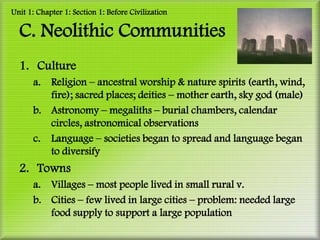
  C. Neolithic Communities
  1. Culture
      a. Religion – ancestral worship & nature spirits (earth, wind,
         fire); sacred places; deities – mother earth, sky god (male)
      b. Astronomy – megaliths – burial chambers, calendar
         circles, astronomical observations
      c. Language – societies began to spread and language began
         to diversify
  2. Towns
      a. Villages – most people lived in small rural v.
      b. Cities – few lived in large cities – problem: needed large
         food supply to support a large population
Unit 1: Chapter 1: Section 1: Before Civilization

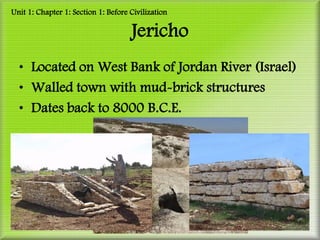
                                     Jericho
  • Located on West Bank of Jordan River (Israel)
  • Walled town with mud-brick structures
  • Dates back to 8000 B.C.E.
Unit 1: Chapter 1: Section 1: Before Civilization

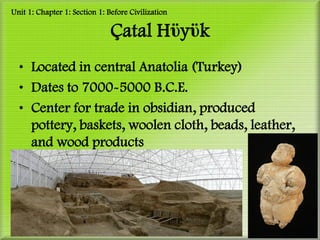
                               Çatal Hϋyϋk
  • Located in central Anatolia (Turkey)
  • Dates to 7000-5000 B.C.E.
  • Center for trade in obsidian, produced
    pottery, baskets, woolen cloth, beads, leather,
    and wood products
Unit 1: Chapter 1: Section 1: Before Civilization

                  What does this mean?
  • Jericho and Çatal Hϋyϋk tell us that there were the
    social organizations necessary to support non-food
    producing specialists such as:
       – Priests
       – Craftspeople
       – Had labor to build defensive walls, megalithic structures,
         and tombs.
            • Unknown if labor to build was free or coerced.
Due Friday!
• AP Exam Pre-Test
• World Map quiz
• Chap 1 Vocab. quiz

              Due Monday
• Reading #1 - Epic of Gilgamesh
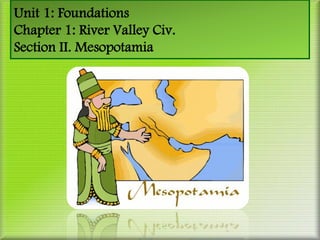
Unit 1: Foundations
Chapter 1: River Valley Civ.
Section II. Mesopotamia
Unit 1: Chapter 1: Section 2: Mesopotamia

                          II. Mesopotamia
  A. Agriculture & the Landscape

  B. Cities, Kings & Trade

  C. Society

  D. Gods, Priests & Temples

  E. Technology & Science
Unit 1: Chapter 1: Section 2: Mesopotamia

         A. Agriculture & the Environ.
  1. Plain around the Tigris and Euphrates Rivers.
  2. Difficult environment for agriculture:
        Little rainfall, floods, rivers change course
  3.   Warm climate & good soil
  4.   Used cattle-pulled plows and seed planter
  5.   Built irrigation canals to bring water to fields
  6.   + food & animals       - no resources
  7.   Early people - Sumerians
Unit 1: Chapter 1: Section 2: Mesopotamia             Do not copy this
         Crops and Natural Resources
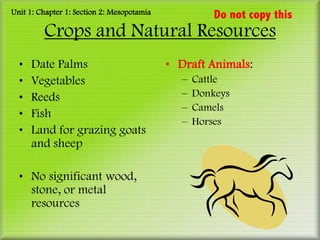
  •   Date Palms                            • Draft Animals:
  •   Vegetables                              –   Cattle
  •   Reeds                                   –   Donkeys
                                              –   Camels
  •   Fish
                                              –   Horses
  •   Land for grazing goats
      and sheep

  • No significant wood,
    stone, or metal
    resources
Unit 1: Chapter 1: Section 2: Mesopotamia

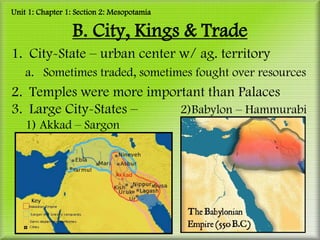
                 B. City, Kings & Trade
1. City-State – urban center w/ ag. territory
    a. Sometimes traded, sometimes fought over resources
2. Temples were more important than Palaces
3. Large City-States –    2)Babylon – Hammurabi
    1) Akkad – Sargon
Unit 1: Chapter 1: Section 2: Mesopotamia

                                C. Society
1. 3 Social Classes (kings controlled most of the wealth)
    a. Free Landowning class
    b. Dependent farmers & artisans
    c. Slaves – POW, minor part of economy
2. Power shift – women men (agriculture)
3. Women – no political role
         - Could: Own property, Control their dowry, Engage in
         trade
4. Rise of urban merchant class greater emphasis on
   male privilege and decline in women’s status.
Unit 1: Chapter 1: Section 2: Mesopotamia

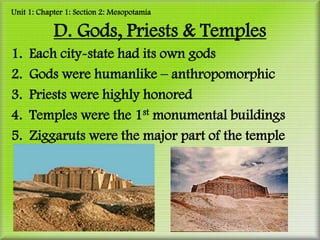
            D. Gods, Priests & Temples
1.   Each city-state had its own gods
2.   Gods were humanlike – anthropomorphic
3.   Priests were highly honored
4.   Temples were the 1st monumental buildings
5.   Ziggaruts were the major part of the temple
Unit 1: Chapter 1: Section 2: Mesopotamia

                                E. Science
1. Technology=specialized knowledge that is used
   to transform the natural environment
2. Forms of technology - Irrigation systems, buildings
    – Transportation, Bronze metallurgy, Brickmaking
    – Engineering, pottery & potter’s wheel
    – Military advances included:
         • Paid, full-time soldiers, Horses, Horse-drawn chariot, Bow and Arrow,
           Siege Machinery
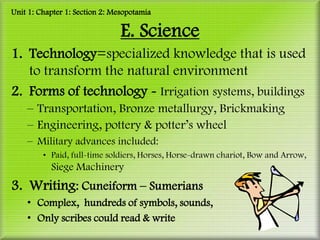
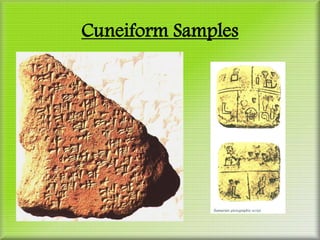
3. Writing: Cuneiform – Sumerians
    • Complex, hundreds of symbols, sounds,
    • Only scribes could read & write
Cuneiform Samples
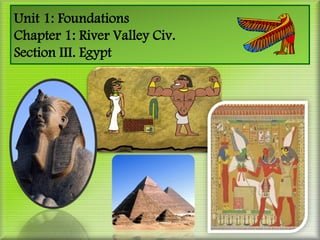
Unit 1: Foundations
Chapter 1: River Valley Civ.
Section III. Egypt
Unit 1: Chapter 1: Section 3: Egypt

                                      III. Egypt
  A. The Land

  B. Divine Kingship

  C. Administration & Communication

  D. People

  E. Beliefs & Knowledge
Unit 1: Chapter 1: Section 3: Egypt
                                      A. The Land
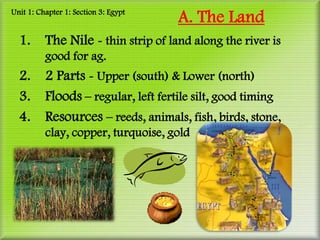
  1.      The Nile - thin strip of land along the river is
          good for ag.
  2.      2 Parts - Upper (south) & Lower (north)
  3.      Floods – regular, left fertile silt, good timing
  4.      Resources – reeds, animals, fish, birds, stone,
          clay, copper, turquoise, gold
Unit 1: Chapter 1: Section 3: Egypt
                                       B. Divine Kingship
  1.        Unification: 3100 BCE – Lower & Upper Nile
  2.        3 Periods: Divided into 30 Dynasties
       a.     Old Kingdom – Pyramid Age
       b.     Middle Kingdom – Agricultural Age
       c.     New Kingdom – Empire Age
  3.        Pharaohs – regarded as gods, death was seen as
            his journey back to the gods
       •      Funeral/burial rites were very important
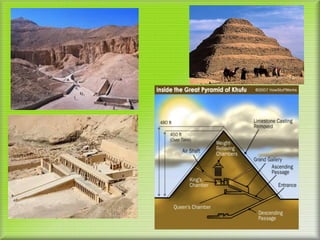
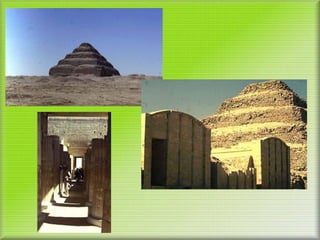
  4.        Pyramids – not all Pharaohs are buried in pyramids!
       •      Early times – flat topped tombs, then stepped pyramids
       •      Great Pyramids of Giza – 2550-2490 BCE – Old Kingdom
       •      Valley of the Kings – tunnels cut into the side of cliffs
Unit 1: Chapter 1: Section 3: Egypt
                                            C. Administration
1. Bureauracy – system of provincial admin.
        •      Tracked: labor, taxes, & people
2. Tax Collection: support the govt, temples, buildings
3. Writing: Hieroglyphics & Demotic (cursive script)
        •      Wrote on papyrus with reed “pens” (paint brushes)
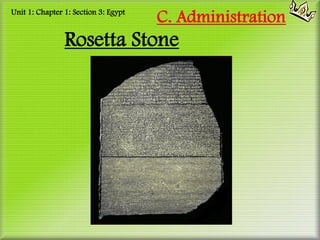
        •      Were able to decipher with the discovery of the Rosetta Stone in
               1799 – 3 languages: Greek, Demotic & Hieroglyphs
4. Power struggles with provincial governors
    •        Strong central govt – loyal prov. gov.
    •        Weak central govt – autonomous prov. gov.
5. Foriegners – seen as enemies
6. Traded with Levant, Nubia & Punt
    •       Exported papyrus, grain, and gold
    •       Imported incense, Nubian gold, Lebanese cedar, African ivory, ebony,
            and animals.
Unit 1: Chapter 1: Section 3: Egypt
                                      C. Administration
                Rosetta Stone
Unit 1: Chapter 1: Section 3: Egypt
                                          D. People
1. Population: 1 – 5 mil.; some darker, some lighter
2. Social Classes
    a. Kings & high ranking govt. officials
    b. Lower level govt. officials, & priests
    c. Peasants (majority)
3. The Working Class – Peasants
    a. Farming villages, paid taxes, source of govt. labor
    b. Slavery – limited scale, well treated
4. Women – more rights than Meso. women
    a. Subordinate to men
    b. Right to hold, inherit, and buy property
    c. Retained rights over dowry
Unit 1: Chapter 1: Section 3: Egypt
                                      E. Beliefs & Knowledge
1. Beliefs based on cyclical view of nature
    a. Re – Sun god
    b. Osiris – god of the underworld
2. Religion
    a.   Wealth & resources went into monumental buildings
    b.   Regular offerings were made to the gods
    c.   Believed in magic and in an afterlife
    d.   Beliefs led to mummification and burials rituals
    e.   Tombs built outside of city in order to save ag. Land
    f.   Contained: food, pictures, transportation, wealth
3. Knowledge
    •    Chemistry, anatomy, mathamatics, astronomy, calendar,
         irrigation, engineering, architecture, transportation
Unit 1: Foundations
Chapter 1: River Valley Civ.
Section IV. Indus River Valley

2600 – 1900 B.C.E.


http://mstreitwieser.com/civilization/indus.php
Unit 1: Chapter 1: Section 4: Indus RV

                     IV. Indus River Valley
  A. Environment

  B. Culture

  C. Transformation
Unit 1: Chapter 1: Section 4: Indus RV
                                         A. Environment
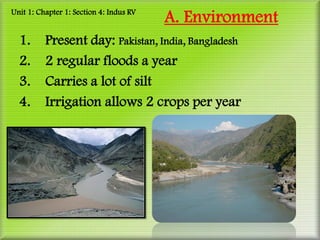
  1.      Present day: Pakistan, India, Bangladesh
  2.      2 regular floods a year
  3.      Carries a lot of silt
  4.      Irrigation allows 2 crops per year
Unit 1: Chapter 1: Section 4: Indus RV
                                         B. Culture
  1.      Don’t know much about civilization because
          scholars have not deciphered their writings
  2.      Evidence suggests standards in city planning,
          architecture and even the size of bricks
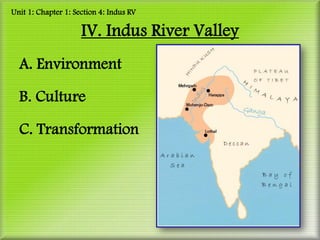
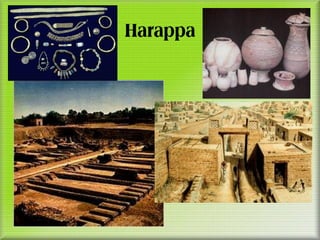
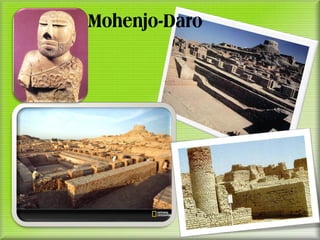
  3.      2 Largest Sites: Mohenjo-Daro & Harappa
  4.      Both were surrounded by brick walls, had streets
          laid out in a grid pattern and were supplied with
          covered drainage systems to carry away waste.
  5.      Had access to more metals than Egypt or Meso.
  6.      Technology – irrigation, potter’s wheel, bricks,
          bronze, writing
  7.      Trade – North – Iran, Afghanistan, Meso.
Harappa
Mohenjo-Daro
Unit 1: Chapter 1: Section 4: Indus RV
                                         C. Transformation
  1. Declined because of natural disasters and
     ecological change.
  2. These changes included:
     1. Drying up of the Hakra River
     2. Stalinization
     3. Erosion
  3. When urban centers collapsed, so did the way of
     life for the elite, but peasants probably adapted
     and survived.

Chapter 01 Short

  • 1.
    Unit 1: Chapter1 Chapter 1: From the Origins of Agriculture to the First River-Valley Civilizations 8000-1500 B.C.E.
  • 2.
    Unit 1: Chapter1: Section 1: Before Civilization Section 1: Before Civilization
  • 3.
    Unit 1: Chapter1: Section 1: Before Civilization I. Stone (Lithic) Age A. Paleo-lithic - Old Stone Age B. Agricultural Revolution C. Neo-Lithic - New Stone Age
  • 4.
    Unit 1: Chapter1: Section 1: Before Civilization A. Paleolithic Age 1. Communities – Hunter (men) & Gatherer (women) 2. Tools – bone, skin, wood, & stone 3. Food – vegetables, nuts & fruits - very little meat 4. Family – women raised children, cooking, sewing 5. Shelter – natural shelters or mobile tents 6. Activities – art, tool making, religious practices, social gatherings 7. Religion – belief in afterlife, complicated deity system
  • 5.
    Unit 1: Chapter1: Section 1: Before Civilization B. Agricultural Revolution 1. Domestication – plants & animals a. Agriculture – cultivation- needed fertile soil & rivers b. Animals – transportation and ag. Purposes c. Americas – limited due to few suitable species – llama S.A. d. Africa & Asia – cattle e. M.E. – camel & donkey 2. Result – Population increase & stable communities
  • 6.
    Unit 1: Chapter1: Section 1: Before Civilization What to Plant? • Mediterranean area - Wheat and Barley • Sub-Saharan Africa - Sorghum, Millet, Teff • Equatorial West Africa - Yams • Eastern and Southern Asia - Rice • America - Maize, Potatoes, Quinoa, Manioc
  • 7.
    Unit 1: Chapter1: Section 1: Before Civilization C. Neolithic Communities 1. Culture a. Religion – ancestral worship & nature spirits (earth, wind, fire); sacred places; deities – mother earth, sky god (male) b. Astronomy – megaliths – burial chambers, calendar circles, astronomical observations c. Language – societies began to spread and language began to diversify 2. Towns a. Villages – most people lived in small rural v. b. Cities – few lived in large cities – problem: needed large food supply to support a large population
  • 8.
    Unit 1: Chapter1: Section 1: Before Civilization Jericho • Located on West Bank of Jordan River (Israel) • Walled town with mud-brick structures • Dates back to 8000 B.C.E.
  • 9.
    Unit 1: Chapter1: Section 1: Before Civilization Çatal Hϋyϋk • Located in central Anatolia (Turkey) • Dates to 7000-5000 B.C.E. • Center for trade in obsidian, produced pottery, baskets, woolen cloth, beads, leather, and wood products
  • 10.
    Unit 1: Chapter1: Section 1: Before Civilization What does this mean? • Jericho and Çatal Hϋyϋk tell us that there were the social organizations necessary to support non-food producing specialists such as: – Priests – Craftspeople – Had labor to build defensive walls, megalithic structures, and tombs. • Unknown if labor to build was free or coerced.
  • 11.
    Due Friday! • APExam Pre-Test • World Map quiz • Chap 1 Vocab. quiz Due Monday • Reading #1 - Epic of Gilgamesh
  • 12.
    Unit 1: Foundations Chapter1: River Valley Civ. Section II. Mesopotamia
  • 13.
    Unit 1: Chapter1: Section 2: Mesopotamia II. Mesopotamia A. Agriculture & the Landscape B. Cities, Kings & Trade C. Society D. Gods, Priests & Temples E. Technology & Science
  • 14.
    Unit 1: Chapter1: Section 2: Mesopotamia A. Agriculture & the Environ. 1. Plain around the Tigris and Euphrates Rivers. 2. Difficult environment for agriculture:  Little rainfall, floods, rivers change course 3. Warm climate & good soil 4. Used cattle-pulled plows and seed planter 5. Built irrigation canals to bring water to fields 6. + food & animals - no resources 7. Early people - Sumerians
  • 15.
    Unit 1: Chapter1: Section 2: Mesopotamia Do not copy this Crops and Natural Resources • Date Palms • Draft Animals: • Vegetables – Cattle • Reeds – Donkeys – Camels • Fish – Horses • Land for grazing goats and sheep • No significant wood, stone, or metal resources
  • 16.
    Unit 1: Chapter1: Section 2: Mesopotamia B. City, Kings & Trade 1. City-State – urban center w/ ag. territory a. Sometimes traded, sometimes fought over resources 2. Temples were more important than Palaces 3. Large City-States – 2)Babylon – Hammurabi 1) Akkad – Sargon
  • 17.
    Unit 1: Chapter1: Section 2: Mesopotamia C. Society 1. 3 Social Classes (kings controlled most of the wealth) a. Free Landowning class b. Dependent farmers & artisans c. Slaves – POW, minor part of economy 2. Power shift – women men (agriculture) 3. Women – no political role - Could: Own property, Control their dowry, Engage in trade 4. Rise of urban merchant class greater emphasis on male privilege and decline in women’s status.
  • 18.
    Unit 1: Chapter1: Section 2: Mesopotamia D. Gods, Priests & Temples 1. Each city-state had its own gods 2. Gods were humanlike – anthropomorphic 3. Priests were highly honored 4. Temples were the 1st monumental buildings 5. Ziggaruts were the major part of the temple
  • 19.
    Unit 1: Chapter1: Section 2: Mesopotamia E. Science 1. Technology=specialized knowledge that is used to transform the natural environment 2. Forms of technology - Irrigation systems, buildings – Transportation, Bronze metallurgy, Brickmaking – Engineering, pottery & potter’s wheel – Military advances included: • Paid, full-time soldiers, Horses, Horse-drawn chariot, Bow and Arrow, Siege Machinery 3. Writing: Cuneiform – Sumerians • Complex, hundreds of symbols, sounds, • Only scribes could read & write
  • 20.
  • 21.
    Unit 1: Foundations Chapter1: River Valley Civ. Section III. Egypt
  • 22.
    Unit 1: Chapter1: Section 3: Egypt III. Egypt A. The Land B. Divine Kingship C. Administration & Communication D. People E. Beliefs & Knowledge
  • 23.
    Unit 1: Chapter1: Section 3: Egypt A. The Land 1. The Nile - thin strip of land along the river is good for ag. 2. 2 Parts - Upper (south) & Lower (north) 3. Floods – regular, left fertile silt, good timing 4. Resources – reeds, animals, fish, birds, stone, clay, copper, turquoise, gold
  • 24.
    Unit 1: Chapter1: Section 3: Egypt B. Divine Kingship 1. Unification: 3100 BCE – Lower & Upper Nile 2. 3 Periods: Divided into 30 Dynasties a. Old Kingdom – Pyramid Age b. Middle Kingdom – Agricultural Age c. New Kingdom – Empire Age 3. Pharaohs – regarded as gods, death was seen as his journey back to the gods • Funeral/burial rites were very important 4. Pyramids – not all Pharaohs are buried in pyramids! • Early times – flat topped tombs, then stepped pyramids • Great Pyramids of Giza – 2550-2490 BCE – Old Kingdom • Valley of the Kings – tunnels cut into the side of cliffs
  • 26.
    Unit 1: Chapter1: Section 3: Egypt C. Administration 1. Bureauracy – system of provincial admin. • Tracked: labor, taxes, & people 2. Tax Collection: support the govt, temples, buildings 3. Writing: Hieroglyphics & Demotic (cursive script) • Wrote on papyrus with reed “pens” (paint brushes) • Were able to decipher with the discovery of the Rosetta Stone in 1799 – 3 languages: Greek, Demotic & Hieroglyphs 4. Power struggles with provincial governors • Strong central govt – loyal prov. gov. • Weak central govt – autonomous prov. gov. 5. Foriegners – seen as enemies 6. Traded with Levant, Nubia & Punt • Exported papyrus, grain, and gold • Imported incense, Nubian gold, Lebanese cedar, African ivory, ebony, and animals.
  • 27.
    Unit 1: Chapter1: Section 3: Egypt C. Administration Rosetta Stone
  • 28.
    Unit 1: Chapter1: Section 3: Egypt D. People 1. Population: 1 – 5 mil.; some darker, some lighter 2. Social Classes a. Kings & high ranking govt. officials b. Lower level govt. officials, & priests c. Peasants (majority) 3. The Working Class – Peasants a. Farming villages, paid taxes, source of govt. labor b. Slavery – limited scale, well treated 4. Women – more rights than Meso. women a. Subordinate to men b. Right to hold, inherit, and buy property c. Retained rights over dowry
  • 29.
    Unit 1: Chapter1: Section 3: Egypt E. Beliefs & Knowledge 1. Beliefs based on cyclical view of nature a. Re – Sun god b. Osiris – god of the underworld 2. Religion a. Wealth & resources went into monumental buildings b. Regular offerings were made to the gods c. Believed in magic and in an afterlife d. Beliefs led to mummification and burials rituals e. Tombs built outside of city in order to save ag. Land f. Contained: food, pictures, transportation, wealth 3. Knowledge • Chemistry, anatomy, mathamatics, astronomy, calendar, irrigation, engineering, architecture, transportation
  • 31.
    Unit 1: Foundations Chapter1: River Valley Civ. Section IV. Indus River Valley 2600 – 1900 B.C.E. http://mstreitwieser.com/civilization/indus.php
  • 32.
    Unit 1: Chapter1: Section 4: Indus RV IV. Indus River Valley A. Environment B. Culture C. Transformation
  • 33.
    Unit 1: Chapter1: Section 4: Indus RV A. Environment 1. Present day: Pakistan, India, Bangladesh 2. 2 regular floods a year 3. Carries a lot of silt 4. Irrigation allows 2 crops per year
  • 34.
    Unit 1: Chapter1: Section 4: Indus RV B. Culture 1. Don’t know much about civilization because scholars have not deciphered their writings 2. Evidence suggests standards in city planning, architecture and even the size of bricks 3. 2 Largest Sites: Mohenjo-Daro & Harappa 4. Both were surrounded by brick walls, had streets laid out in a grid pattern and were supplied with covered drainage systems to carry away waste. 5. Had access to more metals than Egypt or Meso. 6. Technology – irrigation, potter’s wheel, bricks, bronze, writing 7. Trade – North – Iran, Afghanistan, Meso.
  • 35.
  • 36.
  • 37.
    Unit 1: Chapter1: Section 4: Indus RV C. Transformation 1. Declined because of natural disasters and ecological change. 2. These changes included: 1. Drying up of the Hakra River 2. Stalinization 3. Erosion 3. When urban centers collapsed, so did the way of life for the elite, but peasants probably adapted and survived.