Chapters 1 & 2 Notes
 Early Humans &
 Early Civilizations
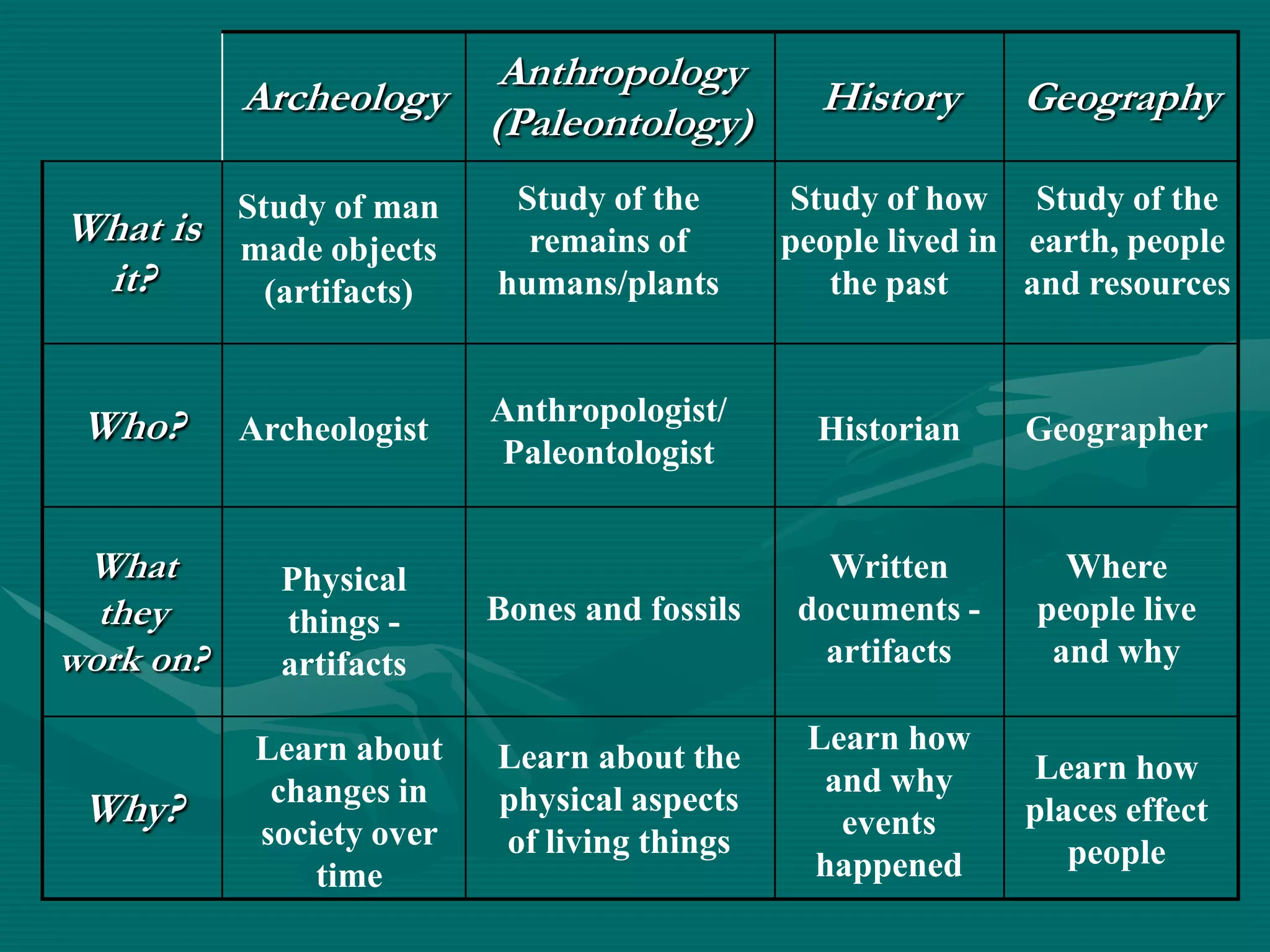
Anthropology
           Archeology                            History      Geography
                      (Paleontology)
           Study of man     Study of the       Study of how Study of the
What is    made objects      remains of        people lived in earth, people
 it?         (artifacts)   humans/plants          the past     and resources


 Who?                      Anthropologist/
           Archeologist                          Historian    Geographer
                           Paleontologist


 What        Physical                             Written        Where
  they       things -      Bones and fossils    documents -    people live
work on?     artifacts                            artifacts     and why

            Learn about                         Learn how
                           Learn about the                    Learn how
             changes in                          and why
 Why?                      physical aspects
                                                  events      places effect
            society over   of living things
                                                happened         people
                time
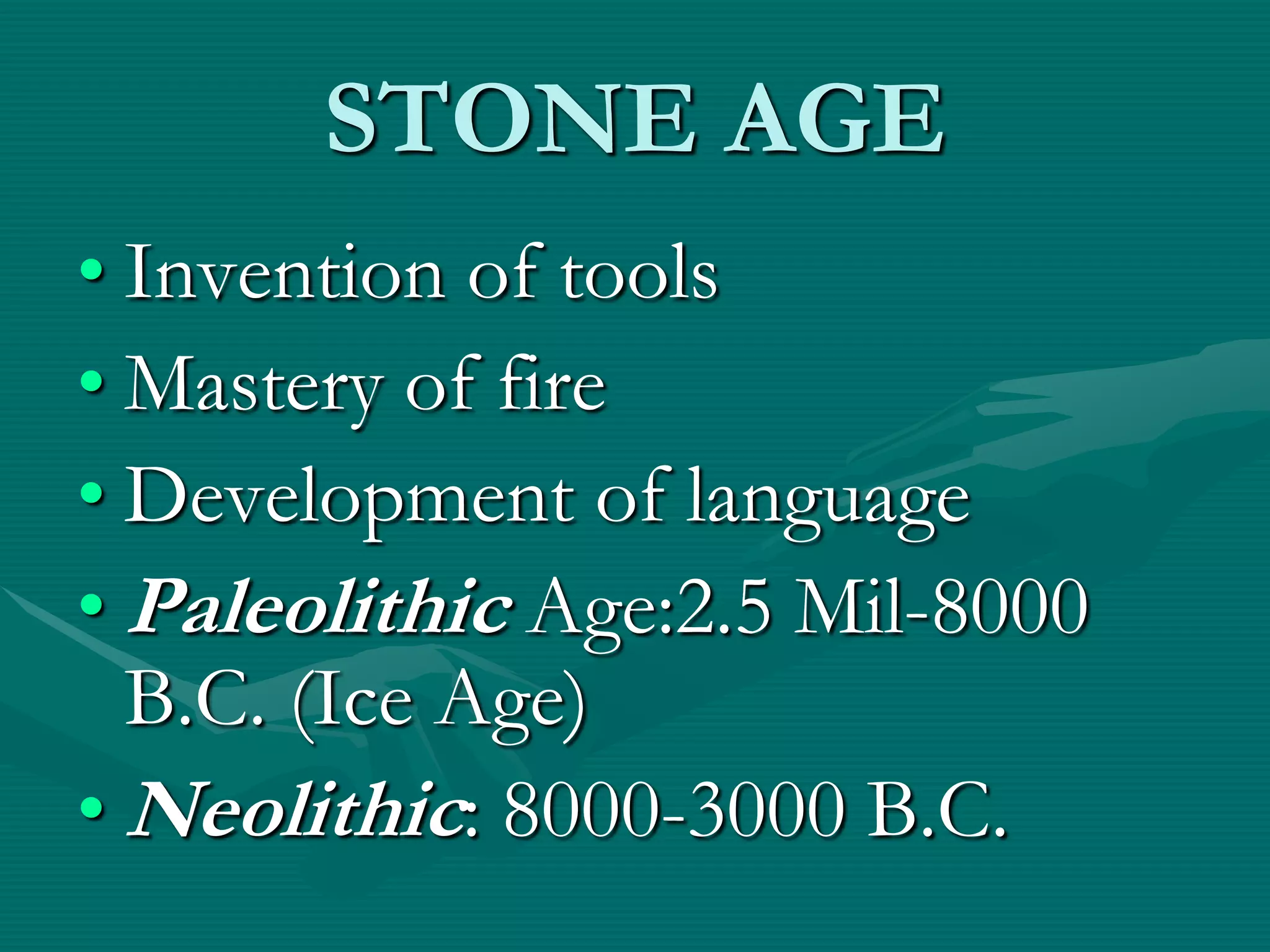
STONE AGE
• Invention of tools
• Mastery of fire
• Development of language
• Paleolithic Age:2.5 Mil-8000
  B.C. (Ice Age)
• Neolithic: 8000-3000 B.C.
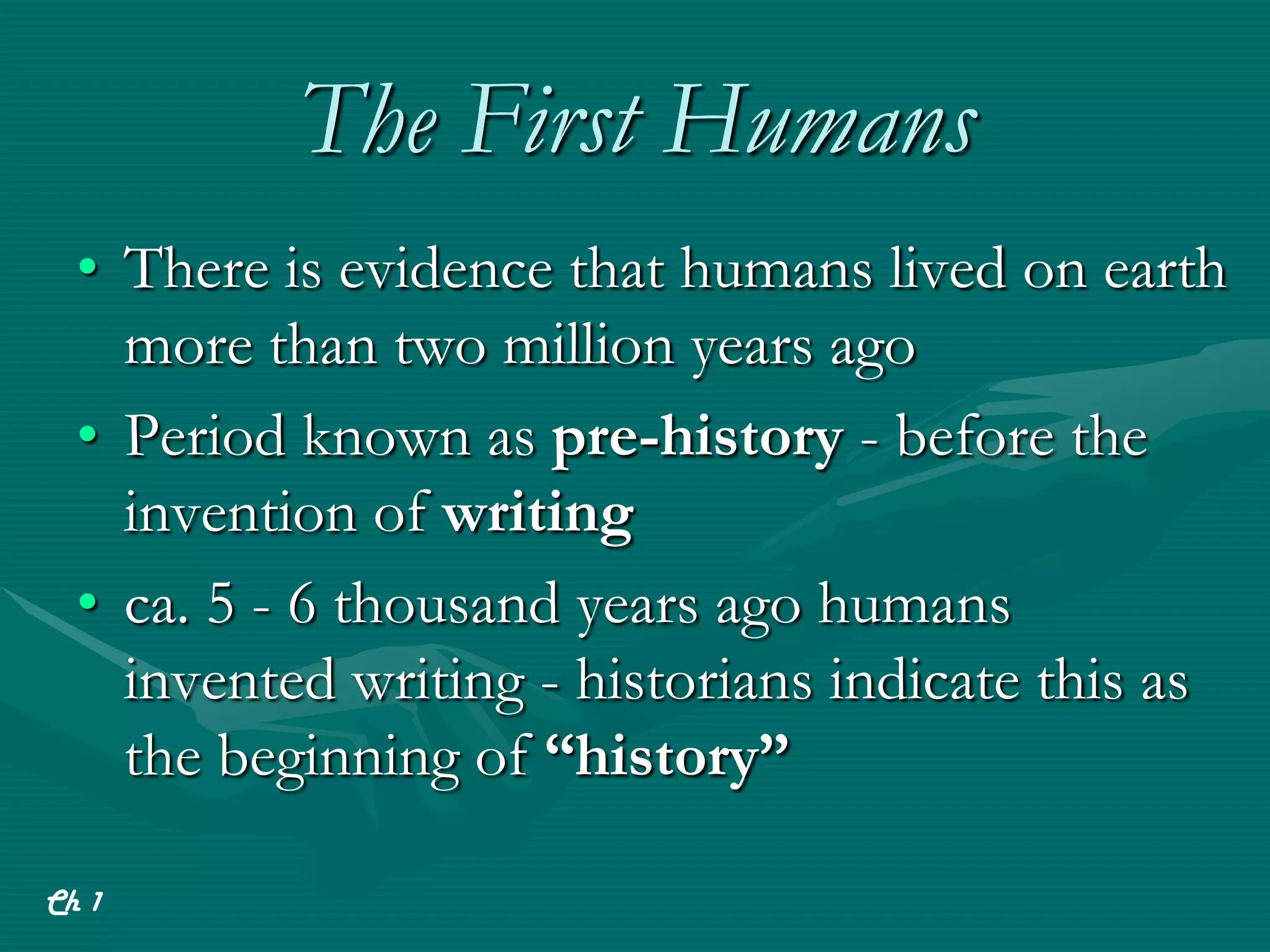
The First Humans
  • There is evidence that humans lived on earth
    more than two million years ago
  • Period known as pre-history - before the
    invention of writing
  • ca. 5 - 6 thousand years ago humans
    invented writing - historians indicate this as
    the beginning of “history”

Ch 1
The Earliest Humans were
          Hunter Gathers
During the Paleolithic (“old stone”) Age
• Migrated to follow food
• Had a small, portable tool kit
• Little specialization
• Men and women were equal
• Ruled by custom & tradition
Very Important Change
• Paleolithic Age         • Neolithic Age
                            • Domestication of
• Hunting of animals               animals
  and gathering of food   • + Growing of crops on
                               a regular basis
                            • = SYSTEMATIC
                              AGRICULTURE
Humans during the Neolithic
           Age
• 1) Learned how to domesticate animals (keep
  them in one place)
  = They didn’t have to follow their food around

• 2) SO, now humans can stay in one place
  = These early settlements were called Neolithic
    Farming villages
           -> Jericho in Palestine
           -> Catal Huyuk in present day Turkey
           was the largest
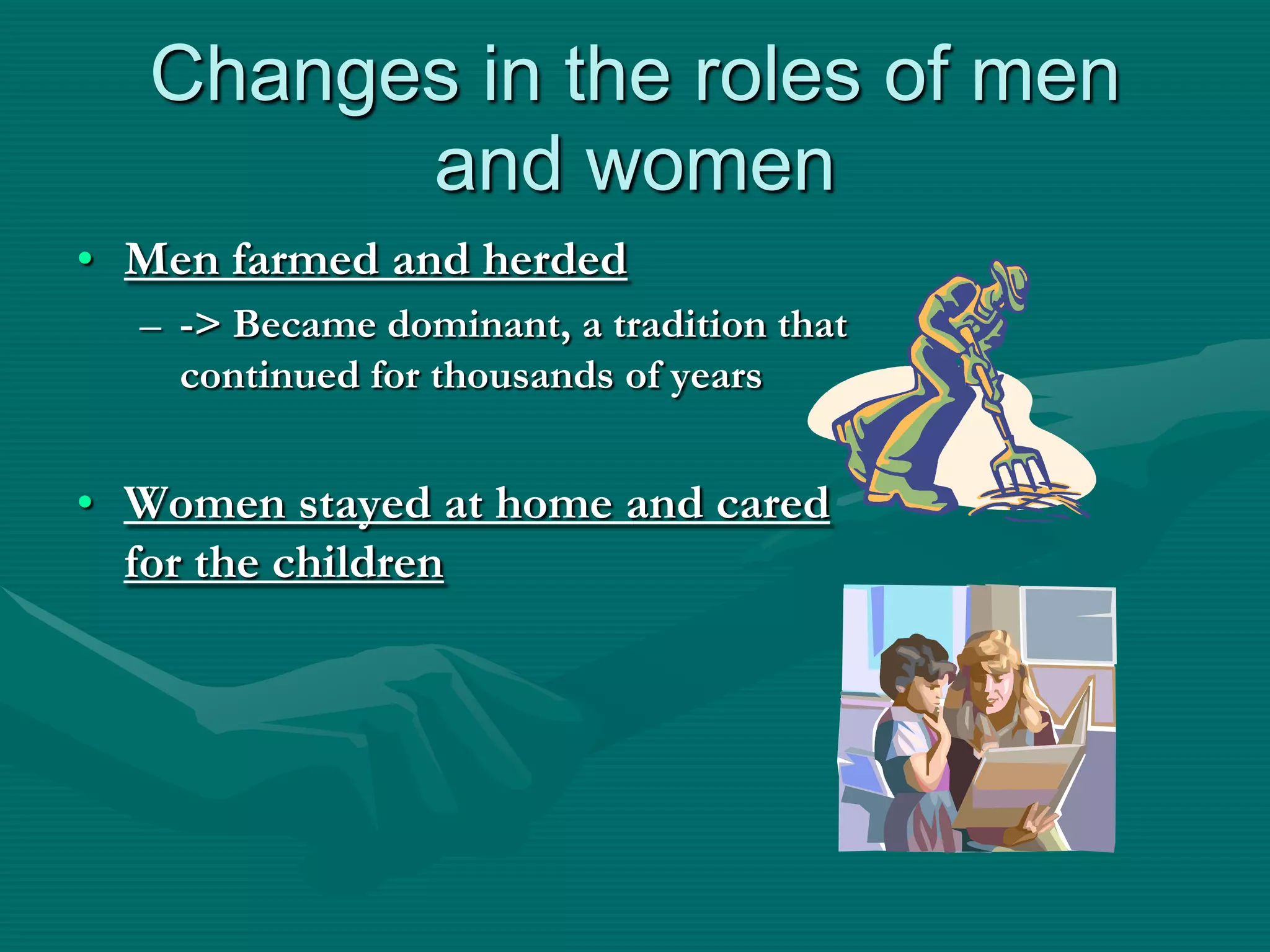
Changes in the roles of men
         and women
• Men farmed and herded
  – -> Became dominant, a tradition that
    continued for thousands of years


• Women stayed at home and cared
  for the children
Effects of the Neolithic
             Revolution
• People acquire food on a regular basis
• Not everyone has to farm
• So the non-farmers can work in trades and crafts
  – Improved tools & weapons using copper and bronze
     • Bronze Age from 3000 BC to 1200BC
More Effects of the Neolithic
           Revolution
• Non-farmers could specialize
  – Each person focused on one job instead of trying to
    do it all


• Now people traded goods and services -> a
  more advanced economy
The Early Humans
Neolithic villages eventually became fortified
cities - this is the beginning of civilization

The word civilization comes from the Latin
Civitas which means city.

Civilizations are complex cultures in which
many people share common elements
Six Characteristics of a
             Civilization
1. Government -> to organize human activity;
   usually a monarch
2. Cities -> usually developed in river valleys
3. Writing -> the 1st works of literature were
   created
Six Characteristics of a
         Civilization, part two
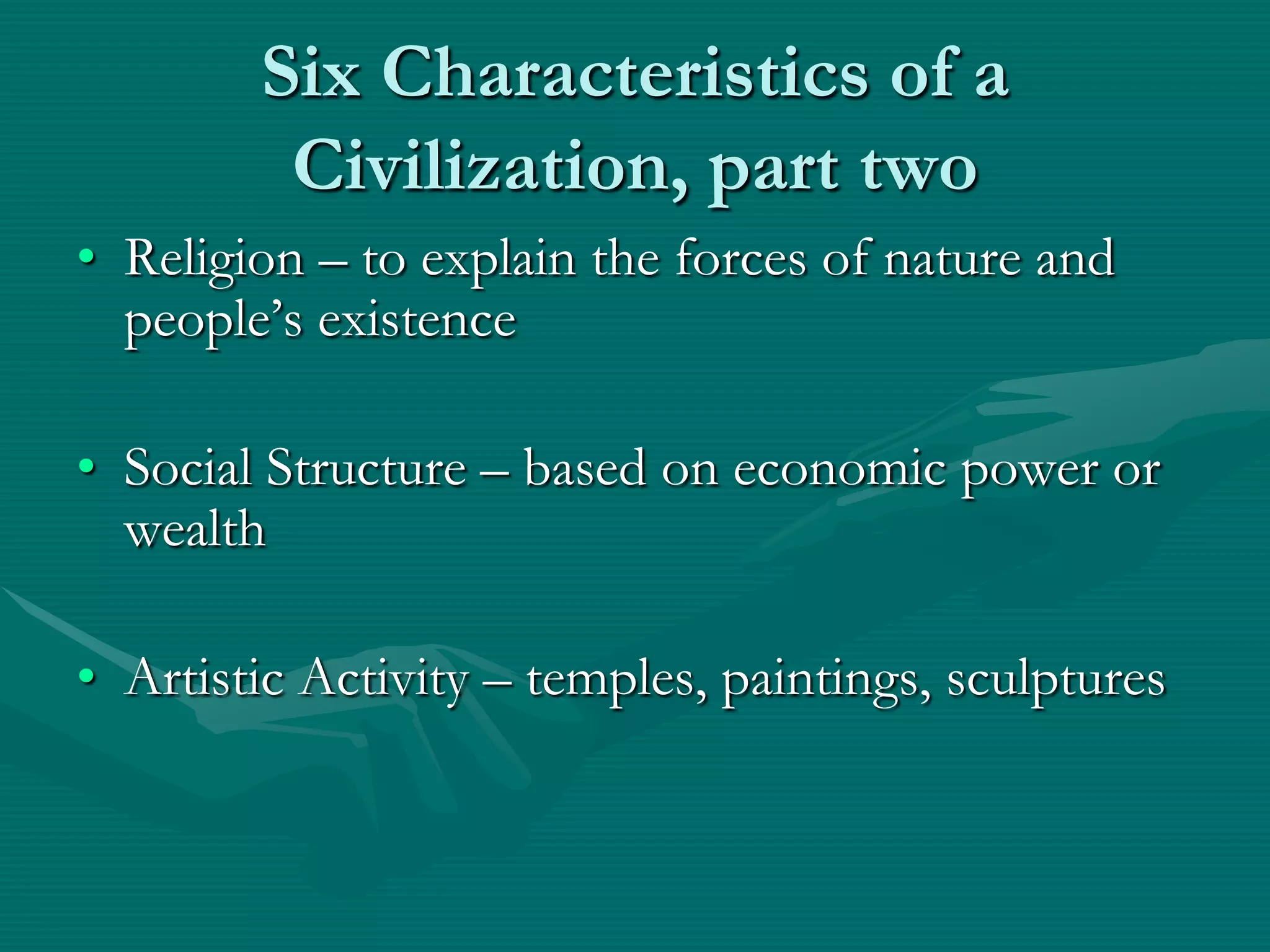
• Religion – to explain the forces of nature and
  people’s existence

• Social Structure – based on economic power or
  wealth

• Artistic Activity – temples, paintings, sculptures
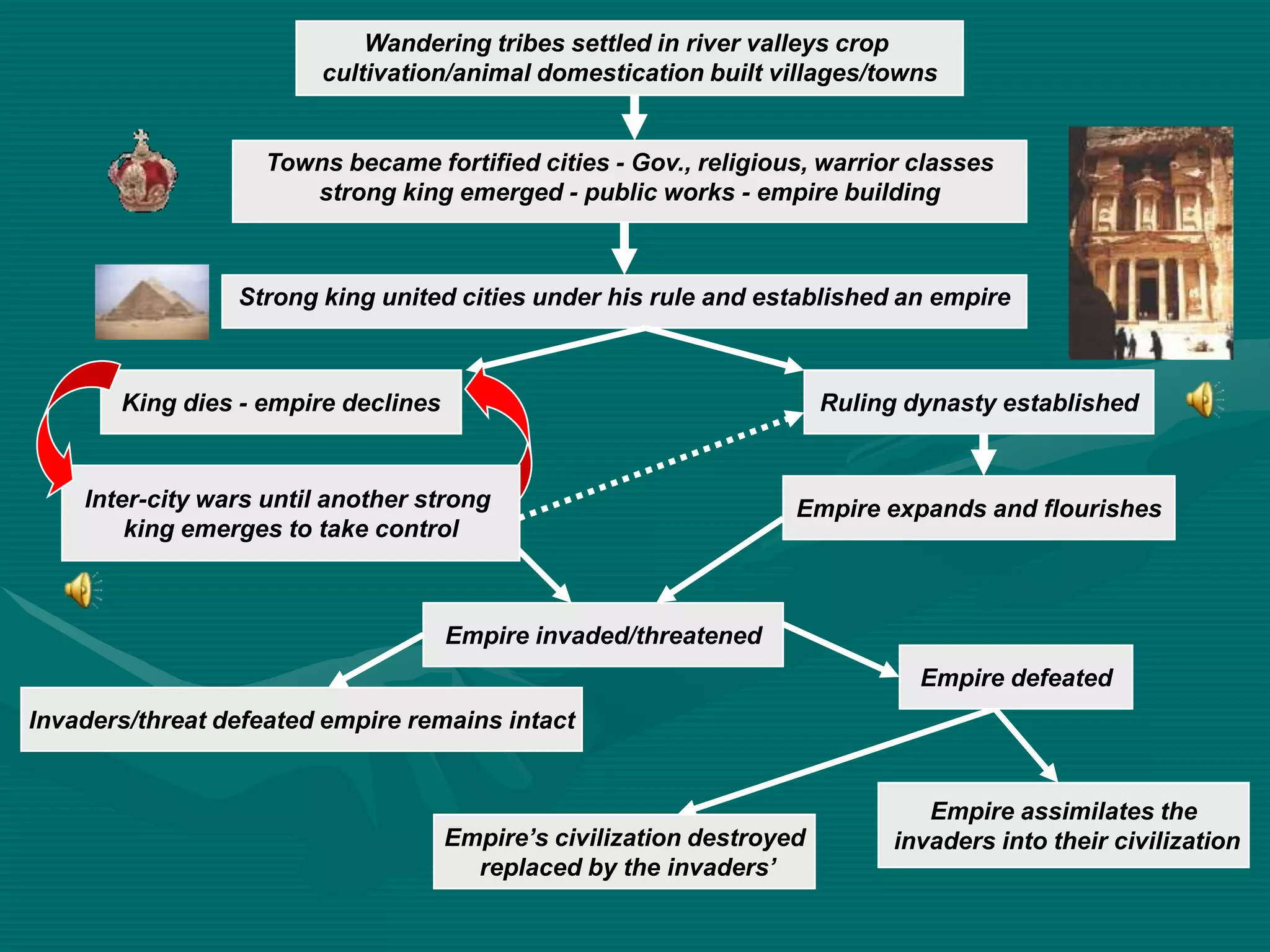
Wandering tribes settled in river valleys crop
                         cultivation/animal domestication built villages/towns


                    Towns became fortified cities - Gov., religious, warrior classes
                       strong king emerged - public works - empire building


                 Strong king united cities under his rule and established an empire


       King dies - empire declines                                     Ruling dynasty established


    Inter-city wars until another strong                           Empire expands and flourishes
        king emerges to take control


                                     Empire invaded/threatened
                                                                               Empire defeated
Invaders/threat defeated empire remains intact


                                                                                Empire assimilates the
                                     Empire’s civilization destroyed         invaders into their civilization
                                       replaced by the invaders’
Chapter 2 – Early Civilizations
Mesopotamia
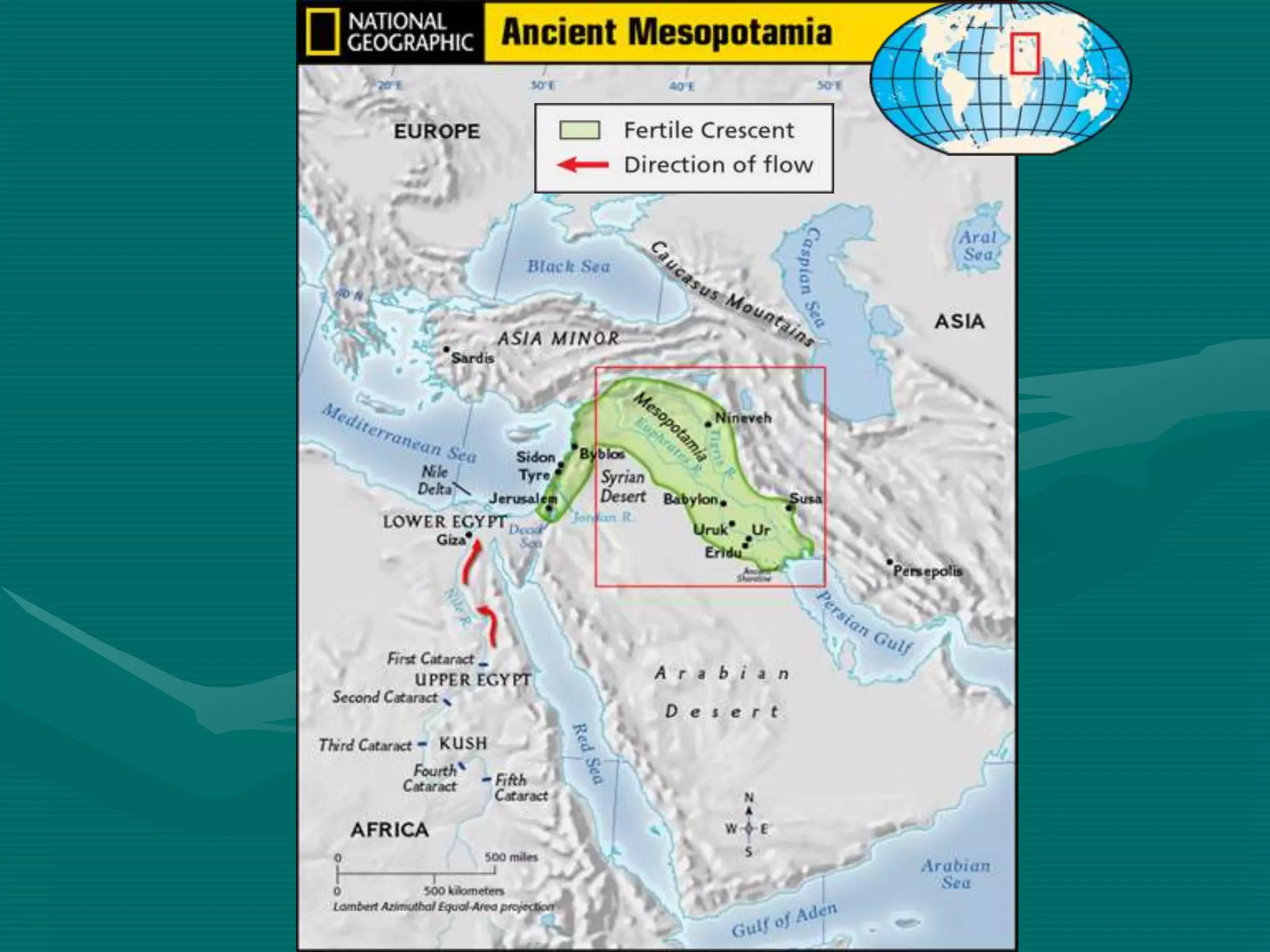
• Mesopotamia – area of fertile land
  between the Tigris and Euphrates
  Rivers in present day Iraq. This area
  was also known as Sumer.


• Irrigation and drainage ditches were
  built to control flooding so Sumerians
  could farm on a regular basis
Sumerians
• The Sumerians built the first cities in
  Mesopotamia by 3000 B.C.

• The Sumerians were polytheistic – they
  believed in many gods

• Each Sumerian city had a temple
  dedicated to the chief god or goddess of
  the city. They believed that the gods ruled
  the cities, making the state a theocracy.
Sumerian Writing
• Sumerians created the oldest writing
  system, cuneiform, which dates from
  about 3000 B.C.

• Men in the upper classes who knew
  how to write held the most important
  positions in society.
• Writing allowed society to keep records
  and to pass along knowledge.
ACCOMPLISHMENTS
• Inventions
   –Wheel, sail, plow, bronze
   –Writing: cuneiform
   –Arithmetic, geometry
   –Arches, columns, ramps,
    ziggurat
The Epic of Gilgamesh
• The Epic of Gilgamesh is a
  Mesopotamian epic poem that follows
  Gilgamesh (a half man-half god king) in
  his failed search for immortality.

• The moral is that everlasting life is only
  for the gods.
Akkadians & Babylonians
• The Akkadians lived north of the Sumerians.
• In 2340 B.C. the Akkadians under Sargon
  took over the Sumerians and united the area
  of Sumer under his rule. This was the first
  empire

• By 1792, Babylon took control of both the
  Akkadian Empire and the Sumerian Empire.
Hammurabi
• In 1792 BC, Hammurabi united the area
  under a new empire – Babylonia

• He developed a Law code which
  controlled all aspects of life – including
  women and slaves, who were unknown
  in previous laws
The Code of Hammurabi
• Was based on the principle of
  retaliation (“an eye for an eye, tooth for
  a tooth”)

• Also held public officials
  accountable, provided consumer
  protection laws, and laws for marriages
  and families.

* * This is the basis for our laws today! **
EGYPT
• The Nile River is the longest river in the
  world and runs through northeastern Africa.
  It’s yearly flooding left rich, fertile soil
  enabling farmers to grow a surplus of food.

• Unlike Mesopotamia, Egypt had natural
  barriers that protected it from invasion:
  deserts, Red Sea, rapids on the
  Nile, Mediterranean Sea
Egyptian History – Old Kingdom
      (2700 to 2200 B.C)
In 3100 B.C. King Menes united Upper
  and Lower Egypt into one dynasty
  - Prosperous and United
  –  Ruled by Egyptian monarchs, or
   Pharaohs
  – Build large tombs and pyramids
• Decline: power struggles, crop
  failures, high cost of building pyramids
Middle Kingdom
          (2200 to 1652 B.C.)
 Chaos for 150 years
 The a period of expansion
 Drained land for farming

• Decline: Hittites invaded and
  conquered
New Kingdom
      (1567 to 1085 B.C.)
 The Hyksos ruled the Egyptians for 100
 years, but taught the Egyptians how to use
 bronze and their military skills
 The Egyptians then used what they
 learned to drive the Hyksos out
 The New Kingdom was the most
 powerful state in SW Asia and created a
 huge empire
 Egypt eventually fell apart and became
 a province of Rome
Role of Women and families
           in Egypt
• Husband was master in the house, but
  women were well respected
• Women kept their own property and
  inheritance, even in marriage

• Some women operated businesses
• Upper class women could become
  priestesses and pharaohs
PHOENICIANS
• 1200 – 500 BC
• Lived in present day Palestine
• Mix of Babylonian and Egyptian culture

• Known for their trading empire and
  language
ISRAELITES
• Lived south of the Phoenicians
• Their religion was Judaism, which was
  based on the Hebrew Bible (Christian
  Old Testament)
• When Moses led his people out of
  Egypt, God made a contract with them.
• God promised to guide them if they
  obeyed His law stated in the Ten
  Commandments.
Assyrian Empire

• (700 B.C. to 612 B.C.)
• Conquered the Babylonians
• Good communication system - an
  early pony express
• Large, effective armies with Iron
  weapons
• Used terror to conquer others
Chaldeans
• Defeated Assyria, conquered the
  Kingdom of Judah, and destroyed
  Jerusalem in 586 B.C.

• The Chaldeans were conquered by the
  Persians in 539 B.C.
The Persians
• Persians - 539 BCE - large empire from the
  Indus river to Libyan desert
• Ruled fairly - allowed local rulers, customs and
  religions to remain
• Copied the Gov. system, roads, postal system
  from the Assyrians
• Monotheistic religion - Zoroaster religious
  reformer - taught life is struggle between good
  and evil - worst crime was lying
• Conquered by Alexander the Great 331 BCE

Chs 1 & 2 pp 06 07

  • 1.
    Chapters 1 &2 Notes Early Humans & Early Civilizations
  • 2.
    Anthropology Archeology History Geography (Paleontology) Study of man Study of the Study of how Study of the What is made objects remains of people lived in earth, people it? (artifacts) humans/plants the past and resources Who? Anthropologist/ Archeologist Historian Geographer Paleontologist What Physical Written Where they things - Bones and fossils documents - people live work on? artifacts artifacts and why Learn about Learn how Learn about the Learn how changes in and why Why? physical aspects events places effect society over of living things happened people time
  • 3.
    STONE AGE • Inventionof tools • Mastery of fire • Development of language • Paleolithic Age:2.5 Mil-8000 B.C. (Ice Age) • Neolithic: 8000-3000 B.C.
  • 4.
    The First Humans • There is evidence that humans lived on earth more than two million years ago • Period known as pre-history - before the invention of writing • ca. 5 - 6 thousand years ago humans invented writing - historians indicate this as the beginning of “history” Ch 1
  • 5.
    The Earliest Humanswere Hunter Gathers During the Paleolithic (“old stone”) Age • Migrated to follow food • Had a small, portable tool kit • Little specialization • Men and women were equal • Ruled by custom & tradition
  • 6.
    Very Important Change •Paleolithic Age • Neolithic Age • Domestication of • Hunting of animals animals and gathering of food • + Growing of crops on a regular basis • = SYSTEMATIC AGRICULTURE
  • 7.
    Humans during theNeolithic Age • 1) Learned how to domesticate animals (keep them in one place) = They didn’t have to follow their food around • 2) SO, now humans can stay in one place = These early settlements were called Neolithic Farming villages -> Jericho in Palestine -> Catal Huyuk in present day Turkey was the largest
  • 8.
    Changes in theroles of men and women • Men farmed and herded – -> Became dominant, a tradition that continued for thousands of years • Women stayed at home and cared for the children
  • 9.
    Effects of theNeolithic Revolution • People acquire food on a regular basis • Not everyone has to farm • So the non-farmers can work in trades and crafts – Improved tools & weapons using copper and bronze • Bronze Age from 3000 BC to 1200BC
  • 10.
    More Effects ofthe Neolithic Revolution • Non-farmers could specialize – Each person focused on one job instead of trying to do it all • Now people traded goods and services -> a more advanced economy
  • 11.
    The Early Humans Neolithicvillages eventually became fortified cities - this is the beginning of civilization The word civilization comes from the Latin Civitas which means city. Civilizations are complex cultures in which many people share common elements
  • 12.
    Six Characteristics ofa Civilization 1. Government -> to organize human activity; usually a monarch 2. Cities -> usually developed in river valleys 3. Writing -> the 1st works of literature were created
  • 13.
    Six Characteristics ofa Civilization, part two • Religion – to explain the forces of nature and people’s existence • Social Structure – based on economic power or wealth • Artistic Activity – temples, paintings, sculptures
  • 14.
    Wandering tribes settledin river valleys crop cultivation/animal domestication built villages/towns Towns became fortified cities - Gov., religious, warrior classes strong king emerged - public works - empire building Strong king united cities under his rule and established an empire King dies - empire declines Ruling dynasty established Inter-city wars until another strong Empire expands and flourishes king emerges to take control Empire invaded/threatened Empire defeated Invaders/threat defeated empire remains intact Empire assimilates the Empire’s civilization destroyed invaders into their civilization replaced by the invaders’
  • 15.
    Chapter 2 –Early Civilizations
  • 17.
    Mesopotamia • Mesopotamia –area of fertile land between the Tigris and Euphrates Rivers in present day Iraq. This area was also known as Sumer. • Irrigation and drainage ditches were built to control flooding so Sumerians could farm on a regular basis
  • 18.
    Sumerians • The Sumeriansbuilt the first cities in Mesopotamia by 3000 B.C. • The Sumerians were polytheistic – they believed in many gods • Each Sumerian city had a temple dedicated to the chief god or goddess of the city. They believed that the gods ruled the cities, making the state a theocracy.
  • 19.
    Sumerian Writing • Sumerianscreated the oldest writing system, cuneiform, which dates from about 3000 B.C. • Men in the upper classes who knew how to write held the most important positions in society. • Writing allowed society to keep records and to pass along knowledge.
  • 20.
    ACCOMPLISHMENTS • Inventions –Wheel, sail, plow, bronze –Writing: cuneiform –Arithmetic, geometry –Arches, columns, ramps, ziggurat
  • 21.
    The Epic ofGilgamesh • The Epic of Gilgamesh is a Mesopotamian epic poem that follows Gilgamesh (a half man-half god king) in his failed search for immortality. • The moral is that everlasting life is only for the gods.
  • 22.
    Akkadians & Babylonians •The Akkadians lived north of the Sumerians. • In 2340 B.C. the Akkadians under Sargon took over the Sumerians and united the area of Sumer under his rule. This was the first empire • By 1792, Babylon took control of both the Akkadian Empire and the Sumerian Empire.
  • 23.
    Hammurabi • In 1792BC, Hammurabi united the area under a new empire – Babylonia • He developed a Law code which controlled all aspects of life – including women and slaves, who were unknown in previous laws
  • 24.
    The Code ofHammurabi • Was based on the principle of retaliation (“an eye for an eye, tooth for a tooth”) • Also held public officials accountable, provided consumer protection laws, and laws for marriages and families. * * This is the basis for our laws today! **
  • 25.
    EGYPT • The NileRiver is the longest river in the world and runs through northeastern Africa. It’s yearly flooding left rich, fertile soil enabling farmers to grow a surplus of food. • Unlike Mesopotamia, Egypt had natural barriers that protected it from invasion: deserts, Red Sea, rapids on the Nile, Mediterranean Sea
  • 26.
    Egyptian History –Old Kingdom (2700 to 2200 B.C) In 3100 B.C. King Menes united Upper and Lower Egypt into one dynasty - Prosperous and United – Ruled by Egyptian monarchs, or Pharaohs – Build large tombs and pyramids • Decline: power struggles, crop failures, high cost of building pyramids
  • 27.
    Middle Kingdom (2200 to 1652 B.C.)  Chaos for 150 years  The a period of expansion  Drained land for farming • Decline: Hittites invaded and conquered
  • 28.
    New Kingdom (1567 to 1085 B.C.)  The Hyksos ruled the Egyptians for 100 years, but taught the Egyptians how to use bronze and their military skills  The Egyptians then used what they learned to drive the Hyksos out  The New Kingdom was the most powerful state in SW Asia and created a huge empire  Egypt eventually fell apart and became a province of Rome
  • 29.
    Role of Womenand families in Egypt • Husband was master in the house, but women were well respected • Women kept their own property and inheritance, even in marriage • Some women operated businesses • Upper class women could become priestesses and pharaohs
  • 30.
    PHOENICIANS • 1200 –500 BC • Lived in present day Palestine • Mix of Babylonian and Egyptian culture • Known for their trading empire and language
  • 31.
    ISRAELITES • Lived southof the Phoenicians • Their religion was Judaism, which was based on the Hebrew Bible (Christian Old Testament) • When Moses led his people out of Egypt, God made a contract with them. • God promised to guide them if they obeyed His law stated in the Ten Commandments.
  • 32.
    Assyrian Empire • (700B.C. to 612 B.C.) • Conquered the Babylonians • Good communication system - an early pony express • Large, effective armies with Iron weapons • Used terror to conquer others
  • 33.
    Chaldeans • Defeated Assyria,conquered the Kingdom of Judah, and destroyed Jerusalem in 586 B.C. • The Chaldeans were conquered by the Persians in 539 B.C.
  • 34.
    The Persians • Persians- 539 BCE - large empire from the Indus river to Libyan desert • Ruled fairly - allowed local rulers, customs and religions to remain • Copied the Gov. system, roads, postal system from the Assyrians • Monotheistic religion - Zoroaster religious reformer - taught life is struggle between good and evil - worst crime was lying • Conquered by Alexander the Great 331 BCE