© 2009 Tara Balakrishnan & Maya Balakrishnan
1­1: Human Origins in Africa
    • 1970’s: archeologist Mary Leakey found prehistoric footprints like that of modern humans in Tanzania (East Africa)
          o made by australopithecines (type of hominid­ walks upright)
    • In Ethiopia, complete skeleton of adult female hominid “Lucy” from 3.5 million yrs ago
    • Early hominids had opposable thumbs and walking upright helped travel distances and carry things
    • Invention of tools, mastery over fire, development of languages all occurred during the Stone Age
    • Earlier and longer part of Stone Age called Paleolithic Age (2,500,000­8000BCE) 
          o Oldest stone chopping tools date back to this era; during the Ice Age
          o Religious beliefs centered around nature; believed in afterlive
    • Neolithic Age (8000­3000BCE/ dates vary in places) 
          o People learned to polish stone tools, make pottery, grow crops, raise animals
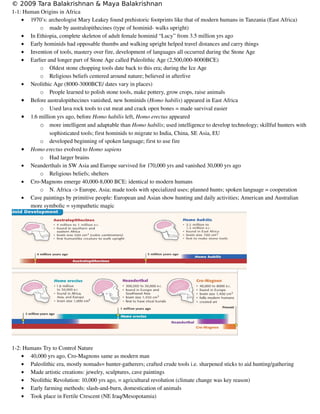
    • Before australopithecines vanished, new hominids (Homo habilis) appeared in East Africa
          o Used lava rock tools to cut meat and crack open bones = made survival easier
    • 1.6 million yrs ago, before Homo habilis left, Homo erectus appeared
          o more intelligent and adaptable than Homo habilis; used intelligence to develop technology; skillful hunters with 
               sophisticated tools; first hominids to migrate to India, China, SE Asia, EU
          o developed beginning of spoken language; first to use fire
    • Homo erectus evolved to Homo sapiens
          o Had larger brains
    • Neanderthals in SW Asia and Europe survived for 170,000 yrs and vanished 30,000 yrs ago
          o Religious beliefs; shelters
    • Cro­Magnons emerge 40,000­8,000 BCE: identical to modern humans
          o N. Africa ­> Europe, Asia; made tools with specialized uses; planned hunts; spoken language = cooperation
    • Cave paintings by primitive people: European and Asian show hunting and daily activities; American and Australian 
       more symbolic = sympathetic magic


1­2: Humans Try to Control Nature
    • 40,000 yrs ago, Cro­Magnons same as modern man
    • Paleolithic era, mostly nomads= hunter­gatherers; crafted crude tools i.e. sharpened sticks to aid hunting/gathering
    • Made artistic creations: jewelry, sculptures, cave paintings
    • Neolithic Revolution: 10,000 yrs ago, = agricultural revolution (climate change was key reason)
    • Early farming methods: slash­and­burn, domestication of animals
    • Took place in Fertile Crescent (NE Iraq/Mesopotamia)
© 2009 Tara Balakrishnan & Maya Balakrishnan
    •   Farming develops independently in Africa, China, Central America…
             o Catal Huyuk and Jarmo important agri. sites for studying Neolithic Age
                     Permanent settlements created, benefits= surplus food, specialized workers
                     Disadvantages= floods/fire/drought/disease destroy village; invasion by neighbors
1­3: Civilization
    • Villages become cities:
             o Economic changes: more cultivation­>elaborate irrigation systems built; food surplus=specialization; wheel and sail 
                 improved trade
             o Social: social classes formed; religion more organized­>worshipped gods with power over nature
    • Civilization characteristics: 1. Advanced cities 2. Specialized workers 3. Complex institutions 4. Record keeping 5. 
        Advanced technology 6. Art and Architecture
Sumer (Ur in bold):
    • Advanced cities: center of trade for larger area; large population
             o Defined social classes: rulers/ priests on top; trade w. bartering
    • Spec. workers: artisans; merchants; scribes; soldiers; teachers; metalworkers; priests; gov. officials; peasants
    • Complex inst.: formal gov. with laws; priests with religious/political power; education system (for scribes)
    • Record keeping: cuneiform tablets with business transactions, hist. events, customs, traditions; calendar
    • Adv. Tech: ox­drawn plows; irrigation systems; pottery eating supplies; bronze weapons; body armor
             o Roads, pottery
    • Art and Architecture: ziggurat(massive pyramid temple), temples, temple gates, storage for grain
2­1: Mesopotamia


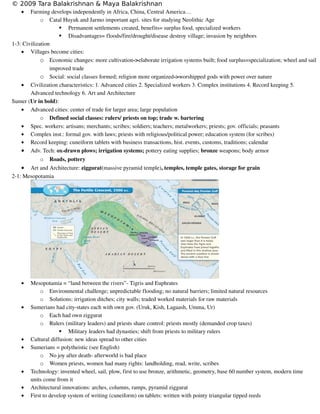
    •   Mesopotamia = “land between the rivers”­ Tigris and Euphrates
            o Environmental challenge; unpredictable flooding; no natural barriers; limited natural resources
            o Solutions: irrigation ditches; city walls; traded worked materials for raw materials
    •   Sumerians had city­states each with own gov. (Uruk, Kish, Lagaash, Umma, Ur)
            o Each had own ziggurat
            o Rulers (military leaders) and priests share control: priests mostly (demanded crop taxes)
                      Military leaders had dynasties; shift from priests to military rulers
    •   Cultural diffusion: new ideas spread to other cities
    •   Sumerians = polytheistic (see English)
            o No joy after death­ afterworld is bad place
            o Women priests, women had many rights: landholding, read, write, scribes
    •   Technology: invented wheel, sail, plow, first to use bronze, arithmetic, geometry, base 60 number system, modern time 
        units come from it
    •   Architectural innovations: arches, columns, ramps, pyramid ziggurat
    •   First to develop system of writing (cuneiform) on tablets: written with pointy triangular tipped reeds
© 2009 Tara Balakrishnan & Maya Balakrishnan
   •    3000­2000 BCE, Sumer city­states constantly at war with each other and could no longer ward of attacks of people of 
        surrounding hills/deserts
    • Sumer never recovered from attacks and succeeding rulers adopted Sumerian culture to their own needs
    • c. 2350 BCE, conqueror Sargon with army from Akkad (city­state N. of Sumer) defeated Sumer
            o Akkadians already had adopted most of Sumerian culture; Sargon’s conquests spread the culture further beyond 
               Tigris­Euphrates Valley
    • By taking control of N. and S. Mesopotamia, Sargon created 1st empire
            o At peak, Akkadian Empire controlled Mediterranean Coast in the west to Iran (today) in the east
            o Lasted only 200 yrs before decline
    • c. 2000 BCE, nomadic warriors (Amorites) invaded Mesopotamia and overwhelmed Sumerians
    • established capital at Babylon along Euphrates River
    • Babylonian Empire reached peak during reign of Hammurabi (1792­1750 BCE)
            o Hammurabi’s Code of laws: first single, uniform code of laws written down in stone all over empire
            o 282 specific laws many related to property issues; protected women and children from unfair treatment
            o diff. punishment for diff. social classes; principle of retaliation (eye for an eye…)
            o gov. responsible for society’s actions
    • 2 centuries after Hammurabi’s reign, Babylonian empire fell to Kassites
2­3: Pyramids on the Nile
    • Egypt united into single kingdom early on
    • Nile flows N.: civilization arose along fertile Nile banks
    • Nile flooded regularly: necessary for life; deserts as natural barriers
    • River travel common­ ended at 1st cataract (rapids)
    •
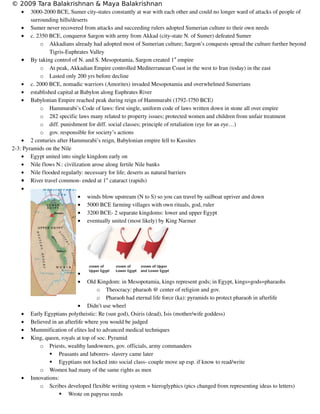
                            • winds blow upstream (N to S) so you can travel by sailboat upriver and down
                            • 5000 BCE farming villages with own rituals, god, ruler
                            • 3200 BCE­ 2 separate kingdoms: lower and upper Egypt
                            • eventually united (most likely) by King Narmer


                           •
                           •     Old Kingdom: in Mesopotamia, kings represent gods; in Egypt, kings=gods=pharaohs
                                     o Theocracy: pharaoh @ center of religion and gov.
                                     o Pharaoh had eternal life force (ka): pyramids to protect pharaoh in afterlife
                            • Didn’t use wheel 
   •   Early Egyptians polytheistic: Re (sun god), Osiris (dead), Isis (mother/wife goddess)
   •   Believed in an afterlife where you would be judged
   •   Mummification of elites led to advanced medical techniques
   •   King, queen, royals at top of soc. Pyramid
           o Priests, wealthy landowners, gov. officials, army commanders
                Peasants and laborers­ slavery came later
                Egyptians not locked into social class­ couple move up esp. if know to read/write
           o Women had many of the same rights as men
   •   Innovations:
           o Scribes developed flexible writing system = hieroglyphics (pics changed from representing ideas to letters)
                    Wrote on papyrus reeds
© 2009 Tara Balakrishnan & Maya Balakrishnan
            o Developed calendar for planting w/ 365 days in a year
            o Arithmetic for taxes
            o Geometry for pyramid building
            o Medicine for healing bones, surgery, check heart rate…
    • Decline of Old Kingdom 
            o Strong pharaohs regained control during Middle Kingdom (2040­1640 BCE)
            o Hyksos from Palestine invaded and ruled Egypt (1630­1523 BCE) 
            o New Kingdom – Egypt rose again
3.1 The Indo­Europeans
    o Group of Nomadic ppl from Steppes dry grass lands
    o Primarily pastoral (herded)
    o Tamed horses and rose light 2 wheeled chariots
    o Lived in tribes that spoke forms of indo­european languages­ 
            o ancestor of many modern languages
    o Nomads migrated in all directions (1700­1200 BCE)
    o By 2000 BCE the Hittites occupied Anatolia (Turkey)
    o High rocky plateau rich in minerals timber agriculture
    o Separate Hittite city states formed empire in 1650
            o Capital Hattusas
    o Adopted Akkadian (to speak w/ foreigners) after conquering Akkadian Babylon
    o Hittites dominated SW Asia­ 450 yrs (occupied Babylon and fought w/ Assyria)
            o Signed treaty w/ Assyrians to help each other
    o Excelled in war technology­ chariots, iron weapons, armor
    o Fell in 1190 BC as part of a great wave of invasions from N. (capital burned)
3­3 Seafaring Traders
    o Minoans: powerful sea traders in the eastern Mediterranean 
    o Exported goods, art and culture (incl. architecture, burial customs, religious rituals): major influence on Greece
    o Minoans seem to be peaceful
    o Named after King Minos who owned a minotaur which he kept in a labyrinth 
    o Women held a higher rank than in most neighboring lands
    o Great Mother Earth Goddess ruler of gods of Crete (Minoan island); many priestesses
    o Sacrificed mostly animals but also a couple humans
    o Mysterious end: giant quakes in 1500’s BCEs­ rebuilt palace twice, then volcano; never quite recovered
Phoenicians
    o After Minoan decline, most powerful traders
    o Never united into country; only city­states(e.x. Sidon and Tyre); cities were great trading centers
    o Remarkable shipbuilders and sea­farers: went around Africa and Asia
    o Produced famous and expensive red­purple dye, papyrus, built colonies along N. African coast and S. Europe coast
    o Greatest Phoenician colony=Carthage in N. Africa
    o Developed phonetic writing system with letters (word alphabet from 1st 2 Phoenician letters)
            o Introduced writing system to trading partners
    o Eastern cities were captured by the Assyrians then Phoenicians came under control of the Babylonians and Persians
3­4 The Origins of Judaism
    o Phoenicians lived in a region later called Palestine along with Philistines 
    o Canaan­ ancient home of the Hebrews (Jews) in this area. Land promised by God to the Hebrew ppl
    o Ancient Palestine’s location = cultural crossroads of ancient world. 
    o God choose Abraham to be father of Jews, he was a shepherd in Ur, Mesopotamia and was ordered by god to move w/ 
        ppl to Canaan in 1800 BCE
    o Descendants of Abe move to Egypt in 1600 BCE b/c of drought and famine. Given places of honor at first in Egyptian 
© 2009 Tara Balakrishnan & Maya Balakrishnan
        kingdom but later forced into slavery. Flee Egypt btw 1300­1200 BCE during the EXODUS remembered each yr. during 
        Passover. 
    o Torah says that Moses (all Jew male babies were supposed to be killed @ this time but his mom hid him and he was 
        adopted by an Egyptian princess) led Hebrews out of slavery
    o Jews traveled across of Sinai Peninsula and Moses went to top of Mt. Sinai to pray. Yahweh (God) spoke to him and 
        gave him the 10 commandments­ they formed a new covenant = god protected Hebrews who protected his 
        commandments. 
    o Hebrews return to Canaan after death of Moses + changed from Nomads to settled ppl. 
            o Loosely organized into 12 self­governing tribes, they would unite in times of emergency and god would send 
                 them a judge (1 was a woman) 
            o Women only raised children
            o 10 commanded resembled Hammurabi’s code but punishments softened by god’s mercy. 
    o Ethical Monotheism: emphasis on right conduct and worship of 1 god. 
    o Hebrews after settlement in Canaan/Palestine expanded north and south. 
    o Tribe of Judah (last tribe left of original 12)­ Hebrews came to be Jews and the religion Judaism 
    o 1000 BCE Hebrews united under Kings (Kingdom of Israel)
            o Saul: chosen for driving out a Philistine invasion, but became greedy/jealous
            o David: son­in­law of Saul, very popular, united tribes, Jerusalem = capital, established dynasty
            o Solomon: son of David, most powerful Hebrew King, built trading empire w/ Hiram­ King of Tyre (Phoenician 
                 city), beautified Jerusalem w/ great temple
                      After death­ revolt in N. part of kingdom 
                      Israel becomes Israel in N. and Judah in S. (sometimes friends sometimes enemies)
                              •  Both began paying tribute to Assyria to ensure peace w/ them 
                              • 725 BCE Assyrians seize Samaria­ capital of Israel, and Israel falls to Assyrians
                              • Assyrians lose power to Neo­Babylonians
                              • Nebuchadnezzar­ gets Syria and Palestine and Israel and seizes Judah (destroys Solomon’s 
                                   temple­ many survivors exiled to Babylon)
                              • Persian King Cyrus conquers Babylon and lets exiles return to Judah/ rebuild temple
4.1 Egyptian and Nubian Empires
    o After prosperity of Middle Kingdom Egypt loses control­ Hyksos take over and Hebrews settle there during this time 
    o Egyptians resent Jews but Hyksos want them
    o 1600 BCE Pharaohs kick out Hyksos and restore power. Hebrews enslaved until Exodus
            o Nubian Kingdom of Kush emerges as a power
    o Pharaohs of New Kingdom 1500­1000 BCE built the biggest/powerfulest/wealthiest empire than before
    o Hatshepsut­ queen Pharaoh encouraged trade rather than war
            o Stepson, Thutmose very warlike: invaded Palestine, Syria, and part of Nubia
    o Egyptians and Hittites fight over Palestine but Pharaoh Ramses II made peace treaty w/ Hittites for 1 century
    o Build many royal tombs temples and palaces in the valley of kings. 
    o Ramses II carved giant statues in red sandstone cliffs. 
    o Decline: attacked by “sea­ppls” tribes of Palestine rebel against Egyptian overlords, Libyan raids in west
            o Egypt never regains previous power­ break apart and fell
            o 950­730 BCE Libyan Pharaohs rule Egypt­ adopted Egyptian culture
    o Kingdom of Kush esp. capital Napata becomes center of cultural spread 
            o w/ Egypt decline Kush regains independence/power and sought to capture Libyan Egypt
    o Kush King Piyanki overthrew Libyan dynasty and united entire Nile Valley. 
    o Then Assyrians conquer Egypt and Kushites retreat south to Meroë which became active in Trade b/c of large amt of 
        natural resources then after 4 centuries begins to decline after Aksum kindom in N. takes over trade. 
4.2 Assyrian Empire
    o 850 BCE Assyria acquires large empire w/ advanced military supplies­ greatest military power in S.W. asia for a time
© 2009 Tara Balakrishnan & Maya Balakrishnan
    o   glorified military everything (strengths, weapons, technology, strategy)
    o   by 650 BCE Assyria defeats Syria, Palestine, and Babylonia (not yet neo), had local governors report to a central 
        authority= model of gov. 
             o governors brought in tribute and taxes
    o King Sennacherib (who burnt Babylon) also established capital at Nineveh along Tigris River. Nineveh had 1 of ancient 
        world’s largest libraries (King Ashurbanipal’s) incl. Epic of Gilgamesh. 
    o After Ashurbanipal’s death Nineveh fell to Medes and Chaldeans and others who burned the city but many tablets 
        survived
    o Assyrians fall
    o Then Chaldeans make Babylon their capital and King Nebuchadnezzar restores city with hanging gardens of Babylon, 7 
        tiered ziggurat, and astronomers, and wall around city.  
3­3 Persian Empire
    • Cyrus, Persian king began to conquer (but showed mercy and honored local customs)
    o grandson Darius brought stability to empire and conquered into Afghanistan and India and to Egypt and Anatolia in the 
        West
    o Darius divided empire into 20 provinces to govern it
              Brilliant administrator but didn’t show same respect for local culture
    o Installed governor called satrap to rule locally and appointed military leaders, tax collectors, and spies to check on stuff
    o Royal Road ran across empire
    o Borrowed coins from the Lydians
    o Conquered by Alexander the Great 
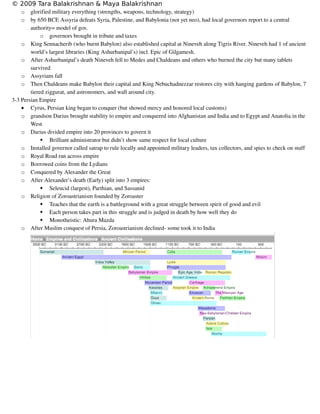
    o After Alexander’s death (Early) split into 3 empires:
              Seleucid (largest), Parthian, and Sassanid
    o Religion of Zoroastrianism founded by Zoroaster
              Teaches that the earth is a battleground with a great struggle between spirit of good and evil
              Each person takes part in this struggle and is judged in death by how well they do
              Monotheistic: Ahura Mazda
    o After Muslim conquest of Persia, Zoroastrianism declined­ some took it to India

Ancient Civilizations

  • 1.
    © 2009 TaraBalakrishnan & Maya Balakrishnan 1­1: Human Origins in Africa • 1970’s: archeologist Mary Leakey found prehistoric footprints like that of modern humans in Tanzania (East Africa) o made by australopithecines (type of hominid­ walks upright) • In Ethiopia, complete skeleton of adult female hominid “Lucy” from 3.5 million yrs ago • Early hominids had opposable thumbs and walking upright helped travel distances and carry things • Invention of tools, mastery over fire, development of languages all occurred during the Stone Age • Earlier and longer part of Stone Age called Paleolithic Age (2,500,000­8000BCE)  o Oldest stone chopping tools date back to this era; during the Ice Age o Religious beliefs centered around nature; believed in afterlive • Neolithic Age (8000­3000BCE/ dates vary in places)  o People learned to polish stone tools, make pottery, grow crops, raise animals • Before australopithecines vanished, new hominids (Homo habilis) appeared in East Africa o Used lava rock tools to cut meat and crack open bones = made survival easier • 1.6 million yrs ago, before Homo habilis left, Homo erectus appeared o more intelligent and adaptable than Homo habilis; used intelligence to develop technology; skillful hunters with  sophisticated tools; first hominids to migrate to India, China, SE Asia, EU o developed beginning of spoken language; first to use fire • Homo erectus evolved to Homo sapiens o Had larger brains • Neanderthals in SW Asia and Europe survived for 170,000 yrs and vanished 30,000 yrs ago o Religious beliefs; shelters • Cro­Magnons emerge 40,000­8,000 BCE: identical to modern humans o N. Africa ­> Europe, Asia; made tools with specialized uses; planned hunts; spoken language = cooperation • Cave paintings by primitive people: European and Asian show hunting and daily activities; American and Australian  more symbolic = sympathetic magic 1­2: Humans Try to Control Nature • 40,000 yrs ago, Cro­Magnons same as modern man • Paleolithic era, mostly nomads= hunter­gatherers; crafted crude tools i.e. sharpened sticks to aid hunting/gathering • Made artistic creations: jewelry, sculptures, cave paintings • Neolithic Revolution: 10,000 yrs ago, = agricultural revolution (climate change was key reason) • Early farming methods: slash­and­burn, domestication of animals • Took place in Fertile Crescent (NE Iraq/Mesopotamia)
  • 2.
    © 2009 TaraBalakrishnan & Maya Balakrishnan • Farming develops independently in Africa, China, Central America… o Catal Huyuk and Jarmo important agri. sites for studying Neolithic Age  Permanent settlements created, benefits= surplus food, specialized workers  Disadvantages= floods/fire/drought/disease destroy village; invasion by neighbors 1­3: Civilization • Villages become cities: o Economic changes: more cultivation­>elaborate irrigation systems built; food surplus=specialization; wheel and sail  improved trade o Social: social classes formed; religion more organized­>worshipped gods with power over nature • Civilization characteristics: 1. Advanced cities 2. Specialized workers 3. Complex institutions 4. Record keeping 5.  Advanced technology 6. Art and Architecture Sumer (Ur in bold): • Advanced cities: center of trade for larger area; large population o Defined social classes: rulers/ priests on top; trade w. bartering • Spec. workers: artisans; merchants; scribes; soldiers; teachers; metalworkers; priests; gov. officials; peasants • Complex inst.: formal gov. with laws; priests with religious/political power; education system (for scribes) • Record keeping: cuneiform tablets with business transactions, hist. events, customs, traditions; calendar • Adv. Tech: ox­drawn plows; irrigation systems; pottery eating supplies; bronze weapons; body armor o Roads, pottery • Art and Architecture: ziggurat(massive pyramid temple), temples, temple gates, storage for grain 2­1: Mesopotamia • Mesopotamia = “land between the rivers”­ Tigris and Euphrates o Environmental challenge; unpredictable flooding; no natural barriers; limited natural resources o Solutions: irrigation ditches; city walls; traded worked materials for raw materials • Sumerians had city­states each with own gov. (Uruk, Kish, Lagaash, Umma, Ur) o Each had own ziggurat o Rulers (military leaders) and priests share control: priests mostly (demanded crop taxes)  Military leaders had dynasties; shift from priests to military rulers • Cultural diffusion: new ideas spread to other cities • Sumerians = polytheistic (see English) o No joy after death­ afterworld is bad place o Women priests, women had many rights: landholding, read, write, scribes • Technology: invented wheel, sail, plow, first to use bronze, arithmetic, geometry, base 60 number system, modern time  units come from it • Architectural innovations: arches, columns, ramps, pyramid ziggurat • First to develop system of writing (cuneiform) on tablets: written with pointy triangular tipped reeds
  • 3.
    © 2009 TaraBalakrishnan & Maya Balakrishnan • 3000­2000 BCE, Sumer city­states constantly at war with each other and could no longer ward of attacks of people of  surrounding hills/deserts • Sumer never recovered from attacks and succeeding rulers adopted Sumerian culture to their own needs • c. 2350 BCE, conqueror Sargon with army from Akkad (city­state N. of Sumer) defeated Sumer o Akkadians already had adopted most of Sumerian culture; Sargon’s conquests spread the culture further beyond  Tigris­Euphrates Valley • By taking control of N. and S. Mesopotamia, Sargon created 1st empire o At peak, Akkadian Empire controlled Mediterranean Coast in the west to Iran (today) in the east o Lasted only 200 yrs before decline • c. 2000 BCE, nomadic warriors (Amorites) invaded Mesopotamia and overwhelmed Sumerians • established capital at Babylon along Euphrates River • Babylonian Empire reached peak during reign of Hammurabi (1792­1750 BCE) o Hammurabi’s Code of laws: first single, uniform code of laws written down in stone all over empire o 282 specific laws many related to property issues; protected women and children from unfair treatment o diff. punishment for diff. social classes; principle of retaliation (eye for an eye…) o gov. responsible for society’s actions • 2 centuries after Hammurabi’s reign, Babylonian empire fell to Kassites 2­3: Pyramids on the Nile • Egypt united into single kingdom early on • Nile flows N.: civilization arose along fertile Nile banks • Nile flooded regularly: necessary for life; deserts as natural barriers • River travel common­ ended at 1st cataract (rapids) • • winds blow upstream (N to S) so you can travel by sailboat upriver and down • 5000 BCE farming villages with own rituals, god, ruler • 3200 BCE­ 2 separate kingdoms: lower and upper Egypt • eventually united (most likely) by King Narmer • • Old Kingdom: in Mesopotamia, kings represent gods; in Egypt, kings=gods=pharaohs o Theocracy: pharaoh @ center of religion and gov. o Pharaoh had eternal life force (ka): pyramids to protect pharaoh in afterlife • Didn’t use wheel  • Early Egyptians polytheistic: Re (sun god), Osiris (dead), Isis (mother/wife goddess) • Believed in an afterlife where you would be judged • Mummification of elites led to advanced medical techniques • King, queen, royals at top of soc. Pyramid o Priests, wealthy landowners, gov. officials, army commanders  Peasants and laborers­ slavery came later  Egyptians not locked into social class­ couple move up esp. if know to read/write o Women had many of the same rights as men • Innovations: o Scribes developed flexible writing system = hieroglyphics (pics changed from representing ideas to letters)  Wrote on papyrus reeds
  • 4.
    © 2009 TaraBalakrishnan & Maya Balakrishnan o Developed calendar for planting w/ 365 days in a year o Arithmetic for taxes o Geometry for pyramid building o Medicine for healing bones, surgery, check heart rate… • Decline of Old Kingdom  o Strong pharaohs regained control during Middle Kingdom (2040­1640 BCE) o Hyksos from Palestine invaded and ruled Egypt (1630­1523 BCE)  o New Kingdom – Egypt rose again 3.1 The Indo­Europeans o Group of Nomadic ppl from Steppes dry grass lands o Primarily pastoral (herded) o Tamed horses and rose light 2 wheeled chariots o Lived in tribes that spoke forms of indo­european languages­  o ancestor of many modern languages o Nomads migrated in all directions (1700­1200 BCE) o By 2000 BCE the Hittites occupied Anatolia (Turkey) o High rocky plateau rich in minerals timber agriculture o Separate Hittite city states formed empire in 1650 o Capital Hattusas o Adopted Akkadian (to speak w/ foreigners) after conquering Akkadian Babylon o Hittites dominated SW Asia­ 450 yrs (occupied Babylon and fought w/ Assyria) o Signed treaty w/ Assyrians to help each other o Excelled in war technology­ chariots, iron weapons, armor o Fell in 1190 BC as part of a great wave of invasions from N. (capital burned) 3­3 Seafaring Traders o Minoans: powerful sea traders in the eastern Mediterranean  o Exported goods, art and culture (incl. architecture, burial customs, religious rituals): major influence on Greece o Minoans seem to be peaceful o Named after King Minos who owned a minotaur which he kept in a labyrinth  o Women held a higher rank than in most neighboring lands o Great Mother Earth Goddess ruler of gods of Crete (Minoan island); many priestesses o Sacrificed mostly animals but also a couple humans o Mysterious end: giant quakes in 1500’s BCEs­ rebuilt palace twice, then volcano; never quite recovered Phoenicians o After Minoan decline, most powerful traders o Never united into country; only city­states(e.x. Sidon and Tyre); cities were great trading centers o Remarkable shipbuilders and sea­farers: went around Africa and Asia o Produced famous and expensive red­purple dye, papyrus, built colonies along N. African coast and S. Europe coast o Greatest Phoenician colony=Carthage in N. Africa o Developed phonetic writing system with letters (word alphabet from 1st 2 Phoenician letters) o Introduced writing system to trading partners o Eastern cities were captured by the Assyrians then Phoenicians came under control of the Babylonians and Persians 3­4 The Origins of Judaism o Phoenicians lived in a region later called Palestine along with Philistines  o Canaan­ ancient home of the Hebrews (Jews) in this area. Land promised by God to the Hebrew ppl o Ancient Palestine’s location = cultural crossroads of ancient world.  o God choose Abraham to be father of Jews, he was a shepherd in Ur, Mesopotamia and was ordered by god to move w/  ppl to Canaan in 1800 BCE o Descendants of Abe move to Egypt in 1600 BCE b/c of drought and famine. Given places of honor at first in Egyptian 
  • 5.
    © 2009 TaraBalakrishnan & Maya Balakrishnan kingdom but later forced into slavery. Flee Egypt btw 1300­1200 BCE during the EXODUS remembered each yr. during  Passover.  o Torah says that Moses (all Jew male babies were supposed to be killed @ this time but his mom hid him and he was  adopted by an Egyptian princess) led Hebrews out of slavery o Jews traveled across of Sinai Peninsula and Moses went to top of Mt. Sinai to pray. Yahweh (God) spoke to him and  gave him the 10 commandments­ they formed a new covenant = god protected Hebrews who protected his  commandments.  o Hebrews return to Canaan after death of Moses + changed from Nomads to settled ppl.  o Loosely organized into 12 self­governing tribes, they would unite in times of emergency and god would send  them a judge (1 was a woman)  o Women only raised children o 10 commanded resembled Hammurabi’s code but punishments softened by god’s mercy.  o Ethical Monotheism: emphasis on right conduct and worship of 1 god.  o Hebrews after settlement in Canaan/Palestine expanded north and south.  o Tribe of Judah (last tribe left of original 12)­ Hebrews came to be Jews and the religion Judaism  o 1000 BCE Hebrews united under Kings (Kingdom of Israel) o Saul: chosen for driving out a Philistine invasion, but became greedy/jealous o David: son­in­law of Saul, very popular, united tribes, Jerusalem = capital, established dynasty o Solomon: son of David, most powerful Hebrew King, built trading empire w/ Hiram­ King of Tyre (Phoenician  city), beautified Jerusalem w/ great temple  After death­ revolt in N. part of kingdom   Israel becomes Israel in N. and Judah in S. (sometimes friends sometimes enemies) •  Both began paying tribute to Assyria to ensure peace w/ them  • 725 BCE Assyrians seize Samaria­ capital of Israel, and Israel falls to Assyrians • Assyrians lose power to Neo­Babylonians • Nebuchadnezzar­ gets Syria and Palestine and Israel and seizes Judah (destroys Solomon’s  temple­ many survivors exiled to Babylon) • Persian King Cyrus conquers Babylon and lets exiles return to Judah/ rebuild temple 4.1 Egyptian and Nubian Empires o After prosperity of Middle Kingdom Egypt loses control­ Hyksos take over and Hebrews settle there during this time  o Egyptians resent Jews but Hyksos want them o 1600 BCE Pharaohs kick out Hyksos and restore power. Hebrews enslaved until Exodus o Nubian Kingdom of Kush emerges as a power o Pharaohs of New Kingdom 1500­1000 BCE built the biggest/powerfulest/wealthiest empire than before o Hatshepsut­ queen Pharaoh encouraged trade rather than war o Stepson, Thutmose very warlike: invaded Palestine, Syria, and part of Nubia o Egyptians and Hittites fight over Palestine but Pharaoh Ramses II made peace treaty w/ Hittites for 1 century o Build many royal tombs temples and palaces in the valley of kings.  o Ramses II carved giant statues in red sandstone cliffs.  o Decline: attacked by “sea­ppls” tribes of Palestine rebel against Egyptian overlords, Libyan raids in west o Egypt never regains previous power­ break apart and fell o 950­730 BCE Libyan Pharaohs rule Egypt­ adopted Egyptian culture o Kingdom of Kush esp. capital Napata becomes center of cultural spread  o w/ Egypt decline Kush regains independence/power and sought to capture Libyan Egypt o Kush King Piyanki overthrew Libyan dynasty and united entire Nile Valley.  o Then Assyrians conquer Egypt and Kushites retreat south to Meroë which became active in Trade b/c of large amt of  natural resources then after 4 centuries begins to decline after Aksum kindom in N. takes over trade.  4.2 Assyrian Empire o 850 BCE Assyria acquires large empire w/ advanced military supplies­ greatest military power in S.W. asia for a time
  • 6.
    © 2009 TaraBalakrishnan & Maya Balakrishnan o glorified military everything (strengths, weapons, technology, strategy) o by 650 BCE Assyria defeats Syria, Palestine, and Babylonia (not yet neo), had local governors report to a central  authority= model of gov.  o governors brought in tribute and taxes o King Sennacherib (who burnt Babylon) also established capital at Nineveh along Tigris River. Nineveh had 1 of ancient  world’s largest libraries (King Ashurbanipal’s) incl. Epic of Gilgamesh.  o After Ashurbanipal’s death Nineveh fell to Medes and Chaldeans and others who burned the city but many tablets  survived o Assyrians fall o Then Chaldeans make Babylon their capital and King Nebuchadnezzar restores city with hanging gardens of Babylon, 7  tiered ziggurat, and astronomers, and wall around city.   3­3 Persian Empire • Cyrus, Persian king began to conquer (but showed mercy and honored local customs) o grandson Darius brought stability to empire and conquered into Afghanistan and India and to Egypt and Anatolia in the  West o Darius divided empire into 20 provinces to govern it  Brilliant administrator but didn’t show same respect for local culture o Installed governor called satrap to rule locally and appointed military leaders, tax collectors, and spies to check on stuff o Royal Road ran across empire o Borrowed coins from the Lydians o Conquered by Alexander the Great  o After Alexander’s death (Early) split into 3 empires:  Seleucid (largest), Parthian, and Sassanid o Religion of Zoroastrianism founded by Zoroaster  Teaches that the earth is a battleground with a great struggle between spirit of good and evil  Each person takes part in this struggle and is judged in death by how well they do  Monotheistic: Ahura Mazda o After Muslim conquest of Persia, Zoroastrianism declined­ some took it to India