Unit 1: Foundations
  Chapter 3: The
Mediterranean and
    Middle East
    2000 – 500 B.C.E.
Unit 1: Foundations
Chapter 3: The Mediterranean and
             Middle East
 •Section 1: Cosmopolitan Middle East
 •Section 2: Aegean World
 •Section 3: The Assyrian Empire
 •Section 4: Israel
 •Section 5: Phoenicia & the Mediterranean
 •Section 6: Failure & Transformation
Unit 1: Foundations
Chapter 3: The Mediterranean and Middle East


     Western Asia
     Egypt: New Kingdom
     Commerce & Communication
Unit 1: Chapter 3: Section 1: Middle East


                            A. Western Asia
    1. Cosmopolitan - culture diffusion across
          Mesopotamia
    2. South - Kassites ruled Babylonia- no empire
    3. North - Assyria (Tigris R. )- tin & silver trade
               Hittites (Anatolia/Turkey)
                        a. Used horse-drawn chariots
                        b. Metallurgy - copper, silver, and iron
                        c. First to use iron tools & weapons
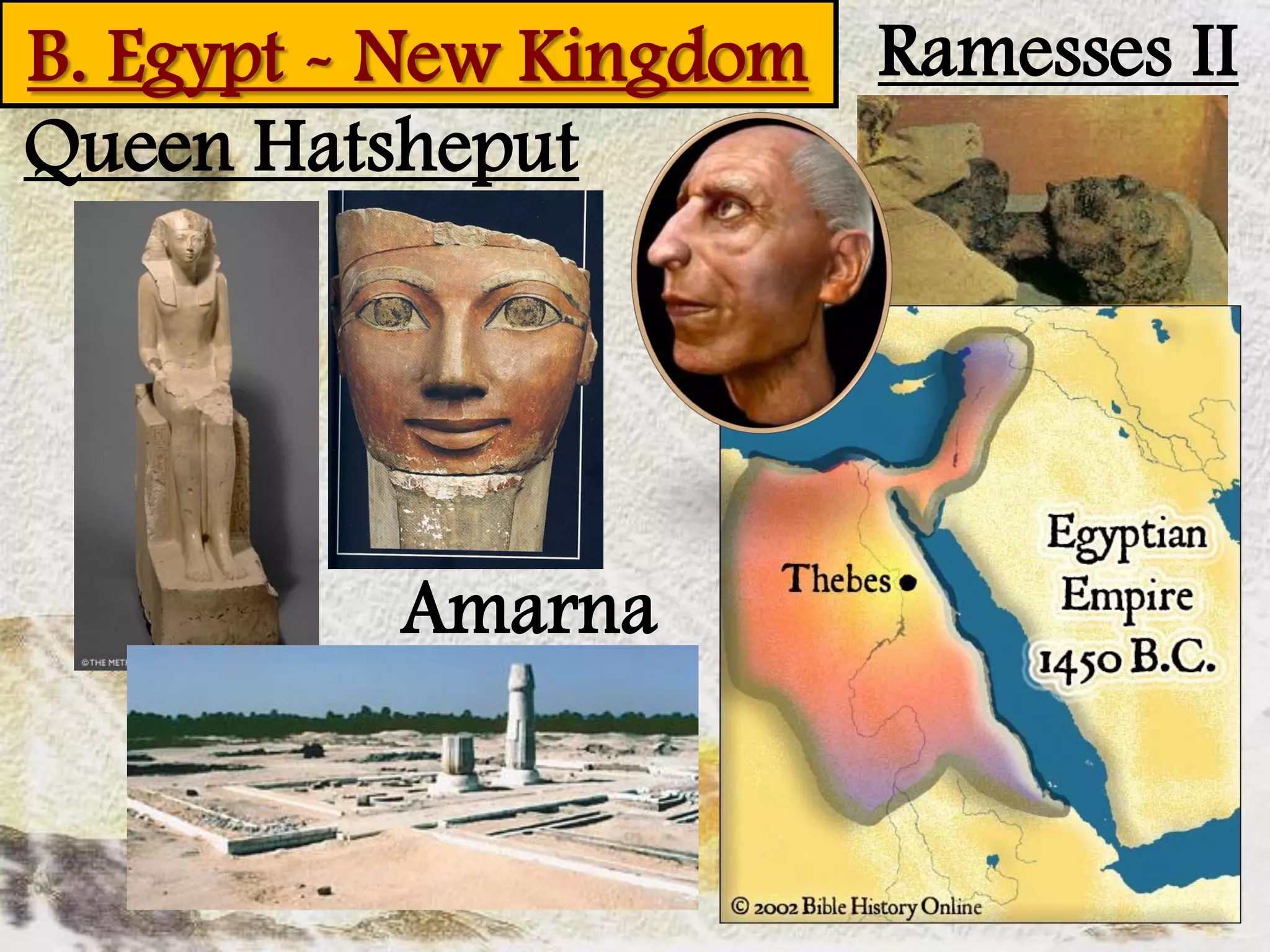
B. Egypt - New Kingdom Ramesses II
Queen Hatsheput


          Amarna
Unit 1: Chapter 3: Section 1: Middle East


                 B. Egypt - New Kingdom
    1. Middle Kingdom - decline & conquered by Hyksos
    2. New Kingdom – empire building!!!
              a. North - Palestine
              b. South - Nubia
    3. Rulers
              a. Hatsheput - trade with Punt
              b. Akenaten - Monotheistic – only god: Aten
                   i.   New capital built at Amarna
              c. Ramessides - new Dynasty – largest ever!
                   i.   Ramesses II – strong ruler of largest empire
                   -
Unit 1: Chapter 3: Section 1: Middle East


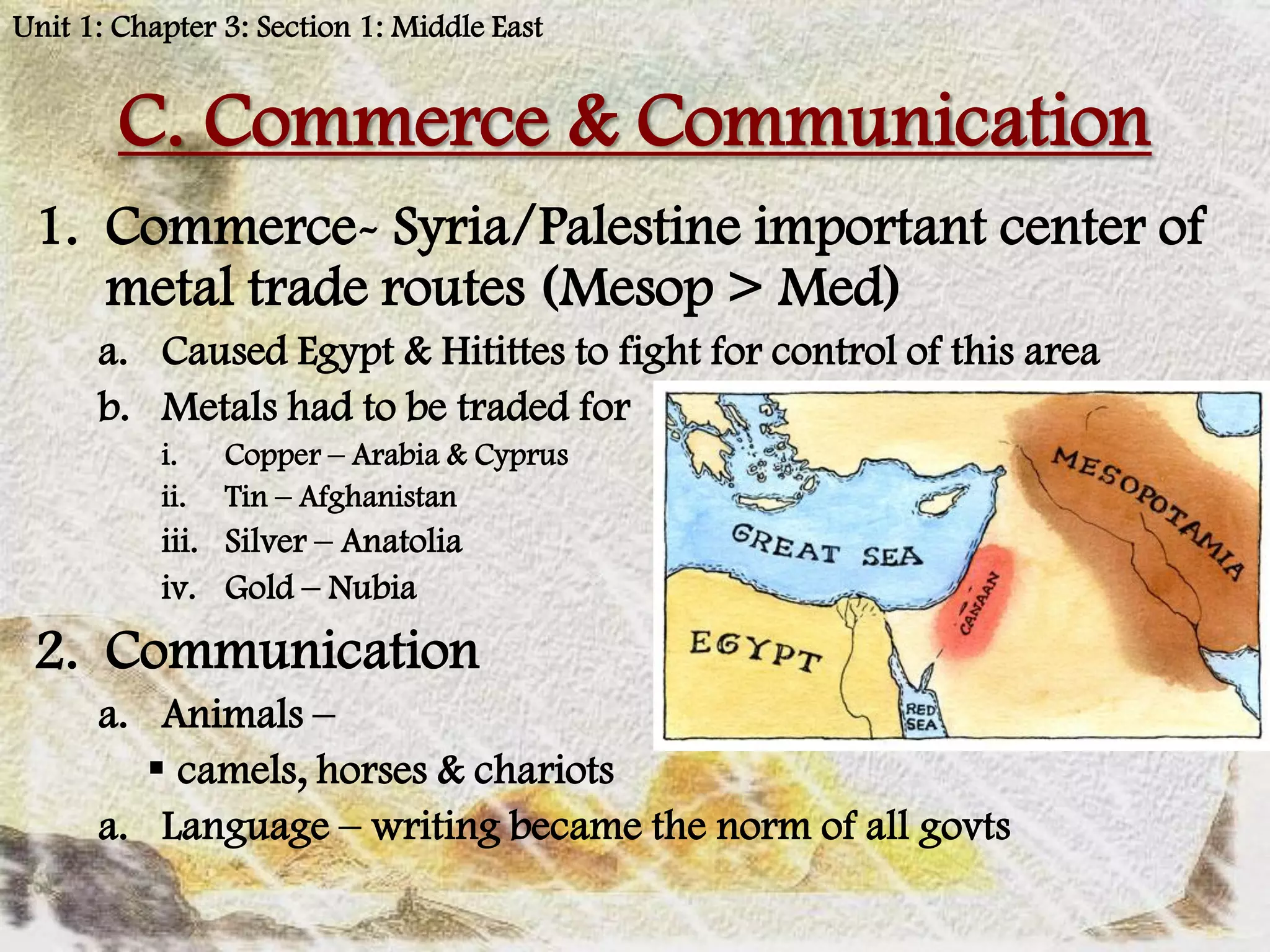
        C. Commerce & Communication
 1. Commerce- Syria/Palestine important center of
    metal trade routes (Mesop > Med)
      a. Caused Egypt & Hitittes to fight for control of this area
      b. Metals had to be traded for
           i.    Copper – Arabia & Cyprus
           ii.   Tin – Afghanistan
           iii. Silver – Anatolia
           iv. Gold – Nubia
 2. Communication
      a. Animals –
          camels, horses & chariots
      a. Language – writing became the norm of all govts
Unit 1: Chapter 3: Section 2: Aegean World


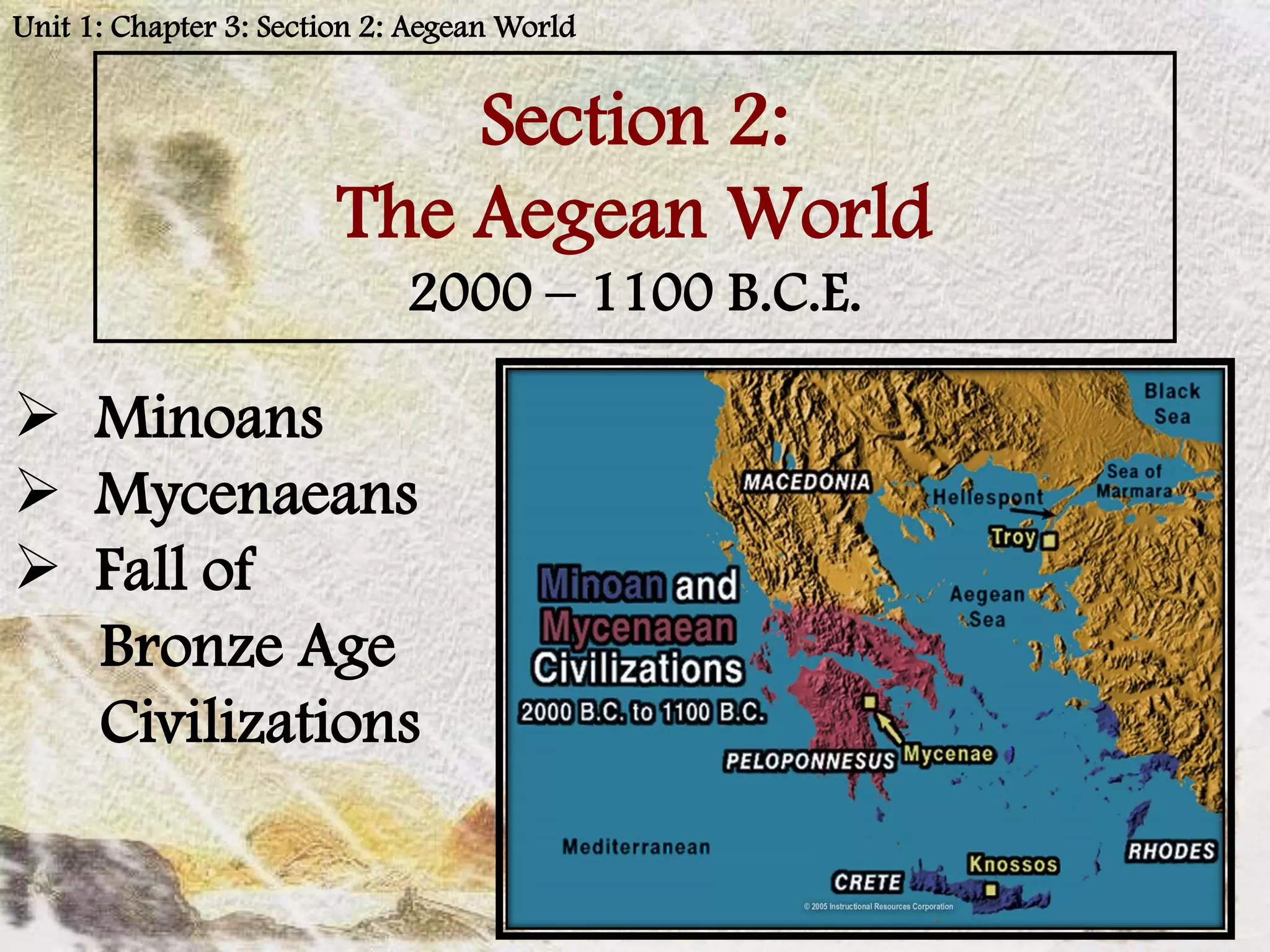
                            Section 2:
                        The Aegean World
                             2000 – 1100 B.C.E.

 Minoans
 Mycenaeans
 Fall of
  Bronze Age
  Civilizations
Unit 1: Chapter 3: Section 2: Aegean World


                 A. Minoans ( - 1450 BCE)
 1. Little is Known
   a. Legends of King Minos, labyrinth beneath his palace
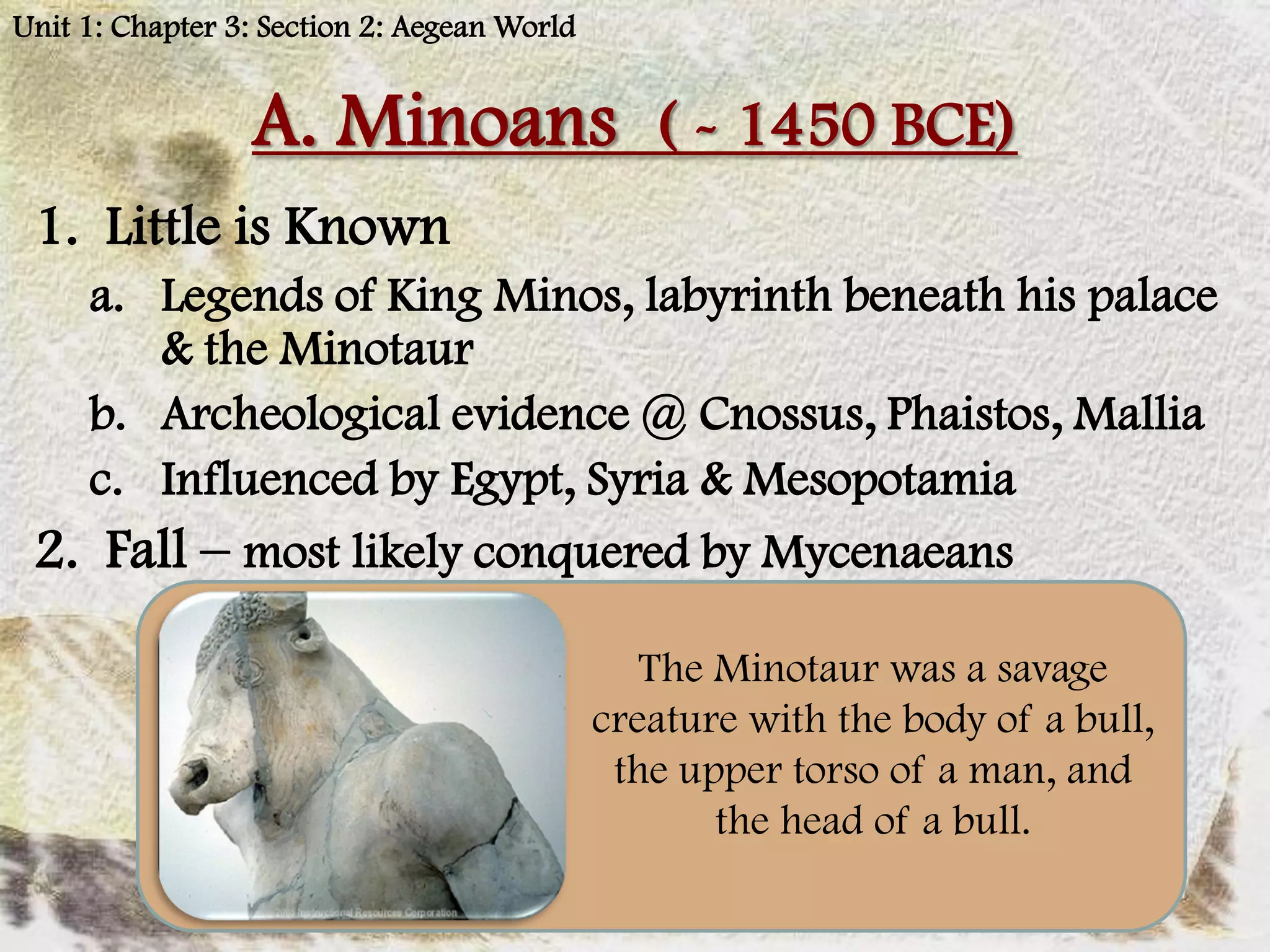
      & the Minotaur
   b. Archeological evidence @ Cnossus, Phaistos, Mallia
   c. Influenced by Egypt, Syria & Mesopotamia
 2. Fall – most likely conquered by Mycenaeans

                                                The Minotaur was a savage
                                             creature with the body of a bull,
                                              the upper torso of a man, and
                                                    the head of a bull.
Unit 1: Chapter 3: Section 2: Aegean World


            B. Mycenae (1600 - 1450 BCE)
 1. Legend of Homer’s: Iliad and Odyssey
 2. Archeological evidence (Schliemann – 1876)
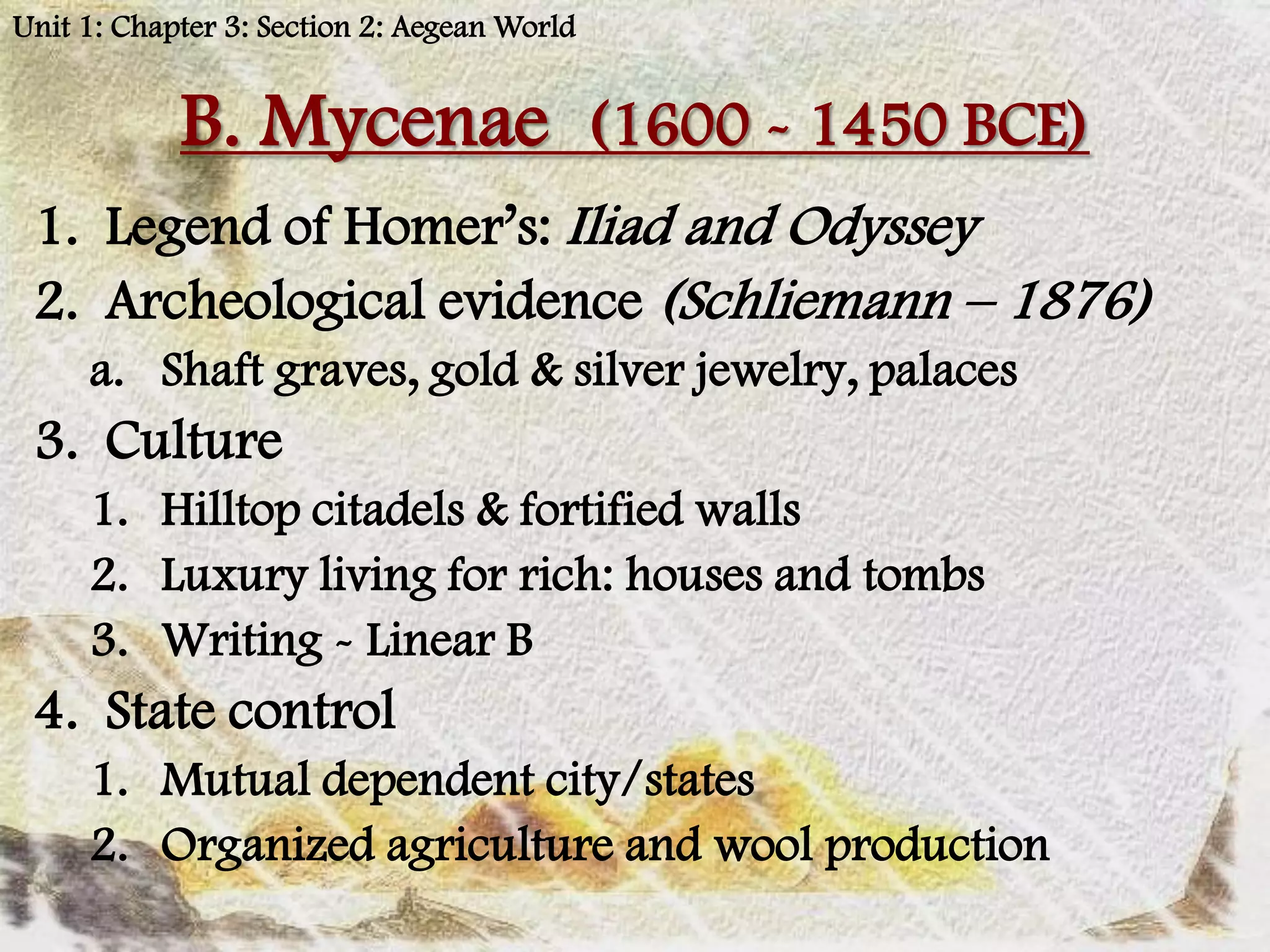
     a. Shaft graves, gold & silver jewelry, palaces
 3. Culture
     1. Hilltop citadels & fortified walls
     2. Luxury living for rich: houses and tombs
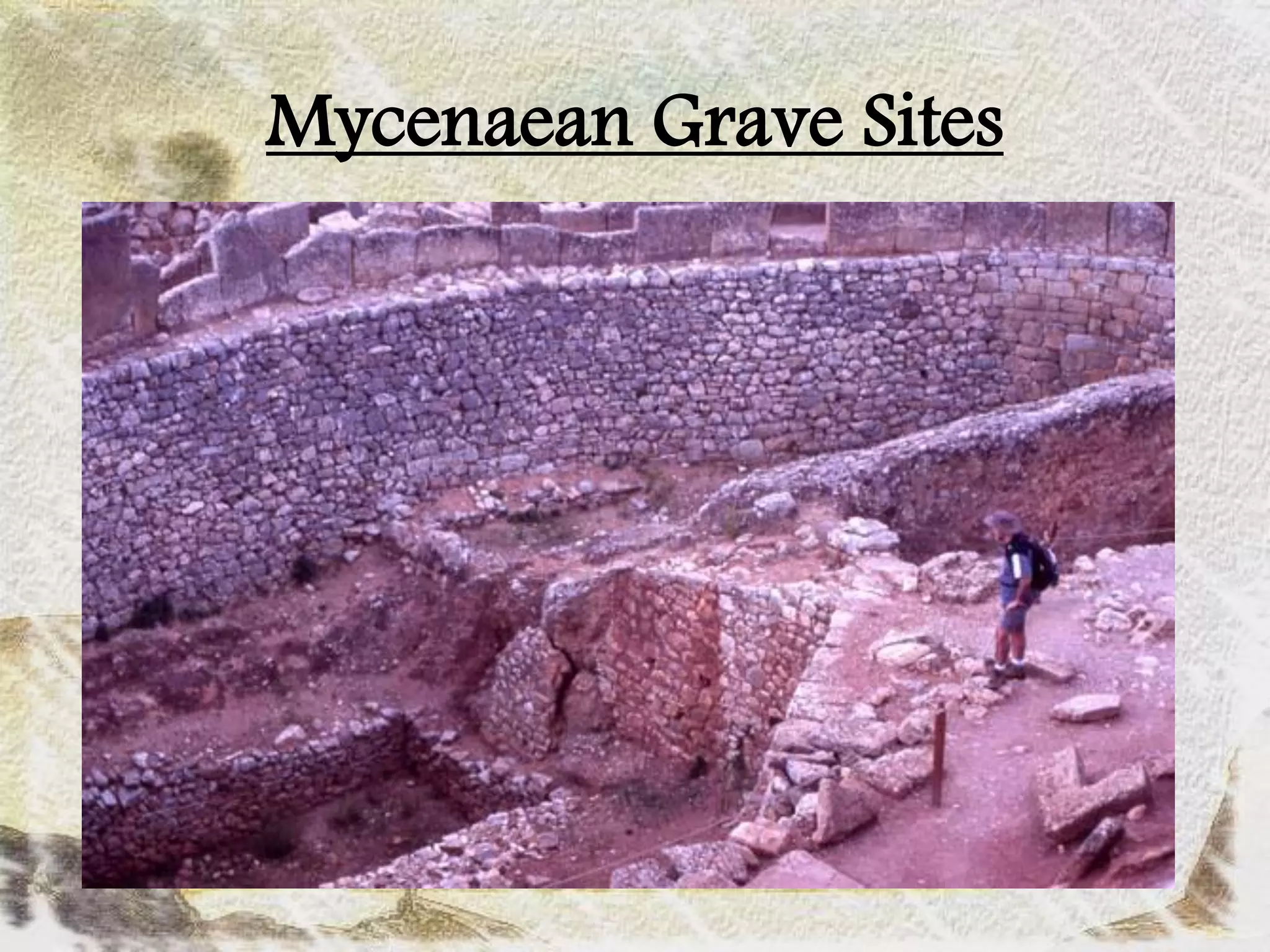
     3. Writing - Linear B
 4. State control
     1. Mutual dependent city/states
     2. Organized agriculture and wool production
Mycenaean Grave Sites
Linear B Writing
Unit 1: Chapter 3: Section 2: Aegean World


            B. Mycenae (1600 - 1100 BCE)
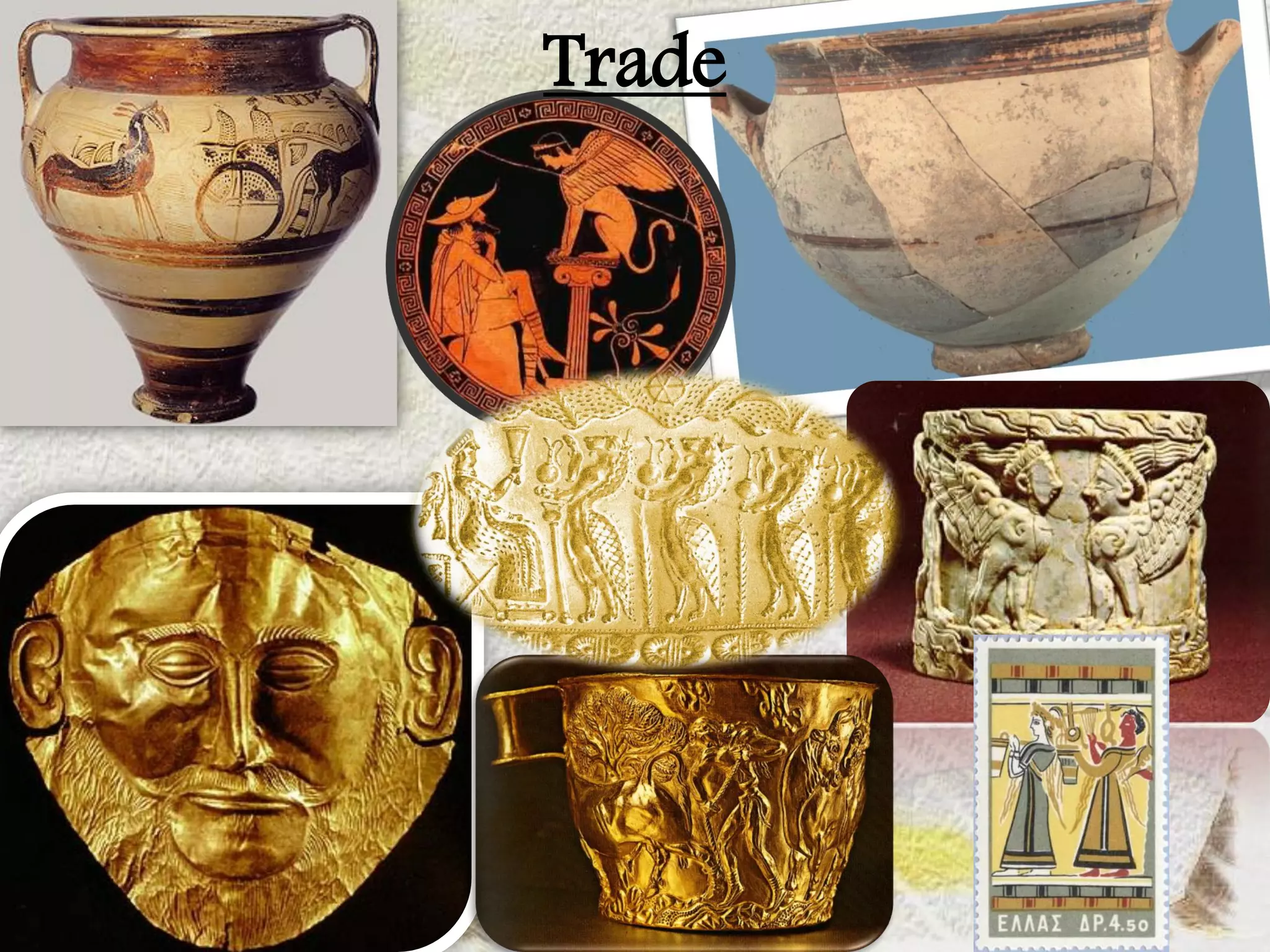
 5. Long Distance Trade
     a. Evidence in Egypt, Aegean and Middle East
     b. Exports: wine, olive oil, weapons, crafts, slaves and
        mercenaries
     c. Imports: ivory, gold, copper, tin
Trade
Unit 1: Chapter 3: Section 2: Aegean World


        C. Fall of Bronze Age (1100 BCE)
 1. Hittites destroyed by unknown invaders
 2. Egypt loses control of Nubia
 3. Mycenae declines: internal and external forces
      Invasion, trade routes seized, economic collapse
 4. “Dark Age”
      Poverty, isolation, decline of knowledge
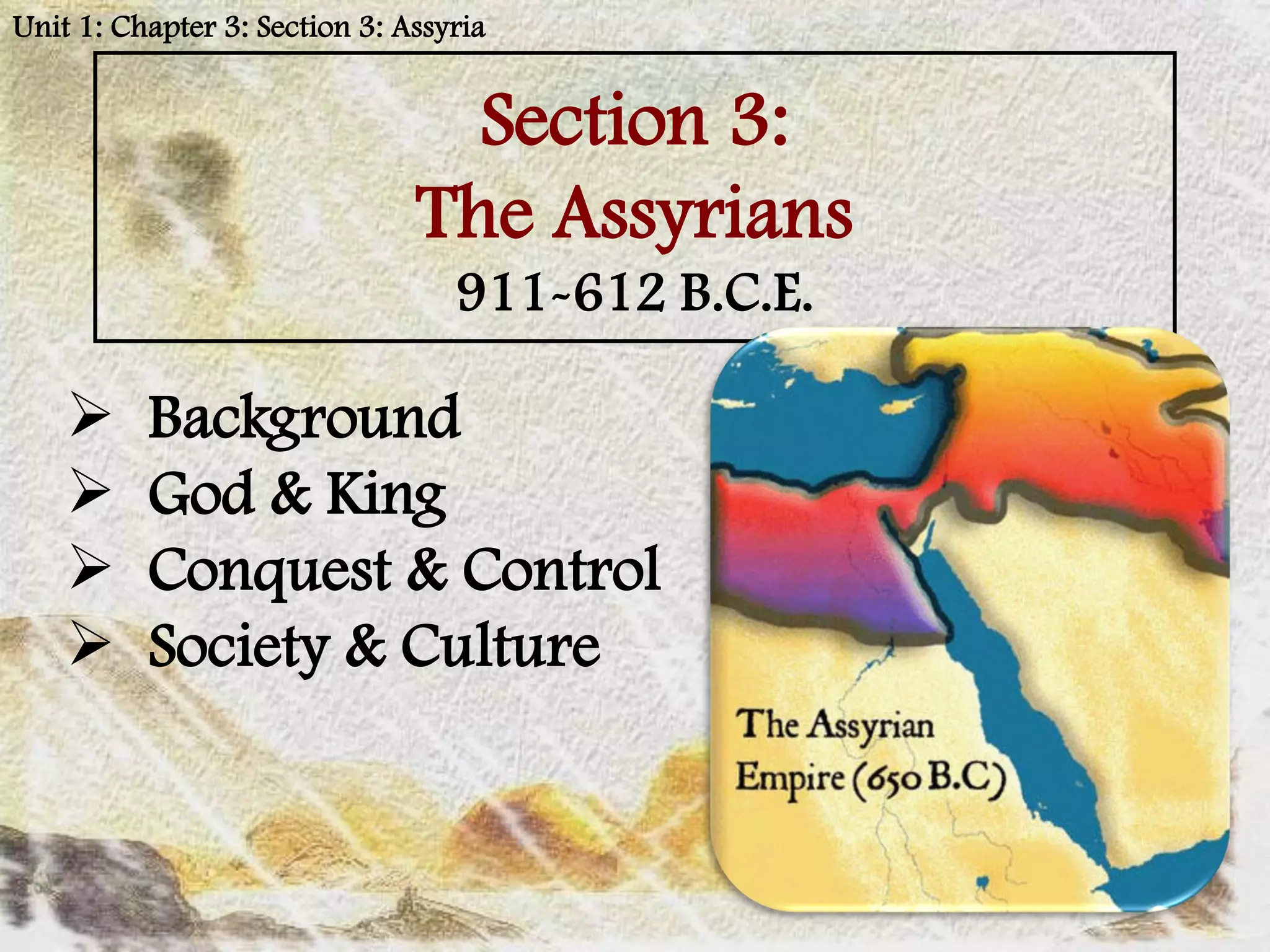
Unit 1: Chapter 3: Section 3: Assyria


                                 Section 3:
                               The Assyrians
                                  911-612 B.C.E.

         Background
         God & King
         Conquest & Control
         Society & Culture
Unit 1: Chapter 3: Section 3: Assyria


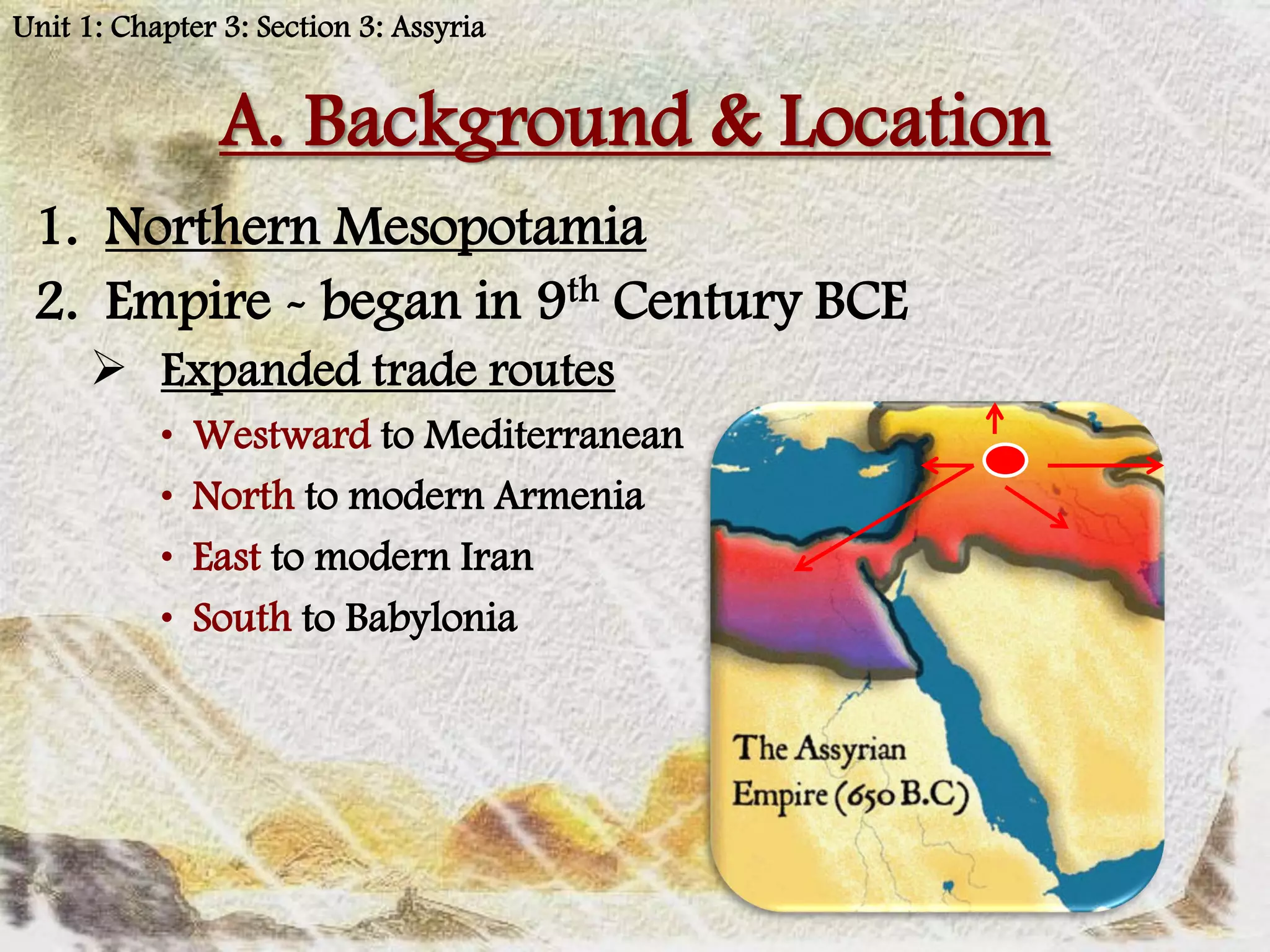
                A. Background & Location
 1. Northern Mesopotamia
 2. Empire - began in 9th Century BCE
       Expanded trade routes
           •   Westward to Mediterranean
           •   North to modern Armenia
           •   East to modern Iran
           •   South to Babylonia
Unit 1: Chapter 3: Section 3: Assyria


                               B. God & King
 1. Kings were chosen by the gods & highly revered
 2. Celebrated as heroes - produce awe & fear
       Secular Duties                   Religious Duties
             Receiving information         Supervision of state
             Hearing and deciding           religion
              complaints                    Public and private rituals
             Diplomacy                     Consulting and getting
             Military leadership            approval of gods

 3. Assyrian Kings: Assur-nasirpal II, Tiglath-pileser III,
       Sargon II, Sennacherib, Esar-haddon
Unit 1: Chapter 3: Section 3: Assyria


                    C. Conquest & Control
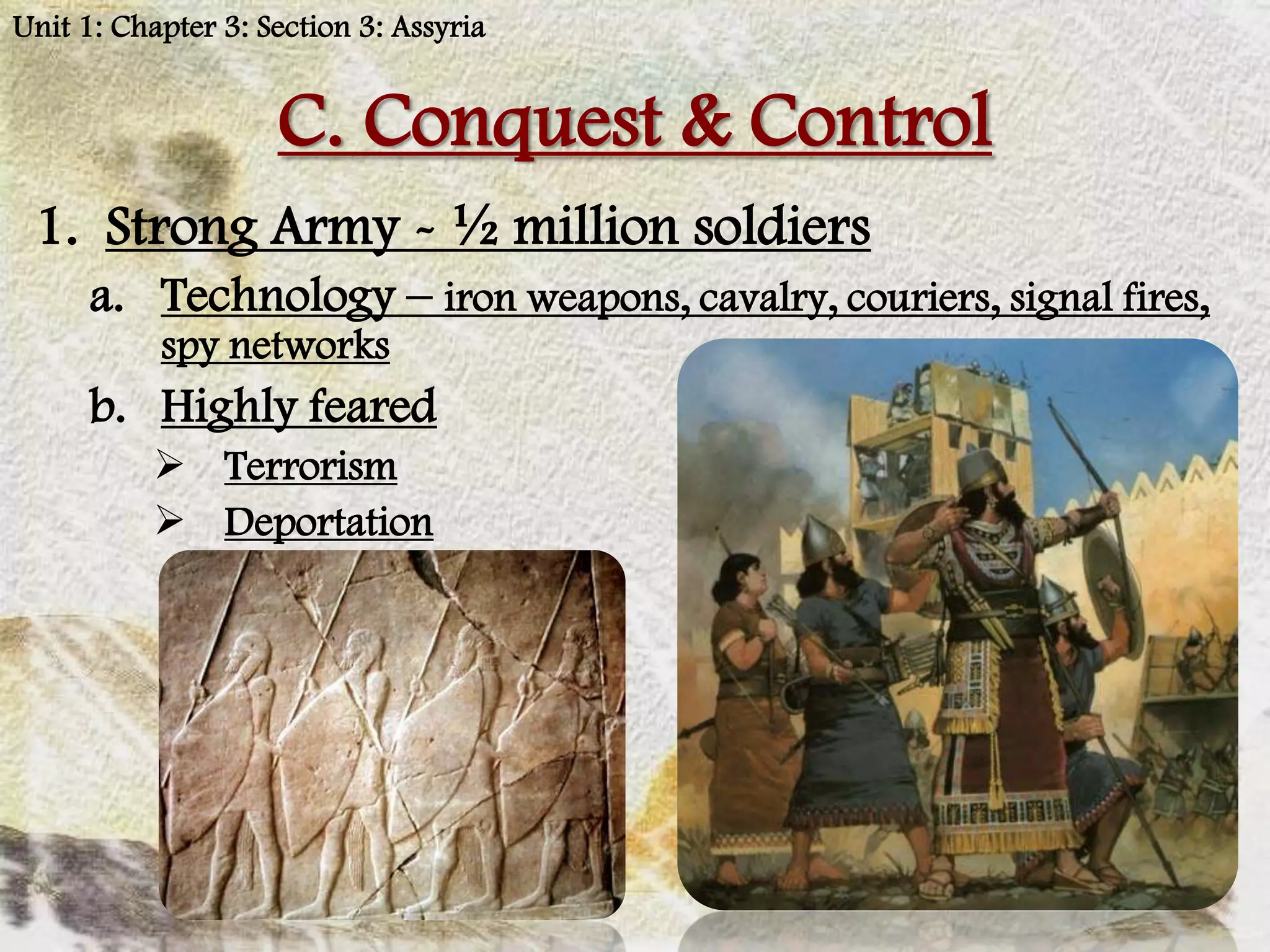
 1. Strong Army - ½ million soldiers
      a. Technology – iron weapons, cavalry, couriers, signal fires,
           spy networks
      b. Highly feared
           Terrorism
           Deportation
Unit 1: Chapter 3: Section 3: Assyria


                    C. Conquest & Control
 2. Officials
      a.   Collected tribute & taxes
      b.   Maintain law & order
      c.   Troops – train & supply
      d.   Construct & maintain public works (roads, bridges)
Unit 1: Chapter 3: Section 3: Assyria


                       D. Society & Culture
 1. 3 Social Classes:
      a. Free Landowning
      b. Farmers & artisans
      c. Slaves
 2.    Economy based on agriculture
 3.    Culture influenced from earlier Mesopotamia
 4.    Knowledgeable in math and astronomy
 5.    Extensive libraries – Epic of Gilgamesh found here
Unit 1: Chapter 3: Section 4: Israel


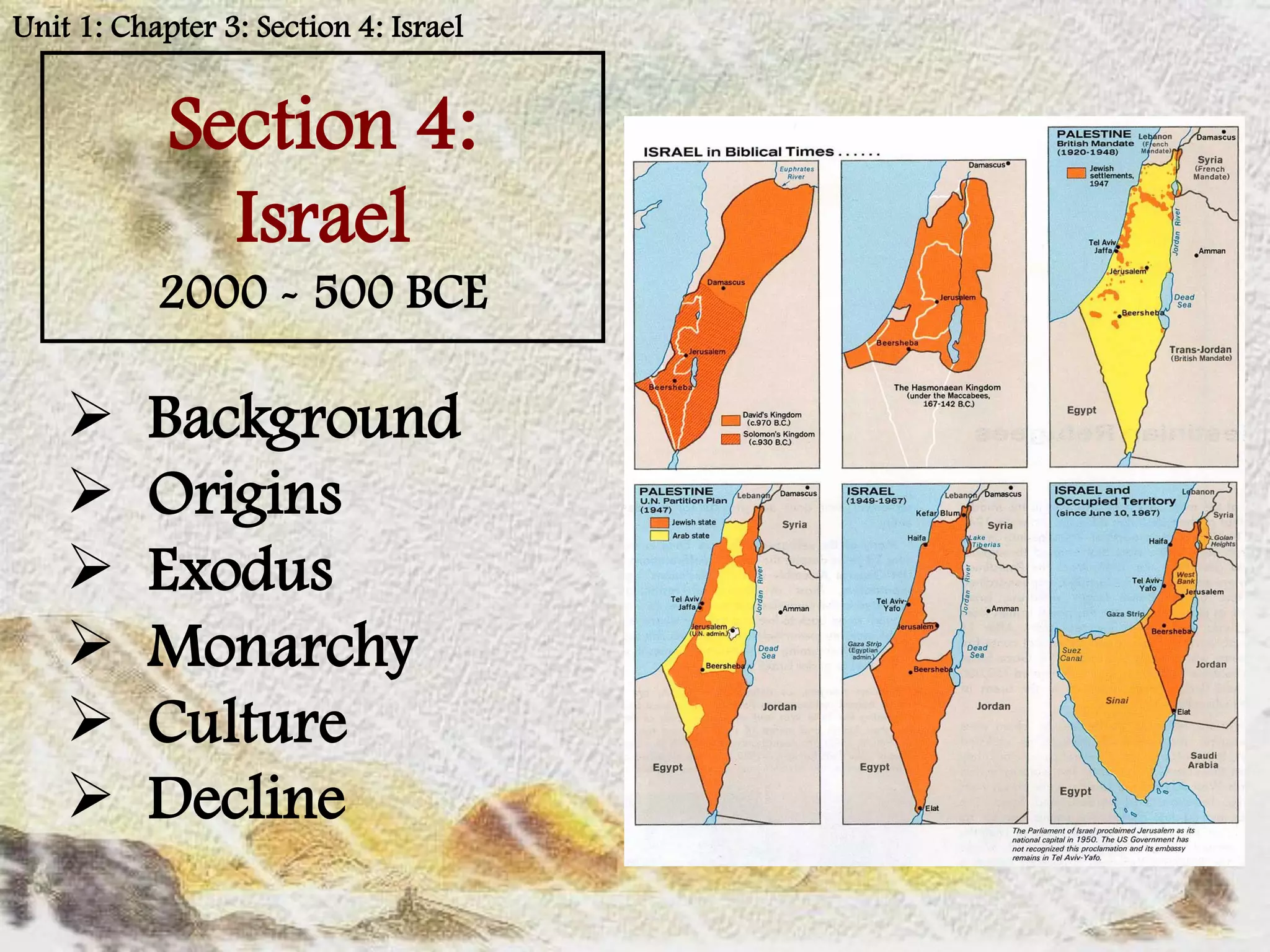
            Section 4:
              Israel
           2000 - 500 BCE

         Background
         Origins
         Exodus
         Monarchy
         Culture
         Decline
Unit 1: Chapter 3: Section 4: Israel


                              A. Background
 1. Nomadic herders
 2. Caravan traders (no resources)
                                       B. Origins
 1. Patriarchs: Abraham, Isaac & Jacob
 2. Tension with neighbors (a lasting theme)
                                       C. Exodus
 1. Egyptian slavery is disputed – maybe Hyksos
 2. Settled into Canaanite territory (battles)
Unit 1: Chapter 3: Section 4: Israel


                                D. Monarchy
 1. Need for strong central govt.
 2. Saul, David, Solomon – then divided in two
       Solomon: Strongest, wealthiest of all Israelite kings
               Alliances, built Jerusalem Temple
               300 wives, 600 concubines
 3. Temples: sacrifices: ag & animal
       Priests became rich off of “taxes” – led to corruption
Unit 1: Chapter 3: Section 4: Israel


                                       E. Culture
 1. Families:
      a. Patriarchal
      b. Arranged monogamous marriages
               Men could have affairs & rich could have multiple wives
      c. Lived with extended families
 2. Women
      a. Could not own property or initiate divorce
      b. Domestic: raising children, maintain house, ag/herd
      c. Urban areas: women worked outside of the home
 3. Temples: sacrifices: ag & animal
       Priests became rich off of “taxes” – led to corruption
Unit 1: Chapter 3: Section 4: Israel


                                       F. Decline
 1. Solomon’s sons divided the kingdom in two
      a. North: Israel - Capital: Samaria
      b. South: Judah - Capital: Jerusalem
 2. Foreign Invasion
       Assyrian invasion of Israel (north) 721 BCE
       Babylonian invasion of Judah
           Large portion of population deported back to Babylon
 3. Diaspora
       Scattering of Jewish population
       Unity: Religious rituals, dietary restrictions, Sabbath
Unit 1: Chapter 3: Section 5: Phoenicia

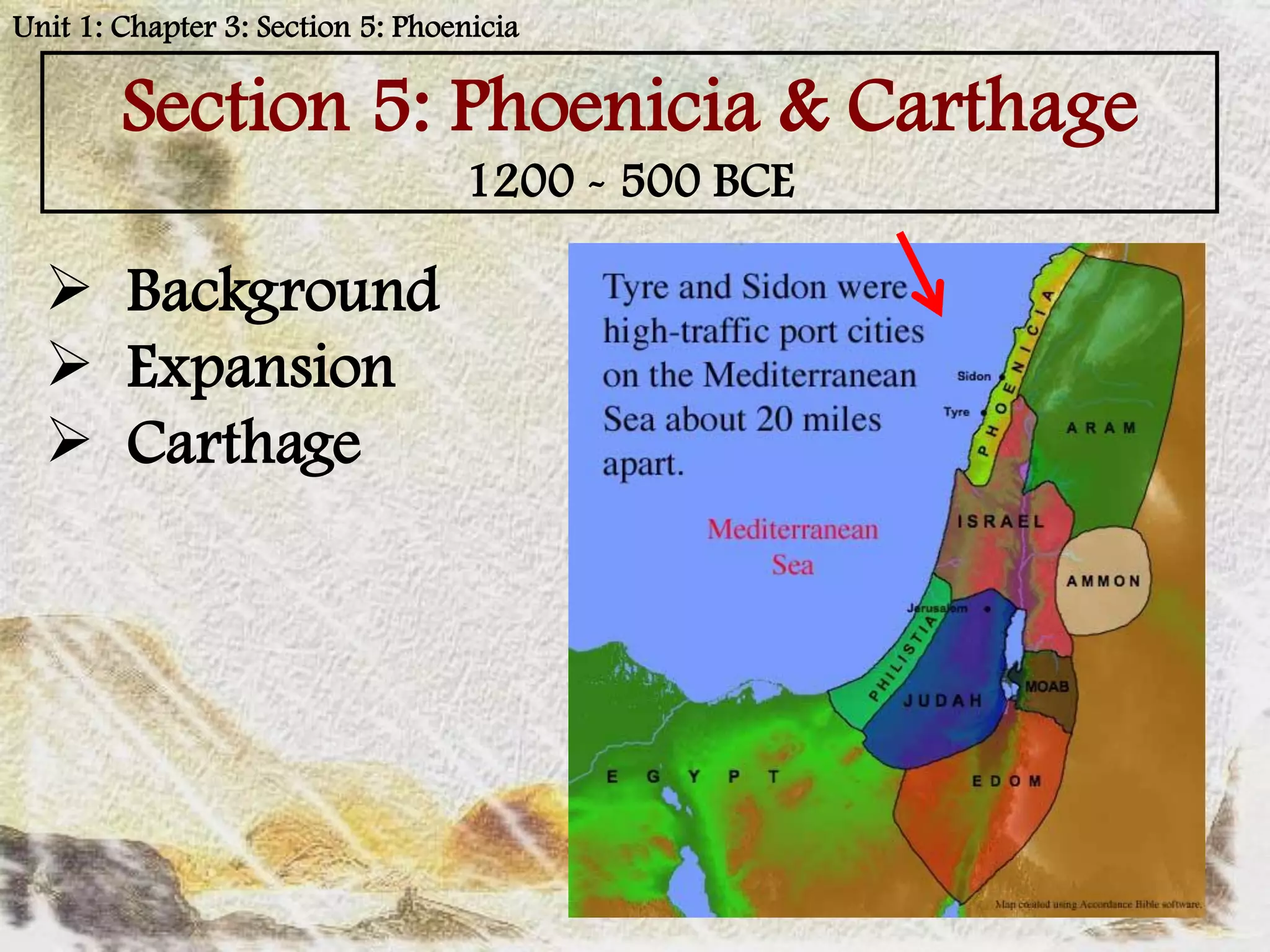
        Section 5: Phoenicia & Carthage
                                  1200 - 500 BCE

   Background
   Expansion
   Carthage
Unit 1: Chapter 3: Section 5: Phoenicia


                             A. Background
1.   Modern day Lebanon
2.   Descendents of Syria, Lebanon & Israel:
3.   Major cities: Byblos, Berytus, Sidon & Tyre
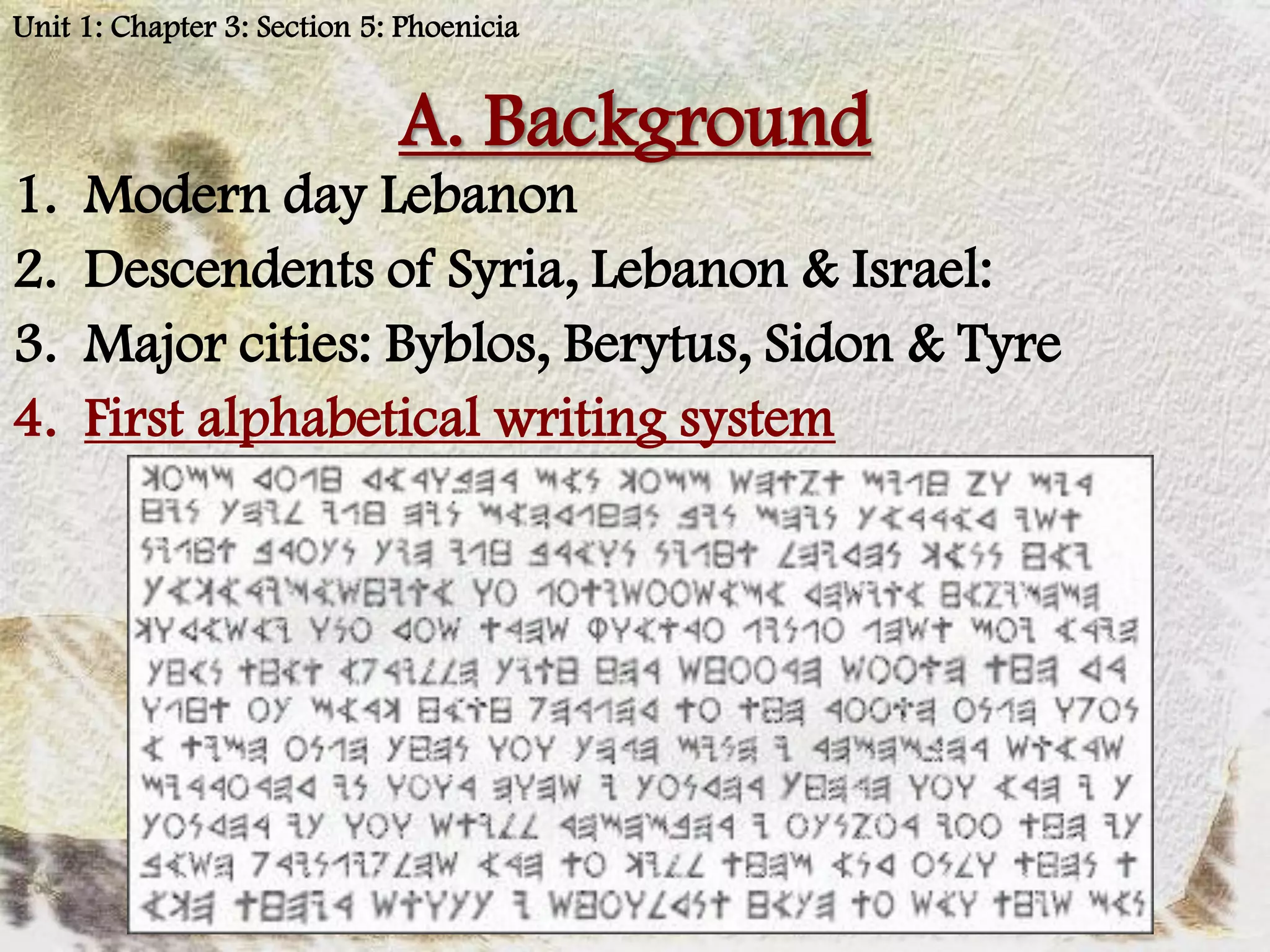
4.   First alphabetical writing system
Unit 1: Chapter 3: Section 5: Phoenicia

                                B. Expansion
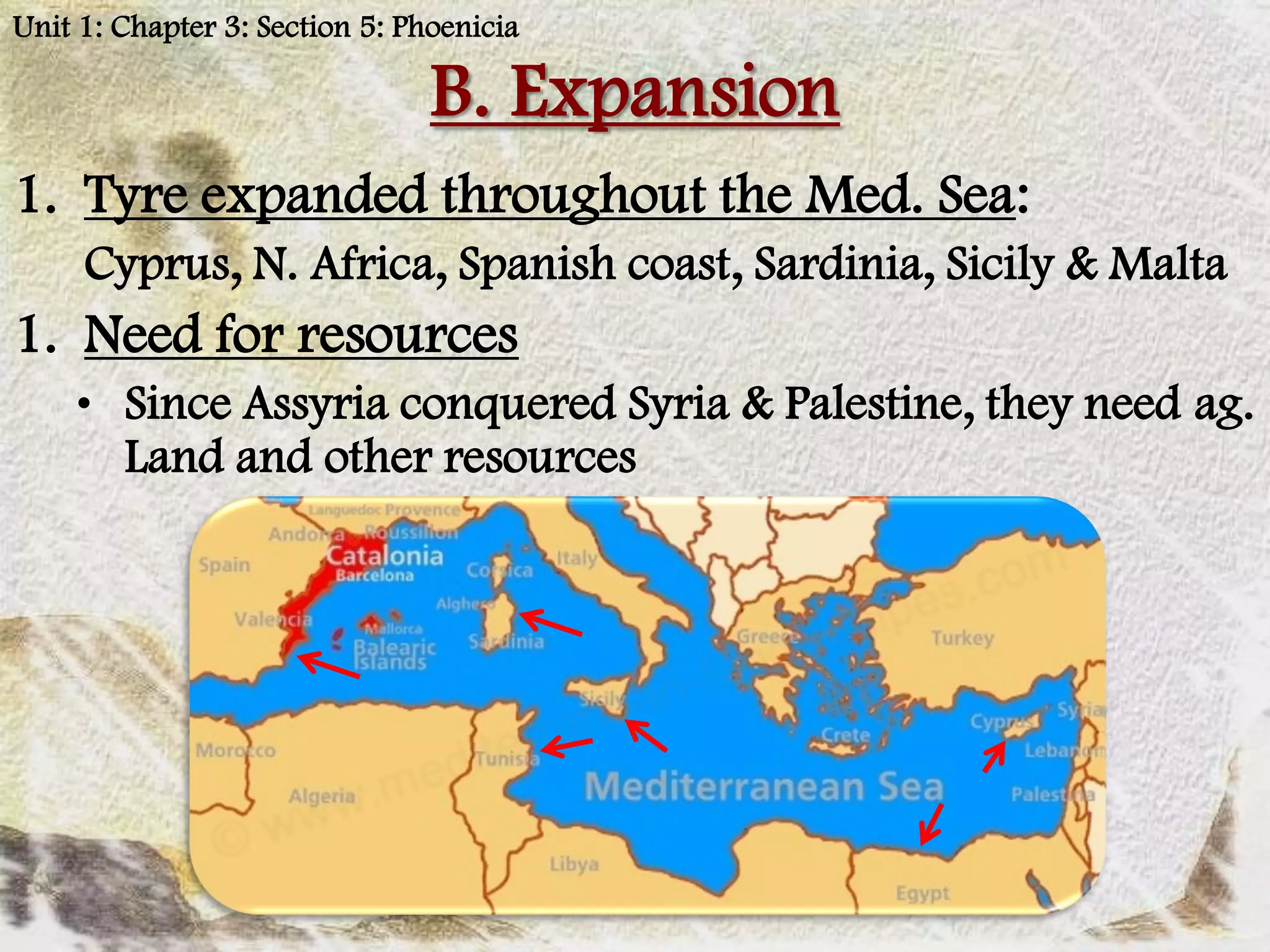
1. Tyre expanded throughout the Med. Sea:
     Cyprus, N. Africa, Spanish coast, Sardinia, Sicily & Malta
1. Need for resources
    • Since Assyria conquered Syria & Palestine, they need ag.
      Land and other resources
Unit 1: Chapter 3: Section 5: Phoenicia

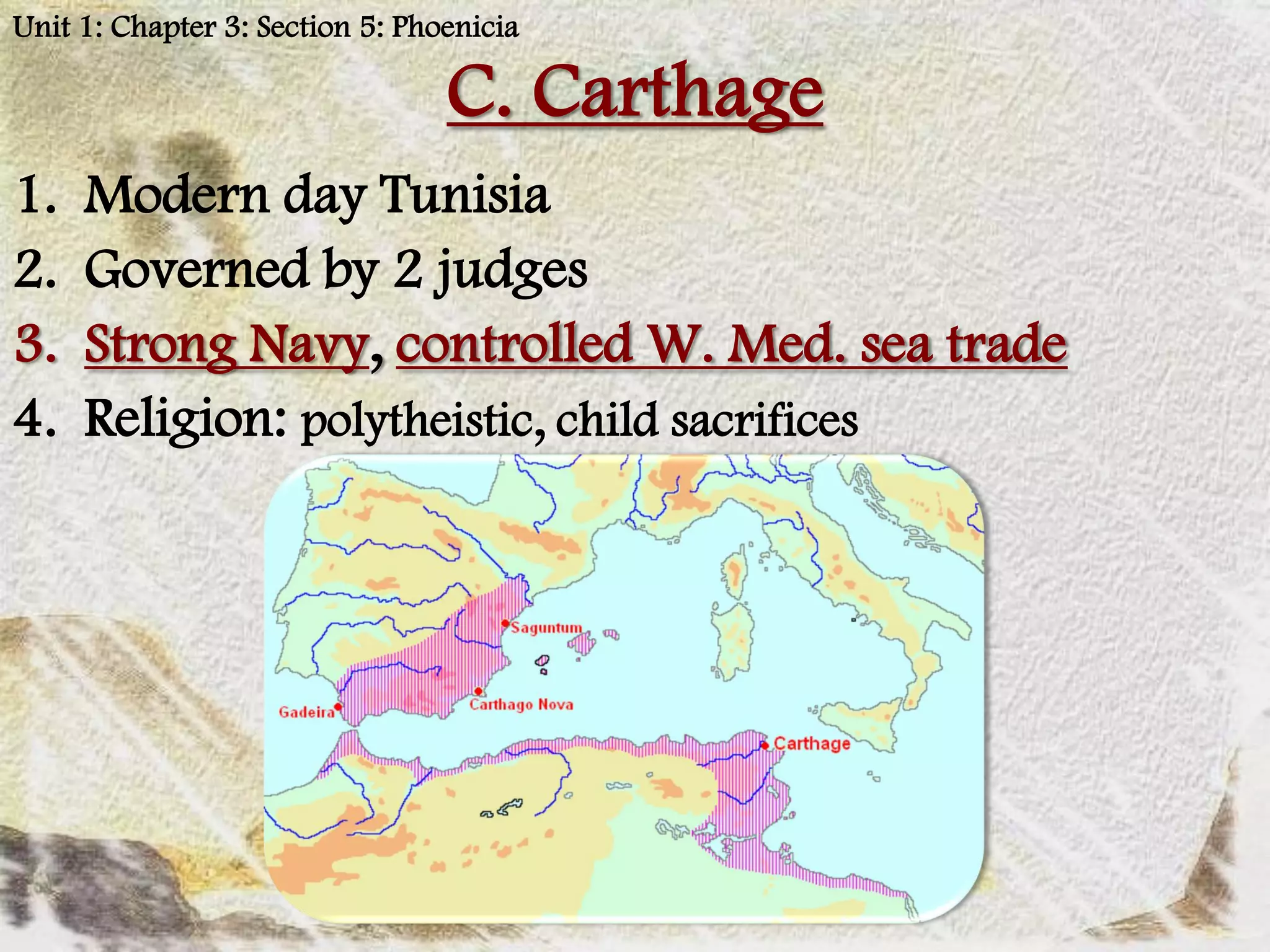
                                 C. Carthage
1.   Modern day Tunisia
2.   Governed by 2 judges
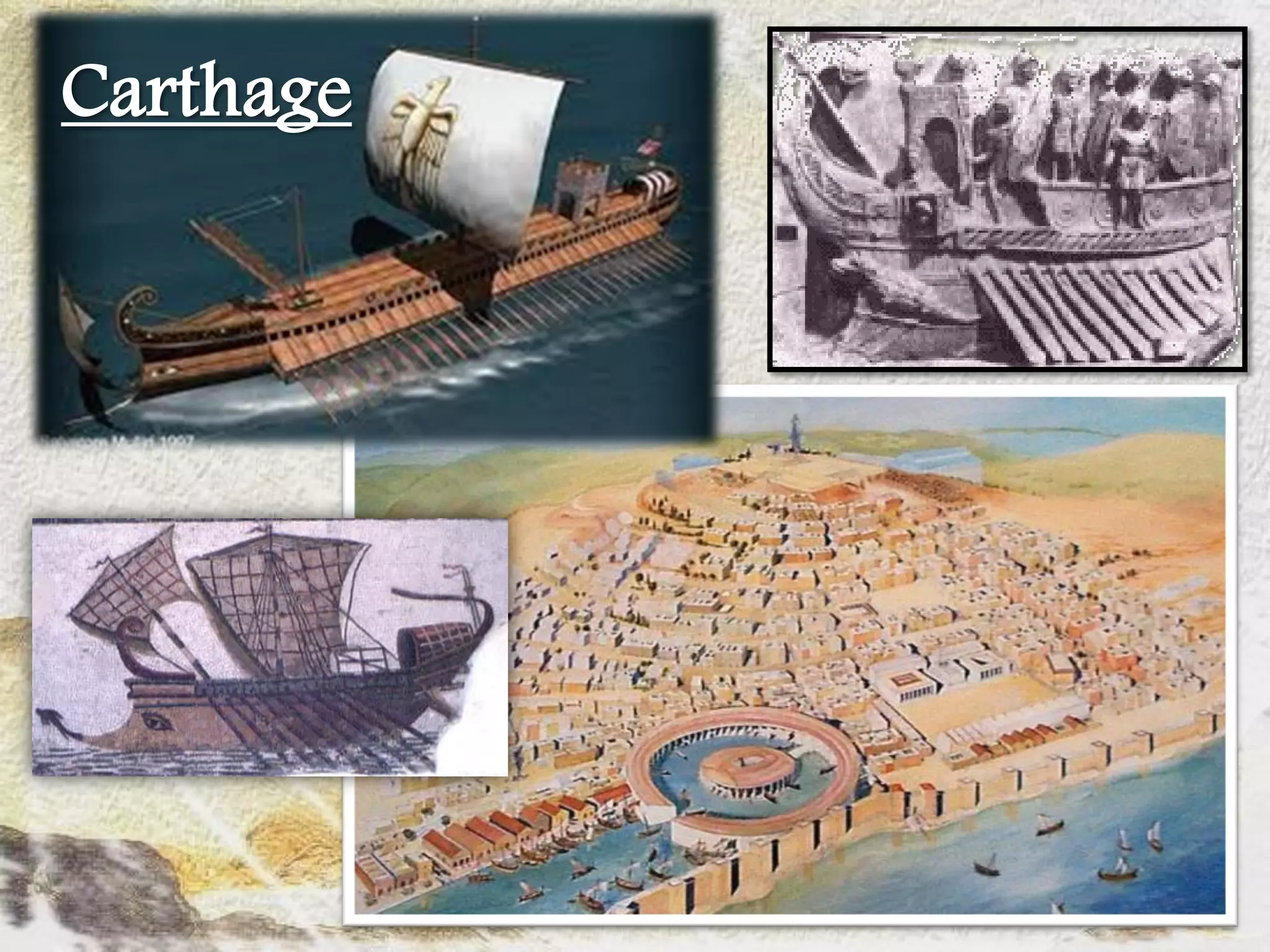
3.   Strong Navy, controlled W. Med. sea trade
4.   Religion: polytheistic, child sacrifices
Carthage
Unit 1: Chapter 3: Section 6: Transformation


       Section 6: Assyrian Consequences
                                    750 – 550 BCE

  1.   Destruction of Israel: deportation of Jews
  2.   Phoenicians expanded into the Med Sea
  3.   Invasion of Egypt
  4.   Control of Babylon & W. Iran
  5.   Empire too large, army overextended, resources
       drained, revolts and rebellions
        Neo-Babylonians rise up & defeat the Assyrians

AP World History Chapter 03

  • 1.
    Unit 1: Foundations Chapter 3: The Mediterranean and Middle East 2000 – 500 B.C.E.
  • 2.
    Unit 1: Foundations Chapter3: The Mediterranean and Middle East •Section 1: Cosmopolitan Middle East •Section 2: Aegean World •Section 3: The Assyrian Empire •Section 4: Israel •Section 5: Phoenicia & the Mediterranean •Section 6: Failure & Transformation
  • 3.
    Unit 1: Foundations Chapter3: The Mediterranean and Middle East  Western Asia  Egypt: New Kingdom  Commerce & Communication
  • 4.
    Unit 1: Chapter3: Section 1: Middle East A. Western Asia 1. Cosmopolitan - culture diffusion across Mesopotamia 2. South - Kassites ruled Babylonia- no empire 3. North - Assyria (Tigris R. )- tin & silver trade Hittites (Anatolia/Turkey) a. Used horse-drawn chariots b. Metallurgy - copper, silver, and iron c. First to use iron tools & weapons
  • 5.
    B. Egypt -New Kingdom Ramesses II Queen Hatsheput Amarna
  • 6.
    Unit 1: Chapter3: Section 1: Middle East B. Egypt - New Kingdom 1. Middle Kingdom - decline & conquered by Hyksos 2. New Kingdom – empire building!!! a. North - Palestine b. South - Nubia 3. Rulers a. Hatsheput - trade with Punt b. Akenaten - Monotheistic – only god: Aten i. New capital built at Amarna c. Ramessides - new Dynasty – largest ever! i. Ramesses II – strong ruler of largest empire -
  • 7.
    Unit 1: Chapter3: Section 1: Middle East C. Commerce & Communication 1. Commerce- Syria/Palestine important center of metal trade routes (Mesop > Med) a. Caused Egypt & Hitittes to fight for control of this area b. Metals had to be traded for i. Copper – Arabia & Cyprus ii. Tin – Afghanistan iii. Silver – Anatolia iv. Gold – Nubia 2. Communication a. Animals –  camels, horses & chariots a. Language – writing became the norm of all govts
  • 8.
    Unit 1: Chapter3: Section 2: Aegean World Section 2: The Aegean World 2000 – 1100 B.C.E.  Minoans  Mycenaeans  Fall of Bronze Age Civilizations
  • 9.
    Unit 1: Chapter3: Section 2: Aegean World A. Minoans ( - 1450 BCE) 1. Little is Known a. Legends of King Minos, labyrinth beneath his palace & the Minotaur b. Archeological evidence @ Cnossus, Phaistos, Mallia c. Influenced by Egypt, Syria & Mesopotamia 2. Fall – most likely conquered by Mycenaeans The Minotaur was a savage creature with the body of a bull, the upper torso of a man, and the head of a bull.
  • 10.
    Unit 1: Chapter3: Section 2: Aegean World B. Mycenae (1600 - 1450 BCE) 1. Legend of Homer’s: Iliad and Odyssey 2. Archeological evidence (Schliemann – 1876) a. Shaft graves, gold & silver jewelry, palaces 3. Culture 1. Hilltop citadels & fortified walls 2. Luxury living for rich: houses and tombs 3. Writing - Linear B 4. State control 1. Mutual dependent city/states 2. Organized agriculture and wool production
  • 11.
  • 12.
  • 13.
    Unit 1: Chapter3: Section 2: Aegean World B. Mycenae (1600 - 1100 BCE) 5. Long Distance Trade a. Evidence in Egypt, Aegean and Middle East b. Exports: wine, olive oil, weapons, crafts, slaves and mercenaries c. Imports: ivory, gold, copper, tin
  • 14.
  • 15.
    Unit 1: Chapter3: Section 2: Aegean World C. Fall of Bronze Age (1100 BCE) 1. Hittites destroyed by unknown invaders 2. Egypt loses control of Nubia 3. Mycenae declines: internal and external forces  Invasion, trade routes seized, economic collapse 4. “Dark Age”  Poverty, isolation, decline of knowledge
  • 16.
    Unit 1: Chapter3: Section 3: Assyria Section 3: The Assyrians 911-612 B.C.E.  Background  God & King  Conquest & Control  Society & Culture
  • 17.
    Unit 1: Chapter3: Section 3: Assyria A. Background & Location 1. Northern Mesopotamia 2. Empire - began in 9th Century BCE  Expanded trade routes • Westward to Mediterranean • North to modern Armenia • East to modern Iran • South to Babylonia
  • 18.
    Unit 1: Chapter3: Section 3: Assyria B. God & King 1. Kings were chosen by the gods & highly revered 2. Celebrated as heroes - produce awe & fear Secular Duties Religious Duties  Receiving information  Supervision of state  Hearing and deciding religion complaints  Public and private rituals  Diplomacy  Consulting and getting  Military leadership approval of gods 3. Assyrian Kings: Assur-nasirpal II, Tiglath-pileser III, Sargon II, Sennacherib, Esar-haddon
  • 19.
    Unit 1: Chapter3: Section 3: Assyria C. Conquest & Control 1. Strong Army - ½ million soldiers a. Technology – iron weapons, cavalry, couriers, signal fires, spy networks b. Highly feared  Terrorism  Deportation
  • 20.
    Unit 1: Chapter3: Section 3: Assyria C. Conquest & Control 2. Officials a. Collected tribute & taxes b. Maintain law & order c. Troops – train & supply d. Construct & maintain public works (roads, bridges)
  • 21.
    Unit 1: Chapter3: Section 3: Assyria D. Society & Culture 1. 3 Social Classes: a. Free Landowning b. Farmers & artisans c. Slaves 2. Economy based on agriculture 3. Culture influenced from earlier Mesopotamia 4. Knowledgeable in math and astronomy 5. Extensive libraries – Epic of Gilgamesh found here
  • 22.
    Unit 1: Chapter3: Section 4: Israel Section 4: Israel 2000 - 500 BCE  Background  Origins  Exodus  Monarchy  Culture  Decline
  • 23.
    Unit 1: Chapter3: Section 4: Israel A. Background 1. Nomadic herders 2. Caravan traders (no resources) B. Origins 1. Patriarchs: Abraham, Isaac & Jacob 2. Tension with neighbors (a lasting theme) C. Exodus 1. Egyptian slavery is disputed – maybe Hyksos 2. Settled into Canaanite territory (battles)
  • 24.
    Unit 1: Chapter3: Section 4: Israel D. Monarchy 1. Need for strong central govt. 2. Saul, David, Solomon – then divided in two  Solomon: Strongest, wealthiest of all Israelite kings  Alliances, built Jerusalem Temple  300 wives, 600 concubines 3. Temples: sacrifices: ag & animal  Priests became rich off of “taxes” – led to corruption
  • 25.
    Unit 1: Chapter3: Section 4: Israel E. Culture 1. Families: a. Patriarchal b. Arranged monogamous marriages  Men could have affairs & rich could have multiple wives c. Lived with extended families 2. Women a. Could not own property or initiate divorce b. Domestic: raising children, maintain house, ag/herd c. Urban areas: women worked outside of the home 3. Temples: sacrifices: ag & animal  Priests became rich off of “taxes” – led to corruption
  • 26.
    Unit 1: Chapter3: Section 4: Israel F. Decline 1. Solomon’s sons divided the kingdom in two a. North: Israel - Capital: Samaria b. South: Judah - Capital: Jerusalem 2. Foreign Invasion  Assyrian invasion of Israel (north) 721 BCE  Babylonian invasion of Judah  Large portion of population deported back to Babylon 3. Diaspora  Scattering of Jewish population  Unity: Religious rituals, dietary restrictions, Sabbath
  • 27.
    Unit 1: Chapter3: Section 5: Phoenicia Section 5: Phoenicia & Carthage 1200 - 500 BCE  Background  Expansion  Carthage
  • 28.
    Unit 1: Chapter3: Section 5: Phoenicia A. Background 1. Modern day Lebanon 2. Descendents of Syria, Lebanon & Israel: 3. Major cities: Byblos, Berytus, Sidon & Tyre 4. First alphabetical writing system
  • 29.
    Unit 1: Chapter3: Section 5: Phoenicia B. Expansion 1. Tyre expanded throughout the Med. Sea: Cyprus, N. Africa, Spanish coast, Sardinia, Sicily & Malta 1. Need for resources • Since Assyria conquered Syria & Palestine, they need ag. Land and other resources
  • 30.
    Unit 1: Chapter3: Section 5: Phoenicia C. Carthage 1. Modern day Tunisia 2. Governed by 2 judges 3. Strong Navy, controlled W. Med. sea trade 4. Religion: polytheistic, child sacrifices
  • 31.
  • 32.
    Unit 1: Chapter3: Section 6: Transformation Section 6: Assyrian Consequences 750 – 550 BCE 1. Destruction of Israel: deportation of Jews 2. Phoenicians expanded into the Med Sea 3. Invasion of Egypt 4. Control of Babylon & W. Iran 5. Empire too large, army overextended, resources drained, revolts and rebellions  Neo-Babylonians rise up & defeat the Assyrians