Networks of Communication and Exchange300 B.C.E. – 1100 C.E.Chapter 7
Part One:The Silk Road
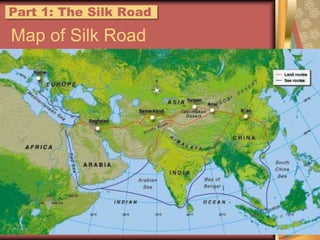
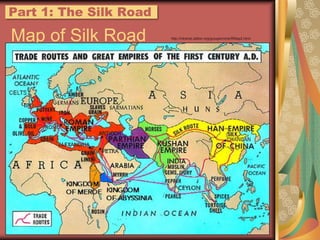
Part 1: The Silk RoadMap of Silk Road
Part 1: The Silk RoadMap of Silk Roadhttp://intranet.dalton.org/groups/rome/RMap2.html-
A. Origins and OperationsOverland route that linked China to the Mediterranean world via Mesopotamia, Iran, and Central Asia.Two periods of heavy use:150 B.C.E. – 907 C.E.Thirteenth through seventeenth centuries C.E.Regular large-scale trade needed to provide Chinese with western products.Part 1: The Silk Road
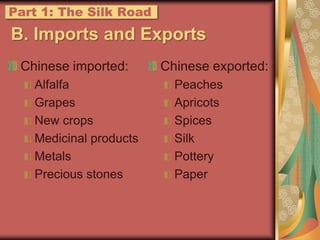
Part 1: The Silk RoadB. Imports and ExportsChinese imported:AlfalfaGrapesNew cropsMedicinal productsMetalsPrecious stonesChinese exported:PeachesApricotsSpicesSilkPotteryPaper
C. Impact of the Silk Road TradeTurkic nomads benefited from the tradeTheir elites constructed houses, lived in settled villages, and became interested in foreign religions.Part 1: The Silk Road
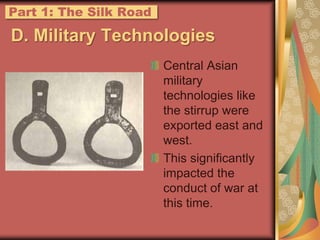
Part 1: The Silk RoadD. Military TechnologiesCentral Asian military technologies like the stirrup were exported east and west.This significantly impacted the conduct of war at this time.
Part Two:Indian Ocean Maritime System
A. IntroductionLinked lands bordering the Indian Ocean basin and the South China Sea.Trade took place in 3 distinct regions:South China SeaSoutheast Asia to the east coast of IndiaWest coast of India to the Persian Gulf and East AfricaPart 2: IndianO. Maritime System
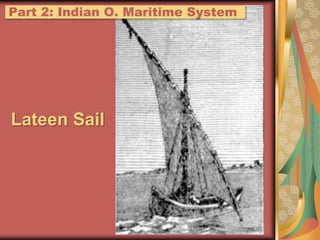
Made possible by and followed the patterns of seasonal changes in the monsoon winds.Sailing technology included lateen sail and new shipbuilding techniques.Because distances traveled were longer than in the Mediterranean, traders in these systems did not maintain political ties to homelands.Part 2: IndianO. Maritime SystemA. Introduction
Part 2: IndianO. Maritime SystemLateen Sail
B. Origins of Contact and TradeEvidence of early trade between ancient Mesopotamia and the Indus Valley.Trade appears to have broken off as Mesopotamia turned more toward trade with East Africa.Two thousand years ago, Malay sailors migrated to Madagascar.Did not maintain ties to homeland.Part 2: IndianO. Maritime System
C. Impact of Indian Ocean TradeWhat we know about it comes from The Periplus of the Erythrean Sea.States goods traded included a wide variety of spices, aromatic resins, pearls Chinese pottery, and other luxury goods.Volume of trade was not as high as in the Mediterranean.Culture of ports was different then culture in their homelands, causing the development of different customs.Part 2: IndianO. Maritime System

Part Three:Routes Across the Sahara
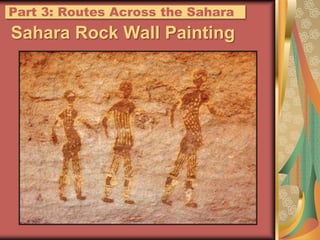
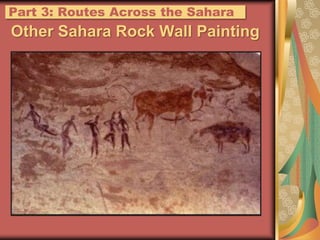
A. Early Saharan CulturesEvidence of an early Saharan hunting culture that was later joined by cattle breeders who looked like contemporary West Africans.Artwork indicates that the cattle breeders were later succeeded by horse herders who drove chariots.Other artwork indicates that camel riders came after charioteers.Camel was probably related to development of trans-Saharan trade.South to north diffusion of camel riding.Part 3: Routes Across the Sahara
Part 3: Routes Across the SaharaSahara Rock Wall Painting
Part 3: Routes Across the SaharaOther Sahara Rock Wall Painting
B. Trade Across the SaharaDeveloped slowly when 2 local trade systems linked.Southern Sahara had salt and exported to sub-Saharan regions for kola nuts and palm oil.Traders in north exported agricultural products and wild animals to Italy.Part 3: Routes Across the Sahara
B.1. Invasion and RevoltWhen Rome declined and the Arabs invaded North Africa (mid-7th century C.E.), trade of Algeria and Morocco was cut off.Berber people of these areas revolted against the Arabs in the 700s and established independent city-states including Sijilmasa and Tahert.Part 3: Routes Across the Sahara
B.2. The BerbersAfter 740 the Berbers found that the southern nomads were getting gold dust from the Niger and other areas of West Africa in exchange for their salt.A pattern of trade then developed in which the Berbers of North Africa traded copper and manufactured goods to the nomads of the southern desert in return for gold.Part 3: Routes Across the Sahara
B.3. Kingdom of GhanaOne of the early sub-Saharan beneficiaries of this new trans-Saharan trade.First description of kingdom is the eleventh century account by al-Bakri.Described a city of two towns, Muslim merchant town and capital of animist king and his court.After 1076, Ghana was weakened by invasion of Moroccan Almorovids.Even after Almorovid retreat, Ghana never recovered.Part 3: Routes Across the Sahara
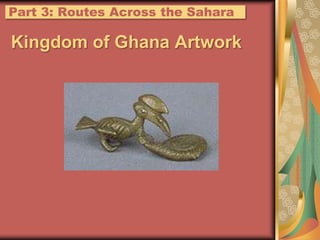
Part 3: Routes Across the SaharaKingdom of Ghana Artwork
Part Four:Sub-Saharan Africa
A. GeographyLarge area with many different environmental zone and many geographical obstacles to movement.Significant geographical areas:SahelTropical SavannaTropical RainforestTemperate highlandsPart 4: Sub-Saharan Africa
B. Development of Cultural UnityAfrican cultures are highly diverse.Estimated 2,000 languages spoken on continent.Numerous food production systems.Difficulty in communication and trade between groups.No foreign power was able to conquer Africa and impose a unified culture.Part 4: Sub-Saharan Africa
C. African Cultural CharacteristicsAfrican cultures display certain common features that attest to an underlying cultural unity that some scholars have called “Africanity.”One concept was a kingship in which kings were isolated and oversee societies in which the people are arranged in age groups and kinship divisions.Part 4: Sub-Saharan Africa
C. More CharacteristicsOther common features include:Cultivation with hoe and digging stickUse of rhythms in African musicFunctions of dancing and mask wearing in ritualsPart 4: Sub-Saharan Africa
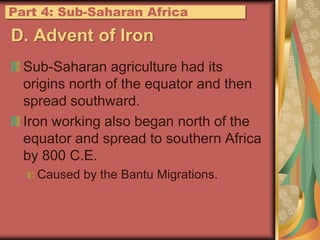
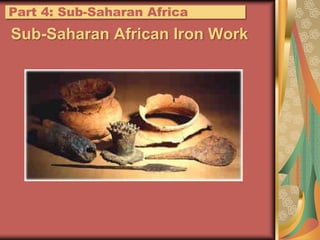
Part 4: Sub-Saharan AfricaD. Advent of IronSub-Saharan agriculture had its origins north of the equator and then spread southward.Iron working also began north of the equator and spread to southern Africa by 800 C.E.Caused by the Bantu Migrations.
Part 4: Sub-Saharan AfricaSub-Saharan African Iron Work
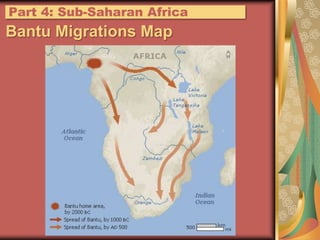
E. Bantu MigrationsOriginal homeland of the Bantu people was in the area on the border of modern Nigeria and Cameroon.Suggests that Bantu people spread out toward the east and south through a series of migrations over the period of the first millennium C.E.By the eighth century, Bantu-speaking people had reached East Africa.Part 4: Sub-Saharan Africa
Part 4: Sub-Saharan AfricaBantu Migrations Map
Part Five:The Spread of Ideas
A. Ideas and Material EvidenceVery hard to trace dissemination of ideas in preliterate societies.Invention of coins – created in Anatolia and spread to Europe, North Africa, and India.China made cast copper coins – was this inspired by the Anatolian example?Part 5: Spread of Ideas
B. Spread of ReligionSpread of ideas in a deliberate and organized fashion such that we can trace it is a phenomenon of the first millennium C.E.Case with spread of Buddhism, Christianity, and IslamPart 5: Spread of Ideas
B.1. Spread of BuddhismFacilitated both by royal sponsorship and by the travels of ordinary pilgrims and missionaries.In India, Mauryan king Ashoka and King Kanishka of the Kushans supported Buddhism.Buddhist missionaries from India traveled to a variety of destinations:West to Syria, Egypt, and MesopotamiaAlso went to Sri Lanka, southeast Asia, and TibetPart 5: Spread of Ideas
B.1. Buddhism ContinuedBuddhism changed and further developed as it spread.Theraveda Buddhism became dominant in Sri LankaMahayana Buddhism in TibetChan (Zen) Buddhism in East AsiaPart 5: Spread of Ideas
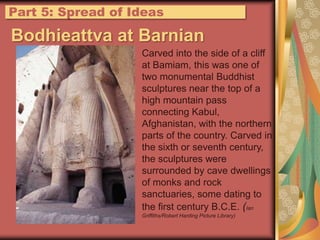
Part 5: Spread of IdeasBodhieattva at BarnianCarved into the side of a cliff at Bamiam, this was one of two monumental Buddhist sculptures near the top of a high mountain pass connecting Kabul, Afghanistan, with the northern parts of the country. Carved in the sixth or seventh century, the sculptures were surrounded by cave dwellings of monks and rock sanctuaries, some dating to the first century B.C.E. (Ian Griffiths/Robert Harding Picture Library)
B.2. Spread of ChristianityArmenia was an important trading center for the Silk Road.Mediterranean states spread Christianity to Armenia in order to bring that kingdom over to its side and thus deprive Iran of control of this area.The transmission of Christianity to Ethiopia was similarly linked to a Mediterranean Christian attempt to deprive Iran of trade.Part 5: Spread of Ideas

Chapter 07 ppt

  • 1.
    Networks of Communicationand Exchange300 B.C.E. – 1100 C.E.Chapter 7
  • 2.
  • 3.
    Part 1: TheSilk RoadMap of Silk Road
  • 4.
    Part 1: TheSilk RoadMap of Silk Roadhttp://intranet.dalton.org/groups/rome/RMap2.html-
  • 5.
    A. Origins andOperationsOverland route that linked China to the Mediterranean world via Mesopotamia, Iran, and Central Asia.Two periods of heavy use:150 B.C.E. – 907 C.E.Thirteenth through seventeenth centuries C.E.Regular large-scale trade needed to provide Chinese with western products.Part 1: The Silk Road
  • 6.
    Part 1: TheSilk RoadB. Imports and ExportsChinese imported:AlfalfaGrapesNew cropsMedicinal productsMetalsPrecious stonesChinese exported:PeachesApricotsSpicesSilkPotteryPaper
  • 7.
    C. Impact ofthe Silk Road TradeTurkic nomads benefited from the tradeTheir elites constructed houses, lived in settled villages, and became interested in foreign religions.Part 1: The Silk Road
  • 8.
    Part 1: TheSilk RoadD. Military TechnologiesCentral Asian military technologies like the stirrup were exported east and west.This significantly impacted the conduct of war at this time.
  • 9.
    Part Two:Indian OceanMaritime System
  • 10.
    A. IntroductionLinked landsbordering the Indian Ocean basin and the South China Sea.Trade took place in 3 distinct regions:South China SeaSoutheast Asia to the east coast of IndiaWest coast of India to the Persian Gulf and East AfricaPart 2: IndianO. Maritime System
  • 11.
    Made possible byand followed the patterns of seasonal changes in the monsoon winds.Sailing technology included lateen sail and new shipbuilding techniques.Because distances traveled were longer than in the Mediterranean, traders in these systems did not maintain political ties to homelands.Part 2: IndianO. Maritime SystemA. Introduction
  • 12.
    Part 2: IndianO.Maritime SystemLateen Sail
  • 13.
    B. Origins ofContact and TradeEvidence of early trade between ancient Mesopotamia and the Indus Valley.Trade appears to have broken off as Mesopotamia turned more toward trade with East Africa.Two thousand years ago, Malay sailors migrated to Madagascar.Did not maintain ties to homeland.Part 2: IndianO. Maritime System
  • 14.
    C. Impact ofIndian Ocean TradeWhat we know about it comes from The Periplus of the Erythrean Sea.States goods traded included a wide variety of spices, aromatic resins, pearls Chinese pottery, and other luxury goods.Volume of trade was not as high as in the Mediterranean.Culture of ports was different then culture in their homelands, causing the development of different customs.Part 2: IndianO. Maritime System
  • 15.
  • 16.
    A. Early SaharanCulturesEvidence of an early Saharan hunting culture that was later joined by cattle breeders who looked like contemporary West Africans.Artwork indicates that the cattle breeders were later succeeded by horse herders who drove chariots.Other artwork indicates that camel riders came after charioteers.Camel was probably related to development of trans-Saharan trade.South to north diffusion of camel riding.Part 3: Routes Across the Sahara
  • 17.
    Part 3: RoutesAcross the SaharaSahara Rock Wall Painting
  • 18.
    Part 3: RoutesAcross the SaharaOther Sahara Rock Wall Painting
  • 19.
    B. Trade Acrossthe SaharaDeveloped slowly when 2 local trade systems linked.Southern Sahara had salt and exported to sub-Saharan regions for kola nuts and palm oil.Traders in north exported agricultural products and wild animals to Italy.Part 3: Routes Across the Sahara
  • 20.
    B.1. Invasion andRevoltWhen Rome declined and the Arabs invaded North Africa (mid-7th century C.E.), trade of Algeria and Morocco was cut off.Berber people of these areas revolted against the Arabs in the 700s and established independent city-states including Sijilmasa and Tahert.Part 3: Routes Across the Sahara
  • 21.
    B.2. The BerbersAfter740 the Berbers found that the southern nomads were getting gold dust from the Niger and other areas of West Africa in exchange for their salt.A pattern of trade then developed in which the Berbers of North Africa traded copper and manufactured goods to the nomads of the southern desert in return for gold.Part 3: Routes Across the Sahara
  • 22.
    B.3. Kingdom ofGhanaOne of the early sub-Saharan beneficiaries of this new trans-Saharan trade.First description of kingdom is the eleventh century account by al-Bakri.Described a city of two towns, Muslim merchant town and capital of animist king and his court.After 1076, Ghana was weakened by invasion of Moroccan Almorovids.Even after Almorovid retreat, Ghana never recovered.Part 3: Routes Across the Sahara
  • 23.
    Part 3: RoutesAcross the SaharaKingdom of Ghana Artwork
  • 24.
  • 25.
    A. GeographyLarge areawith many different environmental zone and many geographical obstacles to movement.Significant geographical areas:SahelTropical SavannaTropical RainforestTemperate highlandsPart 4: Sub-Saharan Africa
  • 26.
    B. Development ofCultural UnityAfrican cultures are highly diverse.Estimated 2,000 languages spoken on continent.Numerous food production systems.Difficulty in communication and trade between groups.No foreign power was able to conquer Africa and impose a unified culture.Part 4: Sub-Saharan Africa
  • 27.
    C. African CulturalCharacteristicsAfrican cultures display certain common features that attest to an underlying cultural unity that some scholars have called “Africanity.”One concept was a kingship in which kings were isolated and oversee societies in which the people are arranged in age groups and kinship divisions.Part 4: Sub-Saharan Africa
  • 28.
    C. More CharacteristicsOthercommon features include:Cultivation with hoe and digging stickUse of rhythms in African musicFunctions of dancing and mask wearing in ritualsPart 4: Sub-Saharan Africa
  • 29.
    Part 4: Sub-SaharanAfricaD. Advent of IronSub-Saharan agriculture had its origins north of the equator and then spread southward.Iron working also began north of the equator and spread to southern Africa by 800 C.E.Caused by the Bantu Migrations.
  • 30.
    Part 4: Sub-SaharanAfricaSub-Saharan African Iron Work
  • 31.
    E. Bantu MigrationsOriginalhomeland of the Bantu people was in the area on the border of modern Nigeria and Cameroon.Suggests that Bantu people spread out toward the east and south through a series of migrations over the period of the first millennium C.E.By the eighth century, Bantu-speaking people had reached East Africa.Part 4: Sub-Saharan Africa
  • 32.
    Part 4: Sub-SaharanAfricaBantu Migrations Map
  • 33.
  • 34.
    A. Ideas andMaterial EvidenceVery hard to trace dissemination of ideas in preliterate societies.Invention of coins – created in Anatolia and spread to Europe, North Africa, and India.China made cast copper coins – was this inspired by the Anatolian example?Part 5: Spread of Ideas
  • 35.
    B. Spread ofReligionSpread of ideas in a deliberate and organized fashion such that we can trace it is a phenomenon of the first millennium C.E.Case with spread of Buddhism, Christianity, and IslamPart 5: Spread of Ideas
  • 36.
    B.1. Spread ofBuddhismFacilitated both by royal sponsorship and by the travels of ordinary pilgrims and missionaries.In India, Mauryan king Ashoka and King Kanishka of the Kushans supported Buddhism.Buddhist missionaries from India traveled to a variety of destinations:West to Syria, Egypt, and MesopotamiaAlso went to Sri Lanka, southeast Asia, and TibetPart 5: Spread of Ideas
  • 37.
    B.1. Buddhism ContinuedBuddhismchanged and further developed as it spread.Theraveda Buddhism became dominant in Sri LankaMahayana Buddhism in TibetChan (Zen) Buddhism in East AsiaPart 5: Spread of Ideas
  • 38.
    Part 5: Spreadof IdeasBodhieattva at BarnianCarved into the side of a cliff at Bamiam, this was one of two monumental Buddhist sculptures near the top of a high mountain pass connecting Kabul, Afghanistan, with the northern parts of the country. Carved in the sixth or seventh century, the sculptures were surrounded by cave dwellings of monks and rock sanctuaries, some dating to the first century B.C.E. (Ian Griffiths/Robert Harding Picture Library)
  • 39.
    B.2. Spread ofChristianityArmenia was an important trading center for the Silk Road.Mediterranean states spread Christianity to Armenia in order to bring that kingdom over to its side and thus deprive Iran of control of this area.The transmission of Christianity to Ethiopia was similarly linked to a Mediterranean Christian attempt to deprive Iran of trade.Part 5: Spread of Ideas