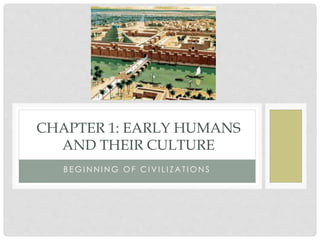
CHAPTER 1: EARLY HUMANS 
AND THEIR CULTURE 
B EGINNING OF CI VI L I ZAT IONS
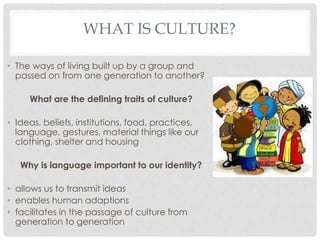
WHAT IS CULTURE? 
• The ways of living built up by a group and 
passed on from one generation to another? 
What are the defining traits of culture? 
• Ideas, beliefs, institutions, food, practices, 
language, gestures, material things like our 
clothing, shelter and housing 
Why is language important to our identity? 
• allows us to transmit ideas 
• enables human adaptions 
• facilitates in the passage of culture from 
generation to generation
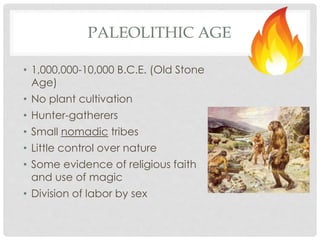
PALEOLITHIC AGE 
• 1,000,000-10,000 B.C.E. (Old Stone 
Age) 
• No plant cultivation 
• Hunter-gatherers 
• Small nomadic tribes 
• Little control over nature 
• Some evidence of religious faith 
and use of magic 
• Division of labor by sex
NEOLITHIC AGE 10,000-3500 B.C.E. (NEW 
STONE AGE) 
• Agricultural Revolution 
• Domestication of animals 
• Birth of first civilizations 
• Beginning of settled societies 
• Rise of complex human societies
NEOLITHIC REVOLUTION 
• Systematic agriculture 
• Humans shifted from hunting & gathering to 
keeping animals & growing food on a regular 
basis 
• Advances in stone tools = surplus of food 
production = growth of population = growth of 
villages = led to first cities 
• Emergence of new professions in cities such as 
artisans, merchants, craftsmen
WHAT IS TECHNOLOGY? 
• Skills and tools people use to help them 
meet their basic needs and wants
7 DEFINING FEATURES OF CIVILIZATION 
• Organized government 
• complex religion 
• job specialization 
• social classes 
• art and architecture 
• public works 
• writing 
forms of 
communication 
Why are the Arts and Architecture important?
OTHER IMPORTANT FEATURES OF 
CIVILIZATION 
• Urbanization 
• Social change 
 Growth in population 
• Technological and industrial change 
 Bronze Age following Neolithic Age 
• Long-distance trade
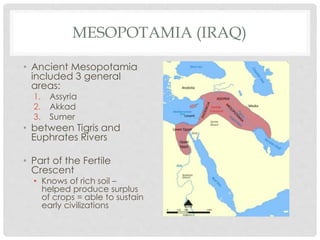
MESOPOTAMIA (IRAQ) 
• Ancient Mesopotamia 
included 3 general 
areas: 
1. Assyria 
2. Akkad 
3. Sumer 
• between Tigris and 
Euphrates Rivers 
• Part of the Fertile 
Crescent 
• Knows of rich soil – 
helped produce surplus 
of crops = able to sustain 
early civilizations
MESOPOTAMIA
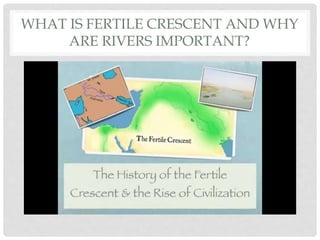
WHAT IS FERTILE CRESCENT AND WHY 
ARE RIVERS IMPORTANT?
EARLY MESOPOTAMIAN CIVILIZATION 
• Sumerians: Created the 1st Mesopotamian civilization 
• Created city-states: basic units of Sumerian civilizations 
• Sumerian cities: 
• Surrounded by walls 
• Many had defense towers 
• dwellings built of sun-dried bricks 
• Sumerian beliefs 
• Polytheistic 
• Believed that gods owned the citied 
• Built temples for gods 
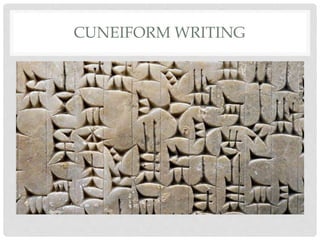
• Writing – Invented cuneiform – earliest writing system 
• Government: Theocracy 
• Kings derived power from gods and were agents of gods
CUNEIFORM WRITING
AKKADIANS 
• 2340 B.C.E. Sargon, leader of the Akkadians 
overran Sumerian city-states 
• Established first empire in world history 
• Empire: large political unit or state, usually 
under a single leader that controls many 
people and territory
BABYLONIANS 
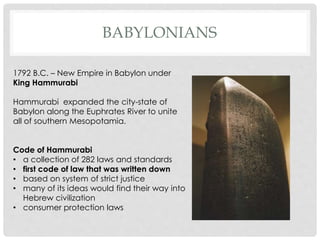
1792 B.C. – New Empire in Babylon under 
King Hammurabi 
Hammurabi expanded the city-state of 
Babylon along the Euphrates River to unite 
all of southern Mesopotamia. 
Code of Hammurabi 
• a collection of 282 laws and standards 
• first code of law that was written down 
• based on system of strict justice 
• many of its ideas would find their way into 
Hebrew civilization 
• consumer protection laws

Honors.ch.1.pp1

  • 1.
    CHAPTER 1: EARLYHUMANS AND THEIR CULTURE B EGINNING OF CI VI L I ZAT IONS
  • 2.
    WHAT IS CULTURE? • The ways of living built up by a group and passed on from one generation to another? What are the defining traits of culture? • Ideas, beliefs, institutions, food, practices, language, gestures, material things like our clothing, shelter and housing Why is language important to our identity? • allows us to transmit ideas • enables human adaptions • facilitates in the passage of culture from generation to generation
  • 3.
    PALEOLITHIC AGE •1,000,000-10,000 B.C.E. (Old Stone Age) • No plant cultivation • Hunter-gatherers • Small nomadic tribes • Little control over nature • Some evidence of religious faith and use of magic • Division of labor by sex
  • 4.
    NEOLITHIC AGE 10,000-3500B.C.E. (NEW STONE AGE) • Agricultural Revolution • Domestication of animals • Birth of first civilizations • Beginning of settled societies • Rise of complex human societies
  • 5.
    NEOLITHIC REVOLUTION •Systematic agriculture • Humans shifted from hunting & gathering to keeping animals & growing food on a regular basis • Advances in stone tools = surplus of food production = growth of population = growth of villages = led to first cities • Emergence of new professions in cities such as artisans, merchants, craftsmen
  • 6.
    WHAT IS TECHNOLOGY? • Skills and tools people use to help them meet their basic needs and wants
  • 7.
    7 DEFINING FEATURESOF CIVILIZATION • Organized government • complex religion • job specialization • social classes • art and architecture • public works • writing forms of communication Why are the Arts and Architecture important?
  • 8.
    OTHER IMPORTANT FEATURESOF CIVILIZATION • Urbanization • Social change  Growth in population • Technological and industrial change  Bronze Age following Neolithic Age • Long-distance trade
  • 9.
    MESOPOTAMIA (IRAQ) •Ancient Mesopotamia included 3 general areas: 1. Assyria 2. Akkad 3. Sumer • between Tigris and Euphrates Rivers • Part of the Fertile Crescent • Knows of rich soil – helped produce surplus of crops = able to sustain early civilizations
  • 10.
  • 11.
    WHAT IS FERTILECRESCENT AND WHY ARE RIVERS IMPORTANT?
  • 12.
    EARLY MESOPOTAMIAN CIVILIZATION • Sumerians: Created the 1st Mesopotamian civilization • Created city-states: basic units of Sumerian civilizations • Sumerian cities: • Surrounded by walls • Many had defense towers • dwellings built of sun-dried bricks • Sumerian beliefs • Polytheistic • Believed that gods owned the citied • Built temples for gods • Writing – Invented cuneiform – earliest writing system • Government: Theocracy • Kings derived power from gods and were agents of gods
  • 13.
  • 14.
    AKKADIANS • 2340B.C.E. Sargon, leader of the Akkadians overran Sumerian city-states • Established first empire in world history • Empire: large political unit or state, usually under a single leader that controls many people and territory
  • 15.
    BABYLONIANS 1792 B.C.– New Empire in Babylon under King Hammurabi Hammurabi expanded the city-state of Babylon along the Euphrates River to unite all of southern Mesopotamia. Code of Hammurabi • a collection of 282 laws and standards • first code of law that was written down • based on system of strict justice • many of its ideas would find their way into Hebrew civilization • consumer protection laws

Editor's Notes

  • #2 Indus Valley = Present-day Pakistan
  • #4 made early stone tools and that’s how get the name “old stone” age. Invented bow and arrow + spear for catching fish Used stone tools to hunt, butcher, cut plants, build shelter and to clean animals and animal hides. Learned to make fire Usually lived in groups of 20 or 30 people women = childbearers and gatherers of berries and nuts men – hunters NOTE: early people as you can see had big prominent noses – the big nose helped them adapt to the cold climate better
  • #6 Systematic: done in methodical or organized fashion emergence of new professions since farmers could grow surplus foods and feed those in the cities
  • #8 Arts and architecture – expressed the talents, beliefs, and values of the people who created them. Temples and palaces often dominated the city landscape. – focal points of the civilization
  • #9 Comparing Nomadic life and Civilizations – major difference in social organization – in nomadic cultures, people did not build cities and their governments were simpler than those of civilizations Civilizations developed sophisticated traditions in oral poetry
  • #12 Ufratis river
  • #13 KUNIA - Form
  • #14 wedge shape - Why did people start writing ...to record how much grain someone got or how much was given to the gods
  • #16 “an eye for an eye” and “tooth for a tooth” he earliest-known example of a ruler proclaiming publicly to his people an entire body of laws, arranged in orderly groups, so that all men might read and know what was required of them. The code was carved upon a black stone monument, eight feet high, and clearly intended to be reared in public view. Why is it important that the code was written down? – could not change – gave people guaranteed rights consumer protection laws – if a house collapsed and killed its owner, the builder would be put to death