Transformations in Europe 1500-1750 C.E.
Culture and Ideas
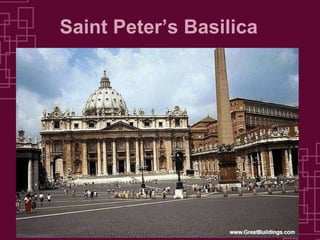
New Churches In 1500, Pope Leo X raised money for new churches by authorizing the sale of indulgences. Indulgences paid for Saint Peter’s Basilica in Rome.
Saint Peter’s Basilica
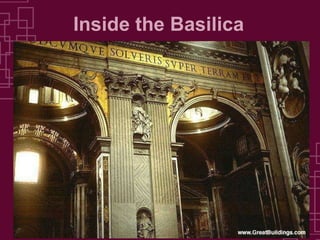
Inside the Basilica
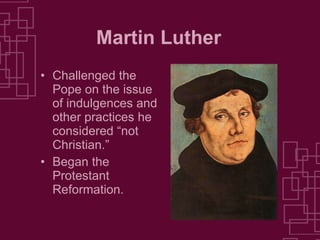
Martin Luther Challenged the Pope on the issue of indulgences and other practices he considered “not Christian.” Began the Protestant Reformation.
Protestant Reformation Salvation could be by faith alone. Christian belief could be based only on: Christian Bible Christian tradition
John Calvin Formulated a different theological position in  The Institutes of Christian Religion . Argued that salvation was God’s gift to those who were predestined. Christian congregations should: be self-governing stress simplicity in life and in worship.
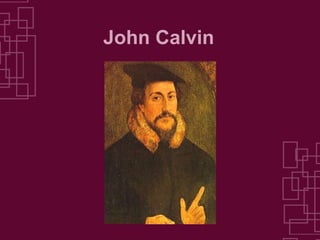
John Calvin
Protestant Reformation Appealed not only to religious sentiments, but also to: Germans who disliked the Italian-dominated Catholic church. Peasants and urban workers who wanted to reject the religion of their masters.
Catholic Reformation Agreed on a number of internal reforms Reaffirmed the fundamental Catholic beliefs in the Council of Trent. These responses to the Protestant Reformation, with the activities of the “Society of Jesus,” comprise the “Catholic Reformation”
War! The Protestant Reformation led to a number of “wars of religion.” Last of these wars concluded in 1648.
Traditional Thinking European concepts of the natural world were derived from: Local folk traditions Judeo-Christian beliefs Most people believed that natural events could have supernatural causes.
Witch Hunts Late sixteenth and early seventeenth centuries. Over 100,000 people (3/4 women) were tried. Half of them were executed on charges of witchcraft
Why Witch Hunts? Manifestations of fear of unattached women? Social stress? Poor and marginal people believed they were capable of witchcraft and welcomed the notoriety and attention gained from public confession?
Scientific Revolution European intellectuals derived understanding of natural world from the writings of the Greeks and Romans. For example: Everything on Earth was reducible to four elements. The sun, moon, planets, and stars were so light and pure, they floated in spheres around the Earth in circular orbits.
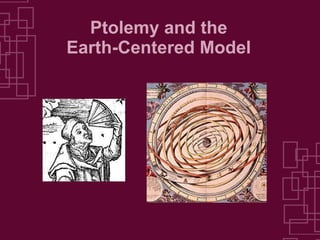
Ptolemy and the Earth-Centered Model
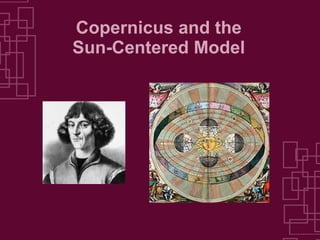
Copernicus and Galileo Observations by scientists like Copernicus and Galileo undermined the earth-centered model of the universe. Led to the introduction of the Copernican sun-centered model of the universe.
Copernicus and the Sun-Centered Model
Criticism Copernican model was suppressed by Protestant leaders and the Catholic church. Even so, printed books spread these and other new scientific ideas among European intellectuals.
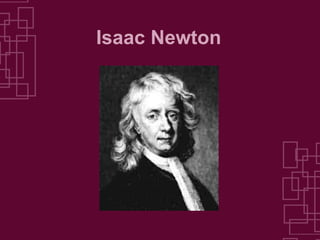
Gravity Isaac Newton’s discovery of the law of gravity showed why planets move around the sun in elliptical orbits. His discoveries led to the development of Newtonian physics. Newton and other scientists did not believe that their discoveries were in conflict with religious belief.
Isaac Newton
Thinking Caps On Advances in scientific thought inspired European governments and groups of individuals to question the reasonableness of accepted practices in fields ranging from agriculture to laws, religions, and social hierarchies.
Early Enlightenment This intellectual movement assumed that social behavior and institutions were governed by scientific laws was called the Enlightenment.
Influences The Enlightenment thinkers were also influenced by the Reformation and by accounts of other cultures, including the Jesuit accounts of China.
Changing Society New scientific methods provided the enlightened thinkers with a model for changing European society. Not a homogeneous group.  Drew inspiration from disparate sources and espoused a variety of agendas. Most were optimistic that the application of reason would lead to human progress.
Opposition Ideas of the Enlightenment aroused opposition from many absolutist rulers and from clergymen. The printing press made the survival and dissemination new ideas of possible.
Social and Economic Life
The Bourgeoisie Europe’s cities experienced major growth between 1500 and 1700. The wealthy urbanites thrived on manufacturing, finance, and trade, including the profitable grain trade. Amsterdam’s growth, built on trade and finance, show the power of the seventeenth century enterprise.
Relationships The bourgeoisie forged mutually beneficial relationships with the monarchs. Built extensive family and ethnic networks to facilitate trade between different parts of the world.
Partnerships Partnerships between merchants and governments led to the development of joint-stock improvement of Europe’s transportation infrastructure.
Nobility Bourgeois gentry gradually increased ownership of land. Many entered the ranks of the nobility by: Marrying into noble families Purchasing titles of nobility
Labor Serfdom declined and disappeared in Western Europe, but it gained prominence in Eastern Europe. African slaves working in the Americas contributed greatly to the European economy. New world crops helped Western European peasants avoid starvation.
Wood Shortage At this time, wood was used for: Heating Cooking Construction Shipbuilding Industrial uses Led to severe shortage and wood became very expensive.
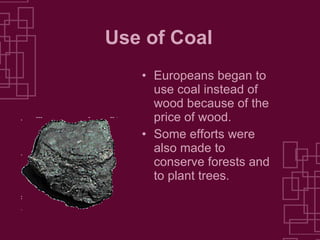
Use of Coal Europeans began to use coal instead of wood because of the price of wood. Some efforts were also made to conserve forests and to plant trees.
Lack of Forests Very devastating to rural poor. The poor relied on free access to forests for: Wood Building materials Nuts and berries Wild game
Urban Poor Deserving Poor = permanent residents Unworthy Poor = migrants, peddlers, beggars, and criminals
Common People and Marriage Married late because: Young men served long periods of apprenticeship while learning a trade. Young women needed to work to earn their dowries.
Bourgeois and Marriage Also married late because men delayed marriage until after finishing their education. Late marriage allowed couples to be independent of their parents. Late marriage also kept the birthrate low.
Political Innovations
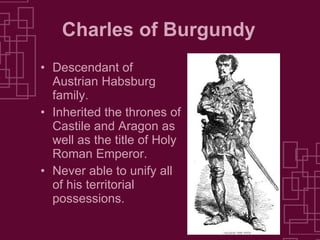
Charles of Burgundy Descendant of Austrian Habsburg family. Inherited the thrones of Castile and Aragon as well as the title of Holy Roman Emperor. Never able to unify all of his territorial possessions.
Rebellion! Lutheran German princes rebelled against the French-speaking Catholic Charles. Seized church lands and brought about the German Wars of Religion. Charles abdicates the throne. Spain goes to his son Philip Holy Roman Empire goes to his brother Ferdinand
Religious Policies Rulers of Spain and France successfully defended state-sponsored Catholicism against Protestant challenge. In England, Henry VIII challenged papal authority and declared himself head of the Church of England.  Later English monarchs resist the efforts of English Calvinists to “purify” the Anglican church.
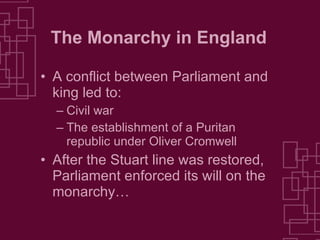
The Monarchy in England A conflict between Parliament and king led to: Civil war The establishment of a Puritan republic under Oliver Cromwell After the Stuart line was restored, Parliament enforced its will on the monarchy…
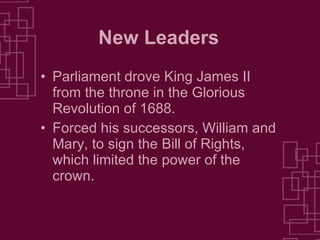
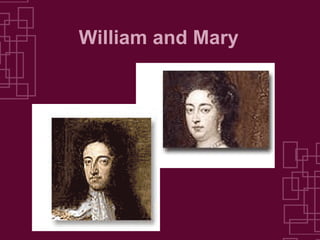
New Leaders Parliament drove King James II from the throne in the Glorious Revolution of 1688. Forced his successors, William and Mary, to sign the Bill of Rights, which limited the power of the crown.
William and Mary
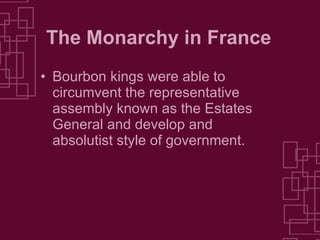
The Monarchy in France Bourbon kings were able to circumvent the representative assembly known as the Estates General and develop and absolutist style of government.
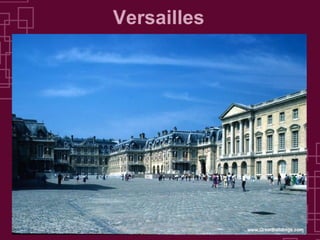
Money Louis XIV’s finance minister Colbert was able to increase revenue through more efficient tax collection and promoted economic growth. Louis entertained the controlled the French nobility by requiring them to attend his court at Versailles.
Versailles
Warfare Constant warfare led to a military revolution in which the cannon, musket, and commoner foot soldier became the mainstays of the European armies. Armies became larger and most European states maintained a standing army.
Naval Technology Warships with multiple tiers of cannons and four-wheel cannon carriages to make reloading easier. England took the lead in developing naval technology. Helped them to beat the Spanish Catholic Armada in 1588. Signaled the end of Spanish military dominance in Europe.
After the fall of Spain… France rises as the strongest power on continental Europe. England remains superior in naval power. During the war of Spanish Succession, England, Austria, and Prussia were able to stop France from taking the Spanish throne.
The Four Powers of Europe France, Britain, Austria, and Russia Able to maintain a balance of power that prevented any one power from becoming too strong for about two centuries.
Paying for War Most successful states made profitable alliances with commercial elites. The Spanish, however, undermined their economy by driving out Jews, Protestants, and the descendants of Muslims so their money was spent on payments to creditors and manufactured goods and food.
The Netherlands Got autonomy from Spain and became a dominant commercial power. United Provinces of the Free Netherlands favored commercial interests, craftsmen, and manufacturing enterprises. Amsterdam became a major center of finance and shipping.
Using Naval Power After 1650 England used its naval power to break Dutch dominance in overseas trade. The English government also improved its financial position by collecting taxes directly and creating a central bank.
French Methods Streamlined tax collection Used protective tariffs to promote domestic industries Improved its transportation network They were not able to: Introduce direct tax collection Tax the land of the nobles Secure low-cost loans

AP WH Chapter 16

  • 1.
  • 2.
  • 3.
    New Churches In1500, Pope Leo X raised money for new churches by authorizing the sale of indulgences. Indulgences paid for Saint Peter’s Basilica in Rome.
  • 4.
  • 5.
  • 6.
    Martin Luther Challengedthe Pope on the issue of indulgences and other practices he considered “not Christian.” Began the Protestant Reformation.
  • 7.
    Protestant Reformation Salvationcould be by faith alone. Christian belief could be based only on: Christian Bible Christian tradition
  • 8.
    John Calvin Formulateda different theological position in The Institutes of Christian Religion . Argued that salvation was God’s gift to those who were predestined. Christian congregations should: be self-governing stress simplicity in life and in worship.
  • 9.
  • 10.
    Protestant Reformation Appealednot only to religious sentiments, but also to: Germans who disliked the Italian-dominated Catholic church. Peasants and urban workers who wanted to reject the religion of their masters.
  • 11.
    Catholic Reformation Agreedon a number of internal reforms Reaffirmed the fundamental Catholic beliefs in the Council of Trent. These responses to the Protestant Reformation, with the activities of the “Society of Jesus,” comprise the “Catholic Reformation”
  • 12.
    War! The ProtestantReformation led to a number of “wars of religion.” Last of these wars concluded in 1648.
  • 13.
    Traditional Thinking Europeanconcepts of the natural world were derived from: Local folk traditions Judeo-Christian beliefs Most people believed that natural events could have supernatural causes.
  • 14.
    Witch Hunts Latesixteenth and early seventeenth centuries. Over 100,000 people (3/4 women) were tried. Half of them were executed on charges of witchcraft
  • 15.
    Why Witch Hunts?Manifestations of fear of unattached women? Social stress? Poor and marginal people believed they were capable of witchcraft and welcomed the notoriety and attention gained from public confession?
  • 16.
    Scientific Revolution Europeanintellectuals derived understanding of natural world from the writings of the Greeks and Romans. For example: Everything on Earth was reducible to four elements. The sun, moon, planets, and stars were so light and pure, they floated in spheres around the Earth in circular orbits.
  • 17.
    Ptolemy and theEarth-Centered Model
  • 18.
    Copernicus and GalileoObservations by scientists like Copernicus and Galileo undermined the earth-centered model of the universe. Led to the introduction of the Copernican sun-centered model of the universe.
  • 19.
    Copernicus and theSun-Centered Model
  • 20.
    Criticism Copernican modelwas suppressed by Protestant leaders and the Catholic church. Even so, printed books spread these and other new scientific ideas among European intellectuals.
  • 21.
    Gravity Isaac Newton’sdiscovery of the law of gravity showed why planets move around the sun in elliptical orbits. His discoveries led to the development of Newtonian physics. Newton and other scientists did not believe that their discoveries were in conflict with religious belief.
  • 22.
  • 23.
    Thinking Caps OnAdvances in scientific thought inspired European governments and groups of individuals to question the reasonableness of accepted practices in fields ranging from agriculture to laws, religions, and social hierarchies.
  • 24.
    Early Enlightenment Thisintellectual movement assumed that social behavior and institutions were governed by scientific laws was called the Enlightenment.
  • 25.
    Influences The Enlightenmentthinkers were also influenced by the Reformation and by accounts of other cultures, including the Jesuit accounts of China.
  • 26.
    Changing Society Newscientific methods provided the enlightened thinkers with a model for changing European society. Not a homogeneous group. Drew inspiration from disparate sources and espoused a variety of agendas. Most were optimistic that the application of reason would lead to human progress.
  • 27.
    Opposition Ideas ofthe Enlightenment aroused opposition from many absolutist rulers and from clergymen. The printing press made the survival and dissemination new ideas of possible.
  • 28.
  • 29.
    The Bourgeoisie Europe’scities experienced major growth between 1500 and 1700. The wealthy urbanites thrived on manufacturing, finance, and trade, including the profitable grain trade. Amsterdam’s growth, built on trade and finance, show the power of the seventeenth century enterprise.
  • 30.
    Relationships The bourgeoisieforged mutually beneficial relationships with the monarchs. Built extensive family and ethnic networks to facilitate trade between different parts of the world.
  • 31.
    Partnerships Partnerships betweenmerchants and governments led to the development of joint-stock improvement of Europe’s transportation infrastructure.
  • 32.
    Nobility Bourgeois gentrygradually increased ownership of land. Many entered the ranks of the nobility by: Marrying into noble families Purchasing titles of nobility
  • 33.
    Labor Serfdom declinedand disappeared in Western Europe, but it gained prominence in Eastern Europe. African slaves working in the Americas contributed greatly to the European economy. New world crops helped Western European peasants avoid starvation.
  • 34.
    Wood Shortage Atthis time, wood was used for: Heating Cooking Construction Shipbuilding Industrial uses Led to severe shortage and wood became very expensive.
  • 35.
    Use of CoalEuropeans began to use coal instead of wood because of the price of wood. Some efforts were also made to conserve forests and to plant trees.
  • 36.
    Lack of ForestsVery devastating to rural poor. The poor relied on free access to forests for: Wood Building materials Nuts and berries Wild game
  • 37.
    Urban Poor DeservingPoor = permanent residents Unworthy Poor = migrants, peddlers, beggars, and criminals
  • 38.
    Common People andMarriage Married late because: Young men served long periods of apprenticeship while learning a trade. Young women needed to work to earn their dowries.
  • 39.
    Bourgeois and MarriageAlso married late because men delayed marriage until after finishing their education. Late marriage allowed couples to be independent of their parents. Late marriage also kept the birthrate low.
  • 40.
  • 41.
    Charles of BurgundyDescendant of Austrian Habsburg family. Inherited the thrones of Castile and Aragon as well as the title of Holy Roman Emperor. Never able to unify all of his territorial possessions.
  • 42.
    Rebellion! Lutheran Germanprinces rebelled against the French-speaking Catholic Charles. Seized church lands and brought about the German Wars of Religion. Charles abdicates the throne. Spain goes to his son Philip Holy Roman Empire goes to his brother Ferdinand
  • 43.
    Religious Policies Rulersof Spain and France successfully defended state-sponsored Catholicism against Protestant challenge. In England, Henry VIII challenged papal authority and declared himself head of the Church of England. Later English monarchs resist the efforts of English Calvinists to “purify” the Anglican church.
  • 44.
    The Monarchy inEngland A conflict between Parliament and king led to: Civil war The establishment of a Puritan republic under Oliver Cromwell After the Stuart line was restored, Parliament enforced its will on the monarchy…
  • 45.
    New Leaders Parliamentdrove King James II from the throne in the Glorious Revolution of 1688. Forced his successors, William and Mary, to sign the Bill of Rights, which limited the power of the crown.
  • 46.
  • 47.
    The Monarchy inFrance Bourbon kings were able to circumvent the representative assembly known as the Estates General and develop and absolutist style of government.
  • 48.
    Money Louis XIV’sfinance minister Colbert was able to increase revenue through more efficient tax collection and promoted economic growth. Louis entertained the controlled the French nobility by requiring them to attend his court at Versailles.
  • 49.
  • 50.
    Warfare Constant warfareled to a military revolution in which the cannon, musket, and commoner foot soldier became the mainstays of the European armies. Armies became larger and most European states maintained a standing army.
  • 51.
    Naval Technology Warshipswith multiple tiers of cannons and four-wheel cannon carriages to make reloading easier. England took the lead in developing naval technology. Helped them to beat the Spanish Catholic Armada in 1588. Signaled the end of Spanish military dominance in Europe.
  • 52.
    After the fallof Spain… France rises as the strongest power on continental Europe. England remains superior in naval power. During the war of Spanish Succession, England, Austria, and Prussia were able to stop France from taking the Spanish throne.
  • 53.
    The Four Powersof Europe France, Britain, Austria, and Russia Able to maintain a balance of power that prevented any one power from becoming too strong for about two centuries.
  • 54.
    Paying for WarMost successful states made profitable alliances with commercial elites. The Spanish, however, undermined their economy by driving out Jews, Protestants, and the descendants of Muslims so their money was spent on payments to creditors and manufactured goods and food.
  • 55.
    The Netherlands Gotautonomy from Spain and became a dominant commercial power. United Provinces of the Free Netherlands favored commercial interests, craftsmen, and manufacturing enterprises. Amsterdam became a major center of finance and shipping.
  • 56.
    Using Naval PowerAfter 1650 England used its naval power to break Dutch dominance in overseas trade. The English government also improved its financial position by collecting taxes directly and creating a central bank.
  • 57.
    French Methods Streamlinedtax collection Used protective tariffs to promote domestic industries Improved its transportation network They were not able to: Introduce direct tax collection Tax the land of the nobles Secure low-cost loans