New Civilizations in the Eastern and Western Hemispheres 2200-250 B.C.E.
New Civilizations Early China
Geography and Resources China is divided into 2 major geographical regions: Steppe, desert, and high plateau west and northwest Eastern zone – which is better for agriculture Eastern zone is separated into 2 areas: North and South North includes Yellow River Valley, dry and cold South includes Yangzi Valley, warm with lots of rain
Natural Resources Timber Stone Metals Can grow millet in the north Can grow rice in the south Agriculture in these areas required lots of people to be successful
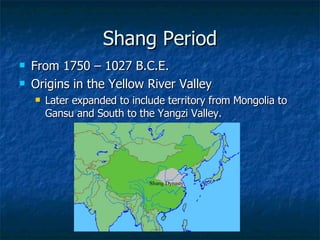
Shang Period From 1750 – 1027 B.C.E. Origins in the Yellow River Valley Later expanded to include territory from Mongolia to Gansu and South to the Yangzi Valley.
Shang Kings Shang kings ruled directly over core area and exercised indirect rule over peripheral areas. Carried out military campaigns against nomadic enemies Engaged in far-flung commerce that may have included indirect trade with Mesopotamia.
Shang Religion Kings worship spirits of male ancestors. Practiced divination and sacrifice Presented themselves as intermediaries between gods and human world.
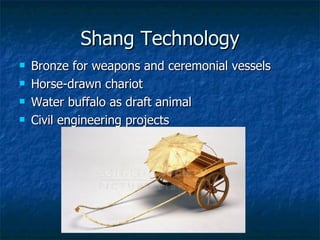
Shang Technology Bronze for weapons and ceremonial vessels Horse-drawn chariot Water buffalo as draft animal Civil engineering projects
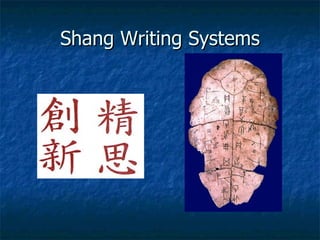
Chinese Writing System Chinese characters developed during Shang period. Chinese writing system today is directly related to the Shang system. Chief written remains of Shang Dynasty are oracle bones used in divination.
Shang Writing Systems
Zhou Period From 1027 – 221 B.C.E. Dependent state of the Shang. Defeated Shang in the eleventh century B.C.E. Invented concept of “Mandate of Heaven” in order to justify actions. Zhou dynasty split into two periods: Western Zhou and Eastern Zhou
Religion and Government During this period, priestly power of the elite faded This resulted in the separation of religion and government Zhou period saw development of many different and important secular philosophies.
Western Zhou Period Government From eleventh to ninth centuries B.C.E. Developed model of government that defined kingship in moral terms Zhou exercised direct control over core territory and indirect control over peripheral areas.
Eastern Zhou Period Decline in strength of the central government Regional elites ruled territories as independent states, often fighting with each other. Eastern Zhou period divided further Spring and Autumn Period (771-481 B.C.E.) Warring States Period (480-221 B.C.E.)
Eastern Zhou Technology Constructed long walls for defense Iron and steel metallurgy Horse riding Development of influential political philosophies Legalism Confucianism Daoism
Legalism Assumes that human nature is essentially wicked and selfish. People will only behave if they are ruled by strict laws and harsh punishments. Functioned as the ideological basis of various independent states as they expanded.
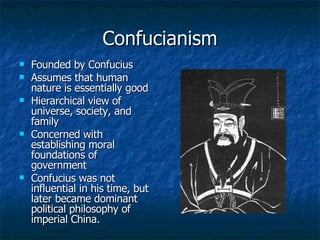
Confucianism Founded by Confucius Assumes that human nature is essentially good Hierarchical view of universe, society, and family Concerned with establishing moral foundations of government Confucius was not influential in his time, but later became dominant political philosophy of imperial China.
Daoism Founded by Laozi. Assumes that universe is in constant flux There are no absolute moral standards People should take the world as they find it Developed into a complex system of popular and magical beliefs Offered the Chinese alternative between Legalism and Confucianism.
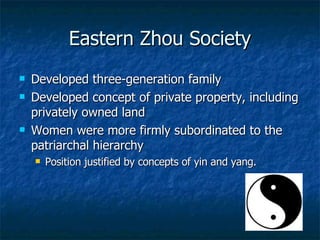
Eastern Zhou Society Developed three-generation family Developed concept of private property, including privately owned land Women were more firmly subordinated to the patriarchal hierarchy Position justified by concepts of yin and yang.
New Civilizations Nubia 3100 B.C.E. – 350 C.E.
Nubia Located in Nile valley from Aswan south to Khartoum Forms a link between tropical Africa and the Mediterranean world. Natural resources included: Gold, semi-precious stones, copper.
Development of Civilization Spurred by need for: Irrigated Agriculture Trade with Egypt Nubian and Egyptian culture developed through mutual influence and borrowing.
Trade and Occupation Early Nubia carried out trade with Old Kingdom Egypt Northern part of Nubia was occupied by Egypt during Middle Kingdom period
Kingdom of Kush Kingdom of Kush developed in southern part of Nubia by 1750 B.C.E. Kush noted from metalworking and construction Egypt invaded Kush during New Kingdom period. Resulted in Egyptian occupation that exploited Nubian laborers
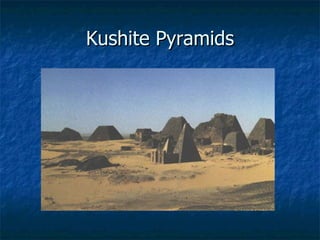
Kushite Pyramids
Kingdom of Meroë 800 B.C.E.-350 C.E. This kingdom ruled Egypt as the 25 th  Dynasty. Nubian Kingdom had a capital at Napata. Napata period characterized by Egyptian cultural influence. In 4 th  century, moved capital to Meroë. Better for agriculture and trade
Meroë Ruling dynasty of Meroë practiced a matrilineal family system Queens were very influential Dominated trade routes Used reservoirs to catch rainfall Became important center for iron smelting
Decline of Meroë Shift in trade routes Rise of kingdom of Aksum Depredations of camel-riding nomads
First Civilizations of the Americas The Olmec and Chavin 1200-250 B.C.E.
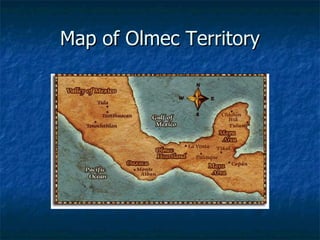
Mesoamerican Olmecs 1200-400 B.C.E. Most important Mesoamerican preclassic civilization Major centers of civilization were located along the coast of Mexico Political structure built around kingship Power rested on control of commodities and religion
Map of Olmec Territory
A Moving Capital Center of early civilization was San Lorenzo. Surpassed by La Venta around 900 B.C.E. Gave way to Tres Zapotes around 600 B.C.E. Large earthen mounds dominated urban centers
Olmec Technology Used raised fields to create agricultural surpluses Olmec architecture was very advanced with so little technology Simple machines only Olmec played a role in early development of writing and astronomy
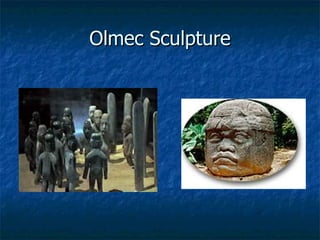
Olmec Sculpture
Chavín First major urban civilization in South America Politically and economically dominant between 900 and 250 B.C.E. Had military strength and religious appeal Used clan-based system of labor Warfare led to fall of Chavín around 200 B.C.E.
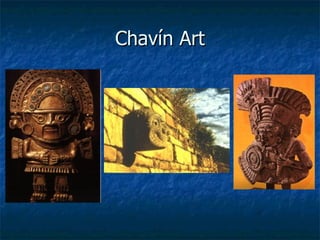
Chavín Art

AP WH Chapter 02 PPT

  • 1.
    New Civilizations inthe Eastern and Western Hemispheres 2200-250 B.C.E.
  • 2.
  • 3.
    Geography and ResourcesChina is divided into 2 major geographical regions: Steppe, desert, and high plateau west and northwest Eastern zone – which is better for agriculture Eastern zone is separated into 2 areas: North and South North includes Yellow River Valley, dry and cold South includes Yangzi Valley, warm with lots of rain
  • 4.
    Natural Resources TimberStone Metals Can grow millet in the north Can grow rice in the south Agriculture in these areas required lots of people to be successful
  • 5.
    Shang Period From1750 – 1027 B.C.E. Origins in the Yellow River Valley Later expanded to include territory from Mongolia to Gansu and South to the Yangzi Valley.
  • 6.
    Shang Kings Shangkings ruled directly over core area and exercised indirect rule over peripheral areas. Carried out military campaigns against nomadic enemies Engaged in far-flung commerce that may have included indirect trade with Mesopotamia.
  • 7.
    Shang Religion Kingsworship spirits of male ancestors. Practiced divination and sacrifice Presented themselves as intermediaries between gods and human world.
  • 8.
    Shang Technology Bronzefor weapons and ceremonial vessels Horse-drawn chariot Water buffalo as draft animal Civil engineering projects
  • 9.
    Chinese Writing SystemChinese characters developed during Shang period. Chinese writing system today is directly related to the Shang system. Chief written remains of Shang Dynasty are oracle bones used in divination.
  • 10.
  • 11.
    Zhou Period From1027 – 221 B.C.E. Dependent state of the Shang. Defeated Shang in the eleventh century B.C.E. Invented concept of “Mandate of Heaven” in order to justify actions. Zhou dynasty split into two periods: Western Zhou and Eastern Zhou
  • 12.
    Religion and GovernmentDuring this period, priestly power of the elite faded This resulted in the separation of religion and government Zhou period saw development of many different and important secular philosophies.
  • 13.
    Western Zhou PeriodGovernment From eleventh to ninth centuries B.C.E. Developed model of government that defined kingship in moral terms Zhou exercised direct control over core territory and indirect control over peripheral areas.
  • 14.
    Eastern Zhou PeriodDecline in strength of the central government Regional elites ruled territories as independent states, often fighting with each other. Eastern Zhou period divided further Spring and Autumn Period (771-481 B.C.E.) Warring States Period (480-221 B.C.E.)
  • 15.
    Eastern Zhou TechnologyConstructed long walls for defense Iron and steel metallurgy Horse riding Development of influential political philosophies Legalism Confucianism Daoism
  • 16.
    Legalism Assumes thathuman nature is essentially wicked and selfish. People will only behave if they are ruled by strict laws and harsh punishments. Functioned as the ideological basis of various independent states as they expanded.
  • 17.
    Confucianism Founded byConfucius Assumes that human nature is essentially good Hierarchical view of universe, society, and family Concerned with establishing moral foundations of government Confucius was not influential in his time, but later became dominant political philosophy of imperial China.
  • 18.
    Daoism Founded byLaozi. Assumes that universe is in constant flux There are no absolute moral standards People should take the world as they find it Developed into a complex system of popular and magical beliefs Offered the Chinese alternative between Legalism and Confucianism.
  • 19.
    Eastern Zhou SocietyDeveloped three-generation family Developed concept of private property, including privately owned land Women were more firmly subordinated to the patriarchal hierarchy Position justified by concepts of yin and yang.
  • 20.
    New Civilizations Nubia3100 B.C.E. – 350 C.E.
  • 21.
    Nubia Located inNile valley from Aswan south to Khartoum Forms a link between tropical Africa and the Mediterranean world. Natural resources included: Gold, semi-precious stones, copper.
  • 22.
    Development of CivilizationSpurred by need for: Irrigated Agriculture Trade with Egypt Nubian and Egyptian culture developed through mutual influence and borrowing.
  • 23.
    Trade and OccupationEarly Nubia carried out trade with Old Kingdom Egypt Northern part of Nubia was occupied by Egypt during Middle Kingdom period
  • 24.
    Kingdom of KushKingdom of Kush developed in southern part of Nubia by 1750 B.C.E. Kush noted from metalworking and construction Egypt invaded Kush during New Kingdom period. Resulted in Egyptian occupation that exploited Nubian laborers
  • 25.
  • 26.
    Kingdom of Meroë800 B.C.E.-350 C.E. This kingdom ruled Egypt as the 25 th Dynasty. Nubian Kingdom had a capital at Napata. Napata period characterized by Egyptian cultural influence. In 4 th century, moved capital to Meroë. Better for agriculture and trade
  • 27.
    Meroë Ruling dynastyof Meroë practiced a matrilineal family system Queens were very influential Dominated trade routes Used reservoirs to catch rainfall Became important center for iron smelting
  • 28.
    Decline of MeroëShift in trade routes Rise of kingdom of Aksum Depredations of camel-riding nomads
  • 29.
    First Civilizations ofthe Americas The Olmec and Chavin 1200-250 B.C.E.
  • 30.
    Mesoamerican Olmecs 1200-400B.C.E. Most important Mesoamerican preclassic civilization Major centers of civilization were located along the coast of Mexico Political structure built around kingship Power rested on control of commodities and religion
  • 31.
    Map of OlmecTerritory
  • 32.
    A Moving CapitalCenter of early civilization was San Lorenzo. Surpassed by La Venta around 900 B.C.E. Gave way to Tres Zapotes around 600 B.C.E. Large earthen mounds dominated urban centers
  • 33.
    Olmec Technology Usedraised fields to create agricultural surpluses Olmec architecture was very advanced with so little technology Simple machines only Olmec played a role in early development of writing and astronomy
  • 34.
  • 35.
    Chavín First majorurban civilization in South America Politically and economically dominant between 900 and 250 B.C.E. Had military strength and religious appeal Used clan-based system of labor Warfare led to fall of Chavín around 200 B.C.E.
  • 36.