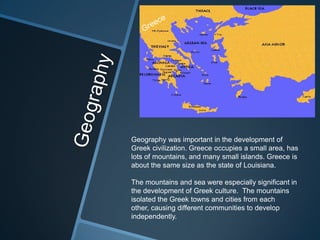

Geography was important in the development of
Greek civilization. Greece occupies a small area, has
lots of mountains, and many small islands. Greece is
about the same size as the state of Louisiana.

The mountains and sea were especially significant in
the development of Greek culture. The mountains
isolated the Greek towns and cities from each
other, causing different communities to develop
independently.
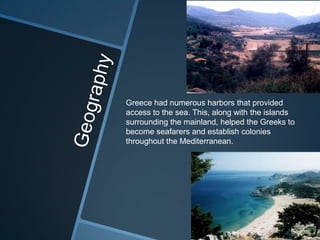
Greece had numerous harbors that provided
access to the sea. This, along with the islands
surrounding the mainland, helped the Greeks to
become seafarers and establish colonies
throughout the Mediterranean.
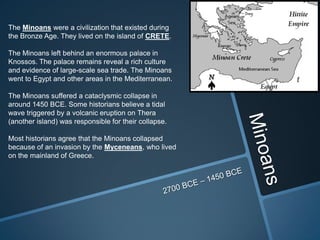
The Minoans were a civilization that existed during
the Bronze Age. They lived on the island of CRETE.

The Minoans left behind an enormous palace in
Knossos. The palace remains reveal a rich culture
and evidence of large-scale sea trade. The Minoans
went to Egypt and other areas in the Mediterranean.

The Minoans suffered a cataclysmic collapse in
around 1450 BCE. Some historians believe a tidal
wave triggered by a volcanic eruption on Thera
(another island) was responsible for their collapse.

Most historians agree that the Minoans collapsed
because of an invasion by the Myceneans, who lived
on the mainland of Greece.
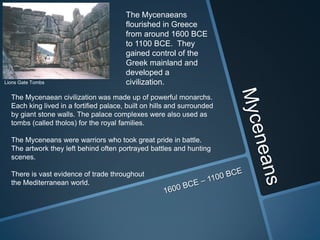
The Mycenaeans
                                        flourished in Greece
                                        from around 1600 BCE
                                        to 1100 BCE. They
                                        gained control of the
                                        Greek mainland and
                                        developed a
Lions Gate Tombs                        civilization.
  The Mycenaean civilization was made up of powerful monarchs.
  Each king lived in a fortified palace, built on hills and surrounded
  by giant stone walls. The palace complexes were also used as
  tombs (called tholos) for the royal families.

  The Myceneans were warriors who took great pride in battle.
  The artwork they left behind often portrayed battles and hunting
  scenes.

  There is vast evidence of trade throughout
  the Mediterranean world.
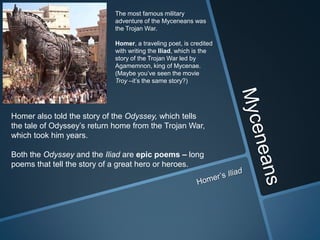
The most famous military
                            adventure of the Myceneans was
                            the Trojan War.

                            Homer, a traveling poet, is credited
                            with writing the Iliad, which is the
                            story of the Trojan War led by
                            Agamemnon, king of Mycenae.
                            (Maybe you’ve seen the movie
                            Troy –it’s the same story?)


Homer also told the story of the Odyssey, which tells
the tale of Odyssey’s return home from the Trojan War,
which took him years.

Both the Odyssey and the Iliad are epic poems – long
poems that tell the story of a great hero or heroes.
From 1100 BCE to around 750 BCE, Greece
experienced a “dark age,” called such because few
records exist of this time period.

During the Dark Age, large numbers of Greeks left the
mainland and sailed to the islands around Greece or to
Ionia in Asia minor (modern day Turkey).

Two major groups of Greeks settled in already
established areas – the Aeolian Greeks and the Dorian
Greeks. Trade was revived and iron began to be used to
make weapons and tools.

Sometime during the 8th century BCE, the Greeks
adopted the Phoenician alphabet, giving themselves a
new system of writing.

Homer’s works appeared at the end of the Dark Age, and
taught the Greeks important values to their culture –
courage, honor, and excellence (called arete).
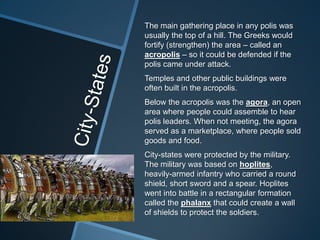
The main gathering place in any polis was
usually the top of a hill. The Greeks would
fortify (strengthen) the area – called an
acropolis – so it could be defended if the
polis came under attack.
Temples and other public buildings were
often built in the acropolis.
Below the acropolis was the agora, an open
area where people could assemble to hear
polis leaders. When not meeting, the agora
served as a marketplace, where people sold
goods and food.
City-states were protected by the military.
The military was based on hoplites,
heavily-armed infantry who carried a round
shield, short sword and a spear. Hoplites
went into battle in a rectangular formation
called the phalanx that could create a wall
of shields to protect the soldiers.
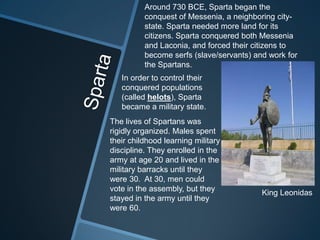
Around 730 BCE, Sparta began the
          conquest of Messenia, a neighboring city-
          state. Sparta needed more land for its
          citizens. Sparta conquered both Messenia
          and Laconia, and forced their citizens to
          become serfs (slave/servants) and work for
          the Spartans.
   In order to control their
   conquered populations
   (called helots), Sparta
   became a military state.
The lives of Spartans was
rigidly organized. Males spent
their childhood learning military
discipline. They enrolled in the
army at age 20 and lived in the
military barracks until they
were 30. At 30, men could
vote in the assembly, but they            King Leonidas
stayed in the army until they
were 60.
The Spartan government was headed by two
kings who led the army on their campaings.

A group of five men known as the ephors
were elected each year and were responsible
for the education of youth and the conduct of
the citizens.

A council of elders, composed of the two kings
and 28 citizens over the age of 60, decided on
the issues that would be presented to the
assembly. The assembly, made up of male
citizens, did not debate, they only voted on
the issues.

The Spartans were an isolated society; they
discouraged foreigners from visiting and did
not allow their citizens to travel (unless it was
with the military). Spartan citizens did not
study philosophy, literature or the arts. They
studied the art of war and the military ideal.
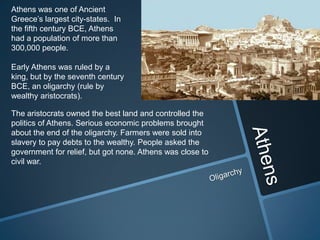
Athens was one of Ancient
Greece’s largest city-states. In
the fifth century BCE, Athens
had a population of more than
300,000 people.

Early Athens was ruled by a
king, but by the seventh century
BCE, an oligarchy (rule by
wealthy aristocrats).

The aristocrats owned the best land and controlled the
politics of Athens. Serious economic problems brought
about the end of the oligarchy. Farmers were sold into
slavery to pay debts to the wealthy. People asked the
government for relief, but got none. Athens was close to
civil war.
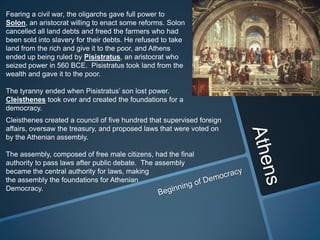
Fearing a civil war, the oligarchs gave full power to
Solon, an aristocrat willing to enact some reforms. Solon
cancelled all land debts and freed the farmers who had
been sold into slavery for their debts. He refused to take
land from the rich and give it to the poor, and Athens
ended up being ruled by Pisistratus, an aristocrat who
seized power in 560 BCE. Pisistratus took land from the
wealth and gave it to the poor.

The tyranny ended when Pisistratus’ son lost power.
Cleisthenes took over and created the foundations for a
democracy.
Cleisthenes created a council of five hundred that supervised foreign
affairs, oversaw the treasury, and proposed laws that were voted on
by the Athenian assembly.

The assembly, composed of free male citizens, had the final
authority to pass laws after public debate. The assembly
became the central authority for laws, making
the assembly the foundations for Athenian
Democracy.
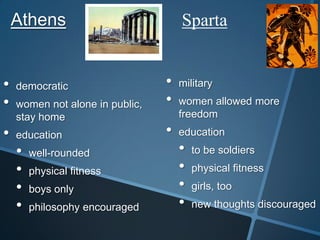
Athens                           Sparta


•   democratic                   •   military
•   women not alone in public,   •   women allowed more
    stay home                        freedom
•   education                    •   education
    •   well-rounded                 •   to be soldiers
    •   physical fitness             •   physical fitness
    •   boys only                    •   girls, too
    •   philosophy encouraged        •   new thoughts discouraged

Ancient greece

  • 2.
    Geography was importantin the development of Greek civilization. Greece occupies a small area, has lots of mountains, and many small islands. Greece is about the same size as the state of Louisiana. The mountains and sea were especially significant in the development of Greek culture. The mountains isolated the Greek towns and cities from each other, causing different communities to develop independently.
  • 3.
    Greece had numerousharbors that provided access to the sea. This, along with the islands surrounding the mainland, helped the Greeks to become seafarers and establish colonies throughout the Mediterranean.
  • 4.
    The Minoans werea civilization that existed during the Bronze Age. They lived on the island of CRETE. The Minoans left behind an enormous palace in Knossos. The palace remains reveal a rich culture and evidence of large-scale sea trade. The Minoans went to Egypt and other areas in the Mediterranean. The Minoans suffered a cataclysmic collapse in around 1450 BCE. Some historians believe a tidal wave triggered by a volcanic eruption on Thera (another island) was responsible for their collapse. Most historians agree that the Minoans collapsed because of an invasion by the Myceneans, who lived on the mainland of Greece.
  • 5.
    The Mycenaeans flourished in Greece from around 1600 BCE to 1100 BCE. They gained control of the Greek mainland and developed a Lions Gate Tombs civilization. The Mycenaean civilization was made up of powerful monarchs. Each king lived in a fortified palace, built on hills and surrounded by giant stone walls. The palace complexes were also used as tombs (called tholos) for the royal families. The Myceneans were warriors who took great pride in battle. The artwork they left behind often portrayed battles and hunting scenes. There is vast evidence of trade throughout the Mediterranean world.
  • 6.
    The most famousmilitary adventure of the Myceneans was the Trojan War. Homer, a traveling poet, is credited with writing the Iliad, which is the story of the Trojan War led by Agamemnon, king of Mycenae. (Maybe you’ve seen the movie Troy –it’s the same story?) Homer also told the story of the Odyssey, which tells the tale of Odyssey’s return home from the Trojan War, which took him years. Both the Odyssey and the Iliad are epic poems – long poems that tell the story of a great hero or heroes.
  • 7.
    From 1100 BCEto around 750 BCE, Greece experienced a “dark age,” called such because few records exist of this time period. During the Dark Age, large numbers of Greeks left the mainland and sailed to the islands around Greece or to Ionia in Asia minor (modern day Turkey). Two major groups of Greeks settled in already established areas – the Aeolian Greeks and the Dorian Greeks. Trade was revived and iron began to be used to make weapons and tools. Sometime during the 8th century BCE, the Greeks adopted the Phoenician alphabet, giving themselves a new system of writing. Homer’s works appeared at the end of the Dark Age, and taught the Greeks important values to their culture – courage, honor, and excellence (called arete).
  • 10.
    The main gatheringplace in any polis was usually the top of a hill. The Greeks would fortify (strengthen) the area – called an acropolis – so it could be defended if the polis came under attack. Temples and other public buildings were often built in the acropolis. Below the acropolis was the agora, an open area where people could assemble to hear polis leaders. When not meeting, the agora served as a marketplace, where people sold goods and food. City-states were protected by the military. The military was based on hoplites, heavily-armed infantry who carried a round shield, short sword and a spear. Hoplites went into battle in a rectangular formation called the phalanx that could create a wall of shields to protect the soldiers.
  • 11.
    Around 730 BCE,Sparta began the conquest of Messenia, a neighboring city- state. Sparta needed more land for its citizens. Sparta conquered both Messenia and Laconia, and forced their citizens to become serfs (slave/servants) and work for the Spartans. In order to control their conquered populations (called helots), Sparta became a military state. The lives of Spartans was rigidly organized. Males spent their childhood learning military discipline. They enrolled in the army at age 20 and lived in the military barracks until they were 30. At 30, men could vote in the assembly, but they King Leonidas stayed in the army until they were 60.
  • 13.
    The Spartan governmentwas headed by two kings who led the army on their campaings. A group of five men known as the ephors were elected each year and were responsible for the education of youth and the conduct of the citizens. A council of elders, composed of the two kings and 28 citizens over the age of 60, decided on the issues that would be presented to the assembly. The assembly, made up of male citizens, did not debate, they only voted on the issues. The Spartans were an isolated society; they discouraged foreigners from visiting and did not allow their citizens to travel (unless it was with the military). Spartan citizens did not study philosophy, literature or the arts. They studied the art of war and the military ideal.
  • 14.
    Athens was oneof Ancient Greece’s largest city-states. In the fifth century BCE, Athens had a population of more than 300,000 people. Early Athens was ruled by a king, but by the seventh century BCE, an oligarchy (rule by wealthy aristocrats). The aristocrats owned the best land and controlled the politics of Athens. Serious economic problems brought about the end of the oligarchy. Farmers were sold into slavery to pay debts to the wealthy. People asked the government for relief, but got none. Athens was close to civil war.
  • 15.
    Fearing a civilwar, the oligarchs gave full power to Solon, an aristocrat willing to enact some reforms. Solon cancelled all land debts and freed the farmers who had been sold into slavery for their debts. He refused to take land from the rich and give it to the poor, and Athens ended up being ruled by Pisistratus, an aristocrat who seized power in 560 BCE. Pisistratus took land from the wealth and gave it to the poor. The tyranny ended when Pisistratus’ son lost power. Cleisthenes took over and created the foundations for a democracy. Cleisthenes created a council of five hundred that supervised foreign affairs, oversaw the treasury, and proposed laws that were voted on by the Athenian assembly. The assembly, composed of free male citizens, had the final authority to pass laws after public debate. The assembly became the central authority for laws, making the assembly the foundations for Athenian Democracy.
  • 17.
    Athens Sparta • democratic • military • women not alone in public, • women allowed more stay home freedom • education • education • well-rounded • to be soldiers • physical fitness • physical fitness • boys only • girls, too • philosophy encouraged • new thoughts discouraged