An Age of Empires: Rome and Han China 753 B.C.E. – 330 C.E.
Rome’s Creation of a Mediterranean Empire 753 B.C.E. – 300 C.E.
Geography Italy and Sicily are at a crossroads in the Mediterranean Serve as a link between Africa and Europe Rome located at a crossroads of the Italian Peninsula
Resources Navigable rivers Forests Iron Mild climate Arable land to support a large population of farmers
Founding of Rome – Legend
Founding of Rome – Fact Rome was inhabited at early as 1000 B.C.E. Ruled by 7 kings between 753 and 507 B.C.E. Representatives of senatorial class of large landowners overthrew kings and established a government.
A Republic of Farmers Centers of political power: 2 Consuls Senate Senate made laws and governed
Family Structure in Rome Several generations living together Oldest living male,  paterfamilias , had absolute authority Roman women had more freedom of Greek women, but they were subordinate to the  paterfamilias. Women eventually became independent after the death of their fathers.
Gods in Rome Worshipped a large number of supernatural spirits. Major gods – Jupiter and Mars. Proper performance of ritual ensured gods would favor Roman state. Jupiter Mars
Roman Expansion Slowly expanded, then expanded very rapidly in the third and second centuries B.C.E. Explanations for Expansion: Greed Aggressiveness Need for consuls to prove themselves as military commanders Constant fear of being attacked
First Stage of Expansion Rome conquered rest of Italy by 290 B.C.E. Won support of Italian people by giving them Roman citizenship. Once citizens, they had to provide soldiers for the military.
Taking Over Rome defeated Carthage to gain control over western Mediterranean and Sicily, Sardinia, and Spain. 200 – 30 B.C.E. – Rome defeated Hellenistic kingdoms to take over Eastern Mediterranean. 59 – 51 B.C.E., Gaius Julius Caesar conquered Celts of Gaul.
Map of Roman Empire
Administration Used elite groups to administer and tax various province of the empire. A governor supervised local administrators. Served a single one-year term in office System was inadequate and prone to corruption.
Failure of the Republic As Rome expanded, the social and economic bases of republic were undermined. Independent farming families had to serve in military. They sold their land while they were serving in the military.  Land was bought by large landowners.
Latifundia Great estates built by large landowners. This caused problems for Rome because  latifundia  owners preferred cash crops like grapes instead of staple crops like wheat. Since slave labor was cheap, there was not a great need for peasant farmers. This created an unemployed underclass in urban areas.
A Lack of Soldiers Because there were less farmers to enlist as soldiers, the unemployed became soldiers. These soldiers tended to pledge loyalty to commanding officer, not Rome.  Generals took control of politics leading to civil war and the end of the republican system of government.
An Urban Empire Roman Empire had population of 50-60 million. Rome had population of 1 million. Alexandria, Antioch, and Carthage had populations of almost 1 million each. 80% of the Roman Empire were rural farmers. Considered an urban empire because of the administration through a network of cities and towns.
Life in Ancient Rome Upper classes lived in elegant, well-built, well-appointed houses. Many aristocrats also owned country villas Poor lived in dark, dank, fire-prone wooden tenements in squalid slums built in low-lying parts of the city.
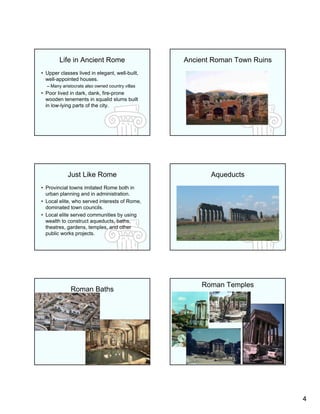
Ancient Roman Town Ruins
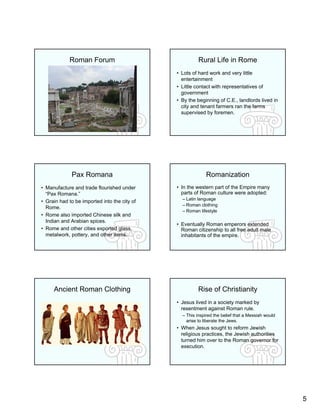
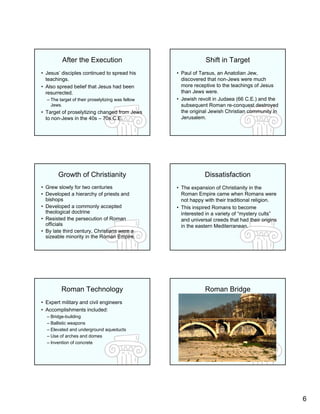
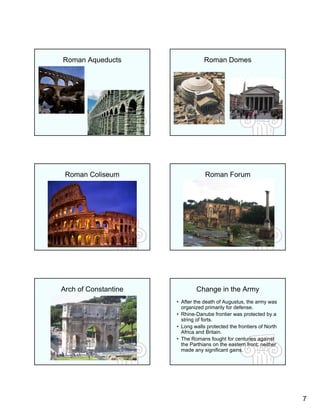
Just Like Rome Provincial towns imitated Rome both in urban planning and in administration. Local elite, who served interests of Rome, dominated town councils. Local elite served communities by using wealth to construct aqueducts, baths, theatres, gardens, temples, and other public works projects.
Aqueducts
Roman Baths
Roman Temples
Roman Forum
Rural Life in Rome Lots of hard work and very little entertainment Little contact with representatives of government By the beginning of C.E., landlords lived in city and tenant farmers ran the farms supervised by foremen.
Pax Romana Manufacture and trade flourished under “Pax Romana.” Grain had to be imported into the city of Rome. Rome also imported Chinese silk and Indian and Arabian spices. Rome and other cities exported glass, metalwork, pottery, and other items.
Romanization In the western part of the Empire many parts of Roman culture were adopted: Latin language Roman clothing Roman lifestyle Eventually Roman emperors extended Roman citizenship to all free adult male inhabitants of the empire.
Ancient Roman Clothing
Rise of Christianity Jesus lived in a society marked by resentment against Roman rule. This inspired the belief that a Messiah would arise to liberate the Jews. When Jesus sought to reform Jewish religious practices, the Jewish authorities turned him over to the Roman governor for execution.
After the Execution Jesus’ disciples continued to spread his teachings. Also spread belief that Jesus had been resurrected. The target of their proselytizing was fellow Jews. Target of proselytizing changed from Jews to non-Jews in the 40s – 70s C.E.
Shift in Target Paul of Tarsus, an Anatolian Jew, discovered that non-Jews were much more receptive to the teachings of Jesus than Jews were. Jewish revolt in Judaea (66 C.E.) and the subsequent Roman re-conquest destroyed the original Jewish Christian community in Jerusalem.
Growth of Christianity Grew slowly for two centuries Developed a hierarchy of priests and bishops Developed a commonly accepted theological doctrine Resisted the persecution of Roman officials By late third century, Christians were a sizeable minority in the Roman Empire.
Dissatisfaction The expansion of Christianity in the Roman Empire came when Romans were not happy with their traditional religion. This inspired Romans to become interested in a variety of “mystery cults” and universal creeds that had their origins in the eastern Mediterranean.
Roman Technology Expert military and civil engineers Accomplishments included: Bridge-building Ballistic weapons Elevated and underground aqueducts Use of arches and domes Invention of concrete
Roman Bridge
Roman Aqueducts
Roman Domes
Roman Coliseum
Roman Forum
Change in the Army After the death of Augustus, the army was organized primarily for defense. Rhine-Danube frontier was protected by a string of forts. Long walls protected the frontiers of North Africa and Britain. The Romans fought for centuries against the Parthians on the eastern front; neither made any significant gains.
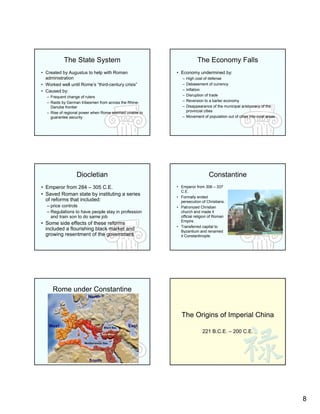
The State System Created by Augustus to help with Roman administration Worked well until Rome’s “third-century crisis” Caused by: Frequent change of rulers Raids by German tribesmen from across the Rhine-Danube frontier Rise of regional power when Rome seemed unable to guarantee security
The Economy Falls Economy undermined by: High cost of defense Debasement of currency Inflation Disruption of trade Reversion to a barter economy Disappearance of the municipal aristocracy of the provincial cities Movement of population out of cities into rural areas
Diocletian Emperor from 284 – 305 C.E. Saved Roman state by instituting a series of reforms that included: price controls Regulations to have people stay in profession and train son to do same job Some side effects of these reforms included a flourishing black market and growing resentment of the government.
Constantine Emperor from 306 – 337 C.E. Formally ended persecution of Christians. Patronized Christian church and made it official religion of Roman Empire. Transferred capital to Byzantium and renamed it Constantinople.
Rome under Constantine
Arch of Constantine
The Origins of Imperial China 221 B.C.E. – 200 C.E.
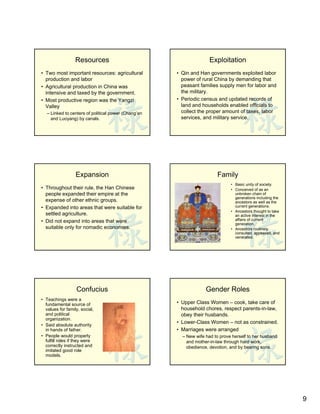
Resources Two most important resources: agricultural production and labor Agricultural production in China was intensive and taxed by the government. Most productive region was the Yangzi Valley Linked to centers of political power (Chang’an and Luoyang) by canals.
Exploitation Qin and Han governments exploited labor power of rural China by demanding that peasant families supply men for labor and the military. Periodic census and updated records of land and households enabled officials to collect the proper amount of taxes, labor services, and military service.
Expansion Throughout their rule, the Han Chinese people expanded their empire at the expense of other ethnic groups. Expanded into areas that were suitable for settled agriculture. Did not expand into areas that were suitable only for nomadic economies.
Family Basic unity of society. Conceived of as an unbroken chain of generations including the ancestors as well as the current generations. Ancestors thought to take an active interest in the affairs of current generation. Ancestors routinely consulted, appeased, and venerated.
Confucius Teachings were a fundamental source of values for family, social, and political organization. Said absolute authority in hands of father. People would properly fulfill roles if they were correctly instructed and imitated good role models.
Gender Roles Upper Class Women – cook, take care of household chores, respect parents-in-law, obey their husbands. Lower-Class Women – not as constrained. Marriages were arranged New wife had to prove herself to her husband and mother-in-law through hard work, obedience, devotion, and by bearing sons.
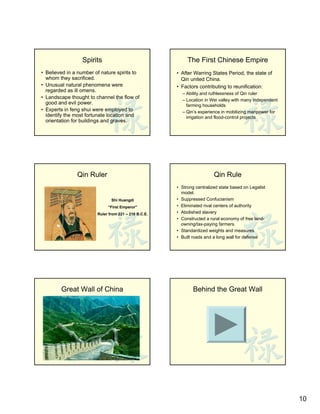
Spirits Believed in a number of nature spirits to whom they sacrificed. Unusual natural phenomena were regarded as ill omens. Landscape thought to channel the flow of good and evil power. Experts in feng shui were employed to identify the most fortunate location and orientation for buildings and graves.
The First Chinese Empire After Warring States Period, the state of Qin united China. Factors contributing to reunification: Ability and ruthlessness of Qin ruler Location in Wei valley with many independent farming households Qin’s experience in mobilizing manpower for irrigation and flood-control projects
Qin Ruler Shi Huangdi “ First Emperor” Ruler from 221 – 210 B.C.E.
Qin Rule Strong centralized state based on Legalist model. Suppressed Confucianism Eliminated rival centers of authority Abolished slavery Constructed a rural economy of free land-owning/tax-paying farmers. Standardized weights and measures Built roads and a long wall for defense
Great Wall of China
Behind the Great Wall
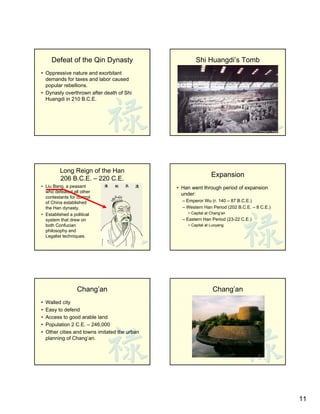
Defeat of the Qin Dynasty Oppressive nature and exorbitant demands for taxes and labor caused popular rebellions. Dynasty overthrown after death of Shi Huangdi in 210 B.C.E.
Shi Huangdi’s Tomb
Long Reign of the Han 206 B.C.E. – 220 C.E. Liu Bang, a peasant who defeated all other contestants for control of China established the Han dynasty. Established a political system that drew on both Confucian philosophy and Legalist techniques.
Expansion Han went through period of expansion under: Emperor Wu (r. 140 – 87 B.C.E.) Western Han Period (202 B.C.E. – 8 C.E.) Capital at Chang’an Eastern Han Period (23-22 C.E.) Capital at Luoyang
Chang’an Walled city Easy to defend Access to good arable land Population 2 C.E. – 246,000 Other cities and towns imitated the urban planning of Chang’an.
Chang’an
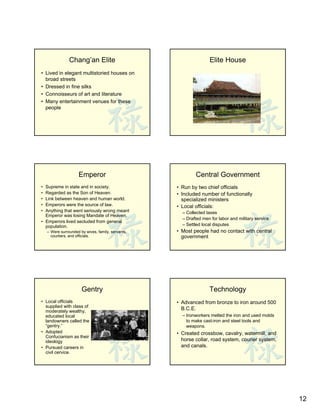
Chang’an Elite Lived in elegant multistoried houses on broad streets Dressed in fine silks Connoisseurs of art and literature Many entertainment venues for these people
Elite House
Emperor Supreme in state and in society. Regarded as the Son of Heaven. Link between heaven and human world. Emperors were the source of law. Anything that went seriously wrong meant Emperor was losing Mandate of Heaven. Emperors lived secluded from general population. Were surrounded by wives, family, servants, courtiers, and officials.
Central Government Run by two chief officials Included number of functionally specialized ministers Local officials: Collected taxes Drafted men for labor and military service Settled local disputes Most people had no contact with central government
Gentry Local officials supplied with class of moderately wealthy, educated local landowners called the “gentry.” Adopted Confucianism as their ideology Pursued careers in civil cervice.
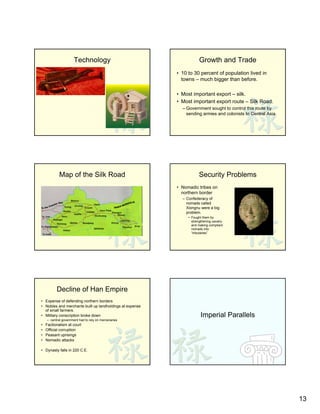
Technology Advanced from bronze to iron around 500 B.C.E. Ironworkers melted the iron and used molds to make cast-iron and steel tools and weapons. Created crossbow, cavalry, watermill, and horse collar, road system, courier system, and canals.
Technology
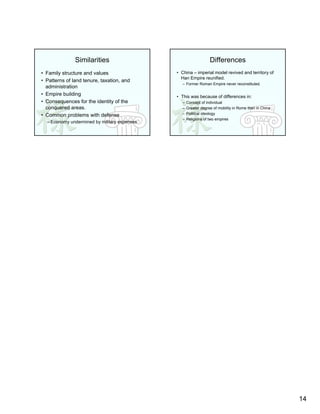
Growth and Trade 10 to 30 percent of population lived in towns – much bigger than before. Most important export – silk. Most important export route – Silk Road. Government sought to control this route by sending armies and colonists to Central Asia.
Map of the Silk Road
Security Problems Nomadic tribes on northern border Confederacy of nomads called Xiongnu were a big problem. Fought them by strengthening cavalry and making compliant nomads into “tributaries”
Decline of Han Empire Expense of defending northern borders Nobles and merchants built up landholdings at expense of small farmers. Military conscription broke down central government had to rely on mercenaries Factionalism at court Official corruption Peasant uprisings Nomadic attacks Dynasty falls in 220 C.E.
Imperial Parallels
Similarities Family structure and values Patterns of land tenure, taxation, and administration Empire building Consequences for the identity of the conquered areas. Common problems with defense Economy undermined by military expenses
Differences China – imperial model revived and territory of Han Empire reunified. Former Roman Empire never reconstituted. This was because of differences in: Concept of individual Greater degree of mobility in Rome than in China Political ideology Religions of two empires

AP WH Chapter 05 PPT

  • 1.
    An Age ofEmpires: Rome and Han China 753 B.C.E. – 330 C.E.
  • 2.
    Rome’s Creation ofa Mediterranean Empire 753 B.C.E. – 300 C.E.
  • 3.
    Geography Italy andSicily are at a crossroads in the Mediterranean Serve as a link between Africa and Europe Rome located at a crossroads of the Italian Peninsula
  • 4.
    Resources Navigable riversForests Iron Mild climate Arable land to support a large population of farmers
  • 5.
    Founding of Rome– Legend
  • 6.
    Founding of Rome– Fact Rome was inhabited at early as 1000 B.C.E. Ruled by 7 kings between 753 and 507 B.C.E. Representatives of senatorial class of large landowners overthrew kings and established a government.
  • 7.
    A Republic ofFarmers Centers of political power: 2 Consuls Senate Senate made laws and governed
  • 8.
    Family Structure inRome Several generations living together Oldest living male, paterfamilias , had absolute authority Roman women had more freedom of Greek women, but they were subordinate to the paterfamilias. Women eventually became independent after the death of their fathers.
  • 9.
    Gods in RomeWorshipped a large number of supernatural spirits. Major gods – Jupiter and Mars. Proper performance of ritual ensured gods would favor Roman state. Jupiter Mars
  • 10.
    Roman Expansion Slowlyexpanded, then expanded very rapidly in the third and second centuries B.C.E. Explanations for Expansion: Greed Aggressiveness Need for consuls to prove themselves as military commanders Constant fear of being attacked
  • 11.
    First Stage ofExpansion Rome conquered rest of Italy by 290 B.C.E. Won support of Italian people by giving them Roman citizenship. Once citizens, they had to provide soldiers for the military.
  • 12.
    Taking Over Romedefeated Carthage to gain control over western Mediterranean and Sicily, Sardinia, and Spain. 200 – 30 B.C.E. – Rome defeated Hellenistic kingdoms to take over Eastern Mediterranean. 59 – 51 B.C.E., Gaius Julius Caesar conquered Celts of Gaul.
  • 13.
  • 14.
    Administration Used elitegroups to administer and tax various province of the empire. A governor supervised local administrators. Served a single one-year term in office System was inadequate and prone to corruption.
  • 15.
    Failure of theRepublic As Rome expanded, the social and economic bases of republic were undermined. Independent farming families had to serve in military. They sold their land while they were serving in the military. Land was bought by large landowners.
  • 16.
    Latifundia Great estatesbuilt by large landowners. This caused problems for Rome because latifundia owners preferred cash crops like grapes instead of staple crops like wheat. Since slave labor was cheap, there was not a great need for peasant farmers. This created an unemployed underclass in urban areas.
  • 17.
    A Lack ofSoldiers Because there were less farmers to enlist as soldiers, the unemployed became soldiers. These soldiers tended to pledge loyalty to commanding officer, not Rome. Generals took control of politics leading to civil war and the end of the republican system of government.
  • 18.
    An Urban EmpireRoman Empire had population of 50-60 million. Rome had population of 1 million. Alexandria, Antioch, and Carthage had populations of almost 1 million each. 80% of the Roman Empire were rural farmers. Considered an urban empire because of the administration through a network of cities and towns.
  • 19.
    Life in AncientRome Upper classes lived in elegant, well-built, well-appointed houses. Many aristocrats also owned country villas Poor lived in dark, dank, fire-prone wooden tenements in squalid slums built in low-lying parts of the city.
  • 20.
  • 21.
    Just Like RomeProvincial towns imitated Rome both in urban planning and in administration. Local elite, who served interests of Rome, dominated town councils. Local elite served communities by using wealth to construct aqueducts, baths, theatres, gardens, temples, and other public works projects.
  • 22.
  • 23.
  • 24.
  • 25.
  • 26.
    Rural Life inRome Lots of hard work and very little entertainment Little contact with representatives of government By the beginning of C.E., landlords lived in city and tenant farmers ran the farms supervised by foremen.
  • 27.
    Pax Romana Manufactureand trade flourished under “Pax Romana.” Grain had to be imported into the city of Rome. Rome also imported Chinese silk and Indian and Arabian spices. Rome and other cities exported glass, metalwork, pottery, and other items.
  • 28.
    Romanization In thewestern part of the Empire many parts of Roman culture were adopted: Latin language Roman clothing Roman lifestyle Eventually Roman emperors extended Roman citizenship to all free adult male inhabitants of the empire.
  • 29.
  • 30.
    Rise of ChristianityJesus lived in a society marked by resentment against Roman rule. This inspired the belief that a Messiah would arise to liberate the Jews. When Jesus sought to reform Jewish religious practices, the Jewish authorities turned him over to the Roman governor for execution.
  • 31.
    After the ExecutionJesus’ disciples continued to spread his teachings. Also spread belief that Jesus had been resurrected. The target of their proselytizing was fellow Jews. Target of proselytizing changed from Jews to non-Jews in the 40s – 70s C.E.
  • 32.
    Shift in TargetPaul of Tarsus, an Anatolian Jew, discovered that non-Jews were much more receptive to the teachings of Jesus than Jews were. Jewish revolt in Judaea (66 C.E.) and the subsequent Roman re-conquest destroyed the original Jewish Christian community in Jerusalem.
  • 33.
    Growth of ChristianityGrew slowly for two centuries Developed a hierarchy of priests and bishops Developed a commonly accepted theological doctrine Resisted the persecution of Roman officials By late third century, Christians were a sizeable minority in the Roman Empire.
  • 34.
    Dissatisfaction The expansionof Christianity in the Roman Empire came when Romans were not happy with their traditional religion. This inspired Romans to become interested in a variety of “mystery cults” and universal creeds that had their origins in the eastern Mediterranean.
  • 35.
    Roman Technology Expertmilitary and civil engineers Accomplishments included: Bridge-building Ballistic weapons Elevated and underground aqueducts Use of arches and domes Invention of concrete
  • 36.
  • 37.
  • 38.
  • 39.
  • 40.
  • 41.
    Change in theArmy After the death of Augustus, the army was organized primarily for defense. Rhine-Danube frontier was protected by a string of forts. Long walls protected the frontiers of North Africa and Britain. The Romans fought for centuries against the Parthians on the eastern front; neither made any significant gains.
  • 42.
    The State SystemCreated by Augustus to help with Roman administration Worked well until Rome’s “third-century crisis” Caused by: Frequent change of rulers Raids by German tribesmen from across the Rhine-Danube frontier Rise of regional power when Rome seemed unable to guarantee security
  • 43.
    The Economy FallsEconomy undermined by: High cost of defense Debasement of currency Inflation Disruption of trade Reversion to a barter economy Disappearance of the municipal aristocracy of the provincial cities Movement of population out of cities into rural areas
  • 44.
    Diocletian Emperor from284 – 305 C.E. Saved Roman state by instituting a series of reforms that included: price controls Regulations to have people stay in profession and train son to do same job Some side effects of these reforms included a flourishing black market and growing resentment of the government.
  • 45.
    Constantine Emperor from306 – 337 C.E. Formally ended persecution of Christians. Patronized Christian church and made it official religion of Roman Empire. Transferred capital to Byzantium and renamed it Constantinople.
  • 46.
  • 47.
  • 48.
    The Origins ofImperial China 221 B.C.E. – 200 C.E.
  • 49.
    Resources Two mostimportant resources: agricultural production and labor Agricultural production in China was intensive and taxed by the government. Most productive region was the Yangzi Valley Linked to centers of political power (Chang’an and Luoyang) by canals.
  • 50.
    Exploitation Qin andHan governments exploited labor power of rural China by demanding that peasant families supply men for labor and the military. Periodic census and updated records of land and households enabled officials to collect the proper amount of taxes, labor services, and military service.
  • 51.
    Expansion Throughout theirrule, the Han Chinese people expanded their empire at the expense of other ethnic groups. Expanded into areas that were suitable for settled agriculture. Did not expand into areas that were suitable only for nomadic economies.
  • 52.
    Family Basic unityof society. Conceived of as an unbroken chain of generations including the ancestors as well as the current generations. Ancestors thought to take an active interest in the affairs of current generation. Ancestors routinely consulted, appeased, and venerated.
  • 53.
    Confucius Teachings werea fundamental source of values for family, social, and political organization. Said absolute authority in hands of father. People would properly fulfill roles if they were correctly instructed and imitated good role models.
  • 54.
    Gender Roles UpperClass Women – cook, take care of household chores, respect parents-in-law, obey their husbands. Lower-Class Women – not as constrained. Marriages were arranged New wife had to prove herself to her husband and mother-in-law through hard work, obedience, devotion, and by bearing sons.
  • 55.
    Spirits Believed ina number of nature spirits to whom they sacrificed. Unusual natural phenomena were regarded as ill omens. Landscape thought to channel the flow of good and evil power. Experts in feng shui were employed to identify the most fortunate location and orientation for buildings and graves.
  • 56.
    The First ChineseEmpire After Warring States Period, the state of Qin united China. Factors contributing to reunification: Ability and ruthlessness of Qin ruler Location in Wei valley with many independent farming households Qin’s experience in mobilizing manpower for irrigation and flood-control projects
  • 57.
    Qin Ruler ShiHuangdi “ First Emperor” Ruler from 221 – 210 B.C.E.
  • 58.
    Qin Rule Strongcentralized state based on Legalist model. Suppressed Confucianism Eliminated rival centers of authority Abolished slavery Constructed a rural economy of free land-owning/tax-paying farmers. Standardized weights and measures Built roads and a long wall for defense
  • 59.
  • 60.
  • 61.
    Defeat of theQin Dynasty Oppressive nature and exorbitant demands for taxes and labor caused popular rebellions. Dynasty overthrown after death of Shi Huangdi in 210 B.C.E.
  • 62.
  • 63.
    Long Reign ofthe Han 206 B.C.E. – 220 C.E. Liu Bang, a peasant who defeated all other contestants for control of China established the Han dynasty. Established a political system that drew on both Confucian philosophy and Legalist techniques.
  • 64.
    Expansion Han wentthrough period of expansion under: Emperor Wu (r. 140 – 87 B.C.E.) Western Han Period (202 B.C.E. – 8 C.E.) Capital at Chang’an Eastern Han Period (23-22 C.E.) Capital at Luoyang
  • 65.
    Chang’an Walled cityEasy to defend Access to good arable land Population 2 C.E. – 246,000 Other cities and towns imitated the urban planning of Chang’an.
  • 66.
  • 67.
    Chang’an Elite Livedin elegant multistoried houses on broad streets Dressed in fine silks Connoisseurs of art and literature Many entertainment venues for these people
  • 68.
  • 69.
    Emperor Supreme instate and in society. Regarded as the Son of Heaven. Link between heaven and human world. Emperors were the source of law. Anything that went seriously wrong meant Emperor was losing Mandate of Heaven. Emperors lived secluded from general population. Were surrounded by wives, family, servants, courtiers, and officials.
  • 70.
    Central Government Runby two chief officials Included number of functionally specialized ministers Local officials: Collected taxes Drafted men for labor and military service Settled local disputes Most people had no contact with central government
  • 71.
    Gentry Local officialssupplied with class of moderately wealthy, educated local landowners called the “gentry.” Adopted Confucianism as their ideology Pursued careers in civil cervice.
  • 72.
    Technology Advanced frombronze to iron around 500 B.C.E. Ironworkers melted the iron and used molds to make cast-iron and steel tools and weapons. Created crossbow, cavalry, watermill, and horse collar, road system, courier system, and canals.
  • 73.
  • 74.
    Growth and Trade10 to 30 percent of population lived in towns – much bigger than before. Most important export – silk. Most important export route – Silk Road. Government sought to control this route by sending armies and colonists to Central Asia.
  • 75.
    Map of theSilk Road
  • 76.
    Security Problems Nomadictribes on northern border Confederacy of nomads called Xiongnu were a big problem. Fought them by strengthening cavalry and making compliant nomads into “tributaries”
  • 77.
    Decline of HanEmpire Expense of defending northern borders Nobles and merchants built up landholdings at expense of small farmers. Military conscription broke down central government had to rely on mercenaries Factionalism at court Official corruption Peasant uprisings Nomadic attacks Dynasty falls in 220 C.E.
  • 78.
  • 79.
    Similarities Family structureand values Patterns of land tenure, taxation, and administration Empire building Consequences for the identity of the conquered areas. Common problems with defense Economy undermined by military expenses
  • 80.
    Differences China –imperial model revived and territory of Han Empire reunified. Former Roman Empire never reconstituted. This was because of differences in: Concept of individual Greater degree of mobility in Rome than in China Political ideology Religions of two empires