Tropical Africa and Asia 1200-1500
Tropical Lands and Peoples
Tropical Environment Tropical zone between Tropic of Cancer and Tropic of Capricorn.  Afro-Asian tropics have a cycle of rainy and dry seasons dictated by winds known as monsoons. Tropical Zones have areas of abundant rainfall as well as arid zones.
Feeding a Population Human societies adopted different means of surviving in order to fit into the different ecological zones found in the tropics. Wild food and fish Herding and grain trade Farming of rice, wheat, sorghum, and millet Rice growing
Rainfall Tropics has an uneven distribution of rainfall during the year. In order to have year-round access to water, tropical farming societies constructed: Dams Irrigation canals Reservoirs
Managing Water Resources India, Cambodia, and Sri Lanka – governments used resources to construct and maintain large irrigation and water-control projects. These were not the smartest use of resources because they were vulnerable to natural disaster and political disruptions. Village-based irrigation systems were much more stable.
Mineral Resources Tropical peoples used iron for agricultural implements, weapons, and needles. Copper was used to make wire and decorative objects. Africa produced a great deal of gold.
Stability Metalworking and food-producing systems were very important at this time. Mobilized the labor of ordinary people in order to produce surpluses. This helped to support powerful states and profitable commercial systems.  Neither of these elite enterprises would have been possible without the work of ordinary people.
New Islamic Empires
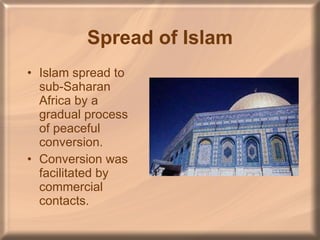
Spread of Islam Islam spread to sub-Saharan Africa by a gradual process of peaceful conversion. Conversion was facilitated by commercial contacts.
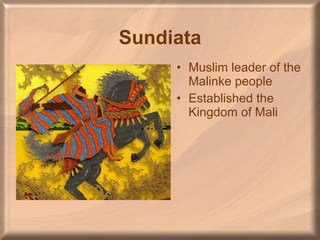
Sundiata Muslim leader of the Malinke people Established the Kingdom of Mali
Kingdom of Mali Economy rested on agriculture Supplemented by control of: regional and trans-Saharan trading routes Gold mines of the Niger headwaters
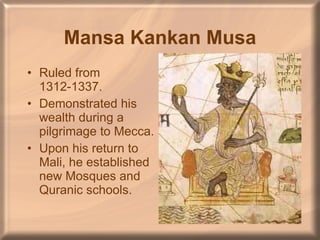
Mansa Kankan Musa Ruled from 1312-1337. Demonstrated his wealth during a pilgrimage to Mecca. Upon his return to Mali, he established new Mosques and Quranic schools.
Islam Comes to Timbuktu
Decline Kingdom declined and collapsed in the mid to late fifteenth century. Decline caused by: Rebellion from within Attacks from without Intellectual life and trade moved to other African states like the Hausa states and Kanem-Bornu
Division Between 1206 and 1236 the divided states of northwest India were defeated by violent Muslim Turkish conquerors. Led by Sultan Iltutmish Established Delhi Sultanate as a Muslim state Muslim elite settled down to rule India peacefully, but Hindu subjects never forgave the violence of the conquest.
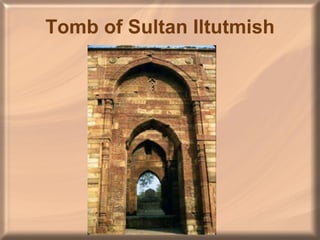
Tomb of Sultan Iltutmish
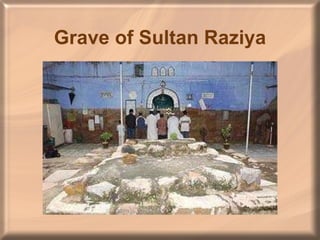
Raziya Iltutmmish passed throne to his daughter, Raziya. Very talented ruler Driven from office by men who were unwilling to accept a female monarch
Grave of Sultan Raziya
Ala-ud-din and Muhammad ibn Tughluq Carried out a policy of aggressive territorial expansion that was accompanied by a policy of religious toleration towards Hindus. This policy was later reversed after their rules.
Delhi Sultans In general, they ruled by terror and were a burden on their subjects. In the mid-fourteenth century, internal rivalries and external threats undermined the stability of the Sultanate. Sultanate was destroyed when Timur sacked Delhi in 1398.
Indian Ocean Trade
Monsoon Mariners Indian Ocean trade increased between 1200 and 1500 Stimulated by the: prosperity of Latin Europe, Asian, and African states Collapse of overland trade routes
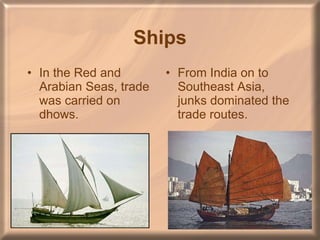
Ships In the Red and Arabian Seas, trade was carried on dhows. From India on to Southeast Asia, junks dominated the trade routes.
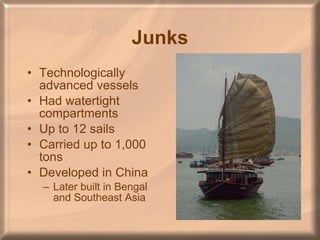
Junks Technologically advanced vessels Had watertight compartments Up to 12 sails Carried up to 1,000 tons Developed in China Later built in Bengal and Southeast Asia
Indian Ocean Trade Decentralized and cooperative Various regions were supplying particular goods In each region a certain port functioned as the major emporium for trade in which good from smaller ports were consolidated and shipped onward.
The Swahili Coast By 1500, there were 30 or 40 separate city-states along the East Africa coast participating in Indian Ocean trade. The people of these coastal cities, the “Swahili” people All spoke an African language enriched with Arabic and Persian vocabulary
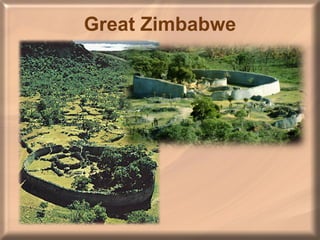
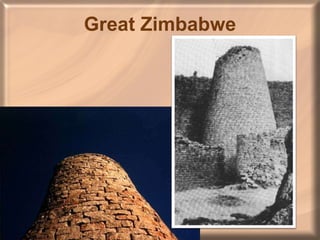
Zimbabwe Swahili cities, including Kilwa, were famous exporters of gold that was mined in or around the inland kingdom Capital was Great Zimbabwe Great Zimbabwe’s economy rested on agriculture, cattle herding, and trade. City declined due to an ecological crisis brought on by deforestation and overgrazing.
Great Zimbabwe
Great Zimbabwe
Zimbabwe
Arabia: Aden and the Red Sea Aden had enough rainfall to produce wheat for export and a location that made it a central transit point for trade in the Middle East. Aden’s merchants prospered on this trade and built a wealthy and impressive city. Common interest in trade allowed peoples to live in peace.  Christian Ethiopia fought with Muslims over control of Red Sea Trade
Gujarat State of Gujarat prospered from the Indian Ocean trade. Exported cotton textiles and indigo in return for gold and silver. Gujarat manufactured textiles, leather goods, carpets, silk, and other commodities. Gujarat’s overseas trade was dominated by Muslims, but Hindus also benefited.
Malabar Coast Calicut and other cities of the Malabar Coast exported cotton textiles and spices. Also served as clearing-houses for long-distance trade. Cities of the Malabar Coast were unified in a loose confederation whose rulers were tolerant of other religious and ethnic groups.
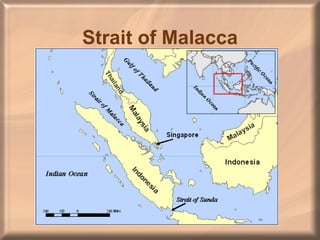
Rise of Malacca Strait of Malacca is the principal passage from the Indian Ocean to the South China Sea. In the fourteenth century a gang of Chinese pirates preyed upon the strait In 1407, the forces of the Ming dynasty crushed the Chinese pirates. Muslim ruler of Malacca took advantage of this to exert his domination over the strait.
Strait of Malacca
Societal and Social Change
Architecture Commercial contacts and spread of Islam led to a variety of social and cultural changes in which local cultures incorporated and changed ideas, customs, and architectural styles from other civilizations.
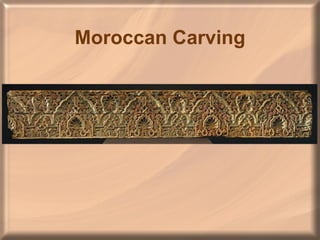
Moroccan Carving
Education Spread of Islam brought literacy to African peoples who learned Arabic Then they used Arabic script to write their own languages Indian literacy was already established, but the spread of Islam brought the development of a new Persian-influenced language (Urdu) and papermaking.
Further Study As Islam spread to Africa, India, and Southeast Asia, Islam also brought: Study of Islamic law and administration Greek science, mathematics, and medicine Timbuktu, Delhi, and Malacca were new centers of Islamic learning.
Religion Islam spread peacefully and forced conversions were rare. Muslim domination of trade contributed to the spread of Islam as merchants converted and traveled. Islamic destruction of the last center of Buddhism in India contributed to the spread of Islam in India. Islam brought social and cultural changes to the communities that were converted, but Islam changed as it developed in different societies.
Social Distinctions Gap between elites and common people widened in tropical societies as the wealthy urban elites prospered from the increased Indian Ocean trade.
Slavery Slavery increased in both Africa and in India. An estimated 2.5 million African slaves were exported across the Sahara and the Red Sea between 1200 and 1500, while more were shipped from the cities of the Swahili coast.
Slaves Most slaves were trained in specific skills Hereditary military slaves could become rich and powerful Other slaves worked hard at menial jobs like copper mining. Many women were employed as household workers and entertainers.  Large number of slaves meant the price was quite low.
Status of Women Early arranged marriage was the rule for Indian women and they were expected to obey strict rules of fidelity and chastity. Women’s status was generally determined by the status of their male masters. Women would cook, brew, spin thread, and work on farms.
Spread of Islam on Women Difficult to tell what effect the spread of Islam might have had on women. It is clear in some places, such as Mali, Muslims did not adopt the Arab practice of veiling and secluding women.

AP WH Chap 13

  • 1.
    Tropical Africa andAsia 1200-1500
  • 2.
  • 3.
    Tropical Environment Tropicalzone between Tropic of Cancer and Tropic of Capricorn. Afro-Asian tropics have a cycle of rainy and dry seasons dictated by winds known as monsoons. Tropical Zones have areas of abundant rainfall as well as arid zones.
  • 4.
    Feeding a PopulationHuman societies adopted different means of surviving in order to fit into the different ecological zones found in the tropics. Wild food and fish Herding and grain trade Farming of rice, wheat, sorghum, and millet Rice growing
  • 5.
    Rainfall Tropics hasan uneven distribution of rainfall during the year. In order to have year-round access to water, tropical farming societies constructed: Dams Irrigation canals Reservoirs
  • 6.
    Managing Water ResourcesIndia, Cambodia, and Sri Lanka – governments used resources to construct and maintain large irrigation and water-control projects. These were not the smartest use of resources because they were vulnerable to natural disaster and political disruptions. Village-based irrigation systems were much more stable.
  • 7.
    Mineral Resources Tropicalpeoples used iron for agricultural implements, weapons, and needles. Copper was used to make wire and decorative objects. Africa produced a great deal of gold.
  • 8.
    Stability Metalworking andfood-producing systems were very important at this time. Mobilized the labor of ordinary people in order to produce surpluses. This helped to support powerful states and profitable commercial systems. Neither of these elite enterprises would have been possible without the work of ordinary people.
  • 9.
  • 10.
    Spread of IslamIslam spread to sub-Saharan Africa by a gradual process of peaceful conversion. Conversion was facilitated by commercial contacts.
  • 11.
    Sundiata Muslim leaderof the Malinke people Established the Kingdom of Mali
  • 12.
    Kingdom of MaliEconomy rested on agriculture Supplemented by control of: regional and trans-Saharan trading routes Gold mines of the Niger headwaters
  • 13.
    Mansa Kankan MusaRuled from 1312-1337. Demonstrated his wealth during a pilgrimage to Mecca. Upon his return to Mali, he established new Mosques and Quranic schools.
  • 14.
  • 15.
    Decline Kingdom declinedand collapsed in the mid to late fifteenth century. Decline caused by: Rebellion from within Attacks from without Intellectual life and trade moved to other African states like the Hausa states and Kanem-Bornu
  • 16.
    Division Between 1206and 1236 the divided states of northwest India were defeated by violent Muslim Turkish conquerors. Led by Sultan Iltutmish Established Delhi Sultanate as a Muslim state Muslim elite settled down to rule India peacefully, but Hindu subjects never forgave the violence of the conquest.
  • 17.
    Tomb of SultanIltutmish
  • 18.
    Raziya Iltutmmish passedthrone to his daughter, Raziya. Very talented ruler Driven from office by men who were unwilling to accept a female monarch
  • 19.
  • 20.
    Ala-ud-din and Muhammadibn Tughluq Carried out a policy of aggressive territorial expansion that was accompanied by a policy of religious toleration towards Hindus. This policy was later reversed after their rules.
  • 21.
    Delhi Sultans Ingeneral, they ruled by terror and were a burden on their subjects. In the mid-fourteenth century, internal rivalries and external threats undermined the stability of the Sultanate. Sultanate was destroyed when Timur sacked Delhi in 1398.
  • 22.
  • 23.
    Monsoon Mariners IndianOcean trade increased between 1200 and 1500 Stimulated by the: prosperity of Latin Europe, Asian, and African states Collapse of overland trade routes
  • 24.
    Ships In theRed and Arabian Seas, trade was carried on dhows. From India on to Southeast Asia, junks dominated the trade routes.
  • 25.
    Junks Technologically advancedvessels Had watertight compartments Up to 12 sails Carried up to 1,000 tons Developed in China Later built in Bengal and Southeast Asia
  • 26.
    Indian Ocean TradeDecentralized and cooperative Various regions were supplying particular goods In each region a certain port functioned as the major emporium for trade in which good from smaller ports were consolidated and shipped onward.
  • 27.
    The Swahili CoastBy 1500, there were 30 or 40 separate city-states along the East Africa coast participating in Indian Ocean trade. The people of these coastal cities, the “Swahili” people All spoke an African language enriched with Arabic and Persian vocabulary
  • 28.
    Zimbabwe Swahili cities,including Kilwa, were famous exporters of gold that was mined in or around the inland kingdom Capital was Great Zimbabwe Great Zimbabwe’s economy rested on agriculture, cattle herding, and trade. City declined due to an ecological crisis brought on by deforestation and overgrazing.
  • 29.
  • 30.
  • 31.
  • 32.
    Arabia: Aden andthe Red Sea Aden had enough rainfall to produce wheat for export and a location that made it a central transit point for trade in the Middle East. Aden’s merchants prospered on this trade and built a wealthy and impressive city. Common interest in trade allowed peoples to live in peace. Christian Ethiopia fought with Muslims over control of Red Sea Trade
  • 33.
    Gujarat State ofGujarat prospered from the Indian Ocean trade. Exported cotton textiles and indigo in return for gold and silver. Gujarat manufactured textiles, leather goods, carpets, silk, and other commodities. Gujarat’s overseas trade was dominated by Muslims, but Hindus also benefited.
  • 34.
    Malabar Coast Calicutand other cities of the Malabar Coast exported cotton textiles and spices. Also served as clearing-houses for long-distance trade. Cities of the Malabar Coast were unified in a loose confederation whose rulers were tolerant of other religious and ethnic groups.
  • 35.
    Rise of MalaccaStrait of Malacca is the principal passage from the Indian Ocean to the South China Sea. In the fourteenth century a gang of Chinese pirates preyed upon the strait In 1407, the forces of the Ming dynasty crushed the Chinese pirates. Muslim ruler of Malacca took advantage of this to exert his domination over the strait.
  • 36.
  • 37.
  • 38.
    Architecture Commercial contactsand spread of Islam led to a variety of social and cultural changes in which local cultures incorporated and changed ideas, customs, and architectural styles from other civilizations.
  • 39.
  • 40.
    Education Spread ofIslam brought literacy to African peoples who learned Arabic Then they used Arabic script to write their own languages Indian literacy was already established, but the spread of Islam brought the development of a new Persian-influenced language (Urdu) and papermaking.
  • 41.
    Further Study AsIslam spread to Africa, India, and Southeast Asia, Islam also brought: Study of Islamic law and administration Greek science, mathematics, and medicine Timbuktu, Delhi, and Malacca were new centers of Islamic learning.
  • 42.
    Religion Islam spreadpeacefully and forced conversions were rare. Muslim domination of trade contributed to the spread of Islam as merchants converted and traveled. Islamic destruction of the last center of Buddhism in India contributed to the spread of Islam in India. Islam brought social and cultural changes to the communities that were converted, but Islam changed as it developed in different societies.
  • 43.
    Social Distinctions Gapbetween elites and common people widened in tropical societies as the wealthy urban elites prospered from the increased Indian Ocean trade.
  • 44.
    Slavery Slavery increasedin both Africa and in India. An estimated 2.5 million African slaves were exported across the Sahara and the Red Sea between 1200 and 1500, while more were shipped from the cities of the Swahili coast.
  • 45.
    Slaves Most slaveswere trained in specific skills Hereditary military slaves could become rich and powerful Other slaves worked hard at menial jobs like copper mining. Many women were employed as household workers and entertainers. Large number of slaves meant the price was quite low.
  • 46.
    Status of WomenEarly arranged marriage was the rule for Indian women and they were expected to obey strict rules of fidelity and chastity. Women’s status was generally determined by the status of their male masters. Women would cook, brew, spin thread, and work on farms.
  • 47.
    Spread of Islamon Women Difficult to tell what effect the spread of Islam might have had on women. It is clear in some places, such as Mali, Muslims did not adopt the Arab practice of veiling and secluding women.