Google
Android
PRESENTED BY…
FAIQ ALI SAYED
What is Android???...
The Android operating system (OS) is widely used
within several types of embedded & mobile platforms, including
mobile phones and tablets, and the industry is exploring the
ability of Android within other embedded platforms, i.e.,
automotive or military, that require real-time guarantees and the
ability to meet deadlines as a pre-requisite for reliable operation.
In this paper, we present preliminary conclusions on Android’s
real-time behavior based on experimental measurements
performed on a commercially available Android platform.
Android – what it includes..?
• software stack for mobile devices
– incl. OS, middleware and key applications

•
•
•
•
•
•
•
•
•
•

Open source – source code is open and contributions are welcome
application framework enabling reuse/replacement of apps
Dalvik virtual machine optimized for mobile
integrated browser based on webkit
Optimized graphics – 2D graphics library, 3D based on OPEN GL ES
SQLite for data storage
Media support (MPEG4, H.264, MP3, AAC, JPG, PNG,…)
Support for radio interfaces, Bluetooth, WiFi, Camera, GPS, accelerometer
Software Development Kit (SDK)
Preinstalled applications from Google (GMS)
– Gmail, Maps, Search, Voice Search, Youtube
Android Software Updates
•
•
•
•
•
•

•
•
•
•

Android 1.0 – G1
1.5 – Cupcake
1.6 – Donuts (CDMA support)
2.0 – Éclair (Droid introduced with Éclair)
2.2 – Froyo
2.3 Gingerbread (SDK released 2 weeks ago and source
will follow soon)
4.0 IceCream Sandwich
4.1 Jelly beans
API Levels used by apps to identify software version on
the device
Android apps are generally forward compatible with
newer version, but not necessarily backwards
compatible
Android OS development
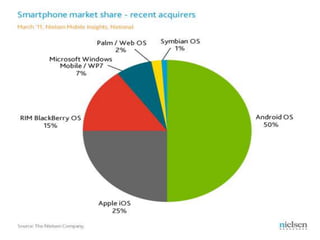
 Fastest growing mobile OS
Over 300,000 Android activations a
day
 Android overtook iOS as the dominant
OS in US during 2H 2010
 First phone launched HTC G1 in 2008
Currently an OS of choice for
Motorola, HTC, Samsung, Sony
Ericsson, among others
 Software updates every few months
Dalvik VM
• All applications written in Java and converted to
the dalvik executable .dex
• Every android app runs its own process, with its
own instance of the dalvik virtual machine
• Not a traditional JVM, but a custom VM designed
to run multiple instances efficiently on a single
device
• VM uses linux kernel to handle low-level
functionality incl. security, threading, process
and memory management
Android is part of the ‘build a better
phone’ process

Open Handset Alliance produces Android

Comprises handset manufacturers, software
firms, mobile operators, and other
manufactures and funding companies
Android applications have common
structure
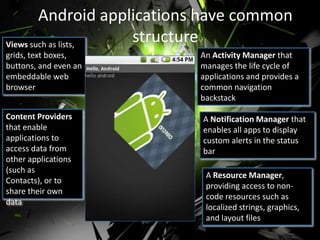
Views such as lists,
grids, text boxes,
buttons, and even an
embeddable web
browser

An Activity Manager that
manages the life cycle of
applications and provides a
common navigation
backstack

Content Providers
that enable
applications to
access data from
other applications
(such as
Contacts), or to
share their own
data

A Notification Manager that
enables all apps to display
custom alerts in the status
bar
A Resource Manager,
providing access to noncode resources such as
localized strings, graphics,
and layout files
Android applications have common
structure
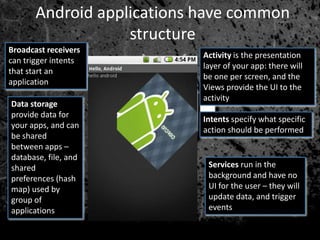
Broadcast receivers
can trigger intents
that start an
application
Data storage
provide data for
your apps, and can
be shared
between apps –
database, file, and
shared
preferences (hash
map) used by
group of
applications

Activity is the presentation
layer of your app: there will
be one per screen, and the
Views provide the UI to the
activity
Intents specify what specific
action should be performed

Services run in the
background and have no
UI for the user – they will
update data, and trigger
events
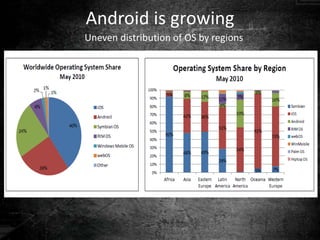
Android is growing
Uneven distribution of OS by regions
Security in Android

Each application runs in its own process
Process permissions are enforced at user
and group IDs assigned to processes
Finer grained permissions are then granted
(revoked) per operations
Android Market(Play Store)
• Google Market - Part of GMS apps
• 3rd party apps submitted to Google, approved and distributed through
Market
• Both Free and Paid apps
• Apps now limited to 50 MB; updates possible through Market
• Monetization through ads available
• Available in many countries, not all countries have support for paid apps
• Other Market place applications available – Amazon has announced its
own Android Market place
• App searches filtered based on Manifest file (eg. if a device does not
have trackball, apps using trackball will be filtered out)
• Every app publishes a list of components the app will access and
permissions need to be granted before installation
• Apps installed on device and SD card (SD Card from Froyo and in updated
versions)
Other possibilities in Android
• Voice Search available and enhanced in
recent releases
• Google TV - a new platform based on
Android
• Tablets –Tab introduced in Oct 2010
• Allows to create security-aware applications
to control employee devices
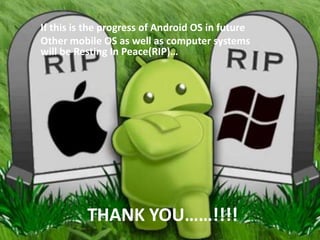
If this is the progress of Android OS in future
Other mobile OS as well as computer systems
will be Resting In Peace(RIP)…

THANK YOU……!!!!

Android Revolution

  • 1.
  • 2.
    What is Android???... TheAndroid operating system (OS) is widely used within several types of embedded & mobile platforms, including mobile phones and tablets, and the industry is exploring the ability of Android within other embedded platforms, i.e., automotive or military, that require real-time guarantees and the ability to meet deadlines as a pre-requisite for reliable operation. In this paper, we present preliminary conclusions on Android’s real-time behavior based on experimental measurements performed on a commercially available Android platform.
  • 3.
    Android – whatit includes..? • software stack for mobile devices – incl. OS, middleware and key applications • • • • • • • • • • Open source – source code is open and contributions are welcome application framework enabling reuse/replacement of apps Dalvik virtual machine optimized for mobile integrated browser based on webkit Optimized graphics – 2D graphics library, 3D based on OPEN GL ES SQLite for data storage Media support (MPEG4, H.264, MP3, AAC, JPG, PNG,…) Support for radio interfaces, Bluetooth, WiFi, Camera, GPS, accelerometer Software Development Kit (SDK) Preinstalled applications from Google (GMS) – Gmail, Maps, Search, Voice Search, Youtube
  • 4.
    Android Software Updates • • • • • • • • • • Android1.0 – G1 1.5 – Cupcake 1.6 – Donuts (CDMA support) 2.0 – Éclair (Droid introduced with Éclair) 2.2 – Froyo 2.3 Gingerbread (SDK released 2 weeks ago and source will follow soon) 4.0 IceCream Sandwich 4.1 Jelly beans API Levels used by apps to identify software version on the device Android apps are generally forward compatible with newer version, but not necessarily backwards compatible
  • 5.
    Android OS development Fastest growing mobile OS Over 300,000 Android activations a day  Android overtook iOS as the dominant OS in US during 2H 2010  First phone launched HTC G1 in 2008 Currently an OS of choice for Motorola, HTC, Samsung, Sony Ericsson, among others  Software updates every few months
  • 6.
    Dalvik VM • Allapplications written in Java and converted to the dalvik executable .dex • Every android app runs its own process, with its own instance of the dalvik virtual machine • Not a traditional JVM, but a custom VM designed to run multiple instances efficiently on a single device • VM uses linux kernel to handle low-level functionality incl. security, threading, process and memory management
  • 7.
    Android is partof the ‘build a better phone’ process Open Handset Alliance produces Android Comprises handset manufacturers, software firms, mobile operators, and other manufactures and funding companies
  • 8.
    Android applications havecommon structure Views such as lists, grids, text boxes, buttons, and even an embeddable web browser An Activity Manager that manages the life cycle of applications and provides a common navigation backstack Content Providers that enable applications to access data from other applications (such as Contacts), or to share their own data A Notification Manager that enables all apps to display custom alerts in the status bar A Resource Manager, providing access to noncode resources such as localized strings, graphics, and layout files
  • 9.
    Android applications havecommon structure Broadcast receivers can trigger intents that start an application Data storage provide data for your apps, and can be shared between apps – database, file, and shared preferences (hash map) used by group of applications Activity is the presentation layer of your app: there will be one per screen, and the Views provide the UI to the activity Intents specify what specific action should be performed Services run in the background and have no UI for the user – they will update data, and trigger events
  • 10.
    Android is growing Unevendistribution of OS by regions
  • 12.
    Security in Android Eachapplication runs in its own process Process permissions are enforced at user and group IDs assigned to processes Finer grained permissions are then granted (revoked) per operations
  • 13.
    Android Market(Play Store) •Google Market - Part of GMS apps • 3rd party apps submitted to Google, approved and distributed through Market • Both Free and Paid apps • Apps now limited to 50 MB; updates possible through Market • Monetization through ads available • Available in many countries, not all countries have support for paid apps • Other Market place applications available – Amazon has announced its own Android Market place • App searches filtered based on Manifest file (eg. if a device does not have trackball, apps using trackball will be filtered out) • Every app publishes a list of components the app will access and permissions need to be granted before installation • Apps installed on device and SD card (SD Card from Froyo and in updated versions)
  • 14.
    Other possibilities inAndroid • Voice Search available and enhanced in recent releases • Google TV - a new platform based on Android • Tablets –Tab introduced in Oct 2010 • Allows to create security-aware applications to control employee devices
  • 15.
    If this isthe progress of Android OS in future Other mobile OS as well as computer systems will be Resting In Peace(RIP)… THANK YOU……!!!!