1
Farooq Khan
֎ Asad
֎ Safwan
֎ Basit
֎ Rehmat
& his
Team
 It is a storage device that used
magnetically platters to store data,
instruction and information.
 The Desktop and notebook
computer contains 1 or more hard
disks.
 It have storage capacity from 40 GB to 1.5
TB and more.
 A Hard Disk that is mounted inside the
system unit sometimes is called fixed-disk.
2
 A Hard Disk which can remove the
medium from one computer and carry it
to another computer is called Portable-
disk.
 Hard Disk store data by two ways:
 Longitudinal Recording .
 Perpendicular Recording .
3
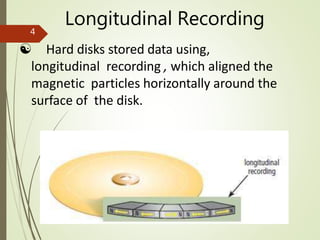
Longitudinal Recording
 Hard disks stored data using,
longitudinal recording , which aligned the
magnetic particles horizontally around the
surface of the disk.
4
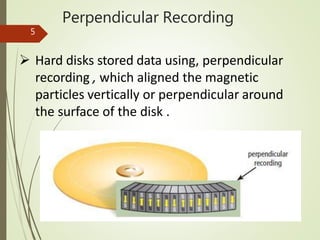
Perpendicular Recording
 Hard disks stored data using, perpendicular
recording , which aligned the magnetic
particles vertically or perpendicular around
the surface of the disk .
5
Components of Hard
Disk
 These are some components of hard disk
:
 Platters .
 Disk case.
 Read/Write Head .
 Cylinder .
 Spindle .
 Disk cache .
6
 Platter : It is a circular, metal disk that is
mounted inside a hard disk drive. It is made
of aluminum, glass, or ceramic and is coated
with an alloy material that allows items to be
recorded magnetically on its surface.
 Before writing data , the hard disk must
be formatted .
7
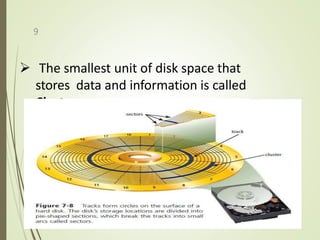
 The process of dividing the disk into tracks
and sectors , so that the operating system
can store and locate data and information on
the disk is called Formatting .
 A narrow recording band that forms a full
circle on the surface of the disk is called
Track.
 The disk’s storage locations consist of pie-
shaped sections, which break the racks
into small arcs called sectors .
8
 The smallest unit of disk space that
stores data and information is called
Cluster .
9
 Disk Case : The rectangular shaped disk case
holds all of the components of a hard disk drive
.
 Read/Write Head : A read/write head
 is the mechanism that reads items and
writes
 items in the drive as it barely touches
the disk’s recording surface .
10
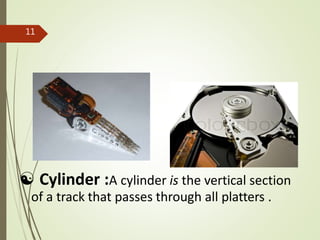
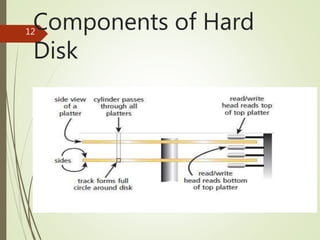
 Cylinder :A cylinder is the vertical section
of a track that passes through all platters .
11
Components of Hard
Disk
12
 Spindle : The spindle holds the platters
together and the motor rotates the platters
at their designated speed, which is
measured in RPM.
 The platters in the hard disk rotate at a high
rate of speed. This spinning, which usually is
5,400 to 15,000 revolutions per minute (rpm)
.
13
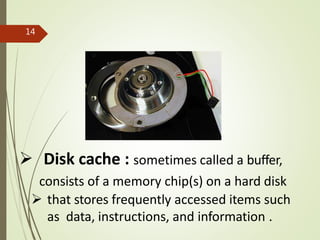
 Disk cache : sometimes called a buffer,
consists of a memory chip(s) on a hard disk
 that stores frequently accessed items such
as data, instructions, and information .
14
Head Crash
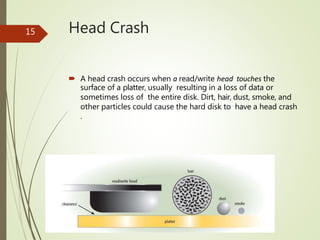
 A head crash occurs when a read/write head touches the
surface of a platter, usually resulting in a loss of data or
sometimes loss of the entire disk. Dirt, hair, dust, smoke, and
other particles could cause the hard disk to have a head crash
.
15
16

Hard Disk Drive Complete structure

  • 1.
    1 Farooq Khan ֎ Asad ֎Safwan ֎ Basit ֎ Rehmat & his Team
  • 2.
     It isa storage device that used magnetically platters to store data, instruction and information.  The Desktop and notebook computer contains 1 or more hard disks.  It have storage capacity from 40 GB to 1.5 TB and more.  A Hard Disk that is mounted inside the system unit sometimes is called fixed-disk. 2
  • 3.
     A HardDisk which can remove the medium from one computer and carry it to another computer is called Portable- disk.  Hard Disk store data by two ways:  Longitudinal Recording .  Perpendicular Recording . 3
  • 4.
    Longitudinal Recording  Harddisks stored data using, longitudinal recording , which aligned the magnetic particles horizontally around the surface of the disk. 4
  • 5.
    Perpendicular Recording  Harddisks stored data using, perpendicular recording , which aligned the magnetic particles vertically or perpendicular around the surface of the disk . 5
  • 6.
    Components of Hard Disk These are some components of hard disk :  Platters .  Disk case.  Read/Write Head .  Cylinder .  Spindle .  Disk cache . 6
  • 7.
     Platter :It is a circular, metal disk that is mounted inside a hard disk drive. It is made of aluminum, glass, or ceramic and is coated with an alloy material that allows items to be recorded magnetically on its surface.  Before writing data , the hard disk must be formatted . 7
  • 8.
     The processof dividing the disk into tracks and sectors , so that the operating system can store and locate data and information on the disk is called Formatting .  A narrow recording band that forms a full circle on the surface of the disk is called Track.  The disk’s storage locations consist of pie- shaped sections, which break the racks into small arcs called sectors . 8
  • 9.
     The smallestunit of disk space that stores data and information is called Cluster . 9
  • 10.
     Disk Case: The rectangular shaped disk case holds all of the components of a hard disk drive .  Read/Write Head : A read/write head  is the mechanism that reads items and writes  items in the drive as it barely touches the disk’s recording surface . 10
  • 11.
     Cylinder :Acylinder is the vertical section of a track that passes through all platters . 11
  • 12.
  • 13.
     Spindle :The spindle holds the platters together and the motor rotates the platters at their designated speed, which is measured in RPM.  The platters in the hard disk rotate at a high rate of speed. This spinning, which usually is 5,400 to 15,000 revolutions per minute (rpm) . 13
  • 14.
     Disk cache: sometimes called a buffer, consists of a memory chip(s) on a hard disk  that stores frequently accessed items such as data, instructions, and information . 14
  • 15.
    Head Crash  Ahead crash occurs when a read/write head touches the surface of a platter, usually resulting in a loss of data or sometimes loss of the entire disk. Dirt, hair, dust, smoke, and other particles could cause the hard disk to have a head crash . 15
  • 16.