Download free for 30 days
Sign in
Upload
Language (EN)
Support
Business
Mobile
Social Media
Marketing
Technology
Art & Photos
Career
Design
Education
Presentations & Public Speaking
Government & Nonprofit
Healthcare
Internet
Law
Leadership & Management
Automotive
Engineering
Software
Recruiting & HR
Retail
Sales
Services
Science
Small Business & Entrepreneurship
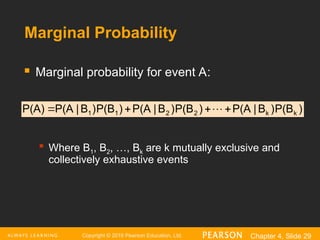
Food
Environment
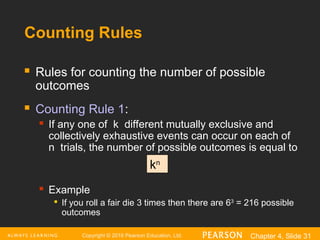
Economy & Finance
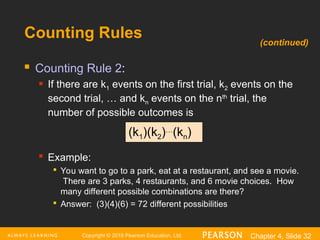
Data & Analytics
Investor Relations
Sports
Spiritual
News & Politics
Travel
Self Improvement
Real Estate
Entertainment & Humor
Health & Medicine
Devices & Hardware
Lifestyle
Change Language
Language
English
Español
Português
Français
Deutsche
Cancel
Save
EN
Uploaded by
ndamlawrence
PPT, PDF
10 views
Lecture notes on the asp.Probability.ppt
The presentation is salient on probability and its implications
Education
◦
Read more
0
Save
Share
Embed
Embed presentation
Download
Download to read offline
1
/ 36
2
/ 36
3
/ 36
4
/ 36
5
/ 36
6
/ 36
7
/ 36
8
/ 36
9
/ 36
10
/ 36
11
/ 36
12
/ 36
13
/ 36
14
/ 36
15
/ 36
16
/ 36
17
/ 36
18
/ 36
19
/ 36
20
/ 36
21
/ 36
22
/ 36
23
/ 36
24
/ 36
25
/ 36
26
/ 36
27
/ 36
28
/ 36
29
/ 36
30
/ 36
31
/ 36
32
/ 36
33
/ 36
34
/ 36
35
/ 36
36
/ 36
More Related Content
PPTX
bbs14e_ppt_ch04.pptx
by
kajalthakkar16
PPT
chapter_4_modified_slides_0.ppt
by
ShubhamChauhan562815
PPT
Basic Probability | Chapter 4 | Global Edition
by
muhammadrazaazamclas
PPT
chapter_4_ modified_slides_0.ppt
by
cashiroow192
PPTX
Basic Business Statistics 12-th edition,Chapter 4,Basic Probability
by
muradsuleymanzade5
PPT
BASIC CONCEPT OF PROBABILITY by Elem Stppt
by
JAMESFRANCISGOSE
PDF
chap03--Discrete random variables probability ai and ml R2021.pdf
by
mitopof121
PDF
probability concepts.pdf
by
RAHULSUTHAR46
bbs14e_ppt_ch04.pptx
by
kajalthakkar16
chapter_4_modified_slides_0.ppt
by
ShubhamChauhan562815
Basic Probability | Chapter 4 | Global Edition
by
muhammadrazaazamclas
chapter_4_ modified_slides_0.ppt
by
cashiroow192
Basic Business Statistics 12-th edition,Chapter 4,Basic Probability
by
muradsuleymanzade5
BASIC CONCEPT OF PROBABILITY by Elem Stppt
by
JAMESFRANCISGOSE
chap03--Discrete random variables probability ai and ml R2021.pdf
by
mitopof121
probability concepts.pdf
by
RAHULSUTHAR46
Similar to Lecture notes on the asp.Probability.ppt
PPTX
Chap03 probability
by
Judianto Nugroho
PPT
Probability+distribution
by
Nilanjan Bhaumik
PPTX
Unit 4--probability and probability distribution (1).pptx
by
akshay353895
PPTX
Decoding Chance: Probability in Everyday Life
by
alwaysbemore1243
PPTX
Guide to Probability & Distributions: From Fundamentals to Advanced Concepts
by
alwaysbemore1243
PPT
chap 1 economy and hownit shapes the world econ
by
v3v3ghurl
PPT
AlfordChapter4.ppt
by
EidTahir
PPTX
chap04.pptx - It provides important information
by
ShahanaNamazova
PPTX
probability a chance for anything(from impossible to sure )
by
alwaysbemore1243
PDF
chap 04 probability chapter 4 statistics.pdf
by
BrunelaTrebicka
PPT
Lesson 5.ppt
by
OkianWarner
PDF
Probabilities distributions
by
Learnbay Datascience
PPT
Newbold_chap04.ppt
by
cfisicaster
PPT
Probability concepts and procedures law of profitability
by
kamalsapkota13
PPT
Week 2 notes.ppt
by
FaizanQadir10
PPTX
Ch02 Probability Concepts and Applications.pptx
by
seaiteccoop
PDF
Bayes primer2
by
MhAcKnI
PDF
Introduction to Probability for beginners.pdf
by
SyedNahin1
PPT
Probability (1)
by
chaitu282693
PPT
Probability
by
narutosasuke16
Chap03 probability
by
Judianto Nugroho
Probability+distribution
by
Nilanjan Bhaumik
Unit 4--probability and probability distribution (1).pptx
by
akshay353895
Decoding Chance: Probability in Everyday Life
by
alwaysbemore1243
Guide to Probability & Distributions: From Fundamentals to Advanced Concepts
by
alwaysbemore1243
chap 1 economy and hownit shapes the world econ
by
v3v3ghurl
AlfordChapter4.ppt
by
EidTahir
chap04.pptx - It provides important information
by
ShahanaNamazova
probability a chance for anything(from impossible to sure )
by
alwaysbemore1243
chap 04 probability chapter 4 statistics.pdf
by
BrunelaTrebicka
Lesson 5.ppt
by
OkianWarner
Probabilities distributions
by
Learnbay Datascience
Newbold_chap04.ppt
by
cfisicaster
Probability concepts and procedures law of profitability
by
kamalsapkota13
Week 2 notes.ppt
by
FaizanQadir10
Ch02 Probability Concepts and Applications.pptx
by
seaiteccoop
Bayes primer2
by
MhAcKnI
Introduction to Probability for beginners.pdf
by
SyedNahin1
Probability (1)
by
chaitu282693
Probability
by
narutosasuke16
Recently uploaded
PPTX
Appreciations - Jan 26 01.pptxkjkjkkjkjkjkj
by
preetheshparmar
PDF
Risks and opportunities of artificial intelligence in education: A critical view
by
Yannis
PPTX
Powerpoint for testing in embed test with Sway
by
jeanpierrefort3
PPTX
Central Line Associated Bloodstream Infection
by
nabinabhaila40
PPTX
That long silence - Novel by Shashi Deshapande
by
sanjanavaghela65
PDF
Bishan_Singh_Presentation - Toba tek Singh
by
gopalsinhchauhan9313
PPTX
Mohan - "A man of silence and authority"
by
nidhibachauhan46
PPTX
28 January 2026 Rebecca Frankum Are high-stakes exams and assessments still r...
by
EduSkills OECD
PPTX
COMMUNICATION ITS PROCESS ELEMENTS & BARRIER .pptx
by
PoojaSen20
PDF
West Hatch High School - GCSE Media Specification
by
WestHatch
PPTX
Payment Follow-Up via WhatsApp in Odoo 18.1 Accounting
by
Celine George
PDF
Information about Presentation strategies
by
mansivaja18126
PDF
Fast Followers Project, Embedding Net Zero into Wakefield Metropolitan Distri...
by
Association for Project Management
PPTX
West Hatch High School: Year 9 Art Course
by
WestHatch
PPTX
" Jaya : Silence as Resistance " - That long silence
by
dharabhandari35
PPTX
Master of Punjabi Short Story "kartar singh duggal
by
bhautikbharwad4
PPTX
literary theory and criticism by Vivek p
by
vivekrathodborda
PPTX
West Hatch High School - GCSE Art Presentation
by
WestHatch
PPTX
West Hatch High School -- GCSE Geography
by
WestHatch
PDF
U.S. Departments of Education and Treasury fact sheet
by
Mebane Rash
Appreciations - Jan 26 01.pptxkjkjkkjkjkjkj
by
preetheshparmar
Risks and opportunities of artificial intelligence in education: A critical view
by
Yannis
Powerpoint for testing in embed test with Sway
by
jeanpierrefort3
Central Line Associated Bloodstream Infection
by
nabinabhaila40
That long silence - Novel by Shashi Deshapande
by
sanjanavaghela65
Bishan_Singh_Presentation - Toba tek Singh
by
gopalsinhchauhan9313
Mohan - "A man of silence and authority"
by
nidhibachauhan46
28 January 2026 Rebecca Frankum Are high-stakes exams and assessments still r...
by
EduSkills OECD
COMMUNICATION ITS PROCESS ELEMENTS & BARRIER .pptx
by
PoojaSen20
West Hatch High School - GCSE Media Specification
by
WestHatch
Payment Follow-Up via WhatsApp in Odoo 18.1 Accounting
by
Celine George
Information about Presentation strategies
by
mansivaja18126
Fast Followers Project, Embedding Net Zero into Wakefield Metropolitan Distri...
by
Association for Project Management
West Hatch High School: Year 9 Art Course
by
WestHatch
" Jaya : Silence as Resistance " - That long silence
by
dharabhandari35
Master of Punjabi Short Story "kartar singh duggal
by
bhautikbharwad4
literary theory and criticism by Vivek p
by
vivekrathodborda
West Hatch High School - GCSE Art Presentation
by
WestHatch
West Hatch High School -- GCSE Geography
by
WestHatch
U.S. Departments of Education and Treasury fact sheet
by
Mebane Rash
Lecture notes on the asp.Probability.ppt
1.
Copyright © 2016
Pearson Education, Ltd. Chapter 4, Slide 1 Basic Probability
2.
Copyright © 2016
Pearson Education, Ltd. Chapter 4, Slide 2 Objectives The objectives for this chapter are: To understand basic probability concepts. To understand conditional probability To be able to use Bayes’ Theorem to revise probabilities To learn various counting rules
3.
Copyright © 2016
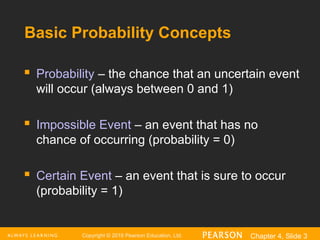
Pearson Education, Ltd. Chapter 4, Slide 3 Basic Probability Concepts Probability – the chance that an uncertain event will occur (always between 0 and 1) Impossible Event – an event that has no chance of occurring (probability = 0) Certain Event – an event that is sure to occur (probability = 1)
4.
Copyright © 2016
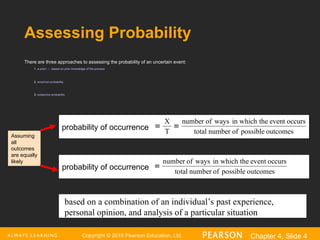
Pearson Education, Ltd. Chapter 4, Slide 4 probability of occurrence Assessing Probability There are three approaches to assessing the probability of an uncertain event: 1. a priori -- based on prior knowledge of the process 2. empirical probability 3. subjective probability outcomes possible of number total occurs event the in which ways of number T X based on a combination of an individual’s past experience, personal opinion, and analysis of a particular situation outcomes possible of number total occurs event the in which ways of number Assuming all outcomes are equally likely probability of occurrence
5.
Copyright © 2016
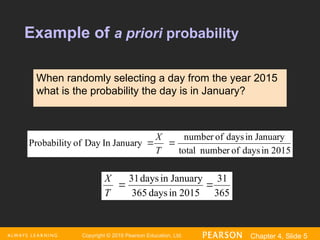
Pearson Education, Ltd. Chapter 4, Slide 5 Example of a priori probability 365 31 2015 in days 365 January in days 31 T X When randomly selecting a day from the year 2015 what is the probability the day is in January? 2015 in days of number total January in days of number January In Day of y Probabilit T X
6.
Copyright © 2016
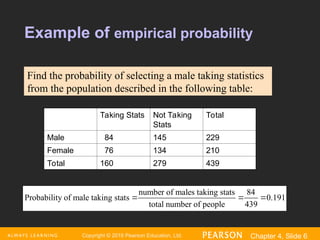
Pearson Education, Ltd. Chapter 4, Slide 6 Example of empirical probability number of males taking stats 84 0.191 total num Proba ber o bility of mal f peopl e taking e 439 stats Taking Stats Not Taking Stats Total Male 84 145 229 Female 76 134 210 Total 160 279 439 Find the probability of selecting a male taking statistics from the population described in the following table:
7.
Copyright © 2016
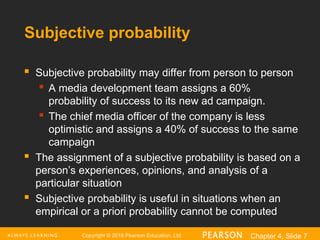
Pearson Education, Ltd. Chapter 4, Slide 7 Subjective probability Subjective probability may differ from person to person A media development team assigns a 60% probability of success to its new ad campaign. The chief media officer of the company is less optimistic and assigns a 40% of success to the same campaign The assignment of a subjective probability is based on a person’s experiences, opinions, and analysis of a particular situation Subjective probability is useful in situations when an empirical or a priori probability cannot be computed
8.
Copyright © 2016
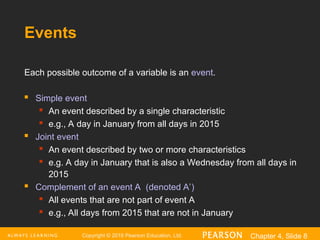
Pearson Education, Ltd. Chapter 4, Slide 8 Events Each possible outcome of a variable is an event. Simple event An event described by a single characteristic e.g., A day in January from all days in 2015 Joint event An event described by two or more characteristics e.g. A day in January that is also a Wednesday from all days in 2015 Complement of an event A (denoted A’) All events that are not part of event A e.g., All days from 2015 that are not in January
9.
Copyright © 2016
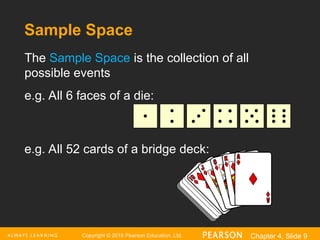
Pearson Education, Ltd. Chapter 4, Slide 9 The Sample Space is the collection of all possible events e.g. All 6 faces of a die: e.g. All 52 cards of a bridge deck: Sample Space
10.
Copyright © 2016
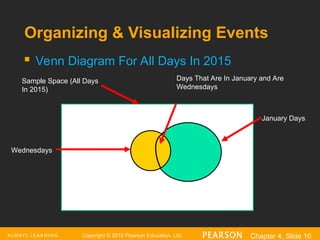
Pearson Education, Ltd. Chapter 4, Slide 10 Organizing & Visualizing Events Venn Diagram For All Days In 2015 Sample Space (All Days In 2015) January Days Wednesdays Days That Are In January and Are Wednesdays
11.
Copyright © 2016
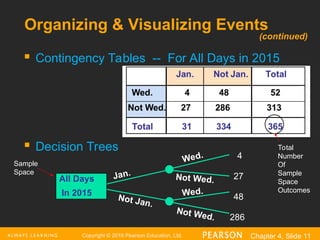
Pearson Education, Ltd. Chapter 4, Slide 11 Organizing & Visualizing Events Contingency Tables -- For All Days in 2015 Decision Trees All Days In 2015 Not Jan. Jan. Not Wed. Wed. Wed. Not Wed. Sample Space Total Number Of Sample Space Outcomes 4 27 48 286 (continued)
12.
Copyright © 2016
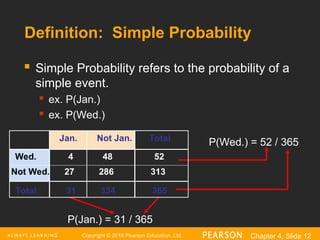
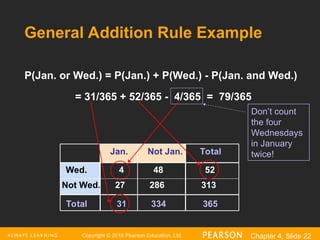
Pearson Education, Ltd. Chapter 4, Slide 12 Definition: Simple Probability Simple Probability refers to the probability of a simple event. ex. P(Jan.) ex. P(Wed.) P(Jan.) = 31 / 365 P(Wed.) = 52 / 365 Not Wed. 27 286 313 Wed. 4 48 52 Total 31 334 365 Jan. Not Jan. Total
13.
Copyright © 2016
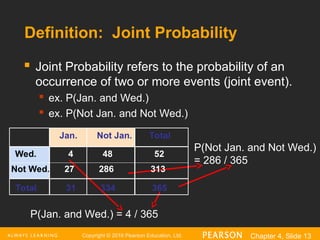
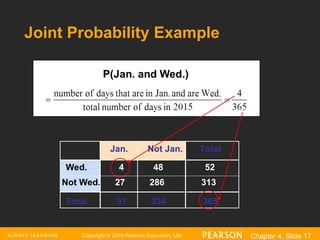
Pearson Education, Ltd. Chapter 4, Slide 13 Definition: Joint Probability Joint Probability refers to the probability of an occurrence of two or more events (joint event). ex. P(Jan. and Wed.) ex. P(Not Jan. and Not Wed.) P(Jan. and Wed.) = 4 / 365 P(Not Jan. and Not Wed.) = 286 / 365 Not Wed. 27 286 313 Wed. 4 48 52 Total 31 334 365 Jan. Not Jan. Total
14.
Copyright © 2016
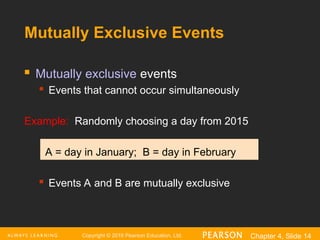
Pearson Education, Ltd. Chapter 4, Slide 14 Mutually Exclusive Events Mutually exclusive events Events that cannot occur simultaneously Example: Randomly choosing a day from 2015 A = day in January; B = day in February Events A and B are mutually exclusive
15.
Copyright © 2016
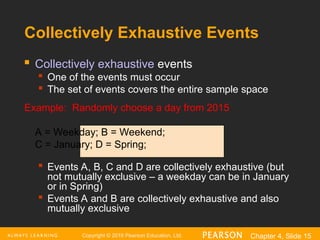
Pearson Education, Ltd. Chapter 4, Slide 15 Collectively Exhaustive Events Collectively exhaustive events One of the events must occur The set of events covers the entire sample space Example: Randomly choose a day from 2015 A = Weekday; B = Weekend; C = January; D = Spring; Events A, B, C and D are collectively exhaustive (but not mutually exclusive – a weekday can be in January or in Spring) Events A and B are collectively exhaustive and also mutually exclusive
16.
Copyright © 2016
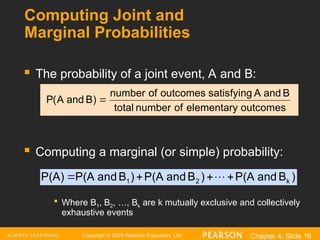
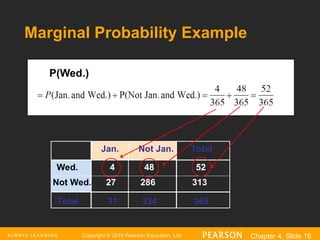
Pearson Education, Ltd. Chapter 4, Slide 16 Computing Joint and Marginal Probabilities The probability of a joint event, A and B: Computing a marginal (or simple) probability: Where B1, B2, …, Bk are k mutually exclusive and collectively exhaustive events outcomes elementary of number total B and A satisfying outcomes of number ) B and A ( P ) B d an P(A ) B and P(A ) B and P(A P(A) k 2 1
17.
Copyright © 2016
Pearson Education, Ltd. Chapter 4, Slide 17 Joint Probability Example Not Wed. 27 286 313 Wed. 4 48 52 Total 31 334 365 Jan. Not Jan. Total
18.
Copyright © 2016
Pearson Education, Ltd. Chapter 4, Slide 18 Not Wed. 27 286 313 Wed. 4 48 52 Total 31 334 365 Jan. Not Jan. Total Marginal Probability Example
19.
Copyright © 2016
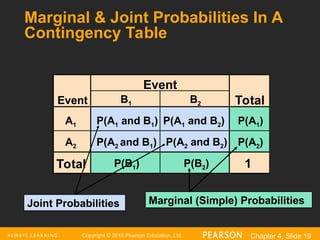
Pearson Education, Ltd. Chapter 4, Slide 19 P(A1 and B2) P(A1) Total Event Marginal & Joint Probabilities In A Contingency Table P(A2 and B1) P(A1 and B1) Event Total 1 Joint Probabilities Marginal (Simple) Probabilities A1 A2 B1 B2 P(B1) P(B2) P(A2 and B2) P(A2)
20.
Copyright © 2016
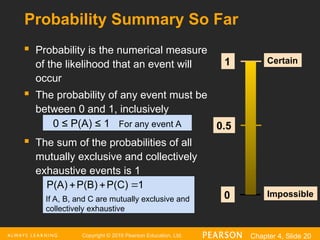
Pearson Education, Ltd. Chapter 4, Slide 20 Probability Summary So Far Probability is the numerical measure of the likelihood that an event will occur The probability of any event must be between 0 and 1, inclusively The sum of the probabilities of all mutually exclusive and collectively exhaustive events is 1 Certain Impossible 0.5 1 0 0 ≤ P(A) ≤ 1 For any event A 1 P(C) P(B) P(A) If A, B, and C are mutually exclusive and collectively exhaustive
21.
Copyright © 2016
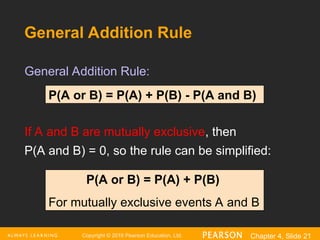
Pearson Education, Ltd. Chapter 4, Slide 21 General Addition Rule P(A or B) = P(A) + P(B) - P(A and B) General Addition Rule: If A and B are mutually exclusive, then P(A and B) = 0, so the rule can be simplified: P(A or B) = P(A) + P(B) For mutually exclusive events A and B
22.
Copyright © 2016
Pearson Education, Ltd. Chapter 4, Slide 22 General Addition Rule Example P(Jan. or Wed.) = P(Jan.) + P(Wed.) - P(Jan. and Wed.) = 31/365 + 52/365 - 4/365 = 79/365 Don’t count the four Wednesdays in January twice! Not Wed. 27 286 313 Wed. 4 48 52 Total 31 334 365 Jan. Not Jan. Total
23.
Copyright © 2016
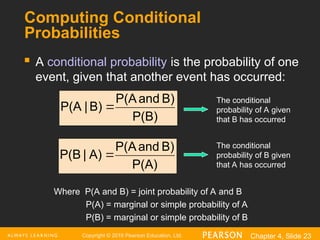
Pearson Education, Ltd. Chapter 4, Slide 23 Computing Conditional Probabilities A conditional probability is the probability of one event, given that another event has occurred: P(B) B) and P(A B) | P(A P(A) B) and P(A A) | P(B Where P(A and B) = joint probability of A and B P(A) = marginal or simple probability of A P(B) = marginal or simple probability of B The conditional probability of A given that B has occurred The conditional probability of B given that A has occurred
24.
Copyright © 2016
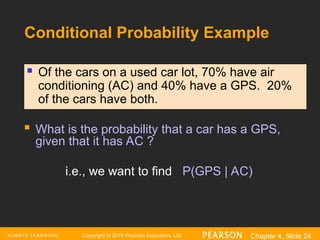
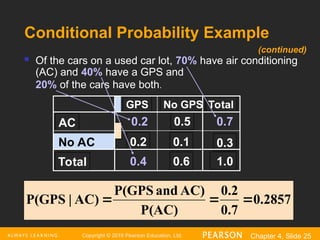
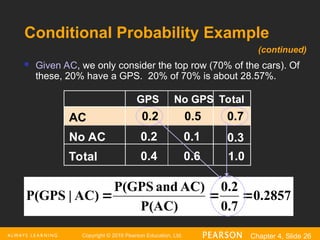
Pearson Education, Ltd. Chapter 4, Slide 24 Conditional Probability Example What is the probability that a car has a GPS, given that it has AC ? i.e., we want to find P(GPS | AC) Of the cars on a used car lot, 70% have air conditioning (AC) and 40% have a GPS. 20% of the cars have both.
25.
Copyright © 2016
Pearson Education, Ltd. Chapter 4, Slide 25 Conditional Probability Example No GPS GPS Total AC 0.2 0.5 0.7 No AC 0.2 0.1 0.3 Total 0.4 0.6 1.0 Of the cars on a used car lot, 70% have air conditioning (AC) and 40% have a GPS and 20% of the cars have both. 0.2857 0.7 0.2 P(AC) AC) and P(GPS AC) | P(GPS (continued)
26.
Copyright © 2016
Pearson Education, Ltd. Chapter 4, Slide 26 Conditional Probability Example No GPS GPS Total AC 0.2 0.5 0.7 No AC 0.2 0.1 0.3 Total 0.4 0.6 1.0 Given AC, we only consider the top row (70% of the cars). Of these, 20% have a GPS. 20% of 70% is about 28.57%. 0.2857 0.7 0.2 P(AC) AC) and P(GPS AC) | P(GPS (continued)
27.
Copyright © 2016
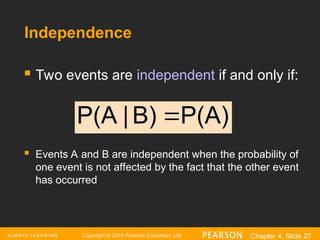
Pearson Education, Ltd. Chapter 4, Slide 27 Independence Two events are independent if and only if: Events A and B are independent when the probability of one event is not affected by the fact that the other event has occurred P(A) B) | P(A
28.
Copyright © 2016
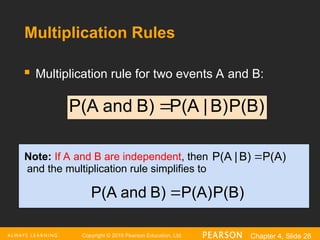
Pearson Education, Ltd. Chapter 4, Slide 28 Multiplication Rules Multiplication rule for two events A and B: P(B) B) | P(A B) and P(A P(A) B) | P(A Note: If A and B are independent, then and the multiplication rule simplifies to P(B) P(A) B) and P(A
29.
Copyright © 2016
Pearson Education, Ltd. Chapter 4, Slide 29 Marginal Probability Marginal probability for event A: Where B1, B2, …, Bk are k mutually exclusive and collectively exhaustive events ) P(B ) B | P(A ) P(B ) B | P(A ) P(B ) B | P(A P(A) k k 2 2 1 1
30.
Copyright © 2016
Pearson Education, Ltd. Chapter 4, Slide 30 Counting Rules Are Often Useful In Computing Probabilities In many cases, there are a large number of possible outcomes. Counting rules can be used in these cases to help compute probabilities.
31.
Copyright © 2016
Pearson Education, Ltd. Chapter 4, Slide 31 Counting Rules Rules for counting the number of possible outcomes Counting Rule 1: If any one of k different mutually exclusive and collectively exhaustive events can occur on each of n trials, the number of possible outcomes is equal to Example If you roll a fair die 3 times then there are 63 = 216 possible outcomes kn
32.
Copyright © 2016
Pearson Education, Ltd. Chapter 4, Slide 32 Counting Rules Counting Rule 2: If there are k1 events on the first trial, k2 events on the second trial, … and kn events on the nth trial, the number of possible outcomes is Example: You want to go to a park, eat at a restaurant, and see a movie. There are 3 parks, 4 restaurants, and 6 movie choices. How many different possible combinations are there? Answer: (3)(4)(6) = 72 different possibilities (k1)(k2)… (kn) (continued)
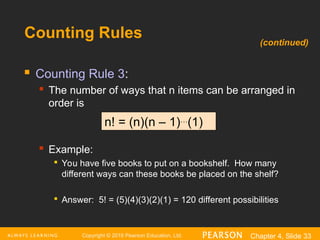
33.
Copyright © 2016
Pearson Education, Ltd. Chapter 4, Slide 33 Counting Rules Counting Rule 3: The number of ways that n items can be arranged in order is Example: You have five books to put on a bookshelf. How many different ways can these books be placed on the shelf? Answer: 5! = (5)(4)(3)(2)(1) = 120 different possibilities n! = (n)(n – 1)… (1) (continued)
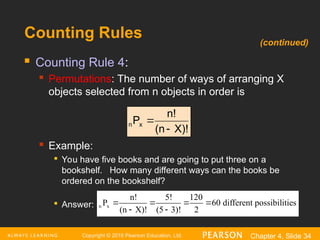
34.
Copyright © 2016
Pearson Education, Ltd. Chapter 4, Slide 34 Counting Rules Counting Rule 4: Permutations: The number of ways of arranging X objects selected from n objects in order is Example: You have five books and are going to put three on a bookshelf. How many different ways can the books be ordered on the bookshelf? Answer: X)! (n n! Px n n x n! 5! 120 P 60 (n X)! (5 3)! 2 different possibilities (continued)
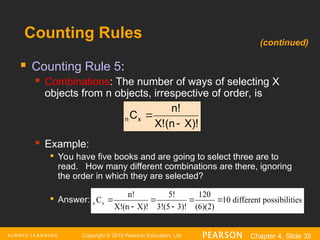
35.
Copyright © 2016
Pearson Education, Ltd. Chapter 4, Slide 35 Counting Rules Counting Rule 5: Combinations: The number of ways of selecting X objects from n objects, irrespective of order, is Example: You have five books and are going to select three are to read. How many different combinations are there, ignoring the order in which they are selected? Answer: X)! (n X! n! Cx n n x n! 5! 120 C 10 X!(n X)! 3!(5 3)! (6) different possi ( b 2) ilities (continued)
36.
Copyright © 2016
Pearson Education, Ltd. Chapter 4, Slide 36 Summary In this chapter we covered: Understanding basic probability concepts. Understanding conditional probability Using Bayes’ Theorem to revise probabilities Various counting rules
Download