Copyright ©2012 Pearson Education, Inc. publishing as Prentice Hall Chap 4-1
Chap 4-1
Chapter 4
Basic Probability
Basic Business Statistics
12th
Edition
Chap 4-2
Copyright ©2012 Pearson Education, Inc. publishing as Prentice Hall Chap 4-2
Learning Objectives
In this chapter, you learn:
 Basic probability concepts
 Conditional probability
 To use Bayes’ Theorem to revise probabilities
 Various counting rules
Chap 4-3
Copyright ©2012 Pearson Education, Inc. publishing as Prentice Hall Chap 4-3
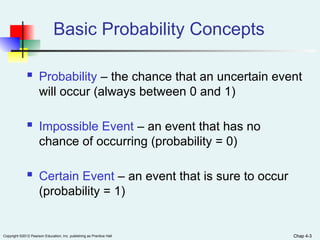
Basic Probability Concepts
 Probability – the chance that an uncertain event
will occur (always between 0 and 1)
 Impossible Event – an event that has no
chance of occurring (probability = 0)
 Certain Event – an event that is sure to occur
(probability = 1)
Chap 4-4
Copyright ©2012 Pearson Education, Inc. publishing as Prentice Hall Chap 4-4
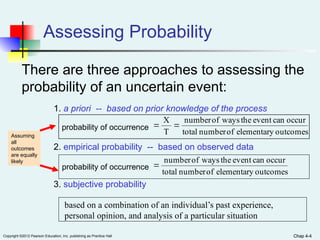
Assessing Probability
There are three approaches to assessing the
probability of an uncertain event:
1. a priori -- based on prior knowledge of the process
2. empirical probability -- based on observed data
3. subjective probability
outcomes
elementary
of
number
total
occur
can
event
the
ways
of
number
T
X


based on a combination of an individual’s past experience,
personal opinion, and analysis of a particular situation
outcomes
elementary
of
number
total
occur
can
event
the
ways
of
number

Assuming
all
outcomes
are equally
likely
probability of occurrence
Chap 4-5
Copyright ©2012 Pearson Education, Inc. publishing as Prentice Hall Chap 4-5
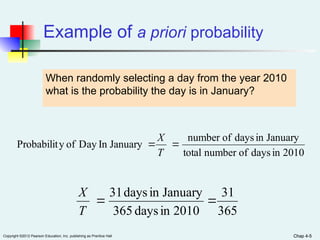
Example of a priori probability
When randomly selecting a day from the year 2010
what is the probability the day is in January?
2010
in
days
of
number
total
January
in
days
of
number
January
In
Day
of
y
Probabilit 

T
X
365
31
2010
in
days
365
January
in
days
31


T
X
Chap 4-6
Copyright ©2012 Pearson Education, Inc. publishing as Prentice Hall Chap 4-6
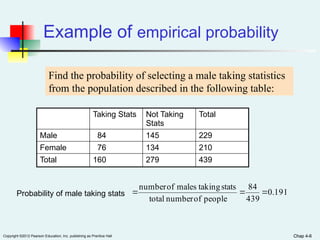
Example of empirical probability
Taking Stats Not Taking
Stats
Total
Male 84 145 229
Female 76 134 210
Total 160 279 439
Find the probability of selecting a male taking statistics
from the population described in the following table:
191
.
0
439
84
people
of
number
total
stats
taking
males
of
number



Probability of male taking stats
Chap 4-7
Copyright ©2012 Pearson Education, Inc. publishing as Prentice Hall Chap 4-7
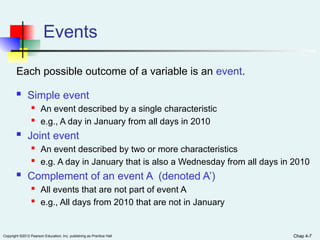
Events
Each possible outcome of a variable is an event.
 Simple event
 An event described by a single characteristic
 e.g., A day in January from all days in 2010
 Joint event
 An event described by two or more characteristics
 e.g. A day in January that is also a Wednesday from all days in 2010
 Complement of an event A (denoted A’)
 All events that are not part of event A
 e.g., All days from 2010 that are not in January
Chap 4-8
Copyright ©2012 Pearson Education, Inc. publishing as Prentice Hall Chap 4-8
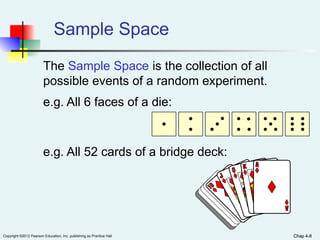
Sample Space
The Sample Space is the collection of all
possible events of a random experiment.
e.g. All 6 faces of a die:
e.g. All 52 cards of a bridge deck:
Chap 4-9
Copyright ©2012 Pearson Education, Inc. publishing as Prentice Hall Chap 4-9
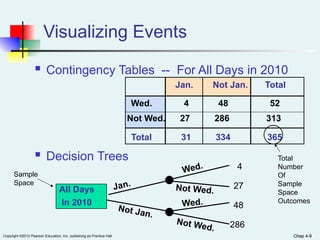
Visualizing Events
 Contingency Tables -- For All Days in 2010
 Decision Trees
All Days
In 2010
Not Jan.
Jan.
Not Wed.
Wed.
Wed.
Not Wed.
Sample
Space
Total
Number
Of
Sample
Space
Outcomes
Not Wed. 27 286 313
Wed. 4 48 52
Total 31 334 365
Jan. Not Jan. Total
4
27
48
286
Chap 4-10
Copyright ©2012 Pearson Education, Inc. publishing as Prentice Hall Chap 4-10
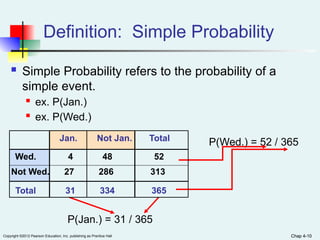
Definition: Simple Probability
 Simple Probability refers to the probability of a
simple event.
 ex. P(Jan.)
 ex. P(Wed.)
P(Jan.) = 31 / 365
P(Wed.) = 52 / 365
Not Wed. 27 286 313
Wed. 4 48 52
Total 31 334 365
Jan. Not Jan. Total
Chap 4-11
Copyright ©2012 Pearson Education, Inc. publishing as Prentice Hall Chap 4-11
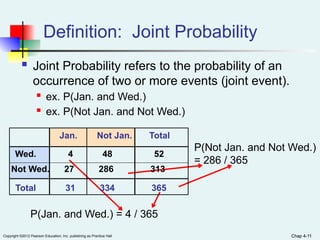
Definition: Joint Probability
 Joint Probability refers to the probability of an
occurrence of two or more events (joint event).
 ex. P(Jan. and Wed.)
 ex. P(Not Jan. and Not Wed.)
P(Jan. and Wed.) = 4 / 365
P(Not Jan. and Not Wed.)
= 286 / 365
Not Wed. 27 286 313
Wed. 4 48 52
Total 31 334 365
Jan. Not Jan. Total
Chap 4-12
Copyright ©2012 Pearson Education, Inc. publishing as Prentice Hall Chap 4-12
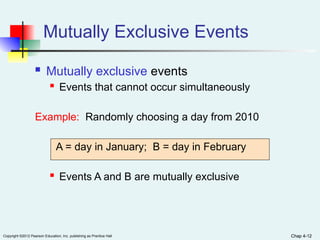
Mutually Exclusive Events
 Mutually exclusive events
 Events that cannot occur simultaneously
Example: Randomly choosing a day from 2010
A = day in January; B = day in February
 Events A and B are mutually exclusive
Chap 4-13
Copyright ©2012 Pearson Education, Inc. publishing as Prentice Hall Chap 4-13
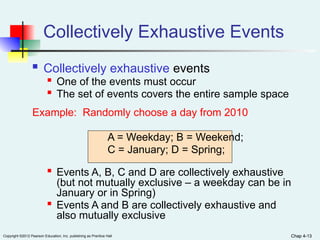
Collectively Exhaustive Events
 Collectively exhaustive events
 One of the events must occur

The set of events covers the entire sample space
Example: Randomly choose a day from 2010
A = Weekday; B = Weekend;
C = January; D = Spring;
 Events A, B, C and D are collectively exhaustive
(but not mutually exclusive – a weekday can be in
January or in Spring)
 Events A and B are collectively exhaustive and
also mutually exclusive
Chap 4-14
Copyright ©2012 Pearson Education, Inc. publishing as Prentice Hall Chap 4-14
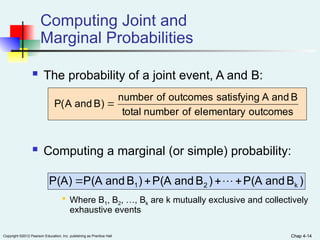
Computing Joint and
Marginal Probabilities
 The probability of a joint event, A and B:
 Computing a marginal (or simple) probability:

Where B1, B2, …, Bk are k mutually exclusive and collectively
exhaustive events
outcomes
elementary
of
number
total
B
and
A
satisfying
outcomes
of
number
)
B
and
A
(
P 
)
B
d
an
P(A
)
B
and
P(A
)
B
and
P(A
P(A) k
2
1 


 
Chap 4-15
Copyright ©2012 Pearson Education, Inc. publishing as Prentice Hall Chap 4-15
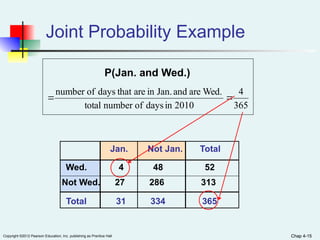
Joint Probability Example
P(Jan. and Wed.)
365
4
2010
in
days
of
number
total
Wed.
are
and
Jan.
in
are
that
days
of
number


Not Wed. 27 286 313
Wed. 4 48 52
Total 31 334 365
Jan. Not Jan. Total
Chap 4-16
Copyright ©2012 Pearson Education, Inc. publishing as Prentice Hall Chap 4-16
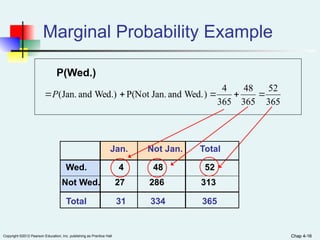
Marginal Probability Example
P(Wed.)
365
52
365
48
365
4
)
Wed.
and
Jan.
P(Not
Wed.)
and
Jan.
( 



P
Not Wed. 27 286 313
Wed. 4 48 52
Total 31 334 365
Jan. Not Jan. Total
Chap 4-17
Copyright ©2012 Pearson Education, Inc. publishing as Prentice Hall Chap 4-17
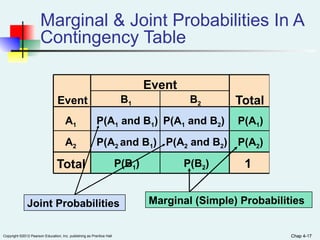
P(A1 and B2) P(A1)
Total
Event
Marginal & Joint Probabilities In A
Contingency Table
P(A2 and B1)
P(A1 and B1)
Event
Total 1
Joint Probabilities Marginal (Simple) Probabilities
A1
A2
B1 B2
P(B1) P(B2)
P(A2 and B2) P(A2)
Chap 4-18
Copyright ©2012 Pearson Education, Inc. publishing as Prentice Hall Chap 4-18
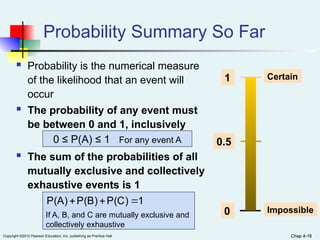
Probability Summary So Far
 Probability is the numerical measure
of the likelihood that an event will
occur
 The probability of any event must
be between 0 and 1, inclusively
 The sum of the probabilities of all
mutually exclusive and collectively
exhaustive events is 1
Certain
Impossible
0.5
1
0
0 ≤ P(A) ≤ 1 For any event A
1
P(C)
P(B)
P(A) 


If A, B, and C are mutually exclusive and
collectively exhaustive
Chap 4-19
Copyright ©2012 Pearson Education, Inc. publishing as Prentice Hall Chap 4-19
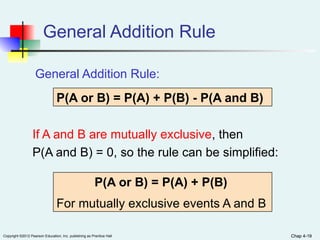
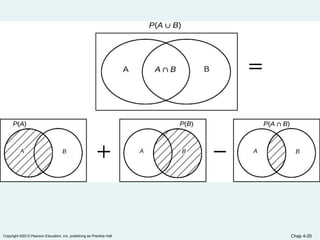
General Addition Rule
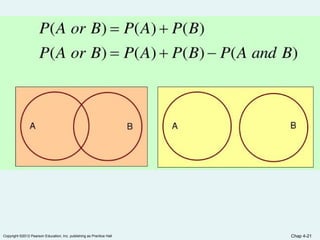
P(A or B) = P(A) + P(B) - P(A and B)
General Addition Rule:
If A and B are mutually exclusive, then
P(A and B) = 0, so the rule can be simplified:
P(A or B) = P(A) + P(B)
For mutually exclusive events A and B
Copyright ©2012 Pearson Education, Inc. publishing as Prentice Hall Chap 4-20
Copyright ©2012 Pearson Education, Inc. publishing as Prentice Hall Chap 4-21
Chap 4-22
Copyright ©2012 Pearson Education, Inc. publishing as Prentice Hall Chap 4-22
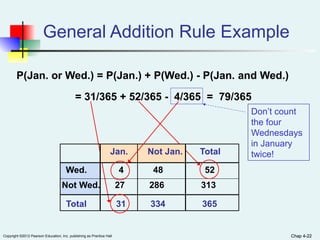
General Addition Rule Example
P(Jan. or Wed.) = P(Jan.) + P(Wed.) - P(Jan. and Wed.)
= 31/365 + 52/365 - 4/365 = 79/365
Don’t count
the four
Wednesdays
in January
twice!
Not Wed. 27 286 313
Wed. 4 48 52
Total 31 334 365
Jan. Not Jan. Total
Chap 4-23
Copyright ©2012 Pearson Education, Inc. publishing as Prentice Hall Chap 4-23
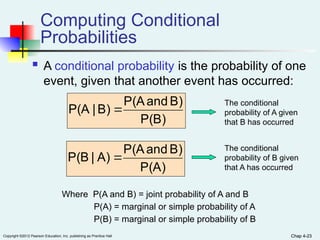
Computing Conditional
Probabilities
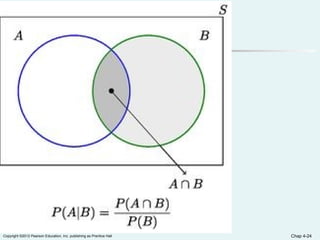
 A conditional probability is the probability of one
event, given that another event has occurred:
P(B)
B)
and
P(A
B)
|
P(A 
P(A)
B)
and
P(A
A)
|
P(B 
Where P(A and B) = joint probability of A and B
P(A) = marginal or simple probability of A
P(B) = marginal or simple probability of B
The conditional
probability of A given
that B has occurred
The conditional
probability of B given
that A has occurred
Copyright ©2012 Pearson Education, Inc. publishing as Prentice Hall Chap 4-24
Chap 4-25
Copyright ©2012 Pearson Education, Inc. publishing as Prentice Hall Chap 4-25
 What is the probability that a car has a GPS
given that it has AC ?
i.e., we want to find P(GPS | AC)
Conditional Probability Example
 Of the cars on a used car lot, 90% have air
conditioning (AC) and 40% have a GPS. 35% of
the cars have both.
Chap 4-26
Copyright ©2012 Pearson Education, Inc. publishing as Prentice Hall Chap 4-26
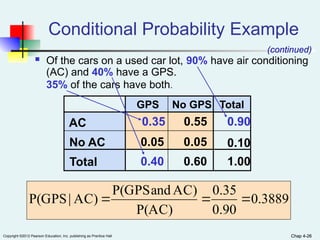
Conditional Probability Example
 Of the cars on a used car lot, 90% have air conditioning
(AC) and 40% have a GPS.
35% of the cars have both.
No GPS
GPS Total
AC 0.35 0.55 0.90
No AC 0.05 0.05 0.10
Total 0.40 0.60 1.00
0.3889
0.90
0.35
P(AC)
AC)
and
P(GPS
AC)
|
P(GPS 


(continued)
Chap 4-27
Copyright ©2012 Pearson Education, Inc. publishing as Prentice Hall Chap 4-27
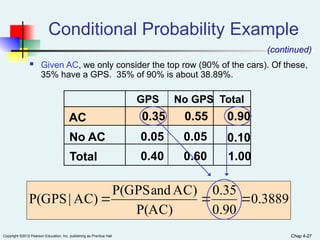
Conditional Probability Example
 Given AC, we only consider the top row (90% of the cars). Of these,
35% have a GPS. 35% of 90% is about 38.89%.
(continued)
No GPS
GPS Total
AC 0.35 0.55 0.90
No AC 0.05 0.05 0.10
Total 0.40 0.60 1.00
0.3889
0.90
0.35
P(AC)
AC)
and
P(GPS
AC)
|
P(GPS 


Chap 4-28
Copyright ©2012 Pearson Education, Inc. publishing as Prentice Hall Chap 4-28
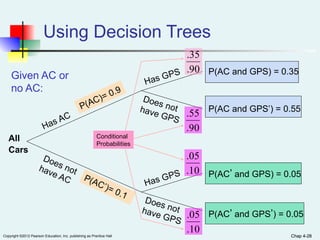
Using Decision Trees
Has AC
Does not
have AC
Has GPS
Does not
have GPS
Has GPS
Does not
have GPS
P(AC)= 0.9
P(AC’)= 0.1
P(AC and GPS) = 0.35
P(AC and GPS’) = 0.55
P(AC’ and GPS’) = 0.05
P(AC’ and GPS) = 0.05
90
.
55
.
10
.
05
.
10
.
05
.
All
Cars
90
.
35
.
Given AC or
no AC:
Conditional
Probabilities
Chap 4-29
Copyright ©2012 Pearson Education, Inc. publishing as Prentice Hall Chap 4-29
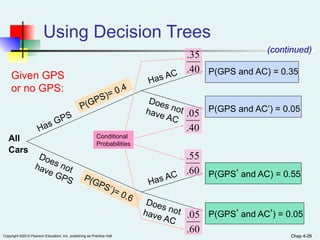
Using Decision Trees
Has GPS
Does not
have GPS
Has AC
Does not
have AC
Has AC
Does not
have AC
P(GPS)= 0.4
P(GPS’)= 0.6
P(GPS and AC) = 0.35
P(GPS and AC’) = 0.05
P(GPS’ and AC’) = 0.05
P(GPS’ and AC) = 0.55
40
.
05
.
60
.
55
.
60
.
05
.
All
Cars
40
.
35
.
Given GPS
or no GPS:
(continued)
Conditional
Probabilities
Chap 4-30
Copyright ©2012 Pearson Education, Inc. publishing as Prentice Hall Chap 4-30
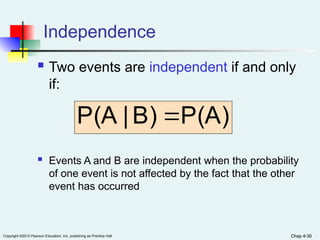
Independence
 Two events are independent if and only
if:
 Events A and B are independent when the probability
of one event is not affected by the fact that the other
event has occurred
P(A)
B)
|
P(A 
Copyright ©2012 Pearson Education, Inc. publishing as Prentice Hall
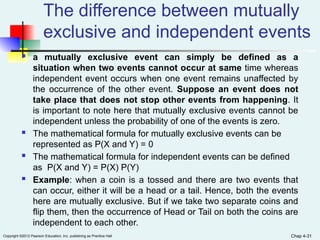
The difference between mutually
exclusive and independent events
 a mutually exclusive event can simply be defined as a
situation when two events cannot occur at same time whereas
independent event occurs when one event remains unaffected by
the occurrence of the other event. Suppose an event does not
take place that does not stop other events from happening. It
is important to note here that mutually exclusive events cannot be
independent unless the probability of one of the events is zero.
 The mathematical formula for mutually exclusive events can be
represented as P(X and Y) = 0
 The mathematical formula for independent events can be defined
as P(X and Y) = P(X) P(Y)
 Example: when a coin is a tossed and there are two events that
can occur, either it will be a head or a tail. Hence, both the events
here are mutually exclusive. But if we take two separate coins and
flip them, then the occurrence of Head or Tail on both the coins are
independent to each other.
Chap 4-31
Chap 4-32
Copyright ©2012 Pearson Education, Inc. publishing as Prentice Hall Chap 4-32
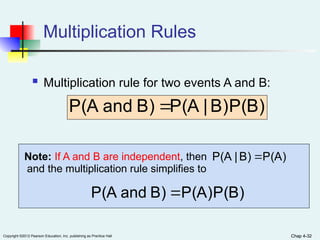
Multiplication Rules
 Multiplication rule for two events A and B:
P(B)
B)
|
P(A
B)
and
P(A 
P(A)
B)
|
P(A 
Note: If A and B are independent, then
and the multiplication rule simplifies to
P(B)
P(A)
B)
and
P(A 
Chap 4-33
Copyright ©2012 Pearson Education, Inc. publishing as Prentice Hall Chap 4-33
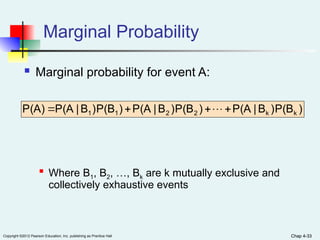
Marginal Probability
 Marginal probability for event A:

Where B1, B2, …, Bk are k mutually exclusive and
collectively exhaustive events
)
P(B
)
B
|
P(A
)
P(B
)
B
|
P(A
)
P(B
)
B
|
P(A
P(A) k
k
2
2
1
1 


 
Chap 4-34
Copyright ©2012 Pearson Education, Inc. publishing as Prentice Hall Chap 4-34
Bayes’ Theorem
 Bayes’ Theorem is used to revise previously
calculated probabilities based on new
information.
 Developed by Thomas Bayes in the 18th
Century.
 It is an extension of conditional probability.
Chap 4-35
Copyright ©2012 Pearson Education, Inc. publishing as Prentice Hall Chap 4-35
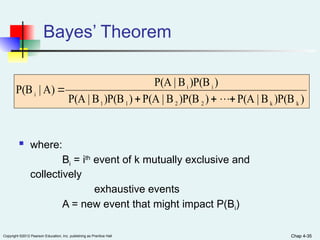
Bayes’ Theorem
 where:
Bi = ith
event of k mutually exclusive and
collectively
exhaustive events
A = new event that might impact P(Bi)
)
)P(B
B
|
P(A
)
)P(B
B
|
P(A
)
)P(B
B
|
P(A
)
)P(B
B
|
P(A
A)
|
P(B
k
k
2
2
1
1
i
i
i







Chap 4-36
Copyright ©2012 Pearson Education, Inc. publishing as Prentice Hall Chap 4-36
Bayes’ Theorem Example
 A drilling company has estimated a 40%
chance of striking oil for their new well.
 A detailed test has been scheduled for more
information. Historically, 60% of successful
wells have had detailed tests, and 20% of
unsuccessful wells have had detailed tests.
 Given that this well has been scheduled for a
detailed test, what is the probability
that the well will be successful?
Chap 4-37
Copyright ©2012 Pearson Education, Inc. publishing as Prentice Hall Chap 4-37
 Let S = successful well
U = unsuccessful well
 P(S) =0.4, P(U) =0.6 (prior probabilities)
 Define the detailed test event as D
 Conditional probabilities:
P(D|S) = 0.6 P(D|U) =0.2
 Goal is to find P(S|D)=?
Bayes’ Theorem Example
(continued)
Chap 4-38
Copyright ©2012 Pearson Education, Inc. publishing as Prentice Hall Chap 4-38
 Let S = successful well
U = unsuccessful well
 P(S) = 0.4 , P(U) = 0.6 (prior probabilities)
 Define the detailed test event as D
 Conditional probabilities:
P(D|S) = 0.6 P(D|U) = 0.2
 Goal is to find P(S|D)
Bayes’ Theorem Example
(continued)
Chap 4-39
Copyright ©2012 Pearson Education, Inc. publishing as Prentice Hall Chap 4-39
0.667
0.12
0.24
0.24
(0.2)(0.6)
(0.6)(0.4)
(0.6)(0.4)
U)P(U)
|
P(D
S)P(S)
|
P(D
S)P(S)
|
P(D
D)
|
P(S







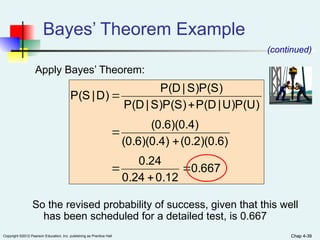
Bayes’ Theorem Example
(continued)
Apply Bayes’ Theorem:
So the revised probability of success, given that this well
has been scheduled for a detailed test, is 0.667
Chap 4-40
Copyright ©2012 Pearson Education, Inc. publishing as Prentice Hall Chap 4-40
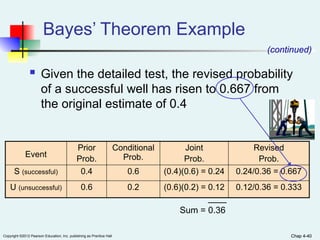
 Given the detailed test, the revised probability
of a successful well has risen to 0.667 from
the original estimate of 0.4
Bayes’ Theorem Example
Event
Prior
Prob.
Conditional
Prob.
Joint
Prob.
Revised
Prob.
S (successful) 0.4 0.6 (0.4)(0.6) = 0.24 0.24/0.36 = 0.667
U (unsuccessful) 0.6 0.2 (0.6)(0.2) = 0.12 0.12/0.36 = 0.333
Sum = 0.36
(continued)
Chap 4-41
Copyright ©2012 Pearson Education, Inc. publishing as Prentice Hall
Counting Rules
 Rules for counting the number of possible
outcomes
 Counting Rule 1:
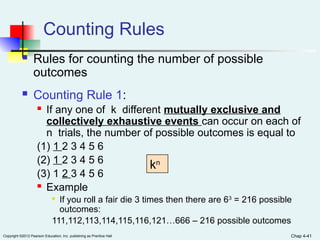
 If any one of k different mutually exclusive and
collectively exhaustive events can occur on each of
n trials, the number of possible outcomes is equal to
(1) 1 2 3 4 5 6
(2) 1 2 3 4 5 6
(3) 1 2 3 4 5 6
 Example

If you roll a fair die 3 times then there are 63
= 216 possible
outcomes:
111,112,113,114,115,116,121…666 – 216 possible outcomes
kn
Chap 4-42
Copyright ©2012 Pearson Education, Inc. publishing as Prentice Hall
Counting Rules
 Counting Rule 2:
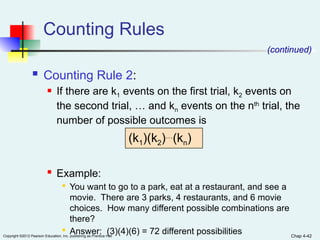
 If there are k1 events on the first trial, k2 events on
the second trial, … and kn events on the nth
trial, the
number of possible outcomes is
 Example:

You want to go to a park, eat at a restaurant, and see a
movie. There are 3 parks, 4 restaurants, and 6 movie
choices. How many different possible combinations are
there?

Answer: (3)(4)(6) = 72 different possibilities
(k1)(k2)…
(kn)
(continued)
Chap 4-43
Copyright ©2012 Pearson Education, Inc. publishing as Prentice Hall
Counting Rules
 Counting Rule 3:
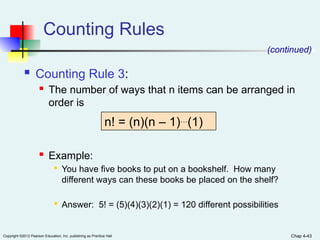
 The number of ways that n items can be arranged in
order is
 Example:

You have five books to put on a bookshelf. How many
different ways can these books be placed on the shelf?

Answer: 5! = (5)(4)(3)(2)(1) = 120 different possibilities
n! = (n)(n – 1)…
(1)
(continued)
Copyright ©2012 Pearson Education, Inc. publishing as Prentice Hall
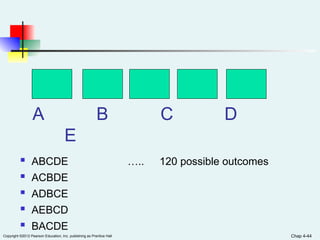
A B C D
E
Chap 4-44
 ABCDE ….. 120 possible outcomes
 ACBDE
 ADBCE
 AEBCD
 BACDE
Chap 4-45
Copyright ©2012 Pearson Education, Inc. publishing as Prentice Hall
Counting Rules
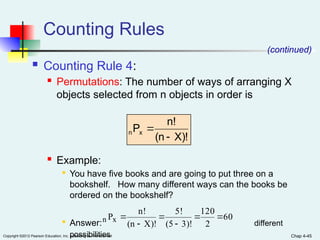
 Counting Rule 4:
 Permutations: The number of ways of arranging X
objects selected from n objects in order is
 Example:

You have five books and are going to put three on a
bookshelf. How many different ways can the books be
ordered on the bookshelf?

Answer: different
possibilities
(continued)
X)!
(n
n!
Px
n


60
2
120
3)!
(5
5!
X)!
(n
n!
Px
n 





Copyright ©2012 Pearson Education, Inc. publishing as Prentice Hall
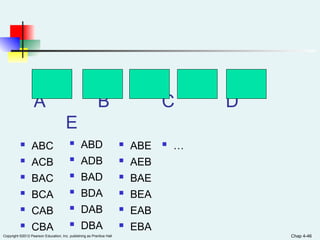
A B C D
E
Chap 4-46
 ABC
 ACB
 BAC
 BCA
 CAB
 CBA
 ABD
 ADB
 BAD
 BDA
 DAB
 DBA
 ABE
 AEB
 BAE
 BEA
 EAB
 EBA
 …
Chap 4-47
Copyright ©2012 Pearson Education, Inc. publishing as Prentice Hall
Counting Rules
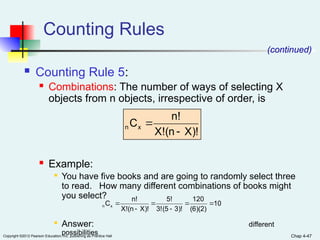
 Counting Rule 5:
 Combinations: The number of ways of selecting X
objects from n objects, irrespective of order, is
 Example:

You have five books and are going to randomly select three
to read. How many different combinations of books might
you select?

Answer: different
possibilities
(continued)
X)!
(n
X!
n!
Cx
n


10
(6)(2)
120
3)!
(5
3!
5!
X)!
(n
X!
n!
Cx
n 





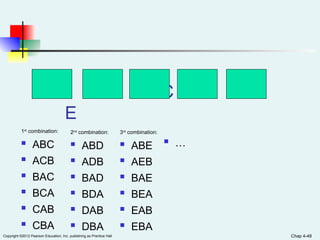
Copyright ©2012 Pearson Education, Inc. publishing as Prentice Hall
A B C D
E
Chap 4-48
1st
combination:
 ABC
 ACB
 BAC
 BCA
 CAB
 CBA
2nd
combination:
 ABD
 ADB
 BAD
 BDA
 DAB
 DBA
3rd
combination:
 ABE
 AEB
 BAE
 BEA
 EAB
 EBA
 …
Chap 4-49
Copyright ©2012 Pearson Education, Inc. publishing as Prentice Hall Chap 4-49
Chapter Summary
 Discussed basic probability concepts
 Sample spaces and events, contingency tables, simple
probability, and joint probability
 Examined basic probability rules
 General addition rule, addition rule for mutually exclusive events,
rule for collectively exhaustive events
 Defined conditional probability
 Statistical independence, marginal probability, decision trees,
and the multiplication rule
 Discussed Bayes’ theorem
 Discussed various counting rules

Basic Business Statistics 12-th edition,Chapter 4,Basic Probability

  • 1.
    Copyright ©2012 PearsonEducation, Inc. publishing as Prentice Hall Chap 4-1 Chap 4-1 Chapter 4 Basic Probability Basic Business Statistics 12th Edition
  • 2.
    Chap 4-2 Copyright ©2012Pearson Education, Inc. publishing as Prentice Hall Chap 4-2 Learning Objectives In this chapter, you learn:  Basic probability concepts  Conditional probability  To use Bayes’ Theorem to revise probabilities  Various counting rules
  • 3.
    Chap 4-3 Copyright ©2012Pearson Education, Inc. publishing as Prentice Hall Chap 4-3 Basic Probability Concepts  Probability – the chance that an uncertain event will occur (always between 0 and 1)  Impossible Event – an event that has no chance of occurring (probability = 0)  Certain Event – an event that is sure to occur (probability = 1)
  • 4.
    Chap 4-4 Copyright ©2012Pearson Education, Inc. publishing as Prentice Hall Chap 4-4 Assessing Probability There are three approaches to assessing the probability of an uncertain event: 1. a priori -- based on prior knowledge of the process 2. empirical probability -- based on observed data 3. subjective probability outcomes elementary of number total occur can event the ways of number T X   based on a combination of an individual’s past experience, personal opinion, and analysis of a particular situation outcomes elementary of number total occur can event the ways of number  Assuming all outcomes are equally likely probability of occurrence probability of occurrence
  • 5.
    Chap 4-5 Copyright ©2012Pearson Education, Inc. publishing as Prentice Hall Chap 4-5 Example of a priori probability When randomly selecting a day from the year 2010 what is the probability the day is in January? 2010 in days of number total January in days of number January In Day of y Probabilit   T X 365 31 2010 in days 365 January in days 31   T X
  • 6.
    Chap 4-6 Copyright ©2012Pearson Education, Inc. publishing as Prentice Hall Chap 4-6 Example of empirical probability Taking Stats Not Taking Stats Total Male 84 145 229 Female 76 134 210 Total 160 279 439 Find the probability of selecting a male taking statistics from the population described in the following table: 191 . 0 439 84 people of number total stats taking males of number    Probability of male taking stats
  • 7.
    Chap 4-7 Copyright ©2012Pearson Education, Inc. publishing as Prentice Hall Chap 4-7 Events Each possible outcome of a variable is an event.  Simple event  An event described by a single characteristic  e.g., A day in January from all days in 2010  Joint event  An event described by two or more characteristics  e.g. A day in January that is also a Wednesday from all days in 2010  Complement of an event A (denoted A’)  All events that are not part of event A  e.g., All days from 2010 that are not in January
  • 8.
    Chap 4-8 Copyright ©2012Pearson Education, Inc. publishing as Prentice Hall Chap 4-8 Sample Space The Sample Space is the collection of all possible events of a random experiment. e.g. All 6 faces of a die: e.g. All 52 cards of a bridge deck:
  • 9.
    Chap 4-9 Copyright ©2012Pearson Education, Inc. publishing as Prentice Hall Chap 4-9 Visualizing Events  Contingency Tables -- For All Days in 2010  Decision Trees All Days In 2010 Not Jan. Jan. Not Wed. Wed. Wed. Not Wed. Sample Space Total Number Of Sample Space Outcomes Not Wed. 27 286 313 Wed. 4 48 52 Total 31 334 365 Jan. Not Jan. Total 4 27 48 286
  • 10.
    Chap 4-10 Copyright ©2012Pearson Education, Inc. publishing as Prentice Hall Chap 4-10 Definition: Simple Probability  Simple Probability refers to the probability of a simple event.  ex. P(Jan.)  ex. P(Wed.) P(Jan.) = 31 / 365 P(Wed.) = 52 / 365 Not Wed. 27 286 313 Wed. 4 48 52 Total 31 334 365 Jan. Not Jan. Total
  • 11.
    Chap 4-11 Copyright ©2012Pearson Education, Inc. publishing as Prentice Hall Chap 4-11 Definition: Joint Probability  Joint Probability refers to the probability of an occurrence of two or more events (joint event).  ex. P(Jan. and Wed.)  ex. P(Not Jan. and Not Wed.) P(Jan. and Wed.) = 4 / 365 P(Not Jan. and Not Wed.) = 286 / 365 Not Wed. 27 286 313 Wed. 4 48 52 Total 31 334 365 Jan. Not Jan. Total
  • 12.
    Chap 4-12 Copyright ©2012Pearson Education, Inc. publishing as Prentice Hall Chap 4-12 Mutually Exclusive Events  Mutually exclusive events  Events that cannot occur simultaneously Example: Randomly choosing a day from 2010 A = day in January; B = day in February  Events A and B are mutually exclusive
  • 13.
    Chap 4-13 Copyright ©2012Pearson Education, Inc. publishing as Prentice Hall Chap 4-13 Collectively Exhaustive Events  Collectively exhaustive events  One of the events must occur  The set of events covers the entire sample space Example: Randomly choose a day from 2010 A = Weekday; B = Weekend; C = January; D = Spring;  Events A, B, C and D are collectively exhaustive (but not mutually exclusive – a weekday can be in January or in Spring)  Events A and B are collectively exhaustive and also mutually exclusive
  • 14.
    Chap 4-14 Copyright ©2012Pearson Education, Inc. publishing as Prentice Hall Chap 4-14 Computing Joint and Marginal Probabilities  The probability of a joint event, A and B:  Computing a marginal (or simple) probability:  Where B1, B2, …, Bk are k mutually exclusive and collectively exhaustive events outcomes elementary of number total B and A satisfying outcomes of number ) B and A ( P  ) B d an P(A ) B and P(A ) B and P(A P(A) k 2 1     
  • 15.
    Chap 4-15 Copyright ©2012Pearson Education, Inc. publishing as Prentice Hall Chap 4-15 Joint Probability Example P(Jan. and Wed.) 365 4 2010 in days of number total Wed. are and Jan. in are that days of number   Not Wed. 27 286 313 Wed. 4 48 52 Total 31 334 365 Jan. Not Jan. Total
  • 16.
    Chap 4-16 Copyright ©2012Pearson Education, Inc. publishing as Prentice Hall Chap 4-16 Marginal Probability Example P(Wed.) 365 52 365 48 365 4 ) Wed. and Jan. P(Not Wed.) and Jan. (     P Not Wed. 27 286 313 Wed. 4 48 52 Total 31 334 365 Jan. Not Jan. Total
  • 17.
    Chap 4-17 Copyright ©2012Pearson Education, Inc. publishing as Prentice Hall Chap 4-17 P(A1 and B2) P(A1) Total Event Marginal & Joint Probabilities In A Contingency Table P(A2 and B1) P(A1 and B1) Event Total 1 Joint Probabilities Marginal (Simple) Probabilities A1 A2 B1 B2 P(B1) P(B2) P(A2 and B2) P(A2)
  • 18.
    Chap 4-18 Copyright ©2012Pearson Education, Inc. publishing as Prentice Hall Chap 4-18 Probability Summary So Far  Probability is the numerical measure of the likelihood that an event will occur  The probability of any event must be between 0 and 1, inclusively  The sum of the probabilities of all mutually exclusive and collectively exhaustive events is 1 Certain Impossible 0.5 1 0 0 ≤ P(A) ≤ 1 For any event A 1 P(C) P(B) P(A)    If A, B, and C are mutually exclusive and collectively exhaustive
  • 19.
    Chap 4-19 Copyright ©2012Pearson Education, Inc. publishing as Prentice Hall Chap 4-19 General Addition Rule P(A or B) = P(A) + P(B) - P(A and B) General Addition Rule: If A and B are mutually exclusive, then P(A and B) = 0, so the rule can be simplified: P(A or B) = P(A) + P(B) For mutually exclusive events A and B
  • 20.
    Copyright ©2012 PearsonEducation, Inc. publishing as Prentice Hall Chap 4-20
  • 21.
    Copyright ©2012 PearsonEducation, Inc. publishing as Prentice Hall Chap 4-21
  • 22.
    Chap 4-22 Copyright ©2012Pearson Education, Inc. publishing as Prentice Hall Chap 4-22 General Addition Rule Example P(Jan. or Wed.) = P(Jan.) + P(Wed.) - P(Jan. and Wed.) = 31/365 + 52/365 - 4/365 = 79/365 Don’t count the four Wednesdays in January twice! Not Wed. 27 286 313 Wed. 4 48 52 Total 31 334 365 Jan. Not Jan. Total
  • 23.
    Chap 4-23 Copyright ©2012Pearson Education, Inc. publishing as Prentice Hall Chap 4-23 Computing Conditional Probabilities  A conditional probability is the probability of one event, given that another event has occurred: P(B) B) and P(A B) | P(A  P(A) B) and P(A A) | P(B  Where P(A and B) = joint probability of A and B P(A) = marginal or simple probability of A P(B) = marginal or simple probability of B The conditional probability of A given that B has occurred The conditional probability of B given that A has occurred
  • 24.
    Copyright ©2012 PearsonEducation, Inc. publishing as Prentice Hall Chap 4-24
  • 25.
    Chap 4-25 Copyright ©2012Pearson Education, Inc. publishing as Prentice Hall Chap 4-25  What is the probability that a car has a GPS given that it has AC ? i.e., we want to find P(GPS | AC) Conditional Probability Example  Of the cars on a used car lot, 90% have air conditioning (AC) and 40% have a GPS. 35% of the cars have both.
  • 26.
    Chap 4-26 Copyright ©2012Pearson Education, Inc. publishing as Prentice Hall Chap 4-26 Conditional Probability Example  Of the cars on a used car lot, 90% have air conditioning (AC) and 40% have a GPS. 35% of the cars have both. No GPS GPS Total AC 0.35 0.55 0.90 No AC 0.05 0.05 0.10 Total 0.40 0.60 1.00 0.3889 0.90 0.35 P(AC) AC) and P(GPS AC) | P(GPS    (continued)
  • 27.
    Chap 4-27 Copyright ©2012Pearson Education, Inc. publishing as Prentice Hall Chap 4-27 Conditional Probability Example  Given AC, we only consider the top row (90% of the cars). Of these, 35% have a GPS. 35% of 90% is about 38.89%. (continued) No GPS GPS Total AC 0.35 0.55 0.90 No AC 0.05 0.05 0.10 Total 0.40 0.60 1.00 0.3889 0.90 0.35 P(AC) AC) and P(GPS AC) | P(GPS   
  • 28.
    Chap 4-28 Copyright ©2012Pearson Education, Inc. publishing as Prentice Hall Chap 4-28 Using Decision Trees Has AC Does not have AC Has GPS Does not have GPS Has GPS Does not have GPS P(AC)= 0.9 P(AC’)= 0.1 P(AC and GPS) = 0.35 P(AC and GPS’) = 0.55 P(AC’ and GPS’) = 0.05 P(AC’ and GPS) = 0.05 90 . 55 . 10 . 05 . 10 . 05 . All Cars 90 . 35 . Given AC or no AC: Conditional Probabilities
  • 29.
    Chap 4-29 Copyright ©2012Pearson Education, Inc. publishing as Prentice Hall Chap 4-29 Using Decision Trees Has GPS Does not have GPS Has AC Does not have AC Has AC Does not have AC P(GPS)= 0.4 P(GPS’)= 0.6 P(GPS and AC) = 0.35 P(GPS and AC’) = 0.05 P(GPS’ and AC’) = 0.05 P(GPS’ and AC) = 0.55 40 . 05 . 60 . 55 . 60 . 05 . All Cars 40 . 35 . Given GPS or no GPS: (continued) Conditional Probabilities
  • 30.
    Chap 4-30 Copyright ©2012Pearson Education, Inc. publishing as Prentice Hall Chap 4-30 Independence  Two events are independent if and only if:  Events A and B are independent when the probability of one event is not affected by the fact that the other event has occurred P(A) B) | P(A 
  • 31.
    Copyright ©2012 PearsonEducation, Inc. publishing as Prentice Hall The difference between mutually exclusive and independent events  a mutually exclusive event can simply be defined as a situation when two events cannot occur at same time whereas independent event occurs when one event remains unaffected by the occurrence of the other event. Suppose an event does not take place that does not stop other events from happening. It is important to note here that mutually exclusive events cannot be independent unless the probability of one of the events is zero.  The mathematical formula for mutually exclusive events can be represented as P(X and Y) = 0  The mathematical formula for independent events can be defined as P(X and Y) = P(X) P(Y)  Example: when a coin is a tossed and there are two events that can occur, either it will be a head or a tail. Hence, both the events here are mutually exclusive. But if we take two separate coins and flip them, then the occurrence of Head or Tail on both the coins are independent to each other. Chap 4-31
  • 32.
    Chap 4-32 Copyright ©2012Pearson Education, Inc. publishing as Prentice Hall Chap 4-32 Multiplication Rules  Multiplication rule for two events A and B: P(B) B) | P(A B) and P(A  P(A) B) | P(A  Note: If A and B are independent, then and the multiplication rule simplifies to P(B) P(A) B) and P(A 
  • 33.
    Chap 4-33 Copyright ©2012Pearson Education, Inc. publishing as Prentice Hall Chap 4-33 Marginal Probability  Marginal probability for event A:  Where B1, B2, …, Bk are k mutually exclusive and collectively exhaustive events ) P(B ) B | P(A ) P(B ) B | P(A ) P(B ) B | P(A P(A) k k 2 2 1 1     
  • 34.
    Chap 4-34 Copyright ©2012Pearson Education, Inc. publishing as Prentice Hall Chap 4-34 Bayes’ Theorem  Bayes’ Theorem is used to revise previously calculated probabilities based on new information.  Developed by Thomas Bayes in the 18th Century.  It is an extension of conditional probability.
  • 35.
    Chap 4-35 Copyright ©2012Pearson Education, Inc. publishing as Prentice Hall Chap 4-35 Bayes’ Theorem  where: Bi = ith event of k mutually exclusive and collectively exhaustive events A = new event that might impact P(Bi) ) )P(B B | P(A ) )P(B B | P(A ) )P(B B | P(A ) )P(B B | P(A A) | P(B k k 2 2 1 1 i i i       
  • 36.
    Chap 4-36 Copyright ©2012Pearson Education, Inc. publishing as Prentice Hall Chap 4-36 Bayes’ Theorem Example  A drilling company has estimated a 40% chance of striking oil for their new well.  A detailed test has been scheduled for more information. Historically, 60% of successful wells have had detailed tests, and 20% of unsuccessful wells have had detailed tests.  Given that this well has been scheduled for a detailed test, what is the probability that the well will be successful?
  • 37.
    Chap 4-37 Copyright ©2012Pearson Education, Inc. publishing as Prentice Hall Chap 4-37  Let S = successful well U = unsuccessful well  P(S) =0.4, P(U) =0.6 (prior probabilities)  Define the detailed test event as D  Conditional probabilities: P(D|S) = 0.6 P(D|U) =0.2  Goal is to find P(S|D)=? Bayes’ Theorem Example (continued)
  • 38.
    Chap 4-38 Copyright ©2012Pearson Education, Inc. publishing as Prentice Hall Chap 4-38  Let S = successful well U = unsuccessful well  P(S) = 0.4 , P(U) = 0.6 (prior probabilities)  Define the detailed test event as D  Conditional probabilities: P(D|S) = 0.6 P(D|U) = 0.2  Goal is to find P(S|D) Bayes’ Theorem Example (continued)
  • 39.
    Chap 4-39 Copyright ©2012Pearson Education, Inc. publishing as Prentice Hall Chap 4-39 0.667 0.12 0.24 0.24 (0.2)(0.6) (0.6)(0.4) (0.6)(0.4) U)P(U) | P(D S)P(S) | P(D S)P(S) | P(D D) | P(S        Bayes’ Theorem Example (continued) Apply Bayes’ Theorem: So the revised probability of success, given that this well has been scheduled for a detailed test, is 0.667
  • 40.
    Chap 4-40 Copyright ©2012Pearson Education, Inc. publishing as Prentice Hall Chap 4-40  Given the detailed test, the revised probability of a successful well has risen to 0.667 from the original estimate of 0.4 Bayes’ Theorem Example Event Prior Prob. Conditional Prob. Joint Prob. Revised Prob. S (successful) 0.4 0.6 (0.4)(0.6) = 0.24 0.24/0.36 = 0.667 U (unsuccessful) 0.6 0.2 (0.6)(0.2) = 0.12 0.12/0.36 = 0.333 Sum = 0.36 (continued)
  • 41.
    Chap 4-41 Copyright ©2012Pearson Education, Inc. publishing as Prentice Hall Counting Rules  Rules for counting the number of possible outcomes  Counting Rule 1:  If any one of k different mutually exclusive and collectively exhaustive events can occur on each of n trials, the number of possible outcomes is equal to (1) 1 2 3 4 5 6 (2) 1 2 3 4 5 6 (3) 1 2 3 4 5 6  Example  If you roll a fair die 3 times then there are 63 = 216 possible outcomes: 111,112,113,114,115,116,121…666 – 216 possible outcomes kn
  • 42.
    Chap 4-42 Copyright ©2012Pearson Education, Inc. publishing as Prentice Hall Counting Rules  Counting Rule 2:  If there are k1 events on the first trial, k2 events on the second trial, … and kn events on the nth trial, the number of possible outcomes is  Example:  You want to go to a park, eat at a restaurant, and see a movie. There are 3 parks, 4 restaurants, and 6 movie choices. How many different possible combinations are there?  Answer: (3)(4)(6) = 72 different possibilities (k1)(k2)… (kn) (continued)
  • 43.
    Chap 4-43 Copyright ©2012Pearson Education, Inc. publishing as Prentice Hall Counting Rules  Counting Rule 3:  The number of ways that n items can be arranged in order is  Example:  You have five books to put on a bookshelf. How many different ways can these books be placed on the shelf?  Answer: 5! = (5)(4)(3)(2)(1) = 120 different possibilities n! = (n)(n – 1)… (1) (continued)
  • 44.
    Copyright ©2012 PearsonEducation, Inc. publishing as Prentice Hall A B C D E Chap 4-44  ABCDE ….. 120 possible outcomes  ACBDE  ADBCE  AEBCD  BACDE
  • 45.
    Chap 4-45 Copyright ©2012Pearson Education, Inc. publishing as Prentice Hall Counting Rules  Counting Rule 4:  Permutations: The number of ways of arranging X objects selected from n objects in order is  Example:  You have five books and are going to put three on a bookshelf. How many different ways can the books be ordered on the bookshelf?  Answer: different possibilities (continued) X)! (n n! Px n   60 2 120 3)! (5 5! X)! (n n! Px n      
  • 46.
    Copyright ©2012 PearsonEducation, Inc. publishing as Prentice Hall A B C D E Chap 4-46  ABC  ACB  BAC  BCA  CAB  CBA  ABD  ADB  BAD  BDA  DAB  DBA  ABE  AEB  BAE  BEA  EAB  EBA  …
  • 47.
    Chap 4-47 Copyright ©2012Pearson Education, Inc. publishing as Prentice Hall Counting Rules  Counting Rule 5:  Combinations: The number of ways of selecting X objects from n objects, irrespective of order, is  Example:  You have five books and are going to randomly select three to read. How many different combinations of books might you select?  Answer: different possibilities (continued) X)! (n X! n! Cx n   10 (6)(2) 120 3)! (5 3! 5! X)! (n X! n! Cx n      
  • 48.
    Copyright ©2012 PearsonEducation, Inc. publishing as Prentice Hall A B C D E Chap 4-48 1st combination:  ABC  ACB  BAC  BCA  CAB  CBA 2nd combination:  ABD  ADB  BAD  BDA  DAB  DBA 3rd combination:  ABE  AEB  BAE  BEA  EAB  EBA  …
  • 49.
    Chap 4-49 Copyright ©2012Pearson Education, Inc. publishing as Prentice Hall Chap 4-49 Chapter Summary  Discussed basic probability concepts  Sample spaces and events, contingency tables, simple probability, and joint probability  Examined basic probability rules  General addition rule, addition rule for mutually exclusive events, rule for collectively exhaustive events  Defined conditional probability  Statistical independence, marginal probability, decision trees, and the multiplication rule  Discussed Bayes’ theorem  Discussed various counting rules

Editor's Notes

  • #4 A priori knowledge is that which is independent from experience. A posteriori knowledge is that which depends on empirical evidence. In prior probability, the number of ways the event occurs and the total number of possible outcomes are known from the composition of the values of variable. Priori probability is a probability based on logical analysis rather than observation or personal judgment. For example, when you toss dice fairly, the probability of rolling an even number is 50%. In the empirical probability approach, the probabilities are based on observed data, not on prior knowledge of a process. For example, based on historical data over a 10-year period, the probability of default for real estate mortgage loans is 7%. For empirical probabilities to be accurate, relationships must be stable over time.
  • #7 A-weekdays A`- weekends
  • #12 Any outcome that is included in both events of A and B?
  • #13 What abt A and C? C and D?
  • #14 Marginal probability states that P of event equals to the sum of joint P`s of that event with the sub-events of another event if sub-events of another event are mutually exclusive and collectively exhaustive. P(A and B1)=p(A|b1)*p(b1) P(A and B2)=p(A}b2)*p(b2)
  • #19 Why do we subtract the joint probability?
  • #22 P(not wed or not jan)=p(not jan)+ P(not wed)-p(not jan and not wed) P(Wed|not jan)=48/334 P(Wed|not jan)=P(wed and not jan)/P(not jan) P(A|B)=P(A and B)/P(B)
  • #23 P(A|B) – is the probability of A occurs with the new sample space of B.
  • #26 P(No AC|No GPS)=0.05/0.6 P(AC|GPS)=p( ac and gps) / p (gps)
  • #31 mutually exclusive events may not be independent, and independent events may not be mutually exclusive.
  • #32 P(A|B)=P(A and B)/P(B) P(A and B)=P(A|B)*P(B)
  • #33 P(A and B1)=p(A|b1)*p(b1) P(A and B2)=p(A}b2)*p(b2)
  • #35 P(Bi|A)=p(bi and a)/p(a)=(p(a|bi)*p(bi))/(p(a|b1)*p(b1)+p(a|b2)*p(b2)+..+) P(A)=P(A and B1)+P(A and B2)+…+ P(A)=p(a|b1)*p(b1)+p(a|b2)*p(b2)+..+ P(A|Bi)=p(a and bi)/p(bi) P(Bi and A)=p(bi|a)*p(a)=p(a|bi)*p(bi)
  • #37 P(S|D)=P(S and D)/P(D)=P(D|S)*P(S)/(P(D and S) + P(D and U))=P(D|S)*P(S)/(P(D|S)*P(S)+P(D|U)*P(U))