6-1
McGraw-Hill/Irwin
Operations Management, Seventh Edition, by William J. Stevenson
Copyright © 2002 by The McGraw-Hill Companies, Inc. All rights reserved.
Process Design and Facility Layout
Chapter 6
Process Design
and
Facility Layout
6-2
McGraw-Hill/Irwin
Operations Management, Seventh Edition, by William J. Stevenson
Copyright © 2002 by The McGraw-Hill Companies, Inc. All rights reserved.
Process Design and Facility Layout
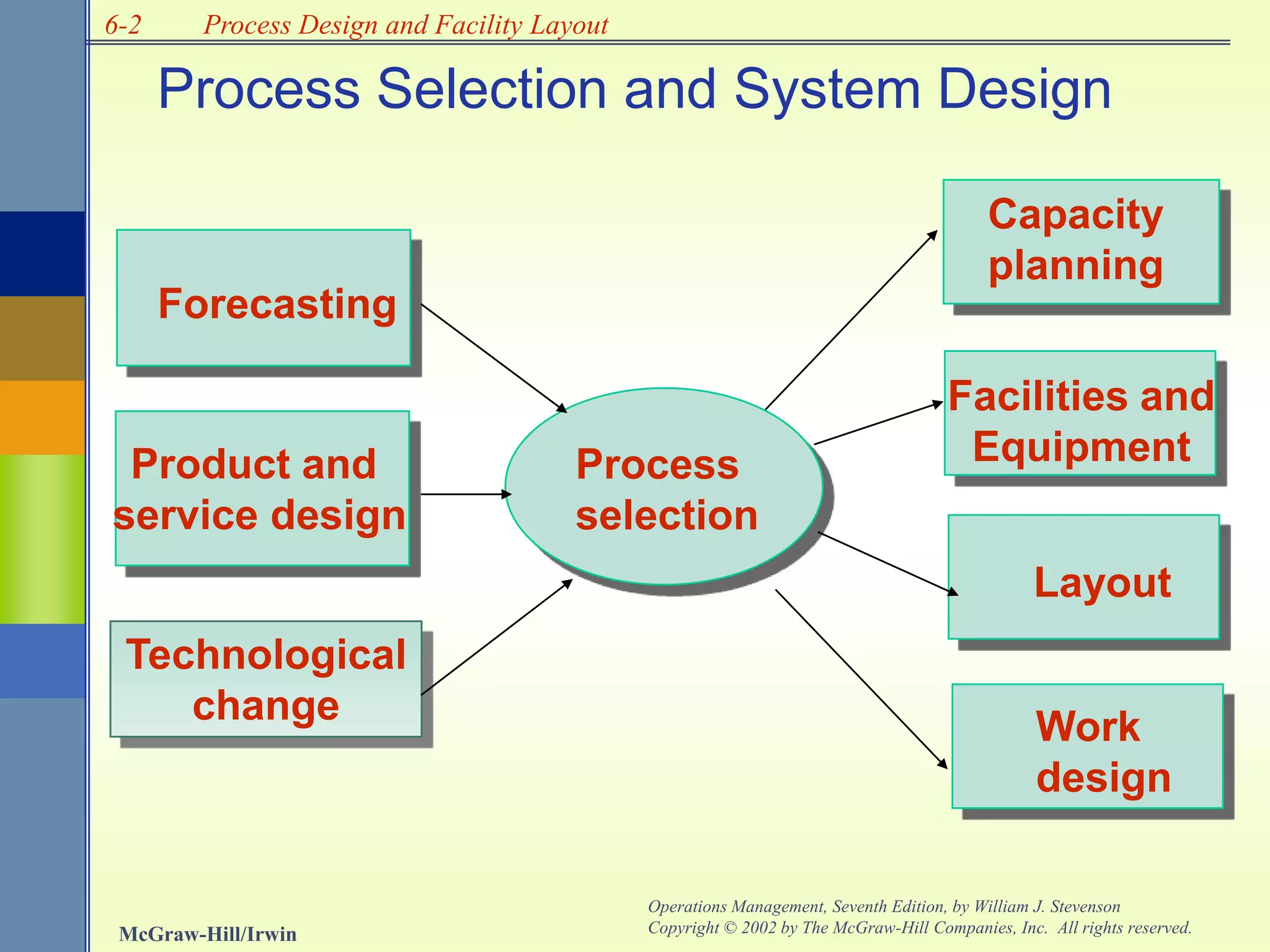
Process Selection and System Design
Forecasting
Product and
service design
Capacity
planning
Facilities and
Equipment
Layout
Work
design
Process
selection
Technological
change
6-3
McGraw-Hill/Irwin
Operations Management, Seventh Edition, by William J. Stevenson
Copyright © 2002 by The McGraw-Hill Companies, Inc. All rights reserved.
Process Design and Facility Layout
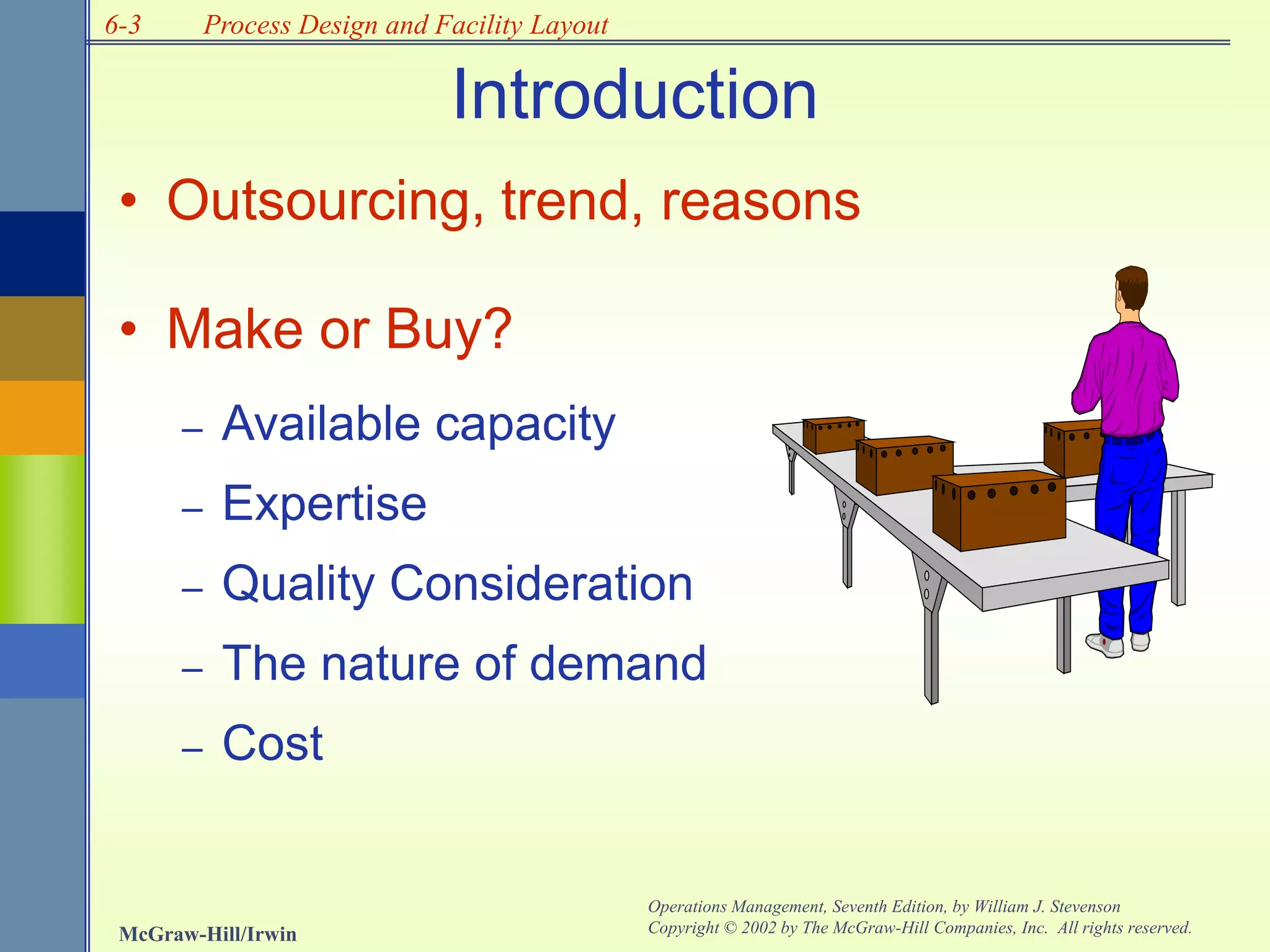
Introduction
• Outsourcing, trend, reasons
• Make or Buy?
– Available capacity
– Expertise
– Quality Consideration
– The nature of demand
– Cost
6-4
McGraw-Hill/Irwin
Operations Management, Seventh Edition, by William J. Stevenson
Copyright © 2002 by The McGraw-Hill Companies, Inc. All rights reserved.
Process Design and Facility Layout
• Variety
– How much
• Flexibility
– What degree
• Volume
– Expected output
• The key trade-off
Process Selection
6-5
McGraw-Hill/Irwin
Operations Management, Seventh Edition, by William J. Stevenson
Copyright © 2002 by The McGraw-Hill Companies, Inc. All rights reserved.
Process Design and Facility Layout
Process Types
• Projects
• Job Shops
• Batch Processing
• Repetitive/Assembly
• Continuous Processing
6-6
McGraw-Hill/Irwin
Operations Management, Seventh Edition, by William J. Stevenson
Copyright © 2002 by The McGraw-Hill Companies, Inc. All rights reserved.
Process Design and Facility Layout
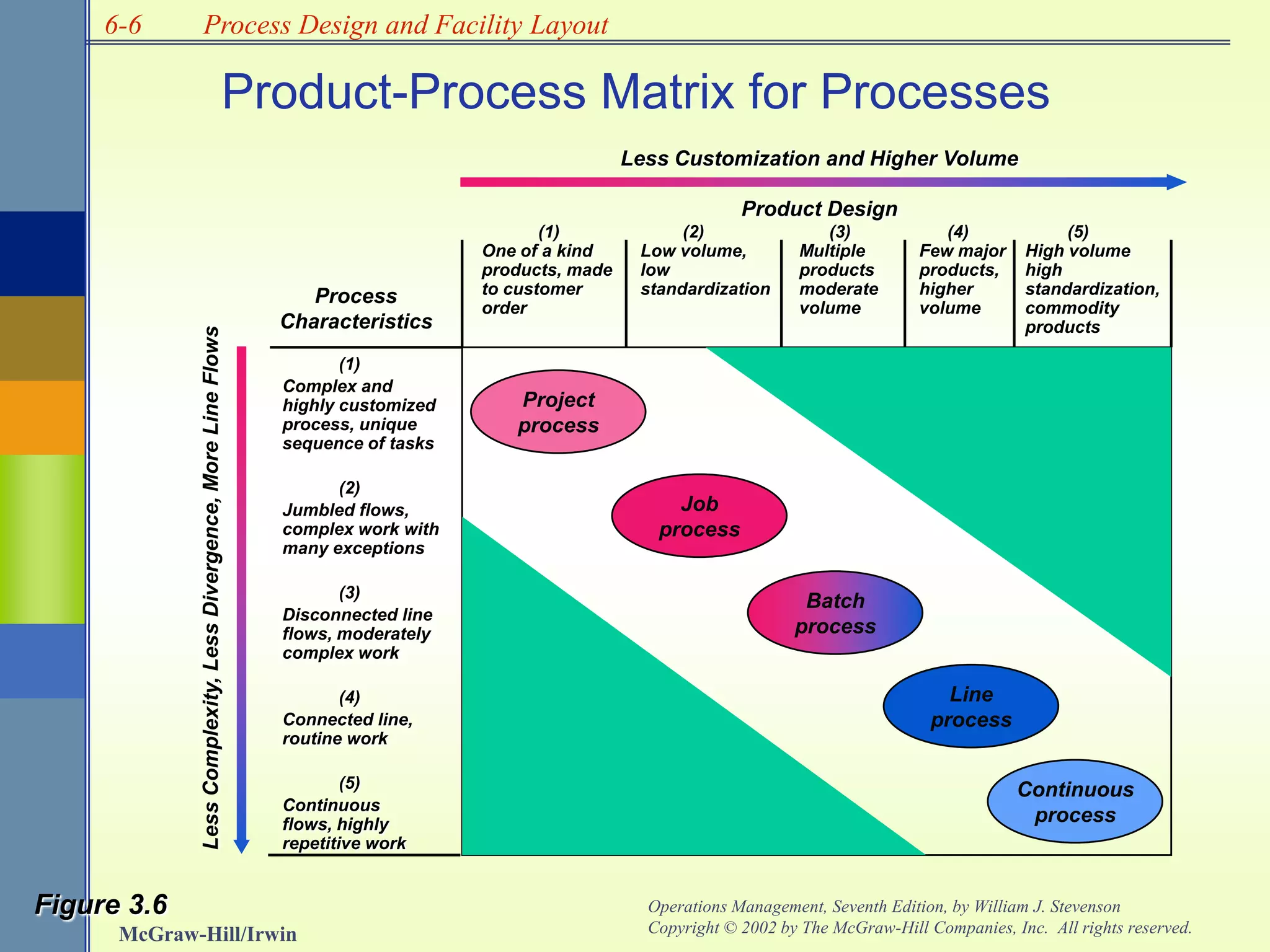
Figure 3.6
Product-Process Matrix for Processes
(1) (2) (3) (4) (5)
One of a kind Low volume, Multiple Few major High volume
products, made low products products, high
to customer standardization moderate higher standardization,
order volume volume commodity
products
Process
Characteristics
(1)
Complex and
highly customized
process, unique
sequence of tasks
(2)
Jumbled flows,
complex work with
many exceptions
(3)
Disconnected line
flows, moderately
complex work
(4)
Connected line,
routine work
(5)
Continuous
flows, highly
repetitive work
LessComplexity,LessDivergence,MoreLineFlows
Less Customization and Higher Volume
Product Design
Continuous
process
Project
process
Line
process
Batch
process
Job
process
6-7
McGraw-Hill/Irwin
Operations Management, Seventh Edition, by William J. Stevenson
Copyright © 2002 by The McGraw-Hill Companies, Inc. All rights reserved.
Process Design and Facility Layout
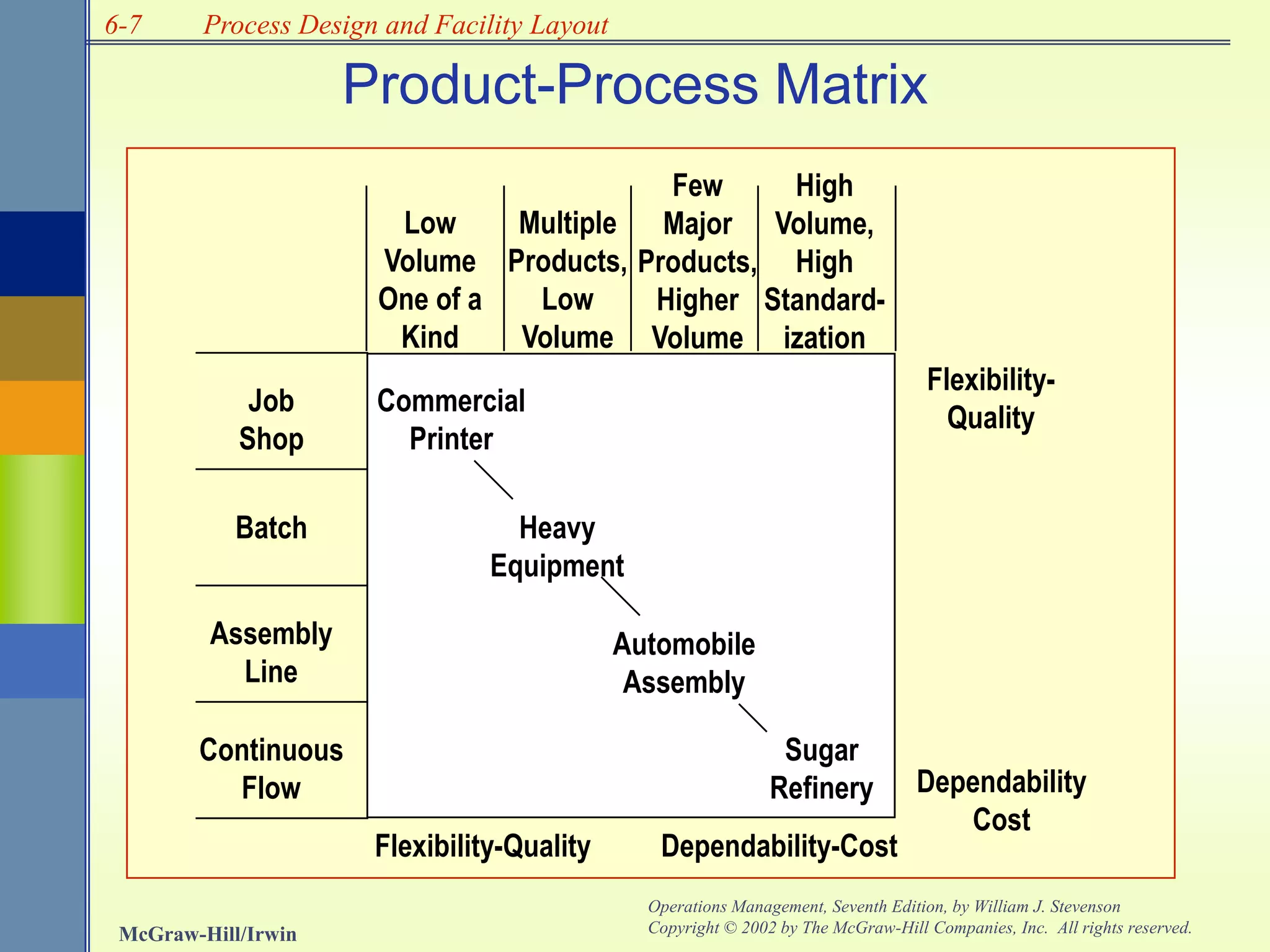
Product-Process Matrix
Flexibility-Quality Dependability-Cost
Continuous
Flow
Assembly
Line
Batch
Job
Shop
Low
Volume
One of a
Kind
Multiple
Products,
Low
Volume
Few
Major
Products,
Higher
Volume
High
Volume,
High
Standard-
ization
Commercial
Printer
Heavy
Equipment
Automobile
Assembly
Sugar
Refinery
Flexibility-
Quality
Dependability
Cost
6-8
McGraw-Hill/Irwin
Operations Management, Seventh Edition, by William J. Stevenson
Copyright © 2002 by The McGraw-Hill Companies, Inc. All rights reserved.
Process Design and Facility Layout
• Automation: Machinery that has
sensing and control devices that
enables it to operate
Automation
6-9
McGraw-Hill/Irwin
Operations Management, Seventh Edition, by William J. Stevenson
Copyright © 2002 by The McGraw-Hill Companies, Inc. All rights reserved.
Process Design and Facility Layout
Automation
• Numerically controlled (NC) machines
• Robot
• Computer-aided design and
manufacturing systems (CAD/CAM)
• Flexible manufacturing systems
• Computer-integrated manufacturing
(CIM)
6-10
McGraw-Hill/Irwin
Operations Management, Seventh Edition, by William J. Stevenson
Copyright © 2002 by The McGraw-Hill Companies, Inc. All rights reserved.
Process Design and Facility Layout
• Layout: the configuration of
departments, work centers, and
equipment, with particular emphasis
on movement of work (customers or
materials) through the system
Layout
6-11
McGraw-Hill/Irwin
Operations Management, Seventh Edition, by William J. Stevenson
Copyright © 2002 by The McGraw-Hill Companies, Inc. All rights reserved.
Process Design and Facility Layout
• Requires substantial investments of
money and effort
• Involves long-term commitments
• Has significant impact on cost and
efficiency of short-term operations
Importance of Layout Decisions
6-12
McGraw-Hill/Irwin
Operations Management, Seventh Edition, by William J. Stevenson
Copyright © 2002 by The McGraw-Hill Companies, Inc. All rights reserved.
Process Design and Facility Layout
Basic Layout Types
• Product Layouts
• Process Layouts
• Fixed-Position
• Combination Layouts
6-13
McGraw-Hill/Irwin
Operations Management, Seventh Edition, by William J. Stevenson
Copyright © 2002 by The McGraw-Hill Companies, Inc. All rights reserved.
Process Design and Facility Layout
Basic Layout Types
• Product Layout
– Layout that uses standardized processing
operations to achieve smooth, rapid, high-
volume flow
– Group equipments according to the sequential
steps of operations of a specific product
• Process Layout
– Layout that can handle varied processing
requirements
– Group equipments according to their functions
6-14
McGraw-Hill/Irwin
Operations Management, Seventh Edition, by William J. Stevenson
Copyright © 2002 by The McGraw-Hill Companies, Inc. All rights reserved.
Process Design and Facility Layout
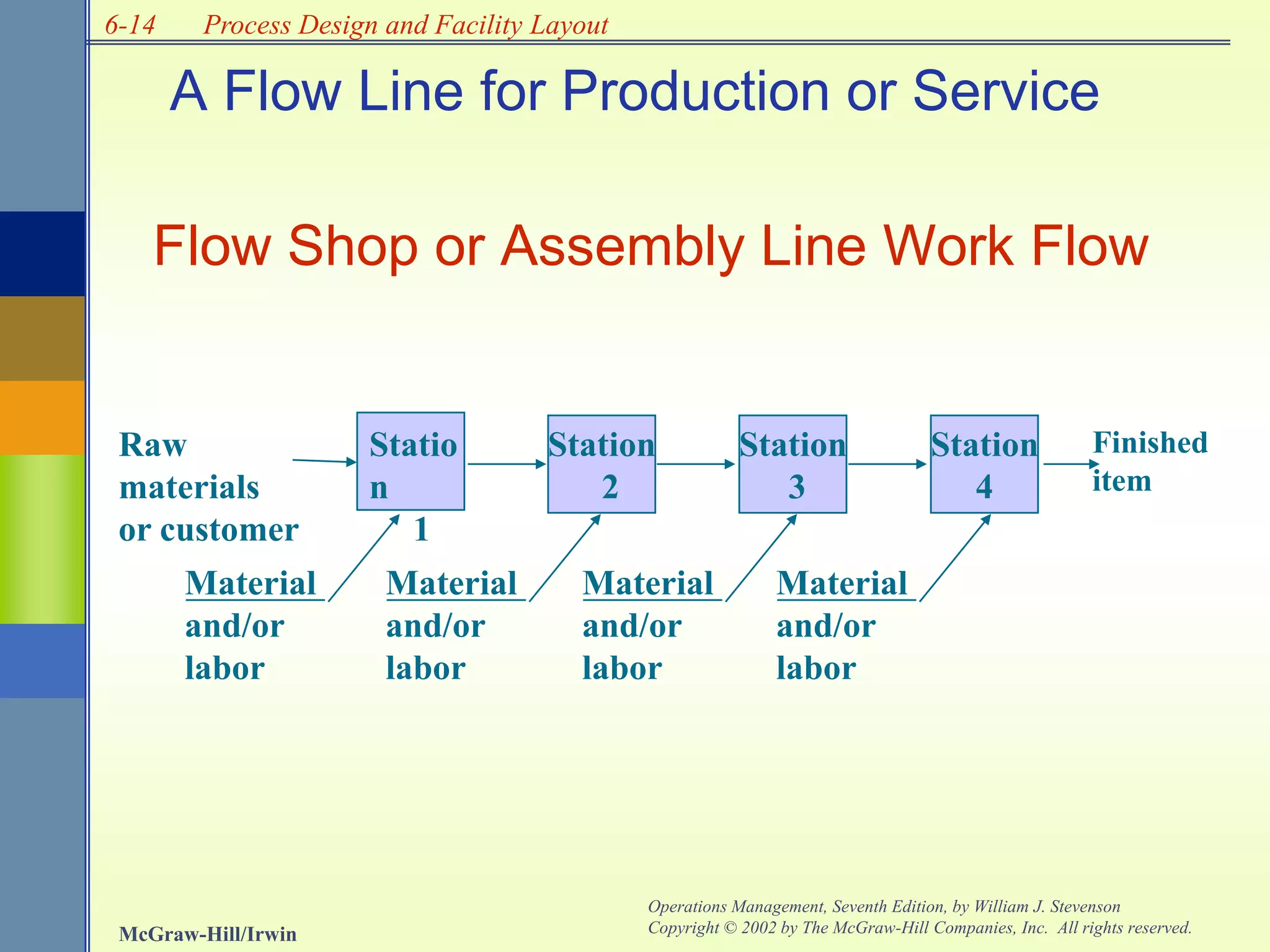
A Flow Line for Production or Service
Flow Shop or Assembly Line Work Flow
Raw
materials
or customer
Finished
item
Station
2
Station
3
Station
4
Material
and/or
labor
Statio
n
1
Material
and/or
labor
Material
and/or
labor
Material
and/or
labor
6-15
McGraw-Hill/Irwin
Operations Management, Seventh Edition, by William J. Stevenson
Copyright © 2002 by The McGraw-Hill Companies, Inc. All rights reserved.
Process Design and Facility Layout
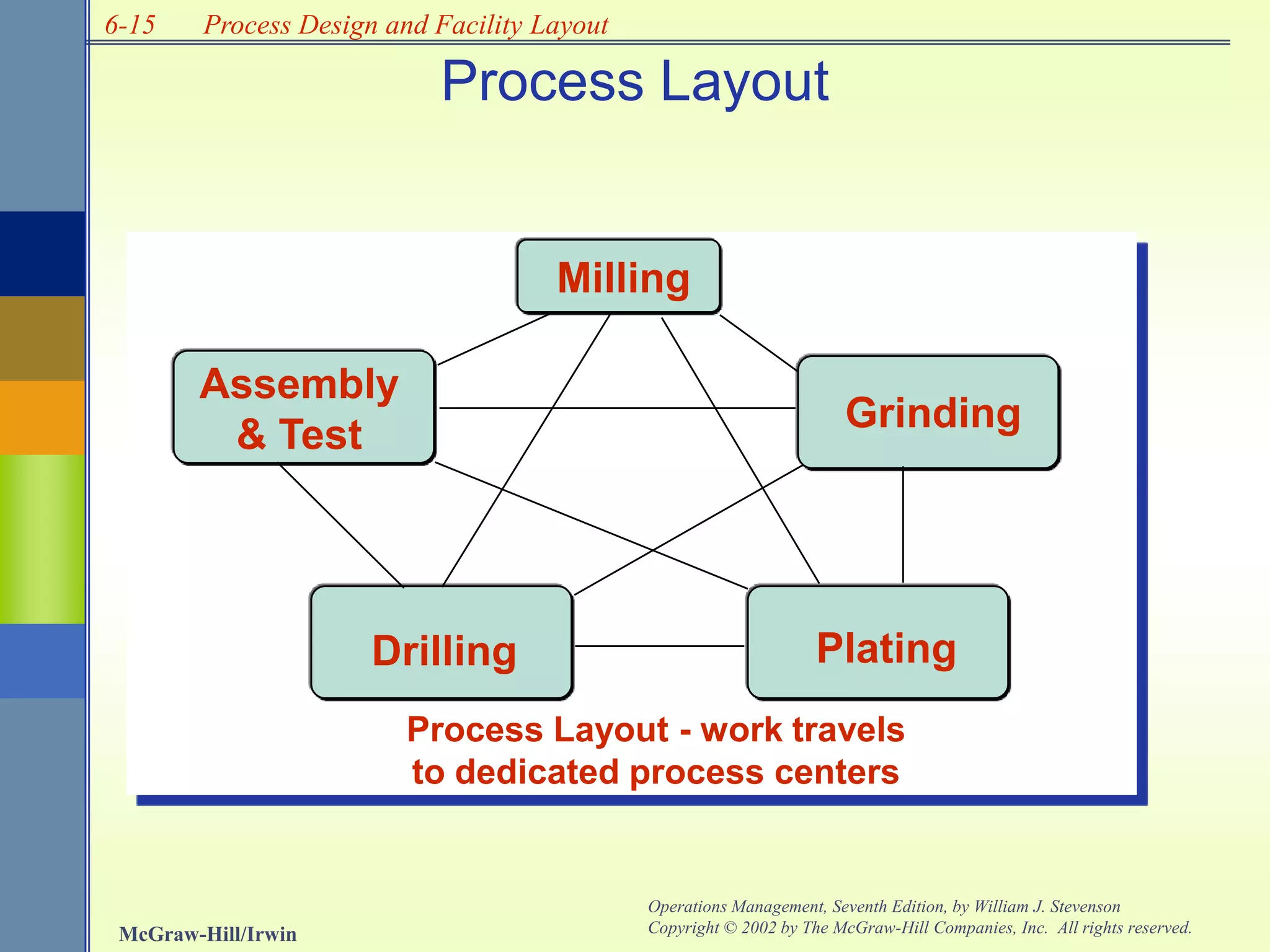
Process Layout
Process Layout - work travels
to dedicated process centers
Milling
Assembly
& Test
Grinding
Drilling Plating
6-16
McGraw-Hill/Irwin
Operations Management, Seventh Edition, by William J. Stevenson
Copyright © 2002 by The McGraw-Hill Companies, Inc. All rights reserved.
Process Design and Facility Layout
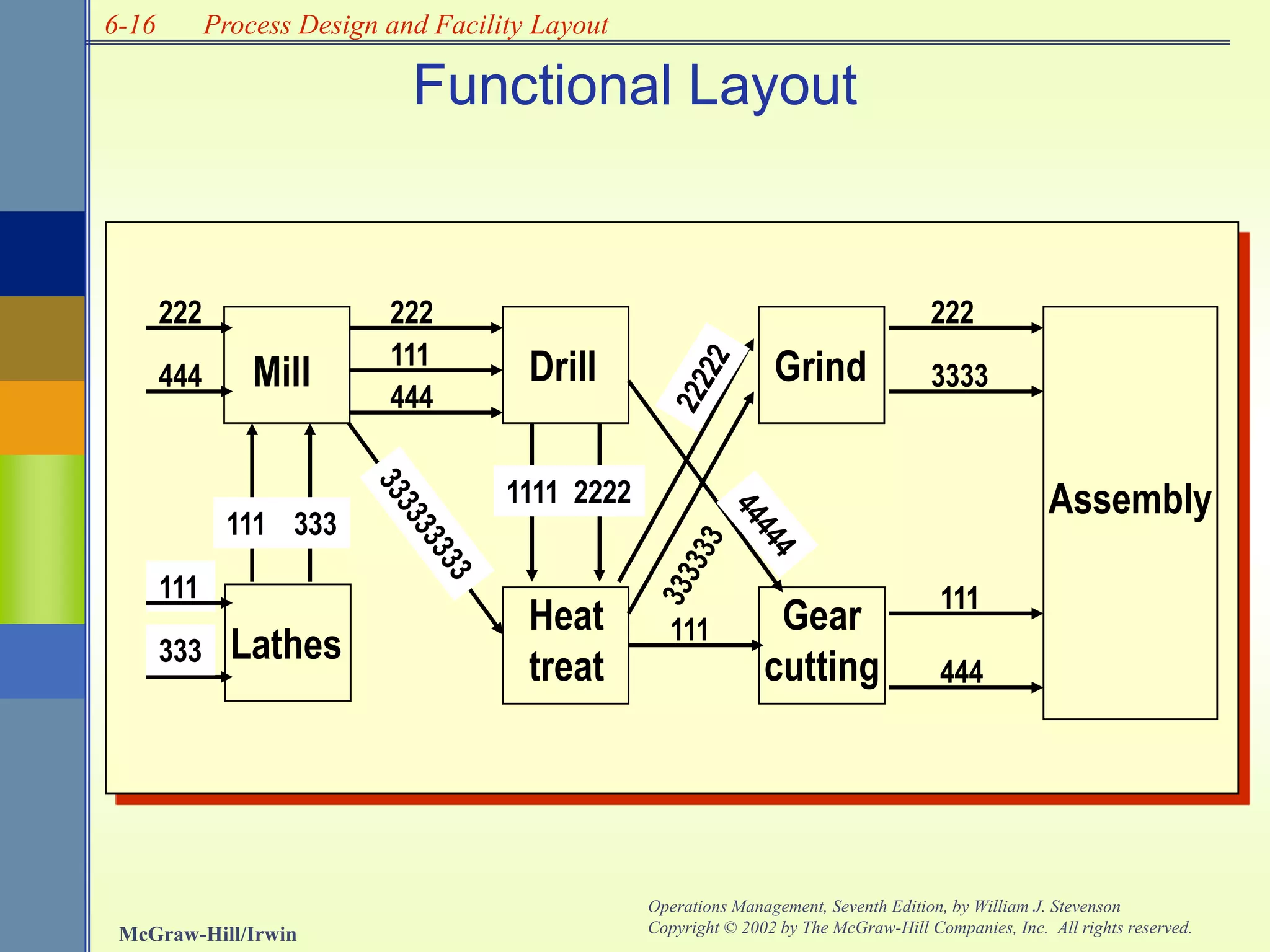
Functional Layout
Gear
cutting
Mill Drill
Lathes
Grind
Heat
treat
Assembly
111
333
222
444
222
111
444
111 333
1111 2222
222
3333
111
444
111
6-17
McGraw-Hill/Irwin
Operations Management, Seventh Edition, by William J. Stevenson
Copyright © 2002 by The McGraw-Hill Companies, Inc. All rights reserved.
Process Design and Facility Layout
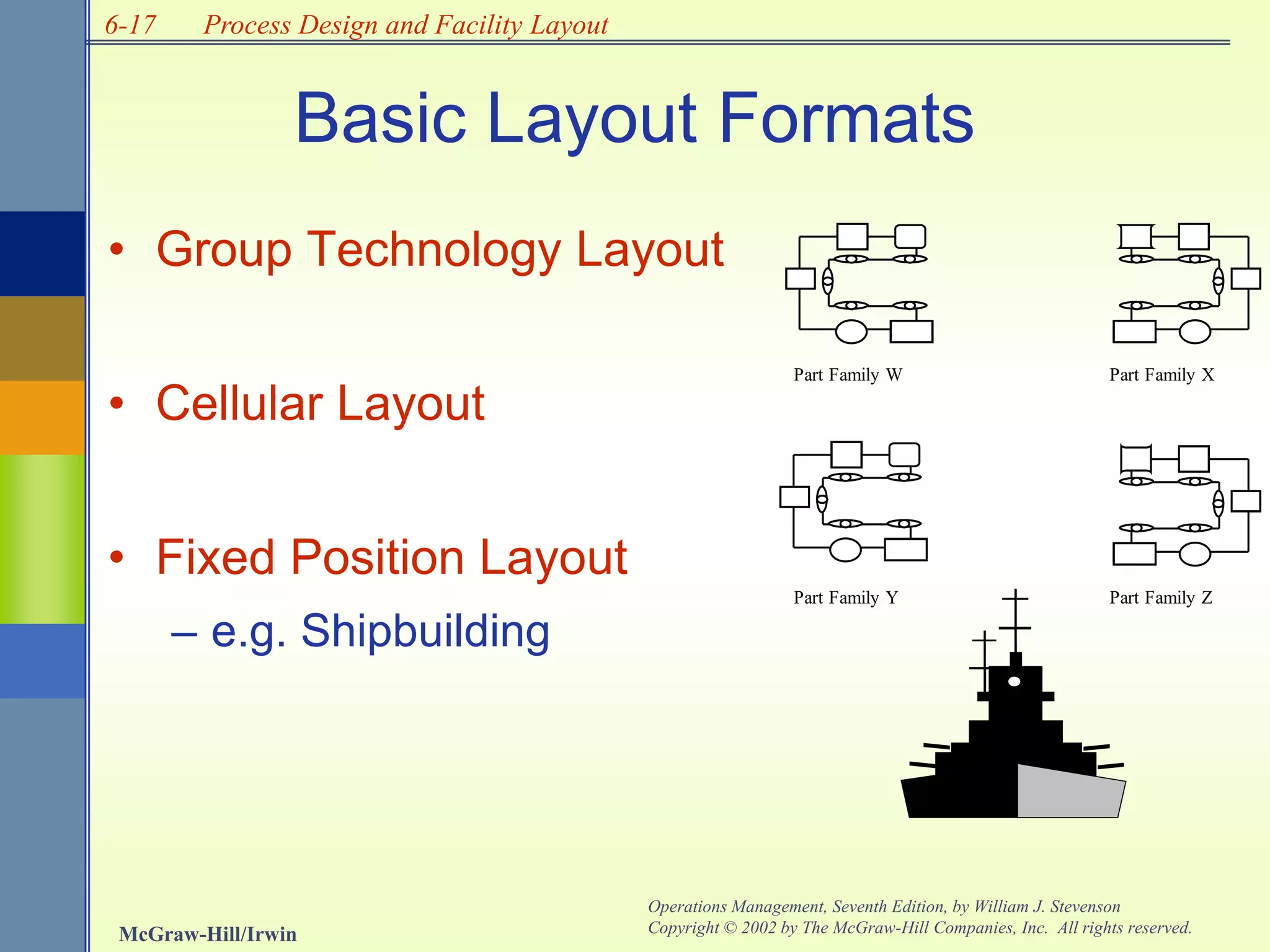
Basic Layout Formats
• Group Technology Layout
• Cellular Layout
• Fixed Position Layout
– e.g. Shipbuilding
Part Family W Part Family X
Part Family Y Part Family Z
6-18
McGraw-Hill/Irwin
Operations Management, Seventh Edition, by William J. Stevenson
Copyright © 2002 by The McGraw-Hill Companies, Inc. All rights reserved.
Process Design and Facility Layout
Cellular Layouts
• Cellular Manufacturing
– Layout in which machines are grouped into
a cell that can process items that have
similar processing requirements
• Group Technology
– The grouping into part families of items with
similar design or manufacturing
characteristics
6-19
McGraw-Hill/Irwin
Operations Management, Seventh Edition, by William J. Stevenson
Copyright © 2002 by The McGraw-Hill Companies, Inc. All rights reserved.
Process Design and Facility Layout
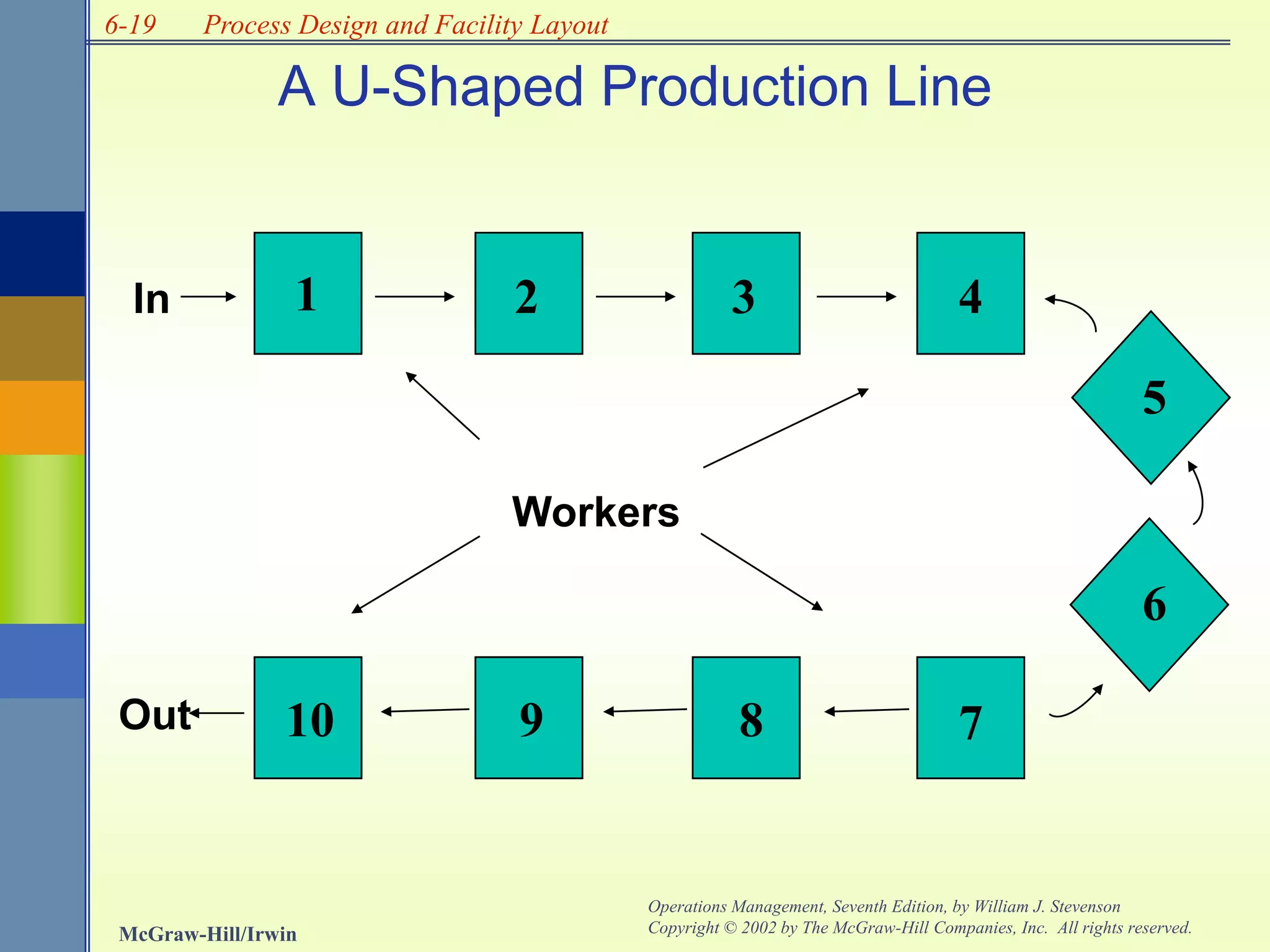
A U-Shaped Production Line
1 2 3 4
5
6
78910
In
Out
Workers
6-20
McGraw-Hill/Irwin
Operations Management, Seventh Edition, by William J. Stevenson
Copyright © 2002 by The McGraw-Hill Companies, Inc. All rights reserved.
Process Design and Facility Layout
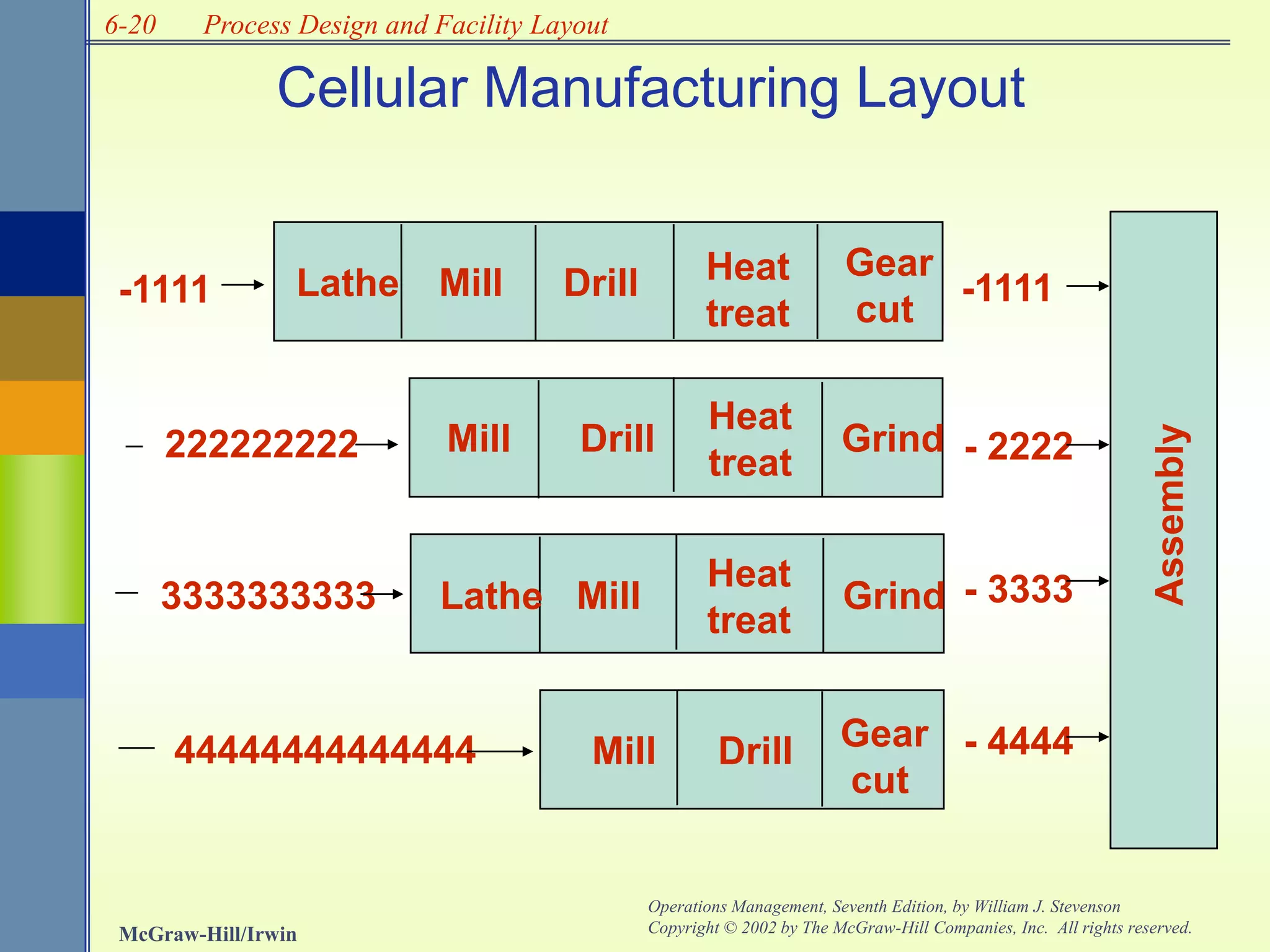
Cellular Manufacturing Layout
-1111 -1111
222222222 - 2222
Assembly
3333333333 - 3333
44444444444444 - 4444
Lathe
Lathe
Mill
Mill
Mill
Mill
Drill
Drill
Drill
Heat
treat
Heat
treat
Heat
treat
Gear
cut
Gear
cut
Grind
Grind
6-21
McGraw-Hill/Irwin
Operations Management, Seventh Edition, by William J. Stevenson
Copyright © 2002 by The McGraw-Hill Companies, Inc. All rights reserved.
Process Design and Facility Layout
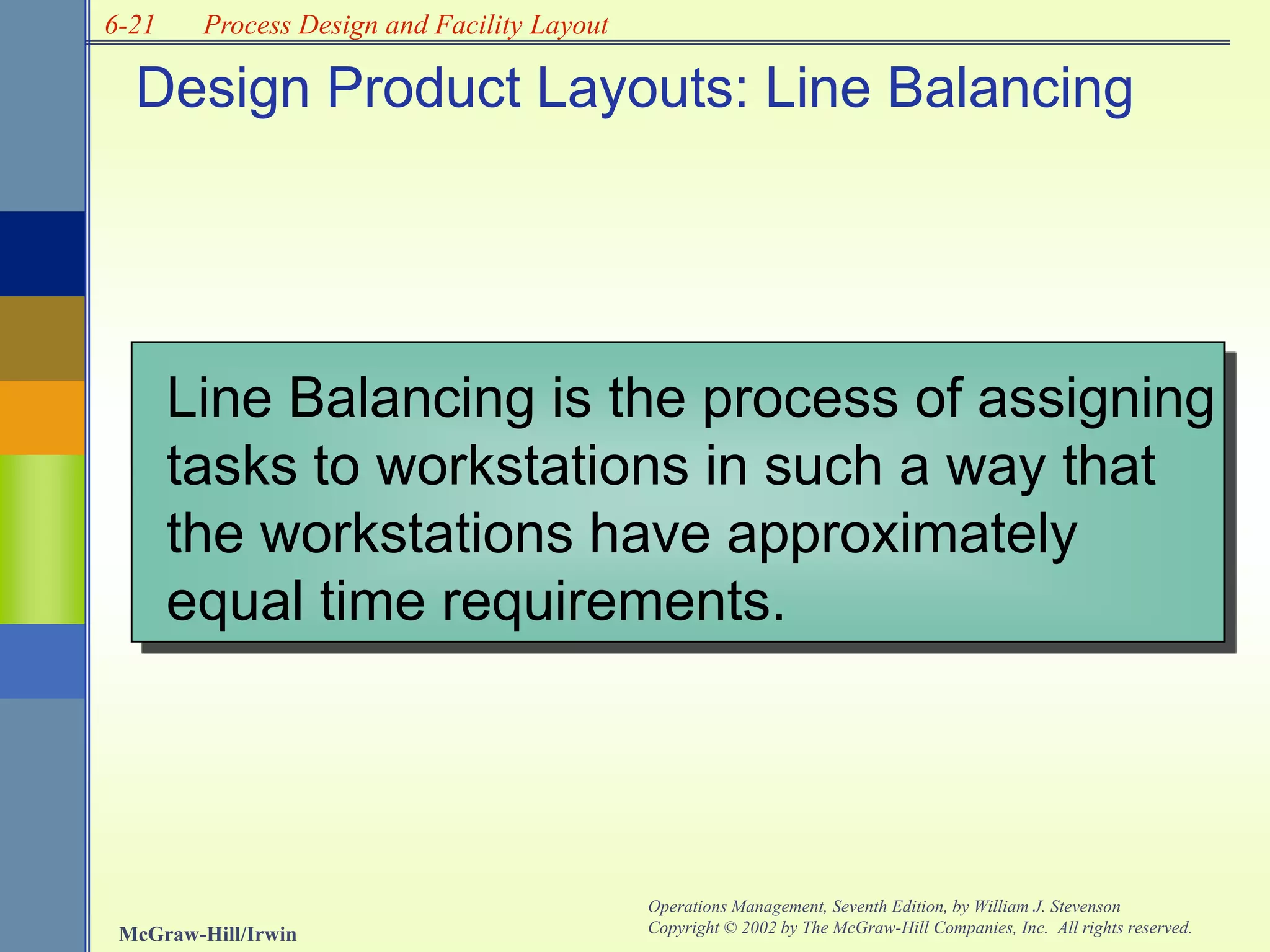
Design Product Layouts: Line Balancing
Line Balancing is the process of assigning
tasks to workstations in such a way that
the workstations have approximately
equal time requirements.
6-22
McGraw-Hill/Irwin
Operations Management, Seventh Edition, by William J. Stevenson
Copyright © 2002 by The McGraw-Hill Companies, Inc. All rights reserved.
Process Design and Facility Layout
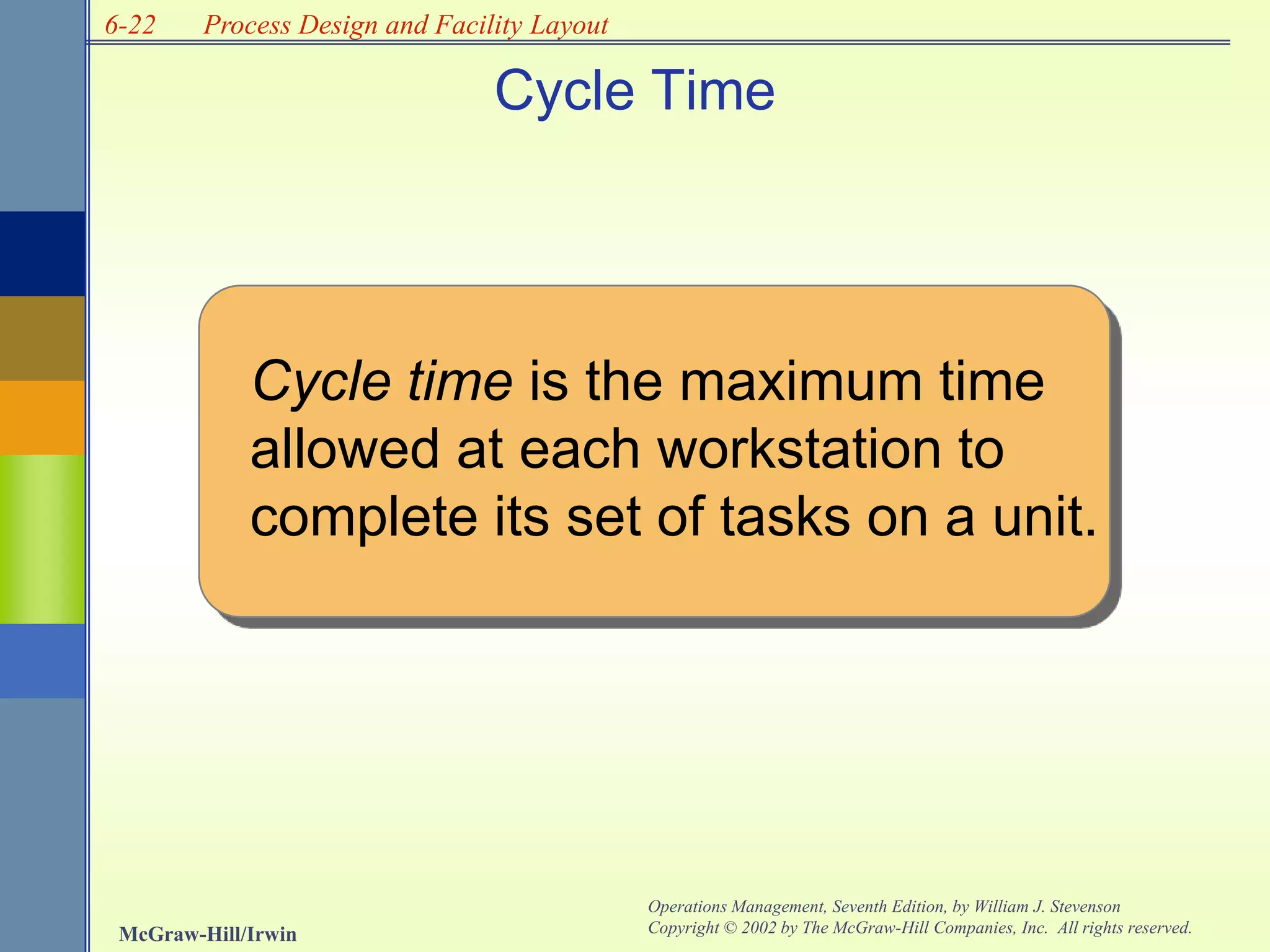
Cycle Time
Cycle time is the maximum time
allowed at each workstation to
complete its set of tasks on a unit.
6-23
McGraw-Hill/Irwin
Operations Management, Seventh Edition, by William J. Stevenson
Copyright © 2002 by The McGraw-Hill Companies, Inc. All rights reserved.
Process Design and Facility Layout
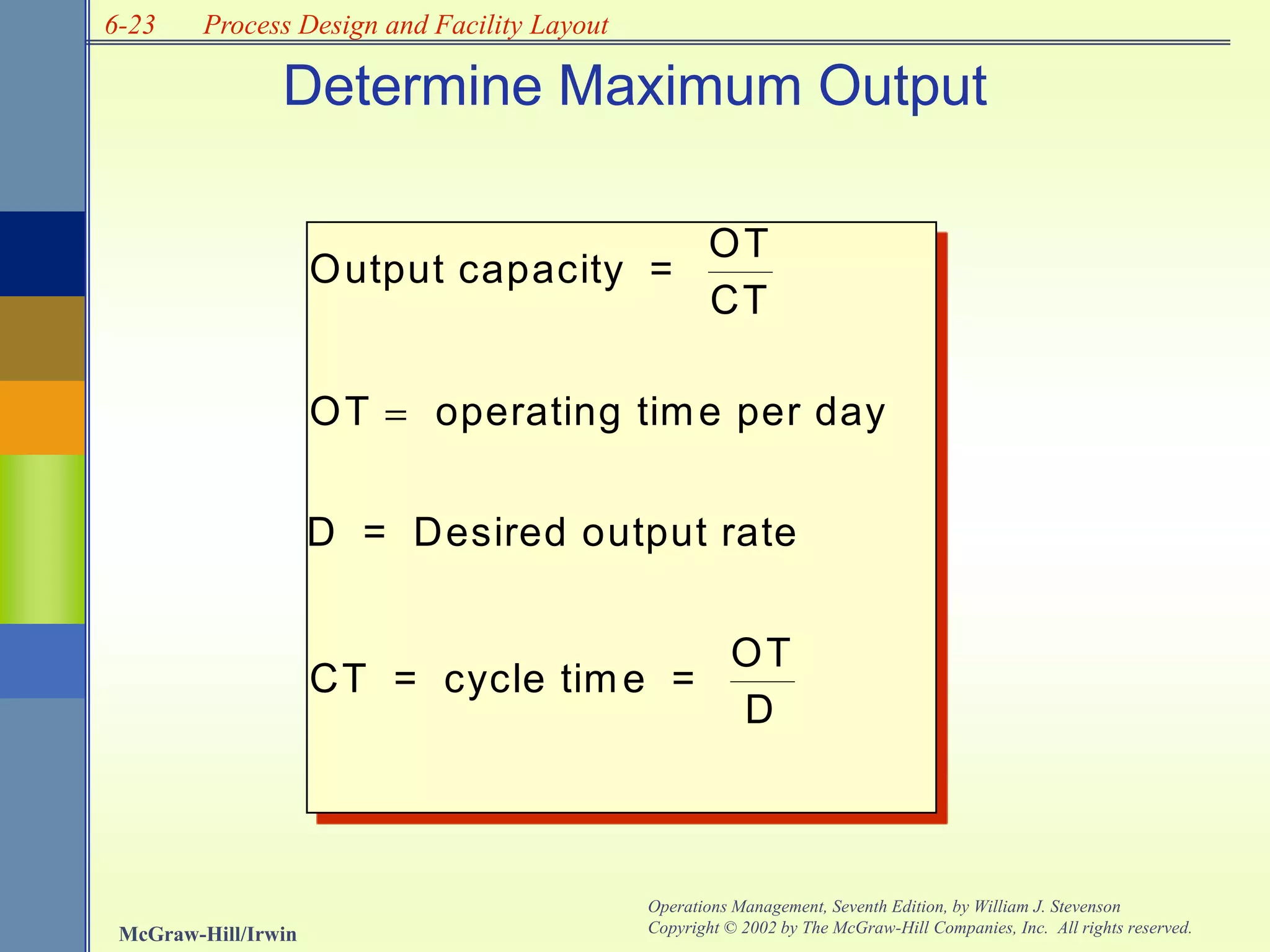
Determine Maximum Output
Output capacity =
OT
CT
OT operating time per day
D = Desired output rate
CT = cycle time =
OT
D
6-24
McGraw-Hill/Irwin
Operations Management, Seventh Edition, by William J. Stevenson
Copyright © 2002 by The McGraw-Hill Companies, Inc. All rights reserved.
Process Design and Facility Layout
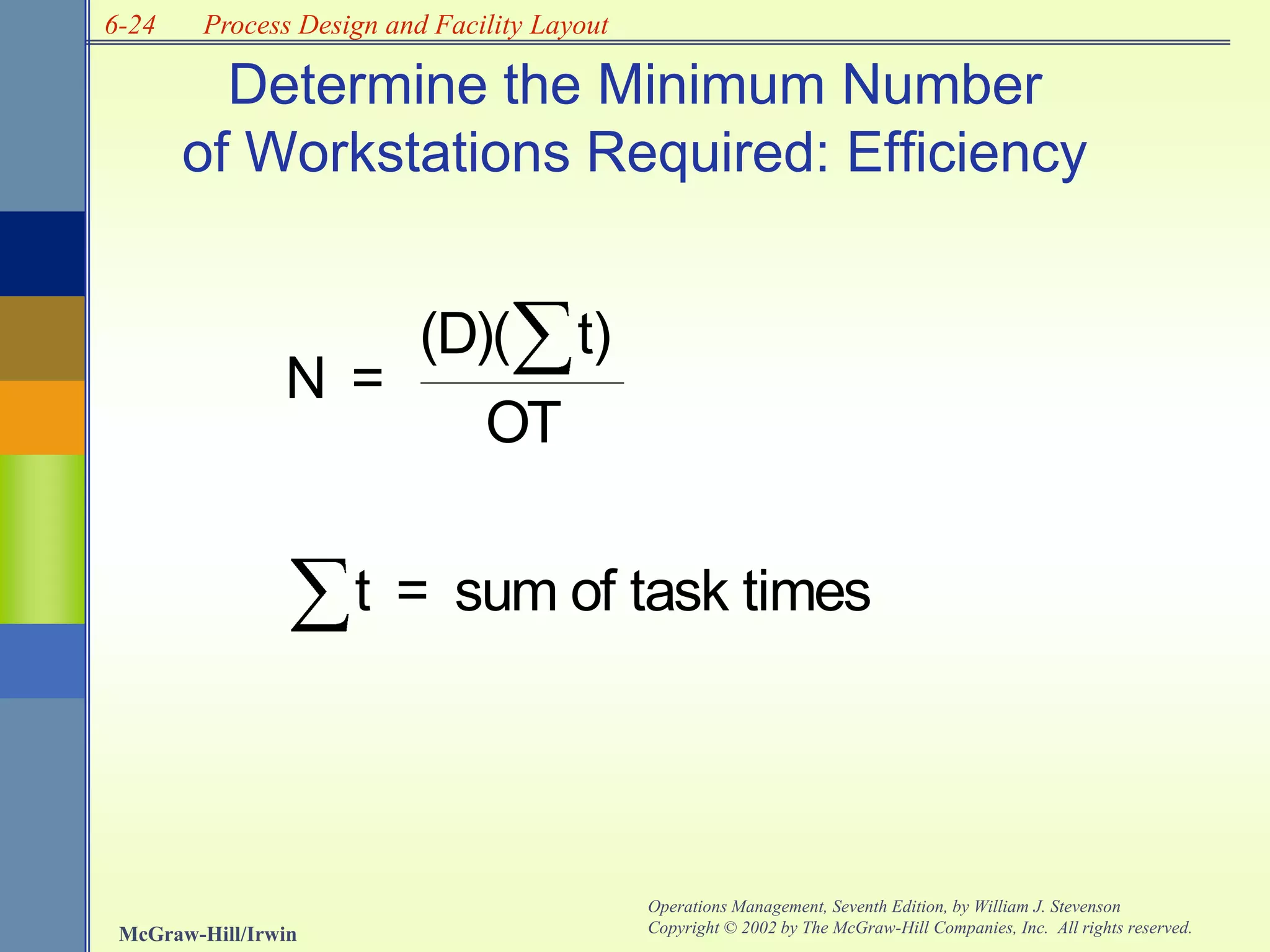
Determine the Minimum Number
of Workstations Required: Efficiency
N =
(D)( t)
OT
t = sum of task times
6-25
McGraw-Hill/Irwin
Operations Management, Seventh Edition, by William J. Stevenson
Copyright © 2002 by The McGraw-Hill Companies, Inc. All rights reserved.
Process Design and Facility Layout
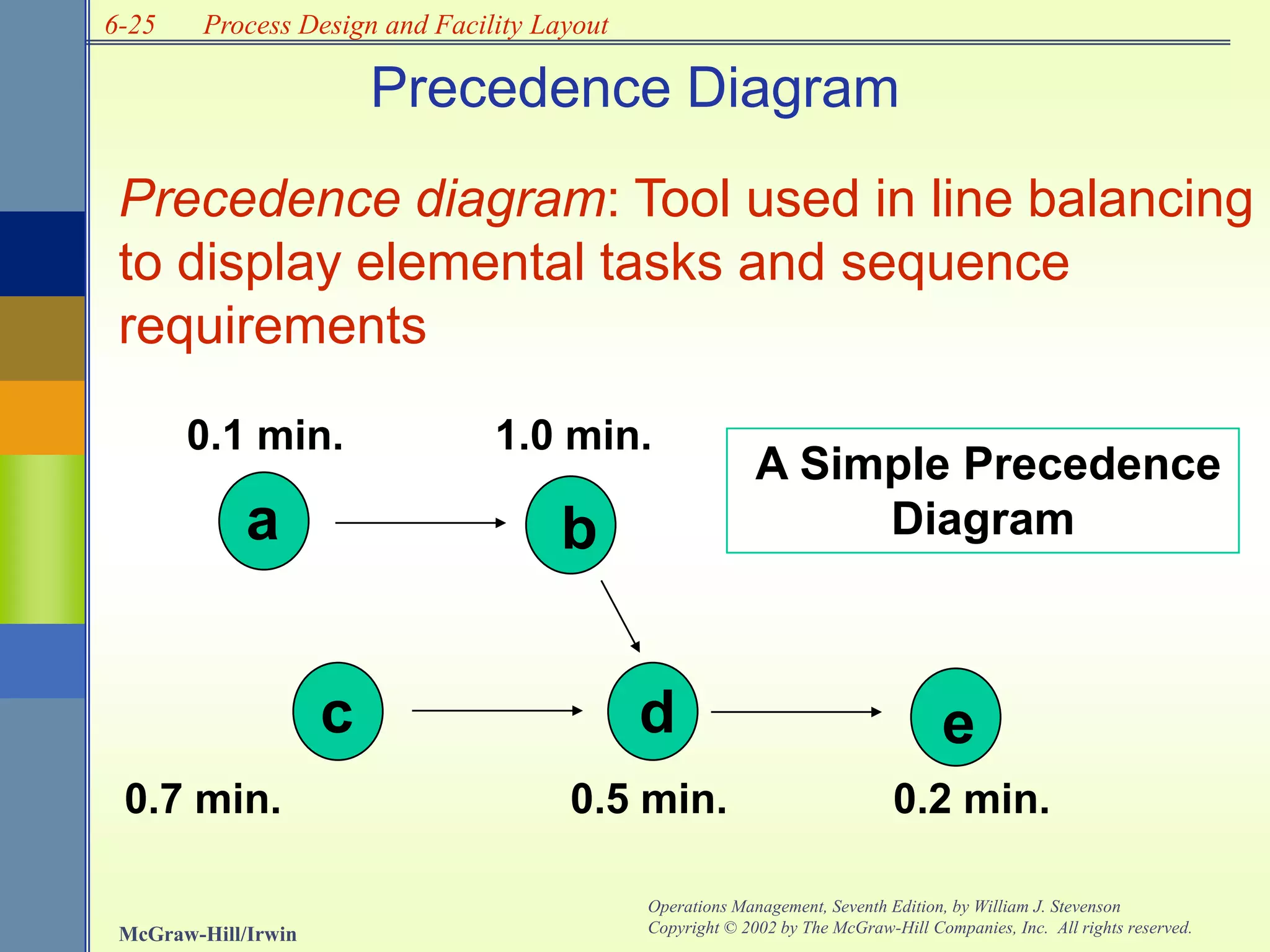
Precedence Diagram
Precedence diagram: Tool used in line balancing
to display elemental tasks and sequence
requirements
A Simple Precedence
Diagrama b
c d e
0.1 min.
0.7 min.
1.0 min.
0.5 min. 0.2 min.
6-26
McGraw-Hill/Irwin
Operations Management, Seventh Edition, by William J. Stevenson
Copyright © 2002 by The McGraw-Hill Companies, Inc. All rights reserved.
Process Design and Facility Layout
Example 1: Assembly Line Balancing
• Arrange tasks shown in the previous
slide into workstations.
– Use a cycle time of 1.0 minute
– Assign tasks in order of the most number of
followers
6-27
McGraw-Hill/Irwin
Operations Management, Seventh Edition, by William J. Stevenson
Copyright © 2002 by The McGraw-Hill Companies, Inc. All rights reserved.
Process Design and Facility Layout
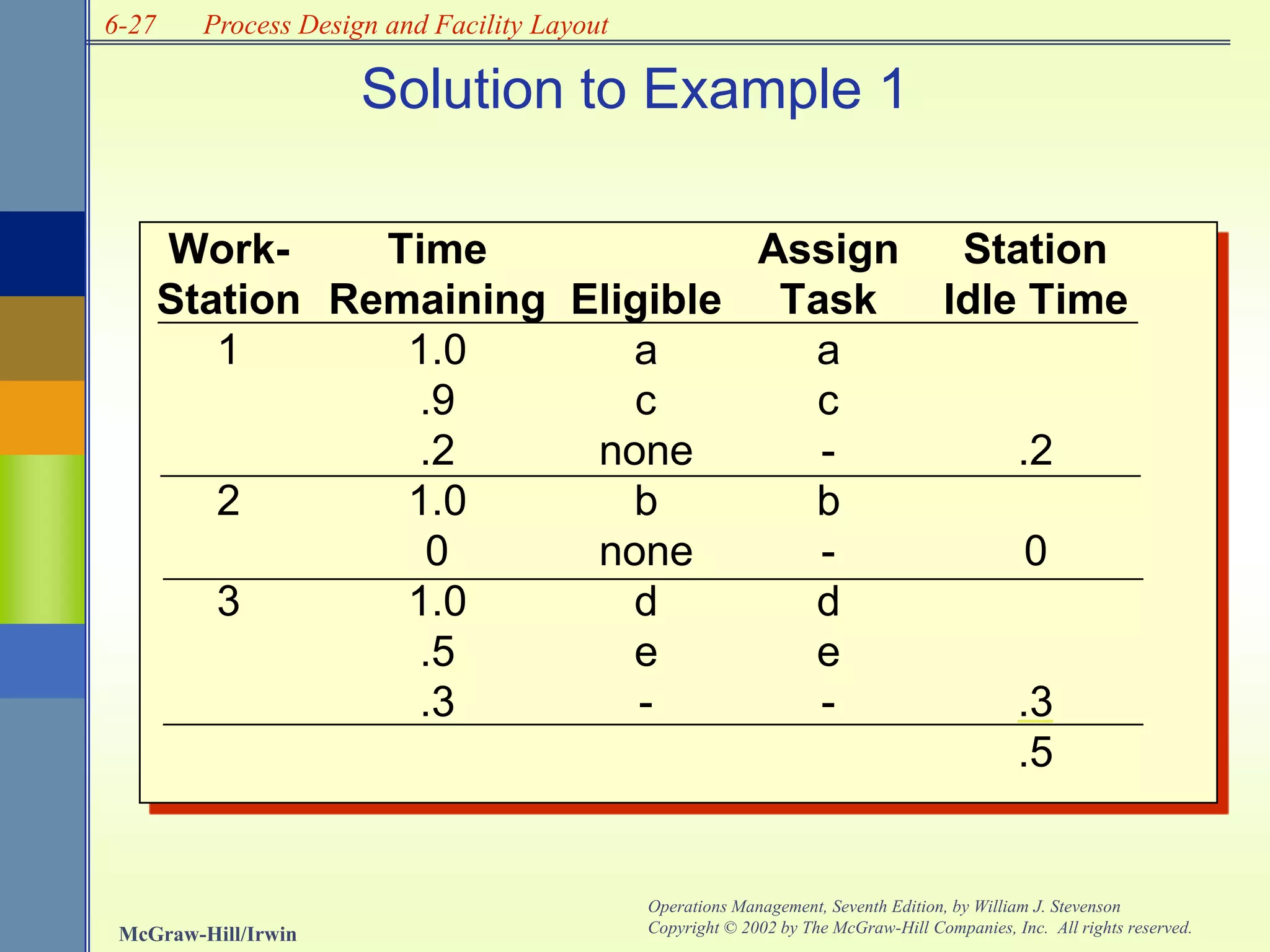
Solution to Example 1
Work-
Station
Time
Remaining Eligible
Assign
Task
Station
Idle Time
1 1.0
.9
.2
a
c
none
a
c
- .2
2 1.0
0
b
none
b
- 0
3 1.0
.5
.3
d
e
-
d
e
- .3
.5
6-28
McGraw-Hill/Irwin
Operations Management, Seventh Edition, by William J. Stevenson
Copyright © 2002 by The McGraw-Hill Companies, Inc. All rights reserved.
Process Design and Facility Layout
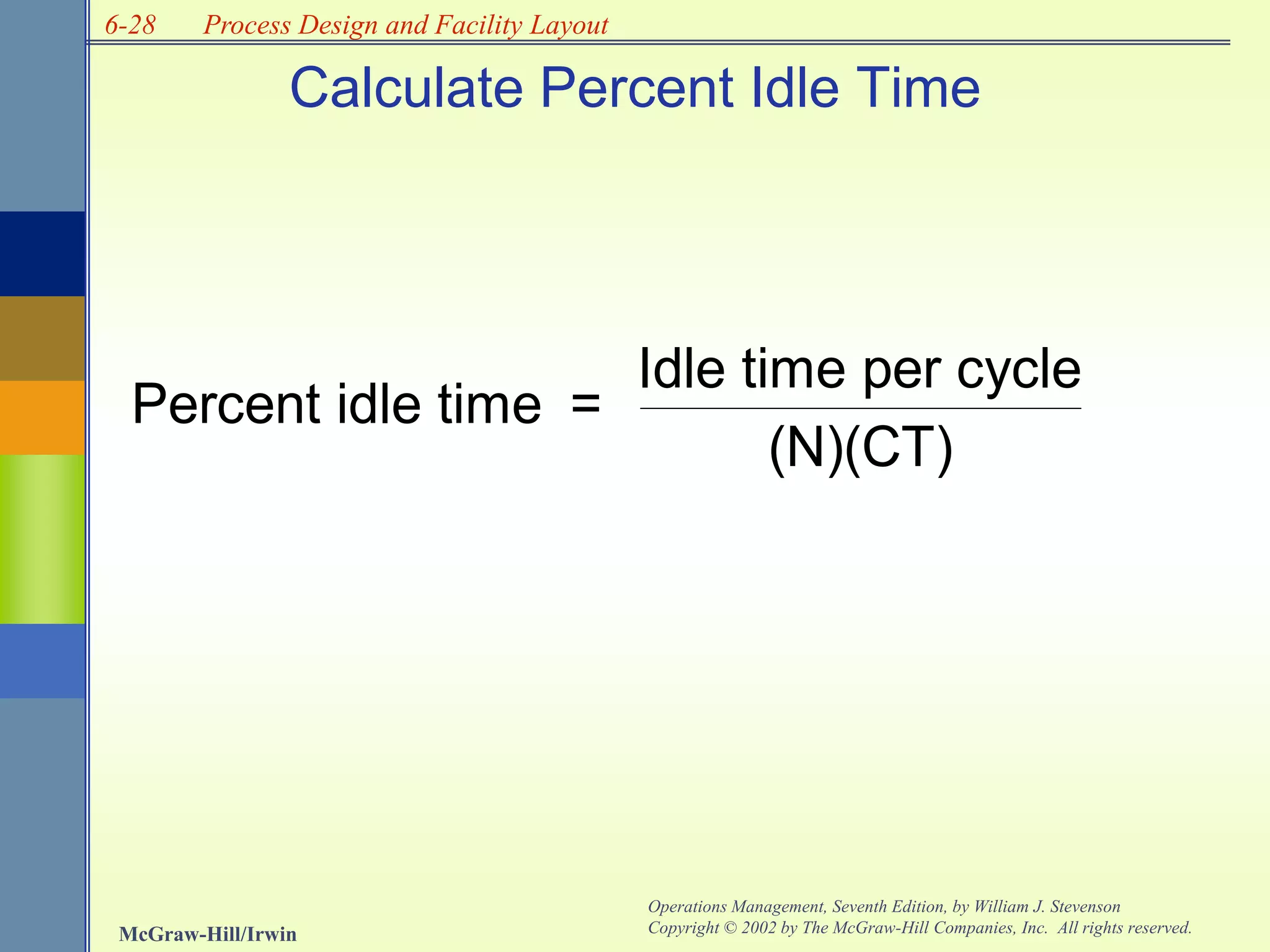
Calculate Percent Idle Time
Percent idle time =
Idle time per cycle
(N)(CT)
6-29
McGraw-Hill/Irwin
Operations Management, Seventh Edition, by William J. Stevenson
Copyright © 2002 by The McGraw-Hill Companies, Inc. All rights reserved.
Process Design and Facility Layout
Line Balancing Rules
• Assign tasks in order of most
following tasks.
• Assign tasks in order of greatest
positional weight.
– Positional weight is the sum of each
task’s time and the times of all
following tasks.
Some Heuristic (intuitive) Rules:
6-30
McGraw-Hill/Irwin
Operations Management, Seventh Edition, by William J. Stevenson
Copyright © 2002 by The McGraw-Hill Companies, Inc. All rights reserved.
Process Design and Facility Layout
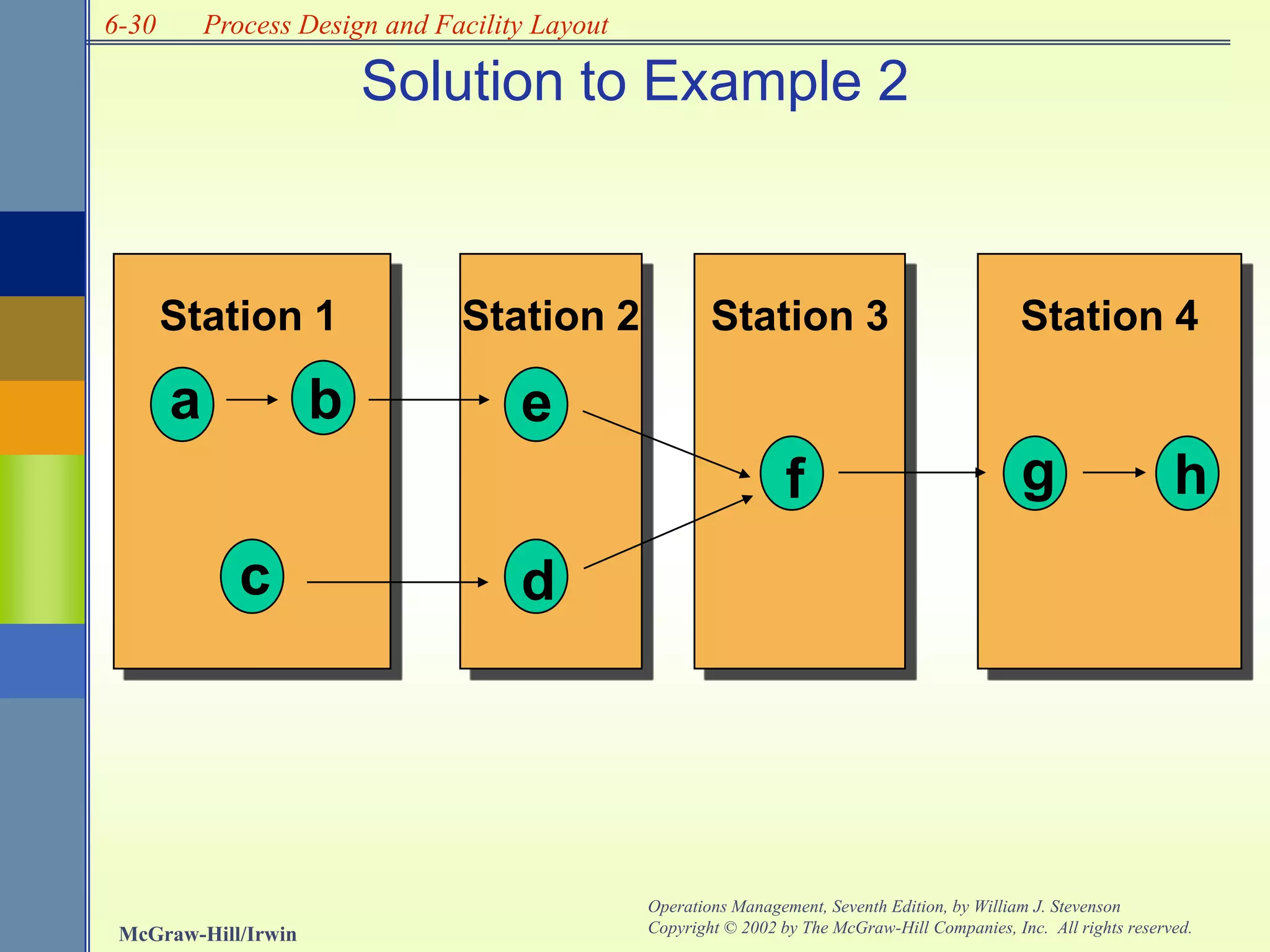
Solution to Example 2
Station 1 Station 2 Station 3 Station 4
a b e
f
d
g h
c
6-31
McGraw-Hill/Irwin
Operations Management, Seventh Edition, by William J. Stevenson
Copyright © 2002 by The McGraw-Hill Companies, Inc. All rights reserved.
Process Design and Facility Layout
Parallel Workstations
1 min.2 min.1 min.1 min.
30/hr. 30/hr. 30/hr. 30/hr.
1 min.
1 min.
1 min.1 min.
60/hr.
30/hr. 30/hr.
60/hr.
1 min.
30/hr.
30/hr.
Bottleneck
Parallel Workstations

S ch6

  • 1.
    6-1 McGraw-Hill/Irwin Operations Management, SeventhEdition, by William J. Stevenson Copyright © 2002 by The McGraw-Hill Companies, Inc. All rights reserved. Process Design and Facility Layout Chapter 6 Process Design and Facility Layout
  • 2.
    6-2 McGraw-Hill/Irwin Operations Management, SeventhEdition, by William J. Stevenson Copyright © 2002 by The McGraw-Hill Companies, Inc. All rights reserved. Process Design and Facility Layout Process Selection and System Design Forecasting Product and service design Capacity planning Facilities and Equipment Layout Work design Process selection Technological change
  • 3.
    6-3 McGraw-Hill/Irwin Operations Management, SeventhEdition, by William J. Stevenson Copyright © 2002 by The McGraw-Hill Companies, Inc. All rights reserved. Process Design and Facility Layout Introduction • Outsourcing, trend, reasons • Make or Buy? – Available capacity – Expertise – Quality Consideration – The nature of demand – Cost
  • 4.
    6-4 McGraw-Hill/Irwin Operations Management, SeventhEdition, by William J. Stevenson Copyright © 2002 by The McGraw-Hill Companies, Inc. All rights reserved. Process Design and Facility Layout • Variety – How much • Flexibility – What degree • Volume – Expected output • The key trade-off Process Selection
  • 5.
    6-5 McGraw-Hill/Irwin Operations Management, SeventhEdition, by William J. Stevenson Copyright © 2002 by The McGraw-Hill Companies, Inc. All rights reserved. Process Design and Facility Layout Process Types • Projects • Job Shops • Batch Processing • Repetitive/Assembly • Continuous Processing
  • 6.
    6-6 McGraw-Hill/Irwin Operations Management, SeventhEdition, by William J. Stevenson Copyright © 2002 by The McGraw-Hill Companies, Inc. All rights reserved. Process Design and Facility Layout Figure 3.6 Product-Process Matrix for Processes (1) (2) (3) (4) (5) One of a kind Low volume, Multiple Few major High volume products, made low products products, high to customer standardization moderate higher standardization, order volume volume commodity products Process Characteristics (1) Complex and highly customized process, unique sequence of tasks (2) Jumbled flows, complex work with many exceptions (3) Disconnected line flows, moderately complex work (4) Connected line, routine work (5) Continuous flows, highly repetitive work LessComplexity,LessDivergence,MoreLineFlows Less Customization and Higher Volume Product Design Continuous process Project process Line process Batch process Job process
  • 7.
    6-7 McGraw-Hill/Irwin Operations Management, SeventhEdition, by William J. Stevenson Copyright © 2002 by The McGraw-Hill Companies, Inc. All rights reserved. Process Design and Facility Layout Product-Process Matrix Flexibility-Quality Dependability-Cost Continuous Flow Assembly Line Batch Job Shop Low Volume One of a Kind Multiple Products, Low Volume Few Major Products, Higher Volume High Volume, High Standard- ization Commercial Printer Heavy Equipment Automobile Assembly Sugar Refinery Flexibility- Quality Dependability Cost
  • 8.
    6-8 McGraw-Hill/Irwin Operations Management, SeventhEdition, by William J. Stevenson Copyright © 2002 by The McGraw-Hill Companies, Inc. All rights reserved. Process Design and Facility Layout • Automation: Machinery that has sensing and control devices that enables it to operate Automation
  • 9.
    6-9 McGraw-Hill/Irwin Operations Management, SeventhEdition, by William J. Stevenson Copyright © 2002 by The McGraw-Hill Companies, Inc. All rights reserved. Process Design and Facility Layout Automation • Numerically controlled (NC) machines • Robot • Computer-aided design and manufacturing systems (CAD/CAM) • Flexible manufacturing systems • Computer-integrated manufacturing (CIM)
  • 10.
    6-10 McGraw-Hill/Irwin Operations Management, SeventhEdition, by William J. Stevenson Copyright © 2002 by The McGraw-Hill Companies, Inc. All rights reserved. Process Design and Facility Layout • Layout: the configuration of departments, work centers, and equipment, with particular emphasis on movement of work (customers or materials) through the system Layout
  • 11.
    6-11 McGraw-Hill/Irwin Operations Management, SeventhEdition, by William J. Stevenson Copyright © 2002 by The McGraw-Hill Companies, Inc. All rights reserved. Process Design and Facility Layout • Requires substantial investments of money and effort • Involves long-term commitments • Has significant impact on cost and efficiency of short-term operations Importance of Layout Decisions
  • 12.
    6-12 McGraw-Hill/Irwin Operations Management, SeventhEdition, by William J. Stevenson Copyright © 2002 by The McGraw-Hill Companies, Inc. All rights reserved. Process Design and Facility Layout Basic Layout Types • Product Layouts • Process Layouts • Fixed-Position • Combination Layouts
  • 13.
    6-13 McGraw-Hill/Irwin Operations Management, SeventhEdition, by William J. Stevenson Copyright © 2002 by The McGraw-Hill Companies, Inc. All rights reserved. Process Design and Facility Layout Basic Layout Types • Product Layout – Layout that uses standardized processing operations to achieve smooth, rapid, high- volume flow – Group equipments according to the sequential steps of operations of a specific product • Process Layout – Layout that can handle varied processing requirements – Group equipments according to their functions
  • 14.
    6-14 McGraw-Hill/Irwin Operations Management, SeventhEdition, by William J. Stevenson Copyright © 2002 by The McGraw-Hill Companies, Inc. All rights reserved. Process Design and Facility Layout A Flow Line for Production or Service Flow Shop or Assembly Line Work Flow Raw materials or customer Finished item Station 2 Station 3 Station 4 Material and/or labor Statio n 1 Material and/or labor Material and/or labor Material and/or labor
  • 15.
    6-15 McGraw-Hill/Irwin Operations Management, SeventhEdition, by William J. Stevenson Copyright © 2002 by The McGraw-Hill Companies, Inc. All rights reserved. Process Design and Facility Layout Process Layout Process Layout - work travels to dedicated process centers Milling Assembly & Test Grinding Drilling Plating
  • 16.
    6-16 McGraw-Hill/Irwin Operations Management, SeventhEdition, by William J. Stevenson Copyright © 2002 by The McGraw-Hill Companies, Inc. All rights reserved. Process Design and Facility Layout Functional Layout Gear cutting Mill Drill Lathes Grind Heat treat Assembly 111 333 222 444 222 111 444 111 333 1111 2222 222 3333 111 444 111
  • 17.
    6-17 McGraw-Hill/Irwin Operations Management, SeventhEdition, by William J. Stevenson Copyright © 2002 by The McGraw-Hill Companies, Inc. All rights reserved. Process Design and Facility Layout Basic Layout Formats • Group Technology Layout • Cellular Layout • Fixed Position Layout – e.g. Shipbuilding Part Family W Part Family X Part Family Y Part Family Z
  • 18.
    6-18 McGraw-Hill/Irwin Operations Management, SeventhEdition, by William J. Stevenson Copyright © 2002 by The McGraw-Hill Companies, Inc. All rights reserved. Process Design and Facility Layout Cellular Layouts • Cellular Manufacturing – Layout in which machines are grouped into a cell that can process items that have similar processing requirements • Group Technology – The grouping into part families of items with similar design or manufacturing characteristics
  • 19.
    6-19 McGraw-Hill/Irwin Operations Management, SeventhEdition, by William J. Stevenson Copyright © 2002 by The McGraw-Hill Companies, Inc. All rights reserved. Process Design and Facility Layout A U-Shaped Production Line 1 2 3 4 5 6 78910 In Out Workers
  • 20.
    6-20 McGraw-Hill/Irwin Operations Management, SeventhEdition, by William J. Stevenson Copyright © 2002 by The McGraw-Hill Companies, Inc. All rights reserved. Process Design and Facility Layout Cellular Manufacturing Layout -1111 -1111 222222222 - 2222 Assembly 3333333333 - 3333 44444444444444 - 4444 Lathe Lathe Mill Mill Mill Mill Drill Drill Drill Heat treat Heat treat Heat treat Gear cut Gear cut Grind Grind
  • 21.
    6-21 McGraw-Hill/Irwin Operations Management, SeventhEdition, by William J. Stevenson Copyright © 2002 by The McGraw-Hill Companies, Inc. All rights reserved. Process Design and Facility Layout Design Product Layouts: Line Balancing Line Balancing is the process of assigning tasks to workstations in such a way that the workstations have approximately equal time requirements.
  • 22.
    6-22 McGraw-Hill/Irwin Operations Management, SeventhEdition, by William J. Stevenson Copyright © 2002 by The McGraw-Hill Companies, Inc. All rights reserved. Process Design and Facility Layout Cycle Time Cycle time is the maximum time allowed at each workstation to complete its set of tasks on a unit.
  • 23.
    6-23 McGraw-Hill/Irwin Operations Management, SeventhEdition, by William J. Stevenson Copyright © 2002 by The McGraw-Hill Companies, Inc. All rights reserved. Process Design and Facility Layout Determine Maximum Output Output capacity = OT CT OT operating time per day D = Desired output rate CT = cycle time = OT D
  • 24.
    6-24 McGraw-Hill/Irwin Operations Management, SeventhEdition, by William J. Stevenson Copyright © 2002 by The McGraw-Hill Companies, Inc. All rights reserved. Process Design and Facility Layout Determine the Minimum Number of Workstations Required: Efficiency N = (D)( t) OT t = sum of task times
  • 25.
    6-25 McGraw-Hill/Irwin Operations Management, SeventhEdition, by William J. Stevenson Copyright © 2002 by The McGraw-Hill Companies, Inc. All rights reserved. Process Design and Facility Layout Precedence Diagram Precedence diagram: Tool used in line balancing to display elemental tasks and sequence requirements A Simple Precedence Diagrama b c d e 0.1 min. 0.7 min. 1.0 min. 0.5 min. 0.2 min.
  • 26.
    6-26 McGraw-Hill/Irwin Operations Management, SeventhEdition, by William J. Stevenson Copyright © 2002 by The McGraw-Hill Companies, Inc. All rights reserved. Process Design and Facility Layout Example 1: Assembly Line Balancing • Arrange tasks shown in the previous slide into workstations. – Use a cycle time of 1.0 minute – Assign tasks in order of the most number of followers
  • 27.
    6-27 McGraw-Hill/Irwin Operations Management, SeventhEdition, by William J. Stevenson Copyright © 2002 by The McGraw-Hill Companies, Inc. All rights reserved. Process Design and Facility Layout Solution to Example 1 Work- Station Time Remaining Eligible Assign Task Station Idle Time 1 1.0 .9 .2 a c none a c - .2 2 1.0 0 b none b - 0 3 1.0 .5 .3 d e - d e - .3 .5
  • 28.
    6-28 McGraw-Hill/Irwin Operations Management, SeventhEdition, by William J. Stevenson Copyright © 2002 by The McGraw-Hill Companies, Inc. All rights reserved. Process Design and Facility Layout Calculate Percent Idle Time Percent idle time = Idle time per cycle (N)(CT)
  • 29.
    6-29 McGraw-Hill/Irwin Operations Management, SeventhEdition, by William J. Stevenson Copyright © 2002 by The McGraw-Hill Companies, Inc. All rights reserved. Process Design and Facility Layout Line Balancing Rules • Assign tasks in order of most following tasks. • Assign tasks in order of greatest positional weight. – Positional weight is the sum of each task’s time and the times of all following tasks. Some Heuristic (intuitive) Rules:
  • 30.
    6-30 McGraw-Hill/Irwin Operations Management, SeventhEdition, by William J. Stevenson Copyright © 2002 by The McGraw-Hill Companies, Inc. All rights reserved. Process Design and Facility Layout Solution to Example 2 Station 1 Station 2 Station 3 Station 4 a b e f d g h c
  • 31.
    6-31 McGraw-Hill/Irwin Operations Management, SeventhEdition, by William J. Stevenson Copyright © 2002 by The McGraw-Hill Companies, Inc. All rights reserved. Process Design and Facility Layout Parallel Workstations 1 min.2 min.1 min.1 min. 30/hr. 30/hr. 30/hr. 30/hr. 1 min. 1 min. 1 min.1 min. 60/hr. 30/hr. 30/hr. 60/hr. 1 min. 30/hr. 30/hr. Bottleneck Parallel Workstations